Abstract
The semantics of ancient Indo-European noun stems has not yet received enough attention from scholars. However, the noun stems exhibit an inner semantic coherence arranged in accordance with the basic linguistic principles of categorisation. My aim in this paper is to demonstrate the internal semantic coherence of the Ancient Greek οι-stem noun category and to compare it with other well-studied morphosemantic categories in order to suggest a particular meaning structure.
1 Introduction
Ancient Greek οι-stems represent a marginal category among Ancient Greek nominal stems. Certainly, words belonging to this category are relatively few, especially if we compare them to other major classes such as the so-called thematic declension. Given the small amount of data regarding this noun category (183 words), it would seem to be appropriate to attempt an full semantic study to ascertain whether there is a basic meaning discernible in its this particular word formation.
1.1 Previous literature
Noun stems among Indo-European languages have traditionally had an ambiguous status. While linguists agree that they work like suffixes, grouping nouns according to some sort of semantics, opacity and polysemy make it difficult to know what their actual meanings were. In foundational works like Brugmannâs monumental Grundriss (1897â1916), for instance, noun-stem descriptions are mixed with derivational suffixes describing the different attested meanings but with no attempt to look for a consistently coherent semantic basis. Adrados (1975) suggested that, theoretically, the formation of noun stems must have had a semantic basis. However, having not discovered it, he proposed that many Indo-European stem suffixes simply lack meaning because they are âthematic vowelsâ or âempty lengtheningsâ. Simultaneously, there is general agreement that the *-eh2 and *-ih2 Indo-European stem suffixes (traditionally -Ä and -Ä« stems), linked with the emergence of the feminine gender, were primitive collective marks (Luraghi 2011). So a primitive meaning is attributed to these stem classes. The question arises then: are Indo-European noun stem classes originally based on meaning or not? The problem here is that, logically, Indo-European noun stems should have an original meaning, but as they are so hard to analyse semantically, they do not seem to have any consistent meaning and, therefore, researchers tend to regard them as morphological categories with random semantic features.
However, outside Indo-European linguistics in recent decades, a lot of work has been carried out concerning linguistic categorisation and polysemy, which has shed light on the issue. Lakoffâs book about categories in the human mind (1987) developed the radial model, a graphic representation of polysemous categories where meanings were shown to develop diachronically following currently recognized semantic change mechanisms from a central prototypical meaning. This model has been successfully applied to various kinds of linguistic categories (Jurafsky 1996) and has made clear that one of the most salient principles concerning categories is that they are indeed usually semantically motivated, that is to say, that meaning is the most basic principle in categorisation (Lakoff 1987, Corbett 1991). Henceforth much relevant work has been conducted regarding noun classes, in particular, gender (Corbett 1991) and classifiers (Aikhenvald 2000). Though remarkable work has also been carried out concerning Indo-European grammatical genders (Luraghi 2011), very few attempts have been made to specifically analyse noun stems from a semantic perspective (Ballester 1999, 2003), and for the most part we are still limited to using lists of meanings collected and provided by the classical manuals in their morphological sections (Schwyzer 1939, Chantraine 1933, etc.).
1.2 Theoretical discussion
Studies on categorisation and linguistic categorisation (Craig 1986, Lakoff 1987) have shown that the human brain organises reality into various fuzzy-boundary categories and that natural language reflects this sort of organisation, giving rise to similar linguistic structures. Hence linguistic categories also consist of members delineated by fuzzy boundaries that are united by what Wittgenstein called family resemblances instead of common properties inside clear boundaries as expected by the Aristotelian tradition. This means that members resemble one another in various ways and that they have various degrees of representation (membership gradience), some of them being more representative of the whole (prototype members) and others less representative (marginal members). What follows are some relevant principles regarding human categorisation and linguistic categories:
-
Meaning motivation: specific semantic features define the category. At the beginning, only members with these properties will be able to be a part of it.
-
Centrality: categories are made up of central members that prototypically represent them and marginal members that share different degrees of properties with the core meaning.
-
Chaining: the structure of the category is based on the fact that members are linked in various ways, core members with other members, and these members in turn with others.
-
Heterogeneity and opacity: a chained structured category with fuzzy boundaries can easily lose its meaning motivation, since members linked with other members and these with others may carry very little of central members, causing a great degree of opacity inside the category.
All these principles are taken into account by the radial model anticipating in turn the various mechanisms of semantic change, such as metaphor, metonym, generalisation or inference by means of the principle of the unidirectional tendency of semantic change, according to which meanings will develop diachronically from core senses toward marginal senses and from physical domains toward more abstract or conceptual domains and from more connoted senses toward more referential ones. As the radial model is intended to explain the category on account of its semantic changes, it will necessarily show a diachronic picture of the whole, even more accurately and exactly than attestations may be able to do, mainly because a late text can attest an ancient meaning and vice versa. The radial model gives an account of the various paths for semantic change featuring a more reliable relative chronology of the semantic types.
The original contribution of this study lies in the fact that it deals with the semantic analysis of one particular polysemous Indo-European inherited Ancient Greek noun stem class (the οι-stem class) using the radial model in order to organise its various meanings consistently and coherently, providing at the same time evidence that Ancient Greek and, by extension, Indo-European, noun stem classes were originally meaning-based. As a matter of fact, Indo-European noun classes offer a propitious field for the kind of surveys already conducted on other noun classes like grammatical gender and classifiers (Corbett 1991, Aikhenvald 2000, Luraghi 2011). On the other hand, further work has to be done in order to reach an accurate picture of ancient Indo-European noun stems, since the approach taken here to analyse the Ancient Greek οι-stem nominal class can be easily extended to other noun categories of Indo-European languages, given that it is based on theoretical principles concerning the more general frame of categorisation and linguistic categorisation.
2 Ancient Greek οι-stems: an overview
Traditionally, οι-stem nouns have been viewed as a subclass of ι-stem nouns semantically heterogeneous and primarily integrated by affectionate female personal names (female hypocoristic names), as well as by substantives referring to women according to their activity or to any other characteristic, and by abstract deverbal action nouns (nomina actionis). From a morphological point of view, there is general agreement that οι-stem nouns represent an Indo-European inherited declension class related to the type of Vedic sákhÄ âfriendâ (acc. sg. sákhÄyam), rather than the result of a foreign adaptation (Schwyzer 1939: 479; Chantraine 1933: 115). In Greek this category has the same formal characteristics as diphthongal stems, that is, its endings underwent the fall of intervocalic /j/ and the subsequent vowel contraction of /o/ plus the corresponding case suffix (Table 1).
The accusative case is usually influenced in dialects other than Attic by the thematic declension, showing the form -Ïν in Lesbian, Boeotian, Doric, and Cretan, and -Î¿Ï Î½ in Ionian (Chantraine 1983: 60). The nominative ending -Ï is due to the Greek phonological tendency to reduce long diphthongs to their long first formant: /oËj/ > /oË/ (Lejeune 1972: 260). This declension is almost exclusively attested in the singular, while the plural forms are quite rare1 and have been historically replaced by other declensions such as the thematic (nom. pl. λεÏοί, acc. pl. ÎοÏÎ³Î¿á½»Ï etc.) and the nasal inflexion (nom. pl. ÎοÏγόνεÏ, acc. pl. ÎοÏÎ³á½¹Î½Î±Ï etc.).
Moreover, the οι-stem nouns in other Indo-European languages experienced the analogical influence of nasal stems, as can be seen in the Lithuanian termination -ie-nÄ or the Vedic -Ä-ná¿, exclusively feminine derivative suffixes (Lith. NaujokÃenÄ âNaujÅkasâ wifeâ, Ved. IndrÄá¹á¿ âIndraâs wifeâ). As we have said before, the same process is attested in Ancient Greek where nouns belonging to this declension were analogically reinterpreted as nasal stem nouns with the result that many alternative forms exist: βληÏá½½/γληÏá½½ âpennyroyalâ but βλήÏÏν/γλήÏÏν, ÎοÏγώ but ÎοÏγών or ÎοÏγόνη (cf. Mod. Gr. ÎοÏγόνα), ÎοÏμώ but ÎοÏμών, λεÏá½½ âwoman in childbedâ but Modern Greek λεÏώνα, as well as variants such as Î Ï Î¸á½½/Î Ï Î¸á½½Î½, ΣαÏδώ/ΣαÏδών, ΣαÏá½½/ΣαÏών. The relevance of this process can also be noticed in the Latin adaptation of words from this Greek declension, e.g. IÅn (Nom.) / IÅnis (Gen.) from Ἰώ or LÄtÅna from Îá¾±Ïá½½.
Table 1
Ancient Greek οι-stem declension
|
Singular |
|
|---|---|
|
Nom. |
*ÎηÏÏι â ÎηÏá½½ |
|
Voc. |
*ÎηÏοι â ÎηÏοῠ|
|
Acc. |
*ÎηÏοι-α â ÎηÏá½½ |
|
Gen. |
*ÎηÏοι-Î¿Ï â ÎηÏÎ¿á¿¦Ï |
|
Dat. |
*ÎηÏοι-ι â ÎηÏοῠ|
Finally, the οι-stem inflectional type survived in the history of Greek language basically through adjectival feminine nouns with the -ού ending and in womenâs personal names (e.g. ÏÏμού âbaker womanâ, γλÏÏÏού âgossip girlâ, ÏαÏÎ±Î¼Ï Î¸Î¿á½» âdeceiver, liar [woman]â) that changed to the dental inflexion (pl. -ούδεÏ) following their inflectional masculine counterpart (e.g. ÏÏÎ¼á½±Ï -άδεÏ, γλÏÏÏá½±Ï -άδεÏ, ÏαÏÎ±Î¼Ï Î¸á½±Ï -άδεÏ). It is noteworthy that both word classes chiefly belong to the similar intimate and colloquial register as the ancient feminine οι-nouns.
3 A semantic grouping attempt
From a semantic perspective, the small group of nouns belonging to οι-stem falls into various semantic classes. The major types are:
-
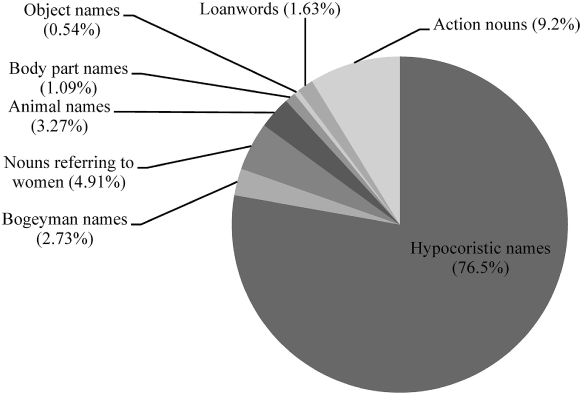
Female hypocoristic names: á¼Î³Î±Î¸Î¸á½½, á¼ÏÏá½½, Îηώ, ÎÏÏá½½, á¼ÏαÏá½½, Îεοκκώ, ÎαλλιÏÏá½½, Îαλοννώ, Îαλλώ, ÎÎ±Î»Ï Ïá½½, ÎαÏá½½, ÎεÏαμώ, Îιλλώ, Îινώ, Îλειδώ, Îλεινώ, ÎλειÏá½½, Îλε[ι]á½½, ÎλÏθώ, ÎÏανώ, ÎÏαÏιÏÏá½½, ÎÏηÏá½½, ÎÏ Î¼á½½, ÎÏμώ, ÎÏÏινώ, ÎαμÏιÏá½½, ÎεÏá½½, ÎηÏá½½, ÎÏ Ïá½½, ÎανÏá½½, Îανώ, ÎαÏεÏá½½, ÎενεÏθώ, ÎηÏÏá½½, Îηνώ, Îινακώ, ÎÏ Î½Î½á½½, ÎÏ ÏÏινώ, ÎÏ ÏÏá½½, ÎÏ Ïá½½, Îεανθώ, ÎικαÏá½½, Îικώ, ÎÏ Î¼Ïá½½, Îεν[ν]á½½, á½Î½Î·Ïá½½, á½Î½Î·Ïακώ, ΠαÏÏá½½, Πειθώ, ΠλÏÏá½½, Î Ïαξώ, Î ÏÏÏá½½, Î Ï Ïαλλώ, Ῥοδώ, Σα[Ï]Ïá½½, Σελινώ, ΣιÏá½½, Î£Ï Îºá½½, ΣÏÏá½½, ΤελεÏá½½, Τεμώ, Τιμώ, Φαινώ, Φειδώ, Φιληκώ, ΦιληÏá½½, Φιλινώ, ΦιλιÏá½½, Φιλλώ, ΦιλÏá½½, ΧαÏιÏá½½, ΧοιÏá½½ etc. (140 words: 76.5â¯%)
-
Bogeyman names: á¼ÎºÎºá½½, á¼Î»ÏιÏá½½, Îελλώ, ÎοÏγώ, ÎοÏμώ (5 words: 2.73â¯%)
-
Nouns referring to women: á¼Î½Î¸ÏÏÏá½½ âwomanâ, á¼[ν]νώ âgrannyâ, δαλλώ âidiot womanâ, âmaidâ or âwoman too old to carry out an activityâ, θηλώ âwet-nurseâ, καμινώ âfurnace-womanâ, κομμώ âa kind of priestess in Athensâ, λεÏá½½ âwoman in childbedâ or âwoman who has just given birthâ, μοÏÏá½½ â[The] Shapelyâ, ÏÏοÏá½½ ânurseâ (9 words: 4.91â¯%)
-
Animal names: á¼Î·Î´á½½ ânightingaleâ, κεÏδώ âfoxâ, μιμώ âapeâ, ÏιÏá½½ âwoodpeckerâ, ÏÏ Ïá½½ ânight-owlâ, Ïελιδώ âswallowâ (6 words: 3.27â¯%)
-
Body part names: Î²Î±Ï Î²á½½ âbelly or vaginaâ, ληκώ âpenisâ (2 words: 1.09â¯%)
-
Object names: κÏÏá½½ âwreathed staffâ (1 word: 0.54â¯%)
-
Loanwords: βληÏá½½/ γληÏá½½ âpennyroyalâ, κιÏÏá½½ âcassia treeâ (cf. Hebrew qiddah), μοÏá½½ âkind of cinnamonâ (3 words: 1.63â¯%)
-
Deverbal action nouns (nomina actionis): αἰδώ âreverenceâ, á¼ÎµÎ¹ÎµÏÏá½½ âeternal beingâ, á¼ÏεÏÏá½½ âabsenceâ, δοκώ âopinionâ, εἰδώ âvisionâ, á¼ÏÏá½½ âsubstanceâ, εá½ÎµÏÏá½½ âwell-beingâ, á¼ Ïá½½ âechoâ, κακεÏÏá½½ âill-beingâ, κινώ âmotionâ, κο[Ï]θώ âdamageâ μελλώ âbeing about to doâ, á½ÏιÏαμβώ âgoing backwardsâ, Ïειθώ âpersuasivenessâ, ÏÎµÏ Î¸á½½ âtidingsâ, ÏÏ Î½ÎµÏÏá½½ âliving togetherâ, Ïειδώ âsparingâ, ÏÏε[ι]á½½ âneedâ (17 words: 9.2â¯%).
According to my accounting, the category consists of 183 words unequally distributed among the various semantic types. Percentages have been provided in order to give a picture of the relative weight of each type within the category (Figure 1). Even though the list is intended to be exhaustive, notice that the first type (female pet names, 140 words: 76.5â¯%) is only a very rough estimate that corresponds to the number of οι-stem personal pet names attested just in the epigraphic sources from the Attic region given by the Lexicon of Greek Personal Names. The figure may be three or four times higher if one takes into account the whole of Greek epigraphic attestations and literary sources all together, but since this type was remarkably productive and no precise estimate of its scope can be made, it is preferable to work with this low but representative figure.
One of the most striking features of the category is the familiar and colloquial, sometimes vulgar, colour of these nouns. Many of them certainly convey an intimate atmosphere of endearment since they appear to some extent in child and caretaker speech or in intimate spaces. Incidentally, another salient feature is the prominent role played by the feminine gender, given that all οι-stem nouns are consistently feminine in accordance with the fact that many of the referents are women or at least female animate beings. Consequently, it has to be assumed that female natural sex is an outstanding semantic feature inside the category. It is, thus, worth saying that the identification of a sense of intimacy and feminine gender give some clues to the semantic survey of the class and offers a path to comparing it with other morphosemantic categories in order to organise its various semantic contents hierarchically and coherently following the theoretical framework already highlighted (§â¯1.2).

Figure 1
οι-stem class: semantic types and distribution
Citation: Journal of Greek Linguistics 19, 2 (2019) ; 10.1163/15699846-01902004
Before starting the survey, it is crucial to point out the difference between word meaning (Wort[schatz]bedeutung) and word formation meaning or suffix meaning (Wortbildungsbedeutung), concepts regarding the semantic processes involved within a word (Rainer 2005). Actually, words are in current scholarly understanding made up of lexical and morphological parts, each of which carries specific semantic contents. When the sense resulting from the combination of the lexical and the morphological parts of a given word is taken into account, we talk about word meaning. For instance, the noun worker consists of a lexical part with a lexical meaning (work- âthe use of effort to produce somethingâ) and a morphological part with a morphological meaning (-er âacting personâ, âagentâ) and the combination of both parts gives rise to the so-called word meaning (âperson who worksâ). On the other hand, when the morphological content is considered separately from the word meaning and a semantic formation pattern can be identified, we talk about word formation meaning. The peculiarity of this semantic content is that, unlike the lexical content, it experiences many changes affecting the whole meaning of a word. For instance, worker refers to a person (agent) but cooker involves an object (instrument); they share the same suffix but different word formation meanings.
It is important to make a distinction between these two concepts, especially when conducting a semantic survey of a given morphological class in order to appropriately and accurately deduce the various meanings of the morphemic part of the word. Word meaning and word formation meaning represent two semantic axes within a morphological category, the former depicting complex noun meanings, the latter portraying specific semantic features of the class and concerning the morphological part of the word. Consider the οι-stem noun θηλώ âwet-nurseâ: it is a name designating women in charge of nursing babies (word meaning) and in turn its morphemic element carries several semantic and pragmatic contents (female sex, child speech affection, referent related to θηλή ânippleâ) that define its word meaning.
Table 2
οι-stem semantic groups and suffix meanings
|
Word meaning |
||||||||
|
Hypocoristic names |
Bogeyman |
Women |
Animals |
Body parts |
Objects |
Action nouns |
||
|
Suffix meaning |
Affection/contempt |
à |
à |
à |
à |
à |
||
|
Female |
à |
à |
à |
à |
à |
à |
||
|
Related-to |
à |
à |
à |
à |
à |
|||
|
Verbal abstract |
à |
|||||||
Table 2 is intended to provide a quick overview of the two meaning axes within the οιâstem noun class: word meaning (semantic groups) and word formation meaning (suffix meaning). It has to be said that word meanings enable us to group together semantically related words, creating some semantic categories based on the relevant semantic features they share.2
Bearing all this in mind, let us have a look inside each meaning type to find out whether nouns belonging to this category share some essential semantic principles or not.
3.1 Female hypocoristic names
A very important group of οι-stem nouns is made up of personal names designating women in an intimate and affectionate manner (140 nouns: 76.5â¯%). These names are usually called pet names, endearment names or simply hypocoristic names (cf. Ancient Greek á½ÏοκοÏίζομαι âcall with endearment namesâ), since they convey the idea of affection or intimacy. Such names are well represented in many languages and their existence and use depend on the cultural frame of the speakers (Schieffelin & Ochs 1996; and see Table 3).
Table 3
Cross-linguistic hypocoristic names
|
Arabian |
Basil > Baslu Malak > Malku |
Mod. Greek |
ÎÎ»ÎºÎ¹Î²Î¹á½±Î´Î·Ï > á¾»Î»ÎºÎ·Ï ÎνδÏομάÏη > Îá½±Ïη |
|
Armenian |
Abraham > Ab[r]o AÇ° > AÇ°o |
Hebrew |
Mixál > Mixáli Xána > Xáni |
|
English |
Robert > Bobby Lucille > Lucy |
Hungarian |
Ferenc > Feri Franciska > Fanni |
|
Finnish |
Jeremia > Jerko Markus > Make |
Italian |
Lorenzo > Enzo Paolo > Paolino |
|
French |
André > Dédé Emmanuel > Manu |
Russian |
Elena > Len[k]a Mikhail > Misha |
|
German |
Barbara > Bärbel Heinrich > Heini |
Turkish |
Abdullah > Apo Mehmet > Memo |
These sorts of names are strongly linked to nursery and child language phenomena, firstly because they usually originate in baby talk and child-directed speech (SavickienÄ & Dressler 2007), as can be easily deduced from the features they specifically share with baby talk (open CV syllables, reduplication, phonological simplification, truncation, specific affective suffixes etc.; from Ferguson 1964). Furthermore, they exhibit the same features as pet names. They are abbreviated pet forms of compound names (ÎλειÏοÏίμη > ÎλειÏá½½, ÎÏ ÏαÏá½³Ïη > ÎÏ Ïá½½ etc.) that emerge by means of the same linguistic mechanisms involved in endearment terms, such as clipping or truncation (ÎαλλιÏÏαÏεÏá½µ > ÎαλλιÏÏá½½), consonantal doubling (ÎεναÏá½·ÏÏη > Îεννώ, ÎηÏÏοÏίλη > Φιλλώ, etc.), a very widespread feature in Boeotia (á¼Î³Î±Î¸Î¸á½½,3 Îεοκκώ,4 etc.), and the use of a special affective suffix (ÎηÏÏ-á½½, Φαιν-á½½, Φειδ-á½½, etc.). Evidence of the affectionate colour of this group is furnished by the particular designation of two central deities of the Greek pantheon: the goddess of wheat and cereal, ÎημήÏηÏ, fondly called Îηώ,5 which seems to be a typical affectionate name in her ritual phraseology, and the goddess of love, á¼ÏÏοδίÏη, affectionately called á¼ÏÏá½½.6
Another key piece of evidence regarding the affectionate nuance of these personal names is the coexistence of equivalent alternative names formed with Ancient Greek diminutive suffixes. In fact, it is quite frequent to find endearment names with the -á½½ ending coexisting with alternative forms with the -ίδ-, -ίλη, -ίνη, -á½·Ïη/á½·Ïον, -á½·Ïκη, -Ï Î»Î»Î±-, -Ï Î»Î»á½·Î´- and -ιον diminutive endings. For example, among female hypocoristic names created from compound names with Îένο-, the form Îενώ co-occurs with ÎενίÏκα, Îá½³Î½Ï Î»Î»Î±, ÎεννίÏ, ÎÎµÎ½Ï [λ]λίÏ, Îένιον, ÎένιÏον. Accordingly, this demonstrates that οιâstem suffix has, at least, a kind of semantic equivalent value with other expressive affectionate diminutive Greek suffixes.7
Given that all these endearment names just designate women referents, even those of a divine nature (deities), two meanings can be assigned to this group of names: âaffectionâ and âfemaleâ.
3.2 Female monsters: bogeyman names
Bogeyman names (5 words: 2.73â¯%) share some formal properties both with female hypocoristic names (§â¯3.1) and with common nouns referring to women (§â¯3.3): with the former, because some of them are created by truncation of a compound name; with the latter, because some of them are created by derivation from a noun referring to a salient feature of the referent. On the other hand, it is worth remembering that in Ancient Greek culture, as well as, for instance, in Slavic folk traditions, the bogeyman was performed by female characters conceptualised as monsters or as old women connected with the evil. Accordingly, these names have two conspicuous traits: first, they name female creatures; and second, they may be affected by euphemistic mechanisms in order to avoid spelling out the name of a terrible creature.
To some extent bogeyman Ancient Greek names originate from a common noun referring to their scaring properties or to their outward appearance. This may be the case of á¼Î»ÏιÏá½½, a doll used to frighten children,8 whose name is related to á¼Î»Ïι âflourâ in reference to the widespread ancient practice of barley divination performed by the á¼Î»ÏιÏομάνÏÎ¹Ï and has to be understood as âThe Flouryâ,9 or ÎοÏγώ, a name related to γοÏÎ³á½¹Ï âterribleâ, which primarily refers to Medusa, a monster able to petrify by means of her vision. ÎοÏμώ is also a mythological female monster referred to by babysitters to scare kids, whose name could be etymologically connected with Latin formÄ«dÅ, -inis âscarecrow, terrorâ (Tambornino 1933: 309; Chantraine 1968: 713; Ernout & Meillet 1959: 248).
According to some authors (Crusius 1893: 1173, 1894: 1637; Tambornino 1933: 311), these names might also be affectionate truncated forms originating from compound names. Then á¼Î»ÏιÏá½½ would have stemmed from á¼Î»ÏιÏόμανÏÎ¹Ï âa woman that divines from barley-mealâ or even from **á¼Î»ÏιÏομήÏÎ·Ï and ÎοÏμώ from ÎοÏμολύκη. Obviously, on such an account, all these names should have been included into the first semantic type (§â¯3.1). However, it is worth saying that most of the οι-stem female deity names accord better with the former explanation, that is, they are created from a noun conveying a salient feature of the referent: ÎÏÏá½½ âThe Giverâ (Nereid) from δÏÏá½µÏ âgiverâ, á¼ÏαÏá½½ âThe Lovelyâ (Muse) from á¼ÏαÏá½¹Ï âkindâ, ÎÏ Î¼á½½ âThe Wavyâ (Nereid) from κῦμα âwaveâ, etc.
On the other hand, Îελλώ, a bogeyman said to take away naughty children (Sapph. 47 Bergk, Hsch. etc.), does not have any plausible etymological connections. Finally, á¼ÎºÎºá½½, a female character paradigmatically said to be stupid (Hermipp. 6 Kassel & Austin, Plu. 65 Leutsch & Schneidewin, Zen. 53 Leutsch & Schneidewin) and to frighten children by means of gestures (Plu. 2,1040b), can be related to Latin Acca LÄrentia and to Sanskrit AkkÄ, female personal name but also âprocurerâ.
3.3 Names referring to women
Three main specific semantic features can be pointed out concerning women names (9 words: 4.91â¯%). First of all, most of them are derivatives conveying the relevant feature of its referent. Such is the case with θηλώ âwet-nurseâ10 from θηλή ânippleâ (cf. Î¸Î·Î»á¿¦Ï âfemaleâ); καμινώ âfurnace-womanâ (i.e., an old woman who works at a furnace),11 from Îºá½±Î¼Î¹Î½Î¿Ï âovenâ; κομμώ âpriestess who adorned the seated statue of Athena on the Acropolis of Athensâ,12 connected with ÎºÎ¿Î¼á½³Ï âtake care ofâ or with κοÏÎ¼á½³Ï âput in orderâ; λεÏá½½ (λοÏá½½ or Delphic λεκÏá½½) âwoman in childbedâ or âwoman who has just given birthâ from λέÏÎ¿Ï âbedâ (cf. λέÏομαι âlie downâ); μοÏÏá½½ â[The] Shapelyâ, used as an epithet of Lacedaemonian Aphrodite,13 created from μοÏÏá½µ âshape, beautyâ.
As can be seen in these examples, the meaning of the suffix is clearly relational, because it conveys a non-specific relation between the ground noun and the οι-stem derivative (ârelated-toâ meaning): so καμινώ would designate a woman related to the furnace (κάμινοÏ), because she is in charge of it; κομμώ would be a woman related to the action of taking care (κομέÏ) or adorning (κοÏμέÏ), because she cares about the embellishment of the seated statue of Athena; λεÏá½½ would mean a woman related to the couch because she has given birth and has to recover, and so on.
In the second place, other οι-stem nouns referring to women seem to be synonymous derivatives, because they exist as the alternative form of another noun. This may be the case of á¼[ν]νώ âgrannyâ,14 a variant of á¼Î½Î½á½·Ï (found in Hsch.), and ÏÏοÏá½½ ânurseâ,15 based on ÏÏοÏá½¹Ï. Notice that these words are very marginally attested because of the familiar register to which they belong. They are, then, to be placed within the realm of intimacy and, therefore, they have to be considered related to child-talk communicative situations by virtue of their endearment nuances.
In the third place, the οι-suffix indicates in this semantic type the âfemaleâ feature of the referent. Particularly, in á¼Î½Î¸ÏÏÏá½½ âwomanâ (found in Hsch.), a Doric derivative of á¼Î½Î¸ÏÏÏÎ¿Ï âhuman beingâ, the âfemaleâ meaning is apparently the only meaning.
One particular case is δαλλώ, a noun designating an idiot woman and also a maid or any kind of woman too old to carry out an activity (Hsch.). This word is etymologically related to δάοÏ/δαá¿Ï âtorchâ (cf. Î´Î±á½·Ï âlight [fire]â) but comes from δᾱλόÏ, which means âtorchâ, âconsumed torchâ and metaphorically âold menâ,16 where the âold womanâ and âidiot womanâ meanings of δαλλώ come from.
Notice that all these names belong to a familiar and intimate register on account of their referents.17 In fact, almost all these words refer to women named by their feminine traditional activities related to a world neither open to men or to society. An affectionate, intimate attitude can be deduced from the use of the οι-suffix especially in words such as the Doric epithet of Aphrodite (μοÏÏá½½ âThe Shapelyâ) or from the designation of nurses (θηλώ, ÏÏοÏá½½), which may belong to child-directed speech, not to mention the pet name á¼Î½Î½á½½. A sense of affection and intimacy is also supported by the presence of emphatic consonantal doubling among these nouns (á¼Î½Î½á½½, δαλλώ, κομμώ, λεκÏá½½). Consequently, this may mean that the οι-suffix additionally conveys affectionate and intimate meanings in at least some names, in agreement with the register they belong to.
3.4 Animals
Nouns belonging to the οι-stem declension also designate animals, more concretely, birds and mammals (6 words: 3.27â¯%). Again these nouns are created from common nouns conveying a representative feature of the referent. So κεÏδώ âfoxâ,18 shaped from the adjective κεÏÎ´Î±Î»á½³Î¿Ï âcrafty, cunningâ (cf. κέÏÎ´Î¿Ï âprofitâ), conveys the cross-cultural idea that the fox is a crafty animal (cf. Spanish zorra meaning âcunning womanâ). Exactly the same can be said about μιμώ âapeâ,19 created from μá¿Î¼Î¿Ï âimitatorâ (cf. μιμέομαι âimitateâ), by reason of its alleged imitative behaviour. Both the fox and the ape seem to have not only the ârelated-toâ semantic trait but also the âfemaleâ sense. I base this assumption on the fact that both nouns feature feminine gender and that living beings are consistently female referents within the οι-stem class. Additionally, in the case of the fox, Aelianus explicitly says that the word refers to the female.20 The assignment of the fox and the ape to the feminine gender can possibly be explained on the grounds of an Ancient Greek male-oriented cultural frame. Both animals are culturally connoted as negative beings for different reasons, the fox being viewed as a dangerous animal, the ape being regarded as inferior and despicable. Moreover, in the case of the ape, the word Ïá½·Î¸Î·ÎºÎ¿Ï is used in reference to the male and to the female, and it conveys some contemptuous nuances, like monkey in English or simio in Spanish; but the word μιμώ seems to involve a special negative connotation in view of the fact that it is a derivative form from μá¿Î¼Î¿Ï âimitatorâ and that it concerns exclusively the female of the ape (cf. Spanish la mona).
Furthermore, bird names such as ÏιÏá½½ âwoodpeckerâ21 and ÏÏ Ïá½½ ânight-owlâ22 have to be put aside because of their onomatopoeic nature reproducing the basic universal bird singing sound structures, [pip]/[tut]. Finally, á¼Î·Î´á½½ ânightingaleâ23 and Ïελιδώ âswallowâ24 are alternative forms of the common nasal stems á¼Î·Î´á½½Î½ and Ïελιδών.
The special and pragmatic value of οι-suffix can be here deduced from the fact that these forms are almost exclusively used in the vocative case, conveying clear affectionate nuances. Passages below are intended to illustrate these uses (-οι vocatives in bold).
(1)
ΧοÏοÏ: á½® Ïίλη, ὦ Î¾Î¿Ï Î¸á½µ,ὦ ÏίλÏαÏον á½ÏνέÏν,ÏάνÏÏν ξύννομε Ïῶν á¼Î¼á¿¶Î½á½Î¼Î½Ïν, ξύνÏÏοÏâ á¼Î·Î´Î¿á¿,á¼¦Î»Î¸ÎµÏ á¼¦Î»Î¸ÎµÏ á½¤ÏθηÏ,ἡδὺν Ïθόγγον á¼Î¼Î¿á½¶ Ïá½³ÏÎ¿Ï Ïâ.âChorus: Lovable golden bird, whom I cherish above all others, you, whom I associate with all my songs, nightingale, you have come, you have come, to show yourself to me and to charm me with your notes.â
Ar. Av. 676â681; transl. Eugene OâNeill
(2)
á¼¡Î´Ï Î¼ÎµÎ»á½²Ï ÏαÏίεÏÏα Ïελιδοá¿âOh you, graceful sweet-singing swallow!â
Anacr. fragm. 49a Page
(3)
á¼Î³Î³ÎµÎ»Îµ ÎºÎ»Ï Ïá½°á¼Î±ÏÎ¿Ï á¼Î´Ï όδμοÏÎºÏ Î±Î½á½³Î± Ïελιδοá¿âBlithe angel of the perfume-breathing spring, dark-vested swallowâ
Simon. fragm. 92 [Page]; transl. John Addington
(4)
Î£Ï ÎºÎ¿ÏανÏηÏ: á½ÏÎ½Î¹Î¸ÎµÏ Ïá½·Î½ÎµÏ Î¿á¼µÎ´â οá½Î´á½²Î½ á¼ÏονÏÎµÏ ÏÏεÏοÏοίκιλοι,ÏÎ±Î½Ï Ïá½·ÏÏεÏε Ïοικίλα Ïελιδοá¿;âInformer: What are these birds with downy feathers, who look so pitiable to me? Tell me, oh swallow with the long dappled wings.â
Ar. Av. 1411â1412; transl. Eugene OâNeill
3.5 Body parts
A very few marginal nouns (2 words: 1.09â¯%) refer to body parts. These words are poorly attested due to the colloquial or vulgar register they may belong to. So ληκώ âcockâ (Hsch.) is related to the very vulgar Î»Î·Îºá½±Ï âfuckâ (cf. λαικάζÏ), a frequentative and intensive verb meaning âdance, move the bodyâ, so the sexual sense is likely to have been secondary and perhaps euphemistic or, better, dysphemistic (Henderson 1991: 153, Chantraine 1968: 646). As a matter of fact, ληκώ is very likely to be interpreted as a deverbal noun conveying the main feature of the penis, that is, being able to have sexâmetaphorically to âdanceâ or to make others âmove their bodyâ (cf. Spanish la chorra from chorro âstreamâ)âso the word formation pattern here would have been the same as οιânouns referring to women (καμινώ, λεκÏá½½, etc.).
On the other hand, Î²Î±Ï Î²á½½ (in Hsch.) designated the personal name of the nursemaid who made Demeter laugh by showing her genitalia25 and a body part, perhaps the belly or more likely the vagina, according to the fact that the related form Î²Î±Ï Î²á½½Î½ refers to a kind of leather dildo used by women26 and that κοιλία, the term used by Hesychius to define Î²Î±Ï Î²á½½, designates many kinds of body cavities (belly, intestines, womb etc.). It is worth noting that Î²Î±Ï Î²á½½âs phonetic shape connects it to baby talk, with a reduplicative structure based on a bilabial plosive consonant [bVbV]. Since it designates female pudenda and no etymological link can be suggested, Î²Î±Ï Î²á½½ is then likely to be a childish euphemistic word for vagina.
3.6 Objects
A very few οι-stem nouns designate inanimate entities (4 words: 2.17â¯%). Among them the only noun featuring a Greek etymological basis is κÏÏá½½, a word related to κώÏη âhandful, bouquetâ and denoting the wreathed staff used in the Daphnephoria in Boeotia.27 In view of the etymological connection between the two words, a relational meaning can here again easily be invoked. Additionally, words like βληÏá½½/γληÏá½½ âpennyroyalâ,28 κιÏÏá½½ âcassia treeâ29 and μοÏá½½ âkind of cinnamonâ30 seem to be loanwords assigned to the οι-stem class for no obvious reasons. Among them, only κιÏÏá½½ âcassia treeâ has a known source (Ancient Hebrew qiddah), the other two being of unknown origin.
Obviously, no useful information about the word formation meaning of these nouns can be suggested here due to the lack of data concerning their origins. Generally, borrowing nouns into a particular nominal class can be explained by adducing either formal grounds or semantic grounds (Corbett 1991). If the foreign word was originally phonetically similar to the salient formal feature of the categoryâits suffixâs phonetic shapeâit would have been borrowed into this particular category instead of others on account of its specific similarity in sound. But if the foreign word had had a meaning fitting with the salient semantic feature of the classâits most representative (central) meaningâit would have been borrowed into the class precisely on the grounds of its affinity in meaning. The problem here is that the origin of these loanwords is unknown, so it is unclear whether the nouns were borrowed by reason of their suffix shape or because of their semantics. However, since these words feature a low degree of semantic representation within the category (2.17â¯%), it is very likely that they were introduced into οι-stem noun class just because of their formal similarity.
3.7 Deverbal action nouns (nomina actionis)
Finally, a semantically isolated type is made up of deverbal nouns conveying the idea of verbal action (nomina actionis). These nouns mostly have an epic, poetic and occasionally Doric colour, and since they experience someâthough smallâdegree of productivity, they constitute the largest group in the class (17 words: 9.2â¯%) apart from the hypocoristic names type (76.5â¯%).
Terms of this sort are αἰδώ âreverenceâ,31 δοκώ âopinionâ,32 εἰδώ âvisionâ,33 á¼ Ïá½½ âechoâ,34 κινώ âmotionâ,35 μελλώ âbeing about to doâ,36 âgoing backwardsâ,37 Ïειθώ âpersuasivenessâ,38 ÏÎµÏ Î¸á½½ âtidingsâ,39 Ïειδώ âsparingâ,40 ÏÏε[ι]á½½ âneedâ.41 Most of them had an alternative form (cf. αἰδώÏ, δόκηÏιÏ, εἶδοÏ, ἦÏοÏ, κίνηÏιÏ, μέλληÏιÏ, ÏÏá½µ). Apart from that, κο[Ï]θώ âdamageâ (in Hsch.) shows no etymological link.
On the other hand, εἰμί âto beâ and its derivatives had a corresponding οι-stem action noun: á¼ÏÏá½½ âsubstanceâ (Doric instead of Attic οá½Ïία, cf. εἰμί), á¼ÎµÎ¹ÎµÏÏá½½ âeternal beingâ,42 á¼ÏεÏÏá½½ âabsenceâ,43 εá½ÎµÏÏá½½ âwell-beingâ,44 κακεÏÏá½½ âill-beingâ (in Hsch.), ÏÏ Î½ÎµÏÏá½½ âliving togetherâ.45
Notice that some of these nouns became deity names conceptualised as females by means of personification (e.g. ἨÏá½½ âEchoâ, a nymph, Πειθώ âPersuasionâ, daughter of Oceanus and Tethys, etc.; Chantraine 1933: 116), a procedure analogically extended from the pattern of word formation of female hypocoristic names. For this reason, it is not surprising that this semantic type shows a strong interaction with affectionate personal names (§â¯3.1), so its existence can easily be explained as a diachronic fusion between the latter and the enthusiastic Greek practice of conceptualising abstract concepts as female deities.
3.8 The category and its essential semantics
As is clear from the foregoing, the οι-suffix conveys four main different meanings. First, it indicates not only the grammatical female gender but also, conspicuously, the female sexual nature of the referent. This is particularly obvious among personal names, bogeyman names and female derivatives (cf. á¼Î½Î¸ÏÏÏá½½), and it is also the case with mammal names (fox and ape) and body part names (penis, conceptually considered a female).
Secondly, the οι-suffix exhibits an affectionate and intimate hypocoristic meaning that cannot be completely differentiated from the âfemaleâ semantic trait. It is featured in female hypocoristic names but also in many nouns referring to women, where the suffix evidently conveyed affection (e.g. μοÏÏá½½). Moreover, taking into account the female referents designated within this category (nurses, hypocoristic names, bogeyman names, etc.), the οι-suffix is to be linked with familiar registers, namely with baby talk and child-directed speech, which subsequently implies that some words can be interpreted in the light of euphemism (cf. Î²Î±Ï Î²á½½ and bogeyman names). However, it is important to bear in mind that expressive mechanisms conveying affection are frequently able to express contempt too and this may explain why pejorative and vulgar terms are part of this category (cf. δαλλώ, ληκώ or bogeyman names).
As pointed out earlier (§â¯3.3.), the οι-suffix also exhibits a relational meaning. In these words the οι-stem noun is a denominative form created from a base noun that expresses a salient defining feature of the resulting derivative, usually the activity carried out by the referent. For this reason, many of these nouns can be eventually interpreted as feminine adjectives (cf. καμινώ âthe female one in charge of the furnaceâ, κεÏδώ âthe female-crafty oneâ, âthe female-beautiful oneâ, etc.).
Finally, there is a group in which the οι-suffix conveys a verbal abstract meaning (nomina actionis), apparently isolated within the category. This meaning is linked to the âfemaleâ one, though, inasmuch as they are formally very similar to the derivative deity and to female hypocoristic names (e.g. ἨÏá½½, Πειθώ, etc.).
Taking all this into account, it is worth pointing out that these meanings are not discrete. On the contrary, their semantic boundaries are fuzzy (§â¯2.2). For this reason, it is not obvious which is the predominant value in each single word, given that the basic values are commonly mixed up. For instance, in a word like ληκώ âpenisâ, the οι-suffix could be interpreted as relational (expressing the kind of activity carried out by the referent, that is, having sex), feminine (penis conceptualised as a female being), and expressive (ληκώ as a vulgar word), at the same time.
3.9 Attestations and relative chronology
The οι-stem noun class is a marginal category in Greek morphology and, putting aside the female hypocoristic names (140 words), it consists of a very small set of elements (43 members) generally with a very low degree of productivity. Furthermore, since many of them are dialectal words or nouns belonging to very familiar language registers, Ancient Greek sources can hardly give a reliable account of their relative chronology. For instance, body parts are only found in the Hesychius lexicon (5th or 6th century AD). But since they seem to be vulgar (ληκώ) and baby-talk-connected (Î²Î±Ï Î²á½½), it cannot be assumed that this semantic type emerged at the time of the attestation, nor that it was more recently developed. In turn, the earliest attestations belong to the Iliad and involve only female hypocoristic names (Îεανώ, Îελανθώ) and deverbal action nouns (Ïειδώ and ÏÏε[ι]á½½). However, it is hard to draw conclusions from this distribution, given that these are the only semantic types corresponding to the οι-stem class fitting into Iliadâs stylistic featuresânobody would have expected ληκώ or Î²Î±Ï Î²á½½ to be attested in this source. In conclusion, since contents, style and features of ancient sources play a decisive role here, no pattern of attestation regarding Greek οι-stem nouns will inform us about the relative chronology of the various semantic types.
4 The οι-stem morphological category
Thus, οι-stem nouns constitute a particular morphological category among Ancient Greek noun stems marked by the presence of the οι-suffix (§â¯2). It is possible, as has been shown (§â¯3), to isolate some essential suffix meanings (word formation meaning) in order to compare the internal semantic organisation of the category with other morphological categories in order to explain its polysemy.
Clearly, the οι-stem morphological meanings are supposed to follow the same semantic tendencies as other morphosemantic categories, such as unidirectionality from spatial world to ideational domains (Heine, Claudi & Hünnemeyer 1991) by means of typical mechanisms of semantic change (metaphor, metonymy, generalisation, inference, etc.). It is then to be assumed that, for instance, the grammatical feminine semantic feature (abstract linguistic domain) of the category comes from the indication of the female sex (real world domain), just as the word for âwomanâ or âgirlâ is cross-linguistically taken as the source for the feminine gender (Corbett 1991: 312).
Regarding the hierarchical organisation of the category, pragmatics is to be considered more basic than semantics (SavickienÄ & Dressler 2007: 5), so the connotative meanings may be older than the referential ones. As a matter of fact, many conventionalized linguistic meanings and uses seem to have originated in pragmatic contexts (e.g. Spanish señor ârespected manâ from Latin senior âolderâ). This principle, that could be named as Pragmatics-above-Semantics Principle, is based on priority of pragmatic senses over semantic senses in paths of meaning change. Accordingly, this principle may be helpful in establishing the relative chronology of the semantic types and their chained connections inside the category.
Obviously, since the οι-stem class is a linguistic category, some basic principles concerning categorisation are expected to occur. So there will be a basic primitive semantic feature (the original meaning) with a very high degree of centrality (prototypical meaning) and variously chained to other meanings following the family resemblance principleâcore meanings will be linked with other meanings and these meanings in turn with othersâdepicting a semantically heterogeneous and apparently opaque group of nouns. Finally, the linkage between the semantic types will be based on basic semantic change mechanisms such as metaphor, metonym, generalisation, inference, etc. (Lakoff 1987, Geeraerts 1997, etc.).
5 Comparison with other categories
In summary, the οι-suffix exhibits the following essential meanings within the οι-stem morphological category:
-
Intimacy, affection and contempt
-
Female sex and feminine gender
-
Adjectival and related-to meanings
-
Verbal action
Figure 2
Semantic universals of the diminutive based on Jurafsky (1996: 542)
Citation: Journal of Greek Linguistics 19, 2 (2019) ; 10.1163/15699846-01902004
Quite strikingly, these senses show a very high degree of resemblance with those worldwide documented for the morphosemantic category of the diminutive as surveyed by Jurafsky (1996) with regard to universal semantic tendencies with diminutives; see Figure 2.
Nevertheless, some objections arise from this comparison. It should be pointed out that neither the âchildâ nor the âsmallâ meanings, which show the highest degree of prototypicality, are identified in οι-stem noun category. It would be also claimed that âsmallnessâ, a meaning absent in the οι-stem category, is supposed in order to explain the other different meanings (contempt, related-to, female, action noun) in Jurafskyâs radial graphic.
5.1 âChildâ meaning
Jurafskyâs work on the diminutive gives an important clue to a deeper understanding of the οι-stem noun class. Even if there is no specific referential âchildâ meaning inside the category, considerable evidence points nonetheless to âchildâ being a central referent. As a matter of fact, most of the semantic types exhibit, to a great extent, a connection to baby talk and child-directed speech phenomena (hypocoristic names, consonantal emphatic doubling, words referring to nurses, childish euphemistic names for genitalia etc.)
The key point here is that âchildâ is not to be taken as a semantic referential meaning but as a pragmatic connotative one and, consequently, pragmatic senses (affection and intimacy) have to be regarded as central (§â¯4). At first glance, the specific weight of female personal pet names in the category leads straight to this conclusion and if one adds the number of nouns conveying expressive nuances, it becomes clear that the âchildâ connotative meaning is the core meaning from which all the other senses have developed. It is then easy to conclude that the οι-suffix stemmed from baby talk or child-directed speech and that this is the reason why the âchildâ pragmatic meaning takes a central position in the category. Furthermore, a core meaning is able to arise from a specific pragmatic sense (e.g. speech situations such as child-directed speech) since pragmatic meanings can inferentially develop into semantic meanings.46 As a matter of fact, Jurafskyâs account of the diminutive takes pragmatic âchildâ as one of the primary sources of diminutive affixes (1996: 562â¯ff.).
It is important to emphasize that this picture is consistent with the data because, as mentioned above, hypocoristic names seem to constitute the core position (prototype) by reason of their prominence (76.5â¯%) inside the category, and by also being the only set of words with actual morphological productivity, which shares all the constituent semantic properties of the category (affection, female sex, related-to, action noun).
Clearly, from the hypothesised identification of the central meaning there arises a collateral question: Since this class is formally inherited from Ancient Greek, did the original core and constituent meaning originate within Greek or can it be traced back to Proto-Indo-European? Certainly, this question poses some problems, and it is far from easy to answer. The key point here is that baby talk and child-directed speech are quasi-universal phenomena related to linguistic iconicity. So, since they are naturally motivated by reason of their iconicity, they can arise spontaneously within the history of a linguistic continuum.47 Therefore, it is possible both that (a) the category stemmed with the âchildâ core meaning in Proto-Indo-European, and (b) the category has been synchronically reinterpreted in Ancient Greek as baby talk and as belonging to the child-directed speech word formation class regardless of the inherited Indo-European meaning. Evidently, further similar studies taking into account this particular noun stem class need to be carried out in other Indo-European languages in order to help clear up this question.
5.2 âSmallâ meaning
In Jurafskyâs survey of the diminutive (1996), âsmallnessâ was a necessary path to explain, by means of metaphor and metonymy, meanings like âfemaleâ, âcontemptâ, ârelated-toâ or âpartitiveâ (also called subevent by Jurafsky). But it is worth saying that, by virtue of the natural relationship between children and smallness, no intermediate step is needed in order to explain further semantic developments, given that children can be easily conceptualised as âsmallâ entities. Jurafsky himself states that âthe link between women and the diminutive rests on a metaphor conceptualizing women as childrenâ (1996: 546), and he uses the general cross-linguistic metaphor GENDER IS SIZE in order to explain the âfemaleâ meaning inside the diminutive category. This metaphor indeed gives rise to WOMEN ARE SMALL SIZE and to MEN ARE BIG SIZE metaphors, based on the fact that women are generally physically smaller than men and cross-culturally are seen as such.
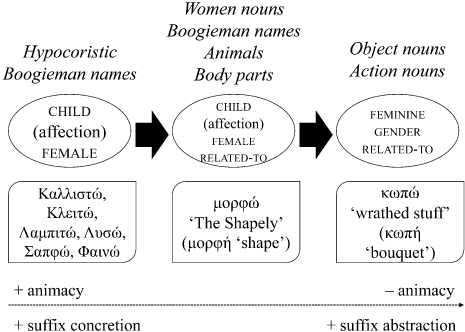
From that fact, it follows that the âfemaleâ meaning in the οι-stem category is to be taken as a straight metaphorical development from âchildâ without it being necessary to attest the âsmallnessâ meaning. Hence, âchildâ and âfemaleâ (âwomanâ) meanings can work as conceptual synonyms of âsmallnessâ. Consequently, they both would have been able to give rise to further semantic developments such as ârelated-toâ and âpartitiveâ (subevent) in the same way proposed by Jurafsky concerning diminutive semantics (1996: 551â556). Further, it can be assumed that within the οι-stem category the central âchildâ meaning would have given rise to a ârelated-toâ meaning by means of generalisation (bleaching). In fact, âchildâ, âfemaleâ and ârelated-toâ meanings seem to be non-detachable in many words (§â¯4). Additionally, in view of the fact that in many instances, pragmatic âchildâ and semantic âfemaleâ meanings cannot be dissociated (cf. hypocoristic names) and at least in one case (i.e. κÏÏá½½) ârelated-toâ seems to be the only meaning, the bleaching path can be traced back as indicated in Figure 3.
Figure 3
Bleaching from âchildâ to ârelated-toâ meaning
Citation: Journal of Greek Linguistics 19, 2 (2019) ; 10.1163/15699846-01902004
Notice that this graphic depicts a morphosemantic process related to the universal animacy hierarchy: the more concrete the meaning of the suffix is, the more animate the referent is. In the first step, the suffix implies senses attached to the physical domain (âchildâ and âfemale sexâ), so the word denotes women (ranked high in the universal animacy hierarchy), but in the last it conveys very abstract meanings such as âfeminine genderâ and ârelated-toâ, so the word refers to an inanimate object (ranked low in the universal animacy hierarchy).
Furthermore, the attestation of deverbal action nouns inside the οι-stem class seems to be a difficult issue since their verbal semantics hardly relate to the various nominal meanings of the category and even less to the central âchildâ and âsmallâ senses. However, in a number of languages, nouns like these are marked by the diminutive morpheme implying a semantic connection between them. Jurafskyâs survey of the diminutive (1996) provides an elegant and coherent explanation that deverbal meaning results in diminutive morphemes from the conceptualisation of âsmallnessâ in the verbal semantic domain. Jurafsky adduces that the partitive sense (âsmall into piecesâ) of the diminutive plays an important role here because it enables the abstract general meaning of the verb to be conceptualised as several individuated small parts. In other words, the action noun may be taken as an individual part of the verbal meaning. For instance, the small (individuated) part of buying would be the purchase. As a matter of fact, in Ancient Greek, the individuated action of sacrificing (ÏÏάζÏ) is the sacrifice (ÏÏάγιον), a verbal noun created by means of the diminutive -ιον. On account of this, οι-stem action nouns can be explained as the conceptualisation of âsmall [part of]â applied to a semantic verbal content: Ïειδώ âsparingâ is to be understood as an individual [small] part of Ïείδομαι âto spareâ.
In view of the fact that âchildâ and âfemaleâ are able to convey the âsmallnessâ meaning, there is no need to explain the semantic process that leads to the âpartitiveâ or âsubeventâ meaning (nomina actionis). However, it is worth mentioning that action nouns seem to have been originated both in female hypocoristic names and in the Greek practice of personification (§â¯3.7), so they can be included in the first semantic type as original affectionate female names that were afterwards reinterpreted as action names.
5.3 âContemptâ meaning
Finally, it is worth pointing out that the âcontemptâ sense belongs to a great extent to pragmatics. It is not necessary then to assume that it originated in the general size metaphor SMALL THINGS ARE NOT WORTHY opposite to BIG THINGS ARE WORTHY. âContemptâ would be better placed next to the âaffectionateâ meaning as a pragmatic development of hypocoristic uses of the οι-suffix. This scenario is to be compared with the English hypocoristic o-suffix used in personal names and common nouns with an affectionate and expressive force (amm-o âammunitionâ, kidd-o âlittle [cute] kidâ, Rick-o, Stevi-o, etc.) but also with pejorative adjectives (fats-o, wack-o, weird-o, wrong-o, etc.; from Schneider 2003: 111).
5.4 The radial organisation of the category
According to what has been said about the semantics of the οι-stem nominal category (§â¯3, §â¯5) and about the internal organisation of categories (§â¯4), the following conclusions can be drawn:
-
The Ancient Greek οι-stem category is made up of four essential morphosemantic (word formation) meanings: affection/contempt, female, related-to, verbal abstraction.
-
These meanings are hierarchically distributed with one central prototypical meaning and others with different degrees of relation with the central meaning.
-
These meanings can be traced back by means of common mechanisms of semantic change (metaphor, metonymy, generalisation, inference, etc.).
Evidently, this account implies that the οι-stem declension is a radial category (Figure 4), the organisation of which is to be understood as follows according to our survey:
Figure 4
Semantic internal organisation of the οι-stem radial category
Citation: Journal of Greek Linguistics 19, 2 (2019) ; 10.1163/15699846-01902004
-
Female hypocoristic names (personal pet names) prototypically represent the category since they are cross-linguistically linked to baby talk and child-directed speech and in view of the principle that pragmatics prevail over semantics, the pragmatic âchildâ meaning is to be taken as the central meaning of the category. In other words, âaffectionâ is the core member within the οι-stem category.
-
Female hypocoristic names link âaffectionâ to âfemaleâ meaning, the other defining semantic feature of the category. This development can be explainedâeven if not necessarilyâby means of the cross-cultural metaphor WOMEN ARE CHILDREN.
-
Female hypocoristic names furnish a formal pattern in order to create derivative nouns, where the basic noun is taken as the defining feature of the derivative. From this pattern arose the relational meaning of the οι-suffix that can in turn be traced back to female deity and bogeyman names because in these names the âaffectionâ (or âcontemptâ) and the âfemaleâ semantic features cannot be separated from the ârelated-toâ meaning.
-
Female hypocoristic names may have also provided a formal naming pattern to create deverbal abstract nouns by means of personification, a cultural mechanism of conceptualisation.
Figure 4 depicts the οιâstem noun category according to its various semantic types. Pragmatic meanings are placed in the upper part and semantic meanings in the lower part. The various word formation meanings are highlighted into oval shapes indicating their degree of centrality inside the category, while rectangular shapes contain the word meanings. Notice that the âsmallnessâ meaning is put into a dotted oval shape because its existence is inferred from its pragmatic counterpart and from the other semantic meanings. What is written outside these shapes are the metaphors (in capital letters) and the metonyms (in small letters) intended to explain the semantic shift among various word formation meanings. Finally, solid arrows indicate the direction of semantic change while dotted arrows stand for suggested plausible shifts.
6 Conclusions
To sum up, in this study, the Ancient Greek οι-stem noun category has been analysed from a morphosemantic perspective, trying to isolate its essential suffixal meanings (word formation meaning). The following conclusions are drawn:
-
The Ancient Greek οι-stem declension is a morphosemantic radial category with a core member (prototype) and others sharing different degrees of semantic resemblance with the latter (family resemblance).
-
The essential meanings (semantic types) are hierarchically organised and can be explained by means of basic mechanisms of semantic change.
-
According to its semantic types, the Ancient Greek οι-stem category is to be compared with the diminutive morphosemantic category, though its particular semantic organisation is in some ways different.
-
Given the relevance of female hypocoristic names in Ancient Greek οι-stem category, it is to be supposed that pragmatic child is the core (central) meaning that originally gave rise to the category.
Hes. Th. 274; E. Tr. 1178; Ar. Nu. 559, etc.
The vertical axis features the word formation meaning or suffix meaning, so its senses involve specifically morphemic meanings. On the other hand, the horizontal axis shows the οι-stem word meaning categories in which semantically related words are grouped. Notice that the hypocoristic names refer specifically to women personal pet names. They form a word class so they belong to the horizontal word meaning axis and not to the vertical one where labels like âaffection/contemptâ or âfemaleâ are morphological meanings concerning the οιâsuffix.
IG 7,720, VIâIII BC, Tanagra.
IG 7,2465,1 III BC, Thebes.
h. Cer. 47, etc.
Nic. Al. 406.
The equivalence of οι-stem endearment names with alternative diminutive forms may easily lead to the conclusion that -ώ is, actually, a diminutive suffix. Nevertheless, as the -ώ suffix has in these cases an allegedly pragmatic meaning (affection) rather than a semantic one (small), it is better to label it as a hypocoristic suffix instead of diminutive.
Plu. 2,1040b.
Putting aside Robert Gravesâ theory about Alphito as the âWhite Goddessâ (1997), since no source gives a clue about the origin of the name á¼Î»ÏιÏá½½, I think it is not difficult to see a link between (creepy?) divinatory magical practises, old women performing them all covered with flour, and a scary cultural image used to frighten children.
Plu. 2,278d, Hsch.
Hom. Od. 18,27.
AB 273.
Paus. 3,15,8.
IG 9,2,877 Larissa, Roman Period.
IG 12,1,454 Rhodes.
AP 12,41.
In the case of καμινώ âfurnace-womanâ, the word is used contemptuously (Od. 18.27) and has a kind of negative connotation based on the prototypically talkative behaviour of the referent (Ael. Dion. s.u. καμινώΠἡ ÏολύλαλοÏ). Given the way this job was performed in Homeric times, it is very likely that the word features some degree of affection and intimacy.
Ar. Eq. 1068, Ael. NA 7,47, etc.
Hdn. Epim. 84,1, Suid. s.u. ÏίθηκοÏ.
HA 7,47.
Arist. HA 609a30, 617a28.
Hsch. s.u.
Ar. Au. 679, S. Ai. 629.
Anacr. fragm. 49a1 Page, 92,3 Page; Ar. Au. 1412.
Clem. Al. Protr. 17,3.
Hdt. 6,19.
Phot. Bibl. 321 [Bekker].
Ar. Lys. 89, Ach. 874, etc.
Dsc. 1,13.
Gal. 14,72.
Philet. fragm. 9 [Powell]; cf. αἴδομαι, αἰδέομαι.
E. El. 747; cf. δοκέÏ.
Hsch.; cf. οἶδα.
Hes. Scut. 279 and 348; A. Pers. 391, etc.; cf. á¼ Ïá½µ.
Doric, Hsch.; cf. κινέÏ.
A. Ag. 1356; cf. μέλλÏ.
S. fragm. 406 [Radt]; cf. á¼Î½Î±Î²Î±á½·Î½Ï.
A. Prom. 173; Pl. Grg. 453a; X. Mem. 1,7,5, etc.; cf. Ïείθομαι.
A. Th. 379; cf. ÏÏ Î½Î¸á½±Î½Î¿Î¼Î±Î¹.
Hom. Il. 7,409, etc.; cf. Ïείδομαι.
Hom. Il. 10,142; cf. ÏÏάομαι.
Antiph. Soph. fragm 22 [Diels & Kranz].
Hdt. 9,85.
Hdt. 1,85; A. Ag. 929; Th. 187, etc.
Hdt. 6,128.
Evidence comes, for instance, from English affective suffix -y/-ie, whose core pragmatic connotative meaning (e.g. daddy, Penny, dearie, etc.) has developed by inference into a semantic referential one (e.g. bootie âsmall babyâs bootâ).
Consider onomatopoeic words. Though they are supposed to be very ancient, speakers tend to create synchronically new onomatopoeic forms. For instance, English laugh was an expressive iconic word in Old English (hlæhhan) that was superseded in terms of iconicity in Middle English by a new onomatopoeic word chuckle âto laugh loudlyâ, the meaning of which shifted in Modern English to âto laugh in a covert wayâ.
References
Adrados, Francisco. 1975. LingüÃstica Indoeuropea. Vol. 2. Madrid: Gredos.
Aikhenvald, Alexandra Y. 2000. Classifiers: A typology of noun categorization devices. Oxford: Oxford University Press.
Ballester, Xaverio. 1999. A propósito de lit. akis, ausis, nosis o sobre i predesinencial. Res Balticæ 5: 81â90.
Ballester, Xaverio. 2003. A propósito de los adjetivos latinos en -ui-. Moenia 8: 435â449.
Brugmann, Karl & Berthold Delbrück. 1967 [1897â1916]. Grundriss der vergleichenden Grammatik der indogermanischen Sprachen. Strassburg: Karl J. Trübner.
Chantraine, Pierre. 1933. La formation des noms en grec ancien. Paris: Klincksieck.
Chantraine, Pierre. 1968. Dictionnaire étymologique de la langue grecque. Histoire des mots. Paris: Klincksieck.
Chantraine, Pierre. 1983. MorfologÃa histórica del griego. Barcelona: Ediciones Avesta.
Corbett, Greville G. 1991. Gender. Cambridge: Cambridge University Press.
Craig, Colette G. (ed.). 1986. Noun classes and categorization. Amsterdam & Philadelphia: John Benjamins.
Crusius, Otto. 1893. Akko. RE 1(1): 1171â1173.
Crusius, Otto. 1894. Alphito. RE 1(2): 1637.
Ernout, Alfred & Antoine Meillet. 1959. Dictionnaire étymologique de la langue latine. Histoire des mots. Paris: Klincksieck.
Ferguson, Charles A. 1964. Baby talk in six languages. American Anthropologist 66: 103â114.
Geeraerts, Dirk. 1997. Diachronic prototype semantics. Oxford: Clarendon Press.
Graves, Robert. 1997. The White Goddess: A historical grammar of poetic myth. Manchester: Carcanet.
Heine, Bernd, Ulrike Claudi & Friederike Hünnemeyer. 1991. Grammaticalization: A conceptual framework. Chicago: University of Chicago Press.
Henderson, Jeffrey. 1991. The maculate muse: Obscene language in Attic comedy. Oxford: Oxford University Press.
Jurafsky, Daniel. 1996. Universal tendencies in the semantics of the diminutive. Language 72(3): 533â578.
Lakoff, George. 1987. Women, fire and dangerous things. What categories reveal about the mind. Chicago: University of Chicago Press.
Lejeune, Michel. 1972. Phonétique historique du mycénien et du grec ancien. Paris: Klincksieck.
Luraghi, Silvia. 2011. The origin of the Proto-Indoeuropean gender system: Typological considerations. Folia Linguistica 45(2): 435â464.
SavickienÄ, Ineta & Wolfang U. Dressler (eds.). 2007. Acquisition of diminutives. A cross-linguistic perspective. Amsterdam: John Benjamins.
Schieffelin, Bambi B. & Elinor Ochs. 1996. The microgenesis of competence: Methodology in language socialization. Social interaction, social context and language: Essays in honor of Susan Ervin-Tripp ed. by D.I. Slobin, J. Gerhardt, A. Kyratzis & J. Guo, 251â264. Mahwah, NJ: Lawrence Erlbaum Associates.
Schneider, Klaus P. 2003. Diminutives in English. Tübingen: Max Niemeyer Verlag.
Schwyzer, Eduard. 1939. Griechische Grammatik. Allgemeiner Teil. Lautlehre, Worbildung. Flexion. I. Band. München: C.H. Beckâsche Verlagsbuchhandlung.
Tambornino, Julius. 1933. Mormo. RE 16(1): 309â311.