Abstract
Scholarly attention to speaking animals in Arabic has focused mainly on the larger collections such as KalÄ«la wa-Dimna, the two sections with animal fables in Alf Layla wa-layla, and the lengthy, brilliant debate in RasÄʾil IkhwÄn al-á¹¢afÄʾ. Animal fables such as found in the Pañcatantra, Aesop, and KalÄ«la wa-Dimna are usually short. There are even shorter fables, however. Arabic literary anthologies contain numerous ultra-short narratives figuring speaking animals, which have been studied less often. This article is concerned with their form and characteristics, and their reception in Arabic literature. Often they are about animal behaviour and characteristics rather than allegories for human behaviour.
Scholarly attention to speaking animals in Arabic has understandably focused mainly on the larger collections such as KalÄ«la wa-Dimna, the two sections with animal fables in Alf Layla wa-layla,1 and the lengthy, brilliant debate in RasÄʾil IkhwÄn al-á¹¢afÄʾ. I shall not discuss them here, nor is there any need to deal with the speaking creatures in the QurʾÄn, where a hoopoe and an ant speak and where the expression maná¹iq al-á¹ayr, the speech of birds, has received ample attention.2 Animal fables such as found in the Pañcatantra, Aesop, and KalÄ«la wa-Dimna are usually short. There are even shorter fables, however. Arabic literary anthologies contain numerous ultra-short narratives figuring speaking animals, which have been studied less often, the main contributions being Brockelmannâs article âFabel und Tiermärchenâ published in 19263 and Karimi, âLe conte animalier,â of 1975.4 Franz Rosenthal also discusses some animal fables, mostly Aesopic, found in a manuscript.5 Brockelmann and others were particularly interested in the possible origins, whether western or oriental, of the several fables. Brockelmann and Karimi show that not all Arabic animal stories can be traced to non-Arabic sources. In this article I am not primarily interested in origins and sources but rather in the forms, functions, and characteristics of those fables. It will be seen that they vary considerably in form or function and that the short narratives may have shifting shapes and serve different purposes, including philological explanation, fanciful zoological information, moral instruction, literary enjoyment, and humour, usually combined to the point of making it impossible to distinguish clearly between categories. These very short fables lack the at times ponderous style of Aesop and KalÄ«la wa-Dimna and as a rule they do not explicitly provide a moral. They are often introduced by expressions such as mimmÄ taqÅ«lu l-Ê¿Arab Ê¿alÄ alsinat al-bahÄʾim, âAmong things the Arabs say on the tongues (i.e., put into the mouth) of beasts.â Their brevity may reach the level of near-incomprehensibility. In the seminal literary anthology by Ibn Qutayba (d. 276/889), Ê¿UyÅ«n al-akhbÄr, one finds:6
ÙÙاÙت اÙعرب ÙÙ٠ا تÙÙ٠عÙ٠أÙسÙÙØ© اÙبÙائ٠:ÙاÙت اÙÙ ÙعÙزÙÙ :اÙاسÙت٠جÙÙÙÙÙÙØ ÙاÙØ°ÙÙب٠أÙÙÙØ ÙاÙجÙÙد٠رÙÙاÙØ ÙاÙشعÙر دÙÙا٠.
Among the things the Arabs say on the tongues of beasts: The goats said, âThe arse bare, the tail curled, the skin thin,7 the wool fine.â
If this is a fable, then the point of this, apart from offering rhymed prose, is not clear, for why should goats describe themselves in such a pitiful fashion? It is partly solved when one finds longer versions, as in Ibn Duraydâs (d. 321/933) dictionary Jamharat al-lugha:8
Ùا٠أب٠زÙد :ÙÙÙ ÙÙعÙز :٠ا أعددت٠ÙÙØ´ØªØ§Ø¡Ø ÙاÙت :اÙØ°ÙÙÙÙب٠ÙÙÙÙاÙØ ÙاÙاسÙت٠جÙÙÙÙÙÙ . (â¦)ÙÙÙÙ ÙÙضأ٠:٠ا أعددت ÙÙØ´ØªØ§Ø¡Ø ÙاÙت :Ø£ÙجÙز٠جÙÙاÙاÙØ ÙØ£ÙÙÙÙد رÙخاÙاÙØ ÙØ£ÙØÙب ÙÙØ«Ùبا٠ثÙاÙاÙØ ÙÙ٠تر٠٠ثÙ٠٠اÙا٠.ÙÙÙÙ ÙÙØ٠ار :٠ا أعددت ÙÙØ´ØªØ§Ø¡Ø Ùا٠:جبÙØ©Ù ÙاÙصÙÙÙاءة ÙØ°ÙÙÙبا٠ÙاÙÙÙتÙر .
AbÅ« Zayd said:9 The goat was asked, âWhat have you prepared for winter?â She10 replied, âThe tail is curled, the arse is bare!â The sheep was asked, âWhat have you prepared for winter?â She replied, âI am shorn of my fleece, I am made to give birth to lambs, I am milked filling heavy pails. You will not see anyone like me in wealth.â The donkey was asked, âWhat have you prepared for winter?â He replied, âA forehead like a stone slab and a tail like a bow-string.â
Not all problems are solved, for it is not clear how the donkey will protect himself against winterâs harshness with a hard forehead and string-like tail, or if the wealth produced by the sheep will help her; whereas the goat merely seems to complain of having scant protection. The bit about the sheep is also found in Ibn Qutayba, separately and again without the question about winter.11 A yet fuller version is given by al-SuyÅ«á¹Ä« (d. 911/1505) in his Muzhir, quoting Ibn Durayd and adding a quotation from the AmÄlÄ« of ThaÊ¿lab (d. 291/904),12 which to the above-mentioned animals adds a dog, who says that his preparation for winter consists in wagging his tail and lying down at the door of his master. The shape-shifting nature illustrated by this tale is compounded by yet another version involving a human instead of animals, a version that may be older than the animal one. Al-JÄḥiẠ(d. 255/868â9) quotes the following:13
ÙÙÙ ÙأعرابÙÙÙ: ٠ا أعددÙت٠ÙÙØ´ÙÙØªØ§Ø¡Ø ÙاÙ: جÙÙÙة٠رÙبÙضاÙØ ÙصÙÙصÙÙÙة٠سÙÙÙÙÙاÙØ ÙØ´ÙÙ ÙØ©Ù Ù ÙÙÙÙداÙØ ÙÙÙÙرÙÙ ÙÙصا٠دÙÙÙئاÙØ ÙÙاÙØ©Ù Ù ÙجÙاÙÙØØ©. ÙÙÙÙ Ùآخر: ٠ا أعددت٠ÙÙØ´ÙتاءÙØ ÙاÙ: Ø´ÙدÙÙØ© اÙرÙÙعدةâª.â¬
A Bedouin was asked, âWhat have you prepared for winter?â He replied, âA large basket for dates, a scoop that is easy to handle, a cloak that will last, a warm hole in the ground, and a milk-yielding she-camel.â Another was asked, âWhat have you prepared for winter?â He replied, âIntense shivering.â
So what is the moral of this fable in its several versions? The answer is that it is no true fable at all, or at least not a fable in the traditional sense of a short animal tale that offers a lesson or moral. I have omitted the lexicographical explanations that accompany the texts in many of the sources, but these explanations provide a clue: they are part of lexicography, examples of old Arabic eloquent diction, with gharÄ«b and sajÊ¿, and they provide information about the traditional nomadic or semi-nomadic life of the Bedouin Arabs. Brockelmann briefly mentions this kind of sayings in his âFabel und Tiermärchen,â14 justifiably, because the texts about the sheep and the goat are more than mere lexicography and eloquence, for they are also aetiological texts, or, to use Kiplingâs term, just-so stories. A version from al-Azmina wa-l-amkina by al-MarzÅ«qÄ« (d. 421/1030) makes this clearer:15
ÙÙÙا٠:Ø¥Ù٠اÙضائÙØ© ÙاÙ٠عز Ø®ÙÙÙÙرتا ÙÙÙÙ ÙÙضاÙÙØ© Ø£ÙÙ٠ا Ø£ØÙبÙ٠إÙÙÙ٠اÙستارة أ٠اÙØºØ²Ø§Ø±Ø©Ø Ùاختارت اÙØ³ØªØ§Ø±Ø©Ø Ùسترت٠ÙÙÙÙÙÙ ÙبÙÙا Ùصارت اÙغزارة ÙÙ٠عز ÙÙت٠سترÙا ÙÙØ´Ù ÙرجÙا .
It is said that the ewe (á¸Äʾina)16 and the goat (maÊ¿z) were given a choice. The ewe was asked, âWhich would you rather have, cover (sitÄra) or plenty (ghazÄra)?â She chose cover. Thus she was covered but her milk was scant. The goat got plenty but âher cover was rentâ (hutika sitruhÄ, meaning âshe was disgracedâ) and her genitals bared.
The eweâs âcoverâ is not only her thick fleece but especially the fatty tail that covers her backside; the goat shamefully lacks such a cover.
There are several such aetiological tales that give fanciful explanations of the appearance and other characteristics of animals. A well-known one is the story of how the frog lost his tail.17 Here is the version offered by al-JÄḥiẠin his al-ḤayawÄn:18

Citation: Journal of Abbasid Studies 8, 1 (2021) ; 10.1163/22142371-12340064
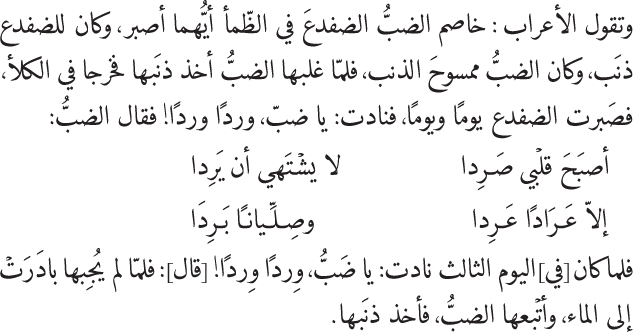
The Bedouins say that the lizard (á¸abb) and the frog (á¸ifdiÊ¿) disputed about which of them could endure thirst better than the other. The frog had a tail and the lizard had only a stunted tail, but when the lizard had won he took the frogâs tail. They had gone out to feed. The frog endured thirst for a day and another day. Then he cried out, âLizard, to the water, to the water!â The lizard said,19
My heart will not let me,It does not want to drinkBut only to take hard Ê¿arÄd20And cold á¹£illiyÄn.21On the third day the frog cried out, âLizard, to the water, to the water!â Receiving no reply, she22 hurried to the water. The lizard followed her and took her tail.
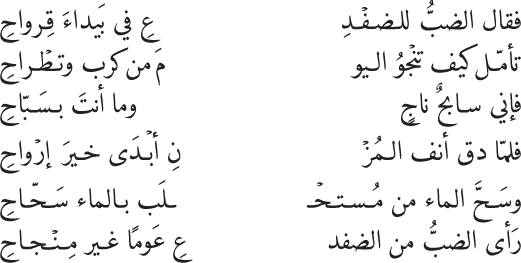
Al-JÄḥiẠcontinues with a poem of thirteen lines about rain by Ibn Harma (d. 176/792), which contains the following lines:23
Citation: Journal of Abbasid Studies 8, 1 (2021) ; 10.1163/22142371-12340064
The connection between these lines and the prose story is tenuous. There is no mention of tails and one would think that frogs are by no means inferior to lizards in swimming; perhaps the poem has only a part of the story. Al-JÄḥiẠthen quotes a verse by the mukhaá¸ram poet al-Kumayt b. ThaÊ¿laba that is more to the point:25
Citation: Journal of Abbasid Studies 8, 1 (2021) ; 10.1163/22142371-12340064
Akin to the just-so stories are texts about the onomatopoeic names of birds. In his book on proverbs al-MaydÄnÄ« (d. 518/1124) writes:26
ÙاÙت اÙÙطاة ÙÙØج٠:ØÙجÙÙÙ ØÙجÙÙÙØ ØªÙÙر٠Ù٠اÙجÙبÙÙÙØ Ù Ù Ø®Ø´ÙÙØ© اÙرÙÙجÙÙÙØ ÙÙا٠ÙÙا اÙØج٠:Ùطا ÙØ·Ø§Ø ÙÙØ§Ù Ø£Ù Ø¹Ø·Ø§Ø Ø¨ÙضÙÙ Ø«ÙÙÙتا٠ÙبÙض٠٠ائتا
The sandgrouse (qaá¹Ä) said to the partridge (ḥajal), âPartridge, partridge (ḥajal, ḥajal), you flee to the mountains (tafirru fÄ« l-jabal), out of fear for man (min khashyati l-rajul)!â27 The partridge replied, âSandgrouse, sandgrouse (qaá¹Ä, qaá¹Ä), your neck is hairless (amÊ¿aá¹Ä), your eggs are (only) two and my eggs are two hundâ!â28
In this story the birds pronounce each otherâs names. Rather better known and more logical is the saying that the sandgrouse, qaá¹Ä, pronounces his own name; poets called it á¹£Ädiqa, âspeaking the truth.â29 These poets, explains al-JÄḥiáº, present the bird as giving truthful information, âeven though the sandgrouse does not intend this.â The Arabs, he continues, take anything they can hear and understand as clear speech (bayÄn), as when DhÅ« l-Rumma says that sheep call for water (mÄʾ). The zÄgh (rook, or crow, or jackdaw, or chough?) also cries out his name, zÄgh zÄgh!, after reciting a poem in eloquent Arabic, bi-lisÄn faṣīḥ á¹aliq dhaliq, in a story.30
The just-so stories are different from the moralistic tales such as those in KalÄ«la wa-Dimna. The typical Aesopic fable or KalÄ«la wa-Dimna tale uses speaking animals to speak about the human world and teach a moral lesson. A lion or a fox may be chosen because the former is strong and the latter is clever, but the fables do not explain the lionâs strength and the foxâs cunning, which are taken for granted as being obvious. The aetiological tales, however, are specifically about the speaking animals themselves, not about the human world.31
Some tales contain neither aetiology nor morality but merely describe events in the animal world, at the same time offering glimpses of Bedouin life. A lizard speaks again in a story quoted (twice) by al-JÄḥiáº:32
Ø¥Ù٠اÙضÙب٠Ùا٠ÙابÙÙ :إذا س٠عت صÙÙÙت٠اÙØرÙØ´Ù ÙÙا تخرÙجÙÙÙÙ !Ùا٠:ÙØ°Ù٠أÙÙÙÙÙ Ùزع٠Ù٠أ٠اÙØرÙش٠تØرÙ٠اÙÙد٠عÙد٠جÙØÙر اÙضÙبÙÙØ ÙÙخرج إذا ظÙÙ٠أÙÙ ØÙØ© âÙا٠:Ùس٠ع ابÙ٠صÙت اÙØÙÙر ÙÙا٠:Ùا Ø£ÙبÙÙÙ Ùذا اÙØØ±Ø´Ø Ùا٠:Ùا بÙÙÙÙØ Ùذا أجÙÙ٠٠٠اÙØرÙØ´ !ÙأرسÙÙÙا Ù Ø«Ùا٠.
A lizard said to his son, âIf you hear the sound of scratching (or tapping, ḥarsh) you must not go outside!â Ḥarsh, they say, is moving the hand near the burrow of a lizard, so that it would come out, thinking it is a snake. The son heard the sound of digging and said, âDaddy, is this scratching?â âSon,â the father replied, âThis is worse than scratching!â This became a proverb.
And, indeed, the saying is found in collections of proverbs.33 Three anonymous rajaz lines quoted in SÄ«bawayhâs KitÄb are said to have been spoken by yet another lizard (this paper seems to be teeming with lizards) whose burrow has been targeted, probably by Bedouins, who are often described as being fond of lizards:34
Citation: Journal of Abbasid Studies 8, 1 (2021) ; 10.1163/22142371-12340064
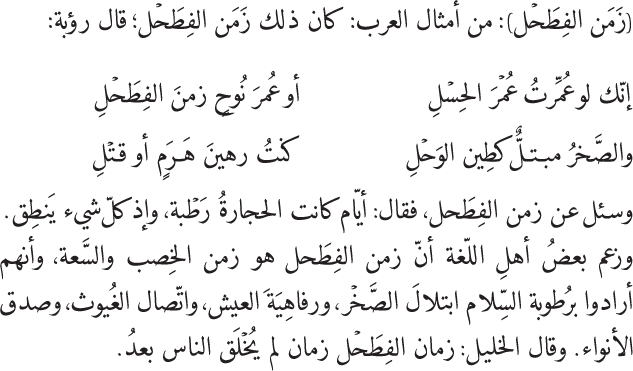
The story behind these lines, if ever there was one, is lost. Al-Mubarrad (d. 285/898), in a chapter on âLies of the Bedouinsâ (takÄdhÄ«b al-aÊ¿rÄb), relates that AbÅ« Ê¿Umar al-JarmÄ« asked AbÅ« Ê¿Ubayda (d. 210/825) about who composed them. He replied, âThe Bedouins say that the lizard said them to his young (ḥisl) in the days when things still spoke (ayyÄm kÄnat al-ashyÄʾ tatakallam).â35 Al-ThaÊ¿ÄlibÄ« (d. 429/1038) discusses this interesting mythical epoch in his ThimÄr al-qulÅ«b, in the entry of zaman al-fiá¹aḥl, âthe time of al-fiá¹aḥl.â36 The passage is worth looking at in some detail.
Citation: Journal of Abbasid Studies 8, 1 (2021) ; 10.1163/22142371-12340064
âThe time of al-fiá¹aḥlâ is one of the sayings (amthÄl) of the Arabs, who say, âThat was in the time of al-fiá¹aḥl.â Ruʾba [b. al-Ê¿AjjÄj, d. 145/762] said,37
He39 was asked about the expression âthe time of al-fiá¹aḥl.â He explained: âThe days when the stones were still wet, when all things could speak.â Some lexicographers say that âthe time of al-fiá¹aḥlâ was a time of fertility and plenty.40 With the âwetness of stonesâ they meant that the rocks were moist, that life was opulent, rain fell steadily, and the rain-stars were reliable. Al-KhalÄ«l41 says, âThe time of al-fiá¹aḥl is the time when people had not yet been created.â42
It is likely that Ruʾba did not know the exact meaning of al-fiá¹aḥl and it is clear that the Arab lexicographers did not have a clue about the meaning and origin of the word, which is in fact an Arabicised form of Ptahil, the name of the Mandaean demiurge who created the earth from muddy clay.43 To Ruʾba the word merely represented âa soggy primordial time,â as Kevin van Bladel aptly put it. Al-ThaÊ¿ÄlibÄ« continues:
Ùا٠اÙÙاض٠أب٠اÙØس٠عÙÙÙ٠بÙ٠عبد اÙعزÙز :Ø£Ù Ùا ÙÙÙÙÙ :Ø£ÙÙا٠ÙاÙت اÙØجارة رÙØ·Ùبة Ùإذ٠ÙÙÙ Ø´ÙØ¡ ÙÙØ·ÙØ ÙÙ٠ا ٠٠اÙØ£Ù Ùر اÙت٠ÙتداÙÙÙÙا جÙÙÙÙØ© اÙØ£Ù Ù Ø ÙÙÙ ÙاÙظاÙر بÙ٠أغÙا٠اÙعرب ÙاÙعا٠ÙØ©Ø Ùذا اب٠أÙÙ ÙÙÙØ© ب٠أب٠اÙصÙÙÙÙت âÙÙÙ Ù Ù ØÙ٠اء اÙعرب ÙاÙ٠تخصÙصÙÙ Ù ÙÙا باÙرÙÙاÙØ© âÙÙÙÙ :
Citation: Journal of Abbasid Studies 8, 1 (2021) ; 10.1163/22142371-12340064
Al-QÄá¸Ä« AbÅ« l-Ḥasan Ê¿AlÄ« b. Ê¿Abd al-Ê¿AzÄ«z44 says: That they speak of the days the stones were still wet and that everything could speak, that is what is current among ignorant nations. It is also evident among gullible Arabs and the common people. Ibn [sic] Umayya b. AbÄ« l-á¹¢alt, one of the sages of the Arabs and who specialised in transmitting (such ideas), says,45
This verse refers to the just-so story about how the cock lost the use of his wings and became a prisoner forced to cry out at dawn, which is told in another poem by Umayya and mentioned in al-JÄḥiáºâs al-ḤayawÄn and later sources.47 The cock and the crow were drinking together. When it was time to pay the crow offered to get money and went off, leaving the cock with the taverner as surety, but he betrayed him and did not return.
Al-ThaÊ¿ÄlibÄ« goes on to say that the idea of the rocks being soft and then hardening was not intended as a kind of scientific explanation but the result of fancifully imagining a primeval epoch in which animals could speak as rational beings and when the branches of the saÊ¿dÄn (a prickly plant) and the twigs of the sayÄl (wild artichoke?) were still soft and green.48 It is possible, he says, that by this those who invented the stories intended to instil wisdom in people, wanting to make them familiar with understanding things, by inventing parables (amthÄl) mixed with some jesting (hazl), incorporating seriousness in the fun (mazḥ), so that people would be more receptive. People with undiscerning minds would therefore believe that animals could speak and express themselves. They invented additional stories. The Arabs were particularly adept, more than all other nations, because they are so fond of speech and gifted with the ability to be versatile in their speech. They composed poetry and rhymed prose, such as what is told about the lizard and his ability to endure being without water better than any other living being.49 Thus far al-ThaÊ¿ÄlibÄ«.
Animal fables receive very little attention in traditional Arabic literary criticism, which had little interest in narrative, especially when unadorned, anonymous, and in prose. There is no sajÊ¿, badÄ«Ê¿, or poetry in KalÄ«la wa-Dimna. Muḥammad b. Ê¿Abd al-GhafÅ«r al-KalÄÊ¿Ä«, a sixth/twelfth-century Andalusian literary critic, is exceptional in having a chapter in his IḥkÄm á¹£anÊ¿at al-kalÄm devoted to maqÄmÄt and ḥikÄyÄt.50 After quoting four maqÄmas by BadÄ«Ê¿ al-ZamÄn al-HamadhÄnÄ« he turns briefly to fables:51
Ù٠٠اÙØÙاÙات اÙ٠ختÙÙØ© ÙاÙأخبار اÙ٠زÙÙÙرة اÙÙ ÙÙ ÙÙØ© Ùتاب (ÙÙÙÙØ© Ùد٠ÙØ© )ÙÙتاب (اÙÙائ٠)Ùأب٠اÙعÙاء اÙ٠عرÙÙØ ÙÙد تÙÙÙ Ùا ÙÙ٠عÙ٠أÙسÙØ© اÙØÙÙا٠ÙغÙر اÙØÙÙا٠.
Among the invented tales and fictional, embellished reports (min al-ḥikÄyÄt al-mukhtalaqa wa-l-akhbÄr al-muzawwara al-munammaqa) are KalÄ«la wa-Dimna and al-QÄʾif by AbÅ« l-Ê¿AlÄʾ al-MaÊ¿arrÄ«, in which they speak quoting animals and non-animals.
Al-MaÊ¿arrÄ«âs al-QÄʾif is lost, as is his own commentary on it, ManÄr al-qÄʾif,52 but al-KalÄÊ¿Ä« quotes four brief stories, three of which are about animals that speak. AbÅ« l-Ê¿AlÄʾâs fables are admirably short, as fables should be. He uses sajÊ¿ sparingly and it does not detract from the quick flow of the narrative. Al-KalÄÊ¿i says that he prefers AbÅ« l-Ê¿AlÄʾâs fables to KalÄ«la wa-Dimna,53 because they are beautifully written, with iḥsÄn and ibdÄÊ¿, wa-huwa aktharu min KalÄ«lata wa-Dimnata waraqÄ, wa-afsaḥu á¹alaqÄ, wa-aá¹yabu shamÄ«man wa-Ê¿abaqÄ, which I find difficult to translate but which seems to say that al-KalÄÊ¿Ä« thinks that the fables of al-MaÊ¿arrÄ« are more lush, run faster, and have more flavour (literally, âfragranceâ) than KalÄ«la wa-Dimna. Perhaps al-KalÄÊ¿Ä« likes the rhymes and the artifice, or possibly also the unveiled sarcasm evident in this and other fables, with their ambiguities. Since these fables are relatively unknown I quote one of them here:54
Øضرت اÙÙÙ Ùة٠اÙÙÙاة٠Ùاجت٠ع ØÙاÙÙÙÙا اÙÙÙ Ù ÙÙاÙت ÙادبتÙÙا :ÙرØ٠٠اÙÙÙÙ°Ù !Ø£Ù ÙÙÙ Ø´ÙعÙرة ٠جرÙØ±Ø©Ø ÙبÙرÙØ© Ù Ù Ø·ÙØ±Ø©Ø Ùآثار سÙÙرة Ù ÙØ´ÙØ±Ø©Ø ÙاÙت ÙÙÙÙ :Ùا تجزÙعÙØ ÙÙد ذخرت٠عÙد اÙÙÙٰ٠ذخÙرة٠٠Ù٠ذخر Ù ÙØ«ÙÙا جدÙر٠باÙرØÙ Ø©Ø ÙØ°Ù٠أÙÙÙ Ù٠أسÙÙ٠د٠ا٠ÙØ·Ù .
An ant (namla) was dying. The other ants gathered around him. A female mourning ant said, âGod have mercy on you! Is there a grain of barley dragged (majrÅ«ra), a grain of wheat on which the rain has fallen (mamá¹Å«ra), or the remains of a tablecloth that was spread (manshÅ«ra)?â The ant replied, âDo not worry, for I have amassed with God a store that entitles the one who stored it to mercy: I have never shed blood.â
We may wonder if al-MaÊ¿arrÄ« was wholly serious about this dying ant: why should it be rewarded for not having done what it could not have done, and since when can ants enter Heaven? In the second fable a small bird whose chicks had been the victim of a snake year after year nevertheless refrains from gloating when the snake has turned blind; it reads as a counter to the tale of the crow and the snake (al-ghurÄb wa-l-aswad) in KalÄ«la and Dimna, in which the crow, helped by a cunning jackal, has his revenge on the snake who has eaten its chicks.55 In the third fable there is a blind lion who becomes a herbivore, which would sound ridiculous coming from most writers; AbÅ« l-Ê¿AlÄʾ, a confirmed vegan from conviction, rather than forced by his blindness, might actually have been semi-serious about such an animal. These are no just-so stories but moral tales of a vegan and pacifist. He was fond of letting animals speak, as is obvious from other works of his, notably al-á¹¢Ähil wa-l-shÄḥij but also RisÄlat al-ghufrÄn, where a lion, a wolf, an oryx, an onager, and several snakes speak. It is somewhat disappointing, therefore, that he, like others, dismissed the fable of the frog and the lizard as âlies (akÄdhÄ«b), produced by people of Scriptures, the Jews and the Christians, heard by Umayya b. AbÄ« l-á¹¢alt and others, who versified them.â56 And he says this, incongruously, in his Epistle of the Neigher and the Brayer, a book full of speaking animals. However, with al-MaÊ¿arrÄ« there is always a chance that his tongue is in his cheek.
The very short, anonymous tales with speaking animals are found scattered in many sources, such as the dictionary of animals by al-DamÄ«rÄ« (d. 808/1405), ḤayÄt al-ḥayawÄn al-kubrÄ, and the several books on proverbs such as Jamharat al-amthÄl by AbÅ« HilÄl al-Ê¿AskarÄ« (d. ca. 404/1010) and al-MaydÄnÄ«âs MajmaÊ¿ al-amthÄl. Clusters of them are also contained in several thematically arranged anthologies, notably Nathr al-durr, the large anthology of prose by al-ÄbÄ« (d. 421/1030),57 MuḥÄá¸arÄt al-udabÄʾ by al-RÄghib al-Iá¹£fahÄnÄ« (d. early 5th/11th century),58 and in Ibn al-JawzÄ«âs (d. 597/1201) al-AdhkiyÄʾ, a book about clever people, or rather clever creatures, because the last two chapters are about clever animals.59 Other clumps of tales are offered by Ibn AbÄ« Ê¿Awn (d. 322/934) in his al-Ajwiba al-muskita,60 al-Ḥuá¹£rÄ«âs (d. 413/1022) JamÊ¿ al-jawÄhir,61 Ibn ḤamdÅ«nâs (d. 562/1166) anthology al-Tadhkira al-ḤamdÅ«niyya,62 and al-MarzÅ«qÄ«âs al-Amkina wa-l-azmina.63
Such clusters usually offer a mélange of Aesopic and other Greek fables64 and âindigenousâ Arabic tales. Among the sixteen fables with speaking animals offered by al-ÄbÄ«, for instance, one finds familiar Aesopic tales, such as the one about the lion, the wolf, and the fox, in which the fox says he has learned a lesson from the severed wolfâs head;65 the fable known as âSour Grapesâ involving a fox;66 or âThe Fox and the Thornbush.â67 Some fables quoted by al-ÄbÄ« are non-Aesopic but known from other sources, such as the tale of the bird (qunbura) who is caught but escapes and teaches his catcher three lessons, found in other Arabic sources such as al-Ê¿Iqd al-farÄ«d and Ibn ḤamdÅ«nâs Tadhkira but also in Bilawhar wa-BÅ«dhÄsf;68 or the well-known story of the two owls who expect a bride price of numerous ruins if a certain vizier or governor (variously identified) remains in office.69 Another tale looks Aesopian, faintly reminiscent of âFox and Crowâ70 yet very different and with an interesting punchline:71
ÙاÙÙا :Ùجد بعÙر٠ÙأرÙب ÙثعÙب جÙبÙØ©ÙØ ÙاصطÙØÙا عÙ٠أ٠تÙÙÙ ÙØ£ÙبرÙ٠سÙÙÙÙØ§Ø ÙÙا٠اÙأرÙب٠:Ø£Ùا ÙÙÙÙدت٠Ùب٠أ٠خÙ٠اÙÙÙٰ٠اÙس٠اÙات٠ÙاÙأرض٠.ÙÙا٠اÙثعÙب٠:صد٠ÙØ¥ÙÙÙ Øضرت٠ÙÙت٠ÙÙادتÙØ Ùأخذ اÙبعÙر اÙجÙبÙة٠بÙÙÙØ ÙرÙع رأس٠ÙÙا٠:٠٠رآÙÙ ÙعÙ٠أÙÙ Ù٠أÙÙÙد٠اÙبارØØ© .
They say that a camel (baÊ¿Ä«r), a hare (arnab), and a fox (thaÊ¿lab) found a piece of cheese. They agreed that it should go to the oldest of them. The hare said, âI was born before God created the heavens and the earth.â The fox said, âHe has spoken the truth, [276] and I was present at his birth.â Then the camel picked up the piece of cheese with his mouth, raised his head, and said, âWhoever sees me knows that I wasnât born yesterday.â
Strikingly, it is not the fox who gains the prize, as no doubt he would have done in Aesop. One does not associate the camel with cunning or wit, or with eating cheese for that matter. The last sentence, âI wasnât born yesterday,â is a remarkably old occurrence of this saying with the sense of âyou cannot fool me.â Another fable reminds one of the English saying âThe owl thinks her own young fairestâ:72
ÙاÙت اÙØ®ÙÙÙساء ÙØ£Ù ÙÙا :٠ا Ø£Ù ÙرÙ٠بأØد٠إÙا بÙزÙÙ٠عÙÙÙÙ .ÙاÙت :Ù Ù ØÙسÙÙÙ٠تÙعÙÙÙØ°ÙÙ .
They say that the dung beetle (or scarab beetle, khunfusÄʾ) said to her mother, âWhenever I meet anyone they spit on me.â âThat is,â replied the mother, âto ward off the evil eye, because you are so beautiful.â
Few animals are more repulsive, to humans, than the dung-beetle. Nevertheless, beauty is relative and in the eye of the beholder. Erasmus, in his Adages, describes the beauties of the dung-beetle at some length in an essay on the saying scarabaeus aquilam quaerit (âA dung-beetle hunting an eagleâ); it could have been written by al-JÄḥiáº:73
As far as physical beauty goes, if only we keep our judgment free of vulgar prejudice, there is no reason to despise the dung-beetle. For if the philosophers are right when they say that the shape they call a sphere is not only the most beautiful but in every way the best (â¦) why should the dung-beetle not seem beautiful which comes far closer to this shape than the eagle? (â¦) The colour of the dung-beetle, I think, no one will denigrate for it has the quality of jewels (â¦)
It will be clear by now, from this heterogeneous collection of quotations, that speaking animals fulfil many functions. They speak in the moralistic fables of the Aesopic kind; in a few aetiological, âjust-soâ stories; in proverbs or tales that purport to explain proverbs; in lexicographical sayings; in miracle tales involving prophets or pious people; in dreams, as when the famous musician IbrÄhÄ«m al-Mawá¹£ilÄ« (d. 188/804) dreams of a black and white cat who does not only speak but teaches him a beautiful song.74 They are usually anonymous, but the moral and artfully crafted fables by al-MaÊ¿arrÄ« are an exception. The anonymous Bedouin tales are sometimes denigrated as the takÄdhÄ«b or akÄdhÄ«b, âliesâ or âfictitious storiesâ of the Bedouin Arabs. They come in different lengths. Explaining the saying ajraʾ min khÄṣī l-asad, âmore daring than the man who castrated the lion,â al-MaydÄnÄ«, in his book on proverbs, tells the story in a mere thirty-five words:75
ÙÙا٠:Ø¥Ù Øراثا٠Ùا٠ÙÙØÙØ±Ø«Ø Ùأتا٠أسد ÙÙا٠:٠ا اÙØ°Ù Ø°ÙÙÙÙÙ ÙÙ Ùذا اÙØ«Ùر Øت٠ÙÙØ·ÙعÙØ Ùا٠:Ø¥ÙÙ Ø®ÙصÙÙÙتÙØ ÙÙا٠:Ù٠ا اÙØ®ÙØµØ§Ø¡Ø Ùا٠:ادÙÙÙ Ù Ù٠أÙرÙÙÙÙØ ÙدÙا Ù Ù٠اÙأسد Ù ÙÙÙÙادا٠ÙÙعÙÙ Ø°ÙÙØ Ùشد٠ÙÙثاÙا٠ÙØ®Ùضا٠.
It is said that a farmer was ploughing when a lion came up to him and asked, âHow did you manage to tame this ox so that it obeys you?â The farmer replied, âI have castrated it.â âWhat is castration?â asked the lion. âCome closer and Iâll show you,â said the farmer. The lion came closer, compliantly, in order to find out. The farmer bound him tight and castrated him.
Al-ZamakhsharÄ« (d. 538/1144) pares it down to even fewer words, calling it âone of the fictitious stories (takÄdhÄ«b)â of the Bedouin Arabs.76 AbÅ« Ê¿Ubayd al-BakrÄ« (d. 487/1094), however, offers what he calls a ḥadÄ«th á¹awÄ«l, a relatively long and bizarre tale that can no longer be called a very short animal fable:77
تزع٠اÙعرب أ٠اÙاسد ٠ر٠بØراث ÙØرث بثÙرÙ٠بادÙÙÙØ ÙÙا٠ÙÙ :Ùا Øراث ٠ا أس٠٠ثÙرÙÙ !Ùب٠اذا أس٠ÙتÙØ§Ø Ù٠ا اÙذ٠تطع٠ÙÙ Ø§Ø Ùا٠Ù٠اÙØراث :Ø¥Ù٠ا سÙÙ ÙÙا ÙØ£Ù٠خصÙتÙ٠ا .ÙÙا٠Ù٠اÙأسد :ÙÙÙ ÙÙ Ù٠أ٠تخصÙÙ٠عس٠أ٠أصÙر بس٠ÙÙ٠ا .Ùا٠:Ùع٠.ÙØ£Ù ÙÙÙ Ù Ù ÙÙسÙØ Ùخصا٠اÙØØ±Ø§Ø«Ø Ù٠ر٠عÙÙØ Ùد٠٠ÙسÙÙØ ÙرÙ٠إÙ٠ربÙØ© ٠٠اÙأرض ÙØ£Ùع٠ÙئÙبا٠٠٠ا ØÙ٠ب٠ÙÙظر ٠٠اÙØØ±Ø§Ø«Ø Ùإذا بثعÙب Ùد ٠ر٠ب٠.ÙÙا٠ÙÙ :٠ا Ù٠أرا٠ØزÙÙا٠Ùا أبا اÙØØ§Ø±Ø«Ø ÙØ°Ùر Ù٠خبر٠٠ع اÙØراث Ù٠ا دÙا٠٠٠اÙخصاء ÙØ¢ÙÙ Ù .ÙÙا٠Ù٠اÙثعÙب :ÙÙÙ ÙÙ Ù٠أ٠آت٠اÙØراث ÙأستدÙر ب٠عس٠أ٠ت٠ÙÙÙÙ ÙÙÙ Ùرصة Ùاتئر ÙÙØ Ùا٠:Ùع٠Ùدا٠أب٠ÙØ£Ù Ù .Ù٠ض٠اÙثعÙØ¨Ø Ùجع٠ÙراÙغ اÙØرÙاث ÙÙØ·Ù٠بÙØ ÙتÙاÙ٠اÙØراث Øجرا٠ÙÙØ°Ù٠ب٠ÙدÙÙ ÙخذÙØ Ùأت٠اÙأسد عÙÙ Ø«Ùاث ÙÙائ٠ÙØ£Ùع٠٠ع٠عÙ٠اÙرابÙØ© ÙØ´ÙÙا٠بثÙÙ Ø§Ø Ù٠ا دÙÙا ب٠٠٠ذÙ٠اÙØراث .Ù٠رت بÙ٠ا ÙÙعÙرÙØ©Ø ÙÙاÙت :٠ا ÙÙ٠ا عÙÙ Ùذ٠اÙØاÙØ ÙأخبراÙا خبرÙÙ Ø§Ø ÙÙاÙت :Ø£Ùا آتÙÙ ÙأستدÙر ب٠Øت٠أدخ٠Ù٠أÙÙÙ ÙØ£ÙتÙÙ ÙÙ٠ا Ù ÙÙØ ÙجزÙاÙا Ø®ÙراÙØ Ù٠ضت ÙجعÙت تستدÙر برأس اÙØرÙاث ÙترÙ٠اÙÙÙÙج Ù٠أÙÙÙ ÙتغاÙÙ ÙÙا Øت٠دÙت ÙÙبض عÙÙÙØ§Ø ÙتÙاÙ٠عÙدا٠ÙدسÙÙ Ù٠استÙØ§Ø ÙأرسÙÙا Ùجاءت Ø¥Ù٠اÙأسد ÙاÙثعÙب ÙÙÙ Ù٠شرÙÙ Ù Ù ØاÙÙÙ Ø§Ø Ùد سد٠اÙعÙد دبرÙا ÙأثÙÙÙا ع٠اÙØ·Ùرا٠.ÙبÙÙا Ù٠عÙÙ Ø°ÙÙ ÙتشاÙÙ٠جاءت ا٠رأة اÙØراث بغدائÙØ ÙتÙدÙ٠اÙØرÙاث Ø¥ÙÙÙا ÙرÙع رجÙÙÙØ§Ø Ùجع٠ÙباشرÙا ÙÙ٠ب٠رأ٠٠٠تÙ٠اÙدÙاب .ÙÙا٠اÙأسد :٠ا ترÙÙ Ùذا اÙ٠شئÙÙ ÙÙع٠بÙذ٠اÙ٠رأة اÙ٠سÙÙÙØ©Ø ÙاÙÙÙ٠إÙÙ ÙأظÙÙ ÙخصÙÙØ§Ø ÙÙا٠اÙثعÙب :٠ا أرا٠إÙا ÙÙسر ÙخذÙØ§Ø ÙÙاÙت اÙÙعرة :Ùا ÙاÙÙÙ٠ب٠Ùدخ٠استÙا عÙداÙØ ÙÙاÙت اÙÙعرة أصدÙÙ٠ظÙا٠.
The Arabs maintain that a lion once came past a farmer who was ploughing his field with two fat oxen. âFarmer,â said the lion, âWhat fat oxen you have! How did you fatten them? What food did you give them?â The farmer replied, âThey are fat because I have castrated them.â The lion said, âWould you like to castrate me, so that I may grow as fat as they?â âYes,â the farmer replied. The lion submitted to the farmer, who castrated him. He left, still bleeding, and having ascended a hillock he squatted down, grieving about what had happened to him and keeping an eye on the farmer. A fox came past, who said, âAbÅ« l-ḤÄrith! Why is it that I see you sad?â The lion told him what the farmer had done to him and how the castration had hurt him. The fox said to him, âWould you like me to go to the farmer and make circles around him, so that I may have an opportunity to take revenge for you?â âYes,â answered the lion, âI would give my father and mother as your ransom!â The fox went to the farmer, moving around him while dodging him. The farmer took up a stone, threw it to the fox and broke its thigh. Limping on three legs the fox returned to the lion and squatted down with him on the hillock, lamenting their fate and what that farmer had done to them. A horsefly (nuÊ¿ara) came past. âWhat has happened to you two?â she asked. They told her their story. She said, âI shall go to him, fly around him and then creep into his nose, so that I can take revenge for you!â âGod bless you!â, they replied, and the fly set off and began to circle around the farmerâs head, attempting to enter his nose. The farmer pretended to ignore her and when she got near he grabbed her. He took up a splinter and pushed it up her arse. Then he let her go. She returned to the lion and the fox in a state worse than theirs, with the splinter blocking her fundament and being too heavy to fly with. While they were lamenting, the farmerâs wife came past with his lunch. The farmer went up to her, raised her legs and had intercourse with her in full sight of the animals. The lion said, âDo you see what that wretched man is doing with that poor woman? I swear to God, I think he is castrating her!â The fox replied, âNo, he is in fact breaking her thigh!â And the horsefly said, âNo, by God, he is putting a wooden splinter into her arse!â The horsefly was closest to the truth.
I suppose a moral may be extracted from the tale in its several forms, but it seems more likely that the story was invented to explain the hyperbolical expression. The longer, farcical version told by AbÅ« Ê¿Ubayd al-BakrÄ«, apart from being entertaining, could serve as an illustration of the unreliability of witnesses, all of whom will relate an observed incident to themselves and claim their subjective experience to be the truth. At the same time, it improves on the version of al-MaydÄnÄ« and al-ZamakhsharÄ«, because it is not clear why the lion would submit to being castrated in order to be tamed, whereas becoming fat, as in AbÅ« Ê¿Ubaydâs version, would presumably be desirable. By dismissing the story as âone of their liesâ instead of appreciating it as entertaining fiction, al-ZamakhsharÄ«, not the least of scholars, demonstrates his obtuseness in dealing with the genre of the fable, as do al-Mubarrad and others when they speak of the âlies of the Bedouinsâ and even al-MaÊ¿arrÄ« when he mentions the âlies of Jews and Christians.â78 Likewise, when al-QÄá¸Ä« al-JurjÄnÄ«, quoted above by al-ThaÊ¿ÄlibÄ«, speaks of ignorant nations and gullible Arabs who believe stories about speaking animals, one is tempted to think that he himself is gullible in believing in the gullibility of those who tell fables and listen to them.
References
Primary Sources
Al-ÄbÄ«, AbÅ« SaÊ¿d Manṣūr b. al-Ḥusayn, Nathr al-durr, ed. by Muḥammad Ê¿AlÄ« Qurana et al., 7 vols., Cairo: al-Hayʾa al-Miá¹£riyya al-Ê¿Ämma, 1980â1990.
AbÅ« NuÊ¿aym al-Iá¹£bahÄnÄ«, Ḥilyat al-awliyÄʾ wa-á¹abaqÄt al-aá¹£fiyÄʾ, 10 vols., Cairo: Maá¹baÊ¿at al-SaÊ¿Äda & Maktabat al-KhÄnjÄ«, 1932â1938.
AbÅ« l-Ṭayyib al-LughawÄ«, MarÄtib al-naḥwiyyÄ«n, ed. by Muḥammad AbÅ« l-Faá¸l IbrÄhÄ«m, Cairo: Nahá¸at Miá¹£r, [1974, date of preface].
AbÅ« Ê¿Ubayd al-BakrÄ«, Faá¹£l al-maqÄl fÄ« sharḥ al-amthÄl, wa-huwa sharḥ li-kitÄb al-AmthÄl li-AbÄ« Ê¿Ubayd al-QÄsim b. SallÄm, ed. by IḥsÄn Ê¿AbbÄs and Ê¿Abd al-MajÄ«d Ê¿ÄbidÄ«n, Beirut: DÄr al-AmÄna, 1983.
AbÅ« Zayd al-Aná¹£ÄrÄ«, al-NawÄdir fÄ« l-lugha, ed. by Muḥammad Ê¿Abd al-QÄdir Aḥmad, Beirut: DÄr al-ShurÅ«q, 1981.
Alf Layla wa-layla, BÅ«lÄq: al-Maá¹baÊ¿a al-Ê¿Ämira al-Ê¿UthmÄniyya, AH 1302.
The Arabian Nights: Tales of 1001 Nights, tr. by Malcolm C. Lyons, with Ursula Lyons, introduced and annotated by Robert Irwin, London: Penguin Classics, 2008.
Al-Ê¿AskarÄ«, AbÅ« HilÄl al-Ḥasan b. Ê¿AbdallÄh b. Sahl, al-AwÄʾil, Beirut: DÄr al-Kutub al-Ê¿Ilmiyya, 1987.
Al-Ê¿AskarÄ«, AbÅ« HilÄl al-Ḥasan b. Ê¿AbdallÄh b. Sahl, Jamharat al-amthÄl, ed. by Aḥmad Ê¿Abd al-SalÄm and AbÅ« HÄjar Muḥammad SaÊ¿Ä«d b. BasyÅ«nÄ« ZaghlÅ«l, 2 vols., Beirut: DÄr al-Kutub al-Ê¿Ilmiyya, 1988.
Al-Aá¹£maÊ¿Ä«, AbÅ« SaÊ¿Ä«d Ê¿Abd al-Malik b. Qurayb, al-ShÄʾ, ed. by á¹¢abīḥ al-TamÄ«mÄ«, Beirut: DÄr UsÄma, 1987.
Babrius and Phaedrus, Fables, tr. by Ben Edwin Perry, n. pl.: Harvard University Press, 1965 (Loeb Classical Library, 436).
Al-BaghdÄdÄ«, Ê¿Abd al-QÄdir, KhizÄnat al-adab wa-lubÄb lisÄn al-Ê¿Arab, ed. by Ê¿Abd al-SalÄm Muḥammad HÄrÅ«n, 13 vols., Cairo: DÄr al-KÄtib al-Ê¿ArabÄ« / al-Hayʾa al-Miá¹£riyya al-Ê¿Ämma, 1967â1986.
Bilawhar wa-YÅ«dÄsaf/BÅ«dhÄsf, ed. by Daniel Gimaret, Beirut: DÄr al-Mashriq, 1972; French tr. by Daniel Gimaret, Le Livre de Bilawhar et BÅ«á¸Äsf selon la version arabe ismaélienne, Genève â Paris: Librairie Droz, 1971.
Al-DamÄ«rÄ«, KamÄl al-DÄ«n, ḤayÄt al-ḥayawÄn al-kubrÄ, 2 vols., Cairo: al-Maktaba al-TijÄriyya al-KubrÄ, repr. Beirut: DÄr al-Fikr, n.d.
Erasmus, The Adages, selected by William Barker, Toronto: University of Toronto Press, 2001.
Fiqar al-ḥukamÄʾ, in RasÄʾil falsafiyya li-l-KindÄ« wa-l-FÄrÄbÄ« wa-Ibn BÄjja wa-Ibn Ê¿AdÄ«, ed. by Ê¿Abd al-RaḥmÄn BadawÄ«, Beirut: DÄr al-Andalus, 1983.
Gesta Romanorum: Entertaining Moral Stories, tr. by Charles Swan, London: Routledge, 1905.
ḤÄjjÄ« KhalÄ«fa, Kashf al-áºunÅ«n Ê¿an asÄmÄ« l-kutub wa-l-funÅ«n, ed. by Åerefettin Yaltkaya and Rifat Bilge, 2 vols., Istanbul: Maarıf Matbaası, 1941â1943.
Al-Ḥuá¹£rÄ«, AbÅ« IsḥÄq IbrÄhÄ«m b. Ê¿AlÄ« al-QayrawÄnÄ«, JamÊ¿ al-jawÄhir fÄ« l-mulaḥ wa-l-nawÄdir, ed. by Ê¿AlÄ« Muḥammad al-BajÄwÄ«, repr. Beirut: DÄr al-JÄ«l, 1987.
Ibn Ê¿Abd Rabbih, AbÅ« Ê¿Umar Aḥmad b. Muḥammad, al-Ê¿Iqd al-farÄ«d, ed. by Aḥmad AmÄ«n, Aḥmad al-Zayn, IbrÄhÄ«m al-AbyÄrÄ«, 7 vols., Cairo, 1948â1953, repr. Beirut: DÄr al-KitÄb al-Ê¿ArabÄ«, 1983.
Ibn Abī ʿAwn, al-Ajwiba al-muskita / Das Buch der schlagfertigen Antworten von Ibn Abī ʿAwn. Ein Werk der klassisch-arabischen Adab-Literatur, Einleiting, Edition und Quellenanalyse, by May A. Yousef (Mayy Aḥmad Yūsuf), Berlin: Klaus Schwarz, 1988 (Islamkundliche Untersuchungen, 125).
Ibn BadrÅ«n, Sharḥ Qaṣīdat Ibn Ê¿AbdÅ«n / Ibn Badroun, Commentaire sur le poème dâIbn-Abdoun, ed. by R.P.A. Dozy, Leiden: Luchtmans, 1848.
Ibn Durayd, AbÅ« Bakr Muḥammad b. al-Ḥasan, Jamharat al-lugha, ed. by RamzÄ« MunÄ«r BaÊ¿labakkÄ«, 3 vols., Beirut: DÄr al-Ê¿Ilm li-l-MalÄyÄ«n, 1987.
Ibn ḤamdÅ«n, Muḥammad b. al-Ḥasan b. Muḥammad b. Ê¿AlÄ«, al-Tadhkira al-ḤamdÅ«niyya, ed. IḥsÄn Ê¿AbbÄs and Bakr Ê¿AbbÄs, 10 vols., Beirut: DÄr á¹¢Ädir, 1996.
Ibn Harma, IbrÄhÄ«m â al-QurashÄ«, ShiÊ¿r, ed. by Muḥammad NaffÄÊ¿ and Ḥusayn Ê¿Aá¹wÄn, Damascus: MajmaÊ¿ al-Lugha al-Ê¿Arabiyya, 1969.
Ibn IyÄs, Muḥammad b. Aḥmad (attrib.), BadÄʾiÊ¿ al-zuhÅ«r fÄ« waqÄʾiÊ¿ al-duhÅ«r, Cairo: ʿĪsÄ al-BÄbÄ« al-ḤalabÄ«, n.d. [not the history by Ibn IyÄs but a different work, probably by another author].
Ibn al-JawzÄ«, JamÄl al-DÄ«n AbÅ« l-Faraj Ê¿Abd al-RaḥmÄn b. Ê¿AlÄ«, AkhbÄr al-adhkiyÄʾ, ed. by BassÄm Ê¿Abd al-WahhÄb al-JÄbÄ«, Beirut: DÄr Ibn Ḥazm, 2003.
Ibn al-JawzÄ«, AbÅ« l-Faraj JamÄl al-DÄ«n Ê¿Abd al-RaḥmÄn b. Ê¿AlÄ«, al-Mudâhish, ed. MarwÄn QabbÄnÄ«, Beirut: DÄr al-Kutub al-Ê¿Ilmiyya, 2005.
Ibn ManáºÅ«r, JamÄl al-DÄ«n Muḥammad b. Mukarram al-Aná¹£ÄrÄ«, LisÄn al-Ê¿Arab, 20 vols., Cairo: al-DÄr al-Miá¹£riyya li-l-TaʾlÄ«f wa-l-Tarjama, n.d. (repr. of ed. BÅ«lÄq, AH 1300â1308).
Ibn al-MuqaffaÊ¿, KalÄ«la wa-Dimna, ed. by LuwÄ«s Cheikho, Beirut: Maá¹baÊ¿at al-ÄbÄʾ al-YasÅ«Ê¿iyyÄ«n, 1922.
Ibn al-MuqaffaÊ¿, KalÄ«la wa-Dimna, Beirut: DÄr á¹¢Ädir, 1984.
Ibn al-NadÄ«m, AbÅ« l-Faraj Muḥammad b. AbÄ« YaÊ¿qÅ«b IsḥÄq â al-WarrÄq al-BaghdÄdÄ«, al-Fihrist, ed. by Ayman FuʾÄd Sayyid, 4 vols., Cairo: Al-FurqÄn Islamic Heritage Foundation, 2014.
Ibn Qutayba al-DÄ«nawarÄ«, KitÄb al-MaÊ¿ÄnÄ« l-kabÄ«r fÄ« abyÄt al-maÊ¿ÄnÄ«, 2 vols., Hyderabad: DÄʾirat al-MaÊ¿Ärif al-Ê¿UthmÄniyya, 1949.
Ibn Qutayba, AbÅ« Muḥammad Ê¿AbdallÄh b. Muslim â al-DÄ«nawarÄ«, al-ShiÊ¿r wa-l-shuÊ¿arÄʾ, ed. by Aḥmad Muḥammad ShÄkir, 2 vols., Cairo: DÄr al-MaÊ¿Ärif, 1966â1967.
Ibn Qutayba, AbÅ« Muḥammad Ê¿AbdallÄh b. Muslim, TaʾwÄ«l mukhtalif al-ḤadÄ«th, ed. by Muḥammad MuḥyÄ« l-DÄ«n al-Aá¹£far, Beirut: al-Maktab al-IslÄmÄ«, 1999.
Ibn Qutayba, Ê¿UyÅ«n al-akhbÄr, 4 vols., Cairo: DÄr al-Kutub, 1925â1930, repr. al-Hayʾa al-Ê¿Ämma li-l-KitÄb, 1972.
Al-IbshÄ«hÄ«, ShihÄb al-DÄ«n Muḥammad b. Aḥmad, al-Mustaá¹raf fÄ« kull fann mustaáºraf, 2 vols., Cairo: Muá¹£á¹afÄ l-BÄbÄ« al-ḤalabÄ«, 1952.
Al-Iá¹£fahÄnÄ«, AbÅ« l-Faraj, al-AghÄnÄ«, 24 vols., Cairo: DÄr al-Kutub / al-Hayʾa al-Miá¹£riyya al-Ê¿Ämma, 1927â1974.
Al-JÄḥiáº, al-BayÄn wa-l-tabyÄ«n, ed. by Ê¿Abd al-SalÄm Muḥammad HÄrÅ«n, 4 vols., á¹. 3 Cairo: Maktabat al-KhÄnjÄ«, 1968.
Al-JÄḥiáº, al-ḤayawÄn, ed. by Ê¿Abd al-SalÄm Muḥammad HÄrÅ«n, 8 vols., á¹. 2 Cairo: Muá¹£á¹afÄ al-BÄbÄ« al-ḤalabÄ«, 1965â1969.
Al-JarÄ«rÄ«, AbÅ« l-Faraj al-MuÊ¿ÄfÄ b. ZakariyyÄ al-NahrawÄnÄ«, al-JalÄ«s al-á¹£Äliḥ al-kÄfÄ« wa-l-anÄ«s al-nÄá¹£iḥ al-shÄfÄ«, ed. by Muḥammad MursÄ« al-KhawlÄ« and IḥsÄn Ê¿AbbÄs, 4 vols., Beirut: Ê¿Älam al-Kutub, 1993.
Al-JawÄlÄ«qÄ«, MawhÅ«b, Sharḥ Adab al-kÄtib, ed. by Ṭayba Ḥamad BÅ«dÄ«, Kuwait: JÄmiÊ¿at al-Kuwayt, 1995.
Al-KalÄÊ¿Ä«, AbÅ« l-QÄsim Muḥammad b. Ê¿Abd al-GhafÅ«r, IḥkÄm á¹£anÊ¿at al-kalÄm, ed. by Muḥammad Riá¸wÄn al-DÄya, Beirut: DÄr al-ThaqÄfa, 1966.
Al-KhalÄ«l b. Aḥmad, al-Ê¿Ayn, ed. by MahdÄ« al-MakhzÅ«mÄ« and IbrÄhÄ«m al-SÄmarrÄʾī, 8 vols., Baghdad: DÄr al-RashÄ«d, 1980â1985.
Al-MaÊ¿arrÄ«, AbÅ« l-Ê¿AlÄʾ, RisÄlat al-á¹¢Ähil wa-l-shÄḥij, ed. by Ê¿Äʾisha Ê¿Abd al-RaḥmÄn, á¹. 2, Cairo: DÄr al-MaÊ¿Ärif, 1984.
Al-MaqdisÄ«, al-Badʾ wa-l-taʾrÄ«kh, ed. by Clément Huart, 6 vols., Paris: Ernest Leroux, 1899â1919, repr. Baghdad: Maktabat al-MuthannÄ, n.d.
Al-MarzÅ«qÄ«, AbÅ« Ê¿AlÄ« Aḥmad b. Muḥammad, al-Azmina wa-l-amkina, ed. by KhalÄ«l al-Manṣūr, Beirut: DÄr al-Kutub al-Ê¿Ilmiyya, 1996.
Al-MasÊ¿Å«dÄ«, MurÅ«j al-dhahab, ed. by Barbier de Meynard & Pavet de Courteille, 7 vols., revue et corrigée par Charles Pellat, Beirut: al-JÄmiÊ¿a al-LubnÄniyya, 1966â1979.
Al-MaydÄnÄ«, AbÅ« l-Faá¸l Aḥmad b. Muḥammad, MajmaÊ¿ al-amthÄl, ed. by NaÊ¿Ä«m Ḥusayn ZarzÅ«r, 2 vols., Beirut: DÄr al-Kutub al-Ê¿Ilmiyya, 1988.
Al-Mubarrad, AbÅ« l-Ê¿AbbÄs Muḥammad b. YazÄ«d, al-KÄmil fÄ« l-lugha wa-l-adab, ed. by Ê¿Abd al-ḤamÄ«d HindÄwÄ«, 4 vols., Beirut: DÄr al-Kutub al-Ê¿Ilmiyya, 1999.
Al-Mufaá¸á¸al b. Salama b. Ê¿Äá¹£im al-á¸abbÄ«, al-FÄkhir fÄ« l-amthÄl, ed. by Muḥammad Ê¿UthmÄn, Beirut: DÄr al-Kutub al-Ê¿Ilmiyya, 2011.
Al-Murtaá¸Ä, Ê¿AlÄ« b. al-Ḥusayn al-SharÄ«f, al-AmÄlÄ« (Ghurar al-fawÄʾid wa-durar al-qalÄʾid), ed. by Muḥammad AbÅ« l-Faá¸l IbrÄhÄ«m, 2 vols., in 1, Cairo: ʿĪsÄ l-BÄbÄ« al-ḤalabÄ«, 1373/1954.
Al-NuwayrÄ«, ShihÄb al-DÄ«n Aḥmad b. Ê¿Abd al-WahhÄb, NihÄyat al-arab fÄ« funÅ«n al-adab, 33 vols., Cairo: DÄr al-Kutub, 1923â2007.
Petrus Alphonsi, Die Kunst, vernünftig zu Leben (Disciplina clericalis), tr. by Eberhard Hermes, Zürich: Artemis, 1970.
Petrus Alphonsi, The Disciplina Clericalis, tr. by Eberhard Hermes, tr. into English by P.R. Quarrie. London: Routledge & Kegan Paul, 1977.
Al-QÄlÄ«, AbÅ« Ê¿AlÄ« IsmÄÊ¿Ä«l b. al-QÄsim, al-AmÄlÄ«, 2 vols., Cairo: DÄr al-Kutub al-Miá¹£riyya, 1926, repr. Beirut: DÄr al-ÄfÄq al-JadÄ«da, n.d.
Al-QalqashandÄ«, AbÅ« l-Ê¿AbbÄs Aḥmad, á¹¢ubḥ al-aÊ¿shÄ fÄ« á¹£inÄÊ¿at al-inshÄ, 14 vols., Cairo: DÄr al-Kutub, 1913â1922.
Al-RÄghib al-Iá¹£fahÄnÄ«, MuḥÄá¸arÄt al-udabÄʾ wa-muḥÄwarÄt al-shuÊ¿arÄʾ, 2 vols., BÅ«lÄq: Maá¹baÊ¿at IbrÄhÄ«m al-Muwayliḥī, AH 1287.
Ruʾba b. al-Ê¿AjjÄj, DÄ«wÄn / Der DÄ«wÄn des Reḡezdichters RÅ«ba ben ElÌảḡḡÄḡ, ed. by W[ilhelm] Ahlwardt, Berlin, 1903 (Sammlungen alter arabischer Dichter), repr. Beirut: DÄr al-ÄfÄq al-JadÄ«da, 1980.
Al-á¹¢afadÄ«, á¹¢alÄḥ al-DÄ«n KhalÄ«l b. Aybak, al-WÄfÄ« bi-l-wafayÄt / Das biographische Lexikon des á¹¢alÄhaddÄ«n ḪalÄ«l ibn Aibak aá¹£-á¹¢afadÄ«, 30 vols., Beirut â Wiesbaden â Berlin: Franz Steiner â Klaus Schwarz, 1931â2005.
Al-SarrÄj, AbÅ« Muḥammad JaÊ¿far b. Aḥmad â al-QÄriʾ, Maá¹£ÄriÊ¿ al-Ê¿ushshÄq, 2 vols., Beirut: DÄr á¹¢Ädir, n.d.
SÄ«bawayh, AbÅ« Bishr Ê¿Amr, KitÄb SÄ«bawayh, 2 vols., Cairo: DÄr al-ṬibÄÊ¿a, AH 1317â1318, repr. Baghdad: Maktabat al-MuthannÄ, n.d.
Al-SuyÅ«á¹Ä«, Ê¿Abd al-RaḥmÄn JalÄl al-DÄ«n, al-Muzhir fÄ« Ê¿ulÅ«m al-lugha wa-anwÄÊ¿ihÄ, ed. by Muḥammad Aḥmad JÄd al-MawlÄ, Ê¿AlÄ« Muḥammad al-BijÄwÄ«, and Muḥammad AbÅ« l-Faá¸l IbrÄhÄ«m, 2 vols., Cairo: DÄr IḥyÄʾ al-Kutub al-Ê¿Arabiyya, n.d.
TaÊ¿rÄ«f al-qudamÄʾ bi-AbÄ« l-Ê¿AlÄʾ, Cairo: al-DÄr al-Qawmiyya li-l-ṬibÄÊ¿a wa-l-Nashr, 1965.
Al-TawḥīdÄ«, AbÅ« ḤayyÄn Ê¿AlÄ« b. Muḥammad b. al-Ê¿AbbÄs, al-Baá¹£Äʾir wa-l-dhakhÄʾir, ed. by WadÄd al-QÄá¸Ä«, 9 vols., Beirut: DÄr á¹¢Ädir, 1988.
Al-ThaÊ¿ÄlibÄ«, AbÅ« Manṣūr Ê¿Abd al-Malik b. Muḥammad b. IsmÄÊ¿Ä«l, al-TamthÄ«l wa-l- muḥÄá¸ara, ed. by Muḥammad Ê¿Abd al-FattÄḥ al-Ḥulw, Beirut: al-DÄr al-Ê¿Arabiyya li-l-KitÄb, 1983.
Al-ThaÊ¿ÄlibÄ«, AbÅ« Manṣūr Ê¿Abd al-Malik b. Muḥammad b. IsmÄÊ¿Ä«l al-NÄ«sÄbÅ«rÄ«, ThimÄr al-qulÅ«b fÄ« l-muá¸Äf wa-l-mansÅ«b, ed. by Muḥammad AbÅ« l-Faá¸l IbrÄhÄ«m, Cairo: DÄr al-MaÊ¿Ärif, 1985.
ThaÊ¿lab, AbÅ« l-Ê¿AbbÄs Aḥmad b. YaḥyÄ, MajÄlis ThaÊ¿lab, ed. by Ê¿Abd al-SalÄm Muḥammad HÄrÅ«n, 2 vols., Cairo: DÄr al-MaÊ¿Ärif, (vol. 1: á¹. 5) 1987, (vol. 2: á¹. 4) 1980.
Al-Ṭurá¹Å«shÄ«, Muḥammad b. al-WalÄ«d, SirÄj al-mulÅ«k, ed. by JaÊ¿far al-BayÄtÄ«, London: RiyÄḠal-Rayyis (Riad El-Rayyes), 1990.
Umayya b. AbÄ« l-á¹¢alt, DÄ«wÄn, ed. by SajÄ«Ê¿ JamÄ«l al-JubaylÄ«, Beirut: DÄr á¹¢Ädir, 1998.
Al-ZabÄ«dÄ«, Murtaá¸Ä, TÄj al-Ê¿arÅ«s, ed. by Ê¿Abd al-SattÄr FarrÄj, 40 vols., Kuweit: Maá¹baÊ¿at ḤukÅ«mat al-Kuwayt, 1965â2001.
YÄqÅ«t, MuÊ¿jam al-udabÄʾ, ed. by Aḥmad FarÄ«d RifÄÊ¿Ä«, 20 vols., Cairo, 1936â1938, repr. Beirut: IḥyÄʾ al-TurÄth al-Ê¿ArabÄ«, n.d.
Al-ZamakhsharÄ«, AbÅ« l-QÄsim JÄr AllÄh MaḥmÅ«d b. Ê¿Umar, al-Mustaqá¹£Ä fÄ« amthÄl al-Ê¿Arab, 2 vols., Hyderabad: DÄʾirat al-MaÊ¿Ärif al-Ê¿UthmÄniyya, 1962.
Al-ZamakhsharÄ«, MaḥmÅ«d b. Ê¿Umar, RabÄ«Ê¿ al-abrÄr wa-nuṣūṣ al-akhbÄr, ed. by SalÄ«m al-NuÊ¿aymÄ«, 4 vols., Baghdad: Maá¹baÊ¿at al-Ê¿ÄnÄ«, 1976â1982.
Secondary Sources
Bonebakker, S.A., Nihil obstat in story-telling?, Mededelingen der Koninklijke Nederlandse Akademie van Wetenschappen, 55/8 (1992), 289â307 [a version of this also published in: Richard G. Hovannisian & Georges Sabagh (eds.), The Thousand and One Nights in Arabic Literature and Society, Cambridge: Cambridge University Press, 1997, 56â77].
Brockelmann, Carl, Fabel und Tiermärchen in der älteren arabischen Literatur, in: Islamica, 2 (1926), 96â106.
Drory, Rina, Three Attempts to Legitimize Fiction in Classical Arabic Literature, in: Jerusalem Studies in Arabic and Islam, 18 (1994), 146â164 [also in: Rina Drory, Models and Contacts: Arabic Literature and its Impact on Medieval Jewish Culture, Leiden: Brill, 2000, 37â47].
Irwin, Robert, The Arabic Beast Fable, in: Journal of the Warburg and Courtauld Institutes, 55 (1992), 36â50.
Karimi, Gholam-Ali, Le conte animalier dans la littérature arabe avant la traduction de Kalila wa Dimna, in: Bulletin dâétudes orientales, 28 (1975), 51â56.
Kennedy, Philip F. (ed.), On Fiction and Adab in Mediaeval Arabic Literature, Wiesbaden: Harrassowitz, 2005 [Studies in Arabic Language and Literature, 6].
Kraeling, Carl H., The Mandaic God Ptahil, in: JAOS, 53 (1933), 152â165.
Lane, Edward William, An Arabic-English Lexicon, 8 parts, London: Williams and Norgate, 1863â1893.
Leder, Stefan (ed.), Story-telling in the Framework of Non-fictional Arabic Literature, Wiesbaden: Harrassowitz, 1998.
Marzolph, Ulrich, 101 Middle Eastern Tales and Their Impact on Western Oral Tradition, Detroit: Wayne State University Press, 2020.
Marzolph, Ulrich, Arabia Ridens. Die humoristische Kurzprosa der frühen adab-Literatur im internationalen Traditionsgeflecht, Band 1: Darstellung, Band 2: Material, 2 vols., Frankfurt am Main: Vittorio Klostermann, 1992 [Frankfurter wissenschaftliche Beiträge, Kulturwissenschaftliche Reihe, 21/2].
Marzolph, Ulrich, and Richard van Leeuwen, The Arabian Nights Encyclopedia, 2 vols., Santa Barbara, California: ABC Clio, 2004.
Miller, Jeannie, Man is Not the Only Speaking Animal: Thresholds and Idiom in al-JÄḥiáº, in: Joseph E. Lowry and Shawkat M. Toorawa (eds.), Arabic Humanities, Islamic Thought: Essays in Honor of Everett K. Rowson, Leiden: Brill, 2017 [Islamic History and Civilization, 141], 94â121.
Perry, Index see Babrius and Phaedrus, Fables, 419â611 [The Perry Index is also readily found online].
Rosenthal, Franz, A Small Collection of Aesopic Fables in Arabic Translation, in: Studia semitica necnon iranica Rudolpho Machuch ⦠dedicata, Wiesbaden: Harrassowitz, 1989, 244â256.
Salhi, Zahia Smail, and Hussain Mohammed Alqarni, New Images in Old Frames: Ibn Harma (d. ca. 176/792) between Classical Poetry and Abbasid Modernity, in: Journal of Abbasid Studies, 3 (2016), 56â89.
Sezgin, Fuat, Geschichte des arabischen Schrifttums. Band II: Poesie bis ca. 430 H., Leiden: Brill, 1975.
Van Bladel, Kevin T., From Sasanian Mandaeans to á¹¢Äbians of the Marshes, Leiden: Brill, 2017 [Leiden Studies in Islam and Society, 6].
Wagner, Ewald, Sprechende Tiere in der arabischen Prosa, in: Asiatische Studien, 48 (1994), 937â957.
Alf Layla wa-layla, I, 288â306 and, in the cycle of King JalÄ«Ê¿Äd and his son Wird KhÄn, IV, 142â172 (tr. Lyons, The Arabian Nights, I, 613â650, III, 441â502, respectively).
See, e.g., JÄḥiáº, ḤayawÄn, IV, 8â9, 22, VII, 50â58; Murtaá¸Ä, AmÄlÄ«, II, 349, 352â353 on the speech of animals (sÅ«rat al-Naml, Q 27:16: maná¹iq al-á¹ayr; Q 27:18 the speech of the ant; Q 27:22â26: the speech of the hoopoe); see Miller, Man is Not the Only Speaking Animal. Other speaking animals are found in many stories in connection with Solomon/SulaymÄn and other prophets. A frog speaks to David/DÄwÅ«d (DamÄ«rÄ«, ḤayÄt al-ḥayawÄn, II, 85â86); a lizard speaks to the Prophet âin fluent, correct, clear, distinct Arabic that was understood by all the peopleâ (ibid., II, 79). People other than prophets also encounter speaking animals. SufyÄn al-ThawrÄ« claims to have been addressed by a dog (AbÅ« NuÊ¿aym, Ḥilyat al-awliyÄʾ, VII, 74; I owe this reference to Christopher Melchert) and wolves spoke to RÄfiÊ¿ b. Ê¿Umayra, Salama b. al-AkwaÊ¿, and UhbÄn b. Aws, nicknamed Mukallim al-Dhiʾb (see DamÄ«rÄ«, ḤayÄt al-ḥayawÄn, I, 362; ThaÊ¿ÄlibÄ«, ThimÄr al-qulÅ«b, 386â387 and many other sources).
Brockelmann, Fabel und Tiermärchen.
Karimi, Le conte animalier; the author does not refer to Brockelmannâs article.
Rosenthal, A Small Collection. For a general survey of animal fables in Arabic, see Irwin, The Arabic Beast Fable. On speaking animals mostly in the larger collections such as KalÄ«la wa-Dimna, al-Namir wa-l-thaÊ¿lab, and al-Asad wa-l-ghawwÄá¹£, see Wagner, Sprechende Tiere in der arabischen Prosa.
Ibn Qutayba, Ê¿UyÅ«n al-akhbÄr, II, 74; cf. Ibn Ê¿Abd Rabbih, Ê¿Iqd, VI, 235.
Ê¿Iqd has ziqÄq, â(for) water-skins.â
Ibn Durayd, Jamhara, 1302. The lexicographical glosses have been omitted.
Presumably AbÅ« Zayd al-Aná¹£ÄrÄ« (d. ca. 215/830), but the text is not found in his NawÄdir; ZabÄ«dÄ«, TÄj (JHW) quotes it saying it is from AbÅ« Zaydâs KitÄb al-Ghanam.
I have used âsheâ and âheâ rather than âitâ in my translations referring to speaking animals.
Ibn Qutayba, Ê¿UyÅ«n al-akhbÄr, II, 78.
SuyÅ«á¹Ä«, Muzhir, II, 546â547. ThaÊ¿labâs AmÄlÄ« are his MajÄlis, but the text has not been found there. The oldest source is Aá¹£maÊ¿Ä«, al-ShÄʾ, 54.
JÄḥiáº, BayÄn, III, 230â221; cf. MarzÅ«qÄ«, Azmina, 267.
Brockelmann, Fabel und Tiermärchen, 119â120, on versions of this story.
Marzūqī, Azmina, 270.
The edition wrongly has á¸Äniya.
Brockelmann, Fabel und Tiermärchen, 118; Karimi, Le conte animalier, 51; JÄḥiáº, ḤayawÄn, V, 528 (summary), VI, 125â128; Ibn Qutayba, MaÊ¿ÄnÄ«, 641; MaydÄnÄ«, MajmaÊ¿ al-amthÄl, I, 400 (at the proverb arsaḥ min á¸ifdaÊ¿, âhaving a scrawny behind like a frog,â as in ZamakhsharÄ«, Mustaqá¹£Ä, I, 139â140); ThaÊ¿ÄlibÄ«, ThimÄr al-qulÅ«b, 634; MaÊ¿arrÄ«, á¹¢Ähil, 181. For a version with a fish instead of a frog, see DamÄ«rÄ«, ḤayÄt al-ḥayawÄn, II, 78. The first two rajaz lines, but not the fable, are found already in KhalÄ«l, al-Ê¿Ayn (JZʾ, á¹¢RD).
JÄḥiáº, ḤayawÄn, VI, 125â126.
Verses in rajaz metre.
Said to be a plant, hard, eaten by camels, growing in places remote from water (see Lane, Lexicon).
Said to be a plant with a thick stem, eaten by camels and donkeys (see Lane, Lexicon).
In al-JÄḥiáºâs version the frog is female/feminine, even though the form used is the masculine á¸ifdiÊ¿, not á¸ifdiÊ¿a.
JÄḥiáº, ḤayawÄn, VI, 127; Ibn Qutayba, MaÊ¿ÄnÄ«, 641 (the first three verses); Ibn Harma, ShiÊ¿r, 95â96. On this poem see Salhi and Alqarni, New Images in Old Frames, 78â79.
Interpretation of the verse unclear. The editor of Ibn Harmaâs poetry explains the second hemistich as â(the lizard) smelled a human being,â but this does not explain the word khayr, and the presence of humans is unexpected. My interpretation is based on the fact that the dictionaries connect arwaḥa with smelling and water, which seems supported here by the mention of ânose.â Salhi and Alqarni translate it as âthe frog showed that it could escape best,â which may be correct but seems to contradict what follows about the ineffectiveness of the frogâs swimming.
JÄḥiáº, ḤayawÄn, VI, 128; MaydÄnÄ«, MajmaÊ¿ al-amthÄl, I, 400; ZamakhsharÄ«, Mustaqá¹£Ä, I, 140. Unfortunately, no more lines of the poem are known.
MaydÄnÄ«, MajmaÊ¿ al-amthÄl, II, 215, Ibn ManáºÅ«r, LisÄn al-Ê¿Arab (ḤJL); a different version in ThaÊ¿ÄlibÄ«, ThimÄr al-qulÅ«b, 644.
Or âfearfully, cowardly,â reading min khashyati l-wajal as in LisÄn al-Ê¿Arab.
MiʾatÄ, instead of the correct miʾatÄn, âtwo hundred,â for the sake of the metre and (poor) rhyme.
JÄḥiáº, ḤayawÄn, V, 287 quotes verses by al-Kumayt and al-Farazdaq; cf. ibid. V, 578â579. See also ThaÊ¿ÄlibÄ«, ThimÄr al-qulÅ«b, 482; MaydÄnÄ«, MajmaÊ¿ al-amthÄl, I, 515â516 (aá¹£daq min qaá¹Äh, âmore truthful than a sandgrouseâ); DamÄ«rÄ«, ḤayÄt al-ḥayawÄn, II, 253, 255 and many other sources.
JarÄ«rÄ«, JalÄ«s, II, 71â72; SarrÄj, Maá¹£ÄriÊ¿ al-Ê¿ushshÄq, I, 85â86; DamÄ«rÄ«, ḤayÄt al-ḥayawÄn, II, 2. Among onomatopoeic bird names is surely the Ê¿aqÊ¿aq (magpie), as al-DamÄ«rÄ« says (II, 148), who remarks that al-JÄḥiẠthought otherwise and connected the name with the verb Ê¿aqqa (âbeing a bad parentâ). But al-DamÄ«rÄ« misrepresents al-JÄḥiáº, who does not posit an etymological connection (see ḤayawÄn, III, 180, V, 151, VI, 478).
There are aetiological tales in which animals do not speak; for some examples see Karimi, Le conte animalier.
JÄḥiáº, ḤayawÄn, IV, 165 and VI, 132â133; he quotes al-Aá¹£maÊ¿Ä«.
Mufaá¸á¸al, FÄkhir, 235â236; AbÅ« Ê¿Ubayd al-BakrÄ«, Faá¹£l al-maqÄl, 471; Ê¿AskarÄ«, Jamhara, I, 66, 269; MaydÄnÄ«, MajmaÊ¿ al-amthÄl, I, 244â45; ZamakhsharÄ«, Mustaqá¹£Ä, II, 50â51, 384; see also Ibn Qutayba, MaÊ¿ÄnÄ«, 643; Ibn Durayd, Jamhara, 512, 1141; Murtaá¸Ä, AmÄlÄ«, I, 235; Ibn ManáºÅ«r, LisÄn al-Ê¿Arab (ḤRSh); BaghdÄdÄ«, KhizÄna, XI, 462. See also Brockelmann, Fabel und Tiermärchen, 121.
SÄ«bawayh, KitÄb, I, 176, see also JÄḥiáº, ḤayawÄn, VI, 128 (where the lines are attributed to AbÅ« ZiyÄd, i.e., AbÅ« ZiyÄd YazÄ«d b. Ê¿AbdallÄh al-KilÄbÄ«); Ibn Qutayba, MaÊ¿ÄnÄ«, 650, and many other sources. AbÅ« ZiyÄd al-KilÄbÄ«, a Bedouin who settled in Baghdad, author of a KitÄb al-nawÄdir (2nd half of 2nd/8th century, see Sezgin, Geschichte, II, 86, Ibn al-NadÄ«m, Fihrist, I, 121), also composed a strange poem with multiple rhymes, or rather a series of short poems, containing a dialogue between a Bedouin and a hyena, quoted in JÄḥiáº, ḤayawÄn, VI, 443â445 (summarised in Karimi, Le conte animalier, 53â54).
Mubarrad, KÄmil, II, 215; similarly, Ibn ḤamdÅ«n, Tadhkira, VII, 340â341 (min akÄdhÄ«bihim), SuyÅ«á¹Ä«, Muzhir, II, 504.
ThaÊ¿ÄlibÄ«, ThimÄr al-qulÅ«b, 642â644. He quotes passages from JÄḥiáº, ḤayawÄn, V, 202â206 on the motif of the rocks and the prickly plants being soft.
See Ruʾba, DÄ«wÄn, 128; JÄḥiáº, ḤayawÄn, IV, 202; Ibn Qutayba, MaÊ¿ÄnÄ«, 648; Mubarrad, KÄmil, II, 217; QÄlÄ«, AmÄlÄ«, I, 234; Ê¿AskarÄ«, Jamhara, I, 254; MaydÄnÄ«, MajmaÊ¿ al-amthÄl, II, 59, 176; ZamakhsharÄ«, Mustaqá¹£Ä, II, 213; MarzÅ«qÄ«, Amkina, 170; DamÄ«rÄ«, ḤayÄt al-ḥayawÄn, I, 234, and many other sources, including dictionaries such as ZabÄ«dÄ«, TÄj al-Ê¿arÅ«s (FṬḤL). The DÄ«wÄn has fa-qultu law Ê¿ummirtu, âSo I said, were I to live â¦â
ThaÊ¿ÄlibÄ«, ThimÄr al-qulÅ«b and some other sources have Ê¿ummirta and, in the fourth line, kunta, but the context in the poem requires the first person, as in the DÄ«wÄn.
Although the context suggests that this is Ruʾba, Van Bladel has found in an unpublished commentary on Ruʾbaâs poetry by Muḥammad b. ḤabÄ«b that it was in fact al-Aá¹£maÊ¿Ä« (From Sasanian Mandaeans to á¹¢Äbians, 16 note 37; for another translation of the lines by Ruʾba see 15â16).
Ibn ManzÅ«r, LisÄn al-Ê¿Arab (FṬḤL): ataytuka Ê¿Äm al-fiá¹aḥl wa-l-hadmala, yaÊ¿nÄ« zaman al-khiá¹£b wa-l-rÄ«f.
KhalÄ«l, al-Ê¿Ayn, III, 334 (entry FṬḤL). See also Van Bladel, From Sasanian Mandaeans to á¹¢Äbians, 15â17.
According to a story told in ps.-Ibn IyÄs, BadÄʾiÊ¿ al-zuhÅ«r (possibly by al-SuyÅ«á¹Ä«), 44, animals stopped speaking soon after the creation of man. âWhen Adam was ploughing the earth with two oxen one of them stopped and Adam beat it with a stick he held in his hand. Then God the Exalted made that ox speak. It said, âWhy do you beat me?â âBecause you did not obey me!â The ox replied, âGod was kind to you since He did not beat you when you disobeyed Him!â Adam cried and said, âO God, everything scolds me, even animals!â Then God commanded JabrÄʾīl/Gabriel to wipe (yamsaḥ Ê¿alÄ) the tongues of animals, striking them dumb. They had been speaking before Adamâs descent.â
See Van Bladel, From Sasanian Mandaeans, 2, 16; Kraeling, The Mandaic God Ptahil, 156â157, on the lines by Ruʾba, with Ahlwardtâs German translation. The first to connect al-Fiá¹aḥl with the Mandaean (or âá¹¢Äbianâ) Ptahil was De Goeje.
He is also known as al-QÄá¸Ä« al-JurjÄnÄ« (d. 392/1001), author of al-WasÄá¹a, on the poet al-MutanabbÄ«. The quotation is not from this book and has not been found elsewhere.
Umayya b. AbÄ« l-á¹¢alt, DÄ«wÄn, 23â24; KhalÄ«l, al-Ê¿Ayn, III, 334 (line 1b only); JÄḥiáº, ḤayawÄn, IV, 196â197; Ibn Qutayba, ShiÊ¿r, 459; idem, TaʾwÄ«l mukhtalif al-ḤadÄ«th, 410; MaqdisÄ«, al-Badʾ wa-l-taʾrÄ«kh, III, 25; Ê¿AskarÄ«, AwÄʾil, 43; MaÊ¿arrÄ«, al-á¹¢Ähil wa-l-shÄḥij, 249; JawÄlÄ«qÄ«, Sharḥ Adab al-kÄtib, 202; BaghdÄdÄ«, KhizÄna, I, 249.
MaqdisÄ«, al-Badʾ wa-l-taʾrÄ«kh: bi-annahu qÄma. For bi-Äyati with the following genitive taken by a sentence, compare the examples in BaghdÄdÄ«, KhizÄna, VI, 512â519. I have translated Äya as âdivine signâ because it does not strictly refer to a QurʾÄnic verse here, even though there is an obvious connection to Q Fuṣṣilat 41:21: aná¹aqanÄ llÄhu lladhÄ« aná¹aqa kulla shayʾin.
Umayya Ibn AbÄ« l-á¹¢alt, DÄ«wÄn, 153; JÄḥiáº, ḤayawÄn, II, 319â321, 325â326; AbÅ« l-Ṭayyib al-LughawÄ«, MarÄtib, 88â89; NuwayrÄ«, NihÄyat al-arab, X, 222â23; Brockelmann, Fabel und Tiermärchen, 118â119.
See JÄḥiáº, ḤayawÄn, IV, 205.
See above, âHow the frog lost his tail.â
KalÄÊ¿Ä«, IḥkÄm, 198â210.
KalÄÊ¿Ä«, IḥkÄm, 208â10; also quoted in TaÊ¿rÄ«f al-qudamÄʾ bi-AbÄ« l-Ê¿AlÄʾ, 451â453.
YÄqÅ«t, MuÊ¿jam al-udabÄʾ, III, 160; á¹¢afadÄ«, WÄfÄ«, VII, 103; ḤÄjjÄ« KhalÄ«fa, Kashf, II, col. 1827.
KalÄÊ¿Ä«, IḥkÄm, 210.
KalÄÊ¿Ä«, IḥkÄm, 209.
Ibn al-MuqaffaÊ¿, KalÄ«la wa-Dimna (Beirut, 1922), 81â84, (Beirut, 1984), 94â96.
MaÊ¿arrÄ«, al-á¹¢Ähil wa-l-shÄḥij, 249.
ÄbÄ«, Nathr al-durr, VII, 275â279: AmthÄl wa-nawÄdir Ê¿alÄ lisÄn al-bahÄʾim.
RÄghib al-Iá¹£bahÄnÄ«, MuḥÄá¸arÄt, II, 415â417: ḤikÄyÄt Ê¿an al-bahÄʾim.
Ibn al-JawzÄ«, AdhkiyÄʾ, 298â308, Ch. 32: FÄ« mÄ dhukira Ê¿an al-ḥayawÄn al-bahÄ«m mimmÄ yushbihu kalÄm al-ÄdamiyyÄ«n; 309â314, Ch. 33: FÄ« dhikr mÄ á¸arabatâhu l-Ê¿Arab al-ḥukamÄʾ mathalan Ê¿alÄ alsinat al-ḥayawÄn al-bahÄ«m mimmÄ yadullu Ê¿alÄ l-dhakÄʾ. Ibn al-JawzÄ«âs al-Mudâhish also contains some short fables with speaking animals (418â419: silkworm and spider; 419: bear and human; 450: frog; 474: a bird speaking bi-lisÄn al-ḥÄl).
Ibn AbÄ« Ê¿Awn, Ajwiba, 126â127, in a section entitled Min amthÄl al-YÅ«nÄniyyÄ«n.
Ḥuá¹£rÄ«, JamÊ¿ al-jawÄhir, 367: NawÄdir yuḥkÄ Ê¿an ghayr al-nÄs.
Ibn ḤamdÅ«n, Tadhkira, III, 141â42, VII, 221â22, 250â51, VIII, 239â40.
MarzÅ«qÄ«, Azmina, 269â270: FÄ«mÄ wuá¸iÊ¿a Ê¿alÄ alsinat al-bahÄʾim.
Wholly Greek in origin are the animal fables fancifully ascribed to individual Greek philosophers in the anonymous seventh/thirteenth-century Fiqar al-ḥukamÄʾ, 234â236, 239â242, 244â245, 247â248, 249â251, 253â254, 257â259, 263â266, 293â294, 296. I thank Ignacio Sánchez for this reference.
ÄbÄ«, Nathr al-durr, VII, 275, cf. Perryâs Index no. 149 and cf. no. 339 âThe Lionâs Share,â several versions (for this index see Babrius and Phaedrus, Fables, 419â611). See also Brockelmann, Fabel und Tiermärchen, 99â100. Found also in JarÄ«rÄ«, JalÄ«s, II, 160; Ibn ḤamdÅ«n, Tadhkira, VII, 222; Ibn al-JawzÄ«, AdhkiyÄʾ, 268; DamÄ«rÄ«, ḤayÄh, I, 176; etc.
Perryâs Index, 15. ÄbÄ«, Nathr al-durr, VII, 275; Ibn AbÄ« Ê¿Awn, Ajwiba, 126; Ê¿AskarÄ«, Jamhara, II, 68; MaydÄnÄ«, MajmaÊ¿ al-amthÄl, II, 62; ThaÊ¿ÄlibÄ«, al-TamthÄ«l wa-l-muḥÄá¸ara, 358; Raghib al-Iá¹£bahÄnÄ«, MuḥÄá¸arÄt, II, 416. The four last-mentioned sources quote three anonymous lines of poetry: âYou who blame SalmÄ, I find you are like a fox || Who wanted a bunch of grapes, but, seeing it was too high for him, || Said, âThose are sour!â when he saw he could not reach them.â
Perryâs Index, 19; ÄbÄ«, Nathr al-durr, VII, 276; Ibn AbÄ« Ê¿Awn, Ajwiba, 126â127; Rosenthal, A Small Collection, no. VIII; Marzolph, Arabia ridens, II, 73 (no. 285).
ÄbÄ«, Nathr al-durr, VII, 277â278; Ibn Ê¿Abd Rabbih, Ê¿Iqd, III, 68; Ibn ḤamdÅ«n, Tadhkira, VIII, 239â40; Ibn al-JawzÄ«, AdhkiyÄʾ, 309â310; Bilawhar wa-BÅ«dhÄsf, 66â68, âThe Fowler and the Nightingaleâ (French tr., 108â109). It became known in Europe too, see Petrus Alphonsi, Disciplina clericalis, tr. Hermes, 189â190, English tr., 141â142 and 186â87 note 116; and in Gesta Romanorum (compiled late thirteenth or early fourteenth century), see Gesta Romanorum: Entertaining Moral Stories, no. 167 (âOf hearing good counselâ), 347â348, notes pp. 457â460. On this tale see also Marzolph, 101 Middle Eastern Tales, 38â44.
ÄbÄ«, Nathr al-durr, VII, 278â279 (with AbÅ« AyyÅ«b al-MÅ«riyÄnÄ« as the vizier of al-Manṣūr); cf. MasÊ¿Å«dÄ«, MurÅ«j, I, 293 (set in the time of BahrÄm b. BahrÄm b. Hurmuz); RÄghib al-Iá¹£bahÄnÄ«, MuḥÄá¸arÄt, I, 101; Ibn BadrÅ«n, Sharḥ Qaṣīdat Ibn Ê¿AbdÅ«n, 29â30; Ṭurá¹Å«shÄ«, SirÄj al-mulÅ«k, 370; DamÄ«rÄ«, ḤayÄt al-ḥayawÄn, I, 160; IbshÄ«hÄ«, Mustaá¹raf, I, 108; QalqashandÄ«, á¹¢ubḥ al-aÊ¿shÄ, II, 83; 1001 Nights, in the cycle of The Forty Viziers. On this tale see Marzolph & Van Leeuwen, The Arabian Nights Encyclopedia, I, 280 and Marzolph, Arabia ridens, II, 103 (no, 414).
Perryâs Index, no. 124.
ÄbÄ«, Nathr al-durr, VII, 275â276.
ÄbÄ«, Nathr al-durr, VII, 277; Ibn Qutayba, Ê¿UyÅ«n al-akhbÄr, IV, 41; Ḥuá¹£rÄ«, JamÊ¿ al-jawÄhir, 367; TawḥīdÄ«, Baá¹£Äʾir, VIII, 116; ThaÊ¿ÄlibÄ«, al-TamthÄ«l wa-l-muḥÄá¸ara, 379; ZamakhsharÄ«, RabÄ«Ê¿ al-abrÄr, III, 525. Compare the anonymous verse âGod made her appear beautiful to the eyes, just as | He made a child appear beautiful to its father,â quoted in Ibn Qutayba, Ê¿UyÅ«n, III, 95; Mubarrad, KÄmil, I, 305; DamÄ«rÄ«, ḤayÄt al-ḥayawÄn, I, 196, in the section about the juÊ¿al (also âdung-beetle,â âscarabâ or âblack beetle,â said to be bigger than the khunfusÄʾ). An anonymous reader mentioned the Egyptian Arabic proverb al-ʾird fÄ« Ê¿Än ummu ghazÄl, âa monkey is a gazelle in its motherâs eye.â It goes back, in fact, to ancient Greek (Perryâs Index, no. 364, âThe Ape Mother and Zeusâ).
Erasmus, The Adages, 297. Al-JÄḥiáº, as it happens, is not very positive about the khunfusÄʾ, but he mentions the juÊ¿al, with the mosquito, butterfly, fly, locust etcetera, among the creatures that should not be despised (al-ḤayawÄn, III, 303).
AbÅ« l-Faraj al-Iá¹£fahÄnÄ«, AghÄnÄ«, V, 193â194.
MaydÄnÄ«, MajmaÊ¿, I, 240. ThaÊ¿ÄlibÄ«, ThimÄr al-qulÅ«b, 383 mentions the expression khÄṣī l-asad but does not give the story.
ZamakhsharÄ«, Mustaqá¹£Ä, I, 46.
AbÅ« Ê¿Ubayd, Faá¹£l al-maqÄl, 504â505.
On the problems of mediaeval udabÄʾ in dealing with fiction in general, see Bonebakker, Nihil obstat; Drory, Three Attempts; and several studies in Kennedy (ed.), On Fiction and Adab and Leder (ed.), Story-telling.