Abstract
Behind the tale of Atys the son of Croesus, as it is told by Herodotus, it is possible to detect the characteristics of the dying royal lover of the goddess that are attested in poetry, hymns, myth, and rituals from the third millennium BCE to the Hellenistic kingdoms of the third and second centuries BCE. Royal marriage in Lydia was the consummation of a symbolic union of the king, or king-to-be, with an avatar of the goddess of rulership, who was Kybebe, or Kuvav(s), among the Lydians, identified as Aphrodite by the Greeks. Funerary rites for the Lydian prince were sufficiently impressive and widely disseminated to make Atys the most memorable archetype of the dying lover of the goddess, who came to be known from the fourth century on as Attis, the beloved of Cybele, by which time his royal status had sublimated into the paradigm of the handsome herdsman.
1 Introduction
Among divinities conjured in the ancient imagination, the cult of the goddess Cybele and her paramour Attis has inspired possibly more attention than most in the works of Hellenistic and Roman poets and literary commentators,1 Christian and polytheist apologists,2 and modern scholars.3 These all have responded to the emotionally charged story of Cybele’s relationship to Attis, which has been seen as the theme of a passion play ritually enacted by her eunuch priests, the galloi. The elements of their story resonate in a general way with other, more ancient cult practices attested in the Near East, prompting a wide range of speculation, both scholarly and devotional, about the antiquity and origin of this image of a great goddess.
Here I narrow the focus to the first millennium BCE, and more specifically to the period between the sixth and the third centuries when, as I will argue, the figure of Attis (or Atys or Ates, as the name occurs in various epichoric forms4 ) emerged in the rituals of the goddess Matar in Phrygia and Kybebe in Lydia, becoming the familiar consort of Cybele, or the Mother of the Gods as she was most commonly known among the Greeks.5 The development that I trace here is thus the background to the more widely familiar image of Cybele and Attis of the later Hellenistic and Roman world, a period in which the mythic narrative of their cult took on features that were not always essential to the meaning and appeal of their earlier cult.
2 The Ritual Background
The Hellenistic and Roman cult of Cybele and Attis is widely recognized as one of the cults of the eastern Mediterranean and Near East whose central drama revolves around the love of a powerful goddess for her mortal darling, whose death plunges the goddess into grief that must be ritually assuaged by her devotees. The drama is known as early as the third millennium BCE in the Sumerian story of the love of Inanna, later Akkadian Ishtar, for her herdsman and prince, Dumuzi.6 It is represented in the biblical reference to the Queen of Heaven, probably Phoenician or Canaanite Astarte, who loses her beloved Tammuz.7 This in turn is reflected in the myth of Aphrodite and her Adonis attested in Phoenicia, Syria, and Cyprus.8 The drama of Aphrodite and Adonis appears in royal ritual in Ptolemaic Egypt, where also the tradition of Isis and the loss and recovery of her spouse, Osiris, provides another manifestation of the motif.9
Common to all of these “dying lover of the goddess” themes is the fact that, in story and in ritual, the beloved is not one of the gods but a mortal who becomes the object of divine affection, and therefore deserves the adoration of all who share in this ritualized imagination. All of these cultic and mythic forms, therefore, represent aspects of a yearning for humanity to engage the affection of divinity and thereby secure divine beneficence. The myth and its ritual reflection was articulated variously, according to the cultic traditions of the celebrant communities.
The best attested and also oldest form of this archetypal relationship promoted kingship as the focus of divine affection. Ritual rhetoric of the later third and early second millennium BCE represents Sumerian kings as the sexual partners of Inanna, whose love assures their rulership and with it the fertility and prosperity of their lands and people.10 Such a relationship was maintained metaphorically by Mesopotamian kings of the first millennium who represented themselves as beloved by Ishtar, or even as children of Ishtar (or one of her hypostases).11 In rare instances the participation of a king in rituals as the spouse of the goddess is actually attested.12 Mutatis mutandis, the same relationship was represented by the pharaohs of Egypt, who were celebrated as the living embodiment of Horus, the son of Isis, and the imagination of their eternally regenerating relationship was analogous to the desired stability and fertility of life-giving Nilotic lands.13
Analogy is identical with efficacy to those who upheld these traditions, and prosperous times reinforce the image that the rituals, and the songs and stories that accompany them, express fundamental truths about the basis of life and the legitimacy of kingship. Prosperity and good fortune are fickle, however, and so kings whose aura of legitimacy depended in large part upon fortune made a considerable investment in the arts of divination, to foresee dangers, and in the arts of propitiation, to avert them.14 Misfortune, especially as it might be experienced through famine, disease, or war, signified a rupture of the bonds of affection between the king and the gods, a consequence of the unwillingness or inability of the goddess, his chief advocate and intercessor among the gods, to act on his behalf. Such a change of fortune could be seen as a consequence of human fallibility, manifested either by the neglect or mismanagement of the rituals that were intended to secure divine affection.15
Human fallibility is always compounded by mortality. The death of a king marks an inevitable moment of insecurity in the relationship between humankind and the divine. The goddess has lost her darling (lover or son, depending on the prevalent motif).16 This is an anxious moment, requiring demonstrative mourning to show that the community shares the grief of the goddess, and requiring a successor to demonstrate that he is invested with all necessary attributes to be the new darling of the goddess. Ritual preparations could make this transition as smooth as possible. But an unexpected death or a contested succession would entail a far greater degree of instability and anxiety as much in theological terms as in social and political realities. Such destabilizing events would require the eventual successor to propagate the message that all had been made well between the king and the gods. Examples of such episodes in the era of Near Eastern kingship under consideration here include the death in battle of the Assyrian king, Sargon II, the struggle for succession after the assassination of Sennacherib, and the struggle for succession that brought Darius I to the Persian throne.17
3 The Lydian Context
In the absence of so rich a documentary record as has survived from Mesopotamia, among the Lydians we are left to infer the existence of similar beliefs and practices as they relate to kingship. Given that the Mermnad Lydian court was in correspondence with the Assyrian court from the time of Gyges, that a diplomatic marriage was arranged through Babylonian mediation between the courts of Alyattes and Cyaxares of Media, and that Nabonidus of Babylon was an ally of Croesus, it should be assumed that much in the ideology of kingship was common among these monarchies.18 Herodotus reports a tradition indicating that these ties between Lydia and Mesopotamia were established long before the rise of the Mermnad Lydian dynasty in the early seventh century.19 This is entirely plausible, given that a community of belief and practice between Mesopotamia and Anatolia was well established by the Late Bronze Age.20
Understanding, then, that the legitimacy of Lydian kingship must have been represented in ritual rhetoric and practice in ways that were generally analogous to the attested practices of contemporary Mesopotamia, we can recognize evidence for these practices in the testimony of Greek sources.
The earliest reference to royal Lydian power and privilege, a much-quoted tag from Archilochus about the tyranny of Gyges, refers to the wealth of the Lydian king and to his involvement in the “doings of the gods” (
4 Croesus and the Death of Atys
Herodotus’ portrayal of Croesus of Lydia develops the theme of a king who, despite his great wealth and the lavish attention he devotes to securing divine support, cannot avert his fated fall. Before narrating the main sequence of events leading to the capture of Sardis by Cyrus, Herodotus devotes considerable space to the story of the death of Croesus’ son, Atys. This story has no connection to Herodotus’ broader theme of the growth of Lydian power and the imperial ambitions of Croesus, but it serves to foreshadow the theme of the inevitable fate of Croesus himself.
As Herodotus narrates, after being warned in a dream that his son would die by the point of a spear, Croesus arranged to keep his son away from martial activities by detaining him in a marriage. In the course of a ceremony that must have transpired over several days, the report of a wild boar devasting a distant part of the king’s land reaches Croesus. After some debate, Croesus agrees to allow his son to display his valor and to lead the hunt. In the event, Atys is accidentally killed by the spear-cast of his companion. The narration ends with Croesus burying Atys “according to custom,” after which Atys’ companion, weighed down by guilt, commits suicide on his grave.29
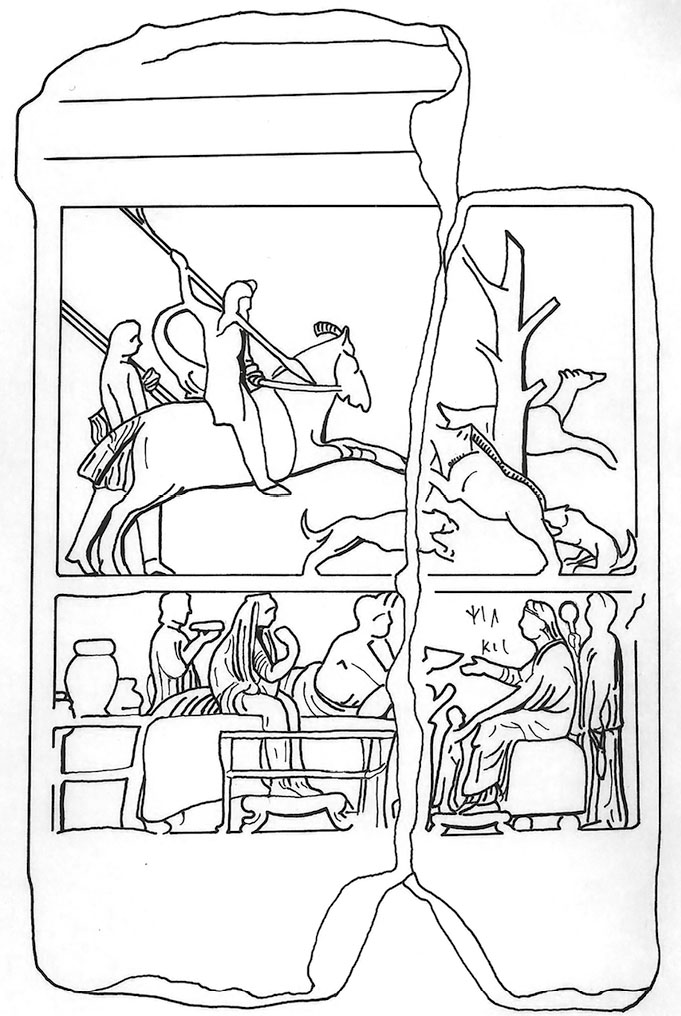
The story of Atys and his death in a boar hunt has been described by commentators as a “novella,” a mini-drama that conforms to the narrative conventions of Greek tragedy, and as such it has been regarded as an embellishment of a local tradition if not an outright invention by Herodotus of a story to heighten his depiction of Croesus as a tragic figure.30 It can be shown, however, that Herodotus’ story of Atys follows a pattern of heroizing elite rulers displayed on funerary monuments in Lydian lands. These monuments of the Achaemenid era typically display a marriage scene and a hunting scene, often a boar hunt, as signs of the status of the deceased (see Figure 1).31 Herodotus’ story of Atys is constructed around exactly these episodes.

Funerary stele from Ҫavuşköy (Daskyleion area). Late fifth–early fourth century BCE. Istanbul Archaeological Museum 1502
Citation: Journal of Ancient Near Eastern Religions 25, 2 (2025) ; 10.1163/15692124-12341355
Herodotus has recast for his own narrative purposes the memorable aspects of the life and death of Atys based on the imagery still to be seen a century after the death of the crown prince. The grave of Atys, prepared “according to custom” Herodotus says, was certainly a monumental tumulus, a symbol, like the great tumulus that Croesus prepared for his father, Alyattes, of the massive scale of mourning devoted to the deceased son of the king.32 The tumulus of Atys has been plausibly identified with the mound known locally as Karnıyarık Tepe, a grand tumulus second in size only to that of Alyattes among the tumuli in the Hermos valley by Sardis.33 The heroic and, as we will see, also sacral status of Atys was almost certainly represented on a stele showing him in two scenes, one as a partner in a marriage ceremony and another as a noble hunter, in the manner displayed on numerous elite funerary stelae starting a generation after the death of Atys.34
Although no such stele from the Lydian period has survived, a near contemporary reference to it can be recognized in a fragment of the poetry of Hipponax of Ephesus. Hipponax remarks on the royal tumuli of the Lydians as conspicuous features along the way through the Hermos valley toward Smyrna.35 Among them he singles out a “stele and monument of Tos” (
5 Atys in Phrygia
Atys the son of Croesus was a historical person. We cannot take most details of Herodotus’ narrative as reliable history, however, since they were plainly derived from the heroic archetype that became a conventional pattern for depicting the elite dead in Lydian lands. Nor can we be sure that he actually died in the course of a boar hunt, since this account was probably an inference from his representation as a hunter on his funerary monument. We can be sure, however, that he celebrated a marriage because he produced a son before his premature death. Pythius, the son of Atys, a Lydian reputed to be “the wealthiest man in the world” after the Persian king, is said by Herodotus to have been host to both Darius and Xerxes in their visits to Lydia.38 His great wealth comports with his likely status as Lydian royalty reduced to Persian vassalage.39 Pythius may have enjoyed his favored status as a loyal vassal of the Persians in part out of respect for the sacral status of his father, Atys, a status that Croesus had done much to create, beginning with the name by which his son was known.
Atys bore a name that had a long legacy in both Lydia and Phrygia. Herodotus reports that an ancestral Atys was the father of Lydus, who gave his name to the Lydians.40 This legendary Atys was also said to be the father of Car, eponym of the Carians, of Mysus, eponym of the Mysians, and of Tyrsenos, eponym of the Tyrsenoi.41 Regardless of the authenticity or distortion of ethnic and linguistic relations among the Anatolian peoples represented in this tradition, it most likely was an account propagated by the Mermnad Lydians, likely by Croesus himself (who had a Carian mother), in order to represent an ancestral unity among the peoples of western Anatolia that he and his father, Alyattes, had brought under Lydian sway.42
Within this ancestry, the connection with Phrygia is especially notable.43 Atys the father of Lydus was said to be the son of Manes, and both Manes and Atys are names with strong connections to Phrygia. Manes, besides being a popular moniker for Phrygian slaves among the Greeks, is widely attested in Phrygia as well as in Lydia and elsewhere in Anatolia.44 The name Atys, with variant forms, both geminated (
At the high point of Lydian power under Alyattes and Croesus, archaeological evidence reveals a strong Lydian presence at Gordion, the former royal citadel of Phrygian King Midas.48 Contemporary with this period of revival and prosperity at Gordion, in the highlands west of Gordion that formed the headwaters of the Sangarius river, a series of monumental rock-cut facades was created to honor the goddess known in Phrygian as Matar.49 The most impressive and famous of these facades is the Yazılıkaya, commonly known as the Midas Monument after the dedicatory inscription above its face. The association of Midas with the Phrygian goddess is reinforced by the names of Midas and Matar inscribed in the monumental niche of the façade, where once a statue of the Phrygian Matar stood. The dedication in the Phrygian language to Midas was made in the name of Ates.50
The Midas Monument was almost certainly created during the reign of Croesus, and the dedicant, Ates, can hardly have been anyone other than his son, Atys.51 The prominence of this Ates at the greatest of the Phrygian facades, and at a site that, like Gordion, preserves clear evidence of an official Lydian presence,52 strongly suggests that this was a monument dedicated by the son of Croesus to the numinous memory of the great Midas, in a shrine of epiphany for the Phrygian Matar, the goddess whom later tradition identified as the mother of Midas.53 The Midas Monument, in other words, should be seen as evidence that Atys, the son of Croesus, was invoking the powers of kingship that had been manifest in the great Midas, who is called lawagetas, “leader of the host,” and vanakt(s) “lord” in Ates’ inscription. By doing this, Ates (Atys the Lydian) was also associating himself with the great goddess of Phrygia, the divinity who had endowed the great Midas with a memorable kingship.54
Elements of this association of Attis with Midas and the conflation of his Lydian and Phrygian identity are clearly present in the later Hellenistic accounts of Attis, the beloved of Cybele, or the Mother of the Gods.55 Already within Herodotus’ story, the close connection between Atys and the legacy of Phrygian royalty is attested. Atys in Herodotus’ story met his fate accidentally by the hand of a Phrygian of royal ancestry, Adrastus son of Gordias and grandson of Midas (a later bearer of the famous dynastic name).56 Adrastus had been assigned by Croesus to be the protector of his son, and the implication of this association between the son of Croesus and the house of Midas is consonant with the evidence of the Midas Monument. In Herodotus’ telling, Croesus welcomed Adrastus when he came as a suppliant to Sardis, saying, “All of your family are friends to us, and you have arrived among friends.”57 Adrastus in this story had come to Sardis as an exile, having killed his brother, and he was granted a ritual purification by Croesus, which Herodotus notes was similar to the customs of purification observed by the Greeks.58 That Atys met his fate at the hand of this Phrygian, Adrastus, may be an embellishment of the story by Herodotus or his source, but the Phrygian connection has plausibility. Herodotus is quite specific about the ritual that invoked the highest divine power, that of Zeus, to sanction the bond between the Phrygian and the household of Croesus, and so it is not improbable that within the testimony gathered by Herodotus was the memory of the performance of a ceremonial union between these royal lines. The Midas Monument would be a plausible setting for such a ceremony. Herodotus’ telling of story highlights the irony of the fact that Adrastus, a Phrygian of royal descent, was the one who brought Atys to his fated end despite all of the elaborate ritual measures taken by Croesus to integrate the Phrygian into his household and to charge him with protecting his favored son. Irony would be thematic in the memory of Atys even outside of Herodotus’ telling, given the prominence of the measures taken by Croesus to invest his son and heir in the legacy of the great Phrygian king, Midas.
6 The Sacred Marriage of Atys
In Herodotus’ account, Atys was involved in a marriage ceremony that lasted for several days. As described above, this element of Herodotus’ story derives from the depiction of a wedding on the funerary monument of Atys, the representation of a symbolic union that became an archetypal image on heroizing funerary monuments in the generations immediately after Atys’ lifetime. Royalty implied a sacral status, as Archilochus indicates when he refers to the Lydian tyrant’s involvement with the “doings of gods.”59 As an essential feature of royal legitimacy, the achievement of sacral standing had to become known, and this was represented by the ceremony and imagery indicating that the king, or king-to-be, was the object of the erotic affections of a goddess of sovereign power. His marriage, in other words, bound him to a woman who represented this goddess, and who was therefore invariably praised for her incomparable beauty. Among Near Eastern kingdoms of the first millennium we find this ideological relationship represented both in prophetic rhetoric and ritual practice.60 The divine protector and mother of kings in Assyria was Ishtar, often invoked in one of her many local hypostases, such as Mullissu or Tašmetu.61 In Lydia she was Kybebe (Lydian Kuvav-), whom Herodotus identifies as “a local goddess” at Sardis, and whom the Greeks knew as Aphrodite among the Phrygians and Lydians.62 The love of this goddess for her mortal consort represented kingship itself, a metaphorical relationship that is amply attested in the stories of the kings of Lydia related by Greek sources.
The royal citadel at Sardis was founded by King Meles, who carried a lion around the circuit of its walls, as Herodotus tells the tale. The lion, he notes, was borne to him by his unnamed concubine (
These storied examples of a woman, usually considered to be supremely beautiful, who enabled her consort (or in the case of Xenophon’s Cyrus, the man who revered and respected her great beauty) to become king at Sardis certainly reflect the underlying ritual pretense that the bride of the king, or king-to-be, embodied the powers of the goddess of love and kingship. In other words, she was an avatar of Ishtar, whose hypostasis at Sardis was Kybebe, a goddess known to the Greeks as the name given by Lydians and Phrygians to Aphrodite.71 To the Greeks of Ionia, neighbors and subjects of the Lydians, Aphrodite was known to be both a lover and a mother of princes, Anchises and Aeneas, reflecting her role in the ideology of Lydian monarchy.72 The ritualized association of Atys, the Lydian prince, with both the Lydian Kybebe through his bride, and with the Phrygian Matar in her cult monument, reveals that both of these ethnic types of a goddess of power could be considered aspects of what the Greeks would describe as Aphrodite among Lydians and Phrygians. This reveals the essential identity of Lydian Kybebe with the goddess who came to be known as Cybele.73 To Lydians and to Phrygians in Croesus’ time, Atys was her newest darling.
7 The Funeral of Atys
Croesus was known for sponsoring elaborate funerals, most notably that of his father, Alyattes, whose tumulus is described by Herodotus as “the greatest construction after those of the Egyptians and Babylonians.”74 The probable tumulus of Atys, his favorite son and heir apparent, is second only to the tumulus of Alyattes in size, and must also have been the focus of massed devotions on the occasion of his funeral.75 The scale and duration of mourning for Atys is suggested also by the fact that, as Herodotus reports, Croesus “sat for two years in deep grief” (
Croesus’ period of mourning is to be understood as more than a sign of his private grief. Conspicuous enough to be remembered more than a century later, mourning for Atys must have been a very public affair.77 It may have been enacted ceremonially at court by professional mourners, like the GALA priests of Mesopotamia, but it also surely involved massed events in which the populace was expected to participate. Herodotus reveals the magnitude of funerals for kings in Anatolia when he compares them to the funeral customs observed for kings of Sparta:
Besides these public marks of distinction during his lifetime, special ceremonies are also observed upon a king’s death. News of the death is carried by riders all over Laconia, and in the city women go the rounds beating cauldrons. This is the signal for two people, one man and one woman, from every free household to disfigure their appearance – which they are compelled to do under penalty of a heavy fine. There is a custom observed by the Lacedaemonians on the occasion of a king’s death which is the same as that observed by the barbarians in Asia; for the majority of the barbarians practice the same custom when their kings die, and that is, when a king of the Lacedaemonians dies, not only Spartans but a certain number of the country people from all over Lacedaemon are forced to attend the funeral. A huge crowd assembles, consisting of many thousands of people – Spartan citizens, country folk, and helots – and men and women together strike their foreheads with every sign of grief, wailing as if they could never stop and continually declaring that the king who has just died was the best they ever had.78
The customs of the “barbarians of Asia” described here are the customs that were observed on the occasions memorialized on the funerary stelae described above, which were common in northwestern Anatolia in Herodotus’ day. They represent the custom of ritualized lamentation that must have been most memorably instituted on the occasion of the death of Croesus’ son.79
In Herodotus’ account, Croesus’ period of mourning was followed by the most extravagant of sacrifices attested in antiquity. The gold that Croesus sent to Delphi has attracted most attention from commentators, ancient and modern.80 More significant here is Herodotus’ report of the wealth consumed in a massive pyre at Sardis: “He sacrificed three thousand of every kind of sacrificial animal; he heaped up a huge pyre and burned couches inlaid with gold and silver, golden cups, and purple cloaks and tunics … and he commanded every Lydian to add to this sacrifice all that they could.”81 Although this pyre sacrifice has not been recognized as funerary in nature, it is characteristic of destructive funerary sacrifices and should be understood as part of the continued ritual response of Croesus to the loss of his son, his most valuable possession.82 Herodotus describes this as Croesus’ effort to win the favor of the god of Delphi, but Apollo at Delphi was not necessarily the only god who might respond to this massive sacrifice at Sardis. The consumption of an enormous quantity of luxury goods, including the golden offerings sent to Delphi, was a gesture of abnegation of all good things with the expectation that divinity, soothed by the display of sympathetic grief, would grant compensation. Gold and silver, among the precious items consigned to the pyre, were not consumed by the fire as the perishable items were. In order that these precious metals might truly be sacrificed, they would have to be sent so far away that Croesus and the Lydians could have no use of them.
While these dedications at distant shrines will have served to impress the Greeks with the wealth of Croesus and his kingdom, at Sardis these actions demonstrated to the gods how the whole land of the Lydians was stricken by the loss of their crown prince, and that they were supplicating the gods, and in particular the divine lover of the deceased prince, to make amends and to restore well-being to the royal family and to the land. In Phrygia, where we can understand that the devotion of Atys to the Phrygian goddess had been celebrated at the rural shrines of the Phrygian highlands, it is likely that these same shrines were now the setting for ritual lamentations. As it had been the aim of Croesus to identify his son as the destined darling of the great goddess of Phrygia, we should expect that all of her rustic shrines became the settings for sympathetic grieving.
8 Lamentations for Atys
In death, Atys, the Lydian prince, became the object of the sort of ritual lamentations that, by long-held custom, had been widely observed in the name of a dying lover/beloved of a great goddess. He became part of the paradigm represented in Mesopotamia by Dumuzi, a legendary king who was also remembered as a legendary shepherd and devoted servant of the deity, and a youth whose beauty inspired the passion of the goddess. Within the lands ruled by the Lydians this paradigm is represented by Anchises the Dardanid, also a herdsman, the lover of Aphrodite, and by her the father of Aeneas, who was destined to be “lord of the Trojans” according to the prophecy of Aphrodite in the Homeric Hymn.83 Paris, prince of Troy, again a herdsman and favorite of Aphrodite, is another instance of this paradigm. In Phoenicia and neighboring Cyprus and beyond, the beautiful and much-lamented Adonis played this role. His name was actually a title, “Lord,” suitable for addressing royalty. This was the title by which deceased Israelite kings were invoked in funerary lamentations. In the prophesy of Jeremiah for King Zedekiah, the king taken into captivity by Nebuchadnezzar (a contemporary of Alyattes), his funeral is described:
They will kindle funeral fires in your honor like the fires kindled in former times for the kings, your ancestors, who preceded you. ‘Alas, my lord!’ (hôy adôn) they will say as they beat their breast in mourning for you.84
Within the realm of Lydia, roughly contemporary with this passage from Jeremiah, lamentation in the name of Adonis is attested in the poetry of Sappho, where the goddess Kytherea (Aphrodite) is addressed:
The context for this fragment of Sappho is unknown. It might have referred to the death of a nobleman of Lesbos, or possibly of Lydia,86 but it could just as well have been composed on the occasion of one of the seasonal rituals of lamentation attested in Babylonia, Israel, Phoenicia, Greece, and Egypt.87 Mourning for Adonis in sympathetic consolation for Kybebe was known in Lydia of Croesus’ day, as the context of an iambic fragment of Callimachus indicates:
Such lamentations, shrieks of grief, beating of breasts, rending of garments, and “striking foreheads with every sign of grief, wailing as if they could never stop,” were customary acts both at actual royal funerals and in rituals of reverence to heroes of the “dying lover of the goddess” type. These outpourings of emotion were demonstrations of orgē, actions that Greek sources refer to as orgia, orgiastika, or orgiasmoi. These induced states of excitement were regularly associated in Greek sources with the music of the Phrygian aulos, as Callimachus attests.89 But such orgiastic rites and their music were not uniquely Phrygian. Musically induced laments in women’s voices were as old as the royal funerals of Sumerian kings.90 The custom of appealing to the gods in a feminized emesal voice of lamentation is attested in Mesopotamia over a period of two millennia. Incantations and lamentations in emesal voice and with musical accompaniment were deemed essential to maintaining the favorable disposition of the gods, and of Ishtar in particular. As a result, within the hierarchy of functionaries serving the cultic needs of temples, palaces, and the public at large, the practices of supplication and lamentation popularly attributed to women became the professional domain of a specialized class of gender-ambiguous cult officiants, the GALA (Akkadian kalû) priests, and related performers, the assinnu and kurgarrû.91 We have no direct testimony to the presence of such a class of cult performers in Lydia, but indirect evidence suggests that this likely was the case. Eunuchs certainly were a feature of the Lydian court, as they were in all Near Eastern kingdoms, where they were sometimes identified as cult officiants.92 In the period of Achaemenid Persian rule, a eunuch was said to be the high priest of Artemis at her temple at Ephesus, a temple embellished through the endowment of Croesus.93 Eunuchs as mourners in Lydia are a feature of Xenophon’s tale of the beautiful Pantheia and her heroic husband, who died and were buried at Sardis in the time of Croesus.94
From this abundance of comparative evidence, and more specifically from the testimony of Sappho, Herodotus, Xenophon, and Callimachus, we can reasonably assume that orgiastic lamentations were customary in Lydia both in seasonal rites of supplication to a great goddess, Kybebe among the Lydians identified as Aphrodite among their Ionian subjects, and for royal funerals, when the deceased would be assimilated to the role of the lamented Adonis of the goddess. In the burial rites for Atys and over the two years of mourning for him observed by Croesus, Atys took on the role of the paramount darling of the goddess. The intensity of Croesus’ grief over his loss, expressed in formalized lamentations by cultic officiants, likely eunuchs of the Lydian court, and especially through the obligatory mourning expected of all of his subjects (Croesus “commanded every Lydian to add to this sacrifice all that they could”), the very real death of a prince who had been the consort of the goddess’ avatar became the new paradigm throughout the lands of the Lydian dominion for lamentations to console the goddess over her loss.
9 The Ritual Role of the Beloved Hero
Outside of Herodotus’ tragic tale, Atys the son of Croesus disappears from our sources. His type, the dying hero who has consummated a sacred marriage, appears on funerary stelae of Anatolian nobility from the turn of the sixth to fifth centuries and into the fourth; but these are all different individuals, sometimes named in inscriptions in Aramaic, Phrygian, and Lydian, who are honored by monuments patterned after the Lydian prototype. These exemplify the “kings … of the barbarians of Asia” whose funerals were so impressive, according to Herodotus. Attis, the paramour of Cybele (or the Mother of the Gods or Agdistis, among her many other names), does not appear in our sources until the fourth century, by which time his origin as a Lydian prince has metamorphosed into the generic darling of the goddess, represented (like Dumuzi, Adonis, Anchises, and Paris) as a handsome herdsman or huntsman, a native child of the land presided over by the goddess.
In the interval of nearly two centuries between the funeral of Atys and the appearance of his name, Attis, in the Greek literary tradition and votive iconography,95 we can confidently surmise that Atys/Attis became an instrumental figure in arcane ritual texts prescribing the supplication of a great goddess, specifically Cybele, the Phrygian Mother of the Gods, as the dying mortal who maintained even in death the sympathetic affections of the goddess.
The existence of such texts and their circulation through the Greek world is well attested. They are most famously described in a passage from Plato’s Republic, where, Plato’s brother Adeimantus (the setting is late-fifth century) scoffs at the fatuous belief that misfortune could be averted by the “sacrifices and spells” (
We learn of Attis’ role in the texts circulating with these begging priests by virtue of the fascination of poets and mythographers of the later fourth century for esoteric lore and etiological stories which they could discover in such arcane ritual texts.99 Some wrote to record the origins of rites and sacrifices, in a manner analogous to the Atthidographers who collected accounts of local Attic traditions, and some wrote to illustrate the varieties of love for poetic purposes. We learn from Harpocration that the Peri Teletōn (“On Initiation Rites”) by Neanthes of Cyzicus (ca. 300 BCE) presented a mystikos logos that described Attis among the Phrygians attached to the Mother of the Gods as her attendant (
The most significant testimony to the place of Attis in the sort of initiation rites attested by Neanthes and alluded to by Plato is found in Demosthenes’ speech On the Crown, delivered in 330 BCE but describing events of a generation earlier.102 In the speech Demosthenes derides his opponent, Aeschines, for the menial occupations of his childhood and youth, which included serving as an acolyte for his mother in the ritual initiations (teletai) that she performed. Upon entering adolescence, Demosthenes says, it was Aeschines’ practice to assist his mother in conducting night-time initiations that involved reading from texts (
Demosthenes is here mocking Aeschines and his ritual shouts in a foreign language, which were probably words prescribed in the sacred text that Aeschines was reading. He is also mocking Aeschines by mimicking his effeminate role in this ritual, referring to his ululations and ritual cries and their sympathetic reception by old women. Demosthenes does not dignify the deities involved by naming them, but as his audience would know, and as later commentators report, these were cries in honor of Sabazius, a Phrygian equivalent of Dionysus, and Attis, the companion of the Mother of the Gods.104 The shouts of “
This ritual of initiation, based on texts of the sort that Plato describes, has a general resemblance to the practices described in a set of Akkadian incantation and exorcism texts surviving from the library of Ashurbanipal, attested also in Neo-Babylonian fragments, prescribing rituals for addressing Ishtar and Dumuzi in order to expel ills and malaise of all sorts. These incantation texts represent a long tradition of learning and practice in ritual and cultic matters, examples of the body of cuneiform literature that remained accessible until well into the Hellenistic era. Allowing for the cultic formulas and titularies specific to their Mesopotamian context, they illustrate the general purpose and mode of operation of the “begging priests and seers” with their “chattering mass of books” who offered their services to those in need in Athens, and certainly more widely in the Greek world, in the fifth and fourth centuries. And they illustrate well the essential role played by the dead lover of the goddess in summoning her to heal the afflicted.
The Akkadian incantation texts indicate that the most efficacious time for conducting these rites would be “in the month of Tammuz (Du’ūzi), when Ishtar makes the people of the land weep for Dumuzi, her lover.”105 The preamble to the rituals describes the symptoms it can treat: “In case someone has been seized by the ‘hand of a spirit of the dead’ (qāt eṭemmi), epilepsy (bennu) has afflicted him, [falling] sickness (miqit šamê) has seized him, a Sagḥulḥāza demon has seized him …” (a series of malevolent demons follows, after which the text goes on to specify):
madness has seized him, he suffers from chills, outbursts of rage, anger, resentment from god and goddess is detected in him, his ears are ringing, he has fits of disturbance, he forgets the word he speaks, always talks to himself, is fickle, cannot make up his mind on anything, constantly changes his mind, he suffers losses always and everywhere, terror overcomes him at night, oppressive silence all day long, discord awaits him at home, strife on the street, and he is a burden to those who meet him, he is under the curse of many, and before a goddess (or Ishtar?) he engages in vile thoughts: as for this man, the wrath of the goddess rests upon him. To relieve him and prevent his fears from befalling him, and to remove these illnesses from his body [do the following …].106
In the extensive ritual prescriptions that follow, there are preparations of appealing food, drink, and incense offerings for Ishtar, all to be accompanied by an assinnu singer, a sinnatu instrument, a flute (embūbu), and “whirling dances” (gūšātu).107 There are repeated instructions to chant praises and appeals to Ishtar, and prayers that she may be mollified:
Ishtar, Queen, Great Lady! May Heaven and the Watery Deep acclaim you! May Anu and Ea greet your great divinity! May the gods of heaven and earth contribute to the peace of your heart! … Ishtar, Mistress of Heaven and Earth! May Heaven and Earth cheer you; may the gods who dwell in temples and watery depths gladden your heart!108
The goal of soothing the grieving goddess in order to gain her beneficent favor is clear.109
A prominent feature of the ritual is the slaughtering and skinning of a choice young goat, the preparation of various poultices applied to the goat skin, and the application of the goat skin to the ailing person with the prayers: “Let him be wrapped in the skin of a kid who has not mated. … Wherever it (the skin) is placed, may it cure the illness of (the sick person’s) body and bring prosperity.”110 The generic curative properties of this animal skin may parallel the use of the fawn skins in the ritual described by Demosthenes.
There are repeated prayers to Ishtar to drive away the afflicting demons, but significant also are the appeals to Dumuzi. These parallel the invocation of Attis in rites that center on appeasing the grief of the goddess over the death of her lover:
He shall recite this three times before Ishtar:
“You are Ishtar, whose lover is Dumuzi, the brave daughter of Sîn, who roams the fields, who loves the shelters, who loves all people, you are! … Intercede for me with Dumuzi, your lover. Dumuzi, your lover, carry away my hardship!”
He should recite this three times before Dumuzi.
“Dumuzi, Lord, Shepherd of Anu, son of Ea you are! Lover of Queen Ishtar, leader of the land, who is dressed in a kusītu garment, carrying a staff, lord of the fold … I, NN, son of NN, whose god is NN, whose goddess is NN, am turning to you here for help. The evil ‘watcher’ (lemnu ḥa’āṭu) who promotes evil, who clings to me and continually pursues me maliciously, the evil ‘watcher’ who promotes evil, or what is in me, hand him over to the mighty HUMba (Humbaba?), the gallû-demon who shows no mercy, may he be separated from me, but instead give me my life (again). Tear him out of my body and lead him away with you!”111
Here we gain insight into the paradox that these rituals are devoted to soothing the grief of the goddess over the death of her lover, while at the same time assuming that these outpourings of sympathetic lamentation are able to summon the dead hero up from the underworld. The efficacy of the ritual is premised on the gratitude of the goddess as she and her deceased mortal lover are thus reunited, at least for the duration of the ritual. The ritual concludes with prayers to the hero that he should act for the benefit of his petitioners, a prayer that assumes that he has powers over the demons of the underworld (“Tear him out of my body and lead him away with you!”). The potency of Dumuzi, himself a denizen of the underworld, derives from the intensity of Ishtar’s affection for him and from the fact that the afflicting demons are themselves creatures of the underworld who should now depart with Dumuzi and return to the underworld.
We find exactly this premise underlying the celebration of the Adonia festival in Ptolemaic Egypt, according to the lamentation hymn (
Dear Adonis, you are the one and only hero, so they say, who visits both Acheron and the world here above. Neither Agamemnon nor mighty Ajax, the wrathful hero, achieved this, … Look on us with favor next year too, dear Adonis. Now we have received you joyfully, Adonis, and you will be dear to us when you come again.112
Just as “when Ishtar makes the people of the land weep for Dumuzi” in annual rites across Mesopotamia, the aim of this public festival of Adonis was to renew the benevolence of the goddess for the benefit of the whole community. The exorcism incantations in the Akkadian text described here were to serve the same purpose on a personal level, in response to any of a wide variety of psychosomatic ailments. Such incantations were surely the pattern represented in the books that were the basis of recitations by young Aeschines, according to Demosthenes, just as they made up the contents of the books of alleged ancient authority carried around by the begging priests, as Plato recounts.113 Euripides alludes to a general awareness of this power of the goddess over mental states in his Hippolytus, where his chorus wonders if Pan, or Hecate, or the Mountain Mother (a common title for the Mother of the Gods, or Cybele) might be the source of the mental torment that wastes Phaedra.114 The best-known critique of ritualized responses to mental and psychosomatic disorders is the Hippocratic On the Sacred Disease, which aimed to disabuse the popular notion that they were caused by divinities such as the Mother of the Gods.115 Notably, the so-called “sacred disease” was epilepsy, seen as a sign of demonic possession, and it appears at the head of the list of afflictions that the Akkadian incantation aims to cure.
The power to make things well, to do away with the bad and lead to the good, resides in the erotic affection of the goddess for her lost lover, according to these spells. The intensity of that affection was measured by the depth of grief felt by the goddess at the death of her beloved. Her grief was invoked through sympathetic rituals for the purpose of directing her powers, and the potency of her beloved one as an animate spirit of the underworld, to drive away malevolent spirits.116
To those who were acquainted with this ritual formula, the power of love between Attis and his divine lover was famous. A century earlier than the attestation of this love story in the poetry of Neanthes we find a reference to Attis’ role as the object of erotic affection in a fragment from the comic poet, Theopompus, a younger contemporary of Aristophanes, in his play The Shopgirls, where one of his characters says: “You’ll get yours, and your Attis too!”117 Apparently, someone is threatening a woman and her boy-love, calling him her “Attis.” This offhand remark would only make sense to audiences of the early fourth century if “Attis” was well known as an archetype of a boyfriend, and its comedic bite would be all the stronger knowing the fate that lay in store for such an Attis.
10 From Atys to Attis
Attis’ role as an accessory in personal and private healing rituals was his entrée into Greek cult.118 The stories of Attis and Cybele, or the Mother of the Gods, that come down to us in later authors entered the literary tradition as commentaries on such ritual texts.119 Certain features of the later Hellenistic and Roman foundation myths for the cult of Attis and the Mother must also have come from the indigenous settings of rites for the Phrygian Mother and Lydian Atys. It is highly probable that older Anatolian theogonic myths entered the aetiological tradition of Attis and the Mother as a result of the emergence of Pessinus as their most prominent Phrygian cult center, a novel development under the Attalids in the late third or early second century BCE.120 These local legends tell of the birth of the Mother herself as the spawn of Zeus born from a rock, and that she, as Agdistis (named for the rock Agdus), was originally bisexual and that castration eventually fixed her gender as female.121 These narrative features, ill-suiting the Greek perspective that consistently identified the Phrygian Mother of the Gods as the mother of Zeus (often identifying her as Rhea), have been rightly supposed to reflect themes attested in older Hittite and Hurrian myths.122 Likewise, the accounts that Attis was either born from or mated with a tree nymph, daughter of the river Sangarius, most likely evolved from local traditions that sought to represent Attis as a native son of the land, possibly a reflection of the historical Atys’ devotions to the Phrygian Mother in the highlands at the headwaters of the Sangarius River.123
The most notable accretion to the story of Attis is the sensational aspect that his death was the result of self-castration, and the further notion that this act of self-mutilation was regularly imitated as a sign of devotion by the eunuch priests of Cybele and Attis, the galloi.124 It has been widely assumed that this was an ancient feature of the Phrygian cult of Attis, but no trace of ritual self-castration has ever been identified in Phrygian or in broader Anatolian antiquity. Among funerary monuments of historical galloi, not one ever recorded castration as a mark of sacramental status, as devotees otherwise did record participation in the taurobolium.125 This aspect of the myth and cult of Attis arose from the prominence of the galloi priests and cult attendants of Attis and the Mother, many of whom made displays of self-flagellation and self-mutilation in their demonstrative lamentations, and some of whom at least were castrated eunuchs as a consequence of their servile status.126 Their prominence is certainly due to the fact that, from its origin in the funerary rites for Atys the son of Croesus, eunuchs and effeminate mourners such as the kalû, assinnu, and kurgarrû of Mesopotamia, whether they were eunuchs or not, were a conspicuous and even essential feature in rituals of lamentation. By the point in time at which we can recognize an official, royal endorsement of the cult of Cybele and Attis, under the Pergamene kingdom, eunuchs must have taken the leading role as ministers of the cult both because they were well-versed in the ritual formalities of honoring this divine couple in the traditional manner, and because they formed a privileged and specialized class of servants in the households of Hellenistic monarchs, just as they always had among the kingdoms of Asia.127
An ungendered status was not, in origin, a quality of Attis himself. But his ability to move between this world and the next likened him to his eunuch attendants to such an extent that their castrated status came to be projected on him. The imagined scenario of the goddess and her lover, like Ishtar and Dumuzi, somehow reuniting with each other when they were summoned by their devotees, involved crossing the boundary between this world and the underworld. In the mythology of Ishtar and her descent into the underworld, the only creatures capable of crossing that boundary with her were her gender-ambiguous cultic attendants, the GALA/kalû, KUR.GAR.RA/kurgarrû, and assinnu, by virtue of the fact that they were neither man nor woman.128 And so eunuchs or transgendered ritual performers in that role, the galloi of Cybele’s Hellenistic and Roman cult, were uniquely qualified to minister in the annual summoning of the dead Attis from the underworld.129
In the Akkadian rituals and in the Ptolemaic Adonia, the beloved one returns to the underworld gratified by the devotions that he and his divine lover have received, and so bearing goodwill for all mankind in the year ahead. This was certainly the scenario for Attis and his lover, Cybele, in their annual rites of lamentation and celebration, as the myths explicitly state that Attis would not be brought back to life in this world. Attis thus remained a hero of the underworld, but through Cybele’s love he retained an exceptional potency to influence the world above, like other great dying heroes (Asclepius, Teiresias, and Amphiaraus among them). Those who celebrated this erotic bond with so much orgē could expect to receive the continued benefits of his and the goddess’ favor.
11 Conclusion
The fervor of lament, praise, and celebration of this archetypal relationship between a goddess and her mortal darling expressed both the anxiety over, and the hope for, sustaining the favor of the powerful goddess. The social context in which this pattern of worship became formal and institutional was kingship, focusing especially on the anxious moments when the death of a king threatened to disrupt a harmonious relationship between humanity and divinity. The memory of kings, the paramount objects of divine affection in their lifetimes, lived on after them and deserved commemoration in what became annual rites, as “when Ishtar makes the people of the land weep for Dumuzi,” so that the affections of the goddess and their benefits for all should not fade away. And so such kings became heroized archetypes. Atys, the Lydian son of Croesus, devotee of the Phrygian Mother and Lydian Kybebe, was one of the most memorable of them.
Acknowledgements
Major classical authors cited in this article can be consulted in Greek or Latin with translations in the Loeb Classical Library (www.loebclassics.com), or in Greek through the Thesaurus Linguae Graecae (stephanus.tlg.uci.edu). Fragmentary Greek historical authors (FGrHist) can be consulted in Greek through Brill’s New Jacoby (brill.com/bnjo). For classical abbreviations see the Oxford Classical Dictionary (oxfordre.com.classics/page/ocdabbreviations). For Assyriological abbreviations see the Reallexikon der Assyriologie (rla.badw.de). I am grateful to my colleague, Gonzalo Rubio, for advice on Assyriological matters.
Bibliography
Alster, B. 1999. “Tammuz,” DDD, 828–834.
Alvar, J. E. 2001. Los misterios: Religiones ‘orientales’ en el Imperio Romano: Editorial Crítica. Barcelona.
Asheri, D., et al. editors. 2007. A Commentary on Herodotus Books I–IV. Oxford.
Assmann, J. 1999. “Isis,” DDD, 456–458.
Avaram, A. 2019. “Phrygian Personal Names in Phrygian Inscriptions,” in Tsetskhladze 2019a, 305–349.
Bachvarova, M. R. 2008. “Sumerian Gala Priests and Eastern Mediterranean Returning Gods: Tragic Lamentation in Cross-Cultural Perspective,” in Lament: Studies in the Ancient Mediterranean and Beyond, ed. A. Suter. Oxford, 18–52.
Bachvarova, M. R. 2013. “Adapting Mesopotamian Myth in Hurro-Hittite Rituals at Hattuša: IŠTAR, the Underworld, and Legendary Kings,” in Beyond Hatti: A Tribute to Gary Beckman, ed. B. J. Collins and P. Michalowski. Atlanta, 23–44.
Bachvarova, M. R. 2016. From Hittite to Homer: The Anatolian Background of Ancient Greek Epic. Cambridge.
Bachvarova, M. R. 2019. “Survival of ‘Popular’ Mythology from Hittite Mountain Man to Phrygian Mountain Mother,” in Blakely and Collins 2019, 203–229.
Baldriga, R. 1997. “Aspetti ideologici della presenze frigia nella tradizione greca sul regno di Lidia,” in Frigi e frigio: atti del 1o. Simposio Internazionale, Roma, 16–17 ottobre 1995, ed. R. Gusmani, M. Salvini, and P. Vannicelli. Rome, 279–285.
Beaulieu, P.-A. 1989. The Reign of Nabonidus King of Babylon 556–539 B.C. YNER 10. New Haven.
Beckman, G. 1998. “Ištar of Nineveh Reconsidered,” JCS 50: 1–10.
Beckman, G. 2019. “Mesopotamians and Mesopotamian Learning at Hattusa, Thirty Years On,” in Over the Mountains and Far Away: Studies in Near Eastern History and Archaeology Presented to Mirjo Salvini on the Occasion of His 80th Birthday, ed. P. S. Avetisyan, R. Dan, and Y. H. Grekyan. Oxford, 65–70.
Berndt-Ersöz, S. 2006a. Phrygian Rock-Cut Shrines: Structure, Function and Cult Practice. Leiden.
Berndt-Ersöz, S. 2006b. “The Anatolian Origin of Attis,” in Pluralismus und Wandel in den Religionen im vorhellenistischen Anatolien, ed. M. Hutter and S. Hutter-Braunsar. Münster, 9–39.
Berndt-Ersöz, S. 2008. “The Chronology and Historical Context of Midas,” Historia 57: 1–37.
Blakely, S., and B. J. Collins, eds. 2019. Religious Convergence in the Ancient Mediterranean. Atlanta.
Boardman, J. 1970. “Pyramidal Stamp Seals in the Persian Empire,” Iran 8: 19–45.
Bøgh, B. S. 2009. Mother of the Gods: The Reception and Transformation of an Anatolian Goddess in the Western Blacks Sea Area. Aarhus.
Borgeaud, P. 1996. La Mère des dieux: De Cybele à la Vierge Marie. Paris.
Bremmer, J. N. 2004. “Attis: A Greek God in Anatolian Pessinous and Catullan Rome,” Mnemosyne 57: 534–573.
Bremmer, J. N. 2008a. “Attis: A Greek God in Anatolian Pessinous and Catullan Rome,” in Greek Religion and Culture, the Bible and the Ancient Near East, ed. G. Strousma and D. Shulman. JSRC 8. Leiden, 269–302.
Bremmer, J. N. 2008b. “Priestly Personnel of the Ephesian Artemision: Anatolian, Persian, Greek, and Roman Aspects,” in Practitioners of the Divine: Greek Priests and Religious Official from Homer to Heliodorus, ed. B. Dignas and K. Trampedach, Washington, 62–90.
Bremmer, J. N. 2020. “Kubaba, Kybele and Mater Magna: The Long March of Two Anatolian Goddesses to Rome,” in Der Kult der Meter/Kybele in Westanatolien und in der Ägäis, Akten des internationalen Symposions an der Österreichischen Akademie der Wissenschaften am 24. Oktober 2017, ed. M. Kerschner. Vienna, 13–32.
Brisch, N., ed. 2008. Religion and Power: Divine Kingship in the Ancient World and Beyond. OIS 4. Chicago.
Brixhe, C. 1979. “Le nom de Cybèle,” Die Sprache 25: 40–45.
Brixhe, C. 2004. “Corpus des inscriptions paléo-phrygiennes Supplément II,” Kadmos 43: 1–130.
Brixhe, C., and M. Lejeune. 1984. Corpus des inscriptions paléo-phrygiennes. 2 vols. Paris.
Bryce, T. 1998. The Kingdom of the Hittites. Oxford.
Buck, C. D. 1928. The Greek Dialects. Chicago.
Burkert, W. 1979. Structure and History in Greek Mythology and Ritual. SCLec 47. Berkeley.
Burkert, W. 1985. Greek Religion. Cambridge.
Burkert, W. 1987. Ancient Mystery Cults. Cambridge.
Burkert, W. 1992. The Orientalizing Revolution: Near Eastern Influence on Greek Culture in the Early Archaic Age. Cambridge.
Burkert, W. 1995. “Lydia between East and West, or How to Date the Trojan War: A Study in Herodotus,” in The Ages of Homer: A Tribute to Emily Townsend Vermeule, ed. J. B. Carter and S. P. Morris. Austin, 139–148.
Chiasson, C. 2003. “Herodotus’ Use of Attic Tragedy in the Lydian Logos,” Classical Antiquity 22: 5–35.
Cohen, M. E. 1981. Sumerian Hymnology: The Eršemma. HUCA Supp. 2. Cincinnati.
Cohen, M. E. 1988. The Canonical Lamentations of Ancient Mesopotamia. Potomac.
Cole, S. W. 1994. “The Crimes and Sacrileges of Nabû-šuma-iškun,” ZA 84: 220–252.
Cole, S. W., and P. Machinist. 1998. Letters from Priests to the Kings Esarhaddon and Assurbanipal. SAA 13. Helsinki.
Collins, B. J. 2019. “The Arzawa Rituals and Religious Production in Hattusa,” in Blakely and Collins 2019, 191–201.
Collins, B. J., M. R. Bachvarova, and I. Rutherford, eds. 2008. Anatolian Interfaces: Hittites, Greeks and Their Neighbors: Proceedings of an International Conference on Cross-Cultural Interaction, September 17–19, 2004, Carlos Museum, Emory University. Oxford.
Cooper, J. S. 1993. “Sacred Marriage and Popular Cult in Early Mesopotamia,” in Official Cult and Popular Religion in the Ancient Near East: Papers of the First Colloquium on the Ancient Near East – The City and its Life, held at the Middle East Culture Center in Japan (Mitaka – Tokyo) March 20–22, 1992, ed. E. Matsushima. Heidelberg, 81–96.
Cooper, J. S. 2008. “Divine Kingship in Mesopotamia, a Fleeting Phenomenon,” in Brisch 2008, 261–265.
Cosi, D. M. 1986. Casta Mater Idaea: Giuliano l’Apostata e l’etica della sessualità. Venice.
Coşkun, A. 2019. “The ‘Temple State’ of Phrygian Pessinus in the Context of Seleucid, Attalid, Galatian and Roman Hegemonic Politics (3rd–1st Centuries BC),” in Tsetskhladze 2019a, 607–648.
Crouch, C. L. 2013. “Ištar and the Motif of the Cosmological Warrior: Assurbanipal’s Adaptation of the Enuma Elish,” in Gordon and Barstad 2013, 129–141.
Cumont, F. 1929. Les religions orientale dans le paganism romain. Leroux.
Dale, A. 2013. “Hipponax fr. 42 IEG2 = 7 Degani,” ZPE 187: 49–51.
Dale, A. 2021. “Gyges and Delphi: Herodotus 1.14,” CQ 70: 518–521.
D’Andria, F. 2019. “The Cult of Cybele at Hierapolis,” in Tsetskhladze 2019a, 479–500.
Degani, E. 1983. Hipponactis Testamonia et Fragmenta. Leipzig.
Deller, K. 1999. “The Assyrian Eunuchs and Their Predecessors,” in Priests and Officials in the Ancient Near East: Papers of the Second Colloquium on the Ancient Near East – the City and its Life, held at the Middle Eastern Cultural Center in Japan (Mitakam Tokyo), March 22–24, 1996, ed. K. Watanabe. Heidelberg, 303–311.
DeVries, K. 1988. “Gordion and Phrygia in the Sixth Century B.C.” Source, Notes in the History of Art 7, 51–59.
Diakonoff, I. M. 1977. “On Cybele and Attis in Phrygia and Lydia,” Acta Ant. Acad. Sci. Hung. 26: 333–340.
Dillery, J. 2019. “Croesus’ Great Nemesis,” CCJ 65: 29–62.
Draycott, C. M. 2016. “Drinking to Death: The Totenmahl, Drinking Culture and Funerary Representation in Late Archaic and Achaemenid Western Anatolia,” in Dining in Death: Interdisciplinary Perspectives on the ‘Funerary Banquet’ in Ancient Art, Burial and Belief, ed. C. M. Draycott and M. Stamatopoulou. Leuven, 219–298.
Dusinberre, E. R. M. 2013. Empire, Authority, and Autonomy in Achaemenid Anatolia. Cambridge.
Erpehlivan, H. 2021. “Anatolian-Persian Grave Stelae from Bozüyük in Phrygia: a Contribution to Understanding Persian Presence and Organization in the Region,” AnSt 71: 59–74.
Fales, F. M., and G. B. Lanfrachi. 1997. “The Impact of Oracular Material on the Political Utterances and Political Actions in the Royal Inscriptions of the Sargonid Dynasty,” in Oracles et Prophéties dans l’Antiquité: Actes du Colloque de Strasbourg, 15–17 juin 1995, ed. J.-G. Heintz. USHS TCR 15. Paris, 99–114.
Farber, W. 1977. Beschwörungsrituale an Ištar und Dumuzi: Attī Ištar ša ḫarmaša Dumuzi. Wiesbaden.
Fasce, S. 1978. Attis e il culto metroaco a Roma. Genoa.
Frahm, E. 2014. “Family Matters: Psychohistorical Reflections on Sennacherib and His Times,” in Sennacherib at the Gates of Jerusalem: Story, History, and Historiography, ed. I. Kalimi and S. Richardson. CHANE 71. Leiden, 163–222.
Frankfort, H. 1948. Kingship and the Gods: A Study of Ancient Near Eastern Religion as the Integration of Society and Nature. Chicago.
Frazer, J. G. 1907. The Golden Bough: A Study of Magic and Religion, vol. 1: Adonis, Attis, Osiris. London.
Frazer, M. 2022. “Heads and Beds: On the Origin of the Akkadian Term for the Eunuch Courtier,” JANEH 9: 95–112.
Gabbay, U. 2014. Pacifying the Hearts of the Gods: Sumerian Emesal Prayers of the First Millennium BC. HES 1. Wiesbaden.
Gilan, A. 2019. “Religious Convergence in Hittite Anatolia: The Case of Kizzuwatna,” in Blakely and Collins 2019, 173–189.
Gordon, R. P., and H. M. Barstad, eds. 2013. “Thus Speaks Ishtar of Arbela”: Prophecy in Israel, Assyria, and Egypt in the Neo-Assyrian Period. Winona Lake.
Grace, C. 2019. “Midas and Matar: The Intertwining of Phrygian Politics and Cult,” in Tsetskhladze 2019a, 57–92.
Graf, F. 1984. “The Arrival of Cybele in the Greek East,” in Proceedings of the VIIth Congress of the International Federation of Societies of Classical Studies II, ed. J. Harmatta. Budapest, 117–120.
Graillot, H. 1912. Le Culte de Cybèle, Mère des dieux, à Rome et dans l’empire romaine. BEFAR 107. Paris.
Grayson, A. K. 1995. “Eunuchs in Power: Their Role in the Assyrian Bureaucracy,” in Von Alten Orient zum Alten Testament: Festschrift für Wolfram Freiherr von Soden zum 85. Geburtstag am 19. Juni 1993, ed. M. Dietrich and O. Loretz. AOAT 240. Neukirchen-Vluyn, 85–98.
Gürtekin-Demir, R. Gül. 2014. “Phrygian Aspects of Lydian Painted Pottery from Sardis,” AJA 118: 223–239.
Gusmani, R. 1964. Lydisches Wörterbuch. Heidelberg.
Haspels, C. H. E. 1951. Phrygie: exploration archéologique faite et publiée sous la direction de M. Albert Gabriel, vol. 3: La cité de Midas: Céramique et trouvailles diverses. Paris.
Haspels, C. H. E. 1971. The Highlands of Phrygia: Sites and Monuments, 2 vols. Princeton.
Hawkins, J. D. 1994. “Mita,” RlA 8, 271–273.
Hawkins, J. D. 2000. Corpus of Hieroglyphic Luwian Inscriptions, vol. 1: Inscriptions of the Iron Age. Berlin.
Hawkins, J. D. 2002. “Eunuchs Among the Hittites,” in Sex and Gender in the Ancient Near East: Proceedings of the 47th Rencontre Assyriologique Internationale, Helsinki, July 2–6, 2001, vol. 1, ed. S. Parpola and R. M. Whiting. Helsinki, 217–233.
Hawkins, S. 2013. Studies in the Language of Hipponax. Bremen.
Heerma van Voss, M. S. H. G. 1999: “Horus,” DDD, 426–427.
Hepding, H. 1903. Attis, seine Mythen und sein Kult. Giessen.
Herda, A. 2024. “Kybebo, Not Kybebos! On New Epigraphical and Archaeological Finds from the Milesian Colony of Amisos on the Black Sea, and Their Meaning for the Origin and Spread of the Cult of Kybebo-Kybebe-Kybele in Asia Minor and Beyond. With an Appendix on the Name and Origin of Herodotus’ Mother and His Own Name,” Il Mar Nero 11: 67–145.
Holm, T. 2017. “Nanay and Her Lover: An Aramaic Sacred Marriage Text from Egypt,” JNES 76: 1–37.
Houtman, C. 1999. “Queen of Heaven,” DDD, 678–680.
How, W. W., and J. Wells. 1928. A Commentary on Herodotus, 2 vols. 2nd ed. Oxford.
Hutter, M. 2017. “Kubaba in the Hittite Empire and the Consequences for her Expansion in Western Anatolia,” in Hittitology Today: Studies on Hittite and Neo-Hittite Anatolia in Honor of Emmanuel Laroche’s 100th Birthday, ed. A. Mouton. Istanbul, 113–122.
James, E. O. 1959. The Cult of the Mother Goddess: An Archaeological and Documentary Study. New York.
Jones, C. W. 2023. “Failed Coup: The Assassination of Sennacherib and Esarhaddon’s Struggle for the Throne, 681–680 B.C.,” JANEH 10: 293–369.
de Jong, I. J. F. 2005. “Narratologia e storiografia: Il racconto di Atys e Adrasto in Erodoto 1, 34–45,” QUCC 80: 87–96.
Kaplan, P. 2006. “Dedications to Greek Sanctuaries by Foreign Kings in the Eighth through Sixth Centuries BC,” Historia 55: 129–152.
Karagöz, Ş. 2013. Kleinasiatisch-gräko-persiche Kunstwerke im archäologischen Museum von Istanbul. IstForsch 5. Tübingen.
Knapp, A. 2015. Royal Apologetic in the Ancient Near East. SBLWAW Supp. 4. Atlanta.
Lancellotti, M. G. 2001. “Le thème du ‘dieu qui meurt’ à l’époque perse: aspects méthodologiques,” in Actes du Ve colloque international la Transeuphratène à l’époque perse : religions, croyances, rites et images. Institut catholique de Paris, 30–31 mars et 1er avril 2000, Transeu 22: 51–62.
Lancellotti, M. G. 2002. Attis: Between Myth and History: King, Priest and God. RGRW 149. Leiden.
Lapinkivi, P. 2004. The Sumerian Sacred Marriage in the Light of Comparative Evidence. SAA 15. Helsinki.
Lapinkivi, P. 2008. “The Sumerian Sacred Marriage and its Aftermath in Later Sources,” in Sacred Marriages: The Divine-Human Sexual Metaphor from Sumer to Early Christianity, ed. M. Nissinen and R. Uro. Winona Lake, 7–41.
Laroche, E. 1960. “Koubaba, déesse anatolienne et le problème des origine de Cybèle,” in Eléments orientaux dans la religion grecque ancienne: Colloque de Strasbourg 22–24 mai 1958. Paris, 113–138.
Larson, J. 2001. Greek Nymphs: Myth, Cult, Lore. Oxford.
Lewis, S. 1998. “Who is Pythius the Lydian?” Histos 2: 185–191.
Lightfoot, J. L. 2003. Lucian On the Syrian Goddess. Oxford.
Lincoln, B. 2008. “The Role of Religion in Achaemenian Imperialism,” in Brisch 2008, 221–241.
Linforth, I. M. 1946. “The Corybantic Rites in Plato,” UCPCP 13: 121–162.
Livingstone, A. 1989. Court Poetry and Literary Miscellenea. SAA 3. Helsinki.
Lovejoy, N., and A. D. G. Matessi. 2023. “Kubaba and other Divine Ladies of the Syro-Anatolian Iron Age: Developmental Trajectories, Local Variations, and Interregional Interactions,” in Theonyms, Panthea and Syncretisms in Hittite Anatolia and Northern Syria: Proceedings of the TeAI Workshop Held in Verona, March 25–26, 2022, ed. L. Warbinek and F. Giusfredi. Florence, 109–126.
Machinist, P. 2006. “Kingship and Divinity in Imperial Assyria,” in Text, Artifact, and Image: Revealing Ancient Israelite Religion, ed. G. Beckman and T. J. Lewis. BJS 46. Providence, 152–188.
Maul, S. M. 1988. “Herzberuhigungsklagen”: die sumerisch-akkadischen Eršaḫunga-Gebete. Wiesbaden.
Melville, S. C. 1999. The Role of Naqia/Zakutu in Sargonid Politics. SAA 9. Helsinki.
Metcalf, C. 2015. “Old Babylonian religious Poetry in Anatolia: From Solar Hymn to Plague Prayer,” ZA 105: 42–53.
Miller, M. 1963. “The Herodotean Croesus,” Klio 41: 58–94.
Munn, M. 2006. The Mother of the God, Athens, and the Tyranny of Asia: A Study of Sovereignty in Ancient Religion. Berkeley.
Munn, M. 2008a. “Kybele as Kubaba in a Lydo-Phrygian Context,” in Collins et al. 2008, 159–164.
Munn, M. 2008b. “Alexander, the Gordian Knot, and the Kingship of Midas,” in Macedonian Legacies: Studies in Ancient Macedonian History and Culture in Honor of Eugene N. Borza, ed. T. Howe and J. Reames. Claremont, 107–143.
Munn, M. 2024. “The Phrygian Inscription W-03 on the Arslan Kaya Monument,” Kadmos 63: 79–92.
Munn, M. 2026) (forthcoming. “Herodotus on the Death of Atys and an Anatolian Heroic Archetype,” JHS 146.
Munn, M. (forthcoming). “The Homeric Hymn to Aphrodite and the Mermnads of Lydia.”
Muss, U. 2008. “Zur Geschichte des Artemisions,” in Die Archäologie der ephesischen Artemis: Gestalt und Rituel eines Heiligtums, ed. U. Muss. Vienna, 47–54.
Naumann, F. 1983. Die Ikonographie der Kybele in der phrygischen und der griechischen Kunst. IstM Beih. 28. Tübingen.
Nissinen, M. 1998. References to Prophecy in Neo-Assyrian Sources. SAA 7. Helsinki.
Nissinen, M. 2001. “Akkadian Rituals and Poetry of Divine Love,” in Mythology and Mythologies: Methodological Approaches to Intercultural Influences: Proceedings of the Second Annual Symposium of the Assyrian and Babylonian Intellectual Heritage Project Held in Paris, France, October 4–7, 1999, ed. R. M. Whiting. MS 2. Helsinki, 93–136.
Nissinen, M. 2013. “Prophecy as Construct: Ancient and Modern,” in Gordon and Barstad 2013, 11–35.
Nissinen, M. 2017. Ancient Prophecy: Near Eastern, Biblical, and Greek Perspectives. Oxford.
Nollé, M. K. 1992. Denkmäler von Satrapensitz Daskyleion: Studien zur graeco-persischen Kunst. Berlin.
Novotny, J. R., and J. Jeffers 2018. The Royal Inscription of Ashurbanipal (668–631 BC), Aššur-etil-ilāni (630–627 BC), and Sîn-šarra-iškun (626–612 BC), Kings of Assyria, Part 1. RINAP 5/1. University Park.
Obrador-Cursach, B. 2020. The Phrygian Language. HdO 1/139. Leiden.
Oreshko, R. 2015. “Hipponax and Linguistic, Ethnic and Religious Milieu of Western Anatolia. Some Further Notes on: Shane Hawkins The Language of Hipponax, 2013,” Hephaistos 30: 88–112.
Oreshko, R. 2021. “Phrygians in Disguise: Onomastic Evidence for Phrygian-Anatolia Ethnocultural Contact in Hieroglyphic-Luwian inscription PORSUK and elsewhere,” RANT 18: 283–316.
Papazarkadas, N. 2014. “Two New Epigrams from Thebes,” in The Epigraphy and History of Boeotia, ed. N. Papazarkadas. Leiden, 223–251.
Parke, H. W. 1984. “Croesus at Delphi,” GRBS 25, 209–232.
Parpola, S. 1997. Assyrian Prophecies. SAA 9. Helsinki.
Payne, A. 2019. “Native Religious Traditions from a Lydian Perspective,” in Blakely and Collins 2019, 231–248.
Pedrucci, G. 2009. Cibele Frigia e la Sicilia: I santuari rupestri nel culto della dea. Rome.
Porter, B. N. 2004. “Ishtar of Nineveh and Her Collaborator, Ishtar of Arbela, in the Reign of Assurbanipal,” Iraq 66: 41–44.
Ratté, C. 1989. “Five Lydian Felines,” AJA 93: 379–393.
Ratté, C. 1994. “Not the Tomb of Gyges,” JHS 114: 157–161.
Rein, M. J. 1996. “Phrygian Matar: The Emergence of an Iconographic Type,” in Cybele and Attis and Related Cults: Essays in Memory of M. J. Vermaseren, ed. E. N. Lane. Leiden, 223–237.
Ribichini, S. 1999. “Adonis,” DDD, 7–10.
Rieken, E. 2019. “Hittite Prayers and Their Mesopotamian Models,” in Blakely and Collins 2019, 149–162.
Robertson, N. 1982. “The Ritual Background of the Dying God in Cyprus and Syro-Palestine,” HTR 75: 313–359.
Roller, L. E. 1994. “Attis on Greek Votive Monuments: Greek God or Phrygian?” Hesperia 63: 245–262.
Roller, L. E. 1999. In Search of God the Mother: The Cult of Anatolian Cybele. Berkeley.
Roller, L. E. 2018. “Pessinus and the Phrygian Mother: The Sanctuary and Its Historical Context,” in Pessinus and its Regional Setting, vol. 2: Work in 2009–2013, ed. G. Tsetskhladze. Leuven, 77–97.
Rollinger, R. 2000. “Herodotus and the Intellectual Heritage of the Ancient Near East,” in The Heirs of Assyria: Proceedings of the Opening Symposium of the Assyrian and Babylonian Intellectual Heritage Project held in Tvärminne, Finland, October 8–11, 1998, ed. S. Aro and R. M. Whiting. MS 1. Helsinki, 65–83.
Roosevelt, C. H. 2009. The Archaeology of Lydia, from Gyges to Alexander. Cambridge.
Rose, C. B. 2021. “Midas, Matar, and Homer at Gordion and Midas City,” Hesperia 90: 27–78.
Rose, C. B. 2025. “Fieldwork at Gordion, 2016–2023,” AJA 129: 219–256.
Rose, C. B., and G. Darbyshire. 2025. “The Citadel of Gordion and the Dating of the Midas Monument at Midas City,” AJA 129: 257–261.
Schwemer, D. 2013. “Gauging the Influence of Babylonian Magic: The Reception of Mesopotamian Traditions in Hittite Ritual Practices,” in Diversity and Standardization: Perspectives on Ancient Near Eastern Cultural History, ed. E. Cancik-Kirschbaum, J. Klinger, and G. G. W. Müller. Berlin, 145–171.
Sefati, Y. 1998. Love Song in Sumerian Literature: Critical Edition of the Dumuzi-Inanna Songs. Ramat-Gan.
Sfameni Gasparo, G. 1985. Soterology and Mystic Aspects in the Cult of Cybele and Attis. EPRO 103. Leiden.
Showerman, G. 1901. The Great Mother of the Gods. Madison.
Singer, I. 1983. “Western Anatolia in the Thirteenth Century B.C.E. according to the Hittite Sources,” AS 33: 205–217.
Smith, J. O. 1996. “The High Priest of the Temple of Artemis at Ephesus,” in Cybele and Attis and Related Cults: Essays in Memory of M. J. Vermaseren, ed. E. N. Lane. Leiden, 323–335.
Stol, M. 1999. “Nanea,” DDD, 612–614.
Strubbe, J. H. M. 2005. The Inscriptions of Pessinous. IK 66. Bonn.
Summers, G. D. 2023. “Notes on Phrygian Architecture: A Sixth-Century BCE Date for the Midas Monument at Midas City,” AJA 127: 189–207.
Talamo, C. 1979. La Lidia Arcaica: Tradizioni genealogiche ed evoluzione istituzionale. Bologna.
Taylor, P. 2008. “The GALA and the Gallos,” in Collins et al. 2008, 173–180.
Ten Brink, S. 1851. “Hipponactea II,” Philologus 6: 35–80.
Thomas, R. 2012. “Herodotus and Eastern Myths and Logoi: Deioces the Mede and Pythius the Lydian,” in Myth, Truth, and Narrative in Herodotus, ed. E. Baragwanath and M. de Bakker. Oxford, 233–253.
Thonemann, P. 2016. “Croesus and the Oracles,” JHS 136: 152–167.
Todd, M. N. 1946. A Selection of Greek Historical Inscriptions to the End of the Fifth Century B.C. 2nd ed. Oxford.
Tsetskhladze, G. R., ed. 2019a. Phrygia in Antiquity: From the Bronze Age to the Byzantine Period. Proceedings of the International Conference ‘The Phrygian Lands over Time: From Prehistory to the Middle of the 1st Millennium AD’, Held at Anadolu University, Eskişehir, Turkey, 2nd–8th November, 2015. Colloquia Antiqua 24. Leuven.
Tsetskhladze, G. R. 2019b. “On Pessinus in pre-Hellenistic Times,” in Pessinus and its Regional Setting, vol. 2: Work in 2009–2013, ed. G. Tsetskhladze. Leuven, 23–62.
Tüfekçi Sivas, T. 1999. Eskişehir – Afyonkarahisar – Kütahya İl Sınırları İçindeki Phryg Kaya Anıtları. Eskişehir.
Vanotti, G. 2013. “Pythios/Pythes e la moglie da Erodoto a Plutarco,” Anabases 18: 11–32.
Verlinde, A. 2015. “The Pessinuntine Sanctuary of the Mother of the Gods in Light of the Excavated Roman Temple,” Latomus 74: 30–72.
Vermaseren, M. J. 1966. Legend of Attis in Greek and Roman Art. EPRO 9. Leiden.
Vermaseren, M. J. 1977. Cybele and Attis: The Myth and the Cult. London.
Welles, C. B. 1934. Royal Correspondence in the Hellenistic Period: A Study in Greek Epigraphy. New Haven.
Zgusta, L. 1964. Kleinasiatische Personennamen. Prague.
Zsolnay, I. 2009. The Function of Ištar in the Assyrian Royal Inscriptions: A Contextual Analysis of the Actions Attributed to Ištar in the Inscriptions of Ititi through Šalmaneser III Ph.D. diss. Brandeis University, 2009.
Poets and commentators: Dioscorides in the Greek Anthology; Lucretius, De rerum natura 2; Catullus, Carmina 63; Ovid, Fasti 4 and Metamorphoses 10; Statius, Thebais and Silvae; Juvenal, Satires 2 and 6; Servius Ad Aeneid; Lactantius Placidus, in Statii Thebaida commentum.
Apologists: Clement, Protrepticus 2; Hippolytus Refutatio omnium haeresium 5; Arnobius, Adversus nationes 5; Lactantius Divinarum institutionum 1; Eusebius Praeperatio evangelicum 3; Firmicus Maternus, De errore profanorum religionum 3, 8; Julian, Oration 5,
Monographs: Showerman 1901; Hepding 1903; Frazer 1907; Graillot 1912; Cumont 1929; James 1959; Vermaseren 1966; 1977; Fasce 1978; Naumann 1983; Sfameni Gasparo 1985; Cosi 1986; Borgeaud 1996; Roller 1999; Alvar 2001; Lancellotti 2002; Munn 2006; Pedrucci 2009; Bøgh 2009. While not a monograph on Attis and the Mother, the several chapters on these figures by Bremmer 2004; 2008a; and 2020 deserve notice, particularly because they represent some of the interpretive approaches to the evidence that the present article aims to redirect.
On the variant forms of the name of Atys/Attis, see nn. 45–46 below.
While the common origin of Greco-Roman Cybele (a descendant of Phrygian Matar Kubile) and Lydian Kybebe (Kuvav-, a descendant of Syro-Anatolian Kubaba) has long been suspected (Graillot 1912: 17, 109; Laroche 1960; Vermaseren 1977: 21–4; Diakonoff 1977; Burkert 1979: 102–4; Borgeaud 2004: 5, 35), there has been a strong tendency in more recent scholarship to emphasize apparent differences in iconography and spheres of influence between Kybebe and Cybele, and so to consider the resemblances in name and attributes to be coincidental and their identity to have been mistakenly assumed by later sources (Brixhe 1979; Graf 1984; Rein 1996; Roller 1999: 44–53; Oreshko 2015: 82–5; 2021; Bremmer 2020: 17–23; Lovejoy and Matessi 2023). Following Munn 2006: 114–25 and 2008a, Berndt-Ersöz 2006a: 83–4, S. Hawkins 2013: 124–6, and Herda 2024, the present study advances considerations that counter this tendency and affirm a culturally coherent evolution of Cybele from aspects of Lydian Kybebe and ultimately Syro-Anatolian Kubaba. On the derivation of Lydian Kybebe from Kubaba, see also Payne 2019: 233, 240–1; Bremmer 2020: 17–8.
On Inanna and Dumuzi, see Sefati 1998; Lapinkivi 2004; 2008. On Ishtar and Dumuzi, see Nissinen 2001: 116–21.
Jer 7:18; 44:15–19; Ezek 8:14; Houtman 1999; Alster 1999.
Lucian On the Syrian Goddess, 6–9; Robertson 1982; Ribichini 1999; Lightfoot 2003: 305–31, with a discussion of relationships among the divine types mentioned here.
Theocritus Idyll 15; Assmann 1999. With perspectives critical of Frazerian theories of myth and ritual, Burkert 1979: 99–111, Lancellotti 2001, and Lightfoot (previous note) review the thematic and cultic links among these “dying lover of the goddess” types.
For example, Shulgi X (ETCSL t.2.4.2.24) and Iddin-Dagan A (ETCSL t.2.5.3.1); for discussion, see Cooper 1993; Nissinen 2001: 93–5; Lapinkivi 2008.
See the texts referring to Middle and early Neo-Assyrian kings cited by Zsolnay 2009, and the texts referring to later Neo-Assyrian kings in Parpola 1997: xxxvi–xliv; Lapinkivi 2004, 127–31; Porter 2004.
The Babylonian king Nabû-šuma-iškun is said to have dressed in garments of the gods Nabû and Bel/Marduk and to have proposed marriage to the goddess Tašmetu; see Nissinen 2001: 100, following the text edition of Cole 1994: 234, col. ii ll. 9–14. Antiochus IV is said to have consorted with the goddess Nanaya as her spouse, allegedly to take possession of her dowry: Second Maccabees 1.13–17; see Nissinen 2001: 103.
See Heerma van Voss 1999. The common elements of these themes as they relate to kingship in Mesopotamia and Egypt are the subject of Henri Frankfort’s Kingship and the Gods (Frankfort 1948), a work still relevant when account is taken of subsequent scholarship (see Brisch 2008).
On divination in first-millennium Assyria and Babylonia see Parpola 1997; Fales and Lanfranchi 1997; Nissinen 1998; Gordon and Barstad 2013; Nissinen 2017: 263–80. On rituals of propitiation, see Cohen 1981; 1988; Maul 1988; Gabbay 2014.
Neo-Assyrian sources attest concern for ritual precision, both to avert misfortune and to explain it. So Sennacherib prays to the gods to reveal the source of divine displeasure, potentially ritual malfeasance, that led to the death of his father, Sargon II (K 4730 + Sm 1816, translated by Livingstone 1989: 77–9 no. 33). A Neo-Assyrian official expresses great concern about Ashurbanipal’s role in the sacred marriage of the gods Nabû and Tašmetu: “For the sake of the life of the crown prince, my lord, they should perform the rites of their gods to perfection” (Cole and Machinist 1998: 70 no. 78 ll. 10–13).
In the Mesopotamian tradition of consoling Inanna/Ishtar over the death of Dumuzi, her beloved is often referred to as both her spouse and her son (e.g., Eršemma no. 97, Cohen 1981: 71–84); see Gabbay 2014: 37–8.
The death of Sargon II in battle left his heir, Sennacherib, anxious to propitiate the divinity or divinities believed to have led Sargon to his death; see Livingstone 1989: 77–9 no. 33; Frahm 2014: 201–6. Following the murder of Sennacherib and the struggle to secure the succession, the legitimacy claimed by Esarhaddon was broadcast in prophetic pronouncements in the name of Ishtar: Parpola 1997: 33–43; Nissinen 2013: 18–21; Crouch 2013; Knapp 2015: 301–35; Jones 2023. Divine authority for the succession of Darius I after an interval of civil war was widely broadcast in the text displayed at Behistun and disseminated in multilingual copies: Lincoln 2008.
Divination is central to the diplomatic exchange between the courts of Gyges and Ashurbanipal recorded on Ashurbanipal “Prism A,” col. ii, ll. 95–102 (Novotny and Jeffers 2018: 237 text 11). Diplomatic relations among the Lydians, Medes, and Babylonians are attested by Herodotus 1.74.3, 1.77.2; see Beaulieu 1989: 80–1; Asheri et al. 2007: 135. Note the presence of Lydians in Nebuchadnezzar’s Syrian campaign against Necho (Jeremiah 46:9), and the contemporary service of the brother of Alcaeus of Lesbos as a mercenary for the Babylonians (Alcaeus fr. 340, from Strabo 13.2.3; cf. Alcaeus fr. 48), and his (unspecified) involvement with Alyattes and Croesus (Alcaeus frs. 98, 102, translated by D. A. Campbell).
Herodotus 1.7.2 recites the Heraclid descent of Lydian kings from Belus and Ninus, representing the eponym of Nineveh and Assyro-Babylonian Bēl. Talamo 1979: 40–56, and Burkert 1995: 144–5 argue that Lydian sources lie behind the report of this ancestry. Xanthus of Lydia FGrHist 765 fr. 375 (= Nicolaus of Damascus FGrHist 90 fr. 45) reports that the pre-Mermnad founder of the citadel of Sardis, Meles, spent a period of exile in Babylon.
On the pervasive Mesopotamian influence on Hittite literary culture and related ritual practices, see Beckman 1998; 2019; Bachvarova 2013; Schwemer 2013; Metcalf 2015; Rieken 2019. The influence in cultic and other matters of the Babylonian wife of Shuppiluliuma, Tawannana, is well documented (Bryce 1998: 225–30). The record of Hittite diplomacy with vassals and peers in western Anatolia (Singer 1983), including the marriage of the daughter of Shuppiluliuma to the king of Mira-Kuwaliya (CTH 68 § 2–4; CTH 76 § 14) and the sister of Muwatalli and Hatushili to the king of the Seha River Land (CTH 105 § 7), presupposes a significant degree of courtly ritual practice common among the elite in lands ancestral to the later Lydian kingdom.
Archilochus fr. 19 (West): “I am not interested in the wealth of golden Gyges, nor have I ever envied him, nor am I jealous of the doings of gods, nor do I desire great tyranny ….”
Machinist 2006: 165–79 describes the manner in which Neo-Assyrian kings are recognized as the embodied likenesses of divinities and are said to be the creations – i.e., children and nurslings – of divinities. See Cole and Machinist 1998 nos. 56, 70, 78, on the involvement of Ashurbanipal in the theogamy of Nabû and Tašmetu. See also Nissinen 2001: 128, on royal concerns for such theogamic rituals, which served to advance “the idea of the establishment of the king’s rule and, through it, the divine-human relationship.”
Herodotus’ accounts of the dedicatory gifts of Croesus were certainly based on autopsy, confirmed in part by references in other authorities (Pindar Pythian 1.93–94; Bacchylides 3.61–62) and by surviving inscriptions (Todd 1946: 9–10 no. 6; Papazarchadas 2014: 233–51), although it is possible that the nature and circumstances of his and other Lydian dedications have been misrepresented or misconstrued (Parke 1984; Kaplan 2006; Thonemann 2016; Dale 2021).
On Telmessian seers, see Herodotus 1.78.2 and 84.3.
Herodotus 1.34.1; Ashurbanipal “Prism A,” col. ii, ll. 95–102.
The usurpation of Gyges: Herodotus 1.13.
For Alyattes to recover from illness: Herodotus 1.19.
War against Cyrus: Herodotus 1.46–56, 69–71, 85–92.
Herodotus 1.34.1–45.3.
Among those who emphasize the tragic structure and possibly invented nature of the story of Atys, see Chiasson 2003; de Jong 2005; Dillery 2019: 49–56. Among those who suggest some basis in Lydian lore, see How and Wells 1928/1: 71; Miller 1963: 74; Talamo 1979: 28; Asheri et al. 2007: 104.
Funerary stelae from northwestern Anatolia of the late 6th to early 4th centuries depicting these scenes are illustrated and variously interpreted, with references to earlier scholarship, by Nollé 1992; Karagöz 2013; Draycott 2016; Erpehlivan 2021. The banquet of a man and woman common to these funerary reliefs has been termed a “Totenmahl” scene, understood as banquets of the dead. They should rather be recognized as commemorating the marriage of the deceased, with sacral implications for the heroized dead; see Munn 2026 (forthcoming).
Herodotus 1.93.2–3.
Ratté 1994.
The best-preserved examples of such funerary stelae are illustrated in Munn 2026 (forthcoming).
Hipponax fr. 42 (West, Bergk = fr. 7 Degani).
The Hipponax fragment has been subjected to many suggested emendations (see Dale 2013). Ten Brink 1851: 70 saw fit to restore the name of Atys directly:
Xenophon Cyropaedia 7.3.15.
Herodotus 7.27. On the identity of Pythius as the grandson of Croesus, see Lewis 1998. Pythius was remembered in later moralizing tales about wealth, insatiable greed, and the wisdom of his wife: Plutarch Moralia 262d–263c and Polyaenus 8.42. Aspects of the memory of Pythius, also called Pythes, are discussed by Rollinger 2000: 66–70; Thomas 2012, 235–53; Vanotti 2013.
When this grandson of Croesus met Xerxes, he had five full-grown sons (Herodotus 7.38.2) and would have been close to seventy years old. Plutarch Moralia 263b–263c reports that a tumulus marked his grave, which comports well with the evidence that many of the tumuli in the Lydian Bin Tepe burial ground were created in the Persian period (Roosevelt 2009: 140–51).
Herodotus 1.7. According to Herodotus, Atys the son of Manes was the founder of a pre-Heraclid dynasty; cf. Strabo 5.2.2, who makes Atys a descendant of Heracles.
Herodotus reports these genealogical relationships at 1.94.3, 1.171.6, and 7.74.1. Tyrsenoi (rendered Tyrrhenoi in later Greek sources, e.g. Dionysius of Halicarnassus, Roman Antiquities 1.27–28) are identified as peoples living in portions of the Hellespontine region and north Aegean in the time of Herodotus (1.57) and Thucydides (4.109).
Herodotus 1.6 and 28 on the Anatolian dominion established by Croesus; 1.92.3 on his Carian mother. Note that Herodotus 4.45.3, discussing another branch of the descendants of Manes, attributes the information to the Lydians, in contrast to “what the Greeks say.”
The strength of this connection as reflected in literary sources is discussed by Baldriga 1997; the Lydian connection with Phrygia is notable also in the material culture of Sardis, see Gürtekin-Demir 2014.
The Phrygian connections of Manes in myth are reviewed by Talamo 1979: 16–24. Attestations of Manes as a personal name, with variant forms, are gathered by Zgusta 1964: 287–92 §§ 858.1–13; attested in Phrygia: Obrador-Cursach 2020: 291 with bibliography; on funerary stelae in Lydia: Gusmani 1964: 163; on Lydian or Phrygian seal stones: Boardman 1970: 21 nos. 4–7; Brixhe 2004, Dd-103, 126–27; on a funerary stele in Hellespontine Phrygia, see Brixhe 2004, B-07, 73–85.
Atys as ancestor to Lydus and Lydia: Talamo 1979: 26–8. Variations on Atys/Ates/At(t)as in Anatolian languages are gathered by Zgusta 1964: 105–10 § 119, see also LGPN VA (2010) 89–90; in Lydia: Gusmani 1964: 69; Berndt-Ersöz 2006b: 26–7; in Phrygia: Brixhe and Lejeune 1984, M-01a, W-08, W-10, G-107, G-123, G-124, G-128, G-221, G-224, G-235, G-252; Brixhe 2004, HP-103–109 and 111; Obrador-Cursach 2020: 186–7, 189; in Tabal (Cappadocia): Hawkins 2000: 527–8 (PORSUK); Oreshko 2021: 287–94. Possibly the earliest attestation is ATA inscribed on a wax panel on a cauldron in the mid-eighth century Tumulus MM at Gordion, G-107. Bremmer 2004: 553 and n. 84; 2008a: 270 n. 17, criticizes Lancellotti (2002: 34), for equating the name Atys and its widespread variants with the name Attis, but unjustifiably so. Brixhe and Obrador-Cursach (above) and Oreshko 2021: 290, recognize that these are all “formes diverses” (Brixhe 2004: 110) of a common Anatolian Lallname. Regarding the vocalic shift from Atys to At(t)is in Greek sources, note the common variation of
On Ates/Atas as a Lallname, which “does not necessarily suppose humble status,” see Avaram 2019: 315, 321, 338–9. On Attis as Papas see Diodorus 3.58.4; Arrian FGrHist 156 fr. 22.
The strength of the tradition of invoking the great Midas as a totem of legitimate rulership is evidenced by the celebrated visit of Alexander the Great to Gordion, two centuries later, and his determination to be recognized as the destined “ruler of all Asia” by loosening the Gordian knot (Arrian Anabasis 2.3.1–8); see Munn 2008b.
Lydian presence at Gordion at a high official level is represented in the so-called Mosaic Building. Rose 2021: 51, comments: “It seems highly likely that the Mosaic Building was erected shortly after Gordion had become part of the Lydian kingdom (ca. 600 BCE) and was intended to function as the residence of the citadel’s rulers.” See also Rose 2025: 233–41, where it is proposed that an annex of this building housed the cart and the famous Gordian knot, symbol of Midas’ kingship.
On these monuments, see Haspels 1971; Roller 1999: 84–105; and Berndt-Ersöz 2006a. Here I follow the arguments for dating the monumental facades adduced by Berndt-Ersöz 2006a: 89–142, 206–11, which are reinforced by the observations made by DeVries 1988: 53–8; Summers 2023; and Munn 2024.
On the inscriptions on the Midas Monument, see Brixhe and Lejeune 1984, 6–17 M-01; Berndt-Ersöz 2006a: 233; Obrador-Cursach 2020: 247–9 M-01.
Arguments that the Midas Monument should belong to the lifetime of Midas in the late eighth century have relied on the impression that such an imposing monument should be the product of royal sponsorship (see Grace 2019; Rose 2021; and Rose and Darbyshire 2025, who follow Haspels 1971: 103–4 and Tüfekçi Sivas 1999: 206–8). I agree with that impression, but regard the royal sponsor to be Lydian. The dating of many other monumental Phrygian facades in the highlands to the period of Lydian domination is nearly universally recognized, see Berndt-Ersöz and Munn (above, n. 49); Rose 2021: 62, and Tüfekçi Sivas (above). Regarding specific evidence for the date of the Midas Monument, I am in agreement with Berndt-Ersöz 2006a: 98–9, 233; Summers 2023. Summers prefers to regard Ates as an otherwise unknown Phrygian, however, dedicating the monument to a lesser Phrygian nobleman who bears the dynastic name of Midas, in the period of Lydian dominance. I find this unconvincing given not only the scale of the monument, but also the grandiose titles of Midas on this monument, hardly befitting an otherwise obscure vassal of the Lydians.
Haspels 1971: 141–2 identifies the evidence for “some monumental edifice … from the first part of the sixth century B.C.” on the Midas Kale, indicating “a period of prosperity with important buildings [in the] period of Lydian supremacy.” See also Haspels 1951: 115–6.
Phrygian Matar is described as the mother of Midas by Hyginus Fabulae 191; Plutarch Caesar 9.3; Hesychius s.v.
On the historical Midas, known in Assyrian sources as Mita, king of the Mushki, see Hawkins 1994; Berndt-Ersöz 2008. On this understanding of the Midas Monument, see Berndt-Ersöz 2006b: 23–6, who points out the parallel between this dedication and Croesus’ dedications at the Artemision of Ephesus and the temple of Apollo at Didyma as indications of a coherent policy of associating his dynasty with the principal religious monuments within his wider dominions. Berndt-Ersöz 2006b: 28 also suggests that the Midas Monument indicates that Atys the son of Croesus became a high priest of the Phrygian Mother, which is not unreasonable in view of the likelihood that one of the titles of Ates in the Phrygian monument, akenanogavos, reflects in its final element the Lydian word, kave-, for “priest” (Gusmani 1964: 150), as proposed by Oreshko 2015: 87–9, and by the fact that the later Galatian priests of the Phrygian Mother at Pessinus took the name of Attis, as attested by Polybius 21.37.4 and in correspondence between Attalid kings and the priests at Pessinus: Welles 1934 nos. 52–59; Strubbe 2005: 1–17; Roller 2018: 87. Note the analogous practice of Hittite kings, Arnuwanda I and Suppiluliuma, who appointed their sons as priests of key cult centers in territories recently integrated into the Hittite kingdom, see Gilan 2019: 181–2; Collins 2019: 199.
Hermesianax of Colophon fr. 10 (from Pausanias 7.17.9), writing ca. 300 BCE, identifies Attis as a Phrygian who comes to Lydia to worship the Mother of the Gods. Diodorus 3.58.1–59.1 describes the death of Attis, lover of Cybele, at the hand of King Meion, king of Lydia and Phrygia; Diodorus’ account ends, 3.59.8, by noting that the divinity of Cybele was celebrated most memorably by Midas.
Herodotus 1.35–43. On the reported lineage of Adrastus and the ancestral name or title of Midas, see Berndt-Ersöz 2006b. The name Adrastus is attested in Lydia as Atraśtaś: Gusmani 1964: 70; cf. Pausanias 7.6.6.
Herodotus 1.35.4.
Herodotus 1.35.1–2, cf. 1.44.2.
See above, n. 21.
See above, n. 12.
Esarhaddon and his son Ashurbanipal are both described in prophetic pronouncements as children of Mullissu (Ishtar of Nineveh); see Lapinkivi 2004: 127–9; Nissinen 2013: 18–21; Crouch 2013. Ashurbanipal as heir-apparent to Esarhaddon was intimately involved (in unspecified but ritually meaningful ways) in the celebration of the divine marriage of the god Nabû and his consort Tašmetu (another hypostasis of Ishtar). Naqia, wife of Sennacherib and queen-mother of Esarhaddon, was also closely involved in the cult of Tašmetu; see Cole and Machinist 1998, nos. 76–78; Melville 1999: 44 and 59. Notable also is the name of another wife of Sennacherib: Tašmetu-šarrat, “Tašmetu the queen” (Melville 1999: 18).
Herodotus 5.102.1:
Herodotus 1.84.3. On the lion as a symbol of Lydian kingship, see Ratté 1989; Payne 2019: 233. On the lions beside the Phrygian Matar on the Arslankaya monument, a Phrygian facade of the Lydian period, see Naumann 1983: 43–5 and no. 11; Roller 1999: 85–8. On the appearance of a lion on the lap of the seated goddess in Ionian naiskoi of the sixth century, forerunners of the common later naiskoi of Cybele, see Naumann 1983: 130–3 and nos. 57–59, 61; Roller 1999: 131–4.
Herodotus 1.8–12.
Xanthus FGrHist 765 fr. 37 (from Nicolaus of Damascus FGrHist 90 fr. 47).
Clearchus fr. 29 Wehrli (cited by Athenaeus 13.31).
Aphrodite had a temple at Ephesus dedicated to her as Hetaira Aphrodite, attested by Eualces, a Hellenistic author of a work, Ephesiaca, cited by Athenaeus 13.31.
Xenophon Cyropaedia 4.6.11.
Parthenius Erotica pathemata 22.
Stol 1999. Antiochus IV allegedly became her spouse at Susa (see note 12 above). See Holm 2017 on the role of Nanaya in a sacred marriage ritual of the Persian period attested by Papyrus Amherst 63.
According to the sixth-century author, Hipponax of Ephesus, and the fifth-century Charon of Lampsacus, see n. 62 above.
See Munn (forthcoming) on Aphrodite as the progenitrix of Mermnad kingship represented in Homeric Hymn 5, To Aphrodite, composed in the time of Gyges and corresponding to the oracular support that legitimized his usurpation according to Herodotus 1.13.
An attempt to explain the onomastic development of Kybebe to Cybele has been offered by Munn 2006: 120–5; 2008a; this has been considered unconvincing by Oreshko 2015: 82–3, Hutter 2017: 118, Bremmer 2020: 21 n. 81, and Obrador-Cursach 2020: 280–1. Thematic considerations for regarding these as separate deities are answered here. The linguistic transformation of Kybebe to Kybele can simply be understood when the Lydian adjectival suffix -ili is affixed to the Greek pronunciation of Kybebe’s name, *Kybebili, and haplology simplifies it to *Kybeli (as English “probably” is commonly pronounced “probly”). Reasons for seeing this name emerge from an adjectival reference to “(places) of Kybebe” are given by Munn 2006; 2008a.
Herodotus 1.93.2.
The website of the Archaeological Exploration of Sardis offers comparative descriptions of the tumulus of Alyattes and the Karnıyarık tumulus: https://sardisexpedition.org/en/essays/about-bin-tepe.
Herodotus 1.46.1.
Miller 1963: 91–2 identifies Croesus’ two years of mourning for Atys as an episode that attracted wide attention among the Greeks, as it marked a significant turn in Croesus’s relations with the Greeks, manifested by his consultations and gifts to oracular sanctuaries.
Herodotus 6.58.1–2 (A. de Sélincourt translation, modified). Xenophon, Lakedaimoniōn Politeia 15.9, reports that the Lacedaemonians, in accordance with the laws of Lycurgus, honor their kings upon their death not as men, but as heroes.
Evidence for the sacral status accorded to the dead on such occasions comes also from the account given by Herodotus of the funerary rites observed by Xerxes upon the death of one of his favored courtiers, Artachaees, while on the march through Thrace. Xerxes gave him an elaborate funeral and had a tumulus heaped up for him by the entire army, and afterward the local population, in obedience to an oracle, offered sacrifices to Artachaees as a hero: Herodotus 7.117.
Herodotus 1.50–52 (cf. Bacchylides 3.23–62; Pindar Pythian 1.94; Diodorus 16.56.6), amounting to nearly three-quarters of a ton of gold, by Parke’s estimate (1984: 209–10). See Asheri et al. 2007: 110–3 for detailed commentary and bibliography. Croesus made numerous dedications in gold at other sanctuaries, including to Apollo at Branchidae (Didyma), in an amount which Herodotus says (1.92.2) was reported to be comparable to his dedications at Delphi.
Herodotus 1.50.1.
See Burkert 1985, 192–193. Croesus’ pyre sacrifice resembles the collective funerary offerings to Melissa, the deceased consort of Periander of Corinth, described by Socles as typical of the outrages imposed by a tyrant on his subjects, according to Herodotus 5.92. The contemporary funeral pyre of Tumulus A at Gordion provides physical evidence for such sacrificial acts, where silver artifacts, gold and electrum jewelry, and ivory and glass inlaid furniture ornaments survive from the pyre that consumed them at the funeral of a young woman, see Dusinberre 2012: 176–7.
Homeric Hymn 5, To Aphrodite, 196; also Iliad 20.307. See Munn (forthcoming) on the relevance of this Homeric hymn to the Mermnad dynasty of Lydia.
Jer 34:5 (cf. 22:18).
Sappho fr. 140a (Lobel-Page), translated by D. A. Campbell.
Sappho’s fascination with the splendors of Sardis is well attested, see Sappho frs. 16, 39, 96, 98, 132 (Lobel-Page).
In Babylonia: “In the month of Tammuz (Du’ūzi), when Ishtar makes the people of the land weep for Dumuzi, her lover” (Farber 1977, Hauptritual A, Tafel II A, ll. 3–4). In Israel, “at the gateway to the Lord’s house … there sat women wailing for Tammuz” (Ezek 8:14). At Byblos, in lamentation for Adonis, “they beat their breasts each year and lament and perform the rites, and there is much mourning throughout the country” (Lucian, On the Syrian Goddess 6); at Athens in early summer, when the women, “with this Adonis-dirge from the roofs … dance and shriek ‘Woe, woe, Adonis! … (and say) ‘beat your breast for Adonis!’” (Aristophanes Lysistrata 389–396; cf. Plutarch Nicias 13.7); in Ptolemaic Egypt, when the refrain is sung: “Woe for Kytherea, the beautiful Adonis is dead!” (Bion 1.37; cf. Theocritus 15.100–44).
Callimachus Iamb 3, fr. 193 ll. 35–37 (Pfeiffer, modified translation of C. A. Trypanis). The voice represented in this iamb is of the poet wishing that he did not live in his present time, but in an idealized past, hence the reference to Kybebe is deliberately archaizing from the point of view of a poet of the third century BCE. Elsewhere (Iamb 1) Callimachus speaks in the voice of Hipponax, who knew Kybebe as Aphrodite (see n. 62), and so the present passage may allude to that sixth-century context.
So orgia of Dionysus and Cybele in Lydia and Phrygia are associated with Phrygian music in Euripides Bacchae 55–88; orgiastika are associated with Phrygian aulos by Aristotle Politics 8.1342b; Dionysius of Halicarnassus 2.19.4–5 associates the Phrygian aulos with orgiasmoi honoring the Mother of the Gods. Lucian, Podagros 30–38, parodies the orgiastic cries of agony associated with celebrants of the rites of Kybebe and Attis to the sound of Phrygian auloi (
Cooper 2006: 42–5; Gabbay 2014: 71.
Leick 1994: 159–62; Bachvarova 2008; Gabbay 2014: 63–79.
On the demand for eunuchs at the Lydian court of Sardis, see Herodotus 3.48. On eunuchs in Assyrian, Babylonian, Hittite, and Neo-Hittite courts, see Grayson 1995; Deller 1999; J. D. Hawkins 2002; M. Frazer 2022.
On the temple of Artemis at Ephesos begun under Croesus and continued under Cyrus and Cambyses, see Muss 2008: 48–50. On Megabyzus as the name of the neokoros of Artemis at Ephesos said to be a eunuch (the doubts expressed by Smith 1996 notwithstanding), see Strabo 14.1.23; Bremmer 2008b: 63–8.
Xenophon, Cyropaedia 7.3.2–16. On the commonplace of eunuchs as officials of the Persian court, see Herodotus 8.105–106 and the discussion of Munn 2006: 157–63.
See Roller 1994; 1999: 114, 177–82, and Berndt-Ersöz 2006a: 166; 2006b, on the absence of evidence for Attis as a cult figure before he appears in Greek sources of the fourth century.
Plato, Republic 364b–c. The Hippocratic On the Sacred Disease, 1–4, similarly derides practitioners of “purifications and incantations” (
Aristotle Rhetoric 1405a l. 20.
Antisthenes fr. 182 (Giannantoni):
An earlier work that may have reported lore of Attis is the Peri Teletōn by Stesimbrotos of Thasos (second half of the fifth century), a work which dealt with Idaean Dactyls, Corybants, the Cabeiroi of Samothrace and the origin of Cabeiros in the Berecynthian land of Phrygia (cf. Strabo 10.3.12).
Neanthes FGrHist 84 fr. 37 (from Harpocration s.v.
Hermesianax fr. 10 (Lightfoot, from Pausanias 7.17.9).
Demosthenes describes Aeschines’ actions as taking place before he was enrolled as in his deme, which took place in his 18th year, so the description applies to events of the early 370s BCE, as observed by Burkert 1987: 33.
Demosthenes 18, On the Crown 259–60, a passage that provides “the most detailed description of telete in the classical period,” according to Burkert 1987: 141 n. 34.
Strabo 10.3.18; Harpocration s.v. E
Farber 1977, Hauptritual A, Tafel II A, ll. 3–4, my translation, here and in what follows, after Farber 1977: 141.
Farber 1977, Hauptritual A, Tafel I A, ll. 1–13, after Farber 1977: 65.
Farber 1977, Hauptritual A, Tafel I A, ll. 19, 36, 50; Hauptritual A, Tafel II A, ll. 37–41, 66–67. The inḥu song of the assinnu is a sorrowful emesal song commonly addressed to Ishtar, performed also by GALA/kalû priests and qadištu-women (CAD I/J, s.v. inḥu).
Farber 1977, Hauptritual A, Tafel I A, ll. 43–45, 76–77, after Farber 1977: 69, 71.
Gabbay 2014: 15: “The purpose of the performance of Emesal prayers was to appease the heart of the gods.”
Farber 1977, Hauptritual A, Tafel I A, ll. 49, 57, after Farber 1977: 69.
Farber 1977, Hauptritual A, Tafel II A, ll. 113–132, after Farber 1977: 147–9.
Theocritus 15.136–44, translated by J. Henderson.
On the Greek reception of such texts, note that among the works attributed to Democritus of Abdera are “On the sacred writings of Babylon” (
Euripides Hippolytus 141–44.
Hippocratic corpus, On the Sacred Disease 4.
Rituals to assuage the grief of Demeter over the abduction of her daughter into the underworld, and the beneficial effects of the periodic return of her daughter from the underworld celebrated by those rituals, were analogous to the ritualized cycles of grief and its mollification performed in honor of Cybele and Attis. The chorus of Euripides Helen 1301–1352 describes this emotional arc of a goddess first identified as the Mountain Mother of the Gods (
Theopompus Comicus,
The first appearance of Attis on a votive relief, significantly, is a private dedication to Attis and Agdistis by a woman, Timothea, on behalf of her children: IG II2 4671, probably from Piraeus, dated mid-late fourth century; see Roller 1994; 1999: 179.
Note that Christian apologist, Arnobius, in the account of the myth of Attis and the Mother of the Gods that he gives, attributes the authority for his elaborate tale to the learned work of a certain Timotheus who gained his knowledge “from arcane books of antiquity and … from the innermost mysteries” (ex reconditis antiquitatum libris et ex intimis eruta … mysteriis): Adversus Nationes 5.5. The identity of this Timotheus is uncertain, although he might be identified with Timotheus the Eumolpid, active in the early third century BCE, see Roller 1999: 244 n. 20; Lancellotti 2002: 2 n. 6.
The appearance of Pessinus in the teleology of the reported “local legends” (see following note) strongly indicates a Pessinuntine source for such stories. On the foundation of the temple at Pessinus and its late rise to fame under Roman influence, see Strabo 12.5.3. Analysis of the archaeological and historical evidence for cult at Pessinus likewise indicates that cult and Pessinuntine legend were developments of the later Hellenistic era, see Verlinde 2015: 69–72; Roller 2018; Coşkun 2019: 610–22; Tsetskhladze 2019b: 30–6.
On the “local legends” related in later sources, see Diodorus 3.58.1 (
On the resonance of aspects of the Pessinuntine accounts with Hittite and Hurrian myths, see Burkert 1979: 7–10, 110; Roller 1999: 247–50; Lancellotti 2002: 20–5; Bachvarova 2016: 343; 2019.
On the daughter of Sangarius, see Pausanias 7.17.11; Arnobius 5.6; Ovid Fasti 4.221–33. Tree nymphs figure as companions of Aphrodite in the Homeric Hymn 5, To Aphrodite, 97–99, 256–75, and as companions of Cybebe on Mount Ida in Virgil, Aeneid 10.220–35. In the Homeric hymn, Aphrodite advises Anchises to describe their child, Aeneas, as an offspring of the nymphs (see above, n. 72, on the connection of this tradition to the lineage of Mermnad kings of Lydia). Larson 2001: 193–205 draws attention to the prevalence of legendary couplings with nymphs in the Troad, Ionia, Lydia, Mysia, and Bithynia, all regions integral to the wider Lydian kingdom.
Accepting that actual self-castration was practiced by the cult ministers of Cybele and Attis, Roller 1999: 254 rightly regards the literary accounts of Attis’ death by self-castration to be late additions to his legend.
Nock 1925: 30–1, who also maintained the belief that self-castration was a regular practice among the galloi of the Mother, drew attention to the remarkable absence of any inscriptional evidence for the act, which, he notes, “we should expect if the castration was regarded as an act of value in itself.”
See discussion in Munn 2006: 157–63.
See above, nn. 92–94. For a eunuch of the early eighth century as a high court official and devotee of the goddess Kubaba, see the dedications by Yariris of Carchemish, J. D. Hawkins 2000: 78, and texts KARKAMIŠ A6 and KARKAMIŠ A15b, discussed by Munn 2006: 119–20.
The Sumerian Descent of Inanna describes the creation of the GALA.TUR and KUR.GAR.RA as the escorts for the goddess out of the underworld; the Akkadian Descent of Ishtar describes the assinnu in this role; see Bachvarova 2008: 33–35; Taylor 2008: 174; Gabbay 2014: 67–79.
I follow Taylor 2008 in regarding the galloi of Greek and Roman antiquity as latter-day GALA or kalû. Note the unique ability of “castrated galloi” (