Abstract
The European Union’s new paradigm of “growing sustainably” underscores the urgent need to complete its digital and green transformation. This study investigates how the integration of digital transformation and sustainability — termed “digitainability” — can be effectively implemented in small and medium-sized enterprises (SMEs) within Eastern Europe. By exploring multi-stakeholder perspectives, this research identifies the systemic digital innovations that can enhance the implementation of Agriculture 4.0. The paper is structured into three stages: Stage 1 conducts a thorough literature review to identify successful factors and barriers related to the digital transition of SMEs in Europe; Stage 2 proposes a conceptual framework that evaluates the synergistic potential of these factors and outlines a step-by-step business model tailored for agri-food SMEs; and Stage 3 validates this model through a case study based on qualitative assessments from semi-structured interviews with company owners and managers. Findings reveal that while innovative agri-food companies in Eastern Europe are increasingly adopting smart technologies to mitigate climate change impacts, there remains a significant gap in their understanding of Industry 4.0 concepts. This research contributes to the discourse on digitainability by offering practical insights for SMEs aiming to leverage digital tools for sustainable growth in an evolving market landscape.
1. Introduction
The European Union (EU) is navigating a confluence of crises that include the COVID-19 pandemic (Bailey, 2024; WHO, 2020), energy supply disruptions (De Rosa, 2022), escalating inflation (Hanke, 2023; Ivanov, 2025; Schnabel, 2024), and the ongoing war in Ukraine (Becker and Aslund, 2024). These events have exposed vulnerabilities in agri-food markets and food security, emphasizing the urgent need to bolster EU competitiveness in this key primary market (Martin, 2019). In response, the EU has embraced a paradigm of “growing sustainably,” as articulated by Commission President Ursula von der Leyen in her 2024 address to the European Parliament (European Commission, 2024). In short, this vision for the common European markets prioritizes completing the digital and green transformation to enhance resilience and sustainability (Hickel, 2019; 2021; Mazzucatto, 2022) (though there are calls for green transition with zero growth or even degrowth with some evidence in leading EU countries; Hickel, 2021; Kallis et al., 2022).
In this context of non-static, disequilibrium economic dynamics (Galbraith, 1970; King, 2016; Ivanov, 2025), this study explores how the adoption of Agriculture 4.0 among agri-food SMEs in Eastern Europe is impacting their business models (Barrett et al., 2022, Del Rio Castro et al., 2021; Guandalini, 2022, Chkarat et al., 2023), focusing on SMEs’ ability to leverage digital technologies and sustainable practices in a competitive and evolving market: or what we call “diginitaibility” (Pellegrini et al., 2023). To wit, the research problem addresses the central question: How can SMEs in Eastern Europe adopt digital technologies and sustainable practices to remain competitive in an evolving market landscape?
In answering this research question, we pay homage to the literature on Industry 4.0, which envisions a decentralized, autonomous manufacturing environment characterized by real-time data integration and flexible production systems (Picarozzi et al., 2018). Initially conceptualized as a technological framework, it has evolved to encompass managerial and strategic dimensions that translate technological potential into economic value (Ehret and Wirtz, 2017; Karaangova and Ivanov, 2024). Technologies such as big data analytics, cloud services, artificial intelligence (AI), and the Internet of Things (IoT) have revolutionized industries by reshaping product life cycles and fostering innovative business models (Chen et al., 2021; Ciampi et al., 2021; Veile et al., 2022). For SMEs, these advancements offer tools to enhance operational efficiency, innovate organizational structures, and enable greater product differentiation and integrated distribution systems (Garzella et al., 2021; Moeuf et al., 2018).
The adoption of Industry 4.0 technologies is particularly relevant for SMEs, which often face resource constraints. These technologies provide opportunities to improve market positioning through digitalization, enabling access to specialized skills and fostering knowledge-sharing partnerships (Del Sarto et al., 2022). However, SMEs must overcome significant challenges, including high investment costs (Mear and Werner, 2020), limited digital competencies, and infrastructural barriers, particularly in underdeveloped rural areas (Annosi et al., 2019; Megyts and Aliyev, 2022), as well as severe credit rationing in underdeveloped financial markets (Duan et al., 2023, 2024; Ivanov, 2025). These twin barriers can act as a “Great Wall” barrier to their sustainable development, or even survival in the short-, medium- or long-term (Gunton, 2023).
In this context, Agriculture 4.0 applies the principles of Industry 4.0 to the agri-food sector, leveraging digital technologies such as AI, IoT, and cloud computing to create sustainable and efficient agricultural processes (Dalmarco et al., 2019). The historical evolution of the agri-food industry highlights a shift from focusing on food safety and flavour enhancement to prioritizing health, sustainability, and economic viability (Romanello and Veglio, 2022). By integrating digital technologies, Agriculture 4.0 enables smart farming practices that optimize complex agricultural systems, improving productivity and reducing environmental impact (Yadav et al., 2022).
Despite its potential, digital transformation in the agri-food sector faces barriers. SMEs in Eastern Europe, particularly in rural settings, struggle with inadequate infrastructure, limited awareness of digital tools, and a shortage of skilled personnel (Peillon and Dubrue, 2019). These challenges hinder their ability to adopt and fully benefit from Agriculture 4.0 solutions, necessitating targeted strategies to bridge these gaps and promote sustainable development.
Building on this framework, our study seeks to:
(1) Examine how Eastern European agri-food SMEs perceive and implement Industry 4.0 concepts.
(2) Analyze the impact of Industry 4.0 adoption on business model innovation within these SMEs.
(3) Propose a conceptual framework for implementing “digitainability” (digital transformation aligned with sustainability).
(4) Validate the proposed framework through a case study of a Bulgarian agri-food company.
The hypothesis underpinning this research posits that while Eastern European agri-food SMEs are increasingly adopting smart technologies, they face a myriad of complex challenges stemming from limited resources, knowledge gaps, and socio-economic factors, as our qualitative, in-depth research unravels (Peillon and Dubrue, 2019; Rüttimann and Stöckli, 2016). The study’s focus on Eastern Europe — an understudied region in the context of Industry 4.0 adoption — adds to its novelty and relevance to the literature on business model innovations (BMIs) (Varbanova, 2022).
The paper is structured as follows: a literature review on digital transformation in agri-food SMEs, the development of a conceptual framework, a methodology section detailing the case study approach, and an analysis and discussion of findings. The conclusion offers implications for policymakers, industry leaders, and academics. By exploring the intersection of digital transformation and sustainability, this research contributes to the emerging field of “digitainability,” providing actionable insights for fostering a resilient and sustainable agri-food sector in the EU (Maffezzoli et al., 2022; Romanello and Veglio, 2022; Yadav et al., 2022).
2. Literature review
2.1 Factors affecting the digital transition in the agri-food sector
There are various factors that influence the sustainable digital transformation of the agri-food producing companies in Europe. Top management commitment and its initialisation, monitoring, and evaluation of performance, competitive advantages, communication channels, trialability, observability, and usability are summarised by Benzidia et al. (2021) as factors for sustainable digital transition. Managers’ initial knowledge of digitalization also affects how Industry 4.0 trend will impact the entire company and the business model (Müller et al., 2018a).
Some authors suggest that modern management in the digital enterprise is realised through the adaptation of new information systems. Management information systems use new data processing solutions to define strategy and build highly integrative enterprise-wide systems such as client relationship management, enterprise resource planning or others to manage pro-cesses (Davenpport,1998) and create new business models (Johnson, 2018). Corporate structures will only evolve efficiently based on the new computing solutions (Goelzer and Fritzsche, 2017) and reach their full potential if they successfully define the organizational culture that best fits their digital strategy (Martínez-Caro et al., 2020; Papazov and Mihaylova, 2015).
To this end, the existing studies show the specific challenges of the size of the company in relation to Industry 4.0. For SMEs in particular, these challenges include limited resources, low bargaining power and concerns that existing business models may be unsuitable for Industry 4.0 (Müller and Voigt, 2016; Müller et al., 2018b). In addition, SMEs usually have specific characteristics when it comes to the introduction of information technologies in general (Sharma and Bhagwat, 2006). Therefore, SMEs need solutions that are tailored to their specific challenges, but research has mainly focused on large enterprises rather than SMEs (Müller, Buliga and Voigt, 2018). Thirdly, the upper management of SMEs is able to oversee the entire organization.
This process is also part of the so-called “circular economy” (Zhelyazkova, 2017). It represents an emerging economic paradigm that seeks to replace traditional linear production models. It emphasizes reducing waste and fundamentally rethinking how products are conceived, used, and managed throughout their lifecycle (Jaaron and Backhouse, 2021). This shift is considered a highly ambitious challenge, impacting both production systems and society at large. It necessitates adopting sustainable activities and processes in production and consumption that can efficiently manage the planet’s limited resources (Lardo et al., 2020).
The transition to a circular economy is significantly supported by the development of digital technologies associated with Industry 4.0, also referred to as the Fourth Industrial Revolution. This phase is characterized by a technological mix that includes robotics, sensors, network connectivity, advanced programming, and the Internet of Things (IoT) (Alqahtani et al., 2019).
The synergy between digitalization and the circular economy has the potential to transform the labour market over the long term, influencing both processes and resources as well as the required skills and expertise (Alcayaga et al., 2019). Digitalization plays a pivotal role in developing activities within the circular economy ecosystem. For instance, IoT technologies can monitor product lifecycles, while data analytics can optimize production quantities, ensuring they remain sustainable. By leveraging insights into consumer purchasing and consumption patterns, businesses can better align production with demand, minimizing waste and overproduction (Jabbour et al., 2019), including such digitization can offer insights into the control and supply of goods aligned with national and transnational, financing conditions as part of the green finance agenda (Zhelyazkova and Kitanov, 2015; Ivanov and Werner, 2025).
The rapid pace of digital transformation has significant socioeconomic implications for small and medium-sized industrial organizations. Among the key social challenges are the heightened risk of cybercrime resulting from increased connectivity and job losses driven by the automation of large operational segments across various industries (Stoycheva and Antonova, 2018). While digitalization may create new opportunities for high-skilled workers, the overall volume of such jobs remains limited. In the agri-food sector, SME managers’ intentions to adopt digital models in operations and processes are primarily influenced by factors such as the expected performance of the technologies, their complexity, and the social pressures exerted on them (Petter, 2022).
In smart factories, employees collaborate to share experiences and knowledge, leveraging their strengths to solve problems collectively. Modern technologies support the production of highly personalized, high-quality products. Collaboration, often in virtual teams, becomes the norm, alongside openness to new challenges. Within these teams, roles are distributed to allow members to fully utilize their capabilities while maintaining exceptional customer service and operational performance. Team members trust and support one another, offering advice and confidently delegating tasks, ensuring they are completed to the highest standard (Grabowska, 2020).
The implementation of smart management and automated manufacturing systems — grounded in Big Data, cyber-physical systems, and dynamic production networks — introduces new challenges related to data integrity, privacy, and security (Rajput and Singh, 2019). Cyber-attacks pose significant threats, including potential destruction of equipment, alteration of product designs, or disruption of manufacturing processes, all of which can result in substantial financial losses for factories (Elhabashy et al., 2019; Vitliemov et al., 2020).
Key components of Industry 4.0 include cyber-physical systems, the Internet of Things (IoT), cloud manufacturing, and additive manufacturing. However, Industry 4.0 remains a broad and complex concept that can be challenging for organizations to implement effectively. Strong managerial leadership is essential, yet the process becomes more feasible when guided by a well-defined strategy or business model that aligns with digital and green transformation goals. Drawing on theoretical insights, this study identifies six critical success factors from the management literature that have the most significant impact on the sustainable implementation of Industry 4.0: (1) strong leadership, (2) an organizational culture that embraces change and adaptation, (3) alignment with the initial level of digitalization, (4) flexibility and adaptability, (5) consideration of external environmental factors, and (6) robust cybersecurity measures (see Varbanova et al., 2023).
2.2 Adapting to disruption: the role of Industry 4.0 in business model transformation
The rapid digitalization of the global business environment is dismantling traditional industry barriers, prompting academics and practitioners to call for a reevaluation of existing business models (BMs). Adapting and evolving BMs to remain competitive has emerged as a key challenge in the face of disruptive technologies (Rachinger et al., 2019; Stock and Seliger, 2016) and the ongoing crises in Europe (Agostini and Nosella, 2021). For instance, Clauss et al. (2022) demonstrated how SMEs responded to the COVID-19 crisis through temporary business model innovation. By conducting a multiple case study of five SMEs in Austria, Germany, and Liechtenstein, they identified this form of innovation as a strategy that generates additional value and opens new revenue streams for firms.
The concept of business models is fundamentally linked to the identification and exploitation of opportunities (DaSilva and Trkman, 2014; George and Bock, 2011), particularly those introduced by emerging technologies (Chesbrough, 2010; Sabatier et al., 2012; Spieth and Schneider, 2016; Zott et al., 2011). Business models provide a framework for understanding how organizations can leverage Industry 4.0 technologies to deliver appropriate value propositions and develop effective pricing models.
As defined by Osterwalder and Pigneur (2010, p.14), a business model describes “the rationale of how an organization creates, delivers, and captures value.” This definition highlights three interconnected dimensions:
(1) Value creation, encompassing key activities, resources, and partnerships.
(2) Value delivery, including the products and services offered, distribution channels, customer segments, and customer relationships.
(3) Value capture, which focuses on the firm’s cost structures and revenue streams.
Traditional business models often integrate agile and lean methodologies, particularly in the context of digital start-ups, to reduce uncertainty and facilitate experimentation, development, and testing of business concepts (Carroll and Casselman, 2019; Ghezzi and Cavallo, 2020). For established companies in traditional industries struggling to innovate, alternative frameworks have been proposed to support the transformation of their business models. For example, Warner and Wager (2019) introduced a process model incorporating external triggers, key enablers, and key barriers to build dynamic capabilities for digital transformation. Similarly, Lichtenthaler (2020) and Hanafizadeh et al. (2018) have explored strategies tailored for traditional companies to foster innovation in their business models.
The transition to new business models in the context of Industry 4.0 requires overcoming traditional frameworks like the automation pyramid in favour of decentralized models with interconnected systems (Monostori, 2014). Kagermann et al. (2013) describe the new Industry 4.0 paradigm as being grounded in three core features:
(1) Horizontal integration through value networks, enabling intelligent supply chains that synchronize suppliers and customers beyond the factory while integrating internal value chains from engineering to sales.
(2) Vertical integration via networked manufacturing systems, wherein IT infrastructures allow data to flow seamlessly between automation systems and enterprise resource planning (ERP) systems, facilitating feedback and corrective actions.
(3) End-to-end digital integration across the value chain, which supports seamless communication throughout the value creation process, from product and process development to maintenance and recycling.
These integrations enhance efficiency and flexibility, enabling firms to adapt to dynamic market conditions and capitalize on opportunities presented by digitalization. By adopting these innovative models, businesses can better align their operations with the demands of a rapidly evolving, digitally-driven global economy.
While business model research has extensively explored the possibilities and impacts of digital technologies, the specific influence of Industry 4.0 – and particularly Agriculture 4.0 – on business models remains underexplored (Arnold et al., 2016). Most empirical studies addressing the Industrial Internet of Things (IoT) have largely overlooked the unique challenges and opportunities faced by SMEs, especially in less economically developed regions such as Eastern Europe (Arnold et al., 2016; Echterfeld et al., 2016; Kiel et al., 2017a,b; Müller et al., 2018a; Ivanov, 2025).
2.3 From Innovation to monetization: crafting business models for the smart factory era
Recent research has predominantly emphasized technological advancements, often sidelining the exploration of new BMs arising from the integration of these innovations. However, the emerging industrial paradigm of Industry 4.0 is profoundly altering traditional value-creation processes (Chkarat et al., 2023). This transformation entails significant shifts in technological and production practices (Annosi et al., 2020), fostering far-reaching organizational changes and creating opportunities such as enhanced collaboration, improved customer relationships, and innovative product and service offerings (Pellegrini et al., 2023). Consequently, there is a growing imperative for the development and adaptation of business models to harness these opportunities effectively.
The enabling technologies of Industry 4.0 compel and empower firms to rethink and potentially overhaul their existing BMs, presenting unprecedented competitive advantages (Ciampi et al., 2021; Del Sarto et al., 2021; Dijkman et al., 2015). Experimentation with emerging technologies, coupled with insights into evolving global market needs, naturally leads to innovative BM approaches (Morrison and Rabellotti, 2017). This has led many scholars to champion the role of Industry 4.0 technologies in driving business model innovation (BMI) (Chen et al., 2021). BMI becomes even more relevant when contextualized within shifting consumer demands (Brannon, 2016).
In this context, the business model of the “new era of innovation” integrates social and technical architectures, bridged through business processes. Social architecture encompasses resources such as knowledge, management systems, employee competencies, and motivational mechanisms. Technical architecture involves the infrastructure, including IT and telecommunication systems, machines, and other technologies. Business processes serve as the dynamic interface, combining these foundational elements to generate the resources necessary for delivering customer-centric products that add value (Grabowska et al., 2020).
The smart factory epitomizes this model. It promotes knowledge-sharing among employees, leverages collective strengths for problem-solving, and utilizes modern technologies to produce highly personalized, premium-quality goods. This evolving BM framework provides insights into how companies can effectively utilize Industry 4.0 technologies to offer compelling value propositions and adopt innovative pricing models. Yet, the implications of these changes for the workforce — both in terms of tasks and required skills — demand further exploration.
Employment, a critical concern of the fourth industrial revolution, is undergoing significant transformations. The adoption of smart technologies necessitates new competencies for both direct and indirect workers. While operators must familiarize themselves with advanced devices, managerial roles increasingly require proficiency with IT tools for data analysis. These shifts underscore the need for comprehensive workforce upskilling to align with Industry 4.0 imperatives.
Finally, the concept of value capture, often termed monetization, plays a pivotal role in sustaining businesses through commercial activity. Value capture refers to the mechanisms by which a company is compensated by customers, ensuring its financial viability (Baden-Fuller and Haefliger, 2013; Sosna et al., 2010; Teece, 2010) or what can also be termed financialization of the wider economy (Ivanov, 2022). By integrating these considerations, this study aims to propose a comprehensive model that bridges the technological advancements of Industry 4.0 with the evolving needs of businesses and their stakeholders, particularly in the context of SMEs.
This paper addresses these gaps by adopting a business model perspective to investigate how agri-food manufacturing SMEs are adapting to the demands of Industry 4.0. Business models, as conceptualized in the literature, articulate how organizations structure their activities to deliver value to customers (Chesbrough and Rosenbloom, 2002; Taran et al., 2015; Zott et al., 2011), interact with suppliers, partners, and clients (Bouncken and Fredrich, 2015; Ng et al., 2013), and monetize their products and services (Massa et al., 2017).
The novel contribution of this study lies in proposing the innovative concept of “digitainability” as discussed in sub-section 2.3. In short, the advanced model integrates the principles of digital transformation with the fundamentals of traditional business models to address sustainability. By doing so, the paper introduces a framework tailored to the unique contexts of SMEs operating in economically constrained regions. This approach not only fills a critical research gap but also offers actionable insights for policymakers and practitioners seeking to navigate the complexities of digital and sustainable transitions, as discussed.
2.4 Research framework: towards leveraging Industry 4.0 for Agriculture 4.0
Agriculture, traditionally one of the least digitalized industries, is increasingly recognizing the transformative potential of Industry 4.0 technologies (Gandhi et al., 2016). While the origins of Industry 4.0 lie outside the agricultural sector, its advanced manufacturing methods offer unprecedented opportunities to address critical challenges such as efficiency gains, maximizing yields, minimizing environmental impact, improving quality, and adapting to climate change (Chandes and Estampe, 2003; Forsman-Hugg et al., 2013; Garcia et al., 2012). Despite this potential, many agri-food industries lag in adopting collaborative innovations, even as external pressures, such as rapid climate change, demand significant transformations (Doloreux et al., 2013).
The urgency of these challenges is evident in the sector’s need for innovation, particularly as climate change intensifies its impact on agricultural activities. Literature on Industry 4.0 in agriculture highlights various models and frameworks aimed at facilitating this transformation. These models address key decisions for integrating new technologies, such as determining when to acquire new equipment and processes or modernize existing systems to align with Industry 4.0 standards (Kolla et al. 2019; Medić et al. 2016).
A notable contribution is the Technology Acceptance Model (TAM) 4.0, which supports management teams in evaluating the integration of Industry 4.0 technologies. This model, proposed by Medić et al., provides a structured approach to decision-making about equipment upgrades, process modernization, and the adoption of digital tools. Additionally, Mitidiero et al. (2023) expand this framework by incorporating a retrofit approach, emphasizing how existing systems can be adapted for Industry 4.0 compatibility.
The present paper builds on the TAM 4.0 framework, adapting it specifically for the digital transformation of SMEs in the agri-food sector. The proposed model integrates multiple critical factors influencing management decisions, including:
(1) Ease of use and perceived usefulness of the technology for the organization and its leadership.
(2) The impact on consumers and employees, focusing on how the technology influences experiences and workflows.
(3) Evaluation of financial performance, ensuring economic viability for SMEs.
(4) Consideration of environmental performance, aligning with sustainability goals.
This comprehensive adaptation ensures the model not only guides technology adoption but also addresses the unique challenges and opportunities faced by agri-food SMEs transitioning into the Industry 4.0 era.
The proposed model incorporates these factors into a cohesive framework (see Figure 1), offering a roadmap for SMEs to navigate the complexities of digital transformation. By bridging technological innovation with practical implementation strategies, the model empowers management teams to make informed decisions that balance organizational, consumer, and environmental priorities. This approach underscores the critical role of Industry 4.0 in shaping the future of agriculture, transforming it into a more resilient, sustainable, and adaptive industry.

New suggested model for Industry 4.0 adoption for industrial SME in Europe.
Citation: International Food and Agribusiness Management Review 28, 3 (2025) ; 10.22434/ifamr.1267
Business Model Innovation (BMI) unfolds in a structured, phased approach, aligning closely with theoretical perspectives on the intersection of Industry 4.0 technologies and organizational objectives (Ciampi et al., 2021; Müller et al., 2018). It integrates core principles of the Technology Acceptance Model (TAM) 4.0 — notably, perceived usefulness and ease of use — to ensure its relevance to manufacturing SMEs undergoing digital transformation.
Therefore, first phase of our research framework focuses on defining the organization’s overarching objectives, followed by specific manufacturing (or operational) goals. This aligns with Chesbrough and Rosenbloom’s (2002) framework for value creation and captures the interplay between strategic goals and operational necessities. The second phase evaluates digital transformation impact factors, reflecting on insights from prior studies emphasizing the critical role of Industry 4.0 enabling technologies in transforming business models (Kagermann et al., 2013; Chen et al., 2021).
Subsequently, the third phase assesses existing manufacturing equipment and processes, identifying whether they require modernization or retrofitting. This stage emphasizes practicality by focusing on achieving operational objectives through targeted changes in infrastructure, a key consideration in Mitidiero et al.’s (2023) retrofit approach.
The fourth phase introduces a detailed analysis of Industry 4.0 technologies applicable to manufacturing processes. This stage involves a comparative assessment of each technology, considering its advantages, disadvantages, and contribution toward achieving defined manufacturing goals. This emphasis on the systematic evaluation of technologies is consistent with frameworks outlined in Müller et al. (2018a) for fostering organizational alignment with Industry 4.0 objectives.
Finally, the fifth phase synthesizes findings into a comprehensive summary table, evaluating the financial, social, environmental, and automation-related effects for the organization. This stage aligns with contemporary calls for a holistic assessment of Industry 4.0 impacts, incorporating dimensions of sustainability and stakeholder value (Baden-Fuller and Haefliger, 2013; Taran et al., 2015).
By integrating theoretical constructs such as TAM 4.0 and leveraging insights from models of business process innovation (Grabowska et al., 2020), this phased approach provides a practical framework for SMEs. It aligns closely with existing literature while addressing gaps in studies focused on digital transformation in less-developed regions or specific industries like agriculture (Arnold et al., 2016; Gandhi et al., 2016). Ultimately, this model serves as a roadmap for businesses navigating the complexities of Industry 4.0, fostering informed decision-making and innovative practices in BMI.
3. Methodology: a case study from Bulgaria
To analyze how SMEs react to Industry 4.0, this paper follows a case study perspective for a BMI. The aim is to show whether and how the pursuit of Industry 4.0 affects the business model innovation of manufacturing SMEs in Eastern Europe. The business model concept is crucial as it allows for the examination of the financial, environmental, and social impacts of Industry 4.0 (Frazzon et al., 2013; Kagermann et al., 2013; Oesterreich and Teuteberg, 2016). This perspective enables the study of the consequences for employees, particularly those who need new skills and knowledge to adapt to digital transformations, particularly key decision-makers in underfunded SMEs in Eastern Europe.
The inclusion of diverse viewpoints in the study from a variety of stakeholders in a company is crucial for a comprehensive analysis. Previous studies have highlighted the importance of stakeholder engagement in understanding the impacts of Industry 4.0 on BMI and the wider socio-economic impact (Gabriel et al., 2023). Thus, this study incorporates multi-stakeholder perspectives by including insights from employees at various levels of the company’s management hierarchy. Conducting focus groups and additional interviews with these stakeholders provides deeper insights into how digitainability affects different facets of the organization.
A longitudinal approach is critical for capturing the dynamic nature of digital transformation processes and their impact on business model innovation. By examining changes over time, particularly through follow-up interviews conducted in 2024, this research tracks the evolution of SMEs in response to Industry 4.0. This aligns with recommendations from recent studies advocating for longitudinal approaches to better understand the adaptation and innovation processes within SMEs (Frazzon et al., 2013; Kagermann et al., 2013).
This study employs a qualitative case study approach to explore the integration of digital transformation and sustainability in SMEs within Eastern Europe. We focus on a single medium-sized Bulgarian company specializing in alfalfa production, chosen for its relevance to the research questions and unique operational context.
Company overview: Company A exemplifies the successful adoption of Industry 4.0 technologies in the agricultural sector, aligning with several key themes identified in the literature review.
In 2015, after years of producing grain and oilseeds and conducting extensive research involving visits to facilities in Spain, Italy, the USA, and Canada, the company’s management made the strategic decision to invest in a modern alfalfa processing plant. This investment marked a significant turning point, allowing the company to expand its operations into producing high-quality dehydrated alfalfa and pellets. The facility, recognized as one of the most technically advanced in Europe, has enabled the company to close the production loop by controlling the entire value chain.
The alfalfa is delivered in bulk directly from the fields, where it is carefully dehydrated using natural gas as fuel. This process ensures the preservation of the forage’s nutritional value and quality. The end products — tasty and nutrient-rich dehydrated alfalfa and pellets — cater to diverse customer demands. These advancements highlight the company’s commitment to excellence and innovation, establishing it as a key player in the European agricultural market.
The company’s strategic decision to invest in a modern alfalfa processing plant in 2015 demonstrates the integration of advanced technologies into agricultural processes, as discussed by Annosi et al. (2020). This investment has enabled “Company A” to enhance its efficiency and sustainability, addressing the challenges of increasing agricultural productivity while minimizing environmental impact (Pellegrini et al., 2023).
The company’s control over the entire value chain, from field to final product, aligns with the concept of precision agriculture and smart farming discussed by Klerkx et al. (2019). This integrated approach allows for better resource management and quality control, which are crucial aspects of Agriculture 4.0 (Del Rio Castro et al., 2021).
The use of natural gas for dehydration and the focus on preserving nutritional value through advanced processing techniques reflect the company’s adoption of sustainable farming practices. This aligns with the findings of Chkarat et al. (2023), who highlight the convergence of digital platforms and sustainability in agriculture. Established in 2001, “Company A” is a private, family-owned agribusiness that has grown to become one of the most successful agricultural enterprises in Bulgaria, specializing in alfalfa production and processing. Over the past two decades, the company has experienced remarkable growth, positioning itself as a leader in the region’s agricultural sector.
Furthermore, Company A’s expansion into international markets, facilitated by its strategic location, exemplifies the potential for digital technologies to enhance supply chain management and market access for agricultural SMEs, as noted by Boström et al. (2015). Strategically located in Letnitsa, central Bulgaria, the company benefits from exceptional logistical advantages. It is situated 160 km northeast of Sofia, 280 km west of Bulgaria’s largest export port in Varna, 58 km south of Svishtov on the Danube River, and 100 km south of the Danube Bridge, which links Bulgaria with Romania. This prime location allows for streamlined transport and access to both domestic and international markets, though the development of public transport infrastructure, both land and maritime, remains wanting (Ivanov, 2025).
The company’s journey from traditional grain and oilseed production to becoming a leader in advanced alfalfa processing illustrates the type of business model innovation discussed by Pellegrini et al. (2023). This transformation demonstrates how SMEs in the agri-food sector can leverage technology-driven innovation to enhance their competitiveness and adapt to changing market demands.
In sum, Company A serves as a prime example of how agricultural SMEs can successfully integrate Industry 4.0 technologies to improve efficiency, sustainability, and market position, while navigating the challenges of infrastructure and adapting to new business models in the context of digital transformation.
3.1 Data collection
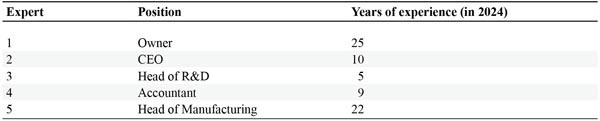
To capture a comprehensive understanding of how Industry 4.0 technologies are adopted within SMEs, data collection utilized a multi-method approach over a six-month period. Semi-structured interviews were conducted with five key stakeholders across various organizational levels, ensuring a diverse range of perspectives (see Table 1). These interviews were designed around a framework that covered critical themes such as digital adoption, managerial challenges, operational changes, and perceived impacts on organizational performance.
Characterization of the experts in Company A
Citation: International Food and Agribusiness Management Review 28, 3 (2025) ; 10.22434/ifamr.1267
Supplementary data included internal documents, operational records, and field observations, which provided additional context and helped validate the findings from the interviews. This triangulation of data sources aligns with recommendations by Gabriel et al. (2023), who advocate for multi-stakeholder engagement to ensure a holistic understanding of organizational transformations. For instance, insights from the company’s owner and CEO provided strategic perspectives, while input from the accountant and Head of Manufacturing highlighted operational and financial implications.
Such an approach is particularly relevant in studying SMEs, where decision-making often involves multiple layers of management and where stakeholder perspectives can significantly influence the trajectory of digital transformation. By incorporating diverse viewpoints, the study sheds light on both the opportunities and challenges associated with integrating Industry 4.0 technologies. All of the experts were involved in the process of digitalization.
3.2 Data coding
The study employed thematic analysis to systematically identify patterns and themes within the collected data. Using NVivo software, the data were coded according to a framework informed by key constructs from the literature. These included:
(1) Initial knowledge and understanding: examining how Industry 4.0 concepts were introduced to the company and the level of awareness among stakeholders (Kagermann et al., 2013).
(2) Development and implementation: assessing how the company operationalized digital transformation within its farming and manufacturing processes (Frazzon et al., 2013).
(3) Data exploitation: analyzing how the company leveraged new data streams for decision-making and performance improvement.
(4) Internal and external effects: exploring the organizational, social, and economic impacts of Industry 4.0 adoption.
(5) Outcomes and barriers: identifying factors that facilitated or hindered the company’s digital transformation (Balocco et al., 2012; Gatautis et al., 2019).
The use of NVivo allowed for the systematic organization and analysis of qualitative data, enabling the identification of recurring themes and the relationships between them. This structured approach ensured that the findings were grounded in the data while also connected to broader theoretical frameworks.
By employing this coding process, the study contributes to the understanding of how SMEs can effectively navigate through their digital transformation. The analysis also highlights the importance of considering organizational culture, stakeholder engagement, and external environmental factors in the adoption of Industry 4.0 technologies.
3.3 Data analysis
To explore how SMEs like Company A adapt to Industry 4.0, a thematic analysis was conducted on data collected through semi-structured interviews and document reviews. Using NVivo software, qualitative data were organized and coded into specific themes: initial understanding of Industry 4.0 concepts, implementation in agricultural and manufacturing processes, data exploitation strategies, and the social, economic, and environmental outcomes of digital transformation.
The interviews were conducted following a structured methodology, beginning with an introduction to the Industry 4.0 concept and its theoretical foundations, followed by a detailed discussion of the proposed model for digital transformation. Each interview phase evaluated the company’s objectives, the contextual factors influencing their Industry 4.0 journey, and the perceived impacts on operational and strategic levels.
Coding efforts revealed that Company A has leveraged Industry 4.0 technologies effectively in its manufacturing processes, despite certain challenges. Initial knowledge acquisition about Industry 4.0 involved both internal and external research. The management team demonstrated foresight by adopting advanced technologies that not only optimized production processes but also enhanced product quality and reduced waste.
Key drivers supporting the company’s digital transition included a proactive managerial vision, investment in cutting-edge technologies, and a strong commitment to employee training and development. Employees at all levels were engaged in the transformation process, fostering a culture of adaptability and innovation. These findings align with existing studies emphasizing the role of management and workforce readiness in Industry 4.0 adoption (Balocco et al., 2012; Gatautis et al., 2019).
Barriers to transformation were also identified. These included financial constraints, skill gaps among employees, and the need to overcome traditional mindsets within the organization. Nevertheless, the company has developed strategic responses to these challenges, such as targeted training programs and phased implementation plans.
The outcomes of Industry 4.0 adoption at Company A are multifaceted. Economically, the company has enhanced its productivity and competitiveness. Socially, it has invested in workforce upskilling, ensuring that employees remain integral to the digital transformation process. Environmentally, the advanced processing methods have reduced energy consumption and preserved natural resources, contributing to the company’s sustainability goals.
The insights gained from this case study contribute to a broader understanding of how SMEs in the agri-food sector can navigate the complexities of digital transformation. By addressing both drivers and barriers, “Company A” exemplifies how an integrated approach to Industry 4.0 can deliver tangible benefits across financial, social, and environmental dimensions. This analysis underscores the critical role of strategic planning and stakeholder engagement in achieving successful business model innovation in SMEs.
4. Results
4.1 Phase 1: Identifying overarching objectives
The first phase of the model involved identifying and defining the company’s overarching objectives, followed by those specific to manufacturing operations. In this case study, Company A set a strategic goal to modernize its operations, expand production capacity, and align with global trends in grain processing. To achieve this, the company engaged in benchmarking by visiting similar facilities in Europe and the United States to gain insights into cutting-edge technologies and their production impact.
Initially, the company relied on both savings and borrowed capital to invest in expensive new technologies. Through collaboration with the research team, Company A developed a comprehensive four-year strategy to digitize its business. This plan included:
-
Implementing a custom-developed management system to collect and analyze data related to production processes.
-
Establishing an in-house laboratory to monitor production quality.
-
Investing in key advanced machinery to enhance operational efficiency.
4.2 Phase 2: Impact factors for digital transformation
The second phase examined the factors influencing the company’s digital transformation and involves an analysis of existing equipment and manufacturing processes. For Company A, the primary drivers of transformation were the need to close the production lifecycle and diversify the business model.
Key theoretical factors identified in the literature played a role, including the initial knowledge and experience of Industry 4.0 among top management, which proved to be pivotal for the transition. Environmental conditions also had a significant impact. Traditional alfalfa production involves drying crops under natural atmospheric conditions, a process that is time-consuming and weather-dependent. In contrast, modern technologies allow for faster and resource-efficient processing under any weather conditions.
These environmental considerations were equally relevant to the company’s farming activities, even though this study primarily focuses on manufacturing. Drought and water scarcity in the region directly impact production, as the plant relies on approximately 80% of its own alfalfa production.
Additional external factors influencing digital transformation included:
-
EU and national directives promoting digital and green transitions.
-
Geopolitical shifts, such as changes in global markets driven by war and instability.
-
Workforce shortages in remote agricultural areas, which posed significant operational challenges.
4.3 Phase 3: Overcoming perceived ease of use challenges
While the management team at Company A clearly recognized the perceived usefulness of Industry 4.0 technologies, the perceived ease of use presented challenges. The transition involved a steep learning curve as employees adapted to new machinery and software systems. The company experienced mistakes and financial losses during this adjustment period.
To address these challenges, Company A implemented workforce training programs and focused on retaining personnel year-round rather than only during the harvesting season. This commitment to employee development was critical to overcoming operational disruptions and fully realizing the benefits of digital transformation.
4.4 Phases 4 and 5: implementing and evaluating technologies
In the final phases, the model evaluates how new technologies support the integration of Industry 4.0 into existing manufacturing processes to achieve financial, social, environmental, and customer-centric objectives.
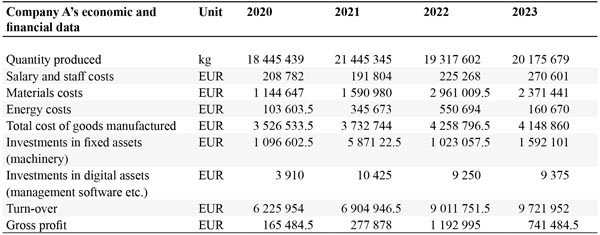
The financial data (Table 2) demonstrate a marked increase in investments in machinery and digital assets over recent years. These investments have driven significant advancements in efficiency and quality. However, external disruptions — such as supply chain interruptions during the COVID-19 pandemic and geopolitical instability from the war in Ukraine — have negatively affected grain markets in the region. As a result, the company has temporarily scaled back some of its initial plans for expanding the use of digital tools in its manufacturing operations.
Financial and economic data for Company A (2020–2023)
Citation: International Food and Agribusiness Management Review 28, 3 (2025) ; 10.22434/ifamr.1267
Company A has leveraged digital transformation and technological advancements to address challenges posed by a volatile market environment and climate change. These external pressures significantly impact the company’s operations, particularly in the agri-food sector, which is heavily reliant on stable environmental conditions. By adopting an innovative business model, the company emphasizes the social dimension of digital sustainability, prioritizing workforce retention and continuous investment in digital skills and knowledge. This focus is particularly relevant for remote agricultural regions, where attracting and retaining skilled labour is a significant challenge.
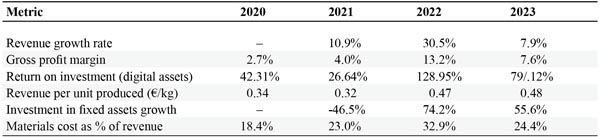
The company’s strategic decisions are supported by a data-driven approach to operations management and sustained investment in key technological assets. Table 3 illustrates the company’s financial performance from 2020 to 2023, revealing key trends and the impact of digital transformation efforts. The data indicate significant growth in revenue and profitability, particularly during 2022, where digital asset investments yielded a high return on investment (ROI) of 128.95%. However, the market volatility caused by external factors such as global market shifts and geopolitical instability, alongside increasing materials costs as a percentage of revenue, underscores the challenges faced by the company.
Financial data, YoY changes (2020–2023)
Citation: International Food and Agribusiness Management Review 28, 3 (2025) ; 10.22434/ifamr.1267
The digital transformation journey at our case study includes several strategic actions designed to modernize operations and enhance sustainability. These are delineated below.
(1) Implementation of management systems for data analysis: Company A has developed systems to analyze production data comprehensively, providing actionable insights for process optimization. This has helped the company respond more effectively to challenges related to efficiency and cost management.
(2) Investments in machinery and fixed assets: over recent years, the company has made substantial investments in modern machinery and fixed assets to improve production efficiency. This is reflected in the high ROI for digital assets in 2022 and the sustained growth in investment in fixed assets through 2023.
(3) Environmental and external considerations: the environmental conditions required for alfalfa production, such as drying and water availability, play a central role in the company’s digital strategy. The use of modern technologies has reduced reliance on favorable weather conditions, thereby increasing resilience. Additionally, EU directives, global market shifts, and workforce shortages in rural areas have informed strategic decisions, underscoring the importance of aligning digital initiatives with external trends.
(4) Challenges in adoption and ease of use: despite recognizing the perceived usefulness of Industry 4.0 technologies, the company faces significant challenges in achieving ease of use. Employees experienced a steep learning curve when adapting to new machinery and software, which led to operational mistakes and financial losses. Workforce training and retention, particularly in agricultural regions with seasonal employment patterns, remain ongoing challenges.
(5) Mitigation of market and climate risks: digital transformation has proven instrumental in mitigating the negative effects of market instability and climate change. By adopting more efficient and automated processes, the company has managed to stabilize operations and maintain competitiveness despite increasing materials costs and other external pressures.
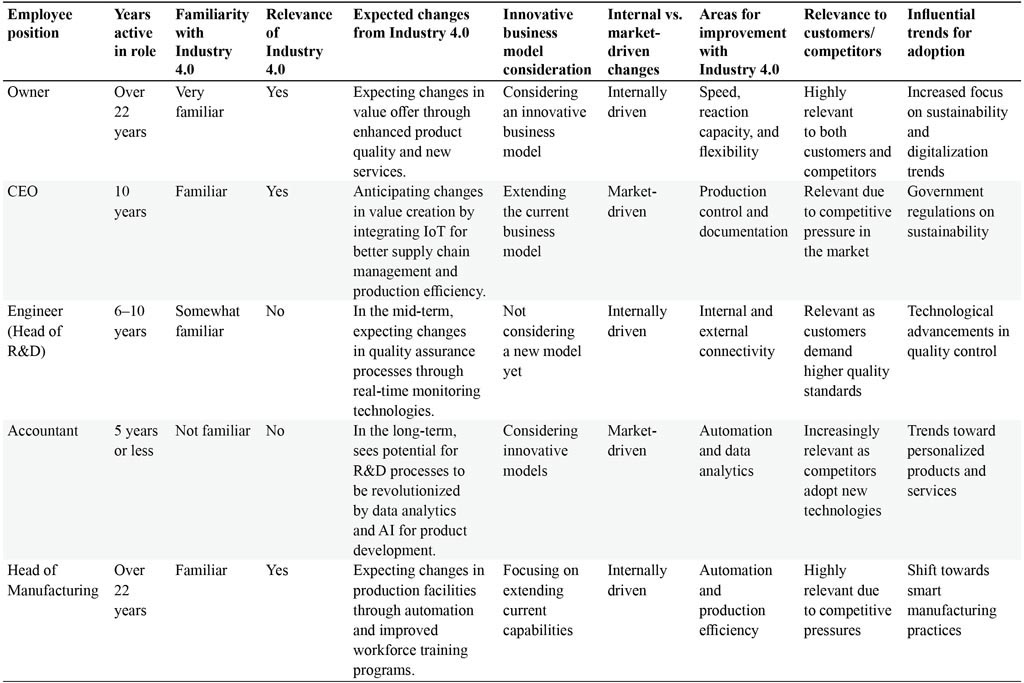
Insights gathered from focus group discussions (Table 4) highlight opportunities to refine and enhance the model for implementing Industry 4.0 in similar SMEs:
(1) Prioritizing workforce development and retention to ensure the long-term sustainability of digital initiatives.
(2) Enhancing the accessibility and usability of digital tools to reduce barriers to adoption among employees.
(3) Leveraging collaborative networks and partnerships to share best practices and technologies across the industry.
Focus group insights on employee perceptions of Industry 4.0: impact, adoption, and areas for improvement
Citation: International Food and Agribusiness Management Review 28, 3 (2025) ; 10.22434/ifamr.1267
Through its efforts, Company A serves as a compelling case study for the adoption of Industry 4.0 technologies in the agri-food sector. The company’s experience underscores the importance of aligning digital transformation strategies with environmental, social, and market realities to achieve sustainable growth.There is a significant disparity in understanding of Industry 4.0 across different organizational levels. While top management (Owner and CEO) are very familiar or familiar with the concept, lower-level managers have limited familiarity. This suggests a need for comprehensive education and training programs within the organization. The relevance of Industry 4.0 is not uniformly recognized across the organization. This indicates a need for better communication of the potential benefits and impacts of Industry 4.0 throughout the company. Each department anticipates different changes from Industry 4.0 implementation, ranging from enhanced product quality to improved R&D processes. This highlights the importance of a holistic approach to Industry 4.0 implementation that addresses various aspects of the business. There is no consensus on whether to adopt an entirely new business model or extend the current one. This suggests a need for a flexible, phased approach to business model innovation that can accommodate different departmental needs and readiness levels. The drivers for change are split between internal and market factors. This indicates the need for a balanced approach that considers both internal capabilities and external market pressures. Different departments identify distinct areas for improvement through Industry 4.0, from speed and flexibility to automation and data analytics. This underscores the need for a comprehensive implementation strategy that addresses multiple operational aspects. However, all respondents acknowledge the relevance of Industry 4.0 to customers and competitors, indicating a strong motivation for adoption. The identified trends range from sustainability to personalized products, suggesting the need for a multi-faceted approach to Industry 4.0 implementation.
The implications of this study extend beyond individual firms; they resonate throughout the broader agricultural sector and regional economies within Eastern Europe. By highlighting the critical need for targeted interventions aimed at facilitating successful transitions toward embracing digitized frameworks, this research underscores the importance of developing tailored strategies that consider both technological advancements and organizational culture.
For managers in agri-food SMEs, this study provides actionable insights into how they can leverage Industry 4.0 technologies to enhance their operations while simultaneously addressing sustainability concerns. Understanding the factors influencing digital transition allows managers to prioritize investments in technology and training that align with their strategic objectives. Furthermore, recognizing the differences between traditional management practices and new business models equips them with the knowledge necessary to adapt their approaches effectively.
However, it is essential to acknowledge limitations inherent in this study. The case study focuses primarily on a single company in Bulgaria; thus, findings may not be universally applicable across all agri-food SMEs in Eastern Europe or other regions facing different socio-economic contexts. Additionally, while qualitative data provides rich insights into managerial perspectives and operational practices, quantitative measures could further validate these findings through broader statistical analysis.
From a policy perspective, this research emphasizes the need for governmental support in fostering an environment conducive to digital transformation within the agricultural sector. Policymakers should consider implementing initiatives that provide financial assistance for technology adoption, facilitate knowledge-sharing platforms among SMEs, and promote educational programs aimed at enhancing digital skills among employees. Moreover, this study contributes to academic discourse by bridging gaps between theory and practice regarding digital transformation in agriculture. It encourages future research endeavors focused on exploring the long-term impacts of Agriculture 4.0 adoption on firm performance and sustainability outcomes across diverse contexts.
5. Conclusion
The digital transformation of Eastern European agri-food SMEs presents a complex landscape of challenges and opportunities. While many innovative companies in this region remain largely unfamiliar with the Industry 4.0 concept, there is a growing trend of adopting smart technologies and digital software to maintain competitiveness pursuit of Industry 4.0 is driving significant changes in SMEs’ business models, particularly in their value creation, capture, and offers. Case studies, such as Company A, demonstrate how companies are developing strategies to digitalize their operations, including implementing data analysis systems and investing in new machinery. The success of these transformations is influenced by several factors, including top management’s initial knowledge of Industry 4.0, environmental conditions specific to agricultural production, and external pressures such as EU directives and global market shifts. However, implementation challenges persist, particularly in terms of ease of use and the learning curve associated with new technologies. Despite these obstacles, digital transformation has shown promise in mitigating the negative effects of difficult market environments and climate change, with substantial increases in investments in machinery and digital assets observed in recent years. The social aspect of digital sustainability, focusing on workforce retention and skill development, emerges as a critical consideration, especially in remote agricultural areas.
To further understand the long-term impacts of these transformations, future research should focus on conducting more diverse case studies across various regions and longitudinal studies to track firm performance over time. This multifaceted approach to digital transformation underscores the need for tailored strategies that consider both technological advancements and organizational culture in the context of Eastern European agri-food SMEs. The successful implementation of Agriculture 4.0 concepts not only improves financial outcomes but also fosters sustainable development aligned with broader societal goals related to economic resilience and ecological balance. As agri-food companies navigate an increasingly complex landscape marked by rapid technological advancements and shifting consumer expectations, embracing a proactive approach toward digital transformation will be essential for securing their competitive advantage in the years ahead. To improve the suggested model based on these insights, several key elements should be incorporated. First, a comprehensive training and education component should be included to address the varying levels of Industry 4.0 familiarity across the organization. Second, a clear communication strategy should be developed to articulate the relevance and potential benefits of Industry 4.0 to all organizational levels. Additionally, the model should adopt a modular approach to Industry 4.0 implementation that allows different departments to focus on their specific areas of improvement while maintaining overall coherence. A flexible business model innovation framework should be included to accommodate both incremental changes and more radical innovations. The implementation strategy should balance internal capability development with market-oriented initiatives. The model should also ensure that multiple operational aspects are addressed, including product quality, supply chain management, R&D processes, and manufacturing efficiency. Furthermore, the competitive advantages of Industry 4.0 adoption should be emphasized in the model to reinforce its market relevance. Lastly, sustainability and personalization should be incorporated as key drivers in the Industry 4.0 implementation strategy, aligning with identified influential trends.
Digitainability, the convergence of digital transformation and sustainability, represents a pivotal paradigm shift in the agri-food sector, particularly for SMEs in Eastern Europe. This paper makes a significant contribution to the field by addressing the urgent need for sustainable growth in the EU’s digital and green transition. It uniquely explores the implementation of Agriculture 4.0 in SMEs, offering a comprehensive three-stage approach that combines theoretical analysis with practical application. By identifying key factors and barriers in digital transition, proposing a tailored conceptual framework, and validating it through a case study in Bulgaria, the research bridges the gap between Industry 4.0 concepts and their practical implementation in Eastern European agri-food SMEs. The study’s findings on the adoption of smart technologies for climate change mitigation, coupled with the revelation of a knowledge gap in Industry 4.0 understanding, provide valuable insights for policymakers, business leaders, and researchers. This work not only advances the theoretical discourse on digitainability but also offers actionable strategies for SMEs to leverage digital tools for sustainable growth in an evolving market landscape, thus directly addressing the call for research on the intersection of sustainability and digitalization in European agribusiness.
By incorporating these elements, the model better address the diverse perspectives and needs within the organization, potentially leading to a more effective and widely accepted Industry 4.0 implementation strategy for Eastern European agri-food SMEs. This approach will help these companies navigate the challenges of digital transformation while capitalizing on the opportunities presented by Industry 4.0 technologies.
References
Alcayaga, A., M. Wiener and E.G. Hansen. 2019. Towards a framework of smart-circular systems: An integrative literature review. Journal of Cleaner Production 221: 622–634. https://doi.org/10.1016/j.jclepro.2019.02.255
Ali, B. 2012. Adoption of new technologies by small farmers: Implications for developing countries. International Journal of Technology Management and Sustainable Development 11(3): 207–222. https://doi.org/10.1386/tmsd.11.3.207_1
Alqahtani, A.Y. and S.M. Gupta. 2019. Warranty as a marketing strategy for remanufactured products. Journal of Cleaner Production 191: 87–95. https://doi.org/10.1016/j.jclepro.2018.04.206
Annosi, M.C., F. Brunetta, A. Monti and F. Nati. 2019. Is the trend your friend? An analysis of technology 4.0 investment decisions in agricultural SMEs. Computers in Industry 109: 59–71. https://doi.org/10.1016/j.compind.2019.04.003
Arnold, C., D. Kiel and K.I. Voigt. 2016. How the industrial internet of things changes business models in different manufacturing industries. International Journal of Innovation Management 20(8): 1640015. https://doi.org/10.1142/S1363919616400156
Baden-Fuller, C. and S. Haefliger. 2013. Business models and technological innovation. Long Range Planning 46(6): 419–426. https://doi.org/10.1016/j.lrp.2013.08.023
Balocco, R., A. Perego and S. Perotti. 2012. B2B eMarketplaces: A classification framework to analyse business models and critical success factors. Industrial Management and Data Systems 112(8): 1214–1233. https://doi.org/10.1108/02635571211264654
Benzidia, S., N. Makaoui and O. Bentahar. 2021. The impact of big data analytics and artificial intelligence on green supply chain process integration and hospital environmental performance. Technological Forecasting and Social Change 165: 120557. https://doi.org/10.1016/j.techfore.2020.120557
Bock, A.K., L. Bontoux, S. Figueiredo do Nascimento and A. Szczepanikova. 2012. The future of the food chain. European Commission Joint Research Centre, Brussels.
Bouncken, R.B. and V. Fredrich. 2015. Business model innovation in alliances: successful configurations. Journal of Business Research 68(9): 1793–1804. https://doi.org/10.1016/j.jbusres.2015.01.004
Brannon, D.L. and J. Wiklund. 2016. An analysis of business models: firm characteristics, innovation and performance. Academy of Entrepreneurship Journal 22(1): 1–20.
Carroll, N. and R.M. Casselman. 2019. Lean startup and the business model canvas: A case study of teaching lean startup methodology in an undergraduate entrepreneurship program. Journal of Small Business and Entrepreneurship 31(6): 471–489. https://doi.org/10.1080/08276331.2018.1515897
Chandes, J. and D. Estampe. 2003. Logistics performance measurement system for sustainable supply chains. International Journal of Logistics Systems and Management 1(2): 168–193. https://doi.org/10.1504/IJLSM.2004.005554
Chen, D., S. Heyer, S. Ibbotson, K. Salonitis, J.G. Steingrímsson and S. Thiede. 2016. Direct digital manufacturing: definition, evolution, and sustainability implications. Journal of Cleaner Production 107: 615–625. https://doi.org/10.1016/j.jclepro.2015.05.009
Chen, Y., H. Chen, A. Gorkhali, Y. Lu, Y. Ma and L. Li. 2021. Big data analytics and IoT in logistics: a review. The International Journal of Logistics Management 32(1): 72–97. https://doi.org/10.1108/IJLM-01-2020-0010
Chesbrough, H. 2010. Business model innovation: opportunities and barriers. Long Range Planning 43(2–3): 354–363. https://doi.org/10.1016/j.lrp.2009.07.010
Chesbrough, H. and R.S. Rosenbloom. 2002. The role of the business model in capturing value from innovation: evidence from Xerox Corporation’s technology spin‐off companies. Industrial and Corporate Change 11(3): 529–555. https://doi.org/10.1093/icc/11.3.529
Ciampi, F., S. Demi, A. Magrini, G. Marzi and A. Papa. 2021. Exploring the impact of big data analytics capabilities on business model innovation: the mediating role of entrepreneurial orientation. Journal of Business Research 123: 1–13. https://doi.org/10.1016/j.jbusres.2020.09.023
Clauss, T., M. Abebe, C. Tangpong and M. Hock. 2022. Strategic agility, business model innovation, and firm performance: an empirical investigation. IEEE Transactions on Engineering Management 69(2): 453–463. https://doi.org/10.1109/TEM.2019.2910381
Dalmarco, G., F.R. Ramalho, A.C. Barros and A.L. Soares. 2019. Providing industry 4.0 technologies: the case of a production technology cluster. The Journal of High Technology Management Research 30(2): 100355. https://doi.org/10.1016/j.hitech.2019.100355
Danjou, C., L. Rivest and R. Pellerin. 2017. Industrie 4.0: des pistes pour aborder l’ère du numérique et de la connectivité. CEFRIO, Montreal, QC.
DaSilva, C.M. and P. Trkman. 2014. Business model: what it is and what it is not. Long Range Planning 47(6): 379–389. https://doi.org/10.1016/j.lrp.2013.08.004
Davenport, T.H. 1998. Putting the enterprise into the enterprise system. Harvard Business Review 76(4): 121–131.
Del Sarto, N., C. Marullo and A. Di Minin. 2022. Digital transformation and SMEs: a systematic literature review. Management Decision 60(5): 1333–1370. https://doi.org/10.1108/MD-09-2020-1192
Dijkman, R.M., B. Sprenkels, T. Peeters and A. Janssen. 2015. Business models for the Internet of Things. International Journal of Information Management 35(6): 672–678. https://doi.org/10.1016/j.ijinfomgt.2015.07.008
Doloreux, D., R. Shearmur and R. Guillaume. 2013. Collaboration, transferable and non-transferable knowledge, and innovation: a study of a cool climate wine industry (Canada). Growth and Change 46(1): 16–37. https://doi.org/10.1111/grow.12090
Duan, K., P. Ivanov and R. Werner. 2023. Deciphering the Chinese economic miracle: the resolution of an age-old economists’ debate—and its central role in rapid economic development. Review of Political Economy 37 (1): 1–27.
Duan, K., P. Ivanov and R. Werner. 2024. The rise of the red dragon: the non-binary political economy of decentralised public banks. Post-Communist Economies 36 (4): 464–481.
Echterfeld, J., B. Amshoff and J. Gausemeier. 2016. How to use business model patterns for exploiting disruptive technologies. International Association for Management of Technology IAMOT 2016 Conference Proceedings, Orlando, FL, USA.
Ehret, M. and J. Wirtz. 2017. Unlocking value from machines: business models and the industrial internet of things. Journal of Marketing Management 33(1–2): 111–130. https://doi.org/10.1080/0267257X.2016.1248041
Elhabashy, A.E., L.J. Wells and J.A. Camelio. 2019. Cyber-physical security research efforts in manufacturing – a literature review. Procedia Manufacturing 34: 921–931. https://doi.org/10.1016/j.promfg.2019.06.010
European Commission. 2024. Speech by President von der Leyen at the European Parliament Plenary Session. Available online at https://ec.europa.eu/commission/presscorner/detail/en/speech_24_6084
European Institute of Innovation and Technology. 2021. EIT Food report on the impact of COVID-19 on the agri-food sector in Central and Eastern Europe. Available online at https://efaidnbmnnnibpcajpcglclefindmkaj/https://www.eitfood.eu/media/EIT-Food-Foresight-ENG-Compressed.pdf
Ferrigno, G. and V. Cucino. 2021. Industry 4.0 enabling technologies and business models: a bibliometric analysis. Technological Forecasting and Social Change 170: 120879. https://doi.org/10.1016/j.techfore.2021.120879
Forsman-Hugg, S., J.M. Katajajuuri, I. Riipi, J. Mäkelä, K. Järvelä and P. Timonen. 2013. Key CSR dimensions for the food chain. British Food Journal 115(1): 30–47. https://doi.org/10.1108/00070701311289867
Fountas, S., G. Carli, C.G. Sørensen, Z. Tsiropoulos, C. Cavalaris, A. Vatsanidou, B. Liakos, M. Canavari, J. Wiebensohn and B. Tisserye. 2015. Farm management information systems: Current situation and future perspectives. Computers and Electronics in Agriculture 115: 40–50. https://doi.org/10.1016/j.compag.2015.05.011
Frazzon, E.M., L.S. Silva and M.C. Pires. 2013. Simulation-based performance evaluation of a concept for integrating intelligent maintenance systems and spare parts supply chains. IFAC Proceedings 46(24): 109–114. https://doi.org/10.3182/20130911-3-BR-3021.00075
Gabriel, M., J.P. Schöggl and A. Posch. 2023. Sustainability-oriented innovation in the context of digital transformation: a systematic literature review. Journal of Cleaner Production 382: 135105. https://doi.org/10.1016/j.jclepro.2022.135105
Gandhi, P., S. Khanna and S. Ramaswamy. 2016. Which industries are the most digital (and why)? Harvard Business Review Digital. Available online at https://hbr.org/2016/04/a-chart-that-shows-which-industries-are-the-most-digital-and-why
Garcia, R., C. Lessio, P. Dacunto and M. Zappatore. 2012. Environmental monitoring in industrial plants: a survey on wireless sensor networks. International Journal of Distributed Sensor Networks 8(8): 601284. https://doi.org/10.1155/2012/601284
Garzella, S., R. Fiorentino, A. Caputo and A. Lardo. 2021. Business model innovation in SMEs: the role of boundaries in the digital era. Technology Analysis and Strategic Management 33(1): 31–43. https://doi.org/10.1080/09537325.2020.1787374
Gatautis, R., A. Medziausiene, A. Tarute and E. Vaiciukynaite. 2019. Towards ICT impact framework: private and public sectors perspective. Journal of Business Economics and Management 20(1): 192–207. https://doi.org/10.3846/jbem.2019.8098
George, G. and A.J. Bock. 2011. The business model in practice and its implications for entrepreneurship research. Entrepreneurship Theory and Practice 35(1): 83–111. https://doi.org/10.1111/j.1540-6520.2010.00424.x
Ghezzi, A. and A. Cavallo. 2020. Agile business model innovation in digital entrepreneurship: lean startup approaches. Journal of Business Research 110: 519–537. https://doi.org/10.1016/j.jbusres.2018.06.013
Goelzer, P. and A. Fritzsche. 2017. Data-driven operations management: Organisational implications of the digital transformation in industrial practice. Production Planning and Control 28(16): 1332–1343. https://doi.org/10.1080/09537287.2017.1375148
Grabowska, S. 2020. Smart factories in the age of Industry 4.0. Management Systems in Production Engineering 28(2): 90–96. https://doi.org/10.2478/mspe-2020–0014
Hanafizadeh, P., M.R. Hanafizadeh and M. Khodabakhshi. 2018. Extracting core business model patterns using k-means clustering algorithm. International Journal of Business Information Systems 29(2): 211–240. https://doi.org/10.1504/IJBIS.2018.094698
Hoyk, E., A. Hüll and A.M. Köck. 2022. Digitalization in agriculture: a systematic literature review of recent research developments. Precision Agriculture 23(1): 596–631. https://doi.org/10.1007/s11119-021-09839-2
Ivanov, P. 2022. Financialization. In L.-P. Rochon and S. Rossi (eds), Elgar encyclopedia of post-Keynesian economics. Edward Elgar, Cheltenham, 176.
Ivanov, P. 2025. Money matters: the power of banking structures and credit in economic growth. St. Grigoriy Bogoslov, Sofia.
Ivanov, P. and R. Werner. 2025. The digital pound. In L.-P. Rochon and S. Rossi (eds), The encyclopedia of central banking. Edward Elgar, Cheltenham.
Jabbour, C.J.C., A.B.L.D.S. Jabbour, J. Sarkis and M.G. Filho. 2019. Unlocking the circular economy through new business models based on large-scale data: An integrative framework and research agenda. Technological Forecasting and Social Change 144: 546–552. https://doi.org/10.1016/j.techfore.2017.09.010
Jaaron, A.A. and C.J. Backhouse. 2021. Operationalising circular economy in the manufacturing sector: The ‘Circularity Compass’ conceptual model. Journal of Cleaner Production 315: 128114. https://doi.org/10.1016/j.jclepro.2021.128114
Johnson, M.W. 2018. Reinvent your business model: How to seize the white space for transformative growth. Harvard Business Press, Boston, MA.
Kagermann, H., W. Wahlster and J. Helbig. 2013. Recommendations for implementing the strategic initiative Industrie 4.0: Final report of the Industrie 4.0 Working Group. Forschungsunion, Frankfurt.
Kiel, D., C. Arnold and K.I. Voigt. 2017a. The influence of the Industrial Internet of Things on business models of established manufacturing companies – a business level perspective. Technovation 68: 4–19. https://doi.org/10.1016/j.technovation.2017.09.003
Kiel, D., J.M. Müller, C. Arnold and K.I. Voigt. 2017b. Sustainable industrial value creation: benefits and challenges of Industry 4.0. International Journal of Innovation Management 21(8): 1740015. https://doi.org/10.1142/S1363919617400151
Kolla, S., M. Minufekr and P. Plapper. 2019. Deriving essential components of lean and Industry 4.0 assessment model for manufacturing SMEs. Procedia CIRP 81: 753–758. https://doi.org/10.1016/j.procir.2019.03.189
Lardo, A., D. Mancini, N. Paoloni and G. Russo. 2020. The perspective of capability providers in creating a sustainable I4.0 environment. Management Decision 58(8): 1759–1777. https://doi.org/10.1108/MD-09-2019-1333
Monostori, L. 2014. Cyber–physical production systems: roots, expectations and R&D challenges. Procedia CIRP 17: 9–13. https://doi.org/10.1016/j.procir.2014.03.115
Morrison, A. and R. Rabellotti. 2017. Gradual catch up and enduring leadership in the global wine industry. Research Policy 46(2): 417 430. https://doi.org/10.1016/j.respol.2016.09.007
Müller, J.M., O. Buliga and K.–I. Voigt. 2018a. Fortune favors the prepared: how SMEs approach business model innovations in Industry 4.0. Technological Forecasting and Social Change 132: 2–17.
Müller, J.M., D. Kiel and K.–I. Voigt. 2018b. What drives the implementation of Industry 4.0? The role of opportunities and challenges in the context of sustainability. Sustainability 10(1): 247. https://doi.org/10.3390/su10010247
Ng, I., D. Parry, L. Smith, R. Maull and G. Briscoe. 2012. Transitioning from a goods–dominant to a service–dominant logic: visualising the value proposition of Rolls-Royce. Journal of Service Management 23(3): 416–439. https://doi.org/10.1108/09564231211248480
Oesterreich, T.D. and F. Teuteberg. 2016. Understanding the implications of digitisation and automation in the context of Industry 4.0: a triangulation approach and elements of a research agenda for the construction industry. Computers in Industry 83: 121–139. https://doi.org/10.1016/j.compind.2016.09.006
Papazov, E. and L. Mihaylova. 2015. Organization of management accounting information in the context of corporate strategy. Procedia – Social and Behavioral Sciences 213: 309–313. https://doi.org/10.1016/j.sbspro.2015.11.543
Petter, R.R.H., L.C. Resende, P.P. de Andrade Júnior and R.J. Horst. 2022. Systematic review on Industry 4.0 and information systems research: bibliometric and content analyses. International Journal of Information Management 62: 102437. https://doi.org/10.1016/j.ijinfomgt.2021.102437
Rachinger, M., R. Rauter, C. Müller, W. Vorraber and E. Schirgi. 2019. Digitalization and its influence on business model innovation. Journal of Manufacturing Technology Management 30(8): 1143–1160. https://doi.org/10.1108/JMTM-01-2018-0020
Rajput, S. and S.P. Singh. 2019. Connecting circular economy and industry 4.0. International Journal of Information Management 49: 98–113. https://doi.org/10.1016/j.ijinfomgt.2019.03.002
Sabatier, V., V. Mangematin and T. Rousselle. 2010. From recipe to dinner: business model portfolios in the European biopharmaceutical industry. Long Range Planning 43(2–3): 431–447. https://doi.org/10.1016/j.lrp.2010.02.001
Sharma, M.K. and R. Bhagwat. 2006. Practice of information systems: evidence from select Indian SMEs. Journal of Manufacturing Technology Management 17(2): 199–223. https://doi.org/10.1108/17410380610642278
Sosna, M., R.N. Trevinyo–Rodríguez and S.R. Velamuri. 2010. Business model innovation through trial–and–error learning: the Naturhouse case. Long Range Planning 43(2–3): 383–407. https://doi.org/10.1016/j.lrp.2010.02.003
Spieth, P. and S. Schneider. 2016. Business model innovativeness: designing a formative measure for business model innovation. Journal of Business Economics 86(6): 671–696. https://doi.org/10.1007/s11573-015-0794-0
Stock, T. and G. Seliger. 2016. Opportunities of sustainable manufacturing in Industry 4.0. Procedia CIRP 40: 536–541. https://doi.org/10.1016/j.procir.2016.01.129
Stoycheva, B. and D. Antonova. 2018. Investigating factor interactions in formalising the process of developing new products. Serbian Journal of Management 13(1): 173–184. https://doi.org/10.5937/sjm13-13354
Taran, Y., H. Boer and P. Lindgren. 2015. A business model innovation typology. Decision Sciences 46(2): 301–331. https://doi.org/10.1111/deci.12128
Teece, D.J. 2010. Business models, business strategy and innovation. Long Range Planning 43(2–3): 172–194. https://doi.org/10.1016/j.lrp.2009.07.003
Vitliemov, P., I. Koleva and K. Krumov. 2020. Cyber security challenges in smart manufacturing. IOP Conference Series: Materials Science and Engineering 878: 012010. https://doi.org/10.1088/1757-899X/878/1/012010
Warner, K.S. and M. Wäger. 2019. Building dynamic capabilities for digital transformation: an ongoing process of strategic renewal. Long Range Planning 52(3): 326–349. https://doi.org/10.1016/j.lrp.2018.12.001
Zott, C., R. Amit and L. Massa. 2011. The business model: recent developments and future research. Journal of Management 37(4): 1019–1042. https://doi.org/10.1177/0149206311406265
Corresponding author: