Abstract
The expectations of digital technologies in sustainable agricultural development are considerable. However, applying these technologies in agri-food value chains can have downsides, which are still barely studied. The main objectives of this systematic literature review were to discover the state of the art of the research in the use of digital technologies in business models contributing to sustainability in the agri-food sector, and to make recommendations for future research and management practice. In order to bring concepts together and develop a theoretical framework and advance knowledge, performing a literature review is conducive. Here, the commonly-used PRISMA-method was used to develop a systematic literature review. From this review, an overview of business model innovations, and drivers, benefits and drawbacks of digitalisation in agri-food value chains were distinguished. Key themes found in the literature were the effects of COVID-19 on digitalisation and business resilience, the economic sustainability of business models, and the importance of communication technologies in agri-food value chains. This article recommends for future research and management practice to use a framework that looks through a value co-creation and open innovation perspective to the individual business model level and the interaction between (sustainable) business models in local and global food systems.
1. Introduction
Several public policies exist in which the expectations of digital technologies (digital platforms, robots, decision support tools and related hardware) are substantial; they are expected to become major instruments in supporting sustainable agricultural development (Lajoie-O’Malley et al., 2020). The EU supports research and innovation on agricultural and rural digital transformation. One of the key aims of the CAP 2023-27 (common agricultural policy of the European Commission) is to modernise agriculture and rural areas through enhanced knowledge sharing, innovation, and digitalisation. Projects such as Horizon Europe and the Digital Europe Programme form the cornerstone of the EU’s digital agricultural transition, as they take part in practices that are considered to enhance sustainability, competitiveness, and progress. According to the Agrinautes survey in France in 2022, 46% of web-connected farmers were connected by obligation instead of their own choice (Bellon-Maurel et al., 2023). This means that, even though that they are using digital tools, many enterprises are using digital technologies because they feel obliged to meet regulatory requirements.
Nevertheless, some authors call for a better understanding of the impact of digitalization (Bronson and Knezevic 2016; Carolan, 2017), as it can strengthen the industrialization of agriculture, potentially leading to detrimental environmental, social and economic consequences (Plumecocq et al. 2018). This is particularly the case in the context of a global food system that is being plagued by climate change, which causes insecurities in food provision and quality (Dagoudou et al., 2023). The question remains if digital technologies can make actual change towards sustainability throughout value chains in agri-food systems.
In general, the growth of the internet and other digital technologies has raised new questions about how businesses can deliver value through providing new (information) services to the costumer (Teece, 2010). New ideas, perspectives and technologies are commercialized through their business models (Antikainen and Valkokari, 2016). Thus, business models that entrepreneurs develop can provide solutions to changing customer needs and even shape the business environment (Galardi et al., 2022; Teece, 2010). Technological innovation can drive business model innovation as well as the other way around (Di Vaio et al., 2020).
Businesses in agri-food value chains are increasingly expected to respond to different sustainability and corporate responsibility concerns instead of solely looking at profit (Fortunati et al., 2020; Klein et al., 2022). Thus, sustainability increasingly becomes the dominant strategic paradigm for entrepreneurs and links to digital transformation and innovation pathways (Bigliardi and Filippelli, 2022; Dressler, 2023). Business model innovation can increase business resilience to changes in the environment and provide competitive advantage (Donner and de Vries, 2021).
Thus, businesses are expected to be responsible, and to proactively respond to issues like financial crises, economic and social inequalities, demographic growth, environmental hazards, climate change, resource scarcities, energy demands and technological development. These issues can be seen as both risks and opportunities in reaching sustainability (Dressler, 2023; Hong et al., 2022; Joyce and Paquin, 2016). Sustainable and collaborative innovations based on digital technologies can contribute to the ability of businesses to face and adapt to these challenges (Hong et al., 2022).
Yet, the way in which digitalization induces new business models in agri-food value chains is barely studied (Klerkx et al., 2019), as is the capacity to integrate principles leading to more sustainable (agro-ecological and circular) practices. When studying the link between sustainability and digital technologies in the agri-food sector, this is often viewed through either a mere economic or technological lense on the producers’ end. On one side, precision agriculture is often pointed out in the literature, which is seen as providing a way to reach efficient agricultural practices by utilising technological solutions such as internet of things (IoT) or sensors (Shafi et al., 2019). This is mainly focused on the technical aspects of the agricultural dimension of the food system, i.e. farming (Fortunati et al., 2020).
On the other hand, business model innovation is based on a ‘profit first’ or economic value orientation (Joyce and Paquin, 2016). Hence, the question remains if digital technologies can make actual change towards a sustainable and healthy food system throughout value chains in the agri-food sector. This means that it will prove to be valuable to make a critical evaluation of sustainability-oriented innovation of entrepreneurs, which includes looking at all the aspects of business models as well as the value chain in which they are placed, and their economic, environmental and social impact (Bigliardi and Filippelli, 2022; Dressler, 2023; Joyce and Paquin, 2016). A critical and systematic evaluation can be reached, first through advancing knowledge by performing a literature review systematically, and then developing a theoretical framework accordingly (Snyder, 2019; Torraco, 2005).
The main objectives of this systematic literature review are to discover the state of the art of the research in the use of digital technologies in business models contributing to sustainability in agri-food value chains, and to make recommendations for future research and management practice. In order to reach these objectives the following research questions are used in the analysis of the literature review:
(1) How do digital technologies lead to innovations of the different business model canvas components (value creation, proposition, delivery, capture) of agri-food businesses?
(2) What are the drivers, benefits and drawbacks of the utilization of digital technologies in agri-food businesses?
(3) How can the use of digital technologies by agri-food businesses contribute to sustainability?
2. Theoretical background
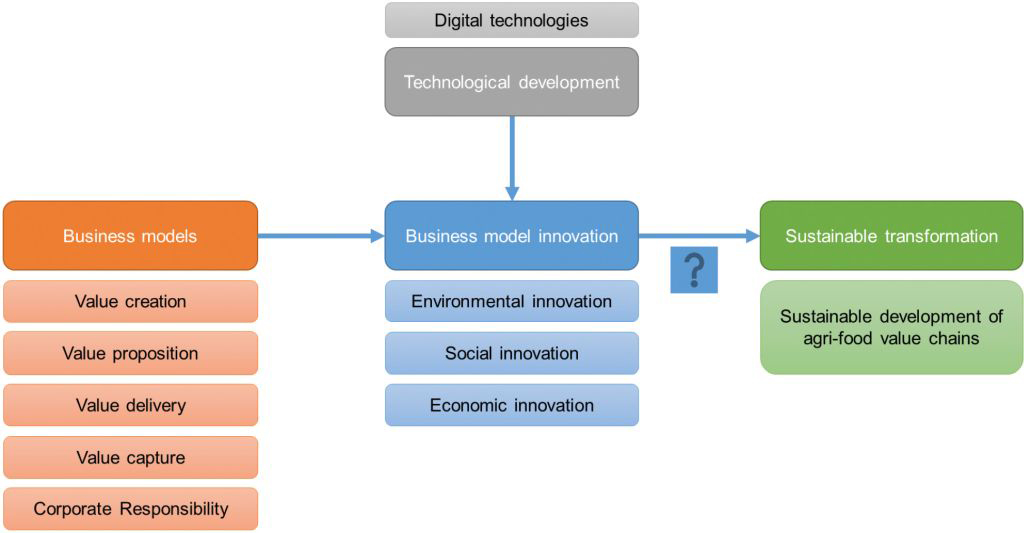
To study the influence of digital technologies on agri-food value chains, this review brings together the concepts of business models, business model innovation, sustainable transformation and technological development (Figure 1). A business model reflects the views of entrepreneurs about how to manage their business to best meet customer needs in order to be well paid (Lagrasta et al., 2021; Teece, 2010). It is a conceptual tool to help understand how entrepreneurs develop complex business ideas and can be used for analysis, comparison, performance assessment, management, communication, and innovation (Galardi et al., 2022). Technological development and innovation by itself does not guarantee economic success of a business (Teece, 2010). In order to capture value from delivering products and services, businesses need to use a well-developed business model. Different business models and strategies are present in various value chains.

Framework of utilised concepts.
Citation: International Food and Agribusiness Management Review 28, 3 (2025) ; 10.22434/ifamr.1219
The Business Model Canvas of Osterwalder and Pigneur (2010) was made to study business model innovation from an economic perspective (Joyce and Paquin, 2016). According to the business model canvas, a business model describes value creation, proposition, delivery, and capture. These descriptions cover: customer segments and relationships, channels, key resources, key activities, partners, costs and revenues. However, solutions consist of many different aspects that lie outside the scope of this canvas; especially in relation to the specific challenges that the agri-food system needs to deal with.
Sustainable and collaborative innovations in business models based on digital technologies may contribute to broader sustainable development in the long term. Joyce and Paquin (2016) propose to bring in the Triple Layer Business Model Canvas (TLBMC) as a tool to support sustainable business model innovation. It is concerned with social and environmental innovation in addition to economic innovation and technological developments. Sustainable BM innovation has the potential to contribute to sustainable transformation through the integration of sustainability related and Corporate Responsibility factors into core processes (Bigliardi and Filippelli, 2022).
Digital techniques can contribute to the renewal, innovation and redefinition of business models. They can do this by connecting producers to consumers, setting up innovative marketing channels, improving logistics, creating new enterprises, improving competitiveness, increasing production and sales, optimizing resource consumption and reducing costs (De Bernardi and Azucar, 2020). Digital technologies that are used in the agri-food sector include artificial intelligence for smart farming, precision and urban farming, data management for less waste, and block chain for supply chain traceability and auditability (De Bernardi and Azucar, 2020).
In agri-food value chains, these initiatives can contribute to business development and employment, environmentally friendly products, income diversification, providing new food and new jobs, increased resilience and risk mitigation of rural and urban actors, and co-creating value (Donner and de Vries, 2023; Hong et al., 2022). A variety of agri-food businesses are expected to respond to different sustainability concerns instead of only looking at profit and efficiency on the farm level (Fortunati et al., 2020; Joyce and Paquin, 2016; Klein et al., 2022). This is why this review transcends the farmer level, and investigates papers on transformation in agri-food value chains.
New digital technologies and strategic reorientation of technological change have provided new opportunities and enabled the agri-food sector to develop collaborations (Bigliardi and Filippelli, 2022; García-Álvarez de Perea et al., 2019). Digital technologies could represent a viable tool to implement successful sustainable open innovation strategies in business models, and are seen as an imperative in the future development of the agri-food sector (Bigliardi and Filippelli, 2022; Krstic et al., 2022).
3. Methodology
In order to bring concepts together, develop a theoretical framework and to advance knowledge, performing a literature review is conducive (Snyder, 2019; Torraco, 2005). The systematic review is a specific literature review that provides the identification of all empirical evidence that fits the pre-specified inclusion and exclusion criteria to answer a particular research question or hypothesis. This explicit and systematic method reduces bias, thus providing reliable results from which decisions can be made (Page et al., 2021; Snyder, 2019). It can also be used to find research gaps and future research needs (Snyder,2019).
PRISMA (Preferred Reporting Items for Systematic reviews and Meta-Analyses) is a commonly used approach for selecting articles for a systematic literature review. It provides a guideline for researchers on how to report their systematic review. The use of PRISMA is associated with more complete reporting of systematic reviews, as the limitation in literature reviews is that not always all of the relevant articles are found (Page et al, 2021). It was used in this review in order to answer the research question of how the use of digital technologies transforms current and leads to new (sustainable) business models in agri-food value chains.
Scopus and Web of Science were used as they are renowned databases and consist of a large quantity and diversity of research papers. There is no exclusion criterion for the date of publication because literature on digital technologies is quite recent, and there are no old articles to exclude. For language of publication, this excludes any other language than English, as papers in the English language are more relevant in the way that most people in the world can read them. Then, solely peer-reviewed articles as document type are included in the search; this excludes document types such as conference contributions or book chapters.
After several trials, the following search terms were used:
‘TITLE-ABS-KEY ( (“digi*” OR ict) AND “business model” AND ( food OR agr*food ) ) AND ( LIMIT-TO ( LANGUAGE , “English” ) ) AND ( LIMIT-TO ( DOCTYPE , “article” )’
The first search was performed on the 23rd of February 2024. Another search was performed on 6 March 2024, after which one new article was added. Then, 115 records from Scopus and 52 records of Web of Science were identified (Figure 2). The duplicate records were removed from this list. Next, the records were screened by reading the title, abstract and keywords. Some publications were excluded based on the following criteria:
(1) If they are not linking the food sector, business models and digital technologies together
(2) If it is a literature review
(3) If they are solely centred on the agricultural aspect of the food system
(4) If they are focused on consumers instead of businesses
Studies that solely concentrate on either producers or consumers were excluded from this review as they do not provide a value chain perspective, while this is one of the aims of conducting this literature review.
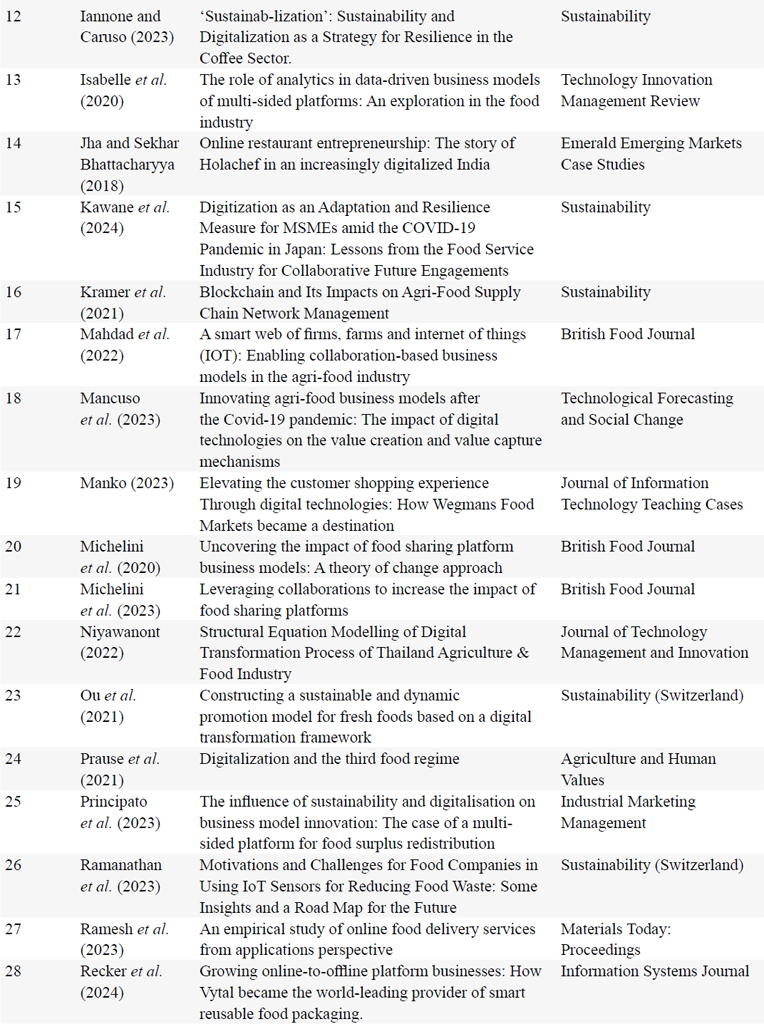
This led to 46 remaining articles. The full texts of these articles were sought for retrieval, but four of them could not be accessed. All full texts that could be retrieved were read. After this, still three articles were excluded as they finally did not fulfil the selection criteria. In the end, this meant that 39 articles were included in this study (Figure 2 and Table A1 in the Appendix).
Identification of studies via databases with the use of PRISMA, adapted from Page et al. (2021).
Citation: International Food and Agribusiness Management Review 28, 3 (2025) ; 10.22434/ifamr.1219
For each article, quantitative information about the studies, and qualitative information in relation to business models, drivers, benefits and drawbacks of digital technologies and sustainability in agri-food businesses were analysed. Content analysis has been used to assess the quality and strength of findings from different types of studies and to compare them. Thus, this systematic review combines a strict systematic review process to collect articles, and a qualitative approach to analyse them (i.e. a qualitative systematic review) (Snyder, 2019). The criteria that have been utilised to analyse the literature in this review are:
(1) Methodology
(2) Location of research
(3) Value chain actors being discussed
(4) Types and purpose of digital technologies
(5) Relation to business models
(6) Impact on value creation, proposition, delivery and capture
(7) Drivers, benefits and drawbacks of digital technology use
(8) Link of technology use to sustainability, circular economy and agro-ecology
4. Results
The presentation of the review results is divided into four sections: overview of the publications, impact on business models, drivers, benefits and drawbacks, and the aspects of sustainability.
4.1 Overview of publications
First, an overview of the 39 articles included is presented through a quantitative analysis to show their main characteristics. These characteristics consist out of number of publications per year, place of study, studied value chain actors and types of digital technologies.
4.1.1 Number of publications per year
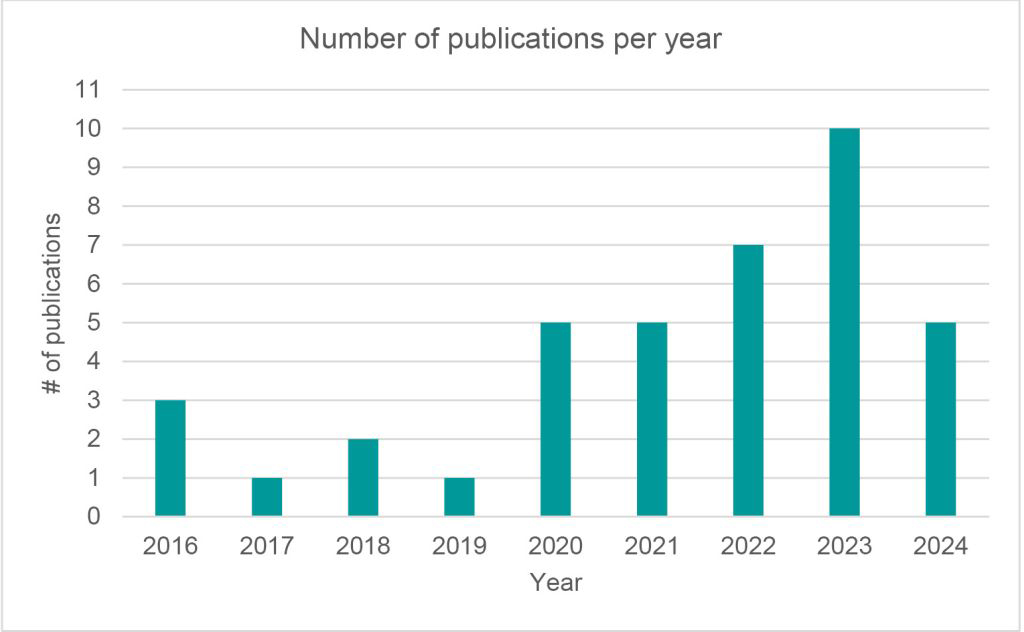
Publications about digitalisation and business models in the agri-food sector only start to appear in 2016 (n=3) (Figure 3). However, there were only few publications in 2017 (n=1), 2018 (n=2) and 2019 (n=1). The number of publications shows a clear increase in 2020, from one to five publications, in the year in which the COVID-19 pandemic started.
Number of publications about digitalisation and business models in the agri-food sector per year.
Citation: International Food and Agribusiness Management Review 28, 3 (2025) ; 10.22434/ifamr.1219
4.1.2 Location of study
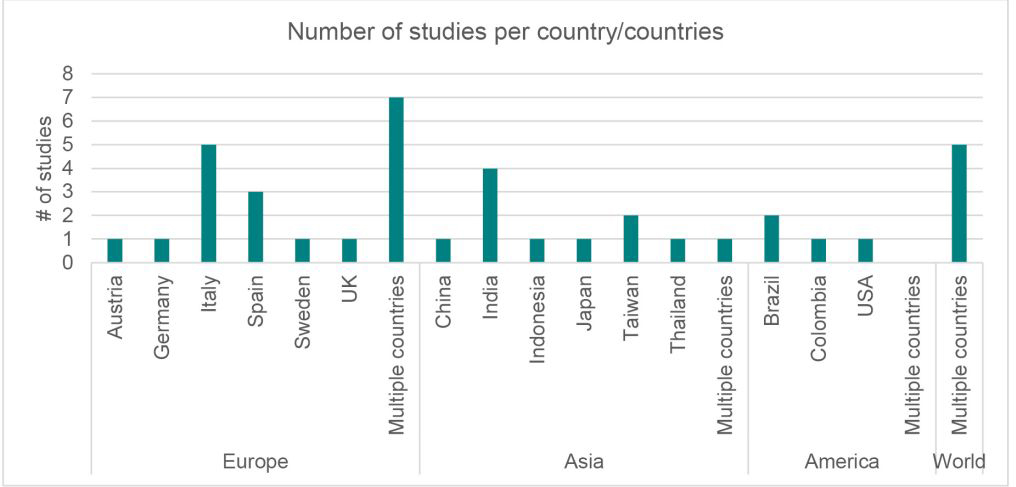
Twenty articles are specifically focused on ‘The Global North’ (51%), which includes papers on multiple countries in Europe (n=7), Austria (n=1), Germany (n=1), Italy (n=5), Spain (n=3), Sweden (n=1), UK (n=1), Japan (n=1) and USA (n=1) (Figure 4). Twelve papers deal with ‘The Global South’ (31%), reporting studies from China (n=1), India (n=4), Indonesia (n=1), Taiwan (n=2), Thailand (n=1), Brazil (n=2) and Colombia (n=1). None of the papers centres on a specific case study in Africa. Five articles (13%) perform cross-continental studies, three of them include countries of both global north and south. Two of these three are based on content analysis. Only one of the cross-continental studies includes case studies, with two enterprises that have their origin in the global north.
Number of studies about digitalisation and business models in the agri-food sector per country/countries.
Citation: International Food and Agribusiness Management Review 28, 3 (2025) ; 10.22434/ifamr.1219
4.1.3 Studied value chain actors
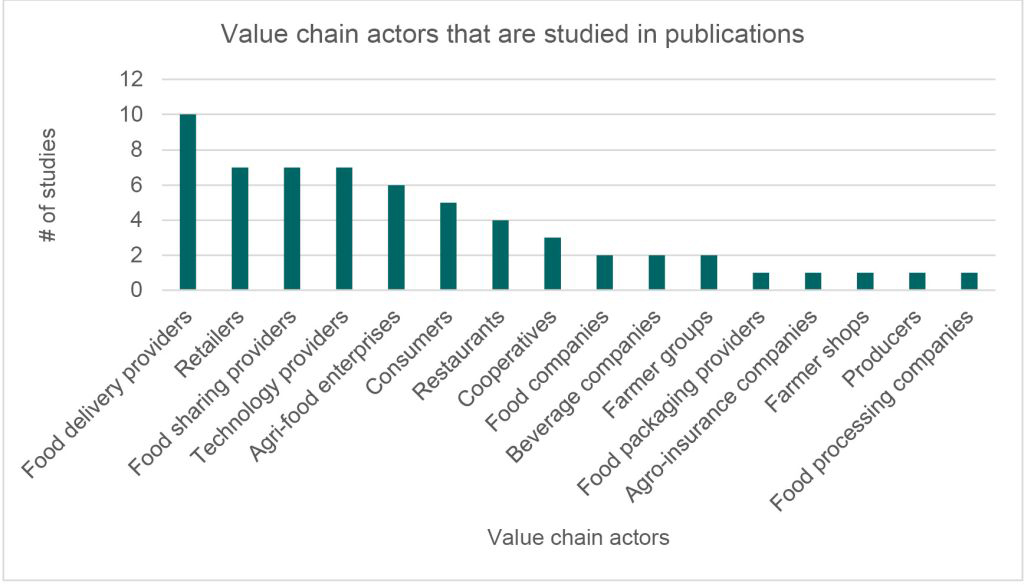
The articles study different actors in the agri-food value chain (Figure 5). Agro-insurance companies (n=1), producers (n=1), farmers’ groups (informal producers’ organizations) (n=2), cooperatives (formal producers’ organizations) (n=3), and agri-food enterprises (n=6) are linked to the agricultural/farmer side of the value chain. Food processing companies (n=1), food packaging providers (n=1), food delivery providers (n=10) and food sharing providers (n=7) are linked to the transformative and logistic part of the value chain. Food delivery providers act as a bridge between food companies and consumers (Zhu et al., 2024), while food sharing providers provide a platform for e.g. restaurants to share leftover food with others (Sarti et al., 2017). Food delivery providers, food sharing platforms and retailers have especially experienced a rise in digital technology use during the COVID-19 pandemic and this has caused a surge in scientific attention (62% of publications).
Value chain actors studied in publications about digitalisation in agri-food business models.
Citation: International Food and Agribusiness Management Review 28, 3 (2025) ; 10.22434/ifamr.1219
Digital technology providers (n=7) offer products or services to different actors in the agri-food value chain. Moreover, some articles look at food companies (n=2), farmer shops (n=1), beverage companies (n=2), retailers (n=8) and/or restaurants (n=4). These actors are dedicated to the selling of food or beverage products to consumers (Iannone and Caruso, 2023). Lastly, five publications involve the consumer perspective among the value chain actors, for example in reference to health food consumption (Uttama, 2021).
4.1.4 Types of digital technologies in agri-food business models
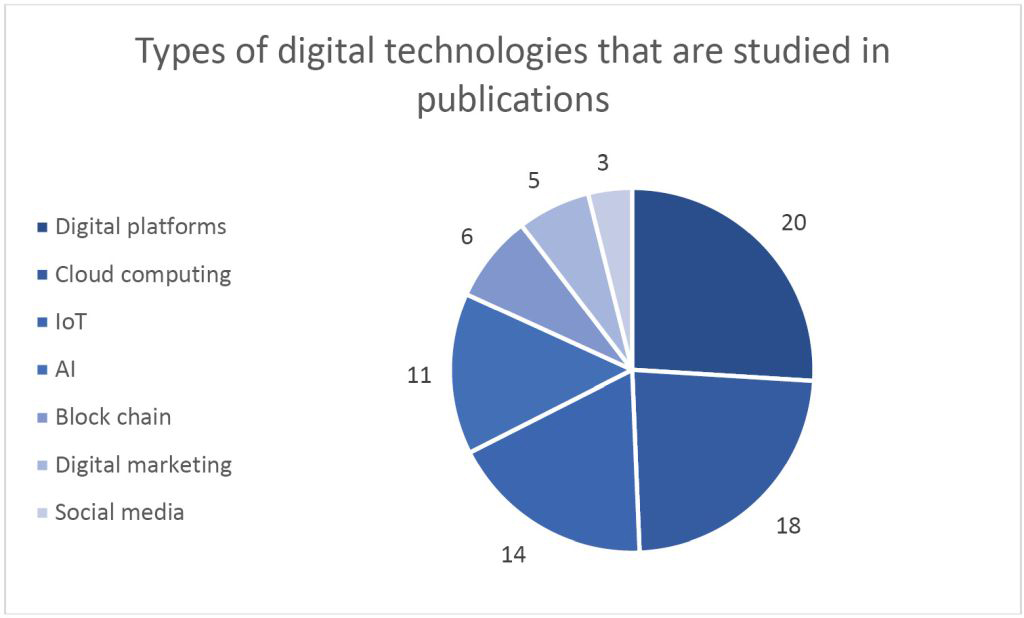
The articles discuss different types of digital technologies. Yet, a few technologies stood out (Figure 6). Digital platforms are prevalent in research about agri-food value chains (n=20), either for food delivery (e.g. Saqib and Shah, 2022) or food sharing (e.g. Sarti et al., 2017). Several articles (n=5) study digital marketing as it can improve the co-creation of value in the food value chain (Utami et al., 2021). Only a few signalize the use of social media, and mostly in context of marketing (n=3). A few articles point out block chain technologies (n=6) as a tool to gather and share information about the origin of products (Kramer et al., 2021). Some articles also deal with the use of AI (n=11), but always in combination with other technologies (Dressler and Paunovic, 2020). Then, cloud computing is signalized a lot in the literature (n=18), as a logical consequence of the increased amount of data in general. Many businesses use it in combination with other technologies (Manko et al., 2023). The IoT is mentioned as well (n=14) even though this technology is less centred on direct communication but rather enhances communication indirectly by connecting devices to the internet. The IoT was the main tool in two cases only.
Types of digital technologies that are studied in publications.
Citation: International Food and Agribusiness Management Review 28, 3 (2025) ; 10.22434/ifamr.1219
4.2 Impact of digital technologies on business models: value creation, proposition, delivery and capture
Business model innovation is a widespread concept among the articles (n=11). Some publications concentrate on the concept of new business models (n=8). The terms sustainable business models (n=4) and sustainable business model innovation (n=3) are used as well (e.g. in Akarsu, 2023). One article is primarily focused on technology use in business models (Jha and Sekhar Bhattacharyya, 2018). Similarly, two articles mention platform business models, which are based on digital technologies that link actors together (Niyawanont, 2022; Recker et al., 2024). The business model concepts with a more system-based and multi-actor perspective approach are in general less used, such as collaboration-based (Mahdad et al., 2022), ecosystem-based (Michelini et al., 2023), integrated (Ramesh et al., 2023) and open innovation (Uttama, 2021) business models.
4.2.1 Value creation
The first matter that is discussed related to value creation is the importance of partnerships. Digital platforms can strengthen and expand existing partnerships and collaborations, and provide new partnerships with businesses, tech companies, NGOs and authorities (e.g. Saqib and Shah, 2022). By a few publications, it was pointed out that digital technologies can reinforce co-creation and a value network (e.g. Amaral and Orsato, 2023), or ecosystem-wide value creation (Mahdad et al., 2022). However, this value creation sometimes consists out of area-specific and short-term collaborations, for example during the COVID-19 pandemic (Kawane et al., 2024). Two papers signalized open innovation, in which people align different dimensions of collaboration when their business is threatened (Mahdad et al., 2022; Uttama, 2021).
The efficient use of resources is also essential for value creation (Iannone and Caruso, 2023). Human resource efficiency is one important aspect (Isabelle et al., 2020), which includes organisational and digital competencies (Niyawanont, 2022; Principato et al., 2023) and entrepreneurship (Jha and Sekhar Bhattacharyya, 2018). Resources also involve social and environmental data that is being gathered by value chain actors (e.g. Jha and Sekhar Bhattacharyya, 2018). This data is used in order to manage reliable information, fuel innovations, and the identification of new partners and partner demands (e.g. Niyawanont, 2022). For this purpose, businesses need tools from technology providers, communication infrastructure and investments (e.g. Sánchez-Montesinos et al., 2018). Large companies are thought to have more resources at their disposal compared to small companies (Santos et al., 2024).
4.2.2 Value proposition
Value proposition consists of both services and products. First, many publications talk about improving service provision through making them increasingly branched, accessible, integrated, flexible and fast (e.g. Shih and Wang, 2016). Due to digital technologies, customers can view and order products online, which makes products accessible in the suburbs and abroad (Jha and Sekhar Bhattacharyya, 2018; Kawane et al., 2024). Several articles point out that digital technologies provide additional services such as marketing, delivery, e-commerce, (remote) customer service, cloud services, networked services, and digital and multiple-sided marketplaces (e.g. Bajaj and Mehendale, 2016). Additionally, digital services are linked to enhanced shopping experiences through personalized recommendations, self-service, interactive elements and descriptions to low-vision customers (Isabelle et al., 2020; Mancuso et al., 2023; Manko et al., 2023). Digital platforms have the potential to provide access to fresh and healthy meals for poor households through redistributing unsold or nearly expired products (Michelini et al., 2020).
Another service often mentioned is product traceability (e.g. Ahmed et al., 2023), providing information about the products for customers, partners and suppliers and aiming for transparency (e.g. Kramer et al., 2021). Supply chain transparency can be reached through for example the use of IoT (monitoring), blockchain technologies and QR codes (e.g. Zhu et al., 2024).
Next, businesses work on the quality, health and safety of products, for example products that are allergy and intolerance friendly, free of pathogens, and organic (Barile et al., 2022; Farace and Tarabella, 2024; Sundmaeker, 2016). Some authors state that businesses differentiate their offerings towards e.g. non-food items (e.g. Niyawanont, 2022). In order to improve the standard, some enterprises offer happy deals or extra goods (Ramesh et al., 2023). In regards to food provision, the menu offering can be flexible and can offer a variety in taste (Jha and Sekhar Bhattacharyya, 2018).
4.2.3 Value delivery
Emerging technologies potentially reveal new ways to meet customer, supplier, and partner demands (Sánchez-Montesinos et al., 2018). Value delivery is often focused on improving the connection between sellers and consumers and reducing the role of intermediaries (Jha and Sekhar Bhattacharyya, 2018; Prause et al., 2021). The goal is to reach stable, long-term and predictable relationships (Amaral and Orsato, 2023; Principato et al., 2023). Digitalisation can contribute to improved channels, management of relationships, member’s participation in the decision making and direct contact, which could lead to a more equal distribution of bargaining power (Principato et al., 2023; Santos et al., 2024).
The digital environment provides an additional food delivery channel for consumers (Bajaj and Mehendale, 2016). For example, websites and social media can be a useful tool here to improve e-commerce and marketing through advertisements, leading to new customized customer experiences (e.g. Isabelle et al., 2020). Other aspects that are being enhanced are an engaging search experience through deep learning, understanding the purchasing of consumers through big data, matching of supply and demand and making product delivery easier (e.g. Silva and Sehnem, 2022). Simple usage, non-stop availability and great assortment of web stores can impress consumers (Csordás et al., 2022). Thus, the customer is seen as the centre of attention, and employees need to improve their managerial and communication skills to deal with them in a digital context (Akyazi et al., 2020; Barile et al., 2022). However, due to digital technology use, human interaction can be lost or minimized (Ahmed et al., 2023; Kawane et al., 2024; Saqib and Shah, 2022).
Businesses also try to change consumer behaviour and culture e.g. by aiming to spread coffee drinking culture or wellness products (Iannone and Caruso, 2023; Uttama, 2021). Social channels provide a new style of communication, image promotions and outreach activities, ties with the local area, educational content, and attention to social bonding with employees, suppliers, customers, partners and consumers (Iannone and Caruso, 2023; Michelini et al., 2020). Platforms are for example centring on enhancing consumer value by incorporating consumers into stakeholder’s performance evaluation and continuous data acquisition (Zhu et al., 2024). Entrepreneurs try to enhance their green image and company reputation by being active in preventing food waste and helping those in need of food as altruistic practices (e.g. Ramanathan et al., 2023). This contributes to feelings that a company is caring and socially responsible, and brings awareness and trust to local communities (Manko et al., 2023; Michelini et al., 2020). This makes digital business models more customer-centric and human-centred instead of following the more traditional product and service-centric business models (e.g. Mahdad et al., 2022).
4.2.4 Value capture
Cost reduction and higher revenues contribute to value capture according to most studies. Because of higher efficiency rates, enhanced speed and improved decision making, technologies can save labour, operational, marketing, customer acquisition, energy and waste disposal costs (e.g. Akyazi et al., 2020). Digital platforms add to that by minimizing transaction costs and lowering search costs (Amaral and Orsato, 2023; Recker et al., 2024). Algorithmic management aids platforms with reducing operational and transaction costs (Zhu et al., 2024). This means that in the end digital technologies can contribute to saving time, resources, fuel and effort (Ramesh et al., 2023). They can also contribute to increasing profits, for example by utilising data analytics, increasing sales, improving human resource efficiency, and creating new offerings and partnerships (e.g. Michelini et al., 2023). Thus, digital BMI has the potential to make business models profitable (Amaral and Orsato, 2023; Mancuso et al., 2023).
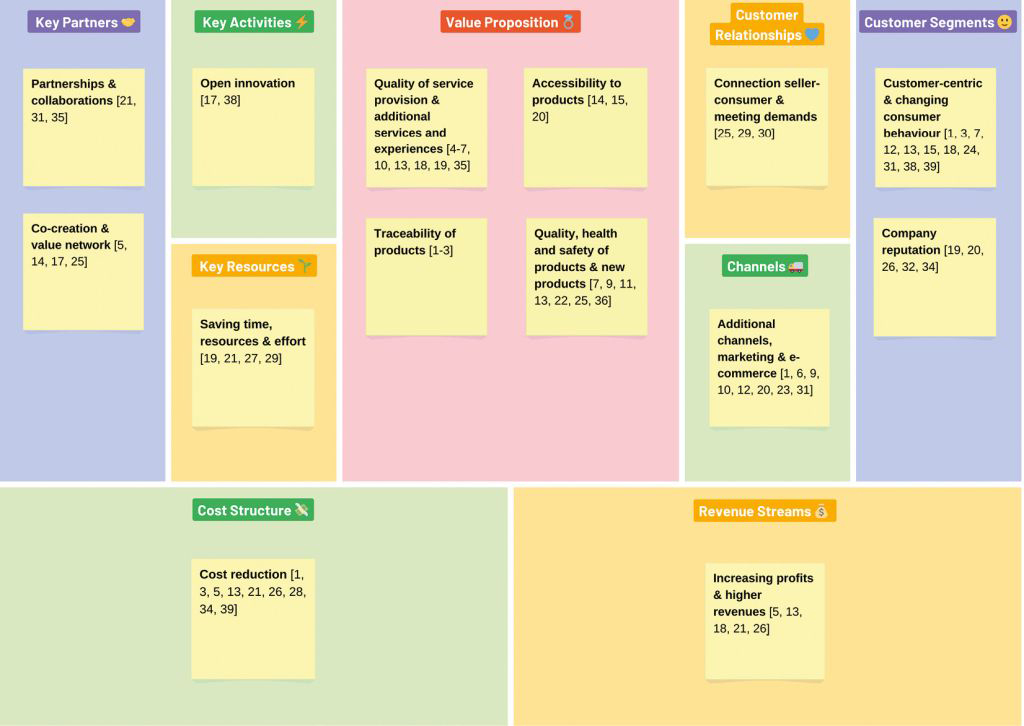
Figure 7 shows an overview of the different business model canvas components that were found in the literature as being linked to digital technology use.
Impact of digital technology use on business model canvas components according to literature from Table A1 in the Appendix (business model canvas is based on Osterwalder and Pigneur, 2010).
Citation: International Food and Agribusiness Management Review 28, 3 (2025) ; 10.22434/ifamr.1219
4.3 Drivers, benefits and drawbacks of digital technologies
Next, an overview will be given of drivers, benefits and drawbacks of digital technologies. These matters contain aspects of economic, environmental, social and technological perspectives.
4.3.1 Drivers
Many publications (n=18) mention the COVID-19 pandemic as a driver of digital technology use and/or business model change. The question is if this trend has been uphold after the pandemic. One of the articles focuses on innovation in agri-food business models after the pandemic (Mancuso et al., 2023). A few articles that were published after the start of the pandemic do not report COVID-19 at all (n=8). Additionally, one paper states that instead of driving technology use, the pandemic made food companies hesitant in using innovative technologies as they prioritised their survival (Ramanathan et al., 2023). Several publications flag keeping up with the current trends as a driver, which generally means that the enterprise in question wants to use digital technologies to stay competitive (e.g. Ahmed et al., 2023).
A few articles point out that enterprises use digital technologies driven by the urge to fulfil the (changing) demands of consumers (e.g. Uttama, 2021) and/or to tackle challenges (Shih and Wange, 2016). Next, financial (Prause et al., 2021; Sundmaeker, 2016) and regulative incentives (Prause et al., 2021; Recker et al., 2024) play a role. Other authors mention technological opportunities as drivers for digitalisation, for example to be able to deal with large amounts of data (e.g. Akarsu, 2023). Several publications argue that actors use technologies as they expect them to be beneficial in terms of maintaining high levels of production (Alvare-Palau et al., 2022) or becoming more efficient (Amaral and Orsato, 2023). Only one publication has signalized bottom-up initiatives and citizen-led approaches as drivers of change (Sarti et al., 2017).
4.3.2 Benefits
Capturing value by saving costs and gaining revenues are considered main benefits of digital technologies. Saving costs can be reached because of higher efficiency rates and improved decision making (e.g. Akyazi et al., 2020). For example, algorithmic management aids platforms with reducing operational costs (Zhu et al., 2024). This means that digital technologies can contribute to saving time, resources, fuel and effort (Ramesh et al., 2023). They can also contribute to increasing profits and revenue growth (e.g. Michelini et al., 2023).
Additionally, digital technologies can contribute to the competitiveness of a business and its survival, by providing new marketing options and better market access (e.g. Santos et al., 2024). They can contribute to business resilience, flexibility and agility through fostering innovation, resolving problems, assuring job continuity, strengthening collaborations and developing long-term growth strategies (e.g. Mancuso et al., 2023). Adding to that, big data can provide a way for small enterprises with few resources to increase visibility (e.g. Saqib and Shah, 2022).
It is also notified that digital technologies can provide consumers with easier access to food by improvements in last-mile logistic services (e.g. Alvarez-Palau et al., 2022). Similarly, marketing, commerce, and customer service can be enhanced by digital technologies (Barile et al., 2022; Sánchez-Montesinos et al., 2018). In the end, technologies provide consumers with cheaper, tastier, safer, fresher and more nourishing food, and a personalised customer experience (e.g. Ramesh et al., 2023).
Next, digital technologies contribute to production in different parts of the process. They facilitate the integration of real-time information systems, sensors, data analytics and smart technologies in the technological infrastructure, and enhancement of technological competencies (e.g. Niyawanont, 2022). In this way, they can contribute to more efficient utilisation of natural resources, and improved storage, processing, distribution, marketing and consumption (e.g. Farace and Tarabella, 2024). Through improving the process and prediction of customer behaviour, entrepreneurs can enhance the quality of final products and develop new products (e.g. Recker et al., 2024). In the end, this can lead to an efficient and sustainable food supply chain (Manko et al., 2023).
Digital technologies can also reduce the environmental impact of business activities, and enhance sustainability performance (Amaral and Orsato, 2023; Principato et al., 2023). In the case of food sharing platforms, they can mediate transactions of food close to the expiration date and facilitate food waste transfer between chain actors (Amaral and Orsato, 2023; Michelini et al., 2020, 2023; Principato et al., 2023). Thus, they can contribute to the fight against food waste and negative environmental impacts by reducing energy consumption, improving the carbon footprint and reducing greenhouse gas emissions (e.g. Shih and Wang, 2016).
Then, digital technologies are said to create job opportunities and economic growth and a range of other social benefits (Dressler and Paunovic, 2020; Shih and Wang, 2016; Sundmaeker, 2016), such as fraud reduction, increased transparency, access to financial services for marginalised actors, a fair marketplace, or mutual benefits (Isabelle et al., 2020; Manko et al., 2023; Prause et al., 2021; Utami et al., 2021). They can therefore aid in reducing information asymmetry, improving trust, social inclusion, justice and empowerment, and shortening distances in the value chain (e.g. Kawane et al., 2024). Blockchain for example has the potential to solve problems in traceability by the reduction of intermediaries (Kramer et al., 2021; Santos et al., 2024). Digital platforms can play a role in food security by encouraging food sharing (Jha and Sekhar Bhattacharyya, 2018; Ramanathan et al., 2023; Sarti et al., 2017; Uttama, 2021).
Other actors, besides businesses, could equally benefit from digital technology use through the development of a networked economy (Mahdad et al., 2022; Niyawanont., 2022). It could help governments to provide the appropriate regulatory and legislative framework for food policies (Michelini et al., 2020, 2023). Additionally, municipalities could benefit from access to data, especially during the Covid-19 pandemic, to manage costs of losses. Citizens residing within the proximity could benefit from reductions in waste taxation (Principato et al., 2023). Digital technologies could also support machine-machine and man-machine interactions (Silva and Sehnem, 2022).
4.3.3 Drawbacks
Digital technology use can cause problems in data security, privacy, ownership and usage (Akarsu, 2023). Sustainability narratives are legitimizing digitalisation in the agri-food system that might otherwise have raised critical questions about data sovereignty, privacy, surveillance and corporate control (Prause et al., 2021). The company’s brand image can be affected, as digital measurements potentially show their inefficiency (Ramanathan et al., 2023). Shared data to multiple actors in the chain could also create opportunities for felonious agents to disrupt the food chain via cyberattacks (Ramanathan et al., 2023; Zhu et al., 2024). Additionally, flexible working relationships and tight controls entailed by algorithmic management expose employees to highly demanding work standards and conditions, leading to negative psychological consequences. This is the case because algorithms lack the same level of ethics as humans, leading to dehumanization of organizational management and digital distance between platforms and participants (Zhu et al., 2024). This can cause overexploitation of associates and employees (Alvarez-Palau et al., 2022).
Digitalisation is seen to be a demanding and slow process (Dressler and Paunovic, 2020; Sarti et al., 2017). Innovations often deal with a lack of understanding, information asymmetry, and competing interests, which means that projects struggle to put digital transformation into practice (Kramer et al., 2021; Mahdad et al., 2022; Ou et al., 2021). This can cause problems in digital power concentration, thus causing divides and trust issues between actors (Kawane et al., 2024; Ramanathan et al., 2023). Food sharing platforms are said to have a positive influence on food security, but platforms neither are able to redistribute food across income categories nor are they an efficient solution in mitigating food insecurity. They are plagued by “winner-takes-all dynamics” leading to the dominance of a few all-powerful platforms (Michelini et al., 2023). Food platforms may advertise themselves as green with the aim of reducing food waste, but no control over these initiatives is enforced (Sarti et al., 2017).
Many organisations and their employees lack digital skills (Santos et al., 2024). Digital technologies request new professional skills from the workforce, as big data can be challenging to manage and is often poorly integrated (e.g. Sundmaeker, 2016). Labourers can lose their bargaining power due to deskilling (Prause et al., 2021). A specific roadmap is still lacking, so the question is how businesses can develop the proper organizational capabilities to take advantage of the data (Isabelle et al., 2020; Sánchez-Montesinos et al., 2018). Digital platforms often struggle or even fail to evolve into financially stable businesses (Principato et al., 2023).
Digital technologies can also be very capital intensive (e.g. Silva and Sehnem, 2022). The adoption and use of digital technologies sometimes requires a large amount of funds and resources (Barile et al., 2022; Farace and Tarabella, 2024; Utami et al., 2021). Digital technologies can increase energy consumption and costs, and demand for maintenance (e.g. Kramer et al., 2021). Especially SMEs (small and medium-sized enterprises) experience great barriers to digital innovation because of limited capacity (Iannone and Caruso, 2023). Similarly, the existing IT infrastructure is not always suitable for new technologies (Mancuso et al., 2023). Additionally, online platform transactions are not always well-connected with offline product transactions (Recker et al., 2024). Then, businesses and customers are often locked into traditions, they might find it difficult to get accustomed to ordering food online (e.g. Bajaj and Mehendale, 2016). This is not only caused by traditions, but also by missing social interactions and human relationships (Ahmed et al., 2023). Consumers, especially older ones, feel a loss of emotional attachment (Manko et al., 2023).
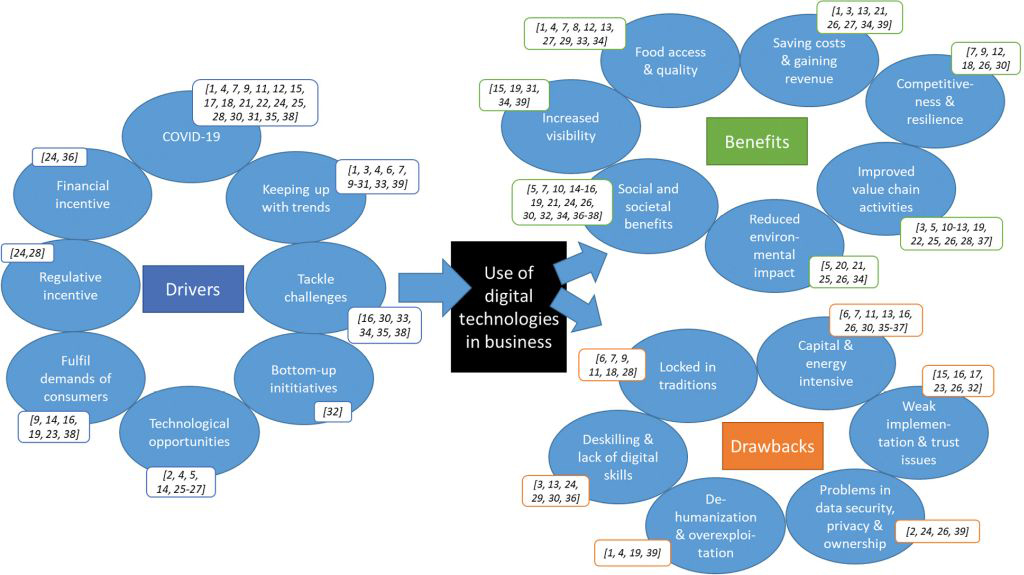
Figure 8 gives an overview of the main drivers, benefits and drawbacks of digital technology use that have been extracted from the analysed literature.
Main drivers, benefits and drawbacks of digital technologies according to literature from Table A1 in Appendix.
Citation: International Food and Agribusiness Management Review 28, 3 (2025) ; 10.22434/ifamr.1219
4.4 The aspects of sustainability
Many of the publications highlight a link between technology use and sustainability (n=35). However, some (n=5) look at sustainability in regards only to sustaining a business. The others apply some aspects of the Triple bottom line (economic, environmental and social sustainability), even though not always stating them explicitly. Dressler and Paunovic (2020) for example, express concerns about the environmental impact and adaptation to climate change. Only two articles do not mention sustainability at all (Bajaj and Mehendale, 2016; Ramesh et al., 2023). Other articles see sustainability for example as part of a circular economy model (Akarsu, 2023), of the sharing economy (Michelini et al., 2023), of a business model (Amaral and Orsato, 2023), of short food supply chains (Csordás et al., 2022), or of an organizational perspective (Michelini et al., 2020). Sometimes the focal point is on environmental aspects of sustainability (e.g. Dressler and Paunovic, 2020), often in the sense of sustainable production models (Sundmaeker, 2016). Kawane et al. (2024) include social sustainability. Additionally, Secondi et al. (2020) look at social issues and corporate social responsibility, and Utami et al. (2021) at social justice. Resilience is another concept that is linked to sustainability and digitalization, as it shows the adaptability of a business model towards changing circumstances (including COVID-19) (Farace and Tarabella, 2024).
Kramer et al. (2021) provide another point of view on digital technologies; they highlight the energy consumption of technological tools as leading to a negative environmental impact. Similarly, Prause et al. (2021) argue that digitalization will not provide a sustainable model in the agri-food sector. In contrast, Mahdad et al. (2022) say that digital technologies offer opportunities to achieve targets set by Sustainable Development Goals and the European Green Deal.
A few publications speak of circularity as a concept in addition to sustainability (21%). Multiple companies have the aim to work towards circular practices, which is not directly related to digital technologies (Iannone and Caruso, 2023). Nevertheless, digitalisation can support the improvement of the circular economy (Akarsu, 2023; Silva and Sehnem, 2022) and improve circular practices (Farace and Tarabella, 2024). Circular business models are being associated with minimizing food waste, reusing waste and recycling materials with the final goal to reach zero waste, and digital technologies can provide new opportunities to help companies to reduce waste in the supply chain (Ramanathan et al., 2023; Sarti et al., 2017). Eight papers do not mention the circular economy or circularity, but point out a few practices that are related to circularity (e.g. Shih and Wang, 2016). Food sharing platforms for example, are assumed to contribute to reducing food waste (Sarti et al., 2017) by increasing awareness, and by being less profit-oriented compared to regular supply chains (Secondi et al., 2020).
Then, agro-ecology as a concept has only been pointed out in one publication, in which it is connected to agro-ecological farmers rather than the other actors of the value chain (Prause et al., 2021). A few others (n=4) do not explicitly report agro-ecology, but do mention ecological aspects as in ecological circles (Ou et al., 2021), ecological footprints (Ramanathan et al., 2023), ecological production (Farace and Tarabella, 2024), or ecological harms (Michelini et al., 2020).
5. Discussion
According to the small quantity of articles that had been identified in this review and the overrepresentation of qualitative research methods, digital technology use of business models in agri-food value chains seem to be scarcely studied. This shows that this field is still in a new and explorative phase, which leaves room for further exploration. The following section discusses the results and compares them to the research questions of this review, and provides research and management recommendations.
5.1 Digital technology use
Digital technologies certainly display potential in sustainable transformation. Yet, digital technologies do not bring change on their own. Communication technologies like block chain, social media and other digital platforms need several additional technologies such as cloud computing, AI and IoT, and partnerships to be able to be used in a collaborative- and environmental-friendly way. Together, they provide services for businesses and consumers (Alvarez-Palau et al., 2022; Amaral and Orsato, 2023; Bajaj and Mehendale, 2016; Barile et al., 2022; Dressler and Paunovic, 2020; Silva and Sehnem, 2022). Block chain, for example, has been argued to be able to offer decentralization, which enhances interaction (Kramer et al., 2021; Principato et al., 2023).
Csordás et al. (2022) consider social media platforms such as Facebook and Instagram as ‘basic’ marketing tools. Thus, these tools might not be ‘special enough’ to be studied more elaborately, but they are definitely used by actors. They are all emphasizing on communication and connections, which is related to improving the network of value chain actors. Value chains are often related to communication and connecting technologies in the literature, as the connection between value chain actors can be enhanced through improved communication (Abideen et al., 2021). Therefore, it is of utmost importance to incorporate these communication and connecting technologies in studies on value chains. These connective properties urge us to look at agri-food value chains through a network perspective, instead of only at the business level.
On the other hand, due to digital technology use, human interaction can be minimized or even lost (Ahmed et al., 2023; Kawane et al., 2024; Saqib and Shah, 2022). This was convenient in the COVID-19 pandemic as it helped with social distancing (Akyazi et al., 2020). Nevertheless, people might miss the lack of human interaction that digital technologies bring with them. Communication can therefore become easier, but might lose its human connections that are essential for social life. In order to guard this human element, value chains could be observed through an open innovation lense. Open innovation stimulates a business to make its boundaries more permeable, allowing the exchange of inter-organizational knowledge flows and collaboration with a variety of external actors in order to produce lasting innovations (Bigliardi and Filippelli, 2022; Piot-Lepetit, 2023).
Yet, most businesses adopt digital technologies directly from tech-companies and are dependent on them for their operations. It is possible to develop innovations without depending on tech-companies, but it is not often done so. Thus, most publications see technology-use as a practice of adoption from tech-companies instead of an initiative that develops at the business, in connection with its surrounding community. This review argues that digital technology use is not only a matter of adoption; it is rather a matter of adaptation to and interaction with the (either local or international) context and transformation with the use of both top-down and bottom-up approaches.
5.2 Impact of digital technologies on the innovation of different business model canvas components.
The results showed that digital technologies can contribute in many ways to value creation, proposition, delivery and capture processes, which contributes to business performance (Farace and Tarabella, 2024). This review confirms that digital technologies have the potential to contribute to transforming towards sustainable business models and supporting business model innovation (Akarsu, 2023; Principato et al., 2023). Nonetheless, there are some factors that define if a business reaches the required technological, human and financial resource availability to use digital technologies successfully. The size of the company and the offerings from technology providers affect the resource accessibility and with that value creation. Additionally, the use of different partnerships and resources is defined by the innovation of technologies (Bajaj and Mehendale, 2016; Manko et al., 2023). Principato et al. (2023) mention that social and environmental sustainability perspectives are part of the value proposition. Thus, it is essential to bring in sustainability perspectives, such as repurposing leftover products to poor households while staying healthy and safe, in order to benefit from products and services.
According to Saqib and Shah (2022), BMI offers a chance to create long-term competitive advantage for a business. Nevertheless, the consequences of digital technologies are not only positive and business success might not last in the long-term. Digital platforms often struggle or even fail to evolve into financially stable business models (Principato et al., 2023). The case explored by Kawane et al. (2024) shows that innovations related to digital technologies does not necessarily lead to an advantage in competitiveness in the long-term, but rather deals with the effects of a crisis (the COVID-19 pandemic) (Kawane et al., 2024). The question is if this trend has been uphold after the pandemic. Changes might or might not last, depending on the adaptability and flexibility of an enterprise.
In correspondence with the literature, this review shows that technologies can have social, economic and environmental benefits for value creation (Principato et al., 2023; Zhu et al., 2024). Most articles seem to give a rather unbalanced view on advantages and disadvantages, and mostly speak about restrictions to the adoption of digital technologies instead of the actual disadvantages of technology use. However, this does not mean that there are no downsides.
5.3 The light and dark sides of digital technologies
Most of the publications display a rather positive outlook on digital technology use; they are more worried about the accessibility and adoption of the digital technologies than the actual consequences. Zhu et al. (2024) on the contrary, show the dark sides of the gig economy and the related digital technologies. While digitalisation offers a fascinating perspective, after viewing all the publications, there seem to be both light and dark sides. These matters are not only related to the adoption of digital technologies but similarly to their daily use and future prospective.
Most businesses adopt digital technologies to keep up with the trends and with other businesses. Thus, digitalisation is seen as something that is bound to happen and mostly in a sustainable way.
As an example, multiple articles pointed out that actors are often locked into traditions, and that is why they are not able to use digital technologies (Bajaj and Mehendale, 2016; Barile et al., 2022; Csordás et al., 2022; Farace and Tarabella, 2024). This is not only caused by traditions, but also by a lack of social interactions and human relationships (Ahmed et al., 2023). This review argues to not forget the human element, it might be more efficient or sustainable to let people use something, but people might not feel the incentive as they feel less human and can miss personal contact. The disadvantages of digital technology use should not be ignored as they have a considerable influence on drivers for decision making regarding digital technologies. This does not exclude that there are restrictions in adoption of technologies, rather the argument here is that actors should not be pressured to use digital technologies if they do not fit in their life style.
The studied articles mostly ignore that, even though that businesses are using digital tools, many of them are using digital technologies because they feel obliged to do so (Bellon-Maurel et al., 2023). It is essential to further explore this obligation. This comes back to the existential question if the modern way is the only way of living. Especially in Europe, development has been seen as always going forward, going hand in hand with globalization and digitalisation. Yet, there are many alternative ways that do not always involve modern technology use. The circular economy, for example, aims to contribute to sustainable practices, but might or might not make use of digital technologies (Akarsu, 2023). There might be other ways for people to deal with issues such as climate change. Digital could be part of the solution, but cannot be considered as the panacea.
Businesses might even make use of the good name of digital technologies as being trustworthy and reliable. As an example, one of the articles mentioned that food alerting platforms may advertise themselves as green and with the aim of reducing food waste but no control over these initiatives is enforced (Sarti et al., 2017). This shows that a certain degree of greenwashing might take place; i.e. ‘green businesses’ might display that they are following sustainable practices in contrary to the truth. Everyone believes their claim as they can prove it with data, but the data might not be that accurate or could even be falsified. Yet, this is what could provide space for misuse of a good reputation, as costumers might think that digital data is fully objective and they lose their criticality. Thus, even though people miss human interaction, they might put more trust in ‘objective’ digital technologies.
5.4 How to bring in sustainability
Thus, digital technologies can both be contributing to risks and opportunities in reaching sustainability (Dressler, 2023; Hong et al., 2022; Joyce and Paquin, 2016). Businesses in agri-food value chains are expected to respond to different sustainability and corporate responsibility concerns (Fortunati et al., 2020; Klein et al., 2022). There is no denial that there is a possibility that innovations based on digital technologies can contribute to business development and employment, ‘green’ products, income diversification, increased resilience of rural and urban actors, and value co-creation (Hong et al., 2022). This point of view represents the current dominant strategic paradigm of sustainability for entrepreneurs (Bigliardi and Filippelli, 2022; Dressler, 2023). Nevertheless, as mentioned before, businesses are not always as green as they would like us to think they are. Using digital technologies does not change the essence and the values of businesses, they can just be as polluting or sustainable with or without digital technology use. Sustainable transformation can be reached through incorporating green values in a business, after which the business might incorporate sustainable practices by utilising digital tools. Economically, digital technologies can be attractive for businesses, but other aspects are underrepresented in the majority of publications. That is why this review integrates other aspects in its analysis. The circular economy (21%) and agro-ecology (3%) are not mentioned often while these concepts are associated with a sustainable network in a value chain. These concepts are especially intriguing when developing an international value chain perspective, as there is a need to link sustainability and Corporate Social Responsibility of businesses in the value chain from different countries together in a network. A network perspective can show the weaknesses and strengths in a value chain, and accordingly which parts should be enhanced.
5.5 Recommendations for further research and management practice
A sustainable value chain is not dependent on only one part of the network. None of the papers seemed to have made a connection between business models in global value chains. The majority of papers are primarily focused on case studies in the global north (mainly Europe) without connecting them to value chains coming from other countries, specifically for the chains originating in the global south (e.g. coffee, cacao). These results showed that publications on agri-food business models centre on one part of the value chain; business models are rather seen as entities on their own instead of a network in an international context. Exporters and importers as international actors are not included in this equation, which leaves the international aspect for a large part out of this type of literature. There seems to be a general bias towards the global north, mainly Europe, in both specific case studies and cross-continental studies.
A chain is as strong as its weakest link, so even if one large business or one part of a value chain manages to use digital technologies in a successful way other parts of the value chain, especially SMEs might not share in the success. This has certain (not always positive) consequences for the value chain. Until now the broader chain impacts are rather guessed instead of known by researchers. This includes the potential for new food products and jobs, increased resilience and risk mitigation of rural and urban actors, and triggers to co-create value (Hong et al., 2022). As to develop a theoretical framework towards improving sustainability in an international perspective, our study urges to bring in concepts of value co-creation and open innovation in business model analysis, in research and management practice.
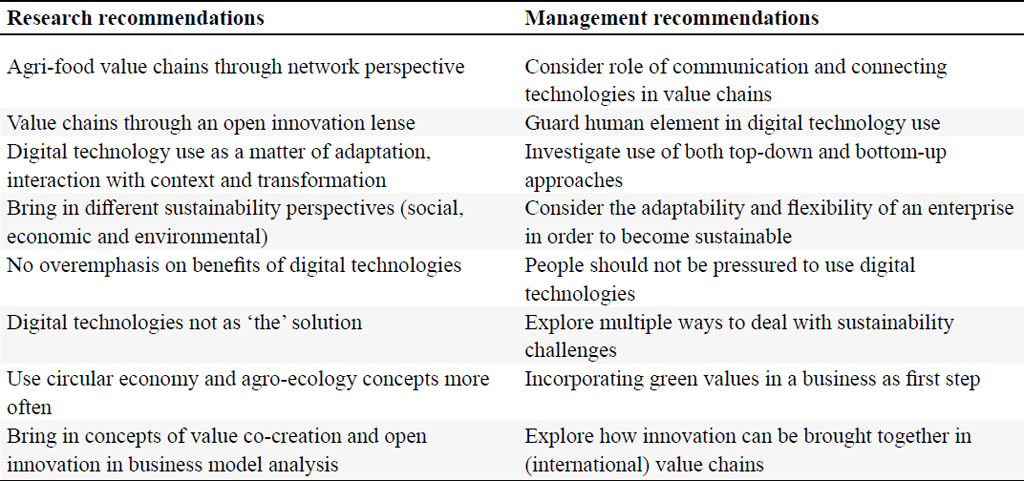
Table 1 provides an overview of research and management recommendations that followed from the discussion.
Main recommendations for researchers and agribusiness managers following from review
Citation: International Food and Agribusiness Management Review 28, 3 (2025) ; 10.22434/ifamr.1219
6. Conclusion
Digital technologies are seen as having the potential to contribute to sustainable practices, but there is still a need to better understand the impact of digitalization in the agri-food sector. The main aim of this review article was to discover the state of the art of the research in the use of digital technologies in business models contributing to sustainability in the agri-food sector, and to make recommendations for future research and management practice.
Although this research field is recent and the number of publications still limited, some valuable insights into possible business model innovations as well as drivers, benefits and drawbacks of digitalisation in agri-food value chains could be gained. Key themes found in the literature were the effects of COVID-19 on digitalisation and business resilience, the sustainability of a business in regards to multiple aspects, and the importance of communication technologies in agri-food value chains.
This review article argues that even though digital technologies can enhance and increase social interaction, the human element can be lost during this process. This can make it difficult for a business to communicate with other actors and reach social sustainability. A value chain is as strong as its weakest link. Thus, even if one business makes successful use of digital technologies, others might not profit due to a lack of the human element in local but also international value chains. This urges us to look at agri-food value chains through a network perspective, instead of only at the business level.
Economic sustainability is not the only aim of a business, there can be looked at the societal and environmental consequences of digitalisation via circular economy and agro-ecology approaches. This is why there was a need to develop a framework linking digital technologies to different social, economic and environmental aspects of business models (Figure 1). This also means that technologies can be seen through a lense of adaptability and transformation instead of adoption. Digitalisation in agri food businesses is a way to contribute to sustainability, but not the only way, so its importance does not have to be overemphasised.
Open innovation and value co-creation can provide a way to look at innovative and value creating interactions between actors and their consequences. Therefore, co-creating innovation are essential in reaching mutual sustainability in the value chain network. This review led to several recommendations for researchers and business managers in the agri-food domain in using digital technologies, which were mentioned in table 1. In the end, this paper recommends for future research and management practice to use a framework that looks through a value co-creation and open innovation perspective to both the business model level and the interaction between (sustainable) business models in local and global food systems.
Acknowledgements
The authors would like to thank the reviewers for their feedback. This project has received funding from the FEDER EMERGENCE project TENABIC in the framework of the Occitanie programme FEDER FSE+ 2021–2027 and PEPR Agroécologie et Numérique project CoEDiTAg in the framework of the ANR (Agence Nationale de la Recherche). This work has also benefited from financial aid by the National Research Agency under the France 2030 program, reference number ANR-16-CONV-0004. The authors state that the research took place without any ties to institutions or individuals that could be considered as a conflict of interest.
References
Abideen, A.Z., V.P.K. Sundram, J. Pyeman, A.K. Othman and S. Sorooshian. 2021. Digital twin integrated reinforced learning in supply chain and logistics. Logistics 5(4): 84. https://doi.org/10.3390/logistics5040084
Ahmed, J.U., A. Ahmed, A. Talukdar, R. Sharif and Z. Jahangir. 2023. Innovation strategy in retail: The unstaffed digital supermarkets at LIFVS. Journal of Information Technology Teaching Cases 13(2): 175–181. https://doi.org/10.1177/20438869221109844
Akarsu, T.N. 2023. Digital transformation towards a sustainable circular economy: can it be the way forward? Journal of Information Technology Teaching Cases 14(2): 186–191. https://doi.org/10.1177/20438869231178036
Akyazi, T., A. Goti, A. Oyarbide, E. Alberdi and F. Bayon. 2020. A guide for the food industry to meet the future skills requirements emerging with industry 4.0. Foods 9(4): 492. https://doi.org/10.3390/foods9040492
Almansour, M. 2022. Food start-ups: Leveraging digital marketing and disruptive information systems innovations to survive in the post-COVID environment. European Journal of Innovation Management 27(3): 944–961. https://doi.org/10.1108/EJIM-07-2022-0370
Alvarez-Palau, E.J., L. Calvet-Liñán, M. Viu-Roig, M. Gandouz and A.A. Juan. 2022. Economic profitability of last-mile food delivery services: lessons from Barcelona. Research in Transportation Business and Management 45: 100659. https://doi.org/10.1016/j.rtbm.2021.100659
Amaral, D. and R. Orsato. 2023. Digital platforms for food waste reduction: the value for business users. Business Strategy and the Environment 32(4): 1373–1387. https://doi.org/10.1002/bse.3193
Antikainen, M. and K. Valkokari. 2016. A framework for sustainable circular business model innovation. Technology Innovation Management Review 6(7): 5–12. https://doi.org/10.22215/timreview/1000
Bajaj, K. and S. Mehendale. 2016. Food-delivery start-ups: in search of the core. Prabandhan: Indian Journal of Management 9(10): 42–53. https://doi.org/10.17010/pijom/2016/v9i10/103073
Barile, D., G. Secundo and P. Del Vecchio. 2022. Food 4.0 for competing during the COVID-19 pandemic: experimenting digitalization in family firms. European Journal of Innovation Management 27(4): 1381–1402. https://doi.org/10.1108/EJIM-07-2022-0373
Bellon-Maurel, V., I. Piot-Lepetit, N. Lachia and B. Tisseyre. 2023. Digital agriculture in Europe and in France: which organisations can boost adoption levels? Crop and Pasture Science 74(6): 573–585.
Bigliardi, B. and S. Filippelli. 2022. Sustainability and Open Innovation: Main Themes and Research Trajectories. Sustainability 14(11): 6763. https://doi.org/10.3390/su14116763
Bronson, K. and I. Knezevic. 2016. Big Data in food and agriculture. Big Data & Society 3(1): 2053951716648174. https://doi.org/10.1177/2053951716648174
Carolan, M. 2017. Publicising food: big data, precision agriculture, and co-experimental techniques of addition. Sociologia Ruralis 57(2): 135–154. https://doi.org/10.1111/soru.12120
Correa, J.C., W. Garzón, P. Brooker, G. Sakarkar, S.A. Carranza, L. Yunado and A. Rincón. 2019. Evaluation of collaborative consumption of food delivery services through web mining techniques. Journal of Retailing and Consumer Services 46: 45–50. https://doi.org/10.1016/j.jretconser.2018.05.002
Csordás, A., J. Pancsira, P. Lengyel, I. Füzesi and J. Felföldi. 2022. The potential of digital marketing tools to develop the innovative SFSC players’ business models. Journal of Open Innovation: Technology, Market, and Complexity 8(3): 122. https://doi.org/10.3390/joitmc8030122
Dagoudo, B.A., C. Ssekyewa, S.D. Tovignan, J. Ssekandi and P.M. Nina. 2023. Agroecological business model: a pillar stone for women’s entrepreneurship in agroecology and sustainable food systems. International Journal of Current Science Research and Review 6(1): 296–304. https://doi.org/10.47191/ijcsrr/V6-i1-31
De Bernardi, P., D. Azucar, C. Forliano, M. Franco, P. DeBernardi and D. Azucar. 2020. Innovative and sustainable food business models. In: Innovation in Food Ecosystems. Contributions to Management Science. Springer, Cham, pp. 73–104. https://doi.org/10.1007/978-3-030-33502-1_7
Di Vaio, A., F. Boccia, L. Landriani and R. Palladino. 2020. Artificial intelligence in the agri-food system: rethinking sustainable business models in the COVID-19 scenario. Sustainability 12(12): 4851. https://doi.org/10.3390/su12124851
Donner, M. and H. de Vries. 2021. How to innovate business models for a circular bio-economy? Business Strategy and the Environment 30(4): 1932–1947. https://doi.org/10.1002/bse.2725
Donner, M. and H. de Vries. 2023. Innovative business models for a sustainable circular bioeconomy in the French agrifood domain. Sustainability 15(6): 5499. https://doi.org/10.3390/su15065499
Donnet, M. L., D.D. Weatherspoon and J.P. Hoehn. 2007. What adds value in specialty coffee? Managerial implications from hedonic price analysis of Central and South American e-auctions. International Food and Agribusiness Management Review 10(3): 1–18. http://dx.doi.org/10.22004/ag.econ.8162
Dressler, M. 2023. Sustainable business model design: a multi-case approach exploring generic strategies and dynamic capabilities on the example of German wine estates. Sustainability 15(5): 3880. https://doi.org/10.3390/su15053880
Dressler, M. and I. Paunovic. 2020. Converging and diverging business model innovation in regional intersectoral cooperation-exploring wine industry 4.0. European Journal of Innovation Management 24(5): 1625–1652. https://doi.org/10.1108/EJIM-04-2020-0142
Farace, B. and A. Tarabella. 2023. Exploring the role of digitalization as a driver for the adoption of circular economy principles in agrifood SMEs — an interpretive case study. British Food Journal 126(1): 409–427. https://doi.org/10.1108/BFJ-12-2022-1103
Fortunati, S., D. Morea and E.M. Mosconi. 2020. Circular economy and corporate social responsibility in the agricultural system: Cases study of the Italian agri-food industry. Agricultural Economics (Zemědělská Ekonomika) 66(11): 489–498. https://doi.org/10.17221/343/2020-AGRICECON
Galardi, M., R. Moruzzo, F. Riccioli, G. Granai and F. Di Iacovo. 2022. Small rural enterprises and innovative business models: a case study of the Turin area. Sustainability 14(3): 1265. https://doi.org/10.3390/su14031265
García-Álvarez de Perea, J., C. Ramírez-García and A. Del Cubo-Molina. 2019. Internationalization business models and patterns of SMEs and MNEs: a qualitative multi-case study in the agrifood sector. Sustainability 11(10): 2755. https://doi.org/10.3390/su11102755
Hong, P., N.L. Balasudarsun, N., Vivek. and M. Sathish. 2022. Sustainable agricultural business model: case studies of innovative Indian farmers. Sustainability 14(16): 10242. https://doi.org/10.3390/su141610242
Hong, Y. 2021. New model of food supply chain finance based on the Internet of Things and blockchain. Mobile Information Systems 2021(1): 7589964. https://doi.org/10.1155/2021/7589964
Iannone, B. and G. Caruso. 2023. ‘Sustainab-lization’: sustainability and digitalization as a strategy for resilience in the coffee sector. Sustainability 15(6): 4893. https://doi.org/10.3390/su15064893
Isabelle, D., M. Westerlund, M. Mane and S. Leminen. 2020. The role of analytics in data-driven business models of multi-sided platforms: an exploration in the food industry. Technology Innovation Management Review 10(7): 4–15. https://doi.org/10.22215/timreview/1371
Jha, S. and S. Sekhar Bhattacharyya. 2018. Online restaurant entrepreneurship: the story of Holachef in an increasingly digitalized India. Emerald Emerging Markets Case Studies 8(1): 1–17. https://doi.org/10.1108/EEMCS-03-2017-0040
Joyce, A. and R.L. Paquin. 2016. The triple layered business model canvas: A tool to design more sustainable business models. Journal of Cleaner Production 135: 1474–1486. https://doi.org/10.1016/j.jclepro.2016.06.067
Kähkönen, A. 2012. Value net—A new business model for the food industry? British Food Journal 114(5): 681–701. https://doi.org/10.1108/00070701211229972
Kawane, T., B. Adu-Gyamfi, Y. Cao, Y. Zhang, N. Yamazawa, Z. He and R. Shaw. 2024. Digitization as an adaptation and resilience measure for MSMEs amid the COVID-19 pandemic in Japan: lessons from the food service industry for collaborative future engagements. Sustainability 16(4): 1550. https://doi.org/10.3390/su16041550
Klein, O., S. Nier and C. Tamásy. 2022. Circular agri-food economies: Business models and practices in the potato industry. Sustainability Science 17(6): 2237–2252. https://doi.org/10.1007/s11625-022-01106-1
Klerkx, L., E. Jakku and P. Labarthe. 2019. A review of social science on digital agriculture, smart farming and agriculture 4.0: new contributions and a future research agenda. NJAS: Wageningen Journal of Life Sciences 90–91: 100315. https://doi.org/10.1016/j.njas.2019.100315
Kramer, M., L. Bitsch and J. Hanf. 2021. Blockchain and its impacts on agri-food supply chain network management. Sustainability 13(4): 2168. https://doi.org/10.3390/su13042168
Krstić, M., G.P. Agnusdei, P.P. Miglietta and S. Tadić. 2022. Logistics 4.0 toward circular economy in the agri-food sector. Sustainable Futures 4: 100097. https://doi.org/10.1016/j.sftr.2022.100097
Lagrasta, F. P., P. Pontrandolfo and B. Scozzi. 2021. Circular economy business models for the Tanzanian coffee sector: a teaching case study. Sustainability 13(24): 13931. https://doi.org/10.3390/su132413931
Lajoie-O’Malley, A., K. Bronson, S. van der Burg and L. Klerkx. 2020. The future(s) of digital agriculture and sustainable food systems: an analysis of high-level policy documents. Ecosystem Services 45: 101183. https://doi.org/10.1016/j.ecoser.2020.101183
Ludin, D., M. Holler, W. Wellbrock and E. Mueller. 2022. How COVID-19 accelerates business model innovation and digital technological transformation in the hospitality industry: a focus on restaurants in Baden-Wuerttemberg. International Journal of Innovation and Technology Management 19(6): 2242002. https://doi.org/10.1142/S0219877022420020
Mahdad, M., M. Hasanov, G. Isakhanyan and W. Dolfsma. 2022. A smart web of firms, farms and internet of things (IOT): Enabling collaboration-based business models in the agri-food industry. British Food Journal 124(6): 1857–1874. https://doi.org/10.1108/BFJ-07-2021-0756
Mancuso, I., A. Petruzzelli and U. Panniello. 2023. Innovating agri-food business models after the Covid-19 pandemic: the impact of digital technologies on the value creation and value capture mechanisms. Technological Forecasting and Social Change 190: 122404. https://doi.org/10.1016/j.techfore.2023.122404
Manko, B. 2023. Elevating the customer shopping experience through digital technologies: how Wegmans Food Markets became a destination. Journal of Information Technology Teaching Cases 13(2): 222–229. https://doi.org/10.1177/20438869221134302
Martin, M., and M. Bustamante. 2021. Growing-service systems: new business models for modular urban-vertical farming. Frontiers in Sustainable Food Systems 5: 787281. https://doi.org/10.3389/fsufs.2021.787281
Michelini, L., C. Grieco, F. Ciulli and A. Di Leo. 2020. Uncovering the impact of food sharing platform business models: A theory of change approach. British Food Journal 122(5): 1437–1462. https://doi.org/10.1108/BFJ-06-2019-0422
Michelini, L., C. Grieco and N. Dentchev. 2023. Leveraging collaborations to increase the impact of food sharing platforms. British Food Journal 125(11): 3953–3978. https://doi.org/10.1108/BFJ-10-2022-0900
Niyawanont, N. 2022. Structural Equation Modelling of Digital Transformation Process of Thailand Agriculture & Food Industry. Journal of Technology Management and Innovation 17(3): 40–51. http://dx.doi.org/10.4067/S0718-27242022000300040
Osterwalder, A. and Y. Pigneur. 2010. Business Model Generation: A Handbook for Visionaries, Game Changers, and Challengers. Wiley, Chichester.
Ou, T.Y., G.Y. Lin, C.Y. Liu and W.L. Tsai 2021. Constructing a sustainable and dynamic promotion model for fresh foods based on a digital transformation framework. Sustainability 13(19): 10687. https://doi.org/10.3390/su131910687
Pachni-Tsitiridou, O. and K. Fouskas. 2022. Mapping digital transformation efforts: Lessons from organisations in agribusiness sector. International Journal of Sustainable Agricultural Management and Informatics 8(2): 119–143. https://doi.org/10.1504/IJSAMI.2022.10047171
Page, M.J., J.E. McKenzie, P.M. Bossuyt, I. Boutron, T.C. Hoffmann, C.D. Mulrow, L. Shamseer, J.M. Tetzlaff, E.A. Akl, S.E. Brennan, R. Chou, J. Glanville, J.M. Grimshaw, A. Hróbjartsson, M.M. Lalu, T. Li, E.W. Loder, E. Mayo-Wilson, S. McDonald, L.A. McGuinness, L.A. Stewart, J. Thomas, A.C. Tricco, V.A. Welch, P. Whiting and D. Moher. 2021. The PRISMA 2020 statement: An updated guideline for reporting systematic reviews. BMJ 2021(372): 71. https://doi.org/10.1136/bmj.n71
Plumecocq, G., T. Debril, M. Duru, M.B. Magrini, J.P. Sarthou and O. Therond. 2018. The plurality of values in sustainable agriculture models: Diverse lock-in and coevolution patterns. Ecology and Society 23(1): 21. https://doi.org/10.5751/ES-09881-230121
Poppe, K.J., S. Wolfert, C. Verdouw and T. Verwaart. 2013. Information and communication technology as a driver for change in agri-food chains. EuroChoices 12(1): 60–65. https://doi.org/10.1111/1746-692X.12022
Prause, L., S. Hackfort and M. Lindgren. 2021. Digitalization and the third food regime. Agriculture and Human Values 38(3): 641–655. https://doi.org/10.1007/s10460-020-10161-2
Principato, L., C. Trevisan, M. Formentini, L. Secondi, C. Comis and C. Pratesi. 2023. The influence of sustainability and digitalisation on business model innovation: The case of a multi-sided platform for food surplus redistribution. Industrial Marketing Management 115: 156–171. https://doi.org/10.1016/j.indmarman.2023.09.001
Ramanathan, R., Y. Duan, T. Ajmal, K. Pelc, J. Gillespie, S. Ahmadzadeh, J. Condell, I. Hermens and U. Ramanathan. 2023. Motivations and challenges for food companies in using IoT sensors for reducing food waste: some insights and a road map for the future. Sustainability 15(2): 1665. https://doi.org/10.3390/su15021665
Ramesh, R., S.V. Prabhu, B. Sasikumar, B.S.K. Devi, P. Prasath and S.P.R. Kamala. 2023. An empirical study of online food delivery services from applications perspective. Materials Today: Proceedings 80: 1751–1755. https://doi.org/10.1016/j.matpr.2021.05.500
Recker, J., T. Bockelmann and F. Barthel. 2024. Growing online-to-offline platform businesses: how Vytal became the world-leading provider of smart reusable food packaging. Information Systems Journal 34(1): 179–200. https://doi.org/10.1111/isj.12474
Sánchez-Montesinos, F., M. Basáez, D. Aranda and O. Bustinza. 2018. Creating isolating mechanisms through digital servitization: the case of Covirán. Strategic Change-Briefings in Entrepreneurial Finance 27(2): 121–128. https://doi.org/10.1002/jsc.2187
Santos, F.J., C. Guzmán and P. Ahumada. 2024. Assessing the digital transformation in agri-food cooperatives and its determinants. Journal of Rural Studies 105: 103168. https://doi.org/10.1016/j.jrurstud.2023.103168
Saqib, N. and G.B. Shah. 2022. Business model innovation through digital entrepreneurship: a case of online food delivery start-up in India. International Journal of E-Entrepreneurship and Innovation 13(1): 1–20. https://doi.org/10.4018/IJEEI.315294
Sarti, S., F. Corsini, N.M. Gusmerotti and M. Frey. 2017. Food sharing: making sense between new business models and responsible social initiatives for food waste prevention. Economics and Policy of Energy and the Environment 2017(1): 123–134. https://doi.org/10.3280/EFE2017-001007
Secondi, L., L. Principato and G. Mattia. 2020. Can digital solutions help in the minimization of out-of-home waste? An analysis from the client and business perspective. British Food Journal 122(5): 1341–1359. https://doi.org/10.1108/BFJ-03-2019-0205
Shafi, U., R. Mumtaz, J. García-Nieto, S.A. Hassan, S.A.R. Zaidi and N. Iqbal. 2019. Precision agriculture techniques and practices: from considerations to applications. Sensors 19(17): 3796. https://doi.org/10.3390/s19173796
Shankar, A., A. Dhir, S. Talwar, N. Islam and P. Sharma. 2022. Balancing food waste and sustainability goals in online food delivery: towards a comprehensive conceptual framework. Technovation 117: 102606. https://doi.org/10.1016/j.technovation.2022.102606
Shih, C.W. and C.H. Wang. 2016. Integrating wireless sensor networks with statistical quality control to develop a cold chain system in food industries. Computer Standards and Interfaces 45: 62–78. https://doi.org/10.1016/j.csi.2015.12.004
Silva, T.H., and Sehnem, S. (2022). Industry 4.0 and the circular economy: integration opportunities generated by startups. Logistics 6(1): 14. https://doi.org/10.3390/logistics6010014
Snyder, H. 2019. Literature review as a research methodology: an overview and guidelines. Journal of business Research 104: 333–339. https://doi.org/10.1016/j.jbusres.2019.07.039
Sumrit, D. 2023. Modelling the causal relationships of the readiness factors for industrial internet of things adoption using DEMATEL-based rough set theory. International Journal of Management and Decision Making 22(2): 123–159. https://doi.org/10.1504/IJMDM.2023.129832
Sundmaeker, H. 2016. Accelerating system development for the food chain: a portfolio of over 30 projects, aiming at impact and growth. International Journal on Food System Dynamics 7(4): 371–381. https://doi.org/10.18461/ijfsd.v7i4.747
Teece, D. J. 2010. Business models, business strategy and innovation. Long Range Planning 43(2): 172–194. https://doi.org/10.1016/j.lrp.2009.07.003
Torraco, R. (2005). Writing integrative literature reviews: guidelines and examples. Human Resource Development Review 4(3): 356–367. https://doi.org/10.1177/1534484305278283
Utami, H.N., E. Alamanos and S. Kuznesof. 2021. ‘A social justice logic’: How digital commerce enables value co-creation at the bottom of the pyramid. Journal of Marketing Management 37(9–10): 816–855. https://doi.org/10.1080/0267257X.2021.1908399
Uttama, N. P. (2021). Open innovation and business model of health food industry in Asia. Journal of Open Innovation: Technology, Market, and Complexity 7(3): 174. https://doi.org/10.3390/joitmc7030174
Zhu, G., J. Huang, J. Lu, Y. Luo and T. Zhu. 2024. Gig to the left, algorithms to the right: a case study of the dark sides in the gig economy. Technological Forecasting and Social Change 199: 123018. https://doi.org/10.1016/j.techfore.2023.12301
Appendix
List of papers that were used in the analysis of this review
Citation: International Food and Agribusiness Management Review 28, 3 (2025) ; 10.22434/ifamr.1219
Corresponding author