Abstract
Agriculture in developing countries is undergoing a transition from self-sustaining subsistence to specialized production. It is believed that the primary barriers to market participation and specialized production for farmers are market remoteness and limited access to market information. Using evidence from China, this paper aims to examine the role of information and communication technologies (ICTs) and market extent in the process of agricultural specialization. The study finds that both the extent of market and the level of coverage and utilization of ICTs contribute positively to crop specialization. Furthermore, the complementary relationship between these factors indicate that ICT adoption enhances specialization for farmers distant from markets. Further analysis shows that the extent of market and ICTs facilitate farmersâ transition towards specialization by fostering commercialization, mechanization and intensification. This study highlights the significance of market extent and information access for agricultural transformation. Therefore, it is important for policymakers to expand infrastructural coverage (especially roads and communication networks), enhance market information services, and promote ICT adoption among rural farmers.
1. Introduction
Since the 20th century agriculture has gradually transformed from a labor-intensive, diversified, and largely subsistence activity into a highly specialized, market-oriented industry (Abson, 2019). Historically, most farmers produced a variety of products primarily for their own consumption, but have increasingly focused on one or a few crops (Timmer, 1997). Agriculture, primarily driven by market forces, has evolved from subsistence and semi-commercial systems to commercial systems, resulting in a more market-oriented and highly specialized products (Pingali and Rosegrant, 1995). This shift toward specialization, coupled with gains in efficiency, has been observed in both developing and developed countries. Research indicates that specialization significantly contributed to total factor productivity growth in the US crop and livestock sectors from 1950 to 1982 (Huffman and Evenson, 2001). Between 1903 and 1992, Pakistan experienced a shift from subsistence cropping patterns to specialized production, leading to enhanced land productivity (Kurosaki, 2003). Similarly, crop and livestock production specialization in China showed an upward trend from 2003 to 2011 (Ma et al., 2014). Recent data from China and the United States also demonstrate an ongoing shift from diversification to specialization in crop production (Aguilar et al., 2015; Jiang et al., 2023).
In Adam Smithâs (1776: p. 21) classic statement in chapter III of his work that, he noted that the âdivision of labor limited by the Extent of the Marketâ, which has become a fundamental principle of economic organization (Stigler, 1951). Inspired by this classic work, the relationship between market and specialized production has been widely discussed. Yang and Shi (1992: p. 397) concluded that âThe economy will be in autarky if transaction efficiency is sufficiently small and will be in complete division of labor if transaction efficiency is sufficiently largeâ. For smallholders, opportunities to increase their incomes through agricultural production often depend on their ability to successfully participate in markets (Markelova et al., 2009). High transportation and transaction costs are major barriers to market participation for farmers in developing countries (Abman and Lundberg, 2024). Smallholder farmers in remote areas with poor transportation and market infrastructure face high transportation costs (Fan and Salas Garcia, 2018; Ouma et al., 2010; Qin and Zhang, 2016); additionally, limited access to information inevitably hampers farmers marketing participation (Goyal, 2010). Information and communication technologies (ICTs) are increasingly acknowledged as pivotal in driving agricultural transformation and rural development (Ajani, 2014; Aker and Mbiti, 2010; Min et al., 2020; Nakasone et al., 2014). Zhang et al. (2021) and Khan et al. (2022) highlight the influence of ICTs on market participation, noting their role in expanding marketing channels, widening market extent, and reducing transaction costs.
ICTs can greatly improve market functioning in rural areas (Goyal, 2010), thereby enhancing market access for rural farmers (Nakasone and Torero, 2016). This trend is evident even in impoverished regions like sub-Saharan Africa, where cellular subscriptions have surged (Kanyam et al., 2017). The efficacy of ICTs in rural depends on three core elements: connectivity, content, and capacity (Nakamatsu and Torero, 2016). In China, the rapid dissemination of ICTs in rural areas over the past decade has markedly enhanced farmersâ connectivity, content and capacity regarding ICT use. By December 2021 the Chinese government had achieved internet connectivity across all rural villages. Approximately 10% of Chinaâs agricultural products were traded online in 2021 (Feng, 2024). Farmers can sell their agricultural products on different e-commerce platforms such as Taobao and Jingdong (similar to eBay and Amazon), and they can also readily access agriculture-related technology, market information and weather services (Tang and Zhu, 2020). Consequently, the rapid expansion of ICTs in Chinaâs rural areas, along with their role in optimizing and complementing the market functioning, deserves further study.
The complementarity between ICTs and market extent in facilitating farmer participation in markets is increasingly recognized (Negi et al., 2018). However, relevant research remains fragmented and there is limited recognition of their synergistic potential. Existing studies have predominantly focused on the influence of market access and ICTs on farmersâ marketing strategies, with scant attention to production impacts, specifically crop structure and selection. Research suggests that improved flow of market information can enhance access to markets and reduce participation barriers caused by inadequate transport infrastructure (Zanello and Srinivasan, 2014). The use of ICTs has not only drastically reduced fixed transaction costs, but also mitigated the constraints of transportation costs (Zant, 2023). Several empirical studies have explored the complementary effects of market extent and ICTs on farmersâ marketing. Muto and Yamano (2009) investigated the combined impact of cell phone coverage and market proximity, finding that network expansion significantly bolstered market participation in remote areas compared to areas closer to central markets, particularly for durable crops like maize. Negi et al. (2018) examined the symbiotic relationship between roadways and communication networks, employing access to information sources as a vital metric for gauging farmersâ market accessibility in conjunction with road infrastructure, and found that simultaneously improving road access and information access can increase prices for agricultural producers. Additional empirical studies also indicate that ICTs can help households in remote locations and those connected by unpaved roads to obtain higher market prices (Aker and Fafchamps, 2010).
This paper, therefore, seeks to ascertain whether the extent of the market and ICTs have stimulated the transformation of crop specialization in China. The potential contributions of this paper are as follows: (1) This is the first study to examine the effects of market extent and ICTs on the transformation of crop specialization, with an emphasis on the production behavior of farmers; (2) The study pays more attention to the complementary effects of market extent and ICTs, and explores whether ICTs can enhance market participation for farmers who are distant from urban centers and lack market information; (3) The research analyzes the impact of market extent and ICTs on the transformation of crop specialization along three dimensions: commercialization, mechanization, and intensification.
2. The impact of ICTs and market extent on agricultural specialization
There is a wide recognition across the literature that market extent determines transaction costs, which in turn affects market participation and specialization. As shown in Figure 1, this section first introduces the transaction cost theory to explain the relationship between markets and agricultural specialization. Next, it describes the relationship between market extent and transaction costs (including variable and fixed transaction costs), further discusses the role of ICTs in reducing transaction costs, and finally examines ICTs in reduces transaction costs for farmersâ market participation across different market locations.

Framework structure.
Citation: International Food and Agribusiness Management Review 28, 1 (2025) ; 10.22434/ifamr.1160
2.1 Transaction cost theory in agri-food markets
How do market access and information acquisition affect farmersâ choice of planting strategies? According to Yang and Shi (1992), this involves a trade-off between the economies of specialization and diversification, considering transaction costs. Minimizing the transaction costs of market participation for smallholder farmers is, therefore, essential to increasing the degree of specialization in agricultural production. Key et al. (2000) categorize transaction costs into fixed transaction costs (FTC) and variable (or proportional) transaction costs (VTC). Variable transaction costs are per-unit costs of accessing markets that fluctuate with the volume traded and may influence both market participation decisions and quantity traded. These include costs associated with transferring traded output, such as transportation costs and time spent delivering products to the market (Ouma et al., 2010). Fixed transaction costs include: (1) search costs to identify suitable buyers (time and resources spent finding the best price or market); (2) negotiation and bargaining costs; and (3) screening, enforcement, and monitoring costs. Farmers selling on credit may need to screen buyers for reliability (Alene et al., 2008; Key et al., 2000). Fixed transaction costs act as the threshold for farmersâ market participation, meaning transactions cannot be completed if farmers cannot afford these costs. Additionally, once the fixed costs of participation are covered, they do not affect transactions volume (Alene et al., 2008). Therefore, as noted by Goetz (1992), fixed transaction costs determine whether farmers participate in the market, while variable transaction costs determine the extent of their participation.
2.2 Market extent as a determinant of transaction costs
The concept of market extent can be divided into market size and market accessibility. As Smith (1776) explained: âthe extent of their market is in proportion to the riches and populousness of countryâ, and âAs using water-carriage a more extensive market is opened to every sort of industry than what land-carriage alone can afford itâ. This suggests that market size closely correlates with population or economic scale, while market accessibility relates to distance to market and the quality of transportation facilities.
Market extent (particularly distance to the market) determines transportation costs and access to market information. Distance to market directly affects transportation costs, a major component of variable transaction costs. Von Thünen (1826) first linked markets to agricultural specialization, arguing that crops are arranged concentrically based on transportation costs. As the distance to the central market increases, land is allocated to products that are easier and cheaper to transport (Thünen and Hall, 1966). Economists have further explored transportation costs. Stigler (1961) emphasizes that price dispersion is ubiquitous, even for homogeneous goods. The âlaw of one priceâ posit if prices vary across locations by more than transport costs, traders will adjust supply and demand to exploit price differences (Overby and Forman, 2015). For agricultural products, transportation costs significantly contribute to regional price variations (Minten and Kyle, 1999; Roehner, 1996). High transportation costs resulting from market distance hinder market access or compel farmers to sell intermediaries at reduced prices (Shimamoto et al., 2015). Farmers in remote areas face greater constraints and incur higher transportation costs. Studies confirm that proximity to markets, lower transport costs, and better road access enhance agricultural production specialization. Data from the US supports the hypothesis that transport costs are inversely associated with specialization (Leaman and Conkling, 1975; Winsberg, 1980). In China, Qin and Zhang (2016) found that improved road access facilitates farmersâ specialization in agricultural production.
Distance from the market similarly increases the fixed transaction costs farmers incur to access the market due to limited availability of market information. In developing countries, most smallholders receive asymmetrical and incomplete market information (Aku et al., 2018), especially those who live far from markets. Information costs, including the opportunity cost of searching for information, difficulties in obtaining relevant price information, and the reliability of obtained information, all increase transaction costs for households, especially as distance complicates the transmission of market information (Woldie and Nuppenau, 2021). High search costs specifically prevent buyers and sellers from connecting or acquiring sufficient information to confidently make transactions (Rajkhowa and Kornher, 2023). Excessive market-seeking costs lead smallholder farmers to produce a narrow range of goods and services, resulting in households primarily producing for family self-sufficiency. Additionally, the lack of market information regarding agricultural product prices, quality, and quantity significantly reduces the bargaining power of rural farmers.
2.3 The role of ICTs in reducing fixed transaction costs
Fixed transactions costs significantly hinder smallholderâs market participation while better information stimulate it (Goetz, 1992). ICTs facilitate market transactions by reducing the monetary and time costs associated with accessing and exchanging information, thereby reducing fixed transaction costs (Deichmann et al., 2016). First, ICTs can help farmers obtain timely market information, reducing search costs when market prices fluctuate (Khan et al., 2022; Zhang et al., 2021). Secondly, ICTs facilitate connection between buyers and sellers, thus reducing the time required for marketing and bargaining t (Aker and Ksoll, 2016; Khan et al., 2022). Lastly but not the least, ICTs enable farmers to build relationships with customers through customer information gathering and personalized marketing (Galloway, 2007), thus improving the stability of marketing channels. Besides, providing reliable market information to farmer at the right time can potentially improve their bargaining position, and allow them the option of travelling to distant markets if these provide better returns (Zanello and Srinivasan, 2014). Market information also helps farmers make better decisions regarding crop choice, planting quantities, land management efforts, and investment decisions for each cropping season (Haile et al., 2019).
2.4 ICTs, market extent of and transaction costs
We introduce the concept of market extent to analyze the transaction costs incurred by farmers in various locations. Under traditional market structures, the variable transaction costs and fixed transaction costs are limited by market extent. With the introduction of ICTs, farmers in different locations can access market information at a uniform and significantly reduced cost through various media, such as cell phones and the Internet. It is clear that ICTs have significantly eliminated differences in fixed transaction costs for households in different market locations, indicating that ICTs aid in bridging the gap in transaction costs between farmers stemming from market extent. More importantly, the implementation of ICTs, results in significantly lower fixed transaction cost, thereby greatly reducing the threshold for market transactions. This encourages more households to change from self-sufficient producers to active market participators.
The theoretical framework of this paper can be summarized as follows: (1) Market extent increases transaction costs, encompassing both fixed and variable transaction costs; (2) market extent raises variable transaction costs by increasing transportation costs, and raises fixed transaction costs by complicating the acquisition of market information; (3) the widespread of ICTs greatly reduces the fixed transaction costs incurred by farmers; and (4) the role of ICTs varies across market locations, with ICTs more likely to reduce transaction costs for farmers situated far from markets.
The next section provides an empirical examination of the impact of ICTs and market extent on crop specialization, aiming to address how and to what extent crop specialization is determined. Based on the above theoretical framework, this paper proposes the following hypotheses:
H1: Increasing market extent contributes to crop specialization;
H2: Expanding coverage and utilization of ICTs enhances crop specialization;
H3: ICTs can mitigate the effects of market extent on crop specialization, particularly benefiting farmers located farther from markets.
3. Model and methodology
3.1 The model
To estimate the effect of ICTs and the extent of market on crop specialization of farmers, the following regression equation is presented:
Specialization_j = α0 + β1ICTs_indexj + β2Marketj + β3Marketj Ã
ICTs_indexj + β4Household_headj + β5Householdj + β5Villagej + μj
Where Specializationj is dependent variable indicating the level of crop specialization. ICTs_indexj is the independent variable defined as the ICTs coverage and usage index, synthesized from indicators related to ICTs coverage and usage. Marketj serves as another independent variable, defined as the market extent, weighted by distance to different types of cities, population metrics and road-related indicators. The term MarketjÃICTs_indexj represents the interaction of two variables, measuring the potential moderating effects of ICTs on market extent. Household_headj, Householdj and Villagej denote control variables at the household head, household and village levels, respectively; uj is the random error term.
3.2 Data and variables
This research uses data from Chinese Family Database (CFD) of Zhejiang University, and China Household Finance Survey (CHFS) conducted by the Survey and Research Center for China Household Finance at the Southwestern University of Finance and Economics (SWUFE), P.R. China. Individual, household and village level data from the Chinese Family Database (CFD) surveyed in 2019 have been aggregated to form a dataset. This dataset includes information on crop type, crop area, and internet access for more than 20â 000 households. After excluding urban households, farmer who do not cultivate crops, and households with missing values, 7967 samples were retained for this study.
Two indicators are employed to assess the transformation of farmersâ crop structure. One is the HerfindahlâHirschman index (HHI), frequently employed to measure industry concentration and also used to gauge agricultural specialization (Emran and Shilpi, 2012; Qin and Zhang, 2016). The other is the Shannon index (SI), commonly used to measure crop diversity (Benin et al., 2004; Chavas et al., 2022). The HHI is defined as:
Citation: International Food and Agribusiness Management Review 28, 1 (2025) ; 10.22434/ifamr.1160
where s is total number of crop types, Ai is the planted area of crop i and At is the total acreage of all crop types. HHI values ranges between 0 and 1, where an index near 0 indicates high non-specialized and an index of 1 denotes complete specialization (only one crop).
The Shannon index (SI) is defined as:
Citation: International Food and Agribusiness Management Review 28, 1 (2025) ; 10.22434/ifamr.1160
The Shannon index ranges from 0 to 2, where an index of 0 signifies complete specialization and an index close to 2 indicates high diversification.
Informed by Baltenweck and Staal (2007) and Chamberlin and Jayne (2013) ,we conceptualize âthe extent of marketâ to capture local market conditions across multiple dimensions (Chamberlin and Jayne, 2013). As summarized earlier, market extent primarily relate to three types of factors: market size (population or economic size), market distance, and transportation facilities. Literature indicators can also be categorized into three types: (1) Market size (population): aggregate population in neighboring area (Dorosh et al., 2011; Emran and Shilpi, 2012); (2) market distance: the distance (travel time) from the farm household (village/community) to the nearest town center (Mather et al., 2013; Muto and Yamano, 2009; Stifel and Minten, 2008; Usman and Haile, 2022; Yamano and Kijima, 2010); (3) Transportation facilities: accessibility (class/density) of roads (Dorosh et al., 2011; Negi et al., 2018; Shrestha, 2018; Usman and Haile, 2022). In the literature, internet access (Fan and Garcia, 2018), telephone and cell phone accessibility (Muto and Yamano, 2009; Negi et al., 2018) have been used to measure the extent of ICTs coverage; the mobile phone bill has also been used as an indicator of network access and usage (Ogbeide and Ele, 2015; Zanello, 2012).
This article considers distance to various market types (county-level city center, prefecture-level city center, provincial capital city center, nearest coastline), population-related variables (county, prefecture-level, and province population), and road-related variables (quality and quantity of roads) as indicators of market extent. Additionally, we utilize the degree of information device coverage (cell phones, computers) and the degree of information technology utilization (cell phone bills, online consumption) as key indicators for the ICT coverage and utilization index. To mitigate the challenges of identifying a single appropriate indicator for market extent and ICT coverage and utilization, and to avoid measurement errors from a singular indicator, we construct indices for market extent and ICT coverage and utilization using entropy weighting.
The indicators of the market index are as follows:
(1) M1: Distance from villages to the county-level city center (km);
(2) M2: Distance from village to the prefecture-level city center (km);
(3) M3: Distance from its county to the provincial capital city (km);
(4) M4: Distance from its county to the nearest coastline (km);
(5) M5: Population of its county;
(6) M6: Population of its prefecture-level city;
(7) M7: Population of its province;
(8) M8: Number of roads connecting villages to county-level cities;
(9) M9: Quality of roads connecting villages to county-level cities (1=completely asphalt or concrete; 0=some or all dirt roads);
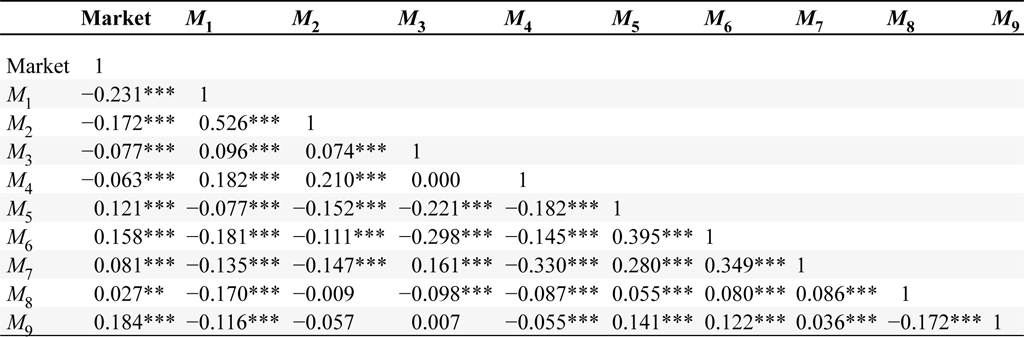
Table 1 presents correlations between the market index and its sub-indicators, consistent with existing literature. Firstly, the distance to various market types negatively correlates with the market index, with stronger correlations observed for distances from villages to county-level and prefecture-level city centers. Secondly, population-related variables exhibit positive correlations with the market index, with stronger associations observed for the populations of prefecture-level and county-level cities. Lastly, the quality and quantity of roads correlate with the market index, emphasizing the importance of road quality.
Correlation between market index and its sub-indicators
Citation: International Food and Agribusiness Management Review 28, 1 (2025) ; 10.22434/ifamr.1160
Table 2 explores the correlations between the ICT index and its sub-indicators. The results reveal a high degree of coordination among sub-indicators. Specifically, both cell phone coverage and computer coverage in villages positively correlate with the ICT index. Interestingly, computer coverage exhibits a significantly higher correlation, likely due to the widespread adoption of smartphones in China, which diminishes the importance of traditional cell phones. Notably, online shopping emerges as a particularly influential factor, while phone bills have relatively low importance, possibly due to the affordability of broadband Internet access for most farmers.
The indicators of the ICTs coverage and utilization index are as follows:
(1) Phone_coverage; Cell phone coverage in the village (%);
(2) Computer_coverage: Computer coverage in the village (%);
(3) Phone_bill: Average monthly telephone bill for households in the village (10 RMB);
(4) Online_rate: Average share of online shopping in total household consumption in the village (%);
Correlation between ICTs index and its sub-indicators
Citation: International Food and Agribusiness Management Review 28, 1 (2025) ; 10.22434/ifamr.1160
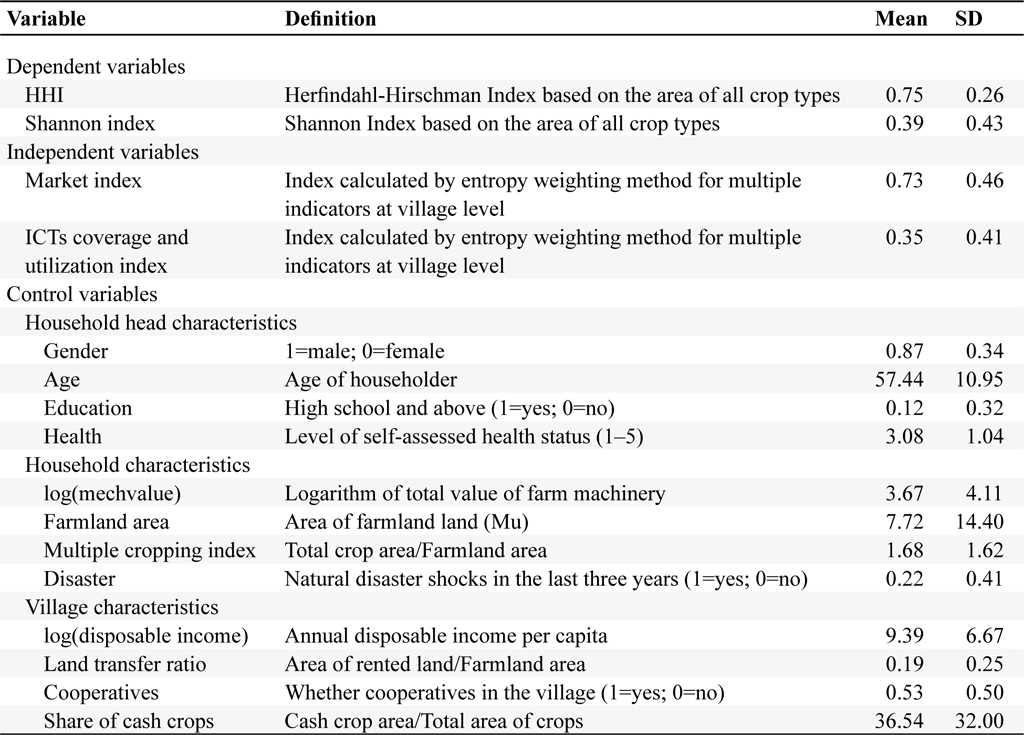
Table 3 gives descriptive statistics for all variables. The control variables are as follows: (1) Household head characteristics: age, gender, education, and health status; (2) Household characteristics: logarithm of total value of farm machinery, area of farmland, multiple cropping index and disaster shock; (3) Village characteristics: annual disposable income per capita, proportion of land transfers, cooperatives, and share of cash crops.
Summary of statistics of variables
Citation: International Food and Agribusiness Management Review 28, 1 (2025) ; 10.22434/ifamr.1160
4. The impact of ICTs and the market extent on crop specialization
4.1 Estimated results
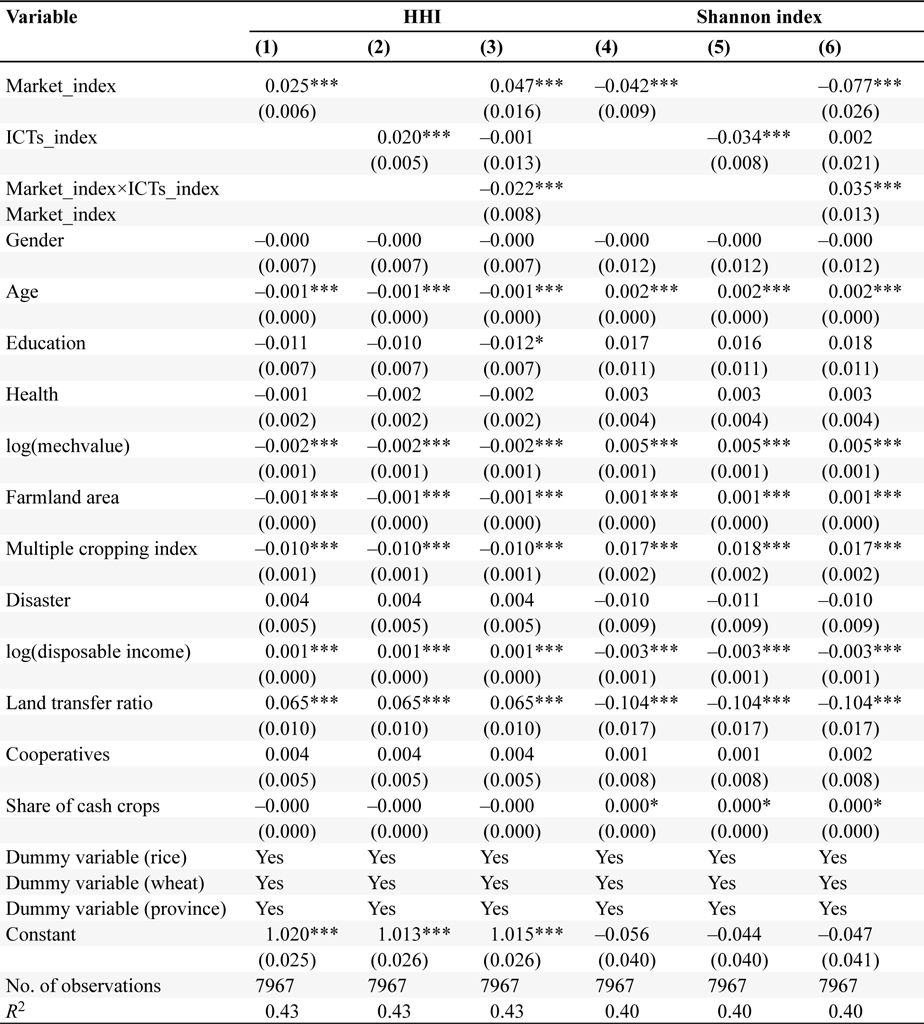
Table 4 presents the estimation results for the market index and ICTs coverage and utilization index on crop specialization. Robust standard errors are used, clustered at the household level. To account for the potential influence of regional cultivation habits and varying natural environments, rice and wheat level dummy variables are employed to capture the characteristics of regions with different staple foods. Provincial-level dummy variables are used to capture the characteristics of different provinces.
Baseline regression: Market extent, ICTs and crop specialization
Citation: International Food and Agribusiness Management Review 28, 1 (2025) ; 10.22434/ifamr.1160
The estimates provide strong evidence of the important positive impact of market extent and ICTs coverage and use on crop specialization for Chinaâs farmers. These findings also reveal that market extent and ICTs are complementary in facilitating farmersâ specialization transformation. Columns 1â3 in Table 4 present the estimated results with the HHI as the dependent variable. The coefficients of the two independent variables in equations 1 and 2 are 0.025 and 0.020 for the market index and ICT index, respectively. The estimated coefficients for both market extent and ICTs are positive and statistically significant, indicating that market extent and ICTs promote farmersâ crop specialization. The negative coefficient on the interaction of market extent and ICTs implies their complementary nature, suggesting that ICTs drive specialization among farmers with more restrictive market access characteristics. Columns 4â6 in Table 4 present the estimation results with the Shannon index as the dependent variable. The coefficients of the two independent variables in equations 1 and 2 are â0.042 and 0.034 for the market index and ICT index, respectively. The estimated coefficients for both market extent and ICTs are negative and statistically significant, indicating that market extent and ICTs reduce farmersâ crop diversification. The positive coefficient on the interaction of market extent and ICTs similarly supports their complementary relationship.
Thus, the three hypotheses were confirmed. The results in columns 1 and 4 support hypothesis 1, indicating that market extent contributes to crop specialization, while results in columns 2 and 5 confirm hypothesis 2, demonstrating that ICTs coverage and utilization promote farmersâ crop specialization. Finally, the results in columns 3 and 6 confirm hypothesis 3, showing that ICTs and market extent play complementary roles.
4.2 Endogeneity and instrumental variables
According to Emran and Hou (2013), issues of endogeneity arise in estimating market extent due to factors such as households location choices, the emergence of marketplaces, and nonrandom placement of transport infrastructure. Similarly, selection bias in the sample can cause estimation bias in ICTs analysis (Fan and Garcia, 2018). Therefore, instrumental variables (IVs) were employed to enhance the validity of the estimates. For instance, Gu et al. (2023) used the number of smartphone users in the community (village) as an IV to measure household smartphone ownership, while Ma et al. (2023) used the average ICT adoption rates within the same county as an IV for ICT adoption. Building on these methods, the study uses the ICT Coverage and Usage Index at the county level an IV for ICT index, generated by aggregating indexes from samples within the same county. Market extent is often influenced by terrain and landscape features, as rugged terrain significantly hinder market access for farmers (Han et al., 2023). Lin et al. (2019) employed the Relief Degree of Land Surface (RDLS) as an IV to assess economic agglomeration in China. Following this approach, RDLS at the county level was used as the IV for market extent in this study. These two IVs exhibit strong correlations with the primary independent variables, but are not directly related to the other variables in the model at the individual, household, or village levels.
Table 5 presents the results of the 2SLS estimation. In columns 1 and 4, RDLS at the county level is the IV, while in columns 2 and 5, the ICT Coverage and Usage Index at the county level serves as the IV. In column 3 and 6, three IVs are used to estimate the three endogenous variables: RDLS at the county level, ICTs coverage and utilization index at the county level and their interaction terms. The Anderson canonical correlations LM test and the CraggâDonaldâWald test in the equations in Table 5 yielded p-values lower than 0.01, with robust F-statistics exceeding 10, supporting the validity of the instrumental variables. Consistent with Table 4, the estimated coefficients with the HHI as the dependent variable are significantly positive but the cross terms are significantly negative. Conversely, the estimates with the Shannon index as the dependent variable are significantly negative but the cross terms are significantly positive. Notably, compared to Table 4, the coefficients in Table 5 estimated using IVs have shifted dramatically. The 2SLS results indicate that the presence of endogeneity causes OLS estimates to significantly underestimate the impact of market extent and ICTs on crop specialization, which is consistent with the previous findings of Emran and Hou (2013), and Fan and Garcia (2018). Consequently, two-stage estimation results after addressing endogeneity provide more robust evidence for the analysis.
2SLS estimation: Market extent, ICTs and crop specialization
Citation: International Food and Agribusiness Management Review 28, 1 (2025) ; 10.22434/ifamr.1160
4.3 Impact of different levels of markets
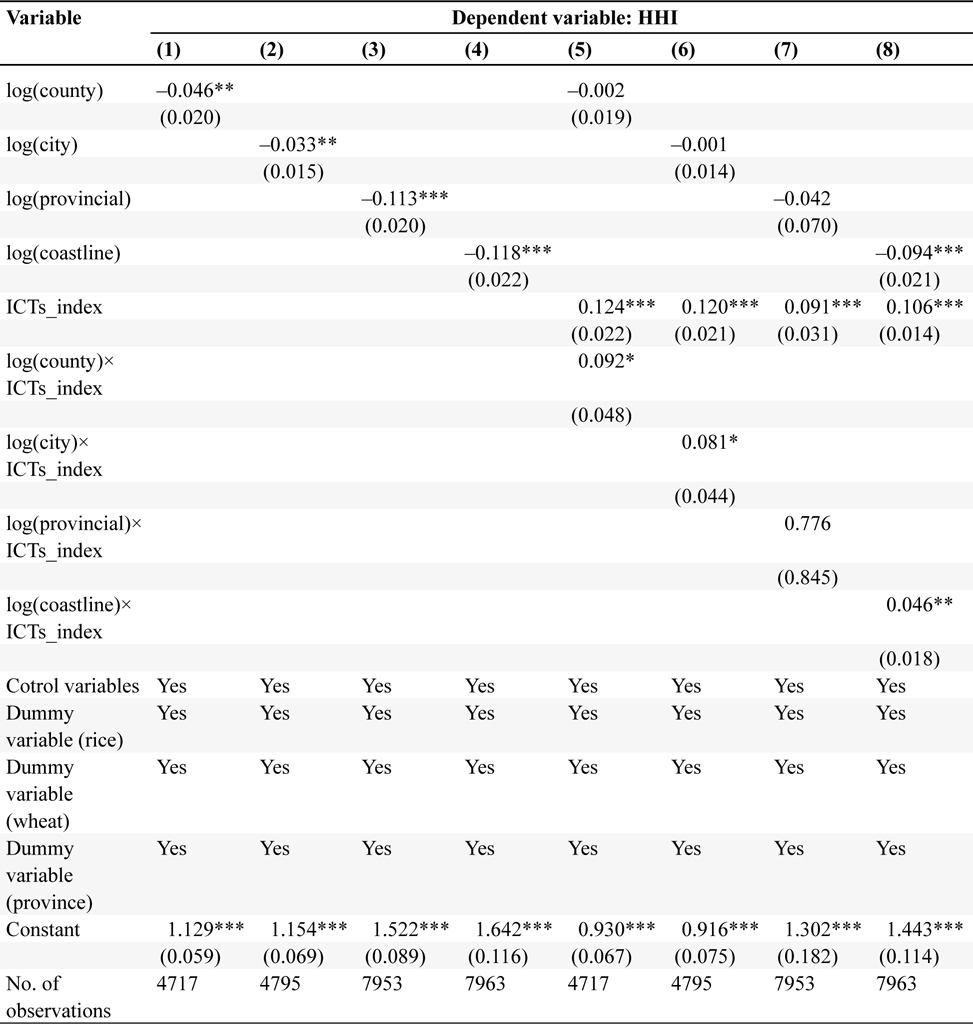
Farmers typically have access to various market levels, including county-level cities, prefecture-level cities, provincial capital cities, and coastal cities where populations and demand for agricultural products are concentrated. In China, county-level, prefecture-level, and provincial capital cities serve as the main trading markets and logistical hubs within their respective regions. The distance to the nearest coastline is used as a proxy variable for access to major national markets, as Chinaâs eastern coast represents largest market in the country, characterized by the densest population and the highest agricultural product consumption. Following Emran and Hou (2013), the logarithm of distance is used as the independent variable to enable comparative analysis of impacts across different market levels. Consequently, this paper uses the logarithmic distance to each of these four market types to examine the impact of different market levels on crop specialization.
Table 6 provides the estimated coefficients for the logarithmic distance to the four types of markets on crop specialization. In columns 1â4, the two-stage estimation results significant and negative, indicating that crop specialization decreases with increasing distance to each type markets. In columns 5â8, the model incorporates the interaction term between ICTs and the logarithmic distance to different markets. The results show that the interaction effects are significant, except for provincial capitals, highlighting the complementary effect of ICTs on market distance. This outcome suggests that ICTs can mitigate the constraints of market distance on crop specialization, thus supporting farmersâ ability to specialize even when located farther from major markets.
2SLS estimation: Distance to the four types of markets, ICTs and crop specialization
Citation: International Food and Agribusiness Management Review 28, 1 (2025) ; 10.22434/ifamr.1160
4.4 Impact on the Transformation of Agricultural Specialization
A more specialized, market-centered, and structurally transformed agricultural sector is crucial for developing countries (Takeshima and Kumar, 2021), where traditional, subsistence-oriented agriculture is transitioning to modern, market-oriented systems. This structural transformation involves processes such as agricultural commercialization, intensification of farming systems, and mechanization (Ecker, 2018). Agricultural specialization refers to the process of concentrating resources (labor, capital, and land) on producing a limited variety of goods (Abson, 2019), rather than merely adjusting crop structure. The evolution of agricultural specialization has seen a shift from labor-intensive subsistence farming to highly mechanized, commercialized, and capital-intensive methods. This paper focuses on the role of market extent and ICTs in agricultural specialization across three dimensions: commercialization, mechanization, and intensification.
4.4.1 Commercialization
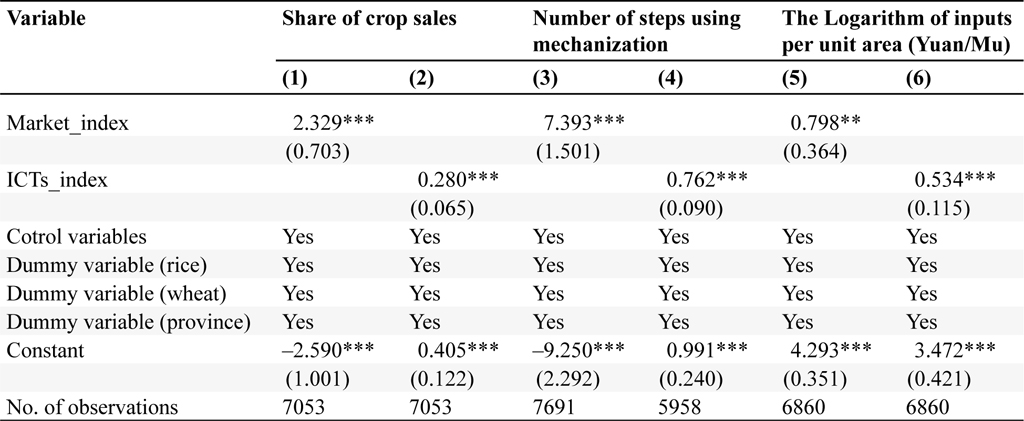
In the transformation of rural economies in developing countries, where commercialization and specialization often advance simultaneously. Structural changes in crop production and the inclination towards specialization are primarily driven by farmersâ need to participate in the market and achieve sufficient profits. Market commercialization is measured in terms of percentage of crops sold. As shown in columns 1 to 2 of Table 7, the 2SLS estimates reveal that both market extent and the use of ICTs significantly enhance the percentage of crop sales. This suggests that improved market access and ICTs motivate farmers to allocate more land to crops intended for sale.
2SLS estimation: Impact of market extent and ICTs on commercialization, mechanization and intensification
Citation: International Food and Agribusiness Management Review 28, 1 (2025) ; 10.22434/ifamr.1160
4.4.2 Mechanization
Mechanization enables the harvesting of larger crop areas within a limited time frame, reducing farmersâ reliance on diversifying cropping choices with staggered harvest dates to match labor availability. This shift increases farmersâ opportunities to transition from subsistence to commercial farming, allowing them to concentrate on the most profitable crops (Abson, 2019). While small farms in China often face challenges in affording agricultural machinery, outsourced mechanization services provide greater access for farmers to mechanize various production stages, such as harvesting (Zhang et al., 2017). The survey assessed machinery use across five production steps (ploughing/fertilizing, sowing, harvesting, transporting and pesticide spraying). The number of production steps utilizing machinery was used to measure the degree of mechanization. Columns 3â4 in Table 7 reports that the degree of market index is highly positively associated with mechanization adoption, with ICT coverage and use similarly enhancing mechanization among farmers.
4.4.3 Intensification
Increased agricultural inputs (artificial fertilizers, herbicides and pesticides) are one of the typical features of agricultural specialization at the farm level (Abson, 2019). The logarithm of inputs per unit area (Yuan/Mu) was used as an indicator of the degree of intensification. Columns 5â6 in Table 7 reports the results of the estimation of market extent and ICTs on production inputs. The results show that the estimated coefficients of both market coverage and ICTs are significantly positive under 2SLS estimation, demonstrating that both factors significantly contribute to agricultural intensification.
4.5 Robustness check
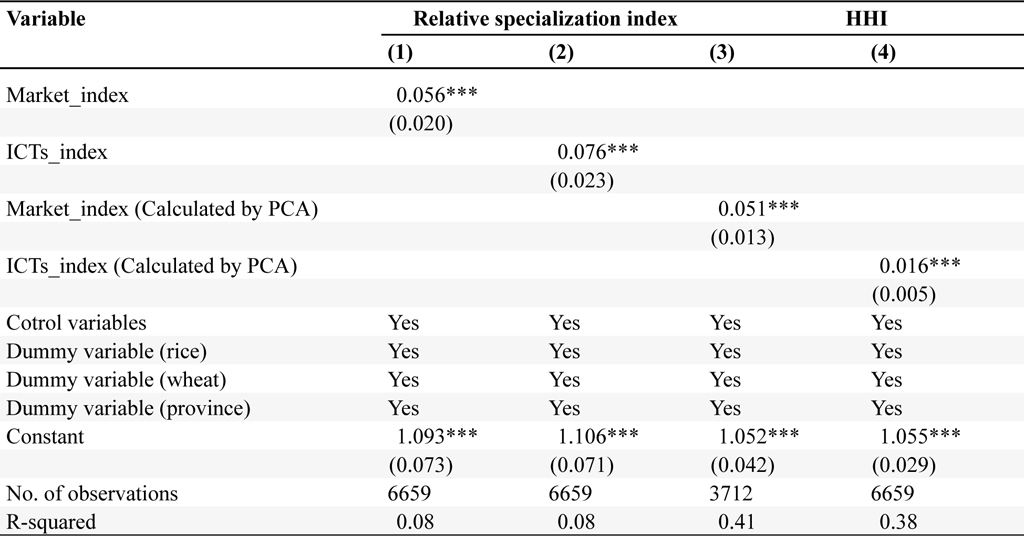
To address potential measurement errors affecting the estimation results, robustness tests were conducted in two ways: (1) constructing a relative specialization index as a new dependent variable; and (2) employing alternative methods to recalculate the weights of the sub-indicators of the independent variables. First, following Michler and Josephson (2017), the relative specialization of farmers was measured by dividing their HHI by the average village-level HHI. This approach controls for village-specific agroclimatic conditions, allowing for a comparison of a householdâs crop specialization within its own village rather than across different villages. Additionally, Principal Component Analysis (PCA) was utilized to recalculate the market index and the ICT index. The estimation results in Table 8 indicate that the estimates remain robust after replacing the measures of the independent and dependent variables.
Robustness check
Citation: International Food and Agribusiness Management Review 28, 1 (2025) ; 10.22434/ifamr.1160
5. Discussion
The OLS and 2SLS results confirm that the positive effects of market extent and ICTs on agriculture extend beyond facilitating market participation to enhancing the specialization of farmersâ production. The significant results of the interaction terms support the complementary effects of market extent and ICTs in promoting farmersâ specialization, indicating that ICTs are particularly effective in fostering specialization among farmers distant from urban centers with limited market information. Further analyses demonstrate a significant positive relationship between distance to markets and specialization in county-level cities, prefecture-level cities, provincial capital cities, and coastal cities, along with a complementary effect of ICTs. Moreover, the paper confirms that market extent and ICTs play a positive role in promoting agricultural commercialization, mechanization, and intensification, which has greater implications for advancing agricultural transformation in developing countries.
The findings extend the understanding of the complementary effects of market extent and ICTs. Previous research has shown that ICTs have a pronounced impact on farmers in remote areas by enhancing market participation (Muto and Yamano, 2009) and increasing agricultural product prices (Aker and Fafchamps, 2010; Negi et al., 2018). This paper further extends their effect to agricultural production behavior, contributing to crop specialization. Agricultural specialization has been viewed as either a change in crop structure (Kurosaki, 2003) or a transition from subsistence to commercialization (Pingali and Rosegrant, 1995). This paper further links agricultural specialization to multidimensional agricultural transformation, confirming that market extent and ICTs promote commercialization, mechanization, and intensification along with crop specialization.
6. Conclusions
Using large-scale survey data from China, this paper examines the role of market extent and ICTs coverage and utilization on the production behavior of Chinaâs farmers, and the results show that both ICTs and market extent significantly contribute to the transformation of farmersâ crop structure into specialization. Our study shows that the dilemma of farmersâ difficulty in participating in the market due to high transaction costs, which has been widely noted in the literature, can be addressed to a large extent by the application of ICTs, which not only improves farmersâ market participation and raises their incomes, but more importantly facilitates farmersâ shift to more efficient and specialized production.
The results of this paper also confirm the strong complementarities between market extent and ICTs in the transition to crop specialization. For farmers with limited market access, ICTs can facilitate this transition by improving market information transmission. While previous studies have highlighted the importance of ICTs in rural areas, this paper emphasizes that the marginal effect of ICTs on improving market access and facilitating crop specialization is more pronounced for farmers distant from large cities, far from markets, and with poor transportation infrastructure. Although geographic location still leads to unequal market access for farmers, ICTs have enabled more farmers to specialize and access markets, thereby increasing profitability and narrowing this gap to some extent.
In the process of specialized transformation of agriculture, the change of structure is accompanied by the commercialization of crops, the intensification of production and the application of mechanization. Market extent and ICTs not only alter farmersâ crop structures but also encourage farmers to select market-demanded crops, adopt mechanization, and increase input intensity. Therefore, improving farmersâ market access and expanding ICTs application in rural areas is crucial for agricultural transformation. Chinaâs recent experience suggests that enhancing market access through improved transportation infrastructure and increased ICTs coverage and utilization effectively accelerates agricultural transformation.
Acknowledgement
This work was supported by the National Natural Science Foundation of China (Grant Nos 72073119 and 72211540724).
References
Abman, R. and C. Lundberg. 2024. Contracting, market access and deforestation. Journal of Development Economics 168: 103269. https://doi.org/10.1016/j.jdeveco.2024.103269
Abson, D.J. 2019. Chapter 19 - The economic drivers and consequences of agricultural specialization. In G. Lemaire, P.C.D.F. Carvalho, S. Kronberg and S. Recous (eds), Agroecosystem Diversity. Academic Press, San Diego, CA, pp. 301â315. https://doi.org/10.1016/B978-0-12-811050-8.00019-4
Aguilar, J., G.G. Gramig, J.R. Hendrickson, D.W. Archer, F. Forcella and M.A. Liebig. 2015. Crop species diversity changes in the United States: 1978â2012. PLOS ONE 10 (8): e0136580. https://doi.org/10.1371/journal.pone.0136580
Ajani, E.N. 2014. Promoting the use of information and communication technologies (ICTs) for agricultural transformation in Sub-Saharan Africa: implications for policy. Journal of Agricultural and Food Information 15(1): 42â53. https://doi.org/10.1080/10496505.2013.858049
Aker, J.C. and M. Fafchamps. 2010. How does mobile phone coverage affect farmâgate prices? Evidence from west Africa. Department of Economics and the Fletcher School, Tufts University, Medford, MA.
Aker, J.C. and C. Ksoll. 2016. Can mobile phones improve agricultural outcomes? Evidence from a randomized experiment in Niger. Food Policy 60: 44â51. https://doi.org/10.1016/j.foodpol.2015.03.006
Aker, J.C. and I.M. Mbiti. 2010. Mobile phones and economic development in Africa. Journal of Economic Perspectives 24(3): 207â232. https://doi.org/10.1257/jep.24.3.207
Aku, A., P. Mshenga, V. Afari-Sefa and J. Ochieng. 2018. Effect of market access provided by farmer organizations on smallholder vegetable farmerâs income in Tanzania. Cogent Food and Agriculture 4(1): 1560596. https://doi.org/10.1080/23311932.2018.1560596
Alene, A.D., V.M. Manyong, G. Omanya, H.D. Mignouna, M. Bokanga and G. Odhiambo. 2008. Smallholder market participation under transactions costs: maize supply and fertilizer demand in Kenya. Food Policy 33(4): 318â328. https://doi.org/10.1016/j.foodpol.2007.12.001
Baltenweck, I. and S. Staal. 2007. Beyond one-size-fits-all: differentiating market access measures for commodity systems in the Kenyan highlands. Journal of Agricultural Economics 58(3): 536â548. https://doi.org/10.1111/j.1477-9552.2007.00129.x
Benin, S., M. Smale, J. Pender, B. Gebremedhin and S. Ehui. 2004. The economic determinants of cereal crop diversity on farms in the Ethiopian highlands. Agricultural Economics 31(2â3): 197â208. https://doi.org/10.1111/j.1574-0862.2004.tb00257.x
Chamberlin, J. and T.S. Jayne. 2013. Unpacking the meaning of âmarket accessâ: evidence from rural Kenya. World Development 41: 245â264. https://doi.org/10.1016/j.worlddev.2012.06.004
Chavas, J.-P., G. Rivieccio, S. Di Falco, G. De Luca and F. Capitanio. 2022. Agricultural diversification, productivity and food security across time and space. Agricultural Economics 53(S1): 41â58. https://doi.org/10.1111/agec.12742
Deichmann, U., A. Goyal and D. Mishra. 2016. Will digital technologies transform agriculture in developing countries? Agricultural Economics 47(S1): 21â33. https://doi.org/10.1111/agec.12300
Dorosh, P., H.G. Wang, L. You and E. Schmidt. 2012. Road connectivity, population and crop production in sub-Saharan Africa. Agricultural Economics 43(1): 89â103. https://doi.org/10.1111/j.1574-0862.2011.00567.x
Ecker, O. 2018. Agricultural transformation and food and nutrition security in Ghana: does farm production diversity(still) matter for household dietary diversity?. Food policy, 79, 271â282. https://doi.org/10.1016/j.foodpol.2018.08.002
Emran, M.S. and F. Shilpi. 2012. The extent of the market and stages of agricultural specialization. Canadian Journal of Economics 45(3): 1125â1153. https://doi.org/10.1111/j.1540-5982.2012.01729.x
Emran, M.S. and Z. Hou. 2013. Access to markets and rural poverty: evidence from household consumption in China. The Review of Economics and Statistics 95(2): 682â697. https://doi.org/10.1162/REST_a_00354
Fan, Q. and V.B. Salas Garcia. 2018. Information access and smallholder farmersâ market participation in Peru. Journal of Agricultural Economics 69(2): 476â494. https://doi.org/10.1111/1477-9552.12243
Feng, X. 2024. Control, exploitation and exclusion: experiences of small farmer e-tailers in agricultural eâcommerce in China. Journal of Agrarian Change 24(1): e12567. https://doi.org/10.1111/joac.12567
Galloway, L. 2007. Can broadband access rescue the rural economy? Journal of Small Business and Enterprise Development 14(4): 641â653. https://doi.org/10.1108/14626000710832749
Goetz, S.J. 1992. A selectivity model of household food marketing behavior in subâSaharan Africa. American Journal of Agricultural Economics 74(2): 444â452. https://doi.org/10.2307/1242498
Goyal, A. 2010. Information, direct access to farmers and rural market performance in Central India. American Economic Journal: Applied Economics 2(3): 22â45. https://doi.org/10.1257/app.2.3.22
Gu, R., W. Zhang, K. Chen and F. Nie. 2023. Can information and communication technologies contribute to poverty reduction? Evidence from poor counties in China. Information Technology for Development 29(1): 128â150. https://doi.org/10.1080/02681102.2022.2123772
Haile, M.G., T. Wossen and M. Kalkuhl. 2019. Access to information, price expectations and welfare: the role of mobile phone adoption in Ethiopia. Technological Forecasting and Social Change 145: 82â92. https://doi.org/10.1016/j.techfore.2019.04.017
Han, H., Z. Yuan and K. Zou. 2023. Does new infrastructure outperform old infrastructure in Chinaâs agricultural specialization: an empirical examination based on One village One product. International Food and Agribusiness Management Review 26(5): 922â940. https://doi.org/10.22434/ifamr2023-0006
Huffman, W.E. and R.E. Evenson. 2001. Structural and productivity change in US agriculture, 1950â1982. Agricultural Economics 24(2): 127â147. https://doi.org/10.1111/j.1574-0862.2001.tb00019.x
Jiang, Y., X. Wang, M. Huo, F. Chen and X. He. 2023. Changes of cropping structure lead diversity decline in China during 1985â2015. Journal of Environmental Management 346: 119051. https://doi.org/10.1016/j.jenvman.2023.119051
Kanyam, D.A., G. Kostandini and S. Ferreira. 2017. The mobile phone revolution: have mobile phones and the internet reduced corruption in SubâSaharan Africa? World Development 99: 271â284. https://doi.org/10.1016/j.worlddev.2017.05.022
Key, N., E. Sadoulet and A.D. Janvry. 2000. Transactions costs and agricultural household supply response. American Journal of Agricultural Economics 82(2): 245â259. https://doi.org/10.1111/0002-9092.00022
Khan, N., R.L. Ray, S. Zhang, E. Osabuohien and M. Ihtisham. 2022. Influence of mobile phone and internet technology on income of rural farmers: evidence from Khyber Pakhtunkhwa Province, Pakistan. Technology in Society 68: 101866. https://doi.org/10.1016/j.techsoc.2022.101866
Kurosaki, T. 2003. Specialization and diversification in agricultural transformation: the case of West Punjab, 1903â1992. American Journal of Agricultural Economics 85(2): 372â386. https://doi.org/10.1111/1467-8276.00126
Leaman, J.H. and E.C. Conkling. 1975. Transport change and agricultural specialization. Annals of the Association of American Geographers 65(3): 425â432. https://doi.org/10.1111/j.1467-8306.1975.tb01050.x
Lin, B. and R. Tan. 2019. Economic agglomeration and green economy efficiency in China. Economic Review Journal 54(2): 119â132.
Ma, M., S. Steinbach and J. Wu. 2014. A study on regional specialization of Chinaâs agricultural production: recent trends and drivers. Asian Journal of Agriculture and Rural Development 4(2): 113â127. https://doi.org/10.22004/ag.econ.198390
Ma, W., H. Qiu and D.B. Rahut. 2023. Rural development in the digital age: does information and communication technology adoption contribute to credit access and income growth in rural China? Review of Development Economics 27(3): 1421â1444. https://doi.org/10.1111/rode.12943
Markelova, H., R. MeinzenâDick, J. Hellin and S. Dohrn. 2009. Collective action for smallholder market access. Food Policy 34(1): 1â7. https://doi.org/10.1016/j.foodpol.2008.10.001
Mather, D., D. Boughton and T.S. Jayne. 2013. Explaining smallholder maize marketing in southern and eastern Africa: the roles of market access, technology and household resource endowments. Food Policy 43: 248â266. https://doi.org/10.1016/j.foodpol.2013.09.008
Michler, J.D. and A.L. Josephson. 2017. To specialize or diversify: agricultural diversity and poverty dynamics in Ethiopia. World Development 89: 214â226. https://doi.org/10.1016/j.worlddev.2016.08.011
Min, S., M. Liu and J. Huang. 2020. Does the application of ICTs facilitate rural economic transformation in China? Empirical evidence from the use of smartphones among farmers. Journal of Asian Economics 70: 101219. https://doi.org/10.1016/j.asieco.2020.101219
Minten, B. and S. Kyle. 1999. The effect of distance and road quality on food collection, marketing margins and tradersâ wages: Evidence from the former Zaire. Journal of Development Economics 60(2): 467â495. https://doi.org/10.1016/S0304-3878(99)00049-8
Muto, M. and T. Yamano. 2009. The impact of mobile phone coverage expansion on market participation: panel data evidence from Uganda. World Development 37(12): 1887â1896. https://doi.org/10.1016/j.worlddev.2009.05.004
Nakasone, E. and M. Torero. 2016. A text message away: ICTs as a tool to improve food security. Agricultural Economics 47(S1): 49â59. https://doi.org/10.1111/agec.12314
Nakasone, E., M. Torero and B. Minten. 2014. The power of information: the ICT revolution in agricultural development. Annual Review of Resource Economics 6(Volume 6, 2014): 533â550. https://doi.org/10.1146/annurev-resource-100913-012714
Negi, D.S., P.S. Birthal, D. Roy and M.T. Khan. 2018. Farmersâ choice of market channels and producer prices in India: Role of transportation and communication networks. Food Policy 81: 106â121. https://doi.org/10.1016/j.foodpol.2018.10.008
Ogbeide, O.A. and I. Ele. 2015. Smallholder farmers and mobile phone technology in SubâSahara Agriculture. Mayfair Journal of Information and Technology Management in Agriculture 1(1): 1â19.
Ouma, E., J. Jagwe, G.A. Obare and S. Abele. 2010. Determinants of smallholder farmersâ participation in banana markets in Central Africa: the role of transaction costs. Agricultural Economics 41(2): 111â122. https://doi.org/10.1111/j.1574-0862.2009.00429.x
Overby, E. and C. Forman. 2014. The effect of electronic commerce on geographic purchasing patterns and price dispersion. Management Science 61(2): 431â453. https://doi.org/10.1287/mnsc.2014.1977
Pingali, P.L. and M.W. Rosegrant. 1995. Agricultural commercialization and diversification: Processes and policies. Food Policy 20(3): 171â185. https://doi.org/10.1016/0306-9192(95)00012-4
Qin, Y. and X. Zhang. 2016. The road to specialization in agricultural production: Evidence from rural China. World Development 77: 1â16. https://doi.org/10.1016/j.worlddev.2015.08.007
Rajkhowa, P. and L. Kornher. 2023. Effects of electronic markets on prices, spikes in prices and price dispersion: a case study of the tea market in India. Agribusiness 39(4): 1117â1138. https://doi.org/10.1002/agr.21818
Roehner, B.M. 1996. The role of transportation costs in the economics of commodity markets. American Journal of Agricultural Economics 78(2): 339â353. https://doi.org/10.2307/1243707
Shimamoto, D., H. Yamada and M. Gummert. 2015. Mobile phones and market information: evidence from rural Cambodia. Food Policy 57: 135â141. https://doi.org/10.1016/j.foodpol.2015.10.005
Shrestha, S.A. 2018. Roads, participation in markets and benefits to agricultural households: Evidence from the topographyâbased highway network in Nepal. Economic Development and Cultural Change 68(3): 839â864. https://doi.org/10.1086/702226
Smith, A. 1776. An inquiry into the nature and causes of the wealth of nations, Volume 1. W. Strahan and T. Cadell, London.
Stifel, D. and B. Minten. 2008. Isolation and agricultural productivity. Agricultural Economics 39(1): 1â15. https://doi.org/10.1111/j.1574-0862.2008.00310.x
Stigler, G.J. 1951. The division of labor is limited by the extent of the market. Journal of Political Economy 59(3): 185â193. https://doi.org/10.1086/257075
Stigler, G.J. 1961. The economics of information. Journal of Political Economy 69(3): 213â225. https://doi.org/10.1086/258464
Takeshima, H. and A. Kumar, 2021. Returns-to-scale and factor-endowments-induced specialization: agricultural mechanization and agricultural transformation in Nepal. The Journal of Developing Areas 55(4), 133â145. https://dx.doi.org/10.1353/jda.2021.0083
Tang, W. and J. Zhu. 2020. Informality and rural industry: Rethinking the impacts of EâCommerce on rural development in China. Journal of Rural Studies 75: 20â29. https://doi.org/10.1016/j.jrurstud.2020.02.010
von Thünen, J. 1826. The isolated state. Pergamon Press, Oxford.
Timmer, C.P. 1997. Farmers and markets: the political economy of new paradigms. American Journal of Agricultural Economics 79(2): 621â627. https://doi.org/10.2307/1244161
Usman, M.A. and M.G. Haile. 2022. Market access, household dietary diversity and food security: Evidence from Eastern Africa. Food Policy 113: 102374. https://doi.org/10.1016/j.foodpol.2022.102374
Winsberg, M.D. 1980. Concentration and specialization in United States agriculture, 1939â1978. Economic Geography 56(3): 183â189. https://doi.org/10.2307/142711
Woldie, G.A. and E.A. Nuppenau. 2011. A contribution to transaction costs: evidence from banana markets in Ethiopia. Agribusiness 27(4): 493â508. https://doi.org/10.1002/agr.20279
Yamano, T. and Y. Kijima. 2010. The associations of soil fertility and market access with household income: Evidence from rural Uganda. Food Policy 35(1): 51â59. https://doi.org/10.1016/j.foodpol.2009.09.005
Yang, X. and H.-l. Shi. 1992. Specialization and product diversity. The American Economic Review 82(2): 392â398.
Zanello, G. 2012. Mobile phones and radios: Effects on transactions costs and market participation for households in Northern Ghana. Journal of Agricultural Economics 63(3): 694â714. https://doi.org/10.1111/j.1477-9552.2012.00352.x
Zanello, G., C.S. Srinivasan and B. Shankar. 2014. Transaction costs, information technologies and the choice of marketplace among farmers in Northern Ghana. The Journal of Development Studies 50(9): 1226â1239. https://doi.org/10.1080/00220388.2014.903244
Zant, W. 2023. Mobile phones and mozambique traders: size, composition and distribution of reduced transaction costs. Food Policy 116: 102423. https://doi.org/10.1016/j.foodpol.2023.102423
Zhang, F., A. Sarkar and H. Wang. 2021. Does Internet and information technology help farmers to maximize profit: a crossâsectional study of apple farmers in Shandong, China. Land 10(4). https://doi.org/10.3390/land10040390
Zhang, X., J. Yang and R. Thomas. 2017. Mechanization outsourcing clusters and division of labor in Chinese agriculture. China Economic Review 43: 184â195. https://doi.org/10.1016/j.chieco.2017.01.012
Appendix
Estimated results of the first stage
Citation: International Food and Agribusiness Management Review 28, 1 (2025) ; 10.22434/ifamr.1160
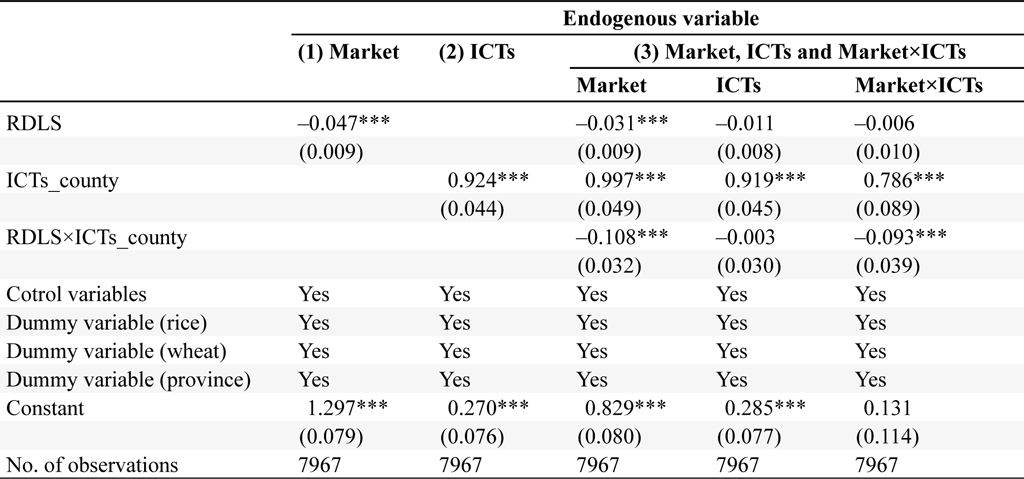
In columns 3â5, three IVs are used to estimate the three endogenous variables, which are RDLS at county level, ICTs coverage and utilization index at county level and their interaction terms respectively. Robust standard errors are reported in parentheses and corrected for clustering at the household level. *, ** and *** denote significance at the 1, 5 and 10% level.
Corresponding authors