Abstract
Consumers increasingly prefer lattes using alternative milk from plant-based sources. This study aims to find the factors affecting consumer intention to purchase lattes using alternative milk from plant-based sources and to compare the links between the factors and purchase intentions depending on two labels, âveganâ and âplant-based.â An online, scenario-based experiment was conducted with a between-subjects design (plant-based: n=268, vegan: n=265), followed by a survey. In both groups, the results show that the perceived benefits positively affect purchase intention, but the perceived barrier (i.e., vegetarian stigma) did not. Perceived benefits and preference were higher when showing a âplant-based latteâ label focusing on the presence of plant-based ingredients than when showing a âvegan latteâ label focusing on the absence of animal-based ingredients. For the label âvegan latte,â even if consumers are non-vegan, the higher their food curiosity, food snobbery, and food variety-seeking tendency, the higher their purchase intention. It suggests to marketers and menu developers what needs to be highlighted and which consumers to target to boost sales of latte using alternative milk. The findings emphasize the potential for labels to promote the purchase intention of alternative lattes, offering a strategy for changing consumer behavior.
1. Introduction
As the recent trend of interest in environmental impact and sustainability, personal health, and animal welfare issues has grown, plant-based alternatives have become increasingly popular and sophisticated (He et al., 2020). Plant-based foods are a large market in the United States, with high growth in many categories. Among these categories, milk alternatives showed total sales of $2.5 billion and meat alternatives showed $1.4 billion in 2020 (Good Food Institute, 2021). Although the market size for plant-based milk is much larger compared to the market size for plant-based meat, most studies have been conducted focusing on acceptance, sensorial properties, and purchasing behavior regarding plant-based meat (e.g., Bakhsh et al., 2021; Hwang et al., 2020; Kyriakopoulou et al., 2019; Michel et al., 2021; Rubio et al., 2020; Tziva et al., 2020).
Plant-based milk is a fast-growing category in the development of functional and special drinks worldwide, with greater demand than ever before (Sethi et al., 2016). This trend has also impacted the coffee market, with latte menus being developed and marketed that replace cowâs milk with plant-based milk (e.g., Nestle, 2019; Starbucks, 2020). Physicochemical studies have been conducted to improve the texture of lattes with plant-based milks (Chung et al., 2022; Liu et al., 2022a,b), and how consumer acceptance and sensory perception varies depending on the type of plant-based milk used (Gorman et al., 2021). However, there is a lack of research on the factors and motivations that influence consumersâ willingness to purchase lattes with plant-based milk.
Since lattes with alternative milk possess both the characteristics of a plant-based alternative and those of coffee, this study sought to understand the factors influencing the purchase intention of such lattes by referring to previous studies on the purchase behavior of plant-based milk products and coffee. Drinking plant-based milk can foster consumersâ perception that it may contribute to health and sustainability (Cruz et al., 2007; Van Loo et al., 2017), and it can also enhance their positive reputation for making altruistic choices for the environment (Schiano et al., 2020). Perceived benefits influence preferences, which in turn affect purchase intentions (Amaudova et al., 2022). Purchasing plant-based milk can potentially elicit a vegetarian stigma for making a choice isolated from non-vegetarians. The vegetarian stigma is known to have a negative impact on purchase intentions (Markowski and Roxburgh, 2019). Plant-based milk, as a novel product type, can pique consumersâ food curiosity (Haas et al., 2019). Given that coffee reflects diverse and fragmented tastes, opting for a latte made with plant-based milk can stimulate the trait of being a discerning gourmet who knows their own taste preferences, thereby eliciting food snobbery (Kaczorowski, 2023; Spiller, 2012). It is found that food curiosity and food snobbery influence food variety-seeking, which can also impact purchase intentions (Ellis and Thompson, 2018; Van Trijp et al., 1996; Xuhui et al., 2019). For these reasons, we considered perceived health benefits, perceived sustainability benefits, perceived reputational benefits, food snobbery, food curiosity, food variety-seeking, vegetarian stigma, and preference as factors influencing the purchase intention of lattes using plant-based alternative milk, and designed a research model to elucidate the mechanisms.
When purchasing food, consumers encounter a number of differentiated products with different attributes (Sharp, 2018). Consumer expectations of food are influenced by external information, which includes product-related posters, stickers, and labels (Ensaff et al., 2015; Grunert, 2002; Hollands et al., 2017; Prada et al., 2019). Labels are one of the most intuitive means of information about characteristics of foods (Meijer et al., 2021; Zeltzer et al., 2022). Simple labels are more effective than lengthy information, especially when it comes to consumer beverage choices (Acton et al., 2019; Liu et al., 2020), and are used as clues to assess sustainability (Lazzarini et al., 2017). Applying labels to products containing plant-based ingredients can exert influence on the selection of plant-based milk, consequently impacting the choice of a latte made with plant-based milk. According to Rosenfeld et al.âs (2022) study, plant-based foods are mainly labeled âvegan/vegetarianâ and âplant-basedâ, and they analyzed different consumer behavior purchasing burgers labeled as âveganâ vs. âplant-basedâ. Ruby et al. (2024) found the âplant-basedâ label was more appealing than the âvegan/vegetarianâ labels on cookies, sausages, cheese, chocolate, and pasta. However, few studies have been conducted on alternative dairy-related products with these two labels (Dominguez et al., 2023; Sleboda et al., 2024).
The purposes of this study are as follows: (i) to find the factors influencing consumer intention to purchase lattes using alternative milk from plant-based sources and (ii) to compare the associations between the factors and purchase intentions depending on two labels, namely âvegan latte (VGL)â and âplant-based latte (PBL).â To achieve these goals, a scenario-based online experiment was conducted with a between-subjects survey. This is one of the first studies to address what affects the purchase intention of latte using alternative milk on two different labels. It can also help expand the scope of labeling research on alternative food and beverage products, contribute to the literature on plant-based alternative beverages, and inform marketers and new product developers.
2. Literature review and hypothesis development
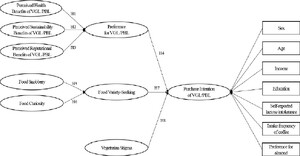
The research framework and hypothesized relationships are presented in Figure 1. Specifically, the research model is designed to examine the effects of eight main factors proposed as influencing the purchase intention of lattes using alternative milk.

Research model and hypothesized relationships. Abbreviations: VGL, Vegan latte; PBL, Plant-based latte.
Citation: International Food and Agribusiness Management Review 27, 4 (2024) ; 10.22434/ifamr2023.0088
2.1. Perceived benefits and preference for vegan/plant-based lattes
The health benefits of plant-based dairy have been investigated for many years. Since plant-based milk products have no lactose and no milk proteins, they are preferred over cowâs milk by consumers who are lactose-intolerant or allergic to milk proteins (Cruz et al., 2007). Plant-based dairy products also have no cholesterol and are low in calories, so people who want to avoid high blood pressure, diabetes, cardiovascular disease, hypercholesterolemia, or obesity tend to choose plant-based dairy alternatives over animal-based ones (Tuso et al., 2013). Recently, the presence of health-promoting ingredients such as minerals, dietary fiber, vitamins, and antioxidants has made plant-sourced products recognized as functional foods (Das et al., 2012). Many plant-based beverages contain functionally active components with health-promoting properties that attract health-conscious consumers (Sethi et al., 2016). Many studies have shown that perceived health benefits can affect consumersâ choice of plant-based alternative products (e.g., Graça et al., 2015; Lea and Worsley, 2003; Lea et al., 2006).
Plant-based products are also considered more sustainable than animal-based foods (Van Loo et al., 2017). From an environmental perspective, the dairy market is one of the largest producers of greenhouse gases in agriculture (Karwacka et al., 2020). The carbon and water footprints of milk are larger than those of plant milk (Clune et al., 2017). In other words, the consumption of plant milk is much more sustainable than the consumption of cow milk. Vainio et al. (2016) investigated motivations in replacing animal-based proteins with plant-based proteins and showed that the main motivation for the change was interest in environmental issues. Previous studies have reported that animal welfare is the main reason for the pursuit of vegetarianism (e.g., Lazzarini et al., 2017; Radnitz et al., 2015; Schiano et al., 2020), and it applied to alternative milk products (Boaitey and Minegishi, 2020; Haas et al., 2019). Animal welfare contributes to ecological, ethical, social, and economic sustainability (Vinnari and Tapio, 2012). In this reason, perceived sustainability benefits can affect the purchase intention of lattes using alternative milk.
The perceived reputational benefits of consuming lattes using plant-based milk can affect purchase intentions. A âreputational benefitâ is known as a factor that positively influences food consumer behavior (e.g., Kimura et al., 2012; van de Grint et al., 2021). This can apply to coffee purchase behavior. Sophisticated coffee consumption no longer serves simply to quench oneâs thirst; indeed, it also contributes to a prestigious reputation (Lin, 2012). Consuming plant-based alternative products is also known to relate to altruistic motives (Schiano et al., 2020). Several studies on altruistic behavior have suggested that altruistic or generous behavior can be enhanced by other peopleâs signals and potential reputation outcomes (Pinto et al., 2019). Therefore, the consumption of lattes using alternative milk can be perceived as obtaining reputational benefits for the reasons mentioned above, which can affect consumersâ intention to purchase.
The literature review found that the perceived benefits affect attitudes in plant-based food consumption based on the theory of planned behavior (Arnaudova et al., 2022; Schiano et al., 2020). Ajzen (1985) said the definition of attitudes is an individualâs positive or negative evaluation of performing the behavior. Fishbein and Ajzen (2011) also said that âattitudeâ means a latent disposition or tendency to respond with a degree of favorableness or unfavorableness to a psychological object. It refers to the positive or negative evaluation of the outcome associated with performing a given behavior, such as purchasing a latte using alternative milk. The factors that can influence attitudes are known as perceived beliefs, but regarding plant-based foods or plant-based milk, research has mainly focused on perceived benefits among perceived beliefs (e.g., Espinosa and Azambuja, 2022; Ketelings et al., 2023; Munialo and Andrei, 2023). Therefore, attitudes should have reflected positive evaluations rather than negative ones, leading preference to be considered as a form of attitude. In many studies, the perception and purchase intention of plant foods have been investigated and compared to existing animal-based foods, since the former are the substitute for the latter (e.g., Charlebois et al., 2019; Ãınar et al., 2022; Cliceri et al., 2018; Duchene and Jackson, 2019). âPreferenceâ is defined as a greater liking of one alternative over another, which requires a comparison between two objects (Szmukler, 2019). For this reason, preference can be a suitable concept for attitude to compare a vegan/plant-based latte with a general animal-based latte. Therefore, we hypothesize the following:
H1a/b: Perceived health benefits of VGL/PBL have a positive effect on preference for VGL/PBL.
H2a/b: Perceived sustainability benefits of VGL/PBL have a positive effect on preference for VGL/PBL.
H3a/b: Perceived reputational benefits of VGL/PBL have a positive effect on preference for VGL/PBL.
H4a/b: Preference for VGL/PBL has a positive effect on purchase intention of VGL/PBL.
2.2. Food snobbery, curiosity, and variety-seeking
Food snobbery drives individuals to seek out new, exotic, or trendy products over traditional ones, reflecting a trend seen in the emphasis on sophistication and uniqueness through restaurant reviews, food programs, and dining-out situations (Ashley et al., 2004; Bauman, 2005; Spiller, 2012). It is based on the thought that being a gourmet is a relatively inexpensive way to represent social and capital status (May, 1996). Since food snobbery has evolved from its past connotation of consuming elitist delicacies to a trend towards seeking more diverse consumption of food (Peterson and Kern, 1996; Yu and Margolin, 2021), this characteristic can affect food variety-seeking tendency. Due to the particular interest in various foods among foodies in modern society, engaging in vegan diets can also be considered a form of food snobbery (Collins, 2014). Latte products using alternative milk can be seen as attractive as a new type of latte product. According to Mintel GNPD (2024), the number of new latte products using plant-based milk globally has been growing rapidly at an average annual rate of 44.4% from 2019 to 2023. Consumers who seek unique and adventurous flavors, are consuming lattes made with plant-based alternatives dairy products, driving potential innovation in the coffee market (Kaczorowski, 2023).
One of the most important drives to a variety-seeking tendency is curiosity. This is an integral concept of the variety-seeking motive (Dember and Earl, 1957; Hoyer and Ridgway, 1984; Van Trijp et al., 1996). Ueda (2017) defined the concept of food curiosity as the âeaterâs ability to know everything about food, whether it is in the stage of production, processing, or consumption.â As a trigger to consume plant-based milk, curiosity was cited as the main factor (Haas et al., 2019). Curiosity regarding plant-based milks is especially about taste, and most people who have tried them are looking for something they can enjoy drinking, not something similar to standard milk (Batista et al., 2023; Pointke et al., 2022). In other words, they consider drinking plant-based milks an opportunity to expand their diet, which is associated with learning that is open to new tastes focused on diversifying (Adamczyk et al., 2022). Therefore, food curiosity can be a factor influencing food variety-seeking tendency that affects purchase intention of latte using plant-based milk.
Coffee is the most consumed beverage worldwide (Farah, 2009), and the coffee industry has catered to individualsâ sophisticated tastes with diverse products (Adams, 2012; de Almeida and Zylbersztajn, 2017; Maciejewski et al., 2019). A latte using alternative milk is a new option for coffee made using soy, almond, or oat milk, which are known to have different sensory characteristics compared to a conventional latte using cow milk (DemiÌr et al., 2021; Gupta and Bisla, 2019; Kundu et al., 2018). In other words, this can be considered a new type of latte with different attributes for consumers who seek variation in coffee. Several studies have shown that a variety-seeking tendency has a significant effect on food consumption and purchase intention (Ellis and Thompson, 2018; Legohérel et al., 2012; Xuhui et al., 2019), so it can be considered that the higher the food variety-seeking propensity consumers have, the higher their intention to purchase a latte using alternative milk. Thus, the following hypotheses are advanced:
H5a/b: Food snobbery has a positive effect on food variety-seeking in the VGL/PBL group.
H6a/b: Food curiosity has a positive effect on food variety-seeking in the VGL/PBL group.
H7a/b: Food variety-seeking has a positive effect on purchase intention of VGL/PBL.
2.3. Vegetarian stigma
Perceived vegetarian stigma is considered a barrier when a non-vegan/non-vegetarian chooses plant products, which can negatively affect the purchase intention of lattes using alternative milk. Minson and Monin (2012) stated that âdo-gooder derogationâ has shown that vegetarians who are perceived to behave morally and ethically can be negatively judged by others. With focus group discussions, Markowski and Roxburgh (2019) showed that non-vegetarians attempt to avoid this stigma through social and behavioral distancing, which suggests that the stigma of vegetarianism is a barrier inhibiting plant-based diet choices. For this reason, purchasing plant-based alternatives can sometimes be stigmatized or socially undervalued. Many studies have demonstrated that vegetarianism is an act that can be denigrated, creating âvegaphobia,â which forms strained relationships with others such as family, friends, and coworkers (e.g., Cole and Morgan, 2011; Hirschler, 2011; Larsson et al., 2003; Rosenfeld and Tomiyama, 2020; Twine, 2014). Especially in South Korea, given the social importance placed on ordering and sharing similar menu items together to create intimate relationships and emotional ties, veganism faces enormous social pressure to give in to traditional omnivorous diets, as it can be seen as a bad practice and contradictory to non-vegetarian norms (Yoo and Yoon, 2015). This behavior tends to be stigmatized more severely by creating dissonance over group conformity (Bresnahan et al., 2016). Especially, purchasing coffee can be more influenced by other peopleâs eyes because it is often consumed at cafes with other people (Petit and Sieffermann, 2007). Accordingly, we hypothesize the following:
H8a/b: Vegetarian stigma has a negative effect on purchase intention of VGL/PBL.
2.4. Label communication for plant-based alternative products
It is not easy to purchase food because one cannot know much about important characteristics such as taste, flavor, and texture before trying it. Yet, labels attached to products and menus help consumers make food choices by providing information about them (Heimbach, 1981). In the absence of face-to-face meetings between the end consumer and the food operator, food labeling, which represents the actual interface, is the best means of providing appropriate information to the consumer (Caswell and Padberg, 1992; Tonkin et al., 2015). Many studies have demonstrated that the information on various labels attached to products affects perception, acceptance, preference, purchase intentions, and purchase behavior (e.g., Ares et al., 2014; Folkvord et al., 2021; McGuinness et al., 2022; Paula et al., 2021; Taillie et al., 2022).
When marketers put labels on plant-based products, they generally use the descriptors âvegetarian/veganâ or âplant-basedâ (Papies et al., 2020). The former can define the boundary of consumers or give people a vegan identity, which may act as a barrier to their purchase intention (Markowski and Roxburgh, 2019). And the âvegetarian/veganâ framing can be explained by loss, which means that it lacks animal-based ingredients (Rosenfeld et al., 2022). However, the latter is likely to focus on what products gain and contain rather than what they lack, so it does not have the barrier associated with veganism (Anderson, 2019). The label âplant-basedâ does not contain information about target consumers, so it may be more value-neutral, not a barrier to consumption. Krpan and Houtsma (2020) showed that consumers choose plant-based products more often when they are labeled with a social frame (e.g., relaxing conversations) or a pro-environmental frame (e.g., environmentally friendly), compared to when they are labeled vegetarian or vegan. According to previous studies, gain framing is more effective than loss framing in healthy and sustainable eating behavior, and it has been applied to these two labels (Carvalho et al., 2022; Gallagher and Updegraff, 2012). For this reason, it can be considered that consumers view a latte labeled âplant-basedâ more favorably than a latte labeled âvegan.â Lattes using alternative milk can be consumed by vegans who refuse to consume cow milk (North et al., 2021); thus, we label them âvegan latteâ and âplant-based latteâ in this study. The effects of labeling on plant-based products have been little studied (Anderson, 2019; Rosenfeld and Tomiyama, 2020), especially in the beverage category. Therefore, we hypothesized the relationship between the purchase intention of plant-based lattes and the factors affecting that intention would differ for two labels, namely âvegan latte (VGL)â and âplant-based latte (PBL).â
3. Research methods
3.1. Data collection
To investigate various factors influencing consumersâ purchase intention of a vegan/plant-based latte, a scenario-based experiment was conducted with a between-subjects online survey design. We collected responses through Embrain, a mobile research company having 1.3 million panels in South Korea. Links were randomly sent to their panels through Embrain survey platform with the quota sampling method for age and gender. Consequently, a total of 533 valid responses were collected in the study, of which 265 were responses to the vegan label group and 268 to the plant-based label group. Based on the literature reviews, sample sizes less than 100 are often considered small, sample sizes between 100 and 200 are moderate, and sample sizes exceeding 200 are considered large enough (Kline, 2005). A similar criterion reported by Ding et al. (1995) is that the minimum sample size suitable for the analysis is typically 100 to 150 participants.
Respondentsâ participant consent was obtained before the experiment started. Data privacy and anonymity were assured. The respondents consisted of both genders with or without lactose intolerance, with a variety of educational background, age (over 18), income, frequency of coffee intake, and preference for almonds. However, vegans and vegetarians are generally known to have different purchasing behavior mechanisms when purchasing plant-based products (Martinelli and De Canio, 2021; Salehi, 2018; Yoh, 2018), and only 0.2% of South Koreans choose not to eat meat, specifically beef, pork, poultry, and fish (Korea Agro-Fisheries and Food Trade Corporation, 2022). So, vegans and vegetarians were excluded from this survey targeted to non-vegetarian food and beverage consumers. Thus, our study is possibly generalizable to non-vegetarian consumers.
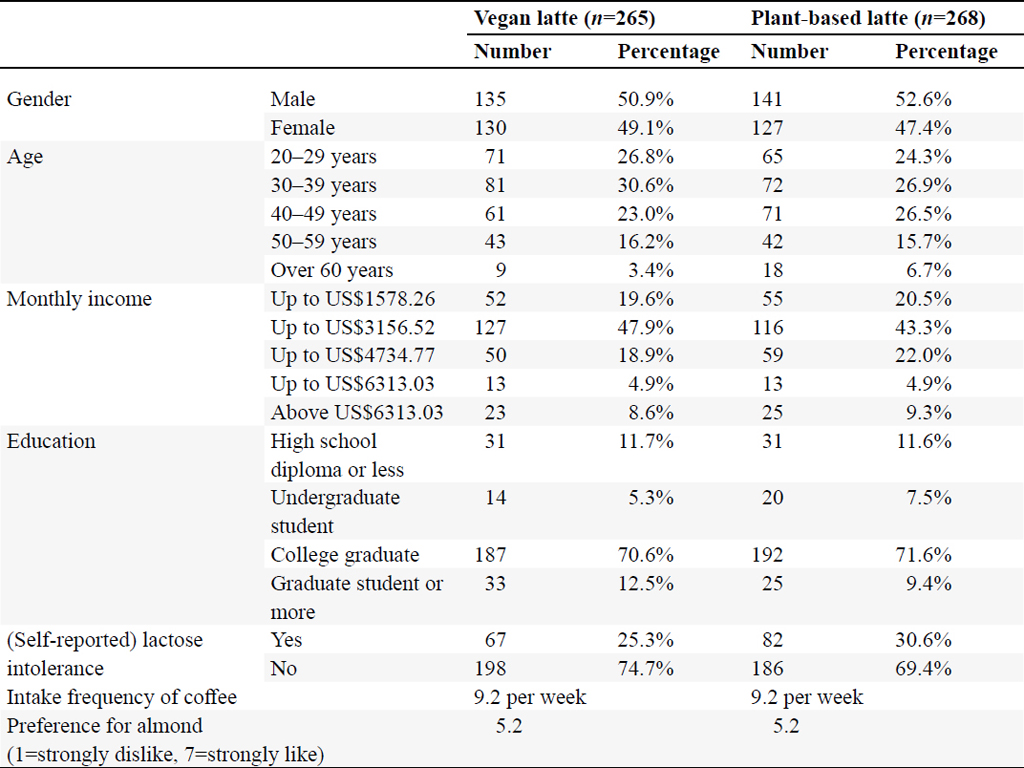
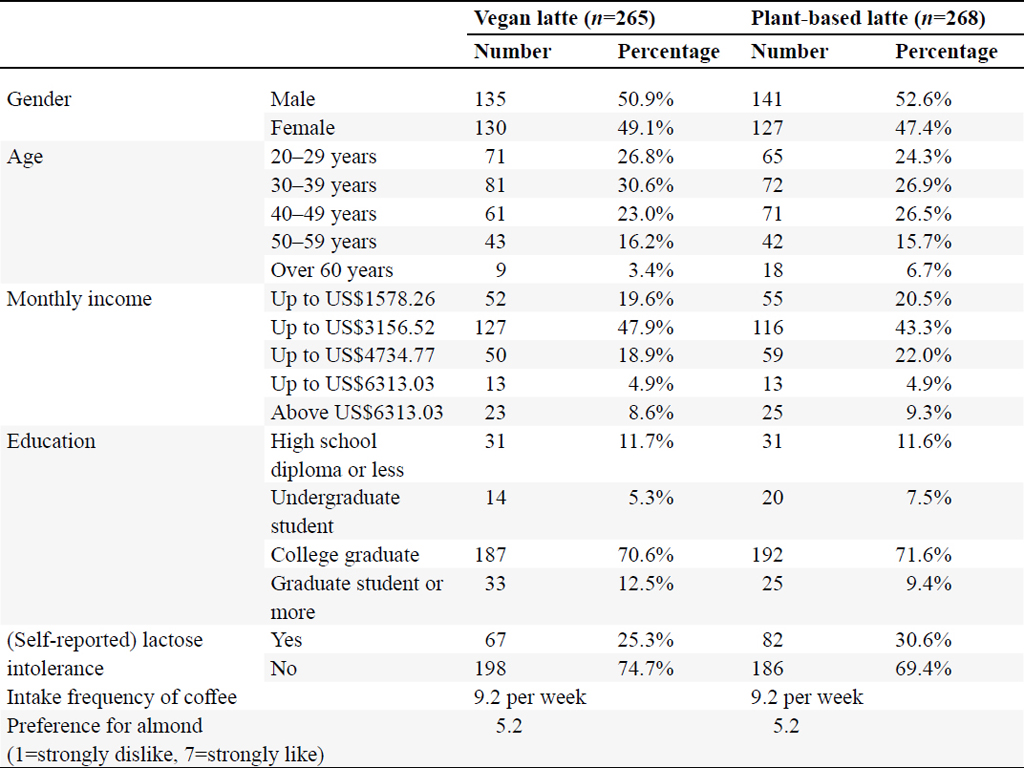
The demographic information of respondents in each group is presented in Table 1, which includes gender, age, monthly income, education level, (self-reported) lactose intolerance, intake frequency of coffee, and preference for almonds. In both groups, the proportion of men and women was nearly the same, and participants aged 20 to 49 accounted for about 80% of the total. Since it was conducted with a mobile survey, the proportion of respondents in their 50s and older, whose smartphone penetration rate is lower, was smaller than that of other age groups. Over 80% of the participants earned a monthly income of less than US$4734.77. Nearly 90% of the respondents had graduated from college. Respondents with (self-reported) lactose intolerance accounted for about 25% of the vegan latte group and 31% of the plant-based latte group. For the question asking about almond preference on a 7-point Likert scale, both groups scored 5.2 points on average. In this sense, it can be considered that there is no difference in the sample properties of the two groups. Compared to the South Korean population, the study sample is biased in favor of younger and better educated (KOSIS, 2022). Since the survey was conducted through a mobile survey app, it is presumed that it was easier to access younger people with higher mobile utilization.
Properties of the sample (n=533)
Citation: International Food and Agribusiness Management Review 27, 4 (2024) ; 10.22434/ifamr2023.0088
3.2. Experimental design and materials
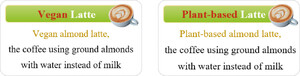
After agreeing to participate, respondents could see the stimuli comprising information with vegan/plant-based labels and then respond to the survey. The stimuli are represented in Figure 2. Since this study aims to reveal whether there is a difference between the factors that influence purchase intention depending on labels, latte information labeled âveganâ or âplant-basedâ was shown to respondents. The words âveganâ and âplant-basedâ were marked in front of the word âlatte,â and an explanation of how the latte was made was added. All information provided to both groups was the same except for the labels, as the focus was only on the effects of the labels. We described it as a latte made with almond milk to help consumers understand vegan/plant-based lattes. In the Korean market, âoat latteâ is likely to be recognized as a product of a certain cafe brand (The Food and Beverage News, 2021), and soy milk has been considered a daily drink for a long time (Kim and Kwon, 2001). Therefore, almond lattes, which are uncommon but sensually less resistant compared to other plant-based milk lattes (Sethi et al., 2016), were selected as stimuli.
Information offered to respondents as stimuli.
Citation: International Food and Agribusiness Management Review 27, 4 (2024) ; 10.22434/ifamr2023.0088
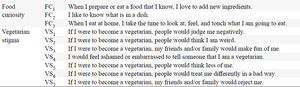
The research was conducted using a quantitative method, operationalized through a cross-sectional survey (Malhotra et al., 2017). To operationalize the constructs, a 7-point Likert scale was used, with its extremes being â1. strongly disagreeâ and â7. strongly agree.â The questionnaire included a series of statements used to measure purchase intention (PI), preference (PRF), perceived health benefits (HB), perceived sustainability benefits (SB), perceived reputational benefits (RB), food snobbery (FS), food curiosity (FC), food variety-seeking (FVS), and vegetarian stigma (VS). The statements used to evaluate the constructs of purchase intention (Chen and Lee, 2015), preference (Wang, 2013), perceived health benefits (Dorce et al., 2021; Yazdanpanah et al., 2015), perceived reputational benefits (Gershon et al., 2020), food variety-seeking (Marshall and Bell, 2004; Steenkamp et al., 1993), food curiosity (Hwang et al., 2020; Ueda, 2017), and vegetarian stigma (Rosenfeld and Tomiyama, 2020) were adapted from previous studies. The measurement items for perceived sustainability benefits and food snobbery were developed. The measure development procedure for these two variables followed Lee et al. (2021)âs method, which is modified from Churchill Jr (1979), Smith et al. (1996), and Sweeney and Soutar (2001). After specifying the domain and dimensionality of the construct in the literature review (Food snobbery: Ashley et al. (2004); Spiller (2012); Williamson et al. (2009); Wood (1996), Perceived sustainability benefits: Schiano et al. (2020); McClements et al. (2019); Reyes-Jurado et al. (2021)), we constituted an offline expert committee with two professors and five master and doctoral students and conducted a pre-test for the face, content, and criterion validity. The Attendance of experts to judge measurementsâ domain is common in marketing areas (e.g., Babin and Burns, 1998; Sweeney and Soutar, 2001). Based on the feedback, items of food snobbery and perceived sustainability benefits have been added, deleted, and modified to improve content validity. The designed questionnaire, including items of all variables, was translated into Korean by five bilingual English-Korean speakers, including authors, following Tsang et al.âs (2017) guidelines. The initial version of the survey was pilot-tested on 70 coffee consumers in South Korea for exploratory/confirmatory factor analysis and a reliability test, which was administered only for the case of latte labeled âplant-basedâ. The pilot-test link was mainly distributed to undergraduate and graduate students through Google Form. As a result, a few items were dropped and shortened based on explanatory/confirmatory factor analysis and reliability analysis of the data. Finally, 4 items were selected for the perceived sustainability benefits, and 4 items were also selected for the food snobbery. This process was performed to reduce the cognitive burden of respondents and to obtain better-quality answers. All statements for the main survey are presented in Table A3 in the Appendix.
3.3. Statistical analysis
The following four-step analysis was conducted to verify the hypotheses in each group (Group 1: offered latte information with the vegan label; Group 2: offered latte information with the plant-based label). First, to evaluate the measurement models by means of partial least squares-structural equation modeling (PLS-SEM), the reliability and validity of the scales were verified with Smart PLS 3.0 (Ramayah et al., 2018) before the next analysis. For both groups, identical structures and items were used, which is essential for the multigroup comparison condition. Second, a t-test was conducted to analyze the difference of perceived benefits, preference, and purchase intention by the different label types. Third, to evaluate the structural model, path coefficients and R-squared- and p-values were separately calculated for each group. Finally, multigroup analysis (MGA) was conducted between the two groups. To study the differences between the path coefficients, the SmithâSatterthwaite t-test was conducted (Chin, 2000). Due to the unequal variances between the two groups, the SmithâSatterthwaite t-test was conducted instead of Studentâs t-test. It has been used to compare path coefficients in MGA applying PLS-SEM (Henseler, 2012; Lamberti, 2023; Velayutham et al., 2012).
4. Results
4.1. Confirmatory factor analysis (CFA)
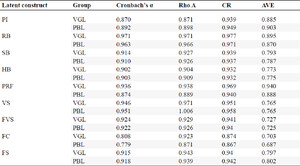
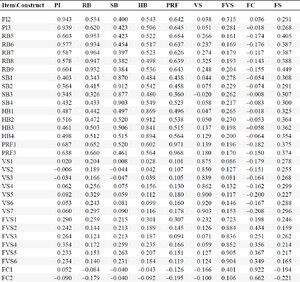
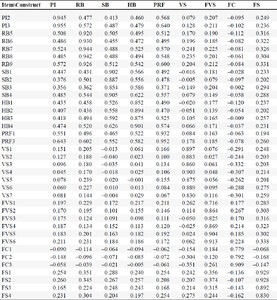
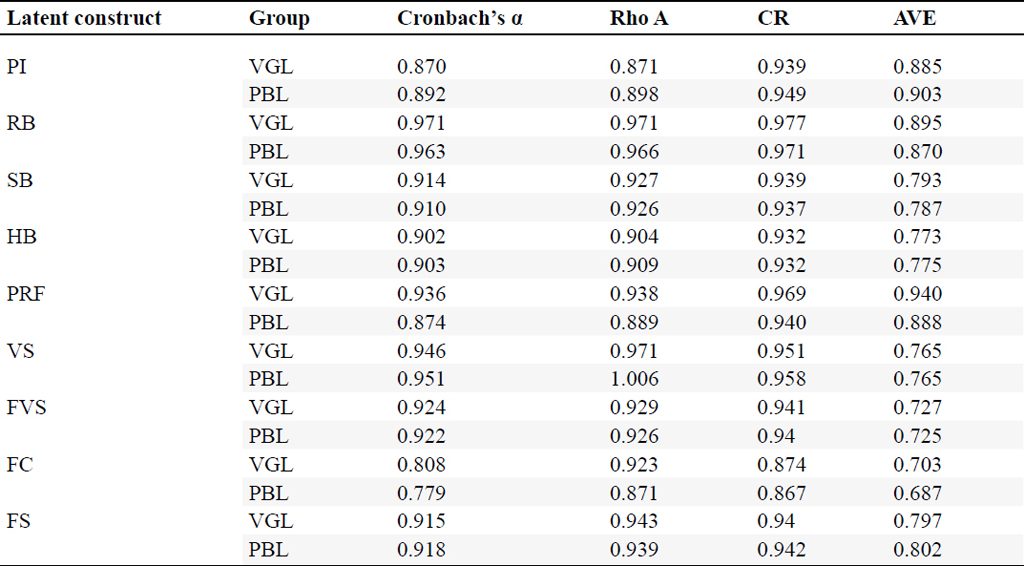
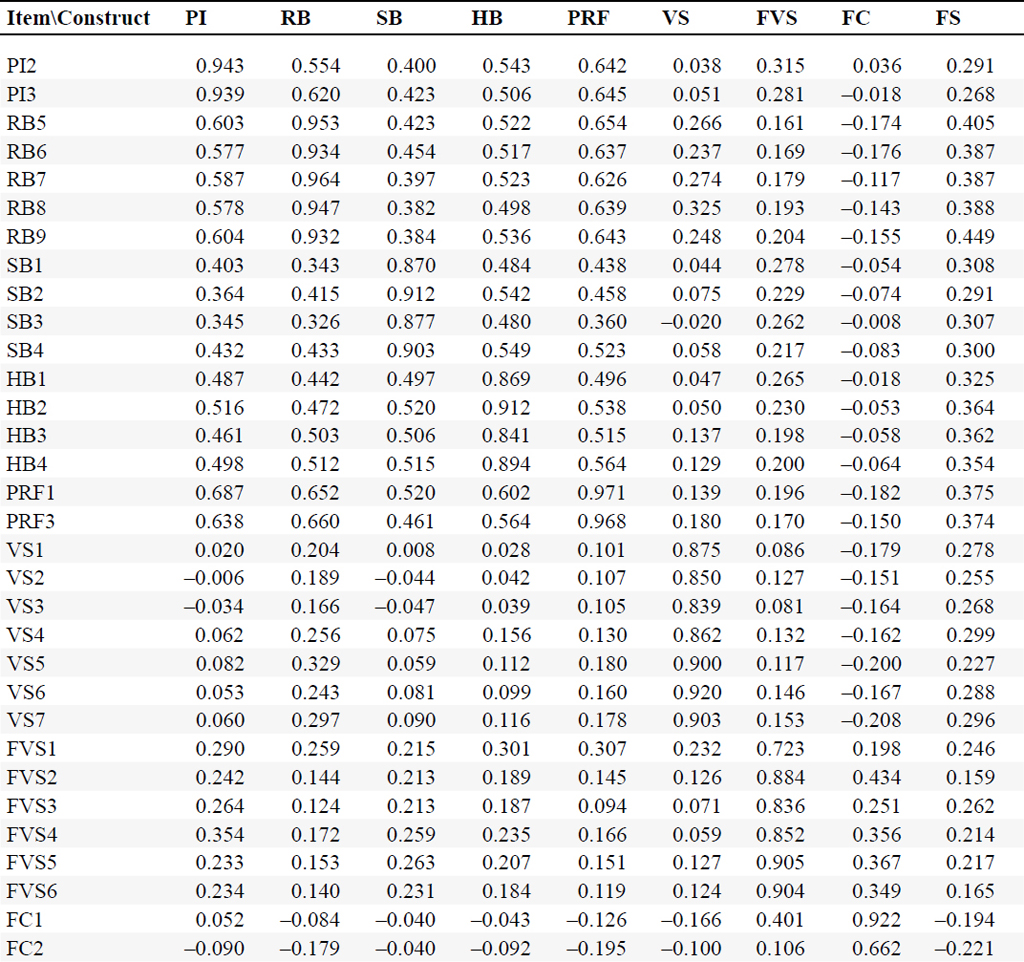
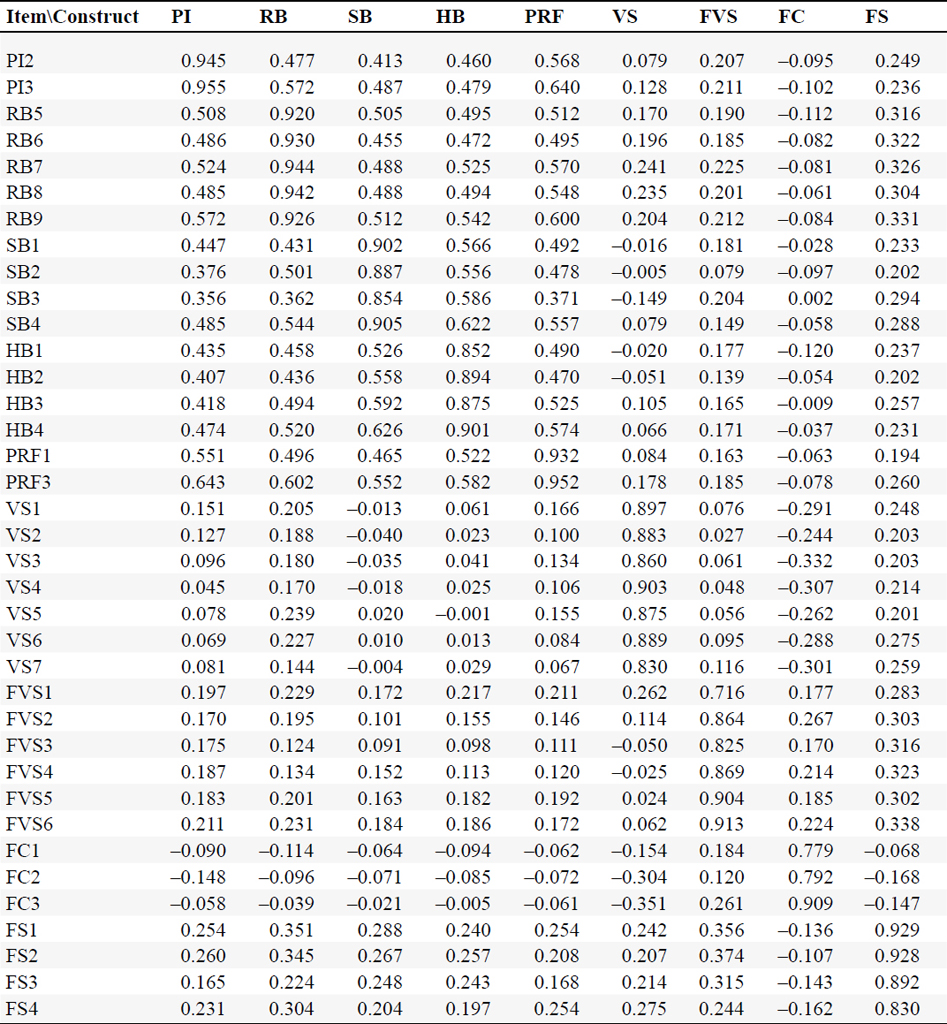
The assessment of the measures included the reliability and discriminant validity of the measurements. Individual item loadings and internal consistency were examined as tests of reliability. Because of high cross-loadings, items PI1, PRF2, and RB1-4 were removed from the model for adequate discriminant validity. As shown in Tables A4 and A5 in the Appendix, the cross-loading for every measurement is greater than 0.7, which means there is adequate internal reliability except for FC2; however, this item is near 0.7, which is still acceptable. Table A1 in the Appendix shows Cronbachâs alpha, rho A, construct reliability (CR), and average variance extracted (AVE). Cronbachâs alpha and rho A for all latent constructs was above 0.7, indicating internal consistency and indicator reliability. Also, since all composite reliability values are above 0.7, measurements have both convergent validity and internal consistency (Werts et al., 1974). AVE was also examined. AVE shows the variance that a construct captures from indicators, in relation to the variance contained in measurement error. This is generally interpreted as a measurement of reliability for the construct and of evaluating discriminant validity (Bakos, 1998). These results indicate that the measurement model has suitable composite reliability and validity.
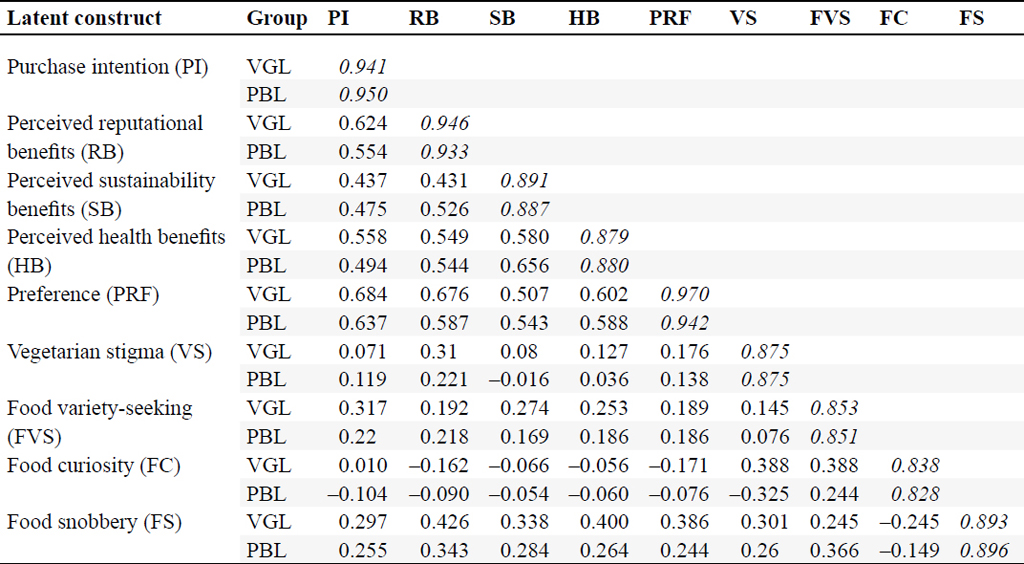
Table A2 in the Appendix shows the correlation coefficients between the variables and the ratio of the square root of AVE of each construct. The diagonal elements in bold are the square roots of AVE, which are the correlations of each variable with its own measurement. The off-diagonal elements are correlations between variables. Diagonal values should be greater than the entries in corresponding rows and columns for discriminate validity. Each construct is more correlated with its own measure than with other constructs, showing strong discriminant validity. Based on this result, the measurements of both models can be considered appropriate.
4.2. Differences in perceived benefits, preference, and purchase intention by labeling
The differences in perceived benefits, preference, and purchase intention between the vegan group and the plant-based group were analyzed with the t-test. The results are listed in Table 2. Perceived preference (mean of the VGL group=3.589, mean of the PBL group=3.931, t=2.512), health benefits (mean of the VGL group=4.229, mean of the PBL group=4.433, t=1.749), and reputational benefits (mean of the VGL group=3.240, mean of the PBL group=3.451, t=1.671) were higher when latte information with the plant-based label was offered than with the vegan label offered. According to the results, this implies that consumers consider the latte more favorable when names of products or menu options have plant-based labels instead of vegan labels. In other words, plant-based labeling can be considered to have a positive effect on perceived benefits and preference. However, there was no significant difference in perceived sustainability benefits and purchase intention depending on the labels.
Differences in perceived benefits, preference, and purchase intention between the vegan label group and the plant-based label group
Citation: International Food and Agribusiness Management Review 27, 4 (2024) ; 10.22434/ifamr2023.0088
4.3. Assessment of the structural model
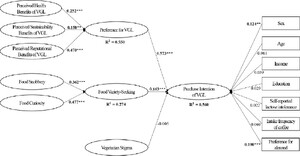
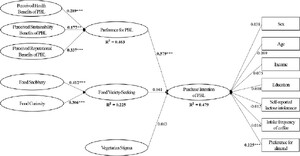
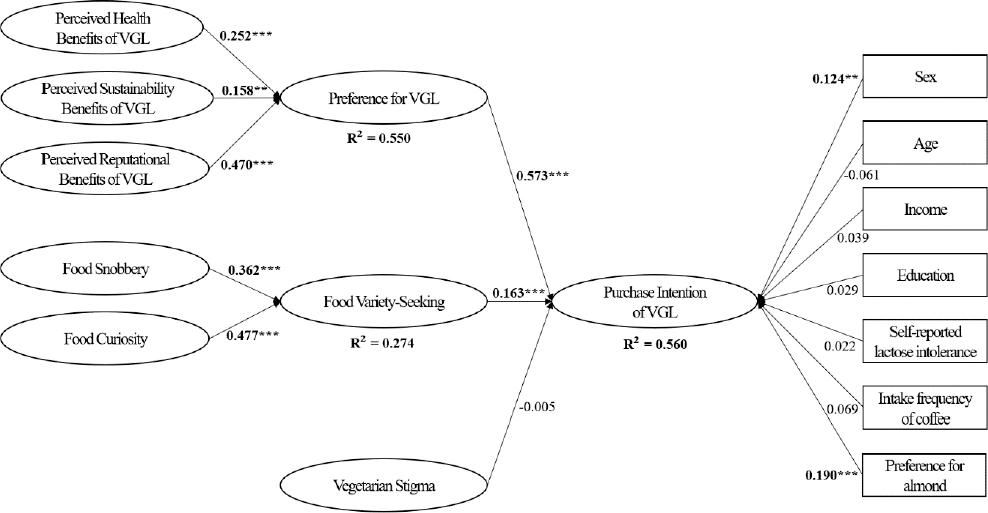
Structural equation modeling was conducted with Smart PLS 3.0 to test the hypothesized structural models. The coefficients of determination (R²) were verified to determine the explanatory power of the proposed models (Malhotra et al., 2017). In the model for the vegan latte group, independent variables explained 56.0% (R²=0.560) of the variance of purchase intention, and in the model for the plant-based latte group, they explained 47.9% (R²=0.479) of the variance of purchase intention.
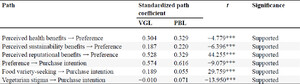
The standardized regression coefficients and their significance levels for the vegan latte (VGL) group are presented in Figure 3 and those for the plant-based latte (PBL) group are presented in Figure 4. For the vegan latte group, the theorized relationships perceived health benefits of VGL â preference for VGL, perceived sustainability benefits of VGL â preference for VGL, perceived reputational benefits of VGL â preference for VGL, preference for VGL â purchase intention of VGL, food snobbery â food variety-seeking, food curiosity â food variety-seeking, and food variety-seeking â purchase intention of VGL were found to be significantly positive. However, the relationship vegetarian â purchase intention of VGL was not significant. For the plant-based latte group, the theorized relationships perceived health benefits of PBL â preference for PBL, perceived sustainability benefits of PBL â preference for PBL, perceived reputational benefits of PBL â preference for PBL, preference for PBL â purchase intention of PBL, food snobbery â food variety-seeking, food curiosity â food variety-seeking, and food variety-seeking â purchase intention of PBL were found to be significantly positive, and the relationship vegetarian â purchase intention of PBL was not significant. In other words, all types of perceived benefits have positive effects on preference, which also has a positive effect on purchase intention, but vegetarian stigma does not have a significant effect on purchase intention in either group. Food curiosity and food snobbery positively affected variety-seeking in all groups, but food variety-seeking had a significantly positive effect on purchase intention only in the vegan latte group. Therefore, hypotheses 1, 2, 3, 4, 5, 6, and 7(a) are supported in both groups with paths significant at the p=0.01 level. In both groups, variety-seeking affects preference in the order of reputation benefits (VGL;
Structural model results in the vegan latte (VGL) group.
Citation: International Food and Agribusiness Management Review 27, 4 (2024) ; 10.22434/ifamr2023.0088
Structural model results in the plant-based latte (PBL) group.
Citation: International Food and Agribusiness Management Review 27, 4 (2024) ; 10.22434/ifamr2023.0088
4.4. Multigroup analysis of the vegan and plant-based labels
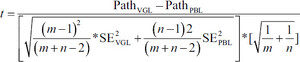
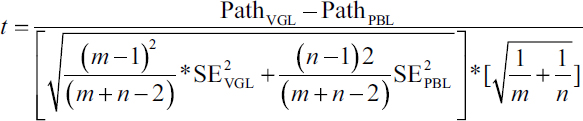
To compare the links between the factors and the purchase intentions depending on two labels, the values of each path coefficient in the structural models of preference and purchase intention were compared using the SmithâSatterthwaite t-test (Chin, 2000). The Smith-Satterthwaite t-test equation used in this study is represented as follows:
Citation: International Food and Agribusiness Management Review 27, 4 (2024) ; 10.22434/ifamr2023.0088
where Pathi, unstandardized path coefficient in group I; SE, standard error in group i, degree of freedom: m+nâ2.
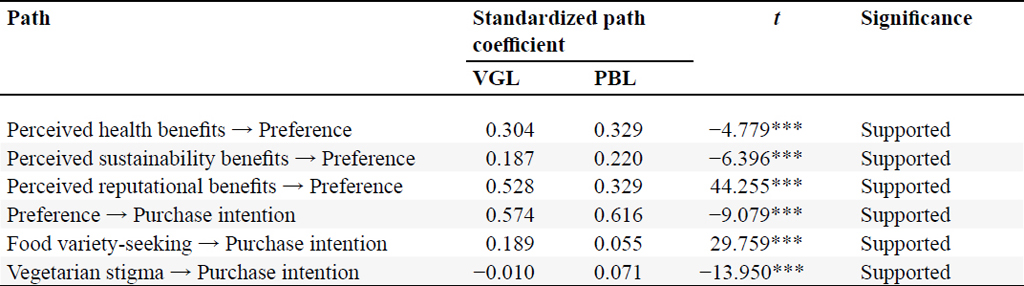
Table 3 indicates the results of the multigroup analysis. In the PBL group, the path coefficients from health benefits to preference, from sustainability benefits to preference, from preference to purchase intention, and from vegetarian stigma to purchase intention are significantly higher than in the VGL group. However, in the VGL group, the path coefficients from reputational benefits to preference and from food variety-seeking to purchase intention are significantly higher than in the PBL group. This shows that there are significant differences for all the effects of the independent variables on the purchase intention of latte products with the vegan labeling and the plant-based labeling at the p=0.01 level.
Multigroup analysis results for structural models of preference and purchase intention using the SmithâSatterthwaite t-test.
Citation: International Food and Agribusiness Management Review 27, 4 (2024) ; 10.22434/ifamr2023.0088
5. Discussion
This study aims to find the factors affecting consumer intention to purchase lattes using alternative milk from plant-based sources and to compare the links between the factors and purchase intentions depending on two labels, âvegan latteâ and âplant-based latte.â To achieve the above goals, the online and scenario-based experiment was conducted with a between-subjects design, followed by a survey. In both groups watching latte information with âveganâ and âplant-basedâ, the perceived benefits had a positively significant effect on purchase intention, but the perceived barrier (i.e., vegetarian stigma) did not. Perceived benefits and preference were higher when showing a âplant-based latteâ label focusing on the presence of plant-based ingredients than when showing a âvegan latteâ label focusing on the absence of animal-based ingredients. However, there was no significant difference between purchase intentions depending on the label. For the label âvegan latte,â the higher their food curiosity, food snobbery, and food variety-seeking tendency, the higher their purchase intention, even though consumers are non-vegan. It implies vegan certifications can work in marketing. The findings of this study provide marketers and practitioners with what needs to be highlighted and which consumers to target to boost sales of lattes using alternative milk. We provide a strategy for changing consumer behavior, emphasizing the potential for labels to promote the purchase intention of lattes using alternative milk.
5.1. Factors associated with purchase intention of latte using alternative milk
According to the results of this study, perceived benefits have a significant effect on product preference, which affected the purchase intention of the product in both the vegan latte group and the plant-based latte group. This is supported by the theory of planned behavior (TPB) in which behavioral beliefs affect attitudes, and attitudes affect intentions (Ajzen, 1991; Fehér et al., 2020). Furthermore, this study shows results similar to those of previous studies demonstrating that perceived health benefits, perceived sustainability benefits, and perceived reputational benefits of plant-based products affect attitudes and purchase intentions toward them (Corepal and Copeman, 2014; Corrin and Papadopoulos, 2017; Fehér et al., 2020; Jang and Cho, 2022; Lea et al., 2006; Lea and Worsley, 2003; Ye and Mattila, 2021). This suggests that they can be applied as factors that affect the preference of coffee products using plant-based milk as well.
In detail, consumers perceive health benefits and sustainability benefits as higher among perceived benefits. In other words, consumers recognize that purchasing a latte using alternative milk not only helps them keep healthy, lose weight, and prevent disease, but also helps reduce the carbon footprint or greenhouse gas emissions and contribute to animal welfare. Not only the above two perceived benefits but also reputation benefits were found to be a factor affecting the preference for a latte using plant-based milk. This supports previous research that demonstrated a relationship between consuming plant-based alternatives and reputation benefits (Pinto et al., 2019; Schiano et al., 2020).
Consumers who purchase sustainable products are recognized as more altruistic (Shiano et al., 2020), and eco-friendly behavior is more likely to occur when it is disclosed to others (Takahashi, 2021). Coffee is frequently consumed during social communication with others in cafes and can thus be greatly affected by reputation benefits. Meanwhile, according to existing studies on the perception of coffee where the consumption of coffee with eco-friendly and ethical attributes leads to a good reputation, the reputation benefits and preference for fair trade or organic coffee are higher than those for general coffee (Brenner et al., 2009; Carr et al., 2021; Donnet et al., 2007). The results of this study demonstrate that a latte using plant-based milk is a type of coffee that can benefit from reputation as well, extending previous literature that reputation benefits based on coffee properties can affect preferences and purchase intentions.
On the other hand, vegetarian stigma did not significantly affect the intention to purchase lattes using alternative milk, which supports findings that social stigma does not prevent consumers from maintaining a vegan lifestyle (Brouwer et al., 2022). Beverages, especially coffees, have been considered a category reflecting individual tastes (Li et al., 2019; Masi et al., 2015; Quintão et al., 2017; Spence and Carvalho, 2020), and they are not shared with others, unlike food in Korea. Therefore, it does not cause a negative perception from people around them, and this barrier does not seem to have an impact on purchasing plant-based beverages. In other words, perceived benefits positively affect the preference and purchase intention of lattes using alternative milk in Korea, but barriers do not. This has the following important implications for marketers of plant-based beverages: showing what consumers can get from the products is more effective than covering what they can lose. This means it can boost sales of lattes using alternative milk by utilizing gain message framing on benefits such as easy to digest, low calorie, greenhouse gas reduction, and animal welfare. For instance, if a latte using plant-based milk is offered on a caféâs coffee menu, health benefits such as âlow calorieâ and âlactose-freeâ could be presented on the menu board or posters within the establishment. Additionally, messages promoting sustainability benefits such as âYou are helping reduce greenhouse gas emissionsâ and âYou are contributing to animalâs welfareâ could be displayed to increase sales. Similarly, if it is sold as a ready-to-drink product, showing these intuitive benefits through labels on the product package could also increase sales.
Next is a discussion of the effect of food consumption propensity on purchase intention. In the results of this study, consumersâ food snobbery and food curiosity have a positive significant effect on variety-seeking tendency. For the latte using alternative milk with a âveganâ label, it is an attractive option for consumers who are curious about unfamiliar foods, snobbish from being knowledgeable about foods, and interested in diverse foods. This can be used as good data for consumer targeting by revealing the properties of consumers with higher purchase intentions for lattes using alternative milk. In addition, it would be effective to appeal with a menu separate from a traditional latte menu by adding it as a new menu or by stating that cow milk can be replaced with plant-based milk, stimulating consumersâ variety-seeking behavior. Academically, it is meaningful that it expands and develops previous studies explaining the drivers for food variety-seeking behavior (Caracciolo et al., 2022; Kahn and Isen, 1993; Liu et al., 2022a,b), since causal relationships among these have not been clearly presented in studies with structural equation modeling in the field of food purchasing. In particular, the relationship between snobbery and purchase intention has been mainly studied in fashion (Chattalas and Shukla, 2015; MajlesiRad and Haji pour Shoushtari, 2020; Martinez and Kim, 2012; Wee et al., 1995). We extended this concept to food and further developed measurements to apply it for the food and beverage category. The reason why the tendency to pursue diversity affects purchase intention only when there is a vegan label is discussed in 5.2.
5.2. Different perceptions depending on labels: comparison between âveganâ and âplant-basedâ
Through this study, we tried to find different perceptions depending on the two labels, âveganâ and âplant-basedâ, to help sell lattes using alternative milk. After showing both labels to consumers, a consumer perception survey found that perceived health benefits, perceived reputation benefits, and preferences were higher in the group of consumers who saw the latte information with the plant-based label. Furthermore, as a result of analyzing the path coefficients, it was found that the health benefits and sustainability benefits were higher in the group that saw the information with the label, âplant-based.â To sum up, most perceived benefits and preferences were higher in the group who saw âplant-basedâ labeled lattes. It suggests that labels representing attributes such as âplant-basedâ may be preferred to labels representing target consumers, such as âvegetarian/veganâ. This result also implies that the gain message can also be effective in labeling. It supports previous studies about the message framing of sustainable and healthy food consumption related to plant-based foods and beverages, since the label âplant-basedâ focuses on what is gained and the label âveganâ focuses on what is lacking. It supports previous studies that demonstrated a gain frame works better than a loss frame does when adopting and consuming eco-friendly and sustainable diets (Carfora et al., 2022; Carvalho et al., 2022; Conor et al., 2018). Nevertheless, there were no statistically significant differences in purchase intention between the two conditions. The market size of the domestic alternative milk-related products is growing rapidly, but it is still an early market in South Korea (Kim, 2021). Since the survey targets general consumers who have not confirmed their past purchase experience, there seems to be no difference in actual purchase intention.
Rosenfeld et al. (2022), however, showed the different results compared to our study. They expected higher sales when a hamburger was labeled as plant-based, but sales were higher when it was labeled as vegan. They explained that this was because people are skeptical of having unfamiliar foods. Consumers are familiar with what it means for a food to be vegan, whereas they are less familiar with what precisely it means for a food to be plant-based. In our study, we interpret the results as Rosenfeld et al. (2022)âs hypothesis, referring to vegetarian/vegan menu as âplant-basedâ would have them more likely to sell, compared to referring to them as âvegetarian/veganâ. Based on prospect theory and its evidence (Gallagher and Updegraff, 2012; Kahneman and Tversky, 1979), it was anticipated that labeling a food as âplant-basedâ would emphasize the benefits consumers receive from it, leading to increased consumer acceptance, whereas âvegetarian/veganâ would emphasize losses and be less appealing. It may be because uncertainty about the product was eliminated by adding an explanation in our study. In other words, it suggests that reducing uncertainty about label content by providing information can affect the consumer perception.
In the case of using the label âvegan,â the more variety people seek, the higher the intention to purchase a latte using plant-based milk. It can be difficult that lattes with the label âplant-basedâ are considered a different type of latte product, since it requires only changing the properties of latte products by replacing cow milk with plant-based milk. However, lattes with the label âveganâ can be perceived as a different product compared to normal lattes because it refers to lattes for another consumer group, vegans, that they do not belong to. Vegan certification work has been conducted to reduce the ambiguity of vegan-edible items around the world (e.g., UK: The Vegan Society; France: EVE VEGAN; Italy: Italian Vegetarian Association; South Korea: Korea Agency of Vegan Certification and Services). The findings of this study imply that vegan certifications increase not only vegansâ purchase intentions by telling them that certain products are clearly edible but also non-vegansâ purchase intentions by offering diverse options.
When the label âplant-based latteâ was attached, reputational benefits were more readily perceived, but once they were perceived, the influence on purchase intention was higher when the label âvegan latteâ was attached. In other words, when consuming a âvegan latte,â people do not recognize the reputational benefits relatively well, but once they recognize these, this leads to purchase intention; thus, they need signals that imply consuming this product can look good to others.
Among the control variables, preference for almonds positively affected purchase intentions for plant-based lattes regardless of label type, suggesting that purchase intentions may vary depending on the type of plant-based milk used in the latte. This means that research should be conducted to determine which types of plant-based milks consumers in each country prefer and use this as a guide when developing plant-based lattes. For example, Korean consumers are more familiar with soy milk and almond milk (Ha et al., 2023), so including them in a latte may increase their preference, whereas they are less familiar with oat milk, coconut milk, and macadamia milk (Ha et al., 2023), so including them in a latte may decrease their preference. Meanwhile, females were more likely to purchase vegan-labeled lattes, which supports previous research showing that men are less likely to choose vegan-labeled plant-based foods (Sleboda et al., 2024). Since male consumers do not perceive a vegetarian diet as âunmanlyâ because it has low in protein (Modlinska et al., 2020), it can be beneficial to advertise plant-based lattes with messages associating them with health benefits (Sleboda et al., 2024).
5.3. Limitations and future research
Although this study has presented significant implications for marketers and menu developers by finding factors affecting the purchase intention of a latte using alternative milk and examining the difference depending on the sustainability-related labels, it has several limitations. First, since this study was conducted through an online survey and plant-based lattes are still not common in South Korea, perceived taste through past experience was not considered. Therefore, future research may be conducted in countries where plant-based lattes are common, or may add perceived taste as a factor affecting purchase intention through sensory experiments. Second, due to the socio-cultural background mentioned in the research design, stimuli were limited to almond lattes. Future studies can examine changes in purchase intention depending on various types of stimuli. This means two types of product variations: one a latte with other plant-based milk (such as soy or oat), and another a different beverage using plant-based milk (other than a latte), such as a milk tea, a smoothie, or a frappuccino. Third, this study focused only on two labels, âplant-basedâ and âvegan,â but excluded the label âlactose free,â known to be an important attribute (McCarthy et al., 2017). We controlled the effect from this property in the regression model with lactose intolerance as a variable, but future studies can explore how the âlactose freeâ label influences intention to purchase a latte using alternative milk. Lastly, since this study was conducted with the online scenario-based experiment in one country, there are some limitations on external validity. To improve external validity, future studies need to prove the above factors influencing the purchase intention of vegan/plant-based lattes affect the purchase behavior in the real world through offline experiments, even though it has been proven for a long time through many studies that purchase intention has a significantly positive effect on purchase behavior (e.g., Fishbein and Ajzen, 2011; Lim et al., 2016; Son et al., 2013; Zhang and Zhang, 2007). In addition, it can be conducted in other countries for cross-cultural comparison. If the external validity increases in these ways, it will be used as more useful data for marketers and practitioners.
6. Conclusion
The present study aimed to find the factors affecting consumersâ intention to purchase plant-based/vegan lattes and to compare the associations between the factors and the purchase intentions depending on two labels, namely âveganâ and âplant-based.â Through an online survey with a between-subjects design and the two labels, we determined that perceived benefits have a positive and significant effect on purchase intention, but perceived barriers do not. In addition, the perceived benefits and preferences were higher when a âplant-basedâ label focusing on the presence of plant-based ingredients was shown than when a âveganâ label focusing on the absence of animal-based ingredients was shown. However, as far as the label âveganâ is concerned, even for non-vegan consumers, the higher their food curiosity, food snobbery, and food variety-seeking tendency, the higher their purchase intention. Therefore, vegan certifications can also work as a tool in marketing. This study suggests to menu developers and marketers what needs to be highlighted and which consumers to target to boost latte sales using plant-based milk. It also highlights the potential for labels to promote plant-based latte purchases, thus offering a strategy for changing consumer behavior.
References
Acton, R.B., A.C. Jones, S.I. Kirkpatrick, C.A. Roberto and D. Hammond. 2019. Taxes and front-of-package labels improve the healthiness of beverage and snack purchases: a randomized experimental marketplace. International Journal of Behavioral Nutrition and Physical Activity 16(46): 1â15. https://doi.org/10.1186/s12966-019-0799-0
Adamczyk, D., D. Jaworska, D. Affeltowicz and D. Maison. 2022. Plant-based dairy alternatives: consumersâ perceptions, motivations, and barriers-results from a qualitative study in Poland, Germany, and France. Nutrients 14(10): 2171. https://doi.org/10.3390/nu14102171
Adams, J. 2012. Australiaâs American coffee culture. Australasian Journal of Popular Culture 2(1): 23â36. https://doi.org/10.1386/ajpc.2.1.23_1
Ajzen, I. 1985. From intentions to actions: A theory of planned behavior. In Action control: From cognition to behavior. Springer, Berlin.
Ajzen, I. 1991. The theory of planned behavior. Organizational Behavior and Human Decision Processes 50(2): 179â211. https://doi.org/10.1016/0749-5978(91)90020-T
Anderson, J. 2019. What To Call Plant-Based Meat Alternatives: A Labeling Study. WBI Studies Repository, Potomac, MD. Available online at: https://www.wellbeingintlstudiesrepository.org/cgi/viewcontent.cgi?article=1003&context=hw_diet
Ares, G., F. Mawad, A. Giménez and A. Maiche. 2014. Influence of rational and intuitive thinking styles on food choice: Preliminary evidence from an eye-tracking study with yogurt labels. Food Quality and Preference 31: 28â37. https://doi.org/10.1016/j.foodqual.2013.07.005
Arnaudova, M., T.A. Brunner and F. Götze. 2022. Examination of studentsâ willingness to change behaviour regarding meat consumption. Meat Science 184: 108695. https://doi.org/10.1016/j.meatsci.2021.108695
Ashley, B., J. Hollows, S. Jones and B. Taylor. 2004. Food and cultural studies. Routledge, London.
Babin, L.A and A.C. Burns. 1998. A modified scale for the measurement of communicationâevoked mental imagery. Psychology and Marketing 15(3): 261â278. https://doi.org/10.1002/(SICI)1520-6793(199805)15:3<261::AID-MAR4>3.0.CO;2-8
Bakhsh, A., S.J. Lee, E.Y. Lee, Y.H. Hwang and S.T. Joo. 2021. Evaluation of rheological and sensory characteristics of plant-based meat analog with comparison to beef and pork. Food Science of Animal Resources 41(6): 983. https://doi.org/10.5851/kosfa.2021.e50
Bakos, Y. 1998. The emerging role of electronic marketplaces on the Internet. Communications of the ACM 41(8): 35â42.
Batista, L.F., F. Rocha, M.M. dos Santos Dias, A.C. dos Santos Pires and M.C.T.R. Vidigal. 2023. Comfort plant-based food: What do consumers want? - A focus group study with different consumers group. International Journal of Gastronomy and Food Science 34: 100810. https://doi.org/10.1016/j.ijgfs.2023.100810
Bauman, Z. 2005. Liquid life. Polity, Cambridge.
Boaitey, A and K. Minegishi. 2020. Determinants of household choice of dairy and plant-based milk alternatives: Evidence from a field survey. Journal of Food Products Marketing 26(9): 639â653. https://doi.org/10.1080/10454446.2020.1857318
Boeck, T., A.W. Sahin, E. Zannini and E.K. Arendt. 2021. Nutritional properties and health aspects of pulses and their use in plantâbased yogurt alternatives. Comprehensive Reviews in Food Science and Food Safety 20(4): 3858â3880. https://doi.org/10.1111/1541-4337.12778
Brenner, M., M. Deneau, B. Von Schulz, L. Webb and A. Wong. 2009. Do ethical practices increase profits? MGBL 804 Global Strategy. Queenâs University, Kingston, ON.
Bresnahan, M., J. Zhuang and X. Zhu. 2016. Why is the vegan line in the dining hall always the shortest? Understanding vegan stigma. Stigma and Health 1(1): 3. https://doi.org/10.1037/sah0000011
Brouwer, A.R., C. DâSouza, S. Singaraju and L.A. Arango-Soler. 2022. Value attitude behaviour and social stigma in the adoption of veganism: An integrated model. Food Quality and Preference 97: 104479. https://doi.org/10.1016/j.foodqual.2021.104479
Caracciolo, F., M. Furno, M. DâAmico, G. Califano and G.D. Vita. 2022. Variety seeking behavior in the wine domain: A consumers segmentation using big data. Food Quality and Preference 97: 104481. https://doi.org/10.1016/j.foodqual.2021.104481
Carfora, V., M. Morandi and P. Catellani. 2022. The influence of message framing on consumersandrsquo; Selection of local food. Foods 11(9): 1268. https://doi.org/10.3390/foods11091268
Carr, S.C., I. Meyer, M. Saxena, C. Seubert, L. Hopfgartner, B. Arora, D. Jyoti, R. Rugimbana, H. Kempton and L. Marai. 2021. âOur fair trade coffee tastes betterâ: It might, but under what conditions? Journal of Consumer Affairs 56(2): 597-612. https://doi.org/10.1111/joca.12416
Carvalho, A.S.M., C.I.A. Godinho and J. Graça. 2022. Gain framing increases support for measures promoting plant-based eating in university settings. Food Quality and Preference 97: 104500. https://doi.org/10.1016/j.foodqual.2021.104500
Caswell, J.A. and D.I. Padberg. 1992. Toward a more comprehensive theory of food labels. American Journal of Agricultural Economics 74(2): 460â468. https://doi.org/10.2307/1242500
Chalupa-Krebzdak, S., C.J. Long and B.M. Bohrer. 2018. Nutrient density and nutritional value of milk and plant-based milk alternatives. International Dairy Journal 87: 84â92. https://doi.org/10.1016/j.idairyj.2018.07.018
Charlebois, S., S. Somogyi, J. Music and C. Cunningham. 2019. Biotechnology in food: Canadian attitudes towards genetic engineering in both plant-and animal-based foods. British Food Journal 121(12), 3181â3192. https://doi.org/10.1108/BFJ-07-2018-0471
Chattalas, M and P. Shukla. 2015. Impact of value perceptions on luxury purchase intentions: a developed market comparison. Luxury Research Journal 1(1): 40â57. https://doi.org/10.1504/LRJ.2015.069806
Chen, M.F., and C.L. Lee. 2015. The impacts of green claims on coffee consumersâ purchase intention. British Food Journal 117(1): 195â209. https://doi.org/10.1108/BFJ-07-2013-0196
Chin, W.W. 2000. Frequently asked questionsâpartial least squares and PLS-graph. Available online at http://disc-nt.cba.uh.edu/chin/plsfaq.htm/
Chung, Y.L., W.Y. Kuo, B.K. Liou, P.C. Chen, Y.C. Tseng, R.Y. Huang and M.C. Tsai. 2022. Identifying sensory drivers of liking for plantâbased milk coffees: implications for product development and application. Journal of Food Science 87(12): 5418-5429. https://doi.org/10.1111/1750-3841.16373
Churchill Jr, G.A. 1979. A paradigm for developing better measures of marketing constructs. Journal of Marketing Research 16(1): 64â73. https://doi.org/10.1177/002224377901600110
Ãınar, Ã., L.W. Wesseldijk, A.K. Karinen, P. Jern and J.M. Tybur. 2022. Sex differences in the genetic and environmental underpinnings of meat and plant preferences. Food Quality and Preference 98: 104421. https://doi.org/10.1016/j.foodqual.2021.104421
Cliceri, D., S. Spinelli, C. Dinnella, J. Prescott and E. Monteleone. 2018. The influence of psychological traits, beliefs and taste responsiveness on implicit attitudes toward plant-and animal-based dishes among vegetarians, flexitarians and omnivores. Food Quality and Preference 68: 276â291. https://doi.org/10.1016/j.foodqual.2018.03.020
Clune, S., E. Crossin and K. Verghese. 2017. Systematic review of greenhouse gas emissions for different fresh food categories. Journal of Cleaner Production 140: 766â783. https://doi.org/10.1016/j.jclepro.2016.04.082
Cole, M. and K. Morgan. 2011. Vegaphobia: Derogatory discourses of veganism and the reproduction of speciesism in UK national newspapers. The British Journal of Sociology 62(1): 134â153. https://doi.org/10.1111/j.1468-4446.2010.01348.x
Collins, K. 2014. The Routledge History of Food. Routledge, Abingdon.
Conor, S., A. Kief, F. Kremer, S. Iyer and M. Sieklucki. 2018. Plant based diets : Effects of framing on willingness to adopt plant-based diets. SEEDS, University of British Columbia, Vancouver, BC.
Corepal, R.K. and J. Copeman. 2014. The perceived barriers and benefits of consuming a plant-based diet. European Journal of Nutrition and Food Safety 4(3): 252â253.
Corrin, T. and A. Papadopoulos. 2017. Understanding the attitudes and perceptions of vegetarian and plant-based diets to shape future health promotion programs. Appetite 109: 40â47. https://doi.org/10.1016/j.appet.2016.11.018
Cruz, N., M. Capellas, M. Hernández, A.J. Trujillo, B. Guamis and V. Ferragut. 2007. Ultra high pressure homogenization of soymilk: Microbiological, physicochemical and microstructural characteristics. Food Research International 40(6): 725â732.
Das, A., U. Raychaudhuri and R. Chakraborty. 2012. Cereal based functional food of Indian subcontinent: a review. Journal of Food Science and Technology 49(6): 665â672. https://doi.org/10.1007/s13197-011-0474-1
de Almeida, L.F. and D. Zylbersztajn. 2017. Key success factors in the brazilian coffee agrichain: Present and future challenges. International Journal on Food System Dynamics 8(1): 45â53. https://doi.org/10.22004/ag.econ.254122
de Paula, S.C.S.E., L. Zuim, M.C. de Paula, M.F. Mota, T. L. Filho and S.M.D. Lucia. 2021. The influence of musical song and package labeling on the acceptance and purchase intention of craft and industrial beers: A case study. Food Quality and Preference 89: 104139. https://doi.org/10.1016/j.foodqual.2020.104139
Dember, W.N. and R.W. Earl. 1957. Analysis of exploratory, manipulatory, and curiosity behaviors. Psychological Review 64(2): 91. https://doi.org/10.1037/h0046861
Demir, H., M. Simsek and G. Yıldırım. 2021. Effect of oat milk pasteurization type on the characteristics of yogurt. LWT 135: 110271. https://doi.org/10.1016/j.lwt.2020.110271
Ding, L., W.F. Velicer and L.L. Harlow. 1995. Effects of estimation methods, number of indicators per factor, and improper solutions on structural equation modeling fit indices. Structural Equation Modeling: A Multidisciplinary Journal 2(2): 119â143. https://doi.org/10.1080/10705519509540000
Dominguez, S., J. Théolier, K. Lizée, B. Povolo, J. Gerdts and S.B. Godefroy. 2023. âVeganâ and âplant-basedâ claims: risk implications for milk- and egg-allergic consumers in Canada. Allergy, Asthma and Clinical Immunologyl 19(1): 74. https://doi.org/10.1186/s13223-023-00836-w
Donnet, M.L., D.D. Weatherspoon and J.P. Hoehn. 2007. What adds value in specialty coffee? Managerial implications from hedonic price analysis of Central and South American e-auctions. International Food and Agribusiness Management Review 10(1030-2016â82517): 1â18. https://doi.org/10.22004/ag.econ.8162
Dorce, L.C., M.C. da Silva, J.R.C. Mauad, C.H. de Faria Domingues and J.A.R. Borges. 2021. Extending the theory of planned behavior to understand consumer purchase behavior for organic vegetables in Brazil: The role of perceived health benefits, perceived sustainability benefits and perceived price. Food Quality and Preference 91: 104191. https://doi.org/10.1016/j.foodqual.2021.104191
Duchene, T.N. and L.M. Jackson. 2019. Effects of motivation framing and content domain on intentions to eat plant-and animal-based foods. Society and Animals 27(5â6): 526â543.
Ellis, D. and F.M. Thompson. 2018. The effect of wine knowledge type on variety seeking behavior in wine purchasing. Journal of Wine Research 29(2): 71â86. https://doi.org/10.1080/09571264.2018.1471393
Ensaff. H., M. Homer, P. Sahota, D. Braybrook, S. Coan and H. McLeod. 2015. Food choice architecture: An intervention in a secondary school and its impact on studentsâ plant-based food choices. Nutrients 7(6): 4426-4437. https://doi.org/10.3390/nu7064426
EVE VEGAN. 2022. Certification. Available online at https://www.certification-vegan.org
Farah, A. 2009. Coffee as a speciality and functional beverage. Functional and Speciality Beverage Technology : 370â395. https://doi.org/10.1533/9781845695569.3.370
Fehér, A., M. Gazdecki, M. Véha, M. Szakály and Z. Szakály. 2020. A comprehensive review of the benefits of and the barriers to the switch to a plant-based diet. Sustainability 12(10): 4136. https://doi.org/10.3390/su12104136
Fishbein, M. and I. Ajzen. 2011. Predicting and changing behavior: The reasoned action approach. Psychology Press, New York, NY.
Folkvord, F., N. Bergmans and S. Pabian. 2021. The effect of the nutri-score label on consumerâs attitudes, taste perception and purchase intention: An experimental pilot study. Food Quality and Preference 94: 104303. https://doi.org/10.1016/j.foodqual.2021.104303
Gallagher, K.M. and J.A. Updegraff. 2012. Health message framing effects on attitudes, intentions, and behavior: a meta-analytic review. Annals of Behavioral Medicine 43(1): 101â116. https://doi.org/10.1007/s12160-012-9446-6
Gershon, R., C. Cryder and L.K. John. 2020. Why prosocial referral incentives work: the interplay of reputational benefits and action costs. Journal of Marketing Research 57(1): 156â172. https://doi.org/10.1177/0022243719888440
Good Food Institute. 2021. 2020 U.S. retail market data for the plant-based industry. Available online at https://gfi.org/marketresearch
Graça, J., A. Oliveira and M.M. Calheiros. 2015. Meat, beyond the plate. Data-driven hypotheses for understanding consumer willingness to adopt a more plant-based diet. Appetite 90: 80â90. https://doi.org/10.1016/j.appet.2015.02.037
Grasso, N., L. Alonso-Miravalles and J.A. OâMahony. 2020. Composition, physicochemical and sensorial properties of commercial plant-based yogurts. Foods 9(3): 252. https://doi.org/10.3390/foods9030252
Grasso, N., Y.H. Roos, S.V. Crowley, E.K. Arendt and J.A. OâMahony. 2021. Composition and physicochemical properties of commercial plant-based block-style products as alternatives to cheese. Future Foods 4: 100048. https://doi.org/10.1016/j.fufo.2021.100048
Greis, M., T. Sainio, K. Katina, A.J. Kinchla, A. Nolden, R. Partanen and L. Seppä. 2020. Dynamic texture perception in plant-based yogurt alternatives: Identifying temporal drivers of liking by TDS. Food Quality and Preference 86: 104019. https://doi.org/10.1016/j.foodqual.2020.104019
Grunert, K.G. 2002. Current issues in the understanding of consumer food choice. Trends in Food Science and Technology 13(8): 275â285. https://doi.org/10.1016/S0924-2244(02)00137-1
Gupta, S. and G. Bisla. 2019. Nutritional and sensory characteristics of oat milk based yoghurt. International Journal of Applied Home science 6: 261â265. https://doi.org/10.36537/IJAHS/6.6-8/261-265
Ha, A.W., M.H. Lee and S.H. Kim. Consumption Propensity of Korean Adults and Nutrient Contents of Domestic Commercial Products for Plant-Based Milk Alternatives. Journal of the Korean Society of Food Science and Nutrition 52(6): 628â639. https://doi.org/10.3746/jkfn.2023.52.6.628
Haas, R., A. Schnepps, A. Pichler and O. Meixner. 2019. Cow milk versus plant-based milk substitutes: A comparison of product image and motivational structure of consumption. Sustainability 11(18): 5046.
He, J., N.M. Evans, H. Liu and S. Shao. 2020. A review of research on plantâbased meat alternatives: Driving forces, history, manufacturing, and consumer attitudes. Comprehensive Reviews in Food Science and Food Safety 19(5): 2639â2656. https://doi.org/10.1111/1541-4337.12610
Heimbach, J.T. 1981. Defining the problem: The scope of consumer concern with food labeling. NA - Advances in Consumer Research 8: 474â476.
Henseler, J. 2012. PLS-MGA: A non-parametric approach to partial least squares-based multi-group analysis. Challenges at the Interface of Data Analysis, Computer Science, and Optimization. Springer, Berlin.
Hirschler, C.A. 2011. âWhat pushed me over the edge was a deer hunterâ: Being vegan in North America. Society and Animals 19(2): 156â174. https://doi.org/10.1163/156853011X56
Hollands, G.J., I. Shemilt, T.M. Marteau, S.A. Jebb, M.P. Kelly, R. Nakamura, M. Suhrcke and D. Ogilvie. 2013. Altering micro-environments to change population health behaviour: Towards an evidence base for choice architecture interventions. BMC Public Health 13(1218): 1â6. https://doi.org/10.1186/1471-2458-13-1218
Hoyer, W.D. and N.M. Ridgway. 1984. Variety seeking as an explanation for exploratory purchase behavior: A theoretical model. Advances in Consumer Research 11: 114â119.
Hwang, J., J. You, J. Moon and J. Jeong. 2020. Factors affecting consumersâ alternative meats buying intentions: Plant-based meat alternative and cultured meat. Sustainability 12(14): 5662. https://doi.org/10.3390/su12145662
Hwang, S.Y. 2021. One month after introducing Starbucksâ âoat milkâ option, 200,000 people chose it over cowâs milk. The Food and Beverage News, Oct 10. Available online at https://www.thinkfood.co.kr/news/articleView.html?idxno=92577
Italian Vegetarian Association. 2022. Vlabel. Available online at http://www.vlabel.org
Jang, H.W., and M. Cho. 2022. Relationship between personal values and intentions to purchase plant-based meat alternatives: Application of the dual concern theory. International Journal of Environmental Research and Public Health 19(14): 8673. https://doi.org/10.3390/ijerph19148673
Jeske, S., E. Zannini and E.K. Arendt. 2017. Evaluation of physicochemical and glycaemic properties of commercial plant-based milk substitutes. Plant Foods for Human Nutrition 72(1): 26â33. https://doi.org/10.1007/s11130-016-0583-0
Kaczorowski, M. 2023. Mintel Report: A year of innovation in coffee 2023. Available online at https://store.mintel.com/report/a-year-of-innovation-in-coffee
Kahn, B.E. and A.M. Isen. 1993. The influence of positive affect on variety seeking among safe, enjoyable products. Journal of Consumer Research 20(2): 257â270. https://doi.org/10.1086/209347
Kahneman, D. and A. Tversky. 2013. Handbook of the fundamentals of financial decision making: Part I. World Scientific, Singapore.
Karwacka, M., A. CiurzyÅska, A. Lenart and M. Janowicz. 2020. Sustainable development in the agri-food sector in terms of the carbon footprint: A Review. Sustainability 12(16): 6463. https://doi.org/10.3390/su12166463
Ketelings, L., E. Benerink, R.C. Havermans, S.P. Kremers and A. de Boer. 2023. Fake meat or meat with benefits? How Dutch consumers perceive health and nutritional value of plant-based meat alternatives. Appetite 188: 106616. https://doi.org/10.1016/j.appet.2023.106616
Kim, H.W. 2021. The alternative to milk that keeps on rising is âplant-based alternative milkâ. IT chosun, Oct 6. Available online at https://it.chosun.com/site/data/html_dir/2021/10/05/2021100502057.html
Kim, J.S. and C.S. Kwon. 2001. Estimated dietary isoflavone intake of Korean population based on National Nutrition Survey. Nutrition Research 21(7): 947â953. https://doi.org/10.1016/S0271-5317(01)00310-4
Kimura, A., N. Mukawa, M. Yamamoto, T. Masuda, M. Yuasa, S. Goto, T. Oka and Y. Wada. 2012. The influence of reputational concerns on purchase intention of fair-trade foods among young Japanese adults. Food Quality and Preference 26(2): 204â210. https://doi.org/10.1016/j.foodqual.2012.05.002
Kline, R.B. 2015. Principles and practice of structural equation modeling. Guilford publications. New York, NY.
Korea Agency of Vegan Certification and Services. 2022. Certification. Available online at https://vegan-korea.com.
Korea Agro-Fisheries and Food Trade Corporation. 2022. 2021 Processed food subdivision market status report: vegan food. Available online at https://www.atfis.or.kr/home/board/FB0027.do?act=readandbpoId=4156.
KOSIS. 2022. Population and Housing Census. Statistics Korea, Seoul. Available online at https://kosis.kr/statisticsList/statisticsListIndex.do?parentId=A.1&vwcd=MT_ZTITLE&menuId=M_01_01&outLink=Y&entrType=
Krpan, D. and N. Houtsma. 2020. To veg or not to veg? The impact of framing on vegetarian food choice. Journal of Environmental Psychology 67: 101391. https://doi.org/10.1016/j.jenvp.2020.101391
Kundu, P., J. Dhankhar and A. Sharma. 2018. Development of non dairy milk alternative using soymilk and almond milk. Current Research in Nutrition and Food Science Journal 6(1): 203â210. https://doi.org/10.12944/CRNFSJ.6.1.23
Kyriakopoulou, K., B. Dekkers and A.J. van der Goot. 2019. Plant-based meat analogues. Sustainable meat production and processing 11: 103â126. https://doi.org/10.1016/B978-0-12-814874-7.00006-7
Labbe, D., A. Ferrage, A. Rytz, J. Pace and N. Martin. 2015. Pleasantness, emotions and perceptions induced by coffee beverage experience depend on the consumption motivation (hedonic or utilitarian). Food Quality and Preference 44: 56â61. https://doi.org/10.1016/j.foodqual.2015.03.017
Lamberti, G. 2023. Hybrid multigroup partial least squares structural equation modelling: an application to bank employee satisfaction and loyalty. Quality and Quantity 57: 683â705. https://doi.org/10.1007/s11135-021-01096-9
Larsson, C.L., U. Rönnlund, G. Johansson and L. Dahlgren. 2003. Veganism as status passage: The process of becoming a vegan among youths in Sweden. Appetite 41(1): 61â67. https://doi.org/10.1016/S0195-6663(03)00045-X
Lazzarini, G.A., V.H.M. Visschers and M. Siegrist. 2017. Our own country is best: Factors influencing consumersâ sustainability perceptions of plant-based foods. Food Quality and Preference 60: 165â177. https://doi.org/10.1016/j.foodqual.2017.04.008
Lea, E. and A. Worsley. 2003. The factors associated with the belief that vegetarian diets provide health benefits. Asia Pacific Journal of Clinical Nutrition 12(3): 296â303.
Lea, E.J., D. Crawford and A. Worsley. 2006. Public views of the benefits and barriers to the consumption of a plant-based diet. European Journal of Clinical Nutrition 60(7): 828â837. https://doi.org/10.1038/sj.ejcn.1602387
Lee, D., J. Moon and J. Jeong. 2022. Consumer sophistication as an enhancer of innovation in the food industry: measurement development and validation. British Food Journal 124(11): 3803-3820. https://doi.org/10.1108/BFJ-06-2021-0686
Legohérel, P., B. Daucé and C.H.C. Hsu. 2012. Divergence in variety seeking: An exploratory study among international travelers in Asia. Journal of Global Marketing 25(4): 213â225. https://doi.org/10.1080/08911762.2012.748322
Li, J., N.A. Streletskaya and M.I. Gómez. 2019. Does taste sensitivity matter? The effect of coffee sensory tasting information and taste sensitivity on consumer preferences. Food Quality and Preference 71: 447â451. https://doi.org/10.1016/j.foodqual.2018.08.006
Lim, Y.J., A. Osman, S.N. Salahuddin, A.R. Romle and S. Abdullah. 2016. Factors influencing online shopping behavior: the mediating role of purchase intention. Procedia Economics and Finance 35: 401â410. https://doi.org/10.1016/S2212-5671(16)00050-2
Lin, E.Y. 2012. Starbucks as the third place: Glimpses into Taiwanâs consumer culture and lifestyles. Journal of International Consumer Marketing 24(1â2): 119â128. https://doi.org/10.1080/08961530.2012.650142
Liu, R., Z. Gao, H.A. Snell and H. Ma. 2020. Food safety concerns and consumer preferences for food safety attributes: Evidence from China. Food Control 112: 107157. https://doi.org/10.1016/j.foodcont.2020.107157
Liu, R., M. Banovic and K.G. Grunert. 2022a. Beliefs about food quality attributes, food-related goals and satisfaction with food-related life among the elderly in China: A means-end approach. Food Quality and Preference 95: 104367. https://doi.org/10.1016/j.foodqual.2021.104367
Liu, X., C. Wang, X. Zhang, G. Zhang, J. Zhou and J. Chen. 2022b. Application prospect of protein-glutaminase in the development of plant-based protein foods. Foods 11(3): 440. https://doi.org/10.3390/foods11030440
Maciejewski, G., S. Mokrysz and Å. Wróblewski. 2019. Segmentation of coffee consumers using sustainable values: Cluster analysis on the Polish coffee market. Sustainability 11(3): 613. https://doi.org/10.3390/su11030613
MajlesiRad, Z. and A.H. Haji pour Shoushtari. 2020. Analysis of the impact of social network sites and eWOM marketing, considering the reinforcing dimensions of the concept of luxury, on tendency toward luxury brand. Future Business Journal 6(1): 1â19. https://doi.org/10.1186/s43093-020-00025-w
Malhotra, N., D. Nunan and D. Birks. 2017. Marketing research: An applied approach. Pearson, London.
Markowski, K.L. and S. Roxburgh. 2019. âIf I became a vegan, my family and friends would hate me:â Anticipating vegan stigma as a barrier to plant-based diets. Appetite 135: 1â9. https://doi.org/10.1016/j.appet.2018.12.040
Marshall, D. and R. Bell. 2004. Relating the food involvement scale to demographic variables, food choice and other constructs. Food Quality and Preference 15(7â8): 871â879. https://doi.org/10.1016/j.foodqual.2004.06.003
Martinelli, E. and F. De Canio. 2021. Non-vegan consumers buying vegan food: the moderating role of conformity. British Food Journal 124(1): 14â30. https://doi.org/10.1108/BFJ-01-2021-0023
Martinez, B. and S. Kim. 2012. Predicting purchase intention for private sale sites. Journal of Fashion Marketing and Management: An International Journal 16(3): 342â365. https://doi.org/10.1108/13612021211246080
Masi, C., C. Dinnella, E. Monteleone and J. Prescott. 2015. The impact of individual variations in taste sensitivity on coffee perceptions and preferences. Physiology and Behavior 138: 219â226. https://doi.org/10.1016/j.physbeh.2014.10.031
May, J. 1996. âA little taste of something more exoticâ: The imaginative geographies of everyday life. Geography 81(1): 57â64.
McCarthy, K.S., M. Parker, A. Ameerally, S.L. Drake and M.A. Drake. 2017. Drivers of choice for fluid milk versus plant-based alternatives: What are consumer perceptions of fluid milk? Journal of Dairy Science 100(8): 6125â6138. https://doi.org/10.3168/jds.2016-12519
McClements, D.J., E. Newman and I.F. McClements. 2019. Plantâbased milks: A review of the science underpinning their design, fabrication, and performance. Comprehensive Reviews in Food Science and Food Safety 18(6): 2047â2067. https://doi.org/10.1111/1541-4337.12505
McGuinness, L., M. McCabe, C. Kiernan, K. McCrickerd, C.G. Forde, E. Dolores OâRiordan and E.L. Feeney. 2022. Impact of front-of-pack labels with nutrition and Grass-Fed claims on consumer perceptions and expected sensory and nutritional characteristics of Cheddar cheese â A comparative study of Irish and US consumers. Food Quality and Preference 101: 104649. https://doi.org/10.1016/j.foodqual.2022.104649
Meijer, G.W., P. Detzel, K.G. Grunert, M.C. Robert and V. Stancu. 2021. Towards effective labelling of foods. An international perspective on safety and nutrition. Trends in Food Science and Technology 118: 45â56. https://doi.org/10.1016/j.tifs.2021.09.003
Michel, F., C. Hartmann and M. Siegrist. 2021. Consumersâ associations, perceptions and acceptance of meat and plant-based meat alternatives. Food Quality and Preference 87: 104063. https://doi.org/10.1016/j.foodqual.2020.104063
Minson, J.A. and B. Monin. 2012. Do-gooder derogation: Disparaging morally motivated minorities to defuse anticipated reproach. Social Psychological and Personality Science 3(2): 200â207. https://doi.org/10.1177/1948550611415695
Mintel GNPD. 2024. Website. Available online at https://www.gnpd.com
Modlinska, K., D. Adamczyk, D. Maison and W. Pisula. 2020. Gender differences in attitudes to vegans/vegetarians and their food preferences, and their implications for promoting sustainable dietary patterns â a systematic review. Sustainability 12(16): 6292. https://doi.org/10.3390/su12166292
Munialo, C.D. and M. Andrei. 2023. General health benefits and sensory perception of plant-based foods. Engineering plant-based food systems. Academic Press, Cambridge, MA.
Nestlé. 2019. Nestlé launches plant-based coffee lattes. Available online at https://www.nestle.com/media/news/nestle-launches-plant-based-coffee-lattes
Pandey, S., C. Ritz and F.J.A. Perez-Cueto. 2021. An application of the theory of planned behaviour to predict intention to consume plant-based yogurt alternatives. Foods 10(1): 148. https://doi.org/10.3390/foods10010148
Papies, E.K., N. Johannes, T. Daneva, G. Semyte and L.L. Kauhanen. 2020. Using consumption and reward simulations to increase the appeal of plant-based foods. Appetite 155: 104812. https://doi.org/10.1016/j.appet.2020.104812
Peterson, R.A. and R.M. Kern. 1996. Changing highbrow taste: From snob to omnivore. American Sociological Review 61(5): 900â907. https://doi.org/10.2307/2096460
Petit, C. and J.M. Sieffermann. 2007. Testing consumer preferences for iced-coffee: Does the drinking environment have any influence? Food Quality and Preference 18(1): 161â172. https://doi.org/10.1016/j.foodqual.2006.05.008
Pinto, D.C., M.M. Herter, P. Rossi, W.M. Nique and A. Borges. 2019. Recycling cooperation and buying status: Effects of pure and competitive altruism on sustainable behaviors. European Journal of Marketing 53(5): 944â971. https://doi.org/10.1108/EJM-09-2017-0557
Pointke, M., M. Ohlau, A. Risius and E. Pawelzik. 2022. Plant-based only: Investigating consumersâ sensory perception, motivation, and knowledge of different plant-based alternative products on the market. Foods 11(15): 2339. https://doi.org/10.3390/foods11152339
Prada, M., C. Godinho, D.L. Rodrigues, C. Lopes and M.V. Garrido. 2019. The impact of a gluten-free claim on the perceived healthfulness, calories, level of processing and expected taste of food products. Food Quality and Preference 73: 284â287. https://doi.org/10.1016/j.foodqual.2018.10.013
Quintão, R.T., E.P.Z. Brito and R.W. Belk. 2017. The taste transformation ritual in the specialty coffee market. Revista de Administração de Empresas 57(5): 483â494. http://dx.doi.org/10.1590/S0034-759020170506
Radnitz, C., B. Beezhold and J. DiMatteo. 2015. Investigation of lifestyle choices of individuals following a vegan diet for health and ethical reasons. Appetite 90: 31â36. https://doi.org/10.1016/j.appet.2015.02.026
Ramayah, T., J. Cheah, F. Chuah, H. Ting and M.A. Memon. 2018. Partial least squares structural equation modeling (PLS-SEM) using smartPLS 3.0: An Updated Guide and Practical Guide to Statistical Analysis, 2nd edn.. Pearson, Kuala Lumpur.
Ratner, R.K. and B.E. Kahn. 2002. The impact of private versus public consumption on variety-seeking behavior. Journal of Consumer Research 29(2): 246â257. https://doi.org/10.1086/341574
Reyes-Jurado, F., N. Soto-Reyes, M. Dávila-RodrÃguez, A.C. Lorenzo-Leal, M.T. Jiménez-MunguÃa, E. Mani-López and A. López-Malo. 2023. Plant-based milk alternatives: Types, processes, benefits, and characteristics. Food Reviews International 39(4): 2320-2351. https://doi.org/10.1080/87559129.2021.1952421
Rosenfeld, D.L. and A.J. Tomiyama. 2020. Taste and health concerns trump anticipated stigma as barriers to vegetarianism. Appetite 144: 104469. https://doi.org/10.1016/j.appet.2019.104469
Rosenfeld, D.L., C. Bartolotto and A.J. Tomiyama. 2022. Promoting plant-based food choices: Findings from a field experiment with over 150,000 consumer decisions. Journal of Environmental Psychology 81: 101825. https://doi.org/10.1016/j.jenvp.2022.101825
Rubio, N.R., N. Xiang and D.L. Kaplan. 2020. Plant-based and cell-based approaches to meat production. Nature Communications 11(1): 1â11. https://doi.org/10.1038/s41467-020-20061-y
Ruby, M.B., J. Graça and E. Olli. 2024. Vegetarian, vegan, or plant-based? Comparing how different labels influence consumer evaluations of plant-based foods. Appetite 197: 107288. https://doi.org/10.1016/j.appet.2024.107288
Salehi, G. 2018. Exploring ethical purchase decision-making toward vegan food products. PhD Thesis, Comillas Pontifical University, Madrid.
Schiano, A.N., W.S. Harwood, P.D. Gerard and M.A. Drake. 2020. Consumer perception of the sustainability of dairy products and plant-based dairy alternatives. Journal of Dairy Science 103(12): 11228â11243. https://doi.org/10.3168/jds.2020-18406
Sethi, S., S.K. Tyagi and R.K. Anurag. 2016. Plant-based milk alternatives an emerging segment of functional beverages: a review. Journal of Food Science and Technology 53(9): 3408â3423. https://doi.org/10.1007/s13197-016-2328-3
Sharp, B. 2018. How brands grow. Oxford University Press, Oxford.
Sleboda, P., W.B. de Bruin, T. Gutsche and J. Arvai. 2024. Donât say âveganâ or âplant-basedâ: Food without meat and dairy is more likely to be chosen when labeled as âhealthyâ and âsustainableâ. Journal of Environmental Psychology 93: 102217. https://doi.org/10.1016/j.jenvp.2023.102217
Smith, H.J., S.J. Milberg and S.J. Burke. 1996. Information privacy: Measuring individualsâ concerns about organizational practices. MIS Quarterly 20(2): 167â196. https://doi.org/10.2307/249477
Son, J., B. Jin and B. George. 2013. Consumersâ purchase intention toward foreign brand goods. Management Decision 51(2): 434â450. https://doi.org/10.1108/00251741311301902
Spence, C. and F.M. Carvalho. 2020. The coffee drinking experience: Product extrinsic (atmospheric) influences on taste and choice. Food Quality and Preference 80: 103802. https://doi.org/10.1016/j.foodqual.2019.103802
Spiller, K. 2012. It tastes better because⦠consumer understandings of UK farmersâ market food. Appetite 59(1): 100â107. https://doi.org/10.1016/j.appet.2012.04.007
Starbucks. 2020. Plant-based menu innovation at Starbucks. Available online at https://stories.starbucks.com/stories/2020/plant-based-menu-innovation-at-starbucks
Steenkamp, J.E.B.M, J.C.M. van Trijp and M.J.J.M. Candel. 1993. Consumentenreacties op de IKB propositie. Marketing and Consumer Behaviour, Rijswijk.
Sweeney, J.C. and G.N. Soutar. 2001. Consumer perceived value: The development of a multiple item scale. Journal of Retailing 77(2): 203â220. https://doi.org/10.1016/S0022-4359(01)00041-0
Szmukler, G. 2019. âCapacityâ,âbest interestsâ,âwill and preferencesâ and the UN Convention on the Rights of Persons with Disabilities. World Psychiatry 18(1): 34â41. https://doi.org/10.1002/wps.20584
Taillie, L.S., I.C.A. Higgins, A.J. Lazard, D.R. Miles, J.L. Blitstein and M.G. Hall. 2022. Do sugar warning labels influence parentsâ selection of a labeled snack for their children? A randomized trial in a virtual convenience store. Appetite 175: 106059. https://doi.org/10.1016/j.appet.2022.106059
Takahashi, R. 2021. How to stimulate environmentally friendly consumption: Evidence from a nationwide social experiment in Japan to promote eco-friendly coffee. Ecological Economics 186: 107082. https://doi.org/10.1016/j.ecolecon.2021.107082
Tangyu, M., J. Muller, C.J. Bolten and C. Wittmann. 2019. Fermentation of plant-based milk alternatives for improved flavour and nutritional value. Applied Microbiology and Biotechnology 103(23): 9263â9275. https://doi.org/10.1007/s00253-019-10175-9
The Vegan Society. 2022. Website. Available online at https://www.vegansociety.com
Tonkin, E., A.M. Wilson, J. Coveney, T. Webb and S.B. Meyer. 2015. Trust in and through labellingâa systematic review and critique. British Food Journal 117(1): 318-338 https://doi.org/10.1108/BFJ-07-2014-0244
Van Trijp, H.C.M., W.D. Hoyer and J.J. Inman. 1996. Why switch? Product categoryâlevel explanations for true variety-seeking behavior. Journal of Marketing Research 33(3): 281â292. https://doi.org/10.1177/002224379603300303
Tsang, S., C.F. Royse and A.S. Terkawi. 2017. Guidelines for developing, translating, and validating a questionnaire in perioperative and pain medicine. Saudi Journal of Anaesthesia 11(Suppl 1): S80âS89. https://doi.org/10.4103/sja.SJA_203_17
Tuso, P.J., M.H. Ismail, B.P. Ha and C. Bartolotto. 2013. Nutritional update for physicians: plant-based diets. The Permanente Journal 17(2): 61. https://doi.org/10.7812/TPP/12-085
Twine, R. 2014. Vegan killjoys at the tableâContesting happiness and negotiating relationships with food practices. Societies 4(4): 623â639. https://doi.org/10.3390/soc4040623
Tziva, M., S.O. Negro, A. Kalfagianni and M.P. Hekkert. 2020. Understanding the protein transition: The rise of plant-based meat substitutes. Environmental Innovation and Societal Transitions 35: 217â231. https://doi.org/10.1016/j.eist.2019.09.004
Ueda, H. 2017. Impact evaluation of a school-based food education intervention on cognitive and attitudinal aspects of childrenâs dietary habits. Journal of Food System Research 24(1): 2â17. https://doi.org/10.5874/jfsr.24.1_2
Vainio, A., M. Niva, P. Jallinoja and T. Latvala. 2016. From beef to beans: Eating motives and the replacement of animal proteins with plant proteins among Finnish consumers. Appetite 106: 92â100. https://doi.org/10.1016/j.appet.2016.03.002
van de Grint, L.T.M., A.M. Evans and O. Stavrova. 2021. Good eats, bad intentions? Reputational costs of organic consumption. Journal of Environmental Psychology 75: 101622. https://doi.org/10.1016/j.jenvp.2021.101622
Van Loo, E.J., C. Hoefkens and W. Verbeke. 2017. Healthy, sustainable and plant-based eating: Perceived (mis) match and involvement-based consumer segments as targets for future policy. Food Policy 69: 46â57. https://doi.org/10.1016/j.foodpol.2017.03.001
Velayutham, S., J.M. Aldridge and B. Fraser. 2012. Gender differences in student motivation and self-regulation in science learning: A multi-group structural equation modeling analysis. International journal of science and mathematics education 10: 1347-1368. https://doi.org/10.1007/s10763-012-9339-y
Vinnari, M. and P. Tapio. 2012. Sustainability of diets: From concepts to governance. Ecological Economics 74: 46â54. https://doi.org/10.1016/j.ecolecon.2011.12.012
Wang, E.S. 2013. The influence of visual packaging design on perceived food product quality, value, and brand preference. International Journal of Retail and Distribution Management 41(10): 805â816. https://doi.org/10.1108/IJRDM-12-2012-0113
Wee, C.H., S.J. Ta and K.H. Cheok. 1995. Nonâprice determinants of intention to purchase counterfeit goods: an exploratory study. International Marketing Review 12(6): 19â46. https://doi.org/10.1108/02651339510102949
Werts, C.E., R.L. Linn and K.G. Jöreskog. 1974. Intraclass reliability estimates: Testing structural assumptions. Educational and Psychological Measurement 34(1): 25â33. https://doi.org/10.1177/001316447403400104
Williamson, D., H. Tregidga, C. Harris and C. Keen. 2009. The working engines of distinction: Discourse for main course in restaurant reviews. Journal of Hospitality and Tourism Management 16(1): 55â61. https://doi.org/10.1375/jhtm.16.1.55
Wood, R.C. 1996. Talking to themselves: food commentators, food snobbery and market reality. British Food Journal 98(10): 5â11. https://doi.org/10.1108/00070709610153777
Xuhui, W., A. Muhammad and S. Ayyub. 2019. Determinants of consumption intention of Chinese cuisines for foreigners: the mediating role of variety seeking behavior. International Journal of Culture, Tourism and Hospitality Research 12(2): 213â222. https://doi.org/10.1108/IJCTHR-05-2017-0061
Yazdanpanah, M., M. Forouzani and M. Hojjati. 2015. Willingness of Iranian young adults to eat organic foods: Application of the Health Belief Model. Food Quality and Preference 41: 75â83. https://doi.org/10.1016/j.foodqual.2014.11.012
Ye, T. and A.S. Mattila. 2021. The effect of ad appeals and message framing on consumer responses to plant-based menu items. International Journal of Hospitality Management 95: 102917. https://doi.org/10.1016/j.ijhm.2021.102917
Yoh, E. 2018. Determinants of purchase intention for vegan fashion products-Application of the modified planned behavior model. The Research Journal of the Costume Culture 26(2): 125â139.
Yoo, T. and I. Yoon. 2015. Becoming a vegetarian in Korea: The sociocultural implications of vegetarian diets in Korean society. Korea Journal 55(4): 111â135.
Yu, C. and D. Margolin. 2021. The disproportion of crowd wisdom: The impact of status seeking on Yelp reviews. Plos one 16(6): e0252157. https://doi.org/10.1371/journal.pone.0252157
Zeltzer, P., D. Moyer and T. Philibeck. 2022. Graduate Student Literature Review: Labeling challenges of plant-based dairy-like products for consumers and dairy manufacturers. Journal of Dairy Science 105(12): 9488â9495. https://doi.org/10.3168/jds.2022-21924
Zhang, T. and D. Zhang. 2007. Agent-based simulation of consumer purchase decision-making and the decoy effect. Journal of Business Research 60(8): 912â922. https://doi.org/10.1016/j.jbusres.2007.02.006
Appendix
Cronbachâs alpha, rho A, construct reliability (CR), and average variance extracted (AVE).
Citation: International Food and Agribusiness Management Review 27, 4 (2024) ; 10.22434/ifamr2023.0088
Correlations of the latent variables and the square root of AVE.
Citation: International Food and Agribusiness Management Review 27, 4 (2024) ; 10.22434/ifamr2023.0088
Items with statements used for each construct.
Citation: International Food and Agribusiness Management Review 27, 4 (2024) ; 10.22434/ifamr2023.0088
Cross-loading in the vegan latte group.
Citation: International Food and Agribusiness Management Review 27, 4 (2024) ; 10.22434/ifamr2023.0088
Cross-loading in the plant-based latte group.
Citation: International Food and Agribusiness Management Review 27, 4 (2024) ; 10.22434/ifamr2023.0088
Corresponding author