Abstract
China has made extensive outward foreign direct investments (FDI) over recent years, and Chinese international dairy sector investments have been substantial. Germany is the largest European Union milk producer and significant exporter of dairy products to China, but has yet to host these investments. Scientific literature considering industry-level macro-environmental factor falls short in exploring this phenomenon, leading to the question of how can the absence of Chinese foreign direct investments in the German dairy industry be explained by factors in the macro business environment? Following an abductive approach, this study explores the question through an adapted PESTEL conceptualization and operationalization based on an extensive literature review, descriptive analysis of secondary data and triangulated with semi-structured expert interviews. Results show factors such as existing governance structures and legislative tightening may outweigh incentives such as product quality characteristics and consumer preferences, and potential deals should be approached cautiously from a commercial perspective. Regulators and policy makers should also not reject Chinese investment applications out of hand. Our PESTEL application additionally illustrates how the framework could be adapted for initial considerations of FDI. This study is of interest to management academics, and stakeholders in both Germany and the wider dairy industry.
1. Introduction
With a population of over 1.4 billion and per capita GDP of $US 10,434 (World Bank, 2022a), the People’s Republic of China is the preeminent emerging market of recent decades. Economic power has changed the Chinese investment outlook; instead of primarily hosting foreign direct investment (FDI), China is now a substantial provider of outward FDI (OFDI). Rapid economic development, shifting demographics, increasing urbanization, and gradual economic liberalization have changed Chinese food consumption patterns (Fuller et al., 2007; Zhang et al., 2018). The result has been a dietary shift from staples to dairy, meat, and processed foods (Fuller et al., 2007; He et al., 2016). To support burgeoning demand for non-traditional foods, China must supplement domestic production with offshore procurement (Fuller et al., 2006; Gooch and Gale, 2015, 2018), and agri-food OFDI (AOFDI) falls under the Chinese “going global” investment strategy (Gooch and Gale, 2018; Jin et al., 2018). While Chinese AOFDI is approximately only two percent of total Chinese OFDI, its share appears to be increasing (Gooch and Gale, 2018).
An agri-food subsector of particularly interesting trends and challenges within China is the dairy industry. Dairy products are promoted as fulfilling important dietary requirements (Fuller et al., 2006), but purchases are characterized by low consumer trust stemming from food safety concerns following the 2008 melamine tainting scandal. Chinese consumers subsequently preferred international dairy products (Li et al., 2017; Yang et al., 2018; Zhang et al., 2018) and Chinese dairy imports have steadily increased post 2008 (Gale and Jewison, 2016) and by volume have increased on average 10.62% per year between 2016 and 2020, to 3.37 million metric tonnes (China Customs, 2022). This emphasises that the dairy industry is expected to be of increasing prominence for China (Collison et al., 2017). Concurrently, the rise of the Chinese dairies Mengniu and Yili in global rankings has been driven by an extensive strategy of international mergers and acquisitions (Rabobank, 2022), with developed countries being key dairy suppliers to China due to stringent food safety standards (Yang et al., 2018).
Germany is the seventh and third largest exporter of food and dairy products respectively to China (World Bank, 2022a), and largest European Union (EU) dairy producer (BLE, 2021). The German dairy industry has annual revenues of €30 billion, totalling 15.9% of food industry turnover, with German dairy exports to China increasing by 3283% between 2008 and 2020 to €424 million, the seventh largest export market (Janze et al., 2022). Despite this, German dairy companies’ annual reports confirm the absence of Chinese investments in German dairy processors (Bundesanzeiger Verlag, 2021). This lack of investment may stem from uncertainties Chinese managers face when considering entry to the German dairy sector via an AOFDI strategy. The following research considers the question: how can the absence of Chinese foreign direct investments in the German dairy industry be explained by factors in the macro business environment?
Even though sectoral studies into the internationalisation of Chinese enterprises are needed (Alon et al., 2018), there is scant research examining Chinese OFDI in dairy or agribusiness sectors in industrialized countries. Studies in agri-food settings focus on specific aspects such as Chinese investments in developing countries (Amighini and Sanfilippo, 2014) or land acquisitions (Chaudhuri and Banerjee, 2010). Du Bois (2022) implemented a case study analysis of two international Chinese dairy investments, but concentrate on a China-centric narrative without critically considering industry factors in the host country. Focusing on the neglected area of Chinese AOFDI to industrialized countries, the objective of this study to examine the macro business environment of the German dairy industry for Chinese FDI. This is achieved by implementing a PESTEL framework with factors explaining Chinese FDI decisions derived from international business literature. This results in an adapted PESTEL extending beyond standard strategic management company-level orientation, towards a detailed and specific industry-level research conceptualization and operationalization more suitable for considering FDI. The results are supported by a comprehensive literature review, triangulated with descriptive secondary data and semi-structured expert interviews. To the best of our knowledge, such an application has not yet been employed in an agri-food FDI perspective, and we contend this approach necessary as strategies guiding FDI are hypothesised to be very different depending on country of origin (Alon et al., 2018; Buckley et al., 2007). By focusing on potential Chinese entrance into the German dairy sector, this study offers both direct insights for Chinese investments into the Germany industry, and provides a template application of the PESTEL framework in the context of Chinese FDI, illustrating how it could be used to support strategic decision making by dairy executives in other countries considering an international cooperation with a Chinese partner.
2. Background
2.1 Chinese foreign direct investment
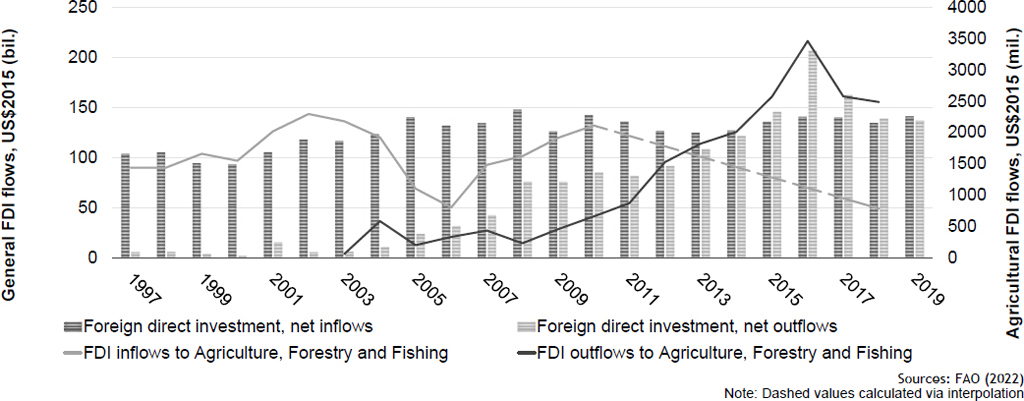
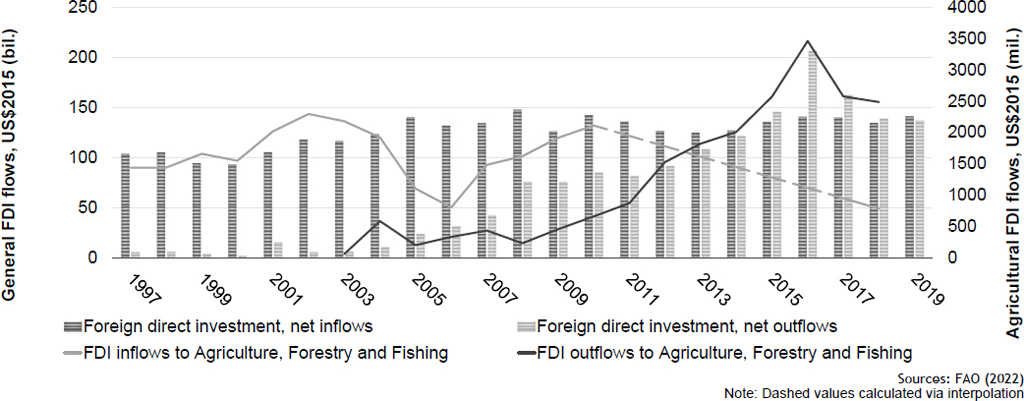
As the Chinese economy has liberalised, it has increasingly integrated into global markets. Following WTO accession in 2001 and reflecting the “going global” strategy (Buckley et al., 2007; Kolstad and Wiig, 2012), Chinese OFDI began to accelerate (Figure 1). Flows reached a peak in 2016, when outflows exceeded inflows for the first time. Recently, China has extended their investment strategies with the “Belt and Road” initiative (Gooch and Gale, 2018) and foundation of the Asian Infrastructure Investment Bank.

Chinese investment flows.
Citation: International Food and Agribusiness Management Review 27, 4 (2024) ; 10.22434/ifamr2022.0052
2.2 The German dairy sector
Germany is the largest EU milk producer at ca. 33 million tonnes, 22.4% of EU production. In 2020, Germany exported 25 million tonnes of processed dairy products, while importing 13.2 million tonnes. EU production accounts for 55% of Chinese fluid milk imports and 28% of skim milk powder imports. Germany alone supplies 68% of Chinese yoghurt imports (USDA, 2018). The German domestic dairy market exhibits high levels of competition. Two large players exist in Müller and Deutsches Milchkontor (DMK), among the overall 231 enterprises operating in the processing stage of the dairy supply chain in Germany (Janze et al., 2022). International dairy enterprise such as Arla Foods (Denmark/Sweden) are directly involved in the German domestic market. Müller and DMK were ranked respectively as the 17th and 18th largest dairy companies in the world in 2022, while the Chinese dairies of Yili and Mengniu outranked them both in positions five and nine (Rabobank, 2022). In the production stage, animal numbers have been decreasing, down about six percent since 2010 and -2.3% over the previous year in 2020, with output increasing ca. 12% since 2010 and 0.2% in 2020 compared to the previous year (BLE, 2021).
3. Methodology
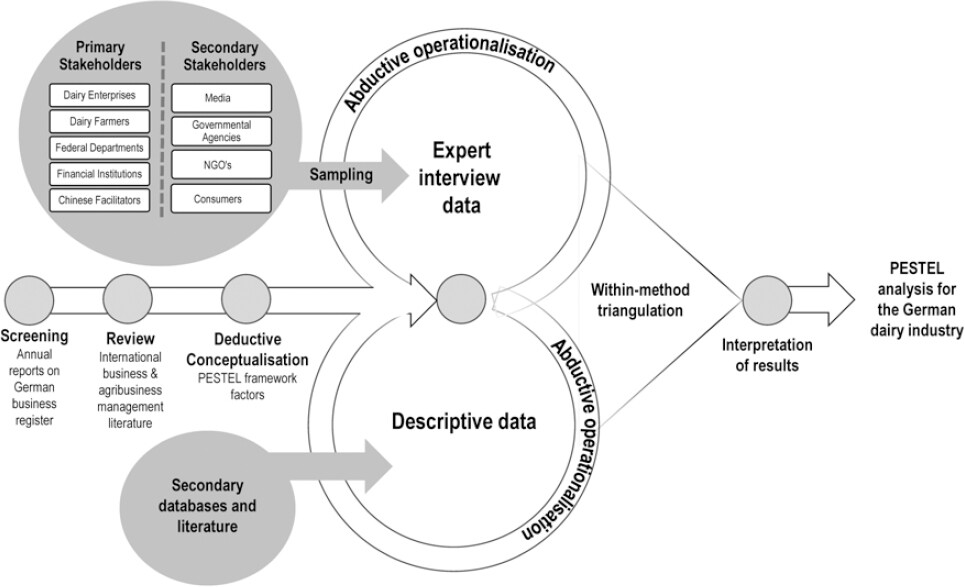
An initial inspection in the German Business Register of annual reports of German dairies failed to reveal Chinese investment in German dairy processors. To facilitate this research, qualitative within-method triangulation was employed to increase study rigor (Thurmond, 2001). Subsequently, a literature review was conducted establishing the PESTEL factors, followed by a preliminary descriptive analysis within the framework. Then, semi-structured expert interviews were completed to corroborate identified PESTEL factors. An overview of the methodological approach is presented in Figure 2.
Overview of the methodological approach towards creating a PESTEL framework for the German dairy industry.
Citation: International Food and Agribusiness Management Review 27, 4 (2024) ; 10.22434/ifamr2022.0052
3.1 PESTEL Framework
The original PESTEL framework gauges market attractiveness by examining political (P), economic (E), social (S), technological (T), ecological (E) and legal (L) factors shaping the firm’s macro business environment (Johnson et al., 2014). A macro-level emphasis fits neatly with our AOFDI analysis; FDI studies often consider macroeconomic indicators as FDI determinants (Boys and Kandilov, 2016; Buckley et al., 2007; Jin et al., 2018; Kolstad and Wiig, 2012). We conceptualize and operationalize our framework abductively from the practical firm to scientific industry level perspective. PESTEL dimensions and concrete agri-food specific factors were deductively derived from earlier conceptualizations in both the international business and agribusiness management literature, while consideration and assessment of specific indicators were inductively explored from data sources described below. This allows a critical examination of factors explaining Chinese investors FDI decisions vis-à-vis the German dairy industry, while conforming with the aim of PESTEL to examine macro-level business environments in an application similar to other authors (see Heise et al., 2015).
The PESTEL framework is rarely utilised in agri-food research studies. Jovovic and Jankovic (2013) and Heise et al. (2015) used a PESTEL/SWOT in agri-food studies on the Montenegrin fruit and vegetable sector and the Nigerian poultry industry investments respectively, while PESTEL is exclusively deployed by authors such as Ray (2012) examining the Indian sugar industry and Oraman (2014) the Turkish organic food industry. FDI, however, goes beyond traditional investment cases, and may by influenced by investor specific elements such as cultural distances (Ghemawat, 2001), investment treaties (Berger et al., 2013), FDI flows and stocks (Buckley et al., 2007) and targeted policy inventions like investment screening (Sauvant and Nolan, 2015). Thus, an approach such as that of Heise et al. (2015) from an investment perspective misses important nuances critical to FDI. Subsequently, we expand the theoretical basis of Heise et al. (2015) by (a) conceptually integrating factors from international business explaining FDI decisions (in a Chinese context), and (b) operationalising these factors in our PESTEL framework beyond consideration of standard strategic management factors.
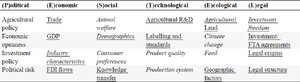
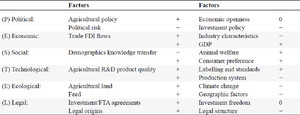
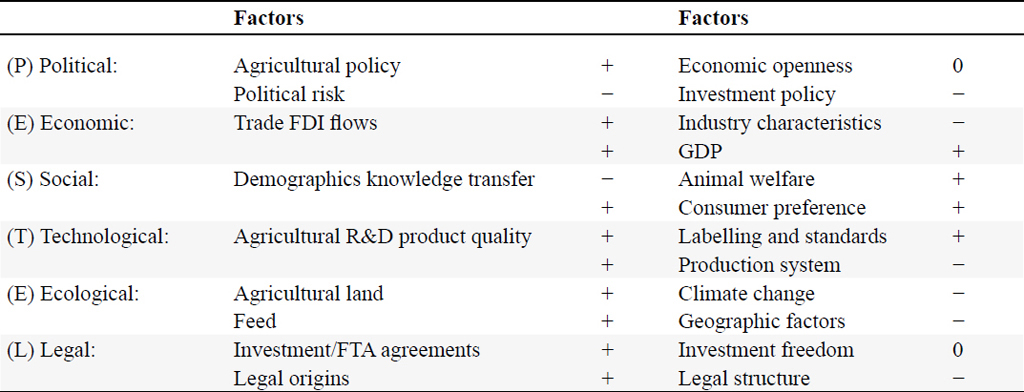
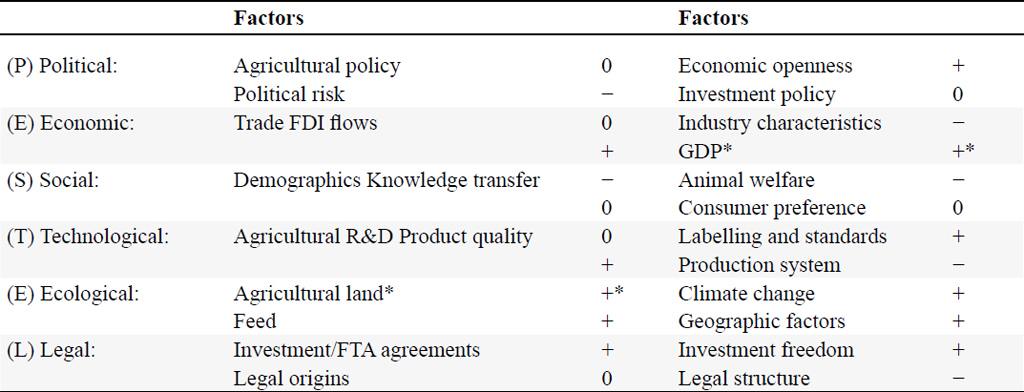
Our PESTEL considers the industry-level business environment Chinese dairy sector investors face in Germany. Johnson et al. (2014) emphasize that PESTEL focus on critical elements having substantial impacts on organizational success, to prevent the analysis being overwhelmed. Factors ranging from economy-wide indicators to industry-specific elements were deductively conceptualised for this study (see Table 1), primarily by examining investment motivation factors from existing Chinese OFDI studies (Boys and Kandilov, 2016; Buckley et al., 2007; Hurst, 2011; Jin et al., 2018; Sauvant and Nolan, 2015). The PESTEL is abductively operationalised through a descriptive analysis drawn from a comprehensive literature review relating to the German dairy industry, supplemented with secondary data relating to identified factors from official statistical agencies and triangulated with expert interviews. Most indices and data are based on OECD averages, as Germany is an industrialized country, post 2009 to minimize irregularities from the global financial and food price crises. Some data are based on five-year averages depending on data availability. The PESTEL indicators are assigned either positive or negative observations based on combinations of literature, data (see Table 2) and expert interviews (see Table 3). As PESTEL analyses can be sensitive to interpretation, Johnson et al. (2014) suggest presenting discussions around key factors which allow for alternative considerations, but provisional judgements may be derived for which the contextual directional observations are made. Discussions over key factors are presented in chapter five.
PESTEL factors for the German dairy industry
Citation: International Food and Agribusiness Management Review 27, 4 (2024) ; 10.22434/ifamr2022.0052
German dairy industry PESTEL based on secondary sources
Citation: International Food and Agribusiness Management Review 27, 4 (2024) ; 10.22434/ifamr2022.0052
German dairy industry PESTEL based on expert interviews
Citation: International Food and Agribusiness Management Review 27, 4 (2024) ; 10.22434/ifamr2022.0052
3.2 Expert interviews
Five primary and four secondary dairy industry stakeholder groups were identified as per Clarkson (1995). Within these groups matching organizations and interview partners knowledgeable in trade and investment were identified, resulting in 39 potential interviewees. Invitations were primarily sent via email, as people were working from home during the pandemic. Despite efforts in screening and approaching suitable interviewees, positive response rates were low. The primary objection was that potential participants, while finding the theme interesting, felt they could not offer constructive insights ex-ante. Snowball interviews encountered similar objections. Four semi-structured interviews were completed by the lead researcher; two senior advisers (henceforth referred to as interviewees A1 and A2) from industry groups related to both German dairy industry enterprises and farmers, a senior manager (interviewee M1) from a larger German dairy enterprise, and a solicitor (interviewee S1) from a legal firm acting as a facilitator for both Chinese and German enterprises engaging in cross-border investments into Germany.
Semi-structured interviews were deemed an appropriate triangulation tool, as they are often employed in qualitative business research (Myers, 2020) and provide direction but remain flexible enough for interview developments (Mann, 2016; Myers, 2020). A 155-question guide based on the PESTEL factors was used, with several questions pre-selected based on interviewee expertise. Approximately one-hour interviews were conducted via the videoconferencing software Zoom. After completion, interviews were transcribed and coded with Atlas.ti to relevant PESTEL factors.
4. Results and Discussion
Results of the descriptive PESTEL analysis (see Table 2) based on secondary source analysis are presented first, followed by the expert interview findings.
4.1 Political factors
Institutions and political stability are fundamental to economic growth and investment activity. Using the World Bank governance political risk indicator (Jin et al., 2018; Ramasamy et al., 2012) as a proxy, between 2016-2020, Germany is placed on average in the lower half of the OECD in 22nd position (World Bank, 2022c). Some studies suggest Chinese firms find weak institutions attractive as they are often less risk-adverse than international peers (Boys and Kandilov, 2016; Buckley et al., 2007), while others find evidence they extract natural resources in institutionally weak countries (Kolstad and Wiig, 2012; Ramasamy et al., 2012). Jin et al. (2018) find Chinese agri-food firms incentivised by political stability but provide no rationale. Adapting an argument from Olson (1993), Chinese firms may extract depletable natural resources before a rival enterprise, but for renewable (such as agricultural) natural resources, ongoing rent extraction is important and thus political stability is valued. Overall, the lower governance rating for Germany is seen as a disincentive for Chinese AOFDI.
For economic openness, Jin et al. (2018) examine the Heritage Foundation (2021) Economic Freedom Index (EFI). Germany (73.88) is ranked 17th in the OECD in the based on a 2016–2020 average, marginally ahead of the OECD average (72.14). Higher scores have a negative effect on Chinese agri-food firms investment decisions, where Chinese firms are presumed to seek natural resources, and countries with large natural resource endowments are negatively correlated with the EFI. Alternatively, economic freedom may be a proxy for cultural distance (Buckley and Hashai, 2009). As Germany sits around the OECD EFI average, economic openness is deemed neutral for Chinese investors.
Sauvant and Nolan (2015) highlight the importance of investment policy and the role of legislatures in welcoming FDI, and Berger et al. (2013) find FDI screening and discrimination by host governments can strongly deter investments. The Federal Ministry for Economic Affairs and Climate Action (BMWK) has jurisdiction in Germany; for investments over 25% of a German firm or in sectors of national interest, the BMWK has authority to review investments requests (BMWK, 2021). The EU has recently tightened their screening mechanism (EU COMM, 2020a), and Germany and other OECD countries also have recently tightened FDI screening rules (Hanemann et al., 2019; Wood and Cao, 2017), while a lack of Chinese reciprocity in FDI freedoms may be concerning (Shenker et al., 2017). Chinese applications to buy the German firms Aixtron and Osram were rejected in 2016 (Wood and Cao, 2017), while deals for 50Hertz Transmission GmbH and Leifeld Metal Spinning AG have also been recently declined (DPA, 2018a,b). In general, China has become a recurring item on the agenda of the German parliament, reaching an all-time high for discussion themes in 2019. While the topics for discussion have largely remained economic, the tone has become more sceptical and there has been much more talk in the German legislature over dependencies on China (Kefferpütz et al., 2022). This could be perceived as legislative tightening, and while these decisions have not been tested in agri-food settings, this factor is rated negatively.
Agricultural policy is an influential factor (Heise et al., 2015), and in Germany is largely determined by the EU Common Agricultural Policy (CAP), offering limited, but increasing flexibility for member states (EU COMM, 2022). The CAP has provided the dairy sector targeted assistance, such as after the EU milk quota abolition in 2015, where German dairy farmers received €31.6 million of the €150 million paid by the EU to reduce production (Rothe and Weber, 2018), while processors received support through private and public stockpiling of dairy commodities (BLE, 2021). Subsidies from the 2015 package totalled ca. €581 million (BMEL, 2017). From 2014-2020, coupled cap payments were allowed to support sectors facing economic, social, or environmental difficulties (Pe’er et al., 2019), and 18 EU member states (but not yet Germany) have implemented payments to support dairy farms. These payments totalled €0.9 bil. p.a. for dairy farms (average 2016–2020, own calculation based on EU COMM (2020b)) and effectively support less competitive farms. As the support payments conversely could potentially systematically disadvantage more competitive German dairy farms, abolishing these payments may result in competitive advantages for the Germany dairy sector. The OECD producer support estimate (PSE) average, which measures transfers to agricultural producers (OECD, 2022), was on average 17.7% of gross farm receipts between 2016 and 2020, which the EU exceeded at an average of 19.4%. Other dairy producers like Australia (2.7%), New Zealand (0.7%) and the USA (10.4%) were significantly lower. The Single Commodity Transfer (SCT) indicator for EU milk production has dropped from 71% in 1986 to 5% in 2020 (OECD, 2022). Between 2016-2020, the average EU SCT has been 2.9%, higher than Australia (0.06%) and New Zealand (0%), but below the USA (17.3%). Still, EU CAP interventions outweigh those offered by many non-EU dairy exporting nations, and the stability these interventions bring to German dairy chains is judged positively for Chinese investors.
4.2 Economic factors
The most universal established factor influencing FDI flows is host market size (Buckley et al., 2007; Jin et al., 2018; Kolstad and Wiig, 2012). By total GDP, Germany is the world’s fourth largest economy with GDP of $US 3.64 trillion in 2020, and is part of the EU-27 common internal market with a total GDP of $US 15.3 trillion (World Bank, 2022a) which would rank as the second largest economy worldwide. Gooch and Gale (2018) note when Chinese agribusiness firms expand overseas, many products are sold in the host market for reasons such as inability to obtain Chinese import quotas. Germany should be viewed attractively, both individually and as an EU member.
Bilateral trade flows indicate existing linkages and networks which can affect FDI, where deeper relationships attract more FDI (Boys and Kandilov, 2016; Buckley et al., 2007). China was Germany’s largest bilateral trading partner in 2020, with bilateral trade equating to 6.7% of GDP, and Germany is China’s fourth largest bilateral partner in food products in 2020, although the average position between 2016–2020 was only 8th (Destatis, 2022). The EU is the largest importer of Chinese products, receiving 17.9% of total Chinese exports in 2020, and Germany the largest EU destination country (World Bank, 2022b). This factor is deemed encouraging for Chinese investors.
Higher OFDI from host countries indicates a saturated host market, and can have negative effects on inward FDI (Hurst, 2011). Germany had FDI outflows of $US 111 bil. in 2020 (3.4% of GDP), above the ten-year OECD average of 2.4%, and inbound FDI share to GDP in Germany was 1.74% in 2019, lower than the 10-year average of 2.17% (World Bank, 2022a). Hanemann and Huotari (2015) note Chinese food and beverage FDI to the EU is yet to target Germany. All things considered, FDI flows are viewed negatively.
As internationalized Chinese agri-food firms tend to sell to host markets (Gooch and Gale, 2018), industry characteristics are relevant. For German dairies, strong domestic competition, a focus on low-cost low-margin products, and retail market power, mean that margins are tight (Hanisch et al., 2012; Jansik et al., 2014). German dairies have tried to buffer margins through mergers and developing economies of scale, but still have low profits by international standards (Grau et al., 2015), and foreign firms control large shares of domestic high-value segments (Jansik et al., 2014). German dairy farmers only had slightly higher profits (+1.4%) than the sector average per labour unit employed between 2016 to 2020, which was largely due to a stellar 2017 (BMEL, 2022). Considering profitability headwinds, Chinese firms should not assume production can be easily sold in the German market for profit in the absence of Chinese buyers, and this factor is considered negative.
4.3 Social factors
A proxy for cultural distance is percentage of Chinese population in the host country (Buckley et al., 2007; Ramasamy et al., 2012), as higher shares reduce this distance (Hurst, 2011) and the Chinese system of personal and social relationships is considered influential in business transactions (Buckley et al., 2007; Ramasamy et al., 2012). 2020, approximately 134 000 Chinese nationals resided in Germany, less than 0.01% of the population (Destatis, 2022). This is under the one percent threshold of Buckley et al. (2007), and considering this small local population, demographics are considered negative.
Chinese FDI may have objectives such as seeking advanced technology or managerial experience, looking to gain advantages that may not be available at home (Deng, 2004; Sauvant and Nolan, 2015). Although German dairies such as DMK invest heavily in research and development (R&D), a stricter understanding of plagiarism by German managers may limit their willingness to share knowledge (Amsberry, 2009). This may incentivize modes such as joint ventures to obtain knowledge, and hence knowledge transfer is assigned a positive effect.
Chinese consumers show preference for German products. EU labelled milk products can already command an average premium up to 37% with consumers in Beijing (Li et al., 2017), while German ultra-high temperature (UHT) can claim a 57.9% premium in a sample based on consumers in Hangzhou, Wuhan, and Shijiazhuang (Yang et al., 2018; Zhang et al., 2018) queried Chinese consumers in nine cities of various sizes over dairy product preferences, and Germany ranked third in “preferred country of origin” and “product quality” categories. This reinforces Chinese consumer preference of German dairy products, and they are assessed as having a positive impact for Chinese investments.
Animal welfare is often cited as concerning for consumers making purchasing decisions (Weinrich et al., 2014). Animal welfare in dairy is often linked to production system (barn vs pasture), with barn systems more likely to cause leg and hoof issues (Rushen et al., 2007) while pasture systems are preferred by consumers (Weinrich et al., 2014). Chinese consumers may have some preference for animal welfare, willing to pay a 26% premium for animal welfare certification on NZ dairy products (Saunders et al., 2013). Reinforcing positive perceptions around German product origin (Yang et al., 2018), this factor is viewed positively.
4.4 Technological factors
German public agricultural R&D funding was €1 bil. in 2020, the highest in the EU and twice that of second placed Spain (€442 mil). Per capita, Germany (€12.45 per inhabitant) sits third in the EU behind Ireland and Denmark, and over twice the EU average (Eurostat, 2022). Chinese dairies must raise productivity to fill rising demand (Fuller et al., 2007), and Chinese investors have previously sought seed technologies with their acquisition of PGG Wrightson in NZ (Ge et al., 2017). Given high agricultural R&D spending in Germany, it should prove attractive for Chinese investors.
The traditional German dairy production system has been pastoral with full grazing. Currently in north-west Germany, ca 50% of cows graze and 25% have permanent pasture access. The remaining farmers implement a restricted grazing system, an intermediary step towards non-grazing (Reijs et al., 2013). Production systems employed could influence consumer preferences (Weinrich et al., 2014), and Gao et al. (2016) find developing Chinese willingness to pay (WTP) for sustainably produced milk, while Yang et al. (2018) cite pastoral environment influences country preferences. If Germany moves towards housed production systems, it may disadvantage Germany compared to pastoral dairy producers, and this factor is rated negatively.
EU origin dairy product labelling is something Chinese consumers would pay a 37% premium for (Li et al., 2017). Dairy products from NZ with animal welfare or food safety certification generate 26 and 74% premiums, respectively. Sun et al. (2014) find tightening Chinese safety standards for dairy products have no significant impact on imports, suggesting imported products standards such as the International Food System used by German retailers (Gawron and Theuvsen, 2009) already meet these standards. Access to German labelling and standards should be attractive for Chinese investors.
As discussed, Chinese consumers have high quality perceptions of German (Yang et al., 2018) and EU products (Li et al., 2017). Product quality is often named as influencing dairy product preferences by Chinese consumers (Gao et al., 2016; Zhang et al., 2018) EU dairy products must meet minimum safety standards (EU COMM, 2019b), and go through rigorous safety checks (van Asselt et al., 2017). Given this background, product quality of German dairies should be rated positively.
4.5 Ecological factors
Geographic factors like distance affect firms’ internationalization, increasing transaction costs and physical barriers to trade (Ghemawat, 2001). The distance between the capitals Berlin and Beijing is 7,363 km, against the OECD average of 8089 km. Empirically, distance has mixed results (Buckley et al., 2007; Kolstad and Wiig, 2012), but agri-food studies find it significant (Boys and Kandilov, 2016; Jin et al., 2018). Due to the perishable nature of dairy products, closer proximity is adjudged a positive influence.
Agricultural land is considered important, with higher endowments attracting Chinese agri-food enterprises (Boys and Kandilov, 2016; Jin et al., 2018). Agricultural land in Germany was 16.7 million ha in 2019, below the OECD average of 32.2 million ha (FAO, 2022). Including the USA and Australia inflates the OECD average, but they are significant dairy exports and are retained. Thus, Germany appears at a disadvantage considering land endowments, and this factor is rated negatively.
Feed is an important dairy input, particularly in intensive housed systems (Reijs et al., 2013). The German index price for compound cattle feedstuff was 101.4 in 2020, below the EU average of 103.5 (Eurostat, 2022). The EU produces domestically half the oilseeds used in animal feed, while import tariffs for oilseeds are set as zero (EU COMM, 2019a). The below average feed price index and zero import tariffs mean feed supply availability is considered positively.
Climate change will potentially affect agricultural production in Germany and the EU (Gauly et al., 2013; Giannakis and Bruggeman, 2015). Germany should be less susceptible as Northern Europe exhibits higher agricultural adaptive capacity (Giannakis and Bruggeman, 2015), and effective adaptation should mean minimal impact on dairy production in Europe (Gauly et al., 2013). Extreme weather events may damage soil and grass swards, rising temperatures may affect lactating animals (Reijs et al., 2013), and fodder productivity should rise (Gauly et al., 2013). This could mean climatic conditions favour housed production systems (Reijs et al., 2013), and moving from pastoral systems may reduce Chinese preferences for German dairy products due to positive Chinese consumer associations with pastoral production (Yang et al., 2018). Chinese investors have made acquisitions in countries with extensive pastoral systems (Gooch and Gale, 2018; Jin et al., 2018), and while climate change impacts can be mitigated, Chinese consumers may not favour transitions to housed systems. Thus, this factor is viewed negatively.
4.6 Legal factors
Legal structures of target firms are important, with some models such as German cooperative legislation prohibiting non-patron representation on supervisory and management boards (Kühl, 2012). Governance issues were one aspect of the initial failure of the DMK merger (Hanisch et al., 2012) and German case studies show different cultural backgrounds and expectations caused the failure of mergers between agricultural cooperatives (Kühl, 2012). Some German dairies use alternative governance structures (BMEL, 2017) such as the “corporation” and “management” models which separate the organizational structure, and the cooperative typically holds controlling stakes in any private enterprises (Bijman et al., 2014). Chinese FDI may prefer investor-owned firms, where voting rights can be held. However, documented failures of German dairy industry mergers between local actors means this factor is rated negatively.
Investment freedom is measured via the Heritage Foundation (2021) investment freedom index, where higher values correlate with more Chinese investment (Hurst, 2011). Germany scored on average 82 in between 2016 and 2020 and was 16th position in the OECD (80.25 average), and this mid-table ranking accrues a neutral evaluation.
Considering legal origins, La Porta et al. (2008) identify five legal origins, where China is considered as sharing German legal origins. Boys and Kandilov (2016) find common legal origins have potential positive effects for Chinese agri-food investments, and could be considered a factor reducing administrate distance (Ghemawat, 2001). This factor should generate a positive effect.
Germany signed an active bilateral investment treaty (BIT) with China in 1985 - the second country to do so - and the current version has been in force since 2005. Berger et al. (2013) find BITs provide positive incentives for investors, and lack of an FTA is not problematic. Having a recently updated BIT indicates China has more extensive protections for public investors, protecting their state-owned enterprises (SOEs) investing overseas (Sauvant and Nolan, 2015). Even without an FTA, the BIT should strongly encourage investment.
4.7 Expert interviews
The most discussed factors in the interviews fell into economic or political categories, while ecological factors were the least considered. Legal, social, and political factors received similar levels of attention, albeit differing between interviewees. S1 and A1 focused on political factors, while M1 and A2 discussed more economic factors. Industry characteristics were the most discussed factor, followed by investment policy and legal structures. Not all factors were mentioned directly during the interviews, but all interviewees had the opportunity to discuss each PESTEL category. Based on responses, language used, and benefits or difficulties identified, PESTEL factors (Table 3) were identified as having positive, negative, or neutral connotations.
After compiling results from secondary sources and expert interviews, it is apparent experts view the situation less favourably, particularly the social category To contextualize the results, a deeper examination of the expert interviews is required. The most mentioned factor was industry characteristics (E). Competition in the German dairy market was seen as intense with tight margins, as A2 elaborated:
‘Yes, we (German dairy industry) have intense competition between companies. Foreign investors also notice… that neighbouring EU countries see Germany as a large European market with a very strong retail (sector) and many consumers with comparatively high incomes. They want to participate, but are surprised at the tough competition and margin size, how small the margins are…’
A view whose significance was corroborated by expert S1:
‘I think there are very few transactions in the (German) food industry (by Chinese investors), because the margins are also very low. Whereas the margins in the Chinese food market are also very low, but turnover is very large…’
Investment policy (P) also came to the fore. S1 noted that the EU screening mechanism is largely irrelevant for Chinese investors, and the EU is liberal regarding FDI. German screening mechanisms are more important, particularly for critical infrastructure and sensitive areas, which some agri-food aspects now belong to. The application process was seen as more complicated following new provisions in 2021 to the Foreign Trade and Payments Act (2013). While no impact was yet noted, Chinese investment flows are sensitive to host country receptivity (Berger et al., 2013; Sauvant and Nolan, 2015). S1 also stated:
‘… with Foreign Trade and Payments Act it has already become more difficult, because you have to imagine that every transaction has a time element. The seller wants to sell quickly, i.e., if there is an auction or situation where several buyers want to buy a company, and where a Chinese buyer still has to obtain a permit, they have a time disadvantage. Normally, the Chinese buyer has to put more money on the table for the approval alone, compared to a French or Dutch buyer… my experience is that the review (BMWK screening) is fair, but the problem is any review takes time and that is critical in such transactions.’
This reinforces how critical time is, and the financial burdens of the investment screening process. Linked to time aspects, legal structures (L) present in the German dairy industry could hinder transactions. Many firms operate as a cooperative, or with a cooperative as the controlling entity, along with dual board structures typical of German companies (Kühl, 2012). M1 commented that:
‘The advantage of a cooperative is clearly that you are very coordinated and close together. And when you decide on something, you are very strong, very powerful. Of course, in a large cooperative… you’re not as fast. That means that decision implementation and investments that follow are usually a process that takes years. And… from a cultural point of view, convincing a farmer, we are now doing a partnership with a Chinese company, be it only something like cold storage, is certainly looked at more critically than by a dairy with no farmers in it.’
Two problems are illustrated. First, German cooperatives react and make decisions slowly, which may work against Chinese partnerships where time is critical. It also questions if cooperative farmers would give their necessary approval to such a deal. Although, this view was contested by A1:
‘There are also cooperatives that have been taken over by foreign dairies, such as the Märkische-Milch-Union Hocheifel. It was taken over by Arla… there were also discussions in this cooperative: “do we want to join foreign investors, a foreign cooperative?” At that time, the decision was taken to do so. If a Chinese company made an attractive offer, what would be the objection, even as a cooperative farmer in Germany?’
It seems a good offer would at least be considered. However, the process would likely be a sensitive event, and critically, take time.
For political risk (P), S1 intimated there could be uncertainty ahead, with the interview completed before the German Federal Elections in September 2021:
‘… the Foreign Trade and Payments Act is an important development in 2021 and is viewed critically in China. People (Chinese) are also looking now, a bit at the federal elections in Germany. We… want to understand what kind of politics Germany will be pursuing in the coming years. Basically, we don’t expect rosy times, but… what Chinese merchants want is fair, competitive conditions abroad, and we’ll have to see for the next four years in Germany.’
This is critical in two junctures. First, in the new German federal government, the foreign minister has taken a hawkish tone with China (RND, 2021). Second, the new agriculture minister is from the Green party, which has implications for agricultural, environmental and animal welfare policy, although this is more pertinent to agricultural policy (P). A1 also noted:
‘… (the industry) structure simply speaks against it and there would be considerable political resistance if a Chinese company simply said “We now want to establish a dairy farm in Saxony-Anhalt with 10,000 cows. Not only (resistance) through environmental law, emissions law…’
reinforcing the importance for appropriate due diligence, and potential for political involvement in rushed, large scale deals.
Agricultural policy (P) was identified as having impact on dairy industry profitability, not due to subsidy payments, rather extra compliance costs from new environmental (EU Green Deal) and animal welfare regulations. The new fertilizer ordinance was identified by A2 as being particularly concerning, in an industry where margins are already tight.
Product quality (T) was described as expected, insofar that German dairy products are prized for their high quality. A2 stated that product quality was more important than technological know-how. Knowledge transfer (S) possibilities to China were played down by experts, for example by A1:
‘Skim milk production is not rocket science. You can do that without a takeover. But if we look at yoghurt or cheese, or milk processing in general, I could perhaps imagine that.’
This statement and the following comment by S1, intimated that less product complexity mitigates knowledge transfer necessity:
‘… (Chinese firms) look less at the funds for R&D, but more at the quality of products. Because financing itself is not a problem, they have very good access to Chinese capital markets and are looking for really good deals.’
Consumer preferences (S) were not as prominent in the interviews as in consumer research studies (Li et al., 2017; Yang et al., 2018; Zhang et al., 2018). Experts agreed preferences existed for dairy products such as infant milk formula, but this was due to product quality (T) and food safety. A2 pointed out Chinese consumers are beginning to purchase more Chinese dairy products as melamine scandal memories fade, but at the same time stated regarding German dairy products sold in China:
‘In addition, the products there are still sold under the German flag to show consumers: “The product is good, it comes from Germany. You can trust the product.’
Sustainability and animal welfare (S), as well as respective labelling and standards (T), are of minor importance and does not generate a price premium in export markets according to A2:
‘… discussions about animal welfare, sustainability and the renunciation of genetic engineering, play only a very small role in export business. They are not really a rewarding issue. Of course, there is demand for organic products in some segments … especially in the drinking milk sector. But specific demand for animal welfare is not a trend segment where export value added can be generated. Rather, they generate additional costs for farmers which are not reimbursed…’
Another expert cited organic production as an example of pastoral production system expansions in Germany. But organic production generates higher costs, and German farmers may be disadvantaged against countries operating extensive conventional pastoral systems without the associated costs of organic farming.
Experts do not expect climate change (E) to impact German production, and that mitigation measures against it will be effective. Other dairy producing areas in Europe were expected to be less resilient. Feed production (E) is expected to be unaffected, extreme weather events aside. Regulation of methane emissions seem to be more concerning, as A1 stated:
‘Climate change will have an impact. On the one hand, dairy farming emits methane… and there will be legal incentives, perhaps even bans, regarding milk production. Nothing is currently on the agenda, but this will certainly happen in the near future.’
Germany will not be the only country impacted by such regulation, but it highlights regulatory risks through agricultural policy (P) in the industry in response to climate change for potential investors.
Demographics (S) and economic openness (E) were widely considered under a “doing business” concept between China and Germany. All experts considered “business as business,” and that cultural barriers could be overcome. One potential barrier would be language, with English preferred by Chinese investors. This could be a disadvantage against English-speaking competitors when attracting Chinese capital. Legal origins (L) were considered neutral, with no substantial legal obstacles or similarities identified.
One interesting comment was made by A2 that fell outside the scope of the PESTEL but is worthy of note:
‘If we look back a few years, there was definitely interest from Chinese investors in the German dairy sector… to invest in the baby food sector. We have been asked several times whether we know of dairies in financial difficulty.’
This point could be relevant for economic (E) factors which were not directly considered, as well as underlining the relevance of the research in that interest definitely exists, but for some reason has not yet eventuated.
There have been reports of Covid-19 testing on agri-food imports to China (Patton and Farge, 2020), and effects of Covid-19 on dairy supply chains to China were also queried - pertinent when dealing with perishable agri-food products. While experts queried the border-testing logic, it has not made the market unviable, and can be concluded this has no adverse impact on Chinese FDI in German dairies.
5. Implications
Policy makers and executives should be aware of considerations around Chinese FDI in the German dairy industry. If German policy makers intervene in Chinese investment applications (P) through the BMWK, they must consider ramifications of declining applications. If applications are declined, Chinese investors may adjust investment strategies accordingly (Sauvant and Nolan, 2015) as their decisions are politically sensitive (Buckley et al., 2007; Deng, 2004; Gooch and Gale, 2018; Kolstad and Wiig, 2012). This could reduce the long-run attractiveness of Germany for Chinese FDI, and it has been noted the application process is already becoming more difficult.
Chinese enterprises looking to enter German dairy chains should consider industry characteristics (E) - competition is intense and margins low. Potential takeover targets may be in financial difficulties that cannot be remedied with a capital injection. Previous struggles with mergers in the sector (Kühl, 2012) mean Chinese investors should carefully assess potential acquisitions for organizational compatibility, stakeholder support and public perceptions (Shenker et al., 2017), and expect protracted timeframes for deal closure. Expert comments on industry characteristics (E) indicate industry specific considerations such as profitability and competition are more important for Chinese investors than host market size, a generalization from many FDI studies (Buckley et al., 2007; Jin et al., 2018; Kolstad and Wiig, 2012). Germany is the fourth largest economy worldwide by GDP, but is small by Chinese standards. While GDP may be an important macroeconomic factor, this indicates in industry-specific contexts it should not be over-interpreted.
Legal structures (L) employed by German cooperatives may inhibit external control and make potential deals convoluted and time-consuming. Alternative management structures are available, and investor-owned firms could be preferable partners. Stakeholders and managers in German dairy firms need not be apprehensive over Chinese board representation - Chinese firms typically employ light touch integration when conducting acquisitions, and allow significant autonomy while retaining oversight capabilities (Haasis and Liefner, 2019). Adopted legal structures are important for German dairies looking for partnerships with Chinese firms.
Consumer preferences (S) currently appear strong (Yang et al., 2018) but may change over time. If competing dairy exporters build market presence in China, or domestic products become more favourable, German advantages may diminish. Other EU countries like Ireland are actively considering strategies encouraging Chinese dairy investments and could supersede Germany as Chinese consumers’ preferred county of origin (Collison et al., 2017). It may be prudent for German dairies to leverage their current advantage in the short-run, and both German dairies and Chinese investors may mutually benefit from investments if organizational strategies match.
A point raised by A2 about concrete interest from Chinese enterprises to purchase distressed German dairy firms is theoretically and practically relevant. Capital market imperfections are hypothesized to drive Chinese OFDI (Buckley et al., 2007) and evidence may exist of access to subsidized capital as S1 indicated financing is no issue. This has implications for German policy makers, and the source of funding for investments applications should be clearly disclosed, as there are current WTO rules around unfair investments by state-owned enterprises (Kowalski and Perepechay, 2015). Market distortions may occur when firms that should fail are successfully acquired by foreign investors using subsidised capital, but it should be noted that acquisitions of financially distressed firms is normal as they may be too highly leveraged or require capital to rationalise the business. However, the German dairy industry is characterised by cooperatives who are capital constrained and may possess capital-raising disadvantages. Whether FDI in the sector should be subject to higher scrutiny to prevent advantages to actors with greater capital access is a question for policy makers.
6. Conclusion
This research has contributed to the literature by examining factors potentially explaining the absence of Chinese OFDI in the German dairy sector. This is achieved with an adapted PESTEL framework developed through a comprehensive literature review of agribusiness and international business literature, and triangulated with descriptive secondary data and semi-structured expert dairy and investment sector interviews. It shows how the PESTEL framework could be adapted by dairy sector managers and executives considering the industry environment for international cooperations with Chinese partners, and emphasises that students and academics should not rely solely on strategic management interpretations when using such tools to analyse situations involving FDI. From the identified factors, economic performance, well-established bilateral trade relationships, high quality of German dairy products, and Chinese consumer preferences for these products were viewed as incentives. Expert interviews revealed significant barriers to Chinese FDI in the German dairy sector: intense domestic competition and low margins, investment legislation and strict and time-consuming investment screening, and unfavourable prevailing governance structures within many German dairy cooperatives.
Our results are relevant both German and EU policy makers due to supra-national investment screening mechanisms, and dairy sector managers and executives interested in cultivating long-term international partnerships. In internationally competitive capital markets, findings underline that if German dairy executives are interested in attracting Chinese investments, they should implement creative governance structures to reduce deal closure times. For Chinese investors, domestic competition and low margins in Germany underscores that due diligence must be completed assiduously, and attractive entry prices may be more complicated than cash-strapped German dairy cooperatives seeking external financing. For policy makers and investment screening regulators, potential Chinese FDI in the German dairy sector should not be rejected ad-hoc, as political rejections of viable deals could have longer-term implications for Germany’s investment attractiveness for Chinese investors. Executives and policy makers should know there has been Chinese interest for deals in Germany, and financing appears available for the right deal. Additionally, both German and Chinese managers, and German policy makers should consider the maximum acceptable FDI level, which could make cooperation more beneficial for all parties.
Our approach is intended for screening initial investment viability for Chinese international dairy investments, and it is recommended that further strategic management approaches are used to consider intricacies of any specific potential partnership. Future studies could theoretically formalise our PESTEL approach, generating supporting tools for managers considering any foreign partnerships including an investment component. While our study outcomes are limited by the small expert sample size, participating experts are diverse and represent various views, and low response rates indicates research novelty. It should be noted our study is cross-sectional in nature, at a time when the macro business environment has been dynamic. This research was first conceptualised and initially drafted before both the Covid-19 pandemic (2020-2022) and the ongoing Ukraine/Russia conflict. Such events could influence the business environment. During interviews Covid was raised with our experts, and they had no specific concerns other than it being a short-term disruptor. On the investment front, public perceptions of FDI and dependencies on China may change, and FDI flows could adjust if Russia is isolated from western financing, with Chinese capital potentially filling shortfalls. Assuming China continues a supply chain diversification strategy in the dairy sector; findings remain relevant even if alternative short-term opportunities arise.
References
Alon. I., J. Anderson, Z.H. Munim and A. Ho. 2018. A review of the internationalization of Chinese enterprises. Asia Pacific Journal of Management 35(3):, 573–605.
Amighini, A. and M. Sanfilippo. 2014. Impact of South–South FDI and trade on the export upgrading of African Economies. World Development 64: 1–17.
Amsberry, D. 2009 Deconstructing plagiarism: International students and textual borrowing practices. The Reference Librarian 51(1): 31–44.
Berger. A., M. Busse. P. Nunnenkamp and M. Roy. 2013. Do trade and investment agreements lead to more FDI? Accounting for key provisions inside the black box. International Economics and Economic Policy 10(2): 247–275.
Bijman, J., M. Hanisch and G. van der Sangen G. 2014. Shifting control? The changes of internal governance in agricultural cooperatives in the EU. Annals of Public and Cooperative Economics 85(4): 641–661.
BLE. 2021. Bericht zur Markt- und Versorgungslage mit Milch und Milcherzeugnissen. Bundesanstalt für Landwirtschaft and Ernährung. Available online at https://www.ble.de/SharedDocs/Downloads/DE/BZL/Daten-Berichte/MilchUndMilcherzeugnisse/JaehrlicheErgebnisse/Deutschland/2021BerichtMilch.pdf?__blob=publicationFile&v=2
BMEL. 2017. Milchbericht 2017, available online at https://www.bmel.de/SharedDocs/Downloads/DE/Broschueren/Milchbericht2017.html.
BMEL. 2022. BMEL-Statistik: Buchführungsergebnisse Landwirtschaft 2020/21, available online at https://www.bmel-statistik.de/landwirtschaft/testbetriebsnetz/testbetriebsnetz-landwirtschaft-buchfuehrungsergebnisse/archiv-buchfuehrungsergebnisse-landwirtschaft/buchfuehrungsergebnisse-landwirtschaft-2020/21 (accessed 14 December 2022).
BMWK. 2021. Investitionsprüfung, available online at https://www.bmwi.de/Redaktion/DE/Artikel/Aussenwirtschaft/investitionspruefung.html (accessed 18 December 2020).
Boys, K. and I. Kandilov. 2016. Strategic acquisitions: determinants of chinese outward direct investment in the agrifood industry. In: 2016 Agricultural and Applied Economics Association Annual Meeting July 31-August 2.
Buckley, P.J. and N. Hashai. 2009. Formalizing Internationalization in the Eclectic Paradigm. Journal of International Business Studies 40(1): 58–70.
Buckley, P.J., L.J. Clegg, A.R. Cross AR, X. Liu, H. Voss and P. Zheng. 2007. The determinants of Chinese outward foreign direct investment. Journal of International Business Studies 38(4): 499–518.
Bundesanzeiger Verlag. 2021 Unternehmensregister, available online at https://www.unternehmensregister.de/ureg/search1.2.html
Chaudhuri, S. and D. Banerjee. 2010. FDI in agricultural land, welfare and unemployment in a developing economy. Research in Economics 64(4): 229–239.
China Customs. 2022. December 2021: Imports of major commodities, available online at http://www.customs.gov.cn/customs/302249/zfxxgk/2799825/302274/302277/302276/4127373/index.html (accessed 28 December 2022).
Clarkson, M.B.E. 1995. A stakeholder framework for analyzing and evaluating corporate social performance. The Academy of Management Review 20(1): 92–117.
Collison, P., L. Brennan and R. Rios-Morales. 2017. Attracting Chinese foreign direct investment to small, developed economies: the case of Ireland. Thunderbird International Business Review 59(3): 401–419.
Deng, P. 2004. Outward investment by Chinese MNCs: motivations and implications. Business Horizons 47(3): 8–16.
Destatis. 2022. GENISIS-Online-Datenbank, available online at https://www-genesis.destatis.de/genesis/online (accessed 15 January 2022).
DPA. 2018a. Berlin untersagt vorsorglich firmenverkauf an Chinesen. Süddetusche Zeitung (8 January).
DPA. 2018b. Einstieg von Chinesen in deutsches Stromnetz gescheitert. Süddetusche Zeitung (27 July).
DuBois, T.D. 2022. Behind China’s overseas food investments: a tale of two dairies. Asian Studies Review 47(1): 1–22.
EU COMM. 2019a. Cereals, oilseeds and protein crops and rice. European Commission, Brussels, available online at https://ec.europa.eu/agriculture/cereals_en (accessed 2 March 2019).
EU COMM. 2019b. Milk and milk products | food safety. European Commission, Brussels, available online at https://ec.europa.eu/food/animals/animalproducts/milk_en (accessed 1 March 2019).
EU COMM. 2020a. EU foreign investment screening mechanism. European Commission, Brussels, available online at https://ec.europa.eu/commission/presscorner/detail/en/ip_20_1867
EU COMM. 2020b. Voluntary coupled support: review by the Member States of their support decisions applicable as from claim year 2020. European Commission, Brussels, available online at https://ec.europa.eu/info/sites/default/files/food-farming-fisheries/key_policies/documents/voluntary-coupled-support-note-revised-july2020_en.pdf
EU COMM. 2022. The Common Agricultural Policy at a glance. European Commission, Brussels, available online at https://ec.europa.eu/info/food-farming-fisheries/key-policies/common-agricultural-policy/cap-glance_en.
Eurostat. 2022. Eurostat database. Eurostat, Brussels, available online at https://ec.europa.eu/eurostat/data/database (accessed 14 January 2022).
FAO. 2022. FAOSTAT. FAO, Rome, available online at http://www.fao.org/faostat/en/#data/FDI (accessed 30 September 2022).
Fuller, F., J. Huang, H. Ma and S. Rozelle. 2006. Got milk? The rapid rise of China’s dairy sector and its future prospects. Food Policy 31(3): 201–215.
Fuller, F., J. Beghin and S. Rozelle. 2007. Consumption of dairy products in urban China: results from Beijing, Shangai and Guangzhou. Australian Journal of Agricultural and Resource Economics 51(4): 459–474.
Gale, F. and Jewison, M. 2016. China as dairy importer: rising milk prices and production costs. International Food and Agribusiness Management Review 19. DOI: 10.22004/ag.econ.244631
Gao, Z., C. Li, J. Bai and J. Fu. 2016. Chinese consumer quality perception and preference of sustainable milk. China Economic Review. DOI: 10.1016/j.chieco.2016.05.004
Gauly, M., H. Bollwein, G. Breves, K. Brügemann, S. Dänicke, G. Daş, J. Demeler, H. Hansen, J. Isselstein, S. König, M. Lohölter, M. Martinsohn, U. Meyer, M. Potthoff, C. Sanker, B. Schröder, N. Wrage, B. Meibaum, G. von Samson-Himmelstjerna, H. Stinshoff and C. Wrenzycki. 2013. Future consequences and challenges for dairy cow production systems arising from climate change in Central Europe – a review. Animal 7(5): 843–859.
Gawron, J.-C. and L. Theuvsen. 2009. The international food standard: Bureaucratic burden or helpful management instrument in global markets? Empirical results from the German food industry. Journal of International Food and Agribusiness Marketing 21(4): 239–252.
Ge, G.L., C. Stringer and D.Z. Ding. 2017. Chinese FDI in New Zealand: what are Chinese investors looking for? Thunderbird International Business Review 59(3): 385–399.
Ghemawat, P. 2001. Distance still matters. Harvard Business Review 79(8): 137–147.
Giannakis, E. and A. Bruggeman. 2015. The highly variable economic performance of European agriculture. Land Use Policy 45: 26–35.
Gooch. E. and F. Gale. 2015. Get ready for Chinese overseas investment in agriculture. Choices 30(2). 316-2016–7769.
Gooch, E. and F. Gale. 2018 China’s foreign agriculture investments. Economic Information Bulletin 192. U.S. Department of Agriculture, Washington, DC.
Grau, A., H. Hockmann and I. Levkovych. 2015. Dairy cooperatives at the crossroads. British Food Journal 117(10): 2515–2531.
Haasis, T.I. and I. Liefner. 2019. Reviewing the research on the internationalization of Chinese firms. International Journal of Emerging Markets 14(1): 24–50.
Hanemann, T. and M. Huotari. 2015. Chinese FDI in Europe and Germany preparing for a new era of Chinese capital. Mercator Institute for China Studies and Rhodium Group, available online at http://rhg.com/wp-content/uploads/2015/06/ChineseFDI_Europe_Full.pdf%5Cnen.cofdi.merics.org
Hanemann, T., M. Huotari and A. Kratz. 2019. Chinese FDI in Europe: 2018 trends and impact of new screening policies. Mercator Institute for China Studies and Rhodium Group, available online at https://www.merics.org/sites/default/files/2019-2003/190311_MERICS-Rhodium%20Group_COFDI-Update_2019_0.pdf
Hanisch, M., M. Müller and J. Rommel. 2012. Support for farmers’ cooperatives: sector report dairy. Wageningen UR, Wageningen, available online at ec.europa.eu/agriculture/external../support-farmers-coop/fulltext_en.pdf
He, Y., X. Yang, J. Xia, L. Zhao and Y. Yang. 2016. Consumption of meat and dairy products in China: a review. Proceedings of the Nutrition Society 75(3): 385–391.
Heise, H., A. Crisan and L. Theuvsen. 2015. The poultry market in Nigeria: Market structures and potential for investment in the market. International Food and Agribusiness Management Review 18(Special Issue A): 197–222.
Heritage Foundation. 2021. 2021 Index of Economic Freedom, available online at https://www.heritage.org/index/ranking (accessed 27 January 2022).
Hurst, L. 2011. Comparative analysis of the determinants of China’s state-owned outward direct investment in OECD and non-OECD countries. China and World Economy 19(4): 74–91.
Jansik, C., X. Irz and N. Kuosmanen. 2014. Competitiveness of Northern European dairy chains. MTT Economic Research, Helsinki, available online at http://docplayer.net/3434034-Competitiveness-of-northern-european-dairy-chains.html
Janze, C., C. Schmidt, L. von Plettenberg, S. Laux, S. Mohrmann, G. Langer, D.M. Robinson, C. Schaper and S. Schukat. 2022. Konjunkturbarometer Agribusiness. EY.
Jin, S, H. Guo, H.H. Wang and M.S. Delgado. 2018. Going global: determinants of Chinese outward foreign direct investment in the agri-food industry. In: 2018 Conference, July 28–August 2, 2018, Vancouver, British Columbia, Vancouver, British Columbia, 2018. International Association of Agricultural Economists.
Johnson, G., R. Whittington, K. Scholes, D. Angwin and P. Regner. 2014. Exploring Strategy, 10th edn. Pearson, Harlow.
Jovovic, R and D. Jankovic. 2013. Swot analysis and identification of the needs , potential and development strategies of the fruit and vegetable sector in Montenegro. Applied Studies in Agribusiness and Commerce 7(2–3): 15–20.
Kefferpütz, R., B. Pongratz and V. Brussee. 2022. China-Politik verankern: Die unterschätzte Rolle des Bundestags bei der Gestaltung deutsch-chinesischer Beziehungen | Merics. 12 August. Mercator Institute for China Studies, available online at https://merics.org/en/report/china-politik-verankern-die-unterschatzte-rolle-des-bundestags-bei-der-gestaltung-deutsch (accessed 15 December 2022).
Kolstad, I. and A. Wiig. 2012. What determines Chinese outward FDI? Journal of World Business 47(1): 26–34.
Kowalski, P. and K. Perepechay. 2015. International trade and investment by state enterprises. OECD trade policy 184. OECD, Paris, available online at https://www.oecd-ilibrary.org/content/paper/5jrtcr9x6c48-en
Kühl, R. 2012. Support for farmers’ cooperatives: country report Germany. Wageningen UR, Wageningen.
La Porta, R., F. Lopez-de-Silanes and A. Shleifer. 2008. The economic consequences of legal origins. Journal of Economic Literature 46(2): 285–332.
Li, C., J. Bai, Z. Gao and J. Fu. 2017. Willingness to pay for “taste of Europe”: geographical origin labeling controversy in China. British Food Journal 119(8): 1897–1914.
Mann, S. 2016. The Research Interview: Reflective Practice and Reflexivity in Research Processes. Palgrave Macmillan. Houndmills.
Myers, M.D. 2020. Qualitative Research in Business and Management. Third edition. SAGE, Los Angeles, CA.
OECD. 2022. Agricultural policy monitoring and evaluation. OECD, Paris, available online at http://www.oecd.org/tad/agricultural-policies/monitoring-and-evaluation.htm (accessed 17 December 2022).
Olson, M. 1993. Dictatorship, democracy, and development. American Political Science Review 87(3): 567–576.
Oraman, Y. 2014. An analytic study of organic food industry as part of healthy eating habit in turkey: Market growth, challenges and prospects. Procedia – Social and Behavioral Sciences. 150: 1030–1039.
Patton, D. and E. Farge. 2020. China’s irritated trade partners push back on coronavirus food tests. Reuters Media. Epub ahead of print 17 November 2020.
Pe’er, G., Y. Zinngrebe, F. Moreira, C. Sirami, S. Schindler, R. Müller, V. Bontzorlos, D. Clough, P. Bezák, A. Bonn, B. Hansjürgens, A. Lomba, S. Möckel, G. Passoni, C. Schleyer, J. Schmidt and S. Lakner. 2019. A greener path for the EU common agricultural policy. Science 365(6452): 449–451.
Rabobank. 2022. Global dairy top 20: movers and shakers, available online at https://research.rabobank.com/far/en/sectors/dairy/dairy_top_20_2022.html (accessed 28 September 2022).
Ramasamy, B., M. Yeung and S. Laforet. 2012. China’s outward foreign direct investment: Location choice and firm ownership. Journal of World Business 47(1): 17–25.
Ray, S. 2012. Reviewing performance of Indian sugar industry: an economic analysis. Food Science and Quality Management 3: 35–54.
Reijs, J.W., C.H.G. Daatselaar, J.F.M. Helming, J.H. Jager and A.C.G. Beldman. 2013. Grazing dairy cows in North-West Europe: Economic farm performance and future developments with emphasis on the Dutch situation. Wageningen UR, Wageningen, available online at http://han.sub.uni-goettingen.de/han/GoogleScholar/https/library.wur.nl/WebQuery/wurpubs/441879
RND. 2021. Annalena Baerbock ist für härteren Kurs gegenüber China. Redaktions Netzwerk Deutschland, available online at https://www.rnd.de/politik/annalena-baerbock-ist-fuer-haerteren-kurs-gegenueber-china-NA3TQMDLFXT5BG33T4X2ZBYCJA.html
Rothe, A. and S.A. Weber. 2018. Evaluierung über die in Deutschland erfolgte Umsetzung der Milchmengenverringerungs- maßnahme sowie der Milchsonderbeihilfe. Thünen-Institut, Braunschweig, available online at https://literatur.thuenen.de/digbib_extern/dn059743.pdf
Rushen, J., D. Haley and A.M. de Passillé. 2007. Effect of softer flooring in tie stalls on resting behavior and leg injuries of lactating cows. Journal of Dairy Science 90(8): 3647–3651.
Saunders, C., M. Guenther, P. Tait and J. Saunders. 2013) Consumer attitudes towards and willingness to pay for NZ food attributes in the UK, China and India and the impact on NZ producer returns. In: 2013 NZARES Conference, Lincoln, New Zealand, 2013. New Zealand Agricultural and Resource Economics Society, available online at http://ageconsearch.umn.edu/record/160561/files/Saundersetal2013final.pdf
Sauvant, K.P. and M.D. Nolan. 2015. China’s outward foreign direct investment and international investment law. Journal of International Economic Law 18(4): 893–934.
Shenker, J.C., C. Wei and J.H. Oreck. 2017. Capitalizing on opportunities and tackling major legal challenges and risks: A practitioner’s perspective. In: X. Ding and M. Chen (eds) From World Factory to Global Investor, pp. 177–187. Routledge, Abingdon.
Sun, D., J. Huang and J. Yang. 2014. Do China’s food safety standards affect agricultural trade? The case of dairy products. China Agricultural Economic Review 6(1): 21–37.
Thurmond, V.A. 2001. The point of triangulation. Journal of Nursing Scholarship 33(3): 253–258.
USDA. 2018. China: dairy and products annual. USDA Foreign Agricultural Service, Beijing, available online at https://www.fas.usda.gov/data/china-dairy-and-products-annual-2
van Asselt, E.D., H.J. van der Fels-Klerx, H.J.P. Marvin, H. van Bokhorst-van De Veen and M. Nierop Groot. 2017. Overview of food safety hazards in the European dairy supply chain. Comprehensive Reviews in Food Science and Food Safety 16(1): 59–75.
Weinrich, R., S. Kühl, A. Zühlsdorf and A. Spiller. 2014. Consumer attitudes in Germany towards different dairy housing systems and their implications for the marketing of pasture raised milk. International Food and Agribusiness Management Review 17: 205–222.
Wood, A. and Y. Cao. 2017. The dynamics of chinese outbound Investment–Challenges and case studies. In: X. Ding and M. Chen (eds) From World Factory to Global Investor, pp. 163–176. Routledge, Abingdon.
World Bank. 2022a. World Bank open data. World Bank, Washington, DC, available online at https://data.worldbank.org/ (accessed 27 September 2022).
World Bank. 2022b) World integrated trade solution. World Bank, Washington, DC, available online at https://wits.worldbank.org/Default.aspx?lang=en
World Bank. 2022c. Worldwide governance indicators. World Bank, Washington, DC, available online at http://info.worldbank.org/governance/wgi/#reports (accessed 27 July 2022).
Yang R, R. Ramsaran and S. Wibowo. 2018. An investigation into the perceptions of Chinese consumers towards the country-of-origin of dairy products. International Journal of Consumer Studies 42(2): 205–216.
Zhang Y, S. Jin, Y.Y. Zhang and X. Yu. 2018. How country-of-origin influence Chinese consumers evaluation for imported milk? In: Conference Proceedings of the International Association of Agricultural Economists, Vancouver, British Columbia, 2018. IAAE, available online at http://ageconsearch.umn.edu/record/277193/files/1281.pdf
Corresponding author