Abstract
Entrepreneurs in the agribusiness sector in Ghana encounter numerous challenges due to the weak institutional framework in the country. This often leads to business failure and poor performance of agribusiness ventures. In this paper, we aim to highlight the significance of institutional support for agribusiness entrepreneurs and its crucial role in creating more opportunities for farm entrepreneurs and ensuring the success of farm ventures. The study analyzes empirical data collected from 246 maize farm entrepreneurs in Ghana using the Structural Equation Modelling technique (PLS-SEM). The findings show that regulatory and cognitive institutions have a more positive significant influence on the opportunity recognition and exploitation strategies of maize farm entrepreneurs. Both opportunity recognition and exploitation partially mediate the effects of regulatory, normative and cognitive institutional pressures and farm business performance. The study suggests that maize farm entrepreneurs appear to benefit from regulatory and cognitive institutions. The findings, therefore, have strong policy relevance. The results of this study contribute significantly to food policy aimed at boosting maize supply chain business and food security.
1. Introduction
Agribusiness entrepreneurship is regarded as a panacea for improving the rural economy by creating job opportunities, promoting food security, and reducing poverty in the various African countries including Ghana (Amankwah and Gwatidzo, 2024; Morris et al., 2017; Osei and Zhuang, 2020; Uduji et al., 2019). One key aspect of agribusiness entrepreneurship is the farm entrepreneurial business which plays a significant primary role in agricultural production and agri-food supply chain. Farm entrepreneurship is a strategic approach to farming that involves a comprehensive reorganization of economic, physical, and natural resources of a farm system. The goal is to enhance the economic benefits of farm production activities while minimizing losses and risks. By embracing farm entrepreneurship, farmers can unlock the full potentials of their land and resources, leading to greater success and profitability. Farm entrepreneurs create a thriving and profitable farming business that meets the demands of modern agriculture (Dias et al., 2019; Morris et al., 2017; Uduji et al., 2019). As demonstrated by numerous scholars, farm entrepreneurs engage in entrepreneurial business activities to improve their livelihoods and expand their farm productivity (Esiobu and Ibe, 2015; McKee, 2018). Therefore, it is essential for farm entrepreneurs to pursue business opportunities and innovations that enhance their business performance and market value competitiveness.
However, unfavourable institutional factors such as poor government policies, limited access to finance, poor pricing systems, lack of adequate human capital, and unfavourable cultural norms have been identified as significant challenges hindering the farm business opportunities and growth of farm entrepreneurship in Africa, and Ghana is no exception. According to Fitz-Koch et al. (2018), institutions play a critical role in the performance of agricultural entrepreneurship. These institutions comprise a set of rules, regulations, government policies, and practices, societal culture, norms, and values that govern how people and organizations interact and behave (North, 1990; Welter et al., 2018). The three focal institutional pressures, namely regulatory, normative, and cognitive institutions, have been highlighted by Busenitz, Gomez, and Spencer (2000) and Scott (2010) as factors that influence entrepreneurial processes and outcomes in developing countries. These distinct institutional pressures provide a framework to control and regulate business activities, entrepreneurs’ behaviours, opportunity alertness, and entrepreneurial orientation (Urban, 2018). For instance, a conducive regulatory institutional environment fosters the ability of entrepreneurs to discover business opportunities and exploit them to create market value (Burns and Fuller, 2020; Farinha, Lopes, Bagchi-Sen, Sebastião and Oliveira, 2020). Extant literature therefore confirms the significant role of institutional pressures in entrepreneurial opportunities and performance (Martínez-Rodriguez et al., 2020; Opolot et al., 2018; Saruchera and Mpunzi, 2023).
Nevertheless, there is still a lack of adequate knowledge regarding the operating pathways and the influence mechanisms of regulatory, normative, and cognitive institutional pressures on entrepreneurial opportunities and the performance of farm enterprises in developing countries, especially in Ghana (Osei and Zhuang, 2024). As a result, this paper has two main objectives: (1) to assess how farm entrepreneurs, specifically Maize farm entrepreneurs, benefit from the existing institutions in terms of recognizing and exploiting entrepreneurial opportunities in Ghana, and (2) to examine the mediating effects of entrepreneurial opportunities recognition and opportunity exploitation in the relationship between the institutional pressures and performance of maize farm entrepreneurs in Ghana. The production of maize in African countries such as Ghana is regarded as a means to achieve food systems resiliency and food security. Maize constitutes the main source of household income and is an essential component of human diets and feed for livestock in Ghana. Maize is therefore the most important cereal crop which accounts for approximately 50% of cereal crops produced in the country (Angelucci, 2019). It is also the most widely consumed staple food by households in Ghana. Maize farm entrepreneurs are regarded to play a crucial role in the food supply chain and food security. Despite the high demand for maize in Ghana, recent studies such as Awunyo-Vitor et al. (2016) and Danso-Abbeam et al. (2017) argue that maize production is far below the optimal output level considering the available resources. The evidence further suggests that weak institutions, among other factors, are hindering maize production in Ghana (Ismaila and Tanko, 2021). Therefore, this study aims to innovatively provide greater insights and new perspectives into the empirical understanding of mechanisms through different types of institutional pressures influence maize farm entrepreneurial opportunities and performance in Ghana. This paper therefore makes several significant contributions. Firstly, in this study, we present empirical evidence on the critical relationship between institutional pressures, entrepreneurial opportunity recognition, opportunity exploitation and performance of maize farm entrepreneurs. By applying the institutional theory, we have tested and validated hypotheses on how institutional environments, specifically regulatory, normative, and cognitive institutions, influence the performance of maize farm entrepreneurs. Furthermore, we have examined the influence mechanisms of institutional environments on entrepreneurial performance through entrepreneurial opportunities. The findings demonstrates that institutions that promoting entrepreneurial opportunity recognition and exploitation contribute significantly to farm business performance. Again, by leveraging effective entrepreneurial opportunities, maize farm entrepreneurs can enhance their competitiveness, including financial and non-financial performance. As such, we propose that entrepreneurial opportunity recognition and exploitation can serve as an insightful mechanism to improve entrepreneurial farm venture performance. The findings further provide a wealth of knowledge that can influence policies aimed at developing the sustainability of the rural agribusiness sector in developing countries such as Ghana. Developing rural farm entrepreneurship is essential in improving rural livelihoods, poverty alleviation, and food security. Thus, the findings from the study may contribute to policies on developing resilience of food supply systems and food security in developing countries, particularly in Africa. To this end, the remaining sections of this paper are divided into four parts: Section 2 presents the theoretical background and hypothesis development of the study. Section 3 further discusses the sample and methods employed in the study, while Section 4 presents the results and discussion of the study. Finally, Section 5 discusses the conclusions, policy implications and recommendations for further study.
2. Theoretical foundation and hypothesis development
The institutional theory has been widely used to investigate the influence of external environments as critical factors in entrepreneurship. In this study, we employ the institutional theory to understand how farm business performance, entrepreneurial opportunity recognition and opportunity exploitation strategies of the maize farmer entrepreneurs are influenced by the prevailing distinctive institutions. North (1990) defined institutions as the rules in society that govern how people and organizations should interact and behave. North describes institutions as the ‘rules of the game’. Three distinct institutional dimensions have been conceptualized by Busenitz et al. (2000) and Scott (2000), namely regulatory, normative and cognitive institutions. (a) A regulatory, institutional environment consists of more formal laws, rules, government policies, programs and projects which may either promote or constrain entrepreneurial activities. (b) The normative institutional environment comprises the accepted social order, norms, values, culture, ethics and beliefs that guide individual entrepreneurs in a particular society to engage in entrepreneurial activities as a career path (Busenitz et al., 2000; Scott, 2000).
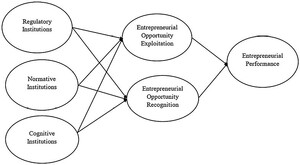
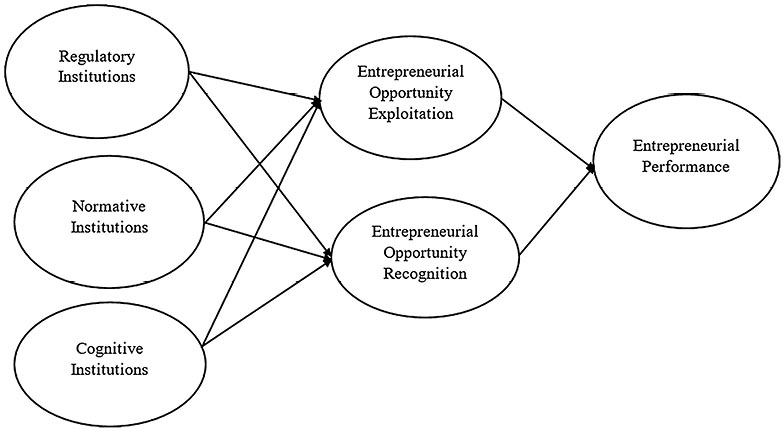
Normative institutions set acceptable means of achieving goals, exploiting business opportunities and creating innovative products and services for the market. (c) Cognitive institutions are sets of social knowledge, experience, skill, and formal and informal education that influence decision-making and shape the behaviour of individuals in society (Scott, 2000). The cognitive institution reflects the mindset, schemas and inferences on which reality, meaning and certain decisions are based. The theory reflects that the existence of entrepreneurial opportunities is a necessary condition for maize farmers’ business performance. Enabling institutional environments that offer technological, economic, market, and resource support is needed for the growth and survival of maize farm businesses. The institutional theory fundamentally implies that, institutions determine how organizations, businesses and entrepreneurial activities perform and reflect in the way in which boundaries are set for business firms and individual behaviours (Scott, 2010; Welter et al., 2018). Based on this background, we investigate institutional environments as critical factors influencing business performance, entrepreneurial opportunity recognition and opportunity exploitation among maize farmer entrepreneurs. The conceptual framework in Figure 1 has been proposed to guide the study.

Conceptual model.
Citation: International Food and Agribusiness Management Review 27, 4 (2024) ; 10.22434/ifamr1008
2.1 Entrepreneurial opportunities and business performance
Entrepreneurial opportunity refers to the process where new goods, services, and production methods are introduced to a new market to create a value higher cost of producing them (Shane and Venkataraman, 2000). The entrepreneurial opportunity theories establish two critical concepts: (1) Entrepreneurial opportunity recognition and (2) entrepreneurial opportunity exploitation (Kuckertz et al., 2017). When entrepreneurs recognize a business opportunity, they take the risk to exploit it. The duality of the entrepreneurial opportunities perspectives determines the profitability and market value of the entrepreneurial venture performance. Opportunity recognition involves searching for business opportunities and evaluating entrepreneurial activities in order to create new products or offer new and innovative services (Santos et al., 2015). The activities involved in the process of entrepreneurial opportunity recognition basically rely on the cognitive processes of the entrepreneur. Entrepreneurial opportunities are thought to be created and developed instead of just seeing them as existing already. Recent studies have established the positive role of opportunity recognition in the business performance of farm entrepreneurs (Xie et al., 2021; Masoomi and Rezaei-Moghaddam, 2021). The process of entrepreneurial opportunity recognition creates a fit between sensing market needs and untapped resources and determining innovation performance. The process of entrepreneurial opportunity recognition accounts for the level of entrepreneurial business performance in the agricultural sector (Xie et al., 2021). Ma and Yang (2022) have emphasized that entrepreneurial recognition is one of the vital significant factors that contribute to venture performance. As a result, improving opportunity recognition enables new ventures to improve business performance. Entrepreneurial recognition makes entrepreneurs aware of the new possibilities of utilizing economic resources to create new products and services. Therefore, identifying new business opportunities and entrepreneurial culture leads to the expansion of entrepreneurial alertness and business competitiveness (Gaglio and Katz, 2001; Nti and Osei, 2022), which further enhances business innovation and performance. Guo et al. (2017) confirm that entrepreneurs who recognize business opportunities are those who can expand their profit and business success more than those who cannot yet recognize them.
Recognizing an opportunity leads to creating market value that serves the needs of potential consumers and improves business product and service innovations. On the other hand, opportunity exploitation consists of a series of activities in the entrepreneurial process, which include developing a product or service, obtaining appropriate human resources, understanding customers, organizing resources and planning the setup of business execution (Kuckertz et al., 2017; Lassalle and McElwee, 2016; Santos et al., 2015). Liu et al. (2019) further posit that opportunity exploitation lends itself to the extent to which entrepreneurs react to the feedback or put the existing resources to use such that additional value will be created. Effectively taking advantage of the entrepreneurial opportunity available requires assembling human capital to tap the opportunity at hand and create value out of it (Lin and Si, 2019). Dencker and Gruber (2015) found that exploiting business opportunities has a positive impact on firm performance. However, the level of influence depends on the risk level associated with the opportunity. Higher-risk opportunities often result in greater payoffs and investment returns. Based on the above discussion, it is hypothesized that:
Entrepreneurship opportunity exploitation has significant impact on Farm entrepreneur’s performance (Hypothesis H1a);
Entrepreneurship opportunity recognition has significant impact on Farm entrepreneur’s performance (Hypothesis H1b)
2.2 Regulatory institutions and entrepreneurial opportunities
Studies by previous scholars such as Stenholm et al. (2013) conclude that regulatory institutions either promote entrepreneurial opportunities or inhibit the exploitation and recognition of these entrepreneurial opportunities. In a regulatory, institutional environment where acquiring a license and business permit is cumbersome, exploitation of attractive business opportunities tends to be affected natively. Similarly, when the regulatory process to start a business is shorter, it discourages individuals and firms from exploiting existing business opportunities and committing them to creating new businesses. At times, the type of resources and time spent in meeting the regulation requirement before obtaining the approval to start up new businesses or expand the existing business discourages entrepreneurs from committing productive resources to opportunity recognition and exploitation. Saruchera and Mpunzi (2023) confirm that regulatory polices tend to have a significant influence on agriculture entrepreneurship positively. The effective enforcement of laws and regulations ensures effect properties, patents, investment capital, land assets, farm land ownership, and other business assets are adequately protected (Fuentelsaz et al., 2019). Government policies and financial systems in the economy facilitate opportunity exploitation. Government policies become a guarantee to ensure market efficiency and enhance entrepreneurs’ ability to innovate, take reasonable risks and exploit business opportunities (Fuentelsaz et al., 2015). In this case, supportive regulatory institutions such as government policies, property rights, and legal safeguards contribute positively to entrepreneurial opportunities (Urbano and Alvarez, 2014). Based on the above discussion, it is hypothesized that:
Regulatory institutions have significant impact on entrepreneurial opportunity exploitation among the farm entrepreneurs (Hypothesis H2a);
Regulatory institutions have significant impact on entrepreneurial opportunity recognition among the farm entrepreneurs (Hypothesis H2b)
2.3 Normative institutions and entrepreneurial opportunities
The normative institutions such as beliefs, norms and values that the individuals in the society comply with determine what they value and admire in the society. An essential indicator of the normative institutions in relationship to entrepreneurial activities is the extent to which societal values and norms encourage individuals, especially farmers, to exploit or discover entrepreneurial opportunities to create their new businesses as a means of creating wealth. In some societies, the norm is that the youths are always pushed into formal sector employment instead of creating their farm business start-ups. According to Aparicio et al. (2016), some societal norms and values encourage individuals to pursue farm business opportunities in the society in most developing countries. Findings by Liu et al. (2018) suggest that cultural norms and values such as individualism and uncertainty avoidance tend to have a significant influence on entrepreneurial opportunity exploitation in developing countries. This implies that entrepreneurial opportunity exploitation decisions are often determined by the socio-cultural environments such as societal values, norms and cherished behaviours. Previous studies articulate that cultural normative institutions play a crucial role in determining entrepreneurial behaviour and the decision-making process. According to Putsenteilo et al. (2020), societal values, customs, and norms encourage farm entrepreneurs to take ambitious steps to discover or create business opportunities and pursue growth aspirations. The prevailing societal customs, such as land tenure systems and land rights, provide the enabling environments for farm entrepreneurs to recognize and exploit business opportunities. For instance, in societies where equitable land rights prevail, farm entrepreneurs have higher motivation to discover and identify the needs of consumers by easily tapping into the access to land resources to expand their farming business or produce new farm products. The normative institutions influence the allocation of entrepreneurial resources and the productive efforts towards entrepreneurial opportunity alertness. In developing countries, some societies do not view entrepreneurship as an admired career path and tend to have a negative impact on entrepreneurial opportunity recognition of the farmers in particular. However, Sambharya and Musteen (2014) argue that in many supportive societies, normative institutions have a positive impact on entrepreneurial opportunity recognition in developing countries
Based on this, it is hypothesized that:
Normative institutions has significant impact on entrepreneurial opportunity exploitation among the farm entrepreneurs (Hypothesis H3a);
Normative institutions has significant impact on entrepreneurial opportunity recognition among the farm entrepreneurs (Hypothesis H3b)
2.4 Cognitive institutions and entrepreneurial opportunities
Cognitive institutions, which constitute the knowledge structure, previous experiences and skills of entrepreneurs, have a direct influence on the decisions and abilities of the entrepreneurs to exploit or discover business opportunities. Based on the institutional theory, cognitive institutions provide the enabling platform for entrepreneurs to identify, discover and make do with the available entrepreneurial opportunities. The cognitive institutions enhance entrepreneurial opportunities, exploitation, and recognition. Empirical studies by Baron and Ensley (2006), Gur et al. (2020) and Lassalle (2018) articulated that the essence of previous experience and knowledge are critical for entrepreneurial opportunity recognition and opportunity recognition. To discover business opportunities, prior knowledge of the entrepreneurs is required.
Cognitive institutions influence entrepreneurship opportunity identification. The experiences and knowledge acquired in society equip the farmers to become alert and discover business opportunities. The cognitive dimensions reflect the significant positive formal and informal education that relates to the skills training and learning processes obtained in society that are required to exploit entrepreneurial opportunities (Volchek et al., 2015; Wammamakok et al., 2018). Findings by Murimbika Urban (2014) and Wammamakok et al. (2018) found a positive impact of cognitive institutions on entrepreneurial opportunities. Cognitive institutions propel the intensity and the desire for individuals to engage in entrepreneurial ventures. Educational training of farmer entrepreneurs significantly impacts the development of entrepreneurial skills and knowledge (Esiobu and Ibe, 2015; Pliakoura et al., 2020). Well-educated farm entrepreneurs can take calculated risks to discover more significant business opportunities and enhance entrepreneurial orientation towards venture development (Sousa, 2018). Empirical evidence from Abubakari et al. (2022) similarly recognizes that entrepreneurs who receive enough training through workshops and entrepreneurial capacity building can improve their performance comparatively, probably due to their ability to recognize and exploit more significant business opportunities.
Cognitive institutions have significant impact on entrepreneurial opportunity exploitation among farm-entrepreneurs (Hypothesis H4a);
Cognitive institutions have significant impact on entrepreneurial opportunity recognition among farm entrepreneurs (Hypothesis H4b)
2.5 Mediation effects of entrepreneurial opportunity recognition and exploitation
Entrepreneurial opportunities are easily discovered and exploited by entrepreneurs when there is a prevailing conducive and supportive institutional environment. In a business environment where government policies, programs and regulations are supportive, business opportunities are easily discovered and exploited, leading to innovation, creation of new products and improvement of business performance (Urbano and Alvarez, 2014). The increasing support of regulatory institutions has a positive influence on business opportunities exploitation and recognition through which business success can be improved (Fuentelsaz et al., 2019). Anisa et al. (2021) emphasized that when the government support farmers with agricultural tools, machines, and irrigation facilities, it helps to improve entrepreneurial competitiveness, thereby facilitating their abilities to recognize and exploit business opportunities. The likelihood that entrepreneurs are able to improve their performance and achieve business success through the exploitation or discovering of business opportunities depends on regulatory institutions (Young et al., 2018). Favourable regulatory institutions encourage business opportunities, exploitation and recognition through which entrepreneurial performance and business survival can be achieved (Wood et al., 2016).
Based on this backdrop, we hypothesized that:
Entrepreneurial opportunity exploitation mediates the relationship between regulatory institutional supports and entrepreneurial performance among the farm entrepreneurs (Hypothesis H5a);
Entrepreneurial opportunity recognition significantly mediates the relationship between regulatory institutional supports and entrepreneurial performance among the farm entrepreneurs (Hypothesis H5b)
Cultural structures and moral values in society and culture of family business have been cited to have a more significant influence on the extent to which individuals can leverage their resources and to exploit or discover business opportunities or development their intentions for entrepreneurship (Aparicio et al., 2016; Osei et al., 2022). According to Martínez-Rodriguez et al. (2020), informal norms and culture influence the desirability of entrepreneurship as a career path in society. It is important to note that informal institutional such as norms and ethics could have a positive impact on entrepreneurial opportunity exploitation and recognition through which business performance is improved (Martínez-Rodriguez et al., 2020).
The desire for firms and entrepreneurs to pursue business innovations, opportunity identification and exploitation is shaped by normative institutional contexts such as beliefs, values, and societal acceptable norms and cultural embeddedness (Muralidharan and Pathak, 2017). Pursuing business innovations, opportunity identification, and exploitation constitute significant vital components of the entrepreneurial process driving business performance outcomes. This implies that business opportunity exploitation and recognition serve as a channel through which social norms and culture contribute positively to entrepreneurial performance. The informal institutional environment may promote the intentions of the members in the society to start-up new ventures in the societies where the existing norms and culture support initiatives and creativity as a career path. Spencer and Gomez (2004) add that in a society where the norms and values in the society accept entrepreneurship, entrepreneurs and individuals in the society are able to harness business opportunities and contribute positively to business performance.
Entrepreneurial opportunity exploitation significantly meditates the positive effect of normative institutions and venture performance among the farm entrepreneurs (Hypothesis H6a);
Entrepreneurial opportunity recognition significantly meditate the effect of normative institutions and venture performance among the farm entrepreneurs (Hypothesis H6b)
Entrepreneurial opportunity recognition and exploitation are part of an interconnected process that involves access to resources, knowledge, experience, skills and social interaction towards creating new businesses or improving firm performance (Baron and Ensley, 2006; Gur et al., 2020; Lassalle, 2018). It is established that, through entrepreneurial opportunity exploitation and recognition, cognitive institutional arrangements are able to improve entrepreneurial performance, mostly in developing countries. Cognitive institutions promote knowledge and skills acquisition to discover and exploit business opportunities towards improving strategic orientation and business performance (Urban, 2019). For instance, education and training systems enhance entrepreneurial cognition capabilities, skills knowledge and experience to recognize and exploit business opportunities leading innovation therefore prompting business growth and success. Lotz and Merwe (2013) observed that improving agriculture entrepreneurship growth requires opportunity identification, discovering new sources of market value, and product and process innovation activities leading to improved farm business performance. Scholars such as (Pathak, 2017) argue that societal norms and values or cultures that promote high innovativeness and creativity correlate with generating high entrepreneurial business ventures. Findings from previous studies, such as Mathafena and Msimango-Galawe (2023), conclude that entrepreneurial opportunity exploitation is a positive driving force for business performance. Business opportunity exploitation improves the capabilities of the firms to introduce new products and improve their business revenues. The exploitation of business opportunities creates competitive advantages for firms to introduce innovations ahead of their competitors.
In developing countries where institutions are weak, entrepreneurs mostly rely on existing opportunities to survive and improve their performance. Supportive cognitive institutions in society provide valuable knowledge, skills and experience for individuals and firms to be able to discover and exploit business opportunities, which are then translated to improve entrepreneurs’ performance (Murimbika and Urban, 2014; Wammamakok et al., 2018). Existing entrepreneurs and firms depend on cognitive institutions to identify potential business opportunities and to create new businesses or improve existing businesses. The ability of entrepreneurs to discover and exploit different business resources and opportunities is a function of cognitive institutional arrangement (Saruchera and Mpunzi, 2023). In this view, entrepreneurial opportunity exploitation and recognition serve as the channels through which cognitive institutional structures contribute to entrepreneurial activities and performance (Cantù, 2017; Torres et al., 2020). In line with the above discussions, we hypothesized that:
Entrepreneurial opportunity exploitation significantly mediates the relationship between cognitive institutional supports and entrepreneurial performance among the rural farm entrepreneurs (Hypothesis H7a);
Entrepreneurial opportunity recognition significantly mediates the relationship between cognitive institutional supports and entrepreneurial performance among the rural farm entrepreneurs (Hypothesis H7b)
3. Methodology
3.1 Research design and data collection
The study was carried out in Ghana, a country situated in Western Africa with a lower-middle-income status. Ghana is known to have exceptional agricultural potential and an abundance of resources, which makes it a suitable location for conducting such studies. A sample size of 272 maize farm entrepreneurs was estimated based on the recommendation by previous scholars such as Gay et al. (2012), who proposed that choosing 20% of the population above 500 but less than 5000 as a sample size for a study is considered adequate. In this survey, the primary cross-sectional data was elicited from maize farm entrepreneurs in the farming communities within the Asante Akim North Municipal in the Ashanti Region of Ghana using a structured questionnaire. The Asante Akim North Municipal is dominated by farming, which is the major economic activity serving as the main source of livelihood. The convenience sampling method was used to select a total sample of 272 maize farm entrepreneurs. During the data collection, all 272 randomly selected maize farm entrepreneurs were visited personally and administered the questionnaire. However, only 246 usable answered responses were returned, representing a response rate of 90.4%. The sampled participants for the study encompassed 191 (77.64%) males and 55 (22.36%) females. The age distribution of the participants included 36 (14.63%) less than 25 years, 73 (29.68%) who are 25–30 years and 137 (55.69%) who are above 30 years. In terms of their farming work experience, the results indicated that most of the participants, 85 (34.55%) have 2–3 years, 44 (17.89%) have 4–6 years, 81 (32.92%) 7–10 years and 36 (14.63%) have above ten years. The majority of the participants had secondary education (83 (33.74%)), while 78 (31.71%) had non-formal education, 69 (28.05%) had Basic education, while only 16 (6.5%) with tertiary education. Participants engage in other minor farming activities such as Livestock production (22.76%), other crops cultivated apart from maize (68.29%) and fishing (8.94%). Moreover, it was ascertained that participants set up their farm ventures through their initiatives (17.07%), friends and relatives (15.04%), government initiatives (38.21%), family inheritance (20.33%) and purchase (9.33%).
3.2 Measurement of constructs
Entrepreneurial Performance (EPERF) was measured using the scale adopted from Raymond et al. (2013) using a 5-Point Likert scale ranging from 1 (strongly disagree) to 5 (strongly agree).
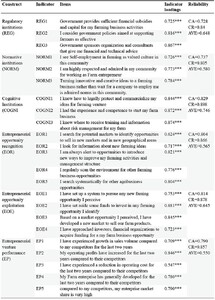
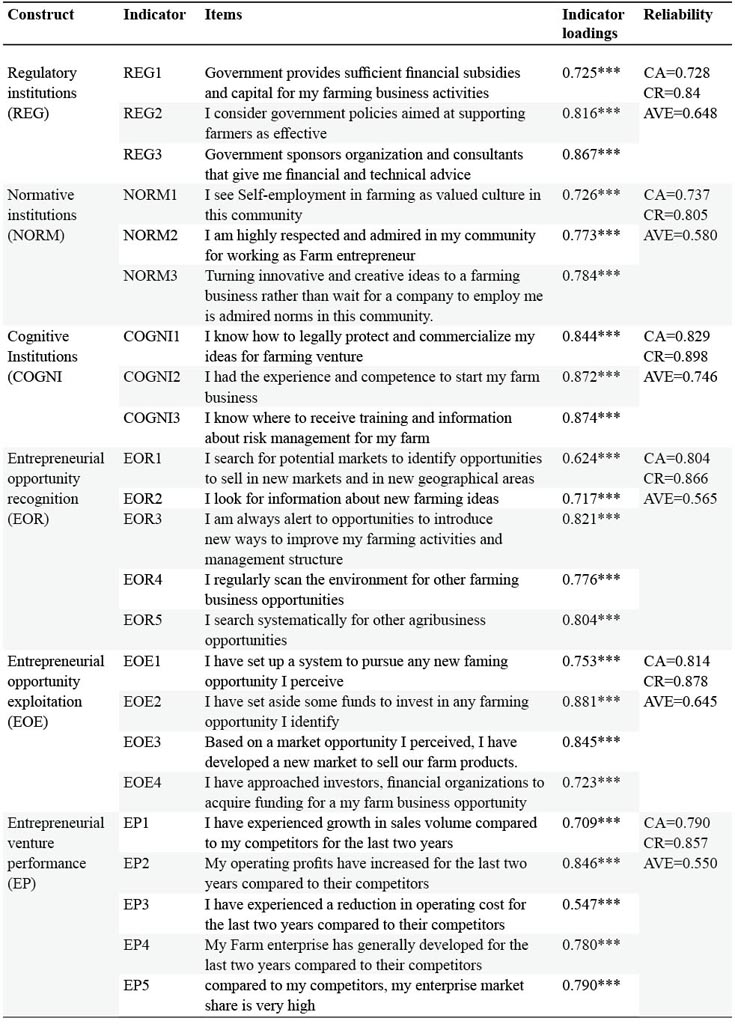
Three dimensions, namely Regulatory (REG), Normative (NORM) and Cognitive (COGNI) institutions, were used to measure institutions. The items utilized to measure all the institutional constructs were adapted and modified from previous including Busenitz et al. (2000), Urban (2019), and Welter and Smallbone (2011). The items were modified in line with the context of farm entrepreneurship in the developing country’s perspectives. The 5-point Likert scale-type responses ranging from 1 (strongly disagree) to 5 (strongly agree) were also used to assess the constructs. The items measuring the Entrepreneurial Opportunity Exploitation (EOE) and Entrepreneurial Opportunity Recognition (EOREC) constructs were measured based on items validated by Kuckertz et al. (2017). Participants’ responses were assessed using a 5-point Likert scale ranging from 1 (strongly disagree) to 5 (strongly agree). All the items measuring the constructs are presented in Table 1. Some control variables were considered in the analysis to cater for the exigencies and extraneous factors that may influence the process of farm entrepreneurial performance. We included two individual-level control variables: educational background and gender of the farm entrepreneurs. According to Bhardwaj (2014) and Hmieleski and Sheppard (2019), the gender and education of farm entrepreneurs influence their entrepreneurial performance. The educational background was measured as a categorical variable (1=No formal education, 2=Primary education, 3= Junior Secondary Education/‘O’ level 4= Senior Secondary education, 5=Tertiary education), and gender was also measured as a categorical variable (1=male, 2=female).
Construct Reliability and Convergent Validity
Citation: International Food and Agribusiness Management Review 27, 4 (2024) ; 10.22434/ifamr1008
3.3 Data analysis strategy
The Partial Least Squares Structural Equation Modelling (PLS-SEM) was applied for the data analysis. Using PLS-SEM as a multivariate analysis technique has several advantages over other regression methods. It produces robust results even if the sample size is small, unlike other estimation techniques, such as AMOS-SEM, which require large sample sizes. PLS-SEM has the strength to overcome issues associated with non-normally distributed data. We first used SPSS to assess the normality of the data based on Kolmogorov–Smirnov or Shapiro–Wilk tests. The issue of standard method bias was checked prior to the analysis. The questionnaire items were evaluated through Harman’s single-factor test, and the results indicated the eigenvalues of all the factors were higher than 1, with 24.625% as the total variance extracted by one factor less than the 50% threshold. Previous scholars such as Manley et al. (2020) and Sarstedt et al. (2020) have proposed assessment of measurement models such as factor loadings of indicators, composite reliability, Cronbach’s alpha and Average variance extracted (AVE). The construct reliability measures the extent of the construct items’ internal consistency, which is evaluated through factor loadings and Cronbach’s alpha. It is recommended that the acceptable loadings of the observed indicators should be greater than 0.5, while each of the Composite reliability and Cronbach’s alpha values should be higher than 0.7 (Hair et al., 2019; Manley et al., 2020; Sarstedt et al., 2020). The PLS-SEM model is estimated in two steps, namely the measurement model, which connects the observable indicators to the latent construct, and the structural model, which presents the magnitude and significance of estimates determining the relationships between the constructs through the bootstrapping approach involving 5000 resamples.
4. Results and Discussion
4.1 Evaluation of measurement model
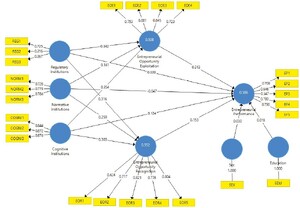
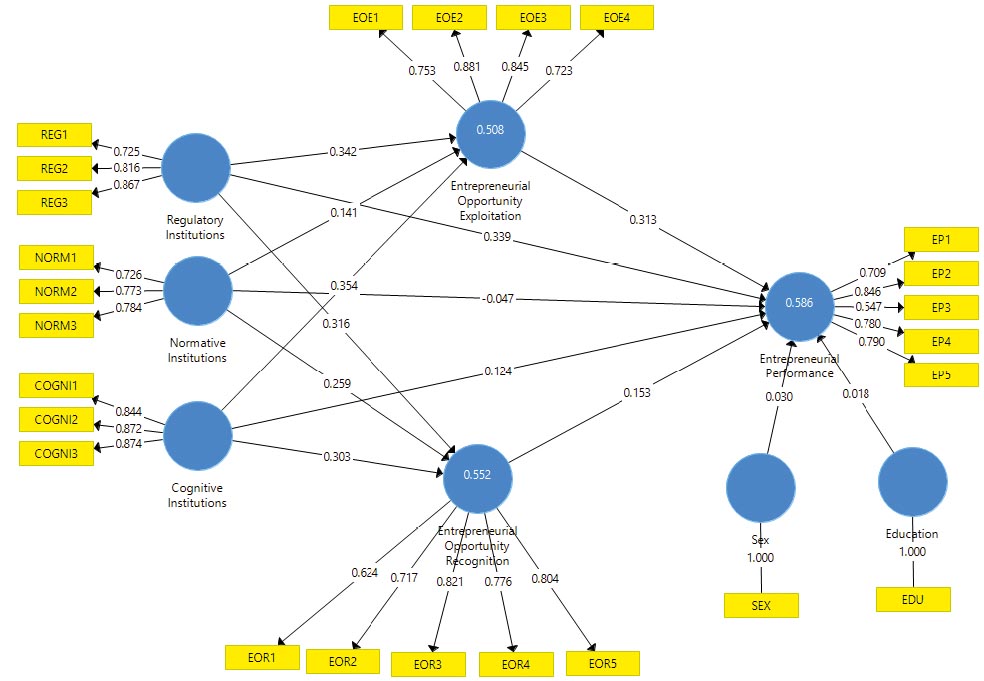
The results from the reliability test show that, all the individual observed indicators measuring the respective constructs have satisfactory loadings above 0.5 as shown in Figure 2 and Table 1. The results align with the recommended criterion for PLS-SEM analysis by Hair et al. (2019). The Cronbach’s Alpha Values (
Structural model.
Citation: International Food and Agribusiness Management Review 27, 4 (2024) ; 10.22434/ifamr1008
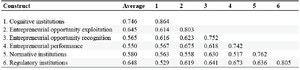
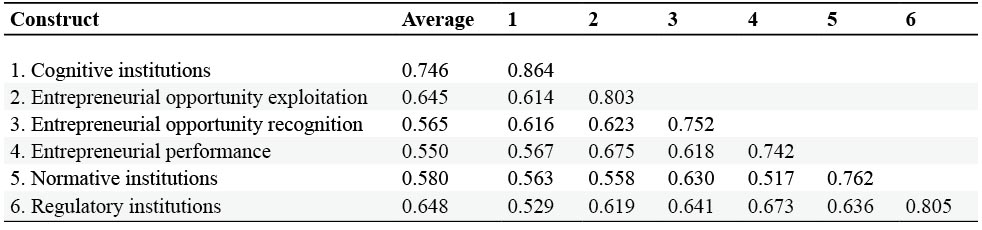
Discriminant validity indicates the extent to which a construct is different from others. Table 2 further presents the results on the construct validity of the measurement model evaluated using the AVE, Fornell, and Larcker Discriminant Validity Criterion. The results from Table 2 suggest that items measuring the construct are valid and satisfy the AVE and Fornell and Larcker Discriminant Validity Criteria thresholds. The Discriminant validity measures the extent to which the construct differs from the other. As a result, the AVE values of all the constructs must be above the minimum threshold of 0.5, as shown in Table 2. Again, the square root of the AVE values of the constructs may have loadings higher than their corresponding correlations with other constructs (see Table 2). The results logically support the guidelines set for PLS-SEM analysis as prescribed by theory (Hair et al., 2019; Manley et al., 2020).
Discriminant Validity test (Fornell and Larcker criterion)
Citation: International Food and Agribusiness Management Review 27, 4 (2024) ; 10.22434/ifamr1008
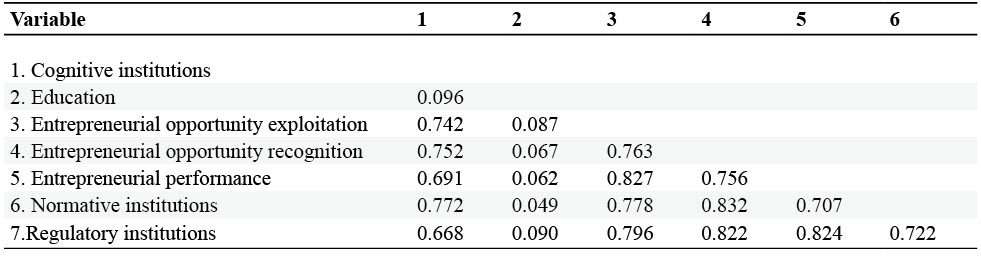
The discriminant validity of the constructs in the Measurement model was further tested based on the Heterotrait-Monotrait Ratio (HTMT). According to Ali et al., (2018) to meet the acceptance threshold for discriminant validity, the values of HTMT must be less than 0.85. The results from the HTMT test indicate that, cross correlation values of HTMT are less than the recommend 0.85 threshold as shown in Table 3.
Heterotrait-Monotrait Ratio (HTMT) for measurement model
Citation: International Food and Agribusiness Management Review 27, 4 (2024) ; 10.22434/ifamr1008
4.2 Structural model evaluation
The structural model was evaluated to determine the relationship between the construct using the bootstrapping approach with 5000 re-samples. The method is preferred to test the hypothesis based on the path coefficient estimates and t-statistic when the data is not normally distributed. Since PLS-SEM does not have a normal distribution assumption, the bootstrapping approach becomes appropriate to estimate the direct path coefficients in the hypothesis testing (Manley et al., 2020). The bootstrap re-sampling approach of the PLS-SEM was applied to simulate the unknown data distribution. This method transforms the original small sample data into a larger sample with minimized standard error. The approach presents consistent and accurate path coefficient estimates even when the data is not normally distributed.
The quality of the structural equation model was verified based on the standardized Root Means Square (SRMR), Chi-square and Normed Fit Index (NFI) values, and R-square. The results confirm that the SRMR, Chi-square, and NFI values were within the acceptable and satisfactory limits, as shown in Table 4. The results from Table 4 show that the structural equation model presented is mainly worth the goodness of fit.
Quality of structural model
Citation: International Food and Agribusiness Management Review 27, 4 (2024) ; 10.22434/ifamr1008
The results from Figure 2 further present the coefficient of determination (R2), which is the explanatory power of the model. The R2 value of 0.586 suggests that the structural model involving the explanatory variables such as regulatory, normative, and cognitive institutions, Entrepreneurial Opportunity exploitation, and opportunity recognition explains up to 58.6% of the variations in the dependent variable (Entrepreneurial Performance). The results from Figure 2 further reveal the R2 values for the mediating variables: EOE (R2=0.508) and EOR (R2=0.552). The results imply that the structural model explains approximately 50.8% and 55.2% of the variations in EOE and opportunity recognition variables, respectively (see Figure 2).
4.3 Test of significance of standardized direct path effects coefficients
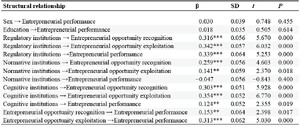
The bootstrapping approach at 5000 re-sampling was employed to estimate the statistical significance of the direct and indirect path coefficients (Manley et al., 2020). Results from Figure 2 and Table 5 confirm that regulatory institutions (
Coefficients of direct path effects
Citation: International Food and Agribusiness Management Review 27, 4 (2024) ; 10.22434/ifamr1008
The influx of government policies, regulations, and programs promoting the capacities of farm entrepreneurs to discover and utilize business opportunities to expand their farm businesses has become very significant (Saruchera and Mpunzi, 2023). Similarly, scholars such as Fuentelsaz et al. (2019) confirm the significant role of regulatory institutions in entrepreneurial opportunities.
The cognitive institutions continuously engage the maize farmer entrepreneurs in training on innovation, application of modern technologies and market identification strategies to boost the farming business. All these training activities improve the skills, innovation, and buffer for the farm enterprises to reduce investment risk and scale up their profitability.
Findings from the study further indicate that both EOE (
Figure 2 and Table 5 additionally reveal that regulatory intuitions (
Likewise, the results show that regulatory institutions (
The findings infer that cognitive institutions provide an institutional environment for farm entrepreneurs to discover and remain alert to business resources and opportunities in order to take advantage of and develop their farm businesses. This means that cognitive institutions such as formal and informal educational institutions facilitate and expand the capacity, knowledge, information and experience level of farm entrepreneurs, making it possible for them to identify and utilize new innovative business opportunities and improve their business performance (Abubakari et al., 2022; Sousa, 2018). In the same vein, the findings from these analyses are in line with those of (Murimbika and Urban 2014; Wammamakok et al.,2018). In South Africa, Farmer support programs and projects have been used as tools by governmental and non-governmental institutions to promote agricultural productivity and food security among rural households (Sikwela and Mushunje, 2013). Opolot, Isubikalu, Obaa, and Ebanyat (2018) conclude that smallholder farmers who were trained through social transformation pilot projects acquired significant farm entrepreneurial skills to boost their production and resource efficiency utilization. The previous farm experiences and skills acquired through informal and formal education build the entrepreneurial efficacy of the farm entrepreneurs to be able to utilize the strategic resources towards improving their profitability. The findings align with that of previous studies such as Fuentelsaz et al. (2015) and Stenholm et al. (2013), who report that a country’s institutional arrangements have a significant influence on entrepreneurial opportunity recognition and utilization to improve the profitability of business ventures. Developing entrepreneurial opportunities through informal and formal learning contributes positively to venture performance. (Cantù, 2017 Torres et al., 2020; Vrontis et al., 2017) observed that informal and formal cognitive learning skills and knowledge in farming-dominated communities equip farm entrepreneurs to develop the ability to evaluate farm business information and market opportunities, which in turn enhances their productivity, innovation and marketing abilities.
The findings from the study further reveal that supportive normative institutions such as the admired cultural values and norms in rural communities inspire farm entrepreneurs to focus more on discovering farm business opportunities and utilizing the opportunities discovered (Jia et al., 2018; Putsenteilo et al., 2020). When the societal norms and cultural values attached to farm entrepreneurship are positive, they encourage farm entrepreneurs to become alert, pursue entrepreneurial opportunities, and exploit, which consequently leads to improving their venture performance (Liu et al., 2019). The results, therefore, corroborate findings from existing studies, such as Aparicio et al. (2016), which found a positive impact of normative institutions on entrepreneurial opportunity and performance.
4.4 Analysis of mediation mechanism
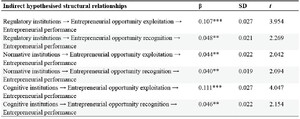
Results from Table 6 suggest the existence of significant partial mediation effects of EOR and EOE in the relationship between the different institutional environments (REG, NORM and COGNI) and entrepreneurs’ venture performance. The findings show that regulatory institutions (
Mediation effects
Citation: International Food and Agribusiness Management Review 27, 4 (2024) ; 10.22434/ifamr1008
On the other hand, the results confirm that Entrepreneurial Opportunity Recognition partially mediates the relationships between the Institutional environments: REG (
Consistent with findings from previous studies, we conclude that entrepreneurial opportunities significantly provide channels or mechanisms through which regulatory institutions contribute to entrepreneurship performance (Fuentelsaz et al., 2019; Roxas and Chadee, 2013; Young et al., 2018). The implications are that in developing countries such as Ghana, directing government policies and programs towards improving the entrepreneurial opportunities of the farmer entrepreneurs has a more significant impact on their entrepreneurial performance than targeting the direct impact on performance.
Hence, the results reveal that opportunity recognition and opportunity exploitation strategies partially mediate the relationships between normative institutions and entrepreneurial farm business performance. Findings by Martínez-Rodriguez et al. (2020) and Aparicio et al. (2016) argue that supportive societal norms and values influence the desirability of entrepreneurs to venture into entrepreneurship as a career path in society. Most of the farmers in the typical farming societies learn farming skills from their families or training groups and organizations in the communities. The farm entrepreneurs in rural Ghana persistently search and discover entrepreneurial opportunities in farming to expand their farm business ventures when they perceive strong normative institutional support. The findings are in line with previous studies such as Cantù (2017) and Torres et al. (2020), who argue that business opportunity discovery and exploitation provide significant channels for institutional influence on entrepreneurship growth.
5. Conclusion and policy implications
The study examined how different institutional environments (regulatory, normative, and cognitive institutions) affect maize farm entrepreneurs’ ability to recognize and exploit opportunities, as well as their overall business performance. The study also looked at how entrepreneurial opportunity recognition and opportunity exploitation mediate the relationship between institutional environments and farm entrepreneurial performance. The study found that supportive institutional environments, such as government policies, programs, and skills training, help maize farmers recognize and exploit business opportunities, leading to increased venture growth. The study also found that cognitive and regulatory institutions have a greater positive impact on opportunity exploitation compared to maize farmers’ opportunity recognition strategy.
Moreover, the study confirmed that entrepreneurial opportunity recognition and opportunity exploitation play a significant positive role in partially mediating the relationship between the institutional environment and venture performance. In other words, successful maize farmers’ entrepreneurial opportunity recognition and opportunity exploitation strategies have a chain partial mediating effect on the institutions-venture performance relationship.
The study has practical and constructive contributions to institutional and entrepreneurial opportunity theories and policies. Its findings can boost maize crop production in Africa, which is a major cereal crop. This can address the persistent food supply shortage encountered in Africa, making the continent less susceptible to food insecurity. Moreover, the study found a strong positive and significant association between regulatory and cognitive institutions and farm entrepreneurs’ opportunities recognition and exploitation strategies. This means that if government programs, NGOs, social institutions and extension organizations increase their support for maize farmers in the region, production output can be increased. Favourable government policies and other social institutions like universities should support rural maize farmer entrepreneurs through skills training to improve their strategic orientation and capacity to discover and exploit profitable business opportunities and resources for efficiency in production. The findings from this study provide policy support to the government of Ghana’s Planting for Food and Jobs (PFJ) program.
This study has important implications for food security policies and the sustainability of agrifood systems in developing countries. Food insecurity is a significant developmental challenge in most developing countries, especially in rural areas. This is due to low productivity, distribution challenges, low-quality food, and inefficient utilization of food produced. By providing supportive institutions, farm entrepreneurs can use sustainable strategies to improve their food production and scale up their operations. Strengthening rural institutions to support farm entrepreneurs is an effective strategy for promoting the supply side of the food value chain. Additionally, supporting rural entrepreneurship has been linked to poverty alleviation and rural development. These findings confirm that continuous efforts to promote farm entrepreneurs in developing countries can provide opportunities to improve the lives of rural people living in extreme poverty. Investing in farm entrepreneurship creates more job opportunities for people experiencing poverty, improves their income distribution, and enhances their livelihoods.
The study provides valuable insights into how institutions contribute to the performance of farm entrepreneurship in developing countries. However, there are still gaps in the research that require further investigation. For instance, using cross-sectional data only captures a snapshot of the variables and fails to account for changes over time. Therefore, using longitudinal data can help extend the analysis to include the impact of institutions on farm entrepreneurship over a longer period. The study used a structural equation model approach, which includes quantitative techniques. However, interpreting these techniques requires a more detailed description of how regulatory, cognitive, and normative institutions affect entrepreneurial performance in the agriculture sector. To gain a deeper understanding of the impact of institutions on farm entrepreneurship in developing countries’ rural areas, future studies may utilize case-specific qualitative studies to explore the research gap.
Acknowledgements
The authors acknowledge the valuable contributions of Officers from the Ministry of Food and Agriculture (MoFA) in Ghana. The authors declare that there is no conflict of interest.
References
Adom, K. 2015. Recognizing the contribution of female entrepreneurs in economic development in sub-Saharan Africa: Some evidence from Ghana. Journal of Developmental Entrepreneurship 20 (1): 1550003.
Ali, F., S.M. Rasoolimanesh, M. Sarstedt, C.M. Ringle and K. Ryu. 2018. An assessment of the use of partial least squares structural equation modeling (PLS-SEM) in hospitality research. International Journal of Contemporary Hospitality Management 30 (1): 514–538.
Amankwah, A. and T. Gwatidzo. 2024. Food security and poverty reduction effects of agricultural technologies adoption− a multinomial endogenous switching regression application in rural Zimbabwe. Food Policy 125: 102629.
Angelucci, F. 2019. Analysis of incentives and disincentives for maize in Ghana. Gates Open Research 3: 1011.
Aparicio, S., D. Urbano and D. Audretsch. 2016. Institutional factors, opportunity entrepreneurship and economic growth: Panel data evidence. Technological Forecasting and Social Change 102: 45–61.
Ardichvili, A., R. Cardozo and S. Ray. 2003. A theory of entrepreneurial opportunity identification and development. Journal of Business Venturing 18 (1): 105–123.
Awunyo-Vitor, D., C.A. Wongnaa and R. Aidoo 2016. Resource use efficiency among maize farmers in Ghana. Agriculture & Food Security 5 (1): 28.
Baron, R.A. and M.D. Ensley. 2006. Opportunity recognition as the detection of meaningful patterns: Evidence from comparisons of novice and experienced entrepreneurs. Management Science 52 (9): 1331–1344.
Bhardwaj, B.R. 2014. Impact of education and training on performance of women entrepreneurs: A study in emerging market context. Journal of Entrepreneurship in Emerging Economies 6 (1): 38–52.
Busenitz, L.W., C. Gomez and J.W. Spencer. 2000. Country institutional profiles: unlocking entrepreneurial phenomena. Academy of Management Journal, 43 (5): 994–1003.
Cantù, C. 2017. Entrepreneurial knowledge spillovers: discovering opportunities through understanding mediated spatial relationships. Industrial Marketing Management 61: 30–42.
Chang, S.-J., A. Van Witteloostuijn and L. Eden. 2010. Common method variance in international business research. Journal of International Business Studies 41: 178–184.
Danso-Abbeam G., J.A. Bosiako, D.S. Ehiakpor and F.N. Mabe. 2017. Adoption of improved maize variety among farm households in the northern region of Ghana. Cogent Economics & Finance 5 (1): 14.
Dencker, J.C. and M. Gruber. 2015. The effects of opportunities and founder experience on new firm performance. Strategic Management Journal 36 (7): 1035–1052.
Dias, C.S., R.G. Rodrigues and J.J. Ferreira. 2019. Agricultural entrepreneurship: going back to the basics. Journal of Rural Studies 70: 125–138.
Esiobu, N. and G.O.G. Ibe. 2015. Analysis of entrepreneurship development in agriculture among arable crop farmers in Imo State, Nigeria. International Journal of African and Asian Studies 7: 92–99.
Figueroa, F.F. 2022. Effects of government intervention in agricultural sustainability and profits: study of Dutch and American agricultural policy. Available online at https://repository.upenn.edu/spur/43
Fischer, E.M., A.R. Reuber and L.S. Dyke. 1993. A theoretical overview and extension of research on sex, gender, and entrepreneurship. Journal of Business Venturing 8 (2): 151–168.
Fitz-Koch, S., M. Nordqvist, S. Carter and E. Hunter. 2018. Entrepreneurship in the agricultural sector: A literature review and future research opportunities. Entrepreneurship Theory and Practice 42 (1): 129–166.
Foss, N.J., J. Lyngsie and S.A. Zahra. 2013. The role of external knowledge sources and organizational design in the process of opportunity exploitation. Strategic Management Journal 34 (12): 1453–1471.
Fuentelsaz, L., C. González and J.P. Maicas. 2019. Formal institutions and opportunity entrepreneurship. The contingent role of informal institutions. BRQ Business Research Quarterly 22 (1): 5–24.
Gay, L.R., G.E. Mills and P.W. Airasian. 2012. Educational research: Competencies for analysis and applications. Pearson, New York, NY.
Gaglio, C.M. and J.A. Katz. 2001. The psychological basis of opportunity identification: entrepreneurial alertness. Small Business Economics 16: 95–111.
Genc, E., M. Dayan and O.F. Genc. 2019. The impact of SME internationalization on innovation: The mediating role of market and entrepreneurial orientation. Industrial Marketing Management 82: 253–264.
Guo, H., J. Tang, Z. Su and J.A. Katz. 2017. Opportunity recognition and SME performance: the mediating effect of business model innovation. R&D Management 47 (3): 431–442.
Gur, F.A., J.S. Bendickson, L. Madden and W.C. McDowell. 2020. Entrepreneurial opportunity recognition in the face of disasters. International Journal of Entrepreneurial Behavior and Research 26 (4): 671–693.
Hair, J.F., J.J. Risher, M. Sarstedt and C.M. Ringle. 2019. When to use and how to report the results of PLS – SEM. European Business Review 31, 2–24.
Hanohov, R. and L. Baldacchino, L. 2018. Opportunity recognition in sustainable entrepreneurship: an exploratory study. International Journal of Entrepreneurial Behavior and Research 24 (2): 333–358.
Hmieleski, K.M. and L.D. Sheppard. 2019. The Yin and Yang of entrepreneurship: gender differences in the importance of communal and agentic characteristics for entrepreneurs’ subjective well–being and performance. Journal of Business Venturing 34 (4): 709–730.
Ismaila, S. and M. Tanko. 2021. Exploring relative deprivation theory in the rice industry: Planting for Food and Jobs (PFJ) in northern Ghana. Technology in Society 65: 101556.
Khan, R.U., Y. Salamzadeh, H. Kawamorita and G. Rethi, G. 2020. Entrepreneurial orientation and small and medium–sized enterprises’ performance; does ‘access to finance’ moderate the relation in emerging economies? Vision 25 (1): 88–102.
Lassalle, P. 2018. Opportunity recognition among migrant entrepreneurs: Household, community and the haphazard nature of migrants’ entrepreneurial decisions. The International Journal of Entrepreneurship and Innovation 19 (3): 143–154.
Lehner, O.M. and J. Kansikas. 2012. Opportunity recognition in social entrepreneurship: a thematic meta–analysis. The Journal of Entrepreneurship 21 (1): 25–58.
Li, Z., G. Li., K. Zhang and J. Zhu. 2022. Do social pension and family support affect farmers’ land transfer? Evidence from China. Land 11 (4): 497.
Liu, J., F.T. Pacho and X. Wang 2019. The influence of culture in entrepreneurs’ opportunity exploitation decision in Tanzania. Journal of Entrepreneurship in Emerging Economies 11 (1): 22–43.
Ma, T. and S. Yang. 2022. Impact of entrepreneurial orientation on the performance of new ventures in China: the roles of entrepreneurial bricolage and opportunity recognition. Chinese Management Studies 16 (4): 924–941.
Manley, S.C., J.F. Hair, R.L. Williams and W.C. McDowell. 2020. Essential new PLS–SEM analysis methods for your entrepreneurship analytical toolbox. International Entrepreneurship and Management Journal 14 (1): 217–244.
Martínez–Rodriguez, I., F.E. Callejas-lbiñana and A.I. Callejas-Albiñana, A. I. 2020. Economic and socio–cultural drivers of necessity and opportunity entrepreneurship depending on the business cycle phase. Journal of Business Economics and Management 21 (2): 373–394.
Mathafena, R.B. and J. Msimango-Galawe. 2023. Entrepreneurial orientation, market orientation and opportunity exploitation in driving business performance: moderating effect of interfunctional coordination. Journal of Entrepreneurship in Emerging Economies 15 (3): 538–565.
McKee, E. 2018. “It’s the Amazon world”: small‐scale farmers on an entrepreneurial treadmill. Culture, Agriculture, Food and Environment 40 (1): 65–69.
Morris, W., A. Henley and D. Dowell. 2017. Farm diversification, entrepreneurship and technology adoption: Analysis of upland farmers in Wales. Journal of Rural Studies 53: 132–143.
Murimbika, M. and B. Urban. 2014. Strategic innovation at the firm level: the impact of strategic management practices on entrepreneurial orientation. International Journal of Innovation Management 18 (2): 1450016.
Nordjo, R.E. and C.K. Adjasi. 2019. The impact of credit on productivity of smallholder farmers in Ghana. Agricultural Finance Review 80 (1): 91–109.
Nti, N.K. and C.D. Osei. (2022). Business characteristics and entrepreneurial management practices of small and medium enterprises in Ghana. International Journal of Entrepreneurship and Business Development 5 (4): 648–659.
Opolot, H.N., P. Isubikalu, B.B. Obaa and P. Ebanyat 2018. Influence of university entrepreneurship training on farmers’ competences for improved productivity and market access in Uganda. Cogent Food and Agriculture 4 (1): 1469211.
Osei, C.D., and J. Zhuang. 2020. Rural poverty alleviation strategies and social capital link: the mediation role of women entrepreneurship and social innovation. Sage Open 10 (2). https://doi.org/10.1177/2158244020925504
Osei, C.D. and J. Zhuang. 2024. The effects of institutional supports on farm entrepreneurial performance: exploring the mediating role of entrepreneurial orientation. Sage Open 14 (1): https://doi.org/10.1177/21582440241227713
Osei, C.D., M. Garcia-Castro and K.N. Nti. 2022. The influence of family business and social capital on entrepreneurial intentions among female university students in the Philippines. International Journal of Entrepreneurship and Business Development 5 (3): 465–475.
Pliakoura, A., G. Beligiannis and A. Kontogeorgos. 2020. Education in agricultural entrepreneurship: training needs and learning practices. Education+ Training 62 (7–8): 723–739.
Podsakoff, P.M., S.B. MacKenzie, J.-Y. Lee and N.P. Podsakoff. 2003. Common method biases in behavioral research: a critical review of the literature and recommended remedies. Journal of Applied Psychology 88 (5): 879–903.
Putsenteilo, P., Y. Klapkiv, V. Karpenko and I. Gvozdecka. 2020. The role of institutions in the development of agriculture. Bulgarian Journal of Agricultural Science 26 (1): 23–33.
Raymond, L., M. Marchand, J. St-Pierre, L. Cadieux and F. Labelle. 2013. Dimensions of small business performance from the owner–manager’s perspective: a re–conceptualization and empirical validation. Entrepreneurship and Regional Development 25 (5–6): 468–499.
Rosairo, H.R. and D.J. Potts. 2016. A study on entrepreneurial attitudes of upcountry vegetable farmers in Sri Lanka. Journal of Agribusiness in Developing and Emerging Economies 6 (1): 39–58.
Roxas, B. and D. Chadee. 2013. Effects of formal institutions on the performance of the tourism sector in the Philippines: the mediating role of entrepreneurial orientation. Tourism Management 37: 1–12.
Sambharya, R. and M. Musteen. 2014. Institutional environment and entrepreneurship: an empirical study across countries. Journal of International Entrepreneurship 12 (4): 314–330.
Santos, S.C., A. Caetano, R. Baron and L. Curral. 2015. Prototype models of opportunity recognition and the decision to launch a new venture. International Journal of Entrepreneurial Behavior and Research 21 (4): 510–538.
Sarstedt, M., J.F. Hair, C. Nitzl, C.M. Ringle and M.C. Howard. 2020. Beyond a tandem analysis of SEM and PROCESS: use of PLS–SEM for mediation analyses! International Journal of Market Research 62 (3): 288–299.
Scott, W.R. 2010. Reflections: The past and future of research on institutions and institutional change. Journal of Change Management 10 (1): 5–21.
Sikwela, M.M. and A. Mushunje. 2013. The impact of farmer support programmes on household income and sustainability in smallholder production: a case study of the Eastern Cape and KwaZulu Natal farmers, South Africa. African Journal of Agricultural Research 8 (21): 2502–2511.
Sousa, M.J. 2018. Entrepreneurship skills development in higher education courses for team leaders. Administrative Sciences 8 (2): 18.
Spencer, J.W. and C. Gómez. 2004. The relationship among national institutional structures, economic factors, and domestic entrepreneurial activity: a multicountry study. Journal of Business Research 57 (10): 1098–1107.
Stenholm, P., Z.J. Acs and R. Wuebker 2013. Exploring country–level institutional arrangements on the rate and type of entrepreneurial activity. Journal of Business Venturing 28 (1): 176–193.
Torres, C.L.F., L.A. Olvera-Vargas, J.S. Gómez and D.I. Contreras-Medina. 2020. Discovering innovation opportunities based on SECI model: reconfiguring knowledge dynamics of the agricultural artisan production of agave–mezcal, using emerging technologies. Journal of Knowledge Management 25 (2): 336–359.
Uduji, J.I., E.N. Okolo Obasi and S.A. Asongu. 2019. The impact of e‐wallet on informal farm entrepreneurship development in rural Nigeria. The Electronic Journal of Information Systems in Developing Countries 85 (3): e12066.
Urban, B. 2019. The influence of the regulatory, normative and cognitive institutions on entrepreneurial orientation in South Africa. The International Journal of Entrepreneurship and Innovation 20 (3): 182–193.
Urbano, D. and C. Alvarez. 2014. Institutional dimensions and entrepreneurial activity: an international study. Small Business Economics 42 (4): 703–716.
Volchek, D., S. Saarenketo and A. Jantunen. 2015. Structural model of institutional environment influence on international entrepreneurship in emerging economies Institutional Impacts on Firm Internationalization. Springer, Berlin, pp. 190–216.
Vrontis, D., A. Thrassou, G. Santoro and A. Papa. 2017. Ambidexterity, external knowledge and performance in knowledge–intensive firms. The Journal of Technology Transfer 42 (2): 374–388.
Wammamakok, W., Y.-Y. Chang and W.-K. Liang. 2018. An Empirical Investigation on Institutional Environments as a Driver of Social Entrepreneurial Intentions. Paper presented at the ICSB World Conference Proceedings.
Welter, F. and D. Smallbone. 2011. Institutional perspectives on entrepreneurial behavior in challenging environments. Journal of Small Business Management 49 (1): 107–125.
Wood, M.S., P. Bylund and S. Bradley. 2016. The influence of tax and regulatory policies on entrepreneurs’ opportunity evaluation decisions. Management Decision 54 (5): 1160–1182.
Young, S.L., C. Welter and M. Conger. 2018. Stability vs. flexibility: The effect of regulatory institutions on opportunity type. Journal of International Business Studies 49 (4): 407–441.
Corresponding author