Abstract
This article aims to analyze the internal and organic structures of the social welfare management and tutelage bodies under the authoritarian Iberian regimes of the twentieth century.
Both the Instituto Nacional do Trabalho e Previdência (INTP-1933-1974) and the Instituto Nacional de Previsión (INP-1908-1978) played central roles in social welfare in Portugal and Spain, respectively. Therefore, it is important to compare their structures, competences, and attributions and the roles they actually played within these regimes. This further seeks to demonstrate the divergences in their nature, while also bearing in mind the corporatism adopted by the different regimes.
1 Introduction
Both authoritarian Iberian regimes adopted, albeit in different ways, corporatism as a doctrine in the wake of the Italian corporatism. Several authors defend the influence of Italian corporatism on the Iberian regimes, especially the example set by the Carta del Lavoro in the drafting of the Portuguese Estatuto Nacional do Trabalho [ETN] and the Spanish Fuero del Trabajo [FdT] (Brito 1996; Garrido 2012; Molinero 2003a; Pinto 2008) – which does not invalidate the differences pointed out between the Italian and Portuguese cases (Lucena 1976a: 179), reinforced by the specificities of the respective political regimes. Thus, Freitas do Amaral highlights the advisory role of the Portuguese Corporate Chamber, unparalleled in the Italian or Spanish cases (Amaral 2012: 85); Santos details the role of the masses in the Italian (and German) regimes compared to the Portuguese while stressing that, unlike its counterparts, Estado Novo opted for the depoliticization and demobilization of the masses (Santos 2017: 142–143). Contrary to what happened in those countries and even in Spain, Salazar did not seize power through an already organized force having first assumed the nation’s destinies and only later the leadership of the national union (Sancho Izquierdo, et al. 1937: 136).
Portuguese corporatism stood out due both to the ETN itself and the legislation passed in parallel, which structured the corporate organization into three levels: primary bodies (farming, industrial and commercial guilds, national unions and houses of the people and of fishermen); intermediate bodies (federations and unions of primary bodies); and corporations, with the symmetry of the Italian system – which had developed symmetrical organizations of unions and federations of workers and analogous structures of employers in each area/sector of activity – thus not verified (Lucena 2015: 81). Employer organizations would be essentially economic in purpose while those of workers would play strictly professional roles (Sancho Izquierdo et al. 1937: 225), with INTP overseeing the corporate organization. Portuguese corporatism has mostly been characterized as authoritarian and state-centric (Lucena 1976a), partial and subordinate in character (Ferreira 2008), which constituted a means for the construction of social balance and harmony (Cardoso 2012: 102), and an instrument for social discipline and the ordination of a directed or institutionalized economy (Garrido 2016).
In recent years, new contributions to the literature have focused on the political construction of the regime and the place that corporatism occupied at the doctrinal level (Santos 2015, 2017, 2018), as well as its effective implementation in the territory (Pereira 2016; Torres 2018) – approaches that meet the requirements highlighted by some authors for placing the corporate agenda into the category of practical achievements (Rosas 2012b: 281–282). This correspondingly identifies inconsistencies between theory and practice (Rollo 2012) even while there is a lack of research enabling a full understanding either of the functioning of these corporate organics and their impact on the territory and society or the practical dimensions of the historical experience of Portuguese corporatism in an approach attentive to the bottom-up dynamics (Garrido 2012: 153).
As in Portugal, in Spain, in the absence of effective interests of the social forces in the creation of corporate organization, Francoism took the initiative by bringing about the corporate organization of society itself in establishing a subordinate (Recio 2016: 145), politically closed, and exclusive (Velasco 1998: 308) state corporatism (Sancho Izquierdo et al. 1937: 73), which acted “as an instrument of political control over the structure of labor relations” (Riquelme 2011: 169). In this country, vertical unionism was implemented, an instrument of the regime’s social policy, responsible for discipline among the elements of production (Giménez Martínez 2015: 227).
The new Spanish state would be based on the vital national forces: labor, production, and culture, with production activities framed within a single corporate organization, with a planned structure in trade unions and industry and commerce guilds (grouped in a professional category association); general farmers’ associations; and, in the cultural field, a general organization (Sancho Izquierdo et al. 1937: 191–192).
In 1938, Francisco Franco ordered the restructuring of the INP, initially subordinate to the Ministry of Organization and Union Action [MOAS], which constituted one of the core pillars of Franco’s welfare policy during its initial phase (Madrid and Heras, 2018a: 367). However, contrary to that proclaimed by the regime, it did not go on to implement any relevant changes in the social protection model, maintaining the social welfare policy in effect under the Republic [1931–39] (Rodriguez, 2000).
The INP has not been the subject of systematized studies. There are, however, some works primarily related to the social welfare in Francoism and social insurances (Velasco 1998; Murcia and Argüelles 2009; Madrid and Heras 2018b; Casado 2019).
Also in the Portuguese case, the INTP – a body established beyond the scope of the central administration machine and subject to close control by the council president1 within the framework of a relatively autonomous state apparatus (Schmitter 1999: 127) – has not hitherto been subject to systematic study. Set up with the purpose of supervising the corporate institutionalization of trade unions and labor contracting (Garrido 2016: 123–124), the aspects that have been made known about the INTP interrelate with the post-1945 labor regulation. Fátima Patriarca, highlighted its role in the relationship between capital and labor and in obtaining agreements with unions and guilds, at times having even replaced the union dimension by conducting negotiations and defining strategies (Patriarca 1995: 234–235). Role stressed by Lucena, who correspondingly highlights its supervisory role for corporate organization, especially for primary organisms (Lucena, 1976b); such as Rosas, who highlights the role of INTP in maintaining the general balance of the corporate system in the early years of Salazar’s regime (Rosas 2012b: 295).
Thus, the aim of this study is to carry out a comparative analysis of these two bodies, namely in terms of organization charts and achievements in the field of social welfare during the 1930s and 1950s. The documentary analysis is based on the main legislative diplomas and statutory regulations that were promulgated (in the Portuguese case, the INTP regulations date from 1942 and 1948; in the Spanish case, the INP statutes refer to 1931 and 1958).
The relevance of the theme under study derives from the mapping of the conceptions of social welfare advocated by the two regimes and with the modalities projected for its exercise among the populations. In this sense, the comparative analysis examined here aims to identify the main similarities and divergences between INTP and INP, in regards to the design of social welfare as well as potential influences. Overall, it aims to contribute to highlighting the links between corporatism and social welfare in the framework of the Iberian dictatorships.
2 The Corporate Regimes
The edification of authoritarian, nationalist, and fascist regimes constituted a response to the global economic crisis, which had a significant impact on Europe, already in the grip of a crisis of the liberal system (Pereira 2012: 436). The European inter-war authoritarian regimes represented a retreat from the social policy of the liberal welfare states, harassing free welfare institutions and cooperative societies associated with workers’ culture (Garrido and Pereira 2018: 149). It should be recalled that corporate social policy was based on the alleged elimination of class conflicts and divergences between socio-professional categories.
The corporativism inscribed in the Portuguese Constitution of 1933 played a central ideological role in underpinning the new political order. The establishment of corporate ideology was not, however, without its critics: some nationalists condemned the state’s reduced commitment to promoting well-being among the most socially disadvantaged sectors. Some Catholics opposed state interventionism in economic matters, which they considered excessive. Lusitanian Integralism – an ideological and political movement (monarchist, traditionalist, and corporative) referred to “a fictitious corporatist creation” (Santos 2021: 1131) beyond its detractors (conservative liberals).
Unlike other contemporary authoritarian regimes (such as Francoism), Salazarism did not place the new services linked to the edification of the corporate state within a ministerial framework. Oliveira Salazar chose to establish a small public body – INTP – under his direct authority, responsible for the implementation, management, and control of the corporate organization (Ferreira and Pereira 2016: 15). Teotónio Pereira, appointed to the position of Undersecretary of State for Corporations and Social Welfare [SSECPS], showed early on that corporate policy was not part of the government’s organic design, as he had not been invested with the exercise of ministerial office like his other colleagues in the executive (Martins 2020: 280). Thus, despite his blunt criticism of the absence of an overall corporate policy in the governing dynamics, the creation of the ministry of Corporations and Social Welfare [MCPS] would only take place in the early 1950s, at a time when corporatism was already scarce in public administration (Lucena 2015: 89).
Francoism, on the other hand, represented the institutionalization of a dictatorship through a radical break with a liberal institutional past, social corporatism being a central aspect of the regime and its institutions (Pinto 2017: 16), imposing a state corporatism, an instrument of political control over labor relations, evolving from a Labor Magistracy that imposed compulsory conciliation between employers and workers on an individual basis to a system of collective agreements from 1958 onwards (Riquelme 2011: 169). In fact, few dictators in interwar Europe were able to achieve the concentration of power enjoyed by Franco when the new Spanish state was established, and most of them had difficulties in institutionalizing their respective regimes, forced to accommodate the most prominent members of the coalitions that had enabled them to come to power (Pinto 2014: 48).
The bodies related to social welfare depended on the Ministry of Labor (the main instrument of Francoist social policy and a fundamental part of the Falangist presence in the government), highlighting the close relationship between these bodies (INP included) and the Spanish union organization [OSE], which channeled the social participation in the INP and Mutualismo Laboral. Labor relations and social protection measures depended on the ministry rather than unions, with Falangist control linking social protection to the government (Molinero 2003: 326).
The Portuguese model (like the Italian and Austrian models) was one of the corporativist paradigm, translating into an institutional structure composed of distinct levels: separate organizations of workers and employers at the first level (unions – industrial, agricultural, and commercial guilds – and houses of the people and of fishermen); above, the federations; and, lastly, the corporations where representatives of the former came together. In the Spanish (and German) model, however, there was a deliberate detachment from the corporate tradition, opting for structures in which the practice of collective bargaining was replaced by unilateral regulation exercised by a Ministry of Labor (García 2017: 73–74).
3 Iberian Corporate Welfare Systems
3.1 Estado Novo’s Social Welfare
The welfare system of the Portuguese Estado Novo (one of the pillars of the corporate system) appeared in 1935, doctrinally consecrated in the ETN and based on the Bismarckian-inspired principles of social insurances (Pereirinha et al. 2009: 4), with a simple capitalization system, rather than the redistribution model more common in universal social security systems (Garrido 2015: 163). Within the corporate organization, it was up to those bodies to initiate and organize welfare institutions, financed and managed by employers and workers, reinforcing the disengagement of the state from their initiative and organization (Rodrigues 1996: 797). The idea of creating a compulsory social insurances system (similar to the Spanish one), was ruled out, maintaining the orientation of traditional welfare institutions based on profession or job (Santos 2021: 1137).
The system, with reduced and scarce benefits and covering a restricted number of contingencies (death, disease and disability, and old age), was made up of four types of institutions: of the corporate bodies (union welfare coffers, welfare coffers of the people’s and fishermen’s houses);2 retirement and welfare coffers; mutual aid associations [ASM]; and civil servants’ welfare institutions.3 Their close association with corporate organization meant, however, that their success depended on the development of primary corporate bodies and their capacity for initiative (Amaro 2008: 75).
The position of the state, from 1940 onwards, in the promotion and constitution of retirement and welfare coffers (given the lack of initiative of the corporate bodies), parallel to the extinction of the welfare coffers of the people’s houses, “inaugurated the direct intervention of the state in the development of the system, initiating a process of nationalization of the welfare system.” (Rodrigues and Carolo 2020: 149).
The transformation of the SSECPS into a ministry in 1950 was, according to Lucena, a turning point in the Portuguese welfare state with the progressive abandonment of the doctrinal views of corporatism of association (Lucena 1999: 161).
3.2 Francoist Social Welfare
Unlike the INTP, the INP occupied a far more pre-eminent role in the Francoist welfare system, and was crucial in “centralizing the coordination of the main typologies of social insurances, their contributions and benefits” (Pereira 2013: 167). Non-universal compulsory social insurances remained the main instrument of social protection4 on a contributory model based on contributions from workers and employers. INP remained the institution responsible for its management and development, introducing significant changes that allowed for political control by the state and the removal of the participation of employers and workers through free associativism (Barroso 2013: 24). The maintenance of INP gave continuity to the Catholic and monarchic social reformism of the 1920s, of a corporate and authoritarian nature, even though Francoism denied it, claiming to be the driving force of a new policy. In practice, it was limited to the creation of new compulsory social insurances (Madrid and Heras 2018: 367).
In 1938, the fascist-inspired “Mandatory Family Subsidies Regime”5 was approved with the aim of increasing Spain’s demographic potential (Táboas 2009: 167). The following year the Old Age and Disability Subsidy (later mandatory) was approved, financed by employer’s quotas and small state subsidies. In 1942, the Compulsory Disease Insurance was created (not universal professional insurance), followed by the Professional Disease Insurance five years later. In 1948, social insurances were unified, while maintaining independent management, and in 1954, the Technological Unemployment Insurance emerged (Barroso 2013: 25).
4 The Organization Charts of the INTP and INP: a Comparison
On April 10, 1933, the SSECPS is created with the Presidency of the Ministry, and in September, the INTP was set up. Presided over by the undersecretary of state,6 answering directly to Salazar, INTP comes with objectives related to work and with social concerns. With functions of inspection and supervision of the corporate organization, politically and ideologically supervising the bodies that comprised it, INTP was the “supreme guarantor of social discipline” (Rosas 2012b: 27), seeking to prevent and resolve labor disputes, even though it was stripped of economic assignments and responsibility of other ministerial portfolios. Described as a bureaucratic governmental institution of a higher order (Schmitter 1999: 127), INTP also integrated workers and other elements of production in the corporate organization, acting under the bodies of professional representation and social welfare, financed through the general state budget. With regard to social welfare, it pushed for the establishment of welfare institutions of the corporate bodies (being also responsible for the supervision of the ASM’s), constituting “the main instrument for the application of government policy in the social, labor, welfare and corporate organization areas” (Rodrigues 2000: 279).
INP, on the other hand, having survived the transition to the authoritarian Spanish regime, was integrated into the MOAS. Re-established in 1938, INP had the objective of regulating and implementing, as soon as possible, the insurances foreseen in article 10 of the FdT, also seeking to return and consolidate normality to the social insurances in force, being seen by the regime as the backbone of the welfare system and the most adequate instrument for its evolution (Murcia and Argüelles 2009: 10). Its funding, like that of the INTP, came from the general state budgets, however, INP could also receive donations and legacies.
4.1 Objectives and Purposes: Evolution
At the time of its creation, INTP had the objective of “ensuring the execution of labor protection and social laws, integrating workers and other elements of production into the corporate organization.”7 INP, on the other hand, maintains the aims and objectives that were enshrined in its 1931 statutes – namely the diffusion and promotion of popular social welfare (in particular the aspect of retirement pensions), the organization and administration of social insurances, and the development and encouragement of retirement pensions practices – increased with the development of Declaration X8 of the FdT.
INTP’s objectives evolved in the 1940s. The 1942 regulation added to its objectives the concordance with the principles of the Constitution and the ETN. The 1948 regulation strengthened the original aims, defining as objectives the development of social standards (particularly in matters of social welfare, labor and corporate organization), in order to improve the living conditions of workers.9
Only in 1958 are the objectives of INP revised with slight changes: the realization and extension of social welfare in all its forms (dropping the focus on retirement pensions); the organization and administration of voluntary insurance an reinsurance operations based on human life; responsibility for Declarations III, § 3 (raising the standard of living of workers in accordance with the nation’s interests) and X of the FdT and article 28 of Fuero de los Españoles;10 the organization and management of any social welfare arrangements entrusted to it; and the collection of union fees and vocational training.11 INP also gained a new epithet, as the managing and advisory body of the Spanish Social Security, having played an important role in the launch of that system, having been the author of the 1963 Social Security Basic Law (Velasco 1998: 301), which unified all existing insurances in a single institution, made possible by a period of unprecedented material well-being in Spanish history, marked by new production methods, restructuring of the workforce, and increased productivity (Guillén 1997: 168–169).
The role of INTP in the launch of Portuguese social security, on the other hand, is questionable. It is certain that the social welfare system was moving towards a unified social security system (only achieved in democracy), which was reinforced by the 1962 Social Welfare reform, having the creation of district coffers and the National Pensions Coffer decisively influenced the Portuguese social security system (Guibentif 1999: 413). It is important to highlight, however, that the legislation that regulated this reform left out INTP. Until then, according to Law no. 1884 (1935), welfare institutions were subject to INTP supervision. Law no. 2115, which revokes the latter, hands over that domain to MCPS, making no reference to INTP.
5 The Organization Charts: Structures and Attributions
5.1 The First Stage
At the time of its creation [Figure 1], INTP was constituted by the General- Secretariat, the District Delegations, Social Action Services,12 the Labor Magistracy, and three repartitions: Labor and Corporations; Economic Houses; and Social Welfare.

INTP organization chart, 1933–1942
Citation: e-Journal of Portuguese History 21, 2 (2023) ; 10.1163/16456432-20040001
The Social Welfare repartition was composed of two sections: Houses of the People and of Fishermen, and the Welfare Coffers and ASM, with article 17 of Decree-Law no. 23 053 reserving to it action with the ASM, mutual entities, welfare institutions of the corporate bodies and within the scope of insurance against work accidents. Besides the sections, the repartition also accommodated the services of Social Welfare Inspection [IPS], responsible for the inspection of the welfare institutions, namely regarding the financial situation and the compliance with the legal precepts. The Economic Houses repartition was responsible for the distribution and administration of the economic houses, which were part of the consultative board, presided over by the secretary-general.
INP was adapted to the new political reality by decree in 1938, inserting it into the Francoist corporative ideology, seeking to place it under the direction of those who “more openly feel the purpose of insurance and the spirit of the Movement” [Decree June 15, 1938: 7999].
The main change was the dissolution of the Patronage Council, replaced by the INP Council [Figure 2]. This was composed of a president and a director appointed by the minister and of members from various backgrounds.13 This council had among its competencies the study and the proposal of projects to reform the organic legislative and statutory provisions, the examination of the annual report submitted by the director, or the approval of the regulations for the application of the statutes, the staff maps, the annual budgets, and all financial operations. Besides the council, INP had in its structure [Figure 2] the National Coffers for Work Accidents and Family Allowances (the latter with six sections), the National Social Welfare Commission and the Collaborating Coffers.
INP organization chart (1938–1939)
Citation: e-Journal of Portuguese History 21, 2 (2023) ; 10.1163/16456432-20040001
5.2 Bureaucratic Improvement: the First Reorganizations
The first major reorganization of INP took place in 1945, by decree of November 2, as a result of the need for its central and management bodies to meet new procedural rules, in accordance with the new task assigned to it. The organization chart (Figure 4) underwent a major evolution, with the renaming of the council to “of Administration” (maintaining, roughly, the same attributions). Its president and vice-president were nominated by the Council of Ministers, by proposal of the Minister of Labor, as were the members – the director commissioner and the sub commissioner of INP, the director general of Health and the subdirector of the Institute of Medicine, Hygiene, and Safety at Work – as well as those representing various entities (National College of Physicians; private industry employers’ coffers; or the OSE).
INP organization chart (1945)
Citation: e-Journal of Portuguese History 21, 2 (2023) ; 10.1163/16456432-20040001
Anuario Del Instituto Nacional de Previsión. Madrid: [S.I.], 1946Attached to the council was the Permanent Commission (composed of the president and vice-president, secretary, director commissioner, and six members), whose functions were to ensure the compliance with regulations and statutes, the resolution of personnel-related matters (appointment of employees, disciplinary measures, etc.), and financial management (monthly agreements on administrative expenses, annual reports/budgets).
The remaining central services are divided into three categories: Coffers and National Services (with sections relating to the various social insurances); Central Services; and Special Services, with the legislation being defective about its competences or structure. A new reorganization took place in 1950, carried out by the Decree of July 11, due to the need to reorganize social welfare. In addition to the already existing central bodies, others emerged: the General Directorate; INP Directorates; the Commissioner of the National Health Facilities of the Disease Insurance Plan; and the Secretary General.14
The INP Presidency was responsible for the liaison with the government and the Ministry of Labor, as well as its maximum representation. In addition, it was incumbent on it to assume the presidency of the Council of Administration and of the commissions or Ponencias of the Council, which implied the convening of its meetings, the fixing of the agenda or the direction of the debates. It also had the obligation to periodically inform the Council of the general activities and functioning.
The Council of Administration – a governing body – functioned in plenary and in their commissions – Permanent Commission, Commission of Services, and Commission of Coordination – with the responsibility of supervising its activities and endowed with four types of functions: resolutive; advisory; superiorly proposed faculties; inspection and oversight faculties.15
The Permanent Commission’s main task was to prepare – in accordance with its proposals and reports – the council’s consideration of matters in plenary and the implementation and conclusion of the rules and guidelines agreed by the council, and to ensure their observance and application.16 The Services Commission was the body through which INP counsellors directly intervened and supervised its activities and services.
Lastly, the Coordination Commission was responsible for resolving issues common to several directorates, the preparation of general administration budgets and their annual settlement, the preparation of annual technical balances and the annual report on activities. The General Directorate, then introduced, had among its functions advising the presidency or issuing opinions and reports.17
INP’s Directorates included four basic areas – Administration; Technical; Unified Allowances and Insurances; Health Assistance and Facilities of the Disease Insurance Plan – and two complementary directorates (Assistant to the Presidency; Special Services) with their own competencies and whose directors were appointed by the Minister of Labor. Finally, the General Secretariat was responsible for acting as secretary to the Council of Administration and for the administrative services of registration and archiving of documents.
The first INTP reorganization, which also produced the first regulation, promulgated by Decree No. 32 593, of December 1942, is marked by a clear concern for institutional and bureaucratic development and improvement, visible in the greater detail attributed to roles and competencies of the services, as well as a detailed description of their bureaucratic processes, both from the point of view of organization and functioning, and from the point of view of staff, in relation to their duties and competences and recruitment processes. The organization chart (Figure 4) undergoes a profound change constituting a Directorate General with three repartitions: Corporate Organization; Labor; and Social Welfare and Economic Houses. In relation to the previous organogram, the union of the latter into a single division stands out.
INTP organization chart (1942–1948)
Citation: e-Journal of Portuguese History 21, 2 (2023) ; 10.1163/16456432-20040001
The third repartition, Social Welfare and Economic Houses, comprised three sections – Welfare Coffers; Mutual Aid Associations; and Economic Houses. The head of Repartition had assigned a set of competences, such as the direction and supervision of works, the distribution of services or the preparation and submission to the director general of semi-annual reports on the functioning of the services at his charge.18
Each of the sections had its own attributions as well as respective heads (responsible for the management and direction of the respective services). Thus, the first section supervised the welfare coffers, with respect to regulations, management bodies and administration; such as the second section, of ASM, in relation to those. The third section, Economic Houses, was responsible for proposing plans for the distribution of houses, supervising acts of property transfer or ensuring compliance with obligations imposed on residents.19
Besides the sections, the IPS, with the same attributions,20 and Actuarial Services – responsible for actuarial studies concerning welfare institutions – were also part of the repartition.
5.3 The Final Reorganizations
The last reorganization of INTP took place in 1948, with the promulgation of a new regulation (Decree no. 37 268, of December 31) emphasizing the two general directorates: of Labor and Corporations [DGTC], to which the SAS and the Delegations were integrated; and of Welfare and Economic Houses [DGPHE]. The Secretariat and the Labor Magistracy remained unchanged21 (figure 5).
INTP organization chart (1948)
Citation: e-Journal of Portuguese History 21, 2 (2023) ; 10.1163/16456432-20040001
DGPHE is organized into two divisions (with two and three sections, respectively), besides the Actuarial and Litigation22 services and the IPS. In relation to the previous regulation, there is also a greater detail in the structure of the repartition, which is now organized by aspects of the system itself and not by the welfare institutions.
The competences attributed to the first section were related to the creation of welfare institutions in the dependence of the INTP (union welfare coffers, retirement or welfare coffers, ASM, among others), as well as family allowance coffers. The second section was responsible for the study and execution of the plan for the integration of activities and professions in the welfare organization and the study and organization of benefit schemes.23
The sections of the second repartition had as competences, respectively: the study of the administrative activity of welfare and family allowance institutions (in relation to the management bodies and internal organization of services, among others); housing distribution and management of neighborhoods of economic houses; guaranteeing the accounting and treasury service of the fund of economic houses and the National Fund for Family Allowance.24
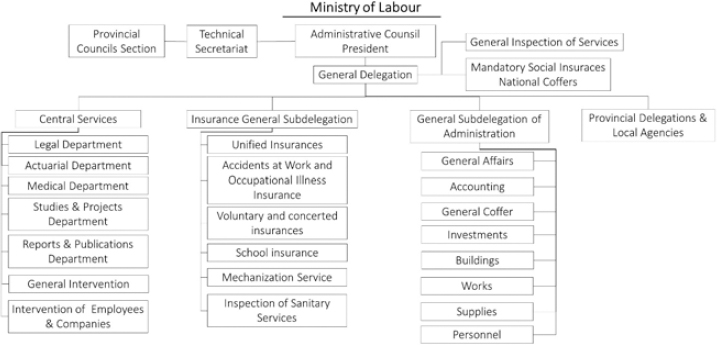
The first revision of the INP statutes since 1931 was carried out in 1958. The statutes enshrine the 1957 transitory reorganization since the central bodies remain unchanged: Council of Administration; General-Delegation; and administrative services25 (Figure 6).
INP organization chart (1958)
Citation: e-Journal of Portuguese History 21, 2 (2023) ; 10.1163/16456432-20040001
The first retained all the competencies that had been attributed to it since 1950, with the addition of knowledge of the management and functioning of the INP through periodic reports submitted to the delegate general. Its functioning – in plenary and in the Permanent Commission – remained the same. In the Permanent Commission, all functions were also maintained, in addition to the agreement to carry out investments in accordance with the annual plan, the authorization of transfers of credits from the general budgets, the examination and review of monthly accounts and the provision of information by the delegate general on the functioning of the services.26
The composition of the Council of Administration underwent some changes, consisting of the chairman, two vice-chairmen (elected among the representatives of workers and employers) and the advisory members. With a natural-born status, INP, Welfare and Labor general delegates, the technical secretary-general of the ministry, and the national delegate of unions. Appointed directly by the ministry, a representative of the ministries of Finance, Governance, Agriculture and Industry, six representatives of workers and six representatives of employers (enrolled in Compulsory Social Insurances and proposed by the OSE), two representatives of the General Medical and Pharmaceutical Councils, a representative of the provincial councils, an employee of the INP itself and ten technical members.
The general delegate, endowed with faculties of direction, management, and legal representation, was the superior head of all services, and who would exercise his action, according to Article 28 of the Statutes (in addition to INP), at the National Mandatory Social Insurances Coffers (if they were not already under the responsibility of the Council of Administration, the Permanent Commission, or the Provincial Councils).27
The main innovation concerns the INP administrative services: two general sub-delegations (Insurances and Administration) and the Central Services. Unfortunately, the statutes are silent in relation to their competences and attributions, only allowing an understanding of their organization. The central services were composed of the Legal, Actuarial, Medical, Studies and Projects, Reports and Publications departments, and by the General and Employees & Companies Interventions. The Unified Insurances Branches (the health benefits of all the insurances managed by the INP), the voluntary and concerted insurances, school and work accidents and occupational diseases, as well as the Mechanization Service and the Inspection of Health Services were dependent on the General-Subdelegate of Insurances. Lastly, under the authority of the General-Subdelegate for Administration, were the General Affairs, Accounting, General Cashier, Investments, Properties, Works, Supplies and Personnel services.
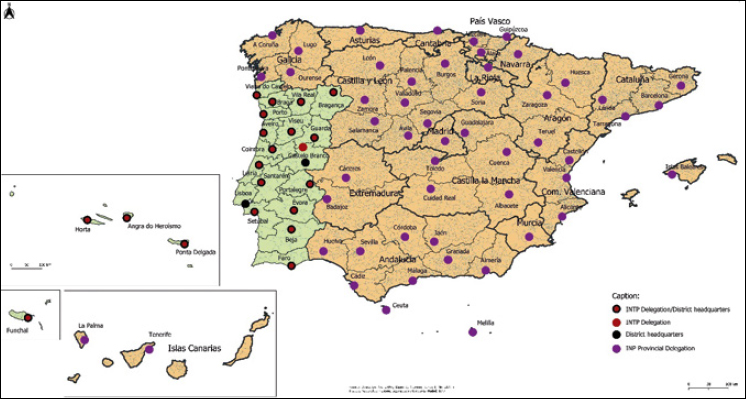
INTP district delegations and INP provincial delegations
Citation: e-Journal of Portuguese History 21, 2 (2023) ; 10.1163/16456432-20040001
5.4 Districts/Provincial Services
INTP and INP were represented throughout Portugal and Spain through district and provincial delegations, respectively, with different attributions and competencies, as a result of the functions attributed to them. The INTP district delegations were managed by private delegates equivalent to assistants (appointed by the President of the Council), who received orders and instructions from the President through the General-Secretary.28 Their competencies included: inspection and assistance to corporate bodies; propaganda of the new social order; and the protection of workers (regarding safety in the workplace, wage regime, and the work of women and minors, among others).
The 1931 Statutes of the INP, in turn, predicted the existence of Collaborating and Auxiliary Coffers (converted into branches of INP in 1939): institutions dedicated to popular insurance; savings coffers; reinsurance and co-insurers for retirement pensions; death benefit funds and mutual aid societies or provincial and municipal official charities. Their main functions were to manage and advertise INP operations, collect quotas and retirement pensions payment.29
In the 1942 INTP regulation, the competences of the delegates are vastly extended: article 141 provided for 55 duties related to the functioning of the delegation, corporate organization, labor inspection, and social welfare, with emphasis, regarding welfare, on the provision of studies, inquiries, and diligences required to prepare salaries and minimum wage projects; action to create and establish welfare and family allowance coffers; and the promotion of effective and permanent protection for workers. The latter is the only one to be retained in the 1948 regulation, which significantly reduces the delegates’ competences (to eleven).
The INP Provincial Delegations, in turn, were only reformulated in 1950, emerging the figure of the President (nominated by the General-Directorate of Welfare), representative of INP in the area of jurisdiction of the delegation and responsible for transmitting, at a higher level, the proposals and interests conveyed in the Provincial Advisory Councils,30 acting as an intermediary with, essentially, representative competencies.
The provincial delegations also had a head of service, appointed by the Administrative Council, who was responsible for their management and for inspecting INP’s activities and departments in the provinces. The 1958 revision of the statutes did not bring any fundamental changes to the INP provincial organization, consecrating it very little: the leadership was in the hands of a director (ultimately responsible for the functioning of the delegation), with technical and administrative management responsibilities.
5.5 Final Prospects
INTP and INP, although framed within corporate authoritarian regimes, differed on many points – objectives, structure, and framework. The main discrepancy, however, lies in the fact that the INTP was assigned competencies related to corporate organization and labor regulation and supervision.
The institutional framework of both is, moreover, a reflection of the corporatism of the respective regimes. In Portugal, corporate organization fell under the INTP, a body of modest dimensions, dependent on Salazar (preventing the emergence of figures able to rival his leadership). In Spain, corporate organization initially fell under the remit of the MOAS (which included the INP), also with attributions over work and welfare, closer to INTP. This was soon afterwards transformed into the Ministry of Labor, with the corporate organization being entrusted to FET y de la JONS, under Franco’s direct dependence.
The objectives of INP have not moved away from welfare, particularly compulsory social insurance and its management, assuming itself as a guarantor of Spanish workers in adversity (old age, disability, or occupational accidents), and committing itself to raising their standard of living. With INTP, the objectives are strengthened over time, culminating in the improvement of the living conditions of workers. Unlike the latter, with only the mission of developing labor and social protection laws with that goal in mind, INP was consecrated with purposes that included the development of social welfare, the organization and administration of voluntary insurance operations, or the development of a family allowance.
Thus, it is easy to conclude that, in the case of the INP, the most relevant policies were related to welfare, its only attribution, whereas for the INTP it is more difficult to point out the most prominent policies. Legislation and regulations do not allow us to determine this directly, but if we take into account the competences attributed to the delegates, one can easily see welfare was relegated to a third level: while there were only five competences in this area (two of which were of a generic nature and two related to economic housing), there were eighteen related to corporate organization and sixteen to work, suggesting that these were the most relevant policies within the INTP.
Structurally, the differences are also obvious. When comparing the organization charts in their early stages, INP shows a clear greater complexity and focus on social welfare, thanks to the system implemented in Spain (based on obligatory social insurances and managed by INP), as opposed to the Portuguese system, based on the welfare institutions of the corporate bodies and the ASM, with INTP having a supervisory role only.
This trend would continue, albeit with some evolution. At the time of the first reorganizations (in 1942 and 1945, respectively), the three sections that the INTP had in the Social Welfare and Economic Houses Repartition (besides the IPS and the actuarial services), contrasted with INP’s organization chart, demonstrating a clear sense for the management of the social welfare system on three levels, with emphasis on the national coffers and services (encompassing all existing social insurances), besides the central and special services of an administrative nature and covering various areas, an organization without parallel in the INTP.
The latest restructurings reinforce this scenario: despite a notable reform in the organization chart of the INTP, with the transformation of the Repartition into a General-Directorate, comprising two repartitions with five sections focused on the system rather than on the bodies that made it up, the INP organization chart was still much more developed and focused on the management of the Spanish social welfare system, with three sub-delegations (insurance, administration, and health services) with various sections, in addition to the general technical secretariat, strengthening the welfare aspect, but also the administration and management of the system. A comparison of the organization charts does not seem to indicate that either institute has influenced the other, with the most notable being the conversion of the INP’s collaborating coffers into delegations at a time when the INTP’s district delegations had already been in existence for six years.
The creation of the MCPS (1950) and the absorption of the INTP services (1951), would have emptied the INTP of its functions, which would have been limited to the district delegations and the publication of the Bulletin. It is important to understand, in the future, the role and existence of the INTP after the creation of the MCPS. Likewise, having analyzed the organization charts, objectives and structures of these bodies which marked the social policy of the Iberian authoritarian regimes, it will be pertinent to try and understand what practical achievements they carried out and how they were perceived by the populations who, at the outset, would be their main beneficiaries.
Acknowledgements
This work was supported by the Institute of Contemporary History, funded by National funding through FCT – Fundação para a Ciência e Tecnologia, I.P., under the scope of the projects UIDB/04209/2020, UIDP/04209/2020, and LA/P/0132/2020. Further support by FCT – SFRH/BD/136297/2018, “O Instituto Nacional do Trabalho e Previdência (INTP) e o Corporativismo Português (1933–1974): as delegações de Braga e Covilhã.
Sources & Bibliography
Sources
Decree no. 22428, April 10, 1933, Diário do Governo, no. 82.
Decree-Law no. 23053, September 23, 1933, Diário do Governo, no. 217.
Decree-Law no. 32443, November 24, 1942, Diário do Governo, no. 272.
Decree no. 32593, December 29, 1942, Diário do Governo, no. 300.
Decree-Law no. 37244, December 27, 1948, Diário do Governo, no. 299.
Decree-Law no. 37268, December 31, 1948, Diário do Governo, no. 303.
Decree of February 27, 1938, Gaceta de la Republica, no. 58.
Decree of June 24, 1938, Boletin Oficial del Estado, no. 610.
Decree of May 31, 1941, Boletin Oficial del Estado, no. 159.
Decree of December 14, 1938, Boletin Oficial del Estado, no. 363.
Decree of January 25, 1952, Boletin Oficial del Estado, no. 55.
Decree of May 22, 1953, Boletin Oficial del Estado, no. 144.
Decree of September 2, 1955, Boletin Oficial del Estado, no. 255.
Decree of October 28, 1955, Boletin Oficial del Estado, no. 325.
Decree of June 14, 1957, Boletin Oficial del Estado, no. 164.
Constitutive Law and Organic Statutes of the Instituto Nacional de Previsión, 1931.
Order of January 24, 1958 [INP Statutes], Boletin Oficial del Estado, no. 29.
Orden of September 24, 1959 [INP Statutes], Boletin Oficial del Estado, no. 231.
Anuario del Instituto Nacional de Previsión 1945. Madrid: Publicaciones del INP, 1946.
References
Amaral, D.F. do. ‘Corporativismo, Fascismos e Constituição.’ In Corporativismo, Fascismos, Estado Novo (Coimbra: Almedina, 2012), 81–98.
Amaro, A.R. ‘O modelo de previdência social do Estado Novo (1933–1962).’ In Estados autoritários e totalitários e suas representações, eds. L.R. Torgal and H. Paulo (Coimbra: Imprensa da Universidade de Coimbra, 2008), 65–79.
Barroso, S.E. ‘La evolución del gasto social público en España, 1850–2005.’ Estudios de historia económica, Banco de España (63) (2013), 5–119.
Brito, J.M.B. de. ‘Corporativismo.’ In Dicionário de História Do Estado Novo, Vol. I (Lisboa: Círculo de Leitores, 1996), 216–224.
de la Calle Velasco, M.D. ‘El Sinuoso Camino de la Política Social Española.’ História Contemporánea (17) (1998), 287–308.
Cardoso, J.L. ‘Corporativismo, Instituições Políticas e Desempenho Económico.’ In Corporativismo, Fascismos, Estado Novo (Coimbra: Almedina, 2012), 101–120.
Fernandez Riquelme, S. ‘Corporativismo y relaciones laborales en España: una historia de la organización del trabajo como sistema de Política Social.’ Cuadernos de Relaciones Laborales 29(1) (2011), 157–175.
Ferreira, F.M. and N. Pereira. ‘Propaganda e corporativização no terreno: Braga anos 30 e 40.’ In A Conquista Social Do Território. Arquitectura e Corporativismo No Estado Novo Português, eds. F.M. Ferreira, F.A. Mendes and N. Pereira (Coimbra: Tenácitas, 2016), 13–38.
Ferreira, N.E. ‘O corporativismo e as instituições do salazarismo: a Câmara Corporativa (1935–1945).’ In O Corporativismo Em Português (Lisboa: Imprensa da Ciências Sociais, 2008), 169–205.
García, F.B. ‘Corporativismo y Fascismo. Los sistemas de relaciones laborales autoritarios en la Europa de entreguerras.’ Hispania Nova: Revista de historia contemporánea (15) (2017), 45–75.
García Murcia, J. and M.A. Castro Argüelles, eds. Legislación Histórica de Previsión Social (Pamplona: Aranzadi, 2009).
Garrido, Á. ‘Contexto, fundamentos e lógicas de construção da economia nacional corporativa.’ Corporativismo, Fascismos, Estado Novo (Coimbra: Almedina, 2012), 143–164.
Garrido, Á. ‘Le corporatism de l’État Nouveau Portugais. Un débat sur l’institutionnalisation economique.’ Storicamente (11) (2015), 1–22.
Garrido, Á. Queremos Uma Economia Nova! Estado Novo e Corporativismo (Lisboa: Círculo de Leitores/Temas & Debates, 2016).
Garrido, Á. and D. Pereira. Economia Social Em Movimento. Uma História Das Organizações (Lisboa: Tinta da China, 2018).
Giménez Martínez, M.Á. ‘El sindicalismo vertical en la España franquista: principios doctrinales, estructura y desarrollo.’ Revista Mexicana de Historia del Derecho, Instituto de Investigaciones Jurídicas (31) (2015), 223–257.
González Madrid, D.A. and M. Ortiz Heras. ‘El franquismo y la construcción del Estado de Bienestar en España: la protección social del Estado (1939–1986).’ Pasado y Memoria. Revista de Historia Contemporánea (17) (2018a), 361–388.
González Madrid, D.A. and M. Ortiz Heras. ‘El franquismo y la construcción del Estado de Bienestar en España: la protección social del Estado (1939–1986).’ Pasado y Memoria. Revista de Historia Contemporánea (17) (2018b), 361–388.
Guibentif, P. ‘Segurança Social.’ In Dicionário de História de Portugal, eds. A. Barreto and M.F. Mónica (Porto: Figueirinhas, 1999).
Guillén, A.M. ‘Un siglo de previsión social en España.’ Ayer, Asociación de Historia Contemporánea (25) (1997), 151–178.
Guillén Rodriguez, A. La Construcción Política Del Sistema Sanitario Español: De La Postguerra a La Democracia (Madrid: ExLibris, 2000).
Lucena, M. de. A evolução do sistema corporativo português (Lisboa: Perspectivas & Realidades, 1976a).
Lucena, M. de. A evolução do sistema corporativo português (Lisboa: Perspectivas & Realidades, 1976b).
Lucena, M. de. ‘Previdência social.’ In Dicionário de História de Portugal, eds. A. Barreto and M.F. Mónica (Porto: Figueirinhas, 1999).
Lucena, M. de. Os Lugar-Tenentes de Salazar: Biografias (Lisboa: Alêtheia, 2015a).
Lucena, M. de. Os lugar-tenentes de Salazar: Armindo Monteiro, Pedro Theotónio Pereira, Alberto Franco Nogueira, José Gonçalo Correia de Oliveira, Adriano Moreira biografias (Lisboa: Alêtheia, 2015b).
Madrid, D.A.G. and M.O. Heras. ‘El franquismo y la construcción del Estado de Bienestar en España: la protección social del Estado (1939–1986).’ Pasado y Memoria (17) (2018), 361–388.
Marín, G. ‘Seguros sociales y confluencias doctrinales en España e Italia (1938–1944/47).’ Historia Contemporánea (61) (2019), 775–796.
Martins, F. Pedro Theotónio Pereira: o outro Delfim de Salazar (Alfragide: D. Quixote, 1a ed., 2020).
Molinero, C. ‘La política social del régimen franquista. Una asignatura pendiente de la historiografia.’ Ayer (50) (2003a), 319–331.
Molinero, C. ‘La política social del régimen franquista. Una asignatura pendiente de la historiografía.’ Ayer [Asociacion de Historia Contemporanea, Marcial Pons Ediciones de Historia] (50) (2003b), 319–331.
Murcia, J.G. and M.A.C. Argüelles, eds. Legislación histórica de previsión social (Pamplona: Aranzadi Thomson Reuters, 2009).
Patriarca, F. A Questão Social No Salazarismo, 1930–1947 (Lisboa: Imprensa Nacional, 1995).
Pereira, D. As políticas sociais em Portugal (1910–1926), Dissertação de Doutoramento (Faculdade de Ciências Sociais e Humanas, Universidade Nova de Lisboa, October 2012).
Pereira, N. ‘Nós, o Povo: as redes das Casas do Povo nos alinhamentos corporativos (1933–1974).’ Oficina do Historiador 9(2) (2016), 99–118.
Pereira, P.T. Salazar y Franco, La Política Social Ibérica (1933–1957), Ph.D. Thesis, TDX (Tesis Doctorals En Xarxa) (Universitat Autònoma de Barcelona, 11 October 2013).
Pereirinha, J.A., M. Arcanjo, and D.F. Carolo. ‘Prestações sociais no corporativismo português: a política de apoio à família no período do Estado Novo.’ (Instituto Superior de Economia e Gestão – GHES Working Paper nº 35, 2009).
Pinto, A.C. ‘O Estado Novo Português e a vaga autoritária dos anos 1930 do séc. XX.’ In O Corporativismo Em Português Estado, Política e Sociedade No Salazarismo e No Varguismo (Lisboa: Imprensa das Ciências Sociais, 2008), 24–29.
Pinto, A.C. ‘O corporativismo nas ditaduras da época do Fascismo.’ Varia Historia, graduação de História da UFMG30(52) (2014), 17–49.
Pinto, A.C. ‘Corporatism and ‘organic representation’ in European dictatorships.’ In Corporatism and Fascism. The Corporatist Wave in Europe (Londres/Nova Iorque: Routledge, 2017), 3–41.
Pires, L.A. ‘Os Grémios da Lavoura no distrito de Bragança e as funcionalidades corporativas nas comunidades rurais.’ (2020).
Recio, G.S. ‘O corporativismo na ditadura franquista.’ In A Vaga Corporativa: Corporativismo e Ditaduras Na Europa e América Latina, eds. A. Costa Pinto and F.P. Martinho (Lisboa: Imprensa das Ciências Sociais, 2016), 129–146.
Riquelme, S.F. ‘Corporativismo y relaciones laborales en España: una historia de la organización del trabajo como sistema de Política Social.’ Cuadernos de Relaciones Laborales 29(1) (2011), 157–175.
Rodrigues, C. and D. Carolo. ‘A Previdência Social.’ In Os Anos Sessenta Em Portugal. Duas Governações, Diferentes Políticas Públicas?, eds. J.M.B. de Brito and P.B. Santos (Porto: Edições Afrontamento, 2020), 147–173.
Rodrigues, C.F. ‘Previdência Social.’ In Dicionário de História Do Estado Novo, eds. J.M.B. de Brito and F. Rosas (Venda Nova: Círculo de Leitores, 1996).
Rodrigues, G.B. ‘Instituto Nacional do Trabalho e Previdência (INTP).’ In Dicionário de História de Portugal, eds. A. Barreto and M.F. Mónica (Porto: Figueirinhas, 2000).
Rollo, M.F. ‘Desmandos da Organização Corporativa e Reencontros do Corporativismo no Rescaldo da II Guerra. O Inquérito à Organização Corporativa em 1947.’ In Corporativismo, Fascismos, Estado Novo (Coimbra: Almedina, 2012), 191–227.
Rosas, F. Salazar e o poder: a arte de saber durar (Lisboa: Tinta-da-China, 1a ed., 2012a).
Rosas, F. ‘O Corporativismo enquanto regime.’ In Corporativismo, Fascismos, Estado Novo, eds. F. Rosas and Á. Garrido (Coimbra: Almedina, 2012b), 17–47.
Sancho Izquierdo, M., L. Prieto Castro, and A. Muñoz Casayús. Corporatismo. Los Movimientos Nacionales Contemporáneos. Causas y Realizaciones (Zaragoza/Granada: Editorial Imperio, 1937).
Santos, P.B. ‘O modelo político do Estado autoritário Português: A ideia corporativa na constitucionalização do regime (1931–1933).’ Espacio Tiempo y Forma. Serie V, Historia Contemporánea 0(27) (2015), 59–84.
Santos, P.B. ‘Caminhos para a estabilidade autoritária em Portugal (1933–1974).’ Aportes 93(1) (2017), 141–181.
Santos, P.B. ‘Na Gênese da Constituição Política de 1933: O Ideário Corporativo e a Estrutura Econômico-Social do Autoritarismo Português.’ Estudos Históricos (Rio de Janeiro) 31(64) (2018), 173–196.
Santos, P.B. ‘A construção autoritária do direito do trabalho em Portugal: evolução e legados.’ Revista Internacional de Direito Do Trabalho (1) (2021), 1111–1167.
Schmitter, P.C. Portugal: do autoritarismo à democracia (Lisboa: Instituto de Ciências Sociais da Universidade, 1999a).
Schmitter, P.C. Portugal: Do Autoritarismo à Democracia (Lisboa: Imprensa de Ciências Sociais, 1999b).
Táboas, D.L. ‘La extensión de los seguros sociales en el mundo rural gallego: entre el Clientelismo Político y los ecos del ‘Estado de Bienestar,’ 1940–1966.’ In Extranjeros en el pasado. Nuevos historiadores de la España contemporánea, ed. F.M. Molina Aparicio (Bilbao: Universidad del País Vasco, 2009), 157–179.
Torres, J.M. ‘O Grémio do Comércio do Concelho de Guimarães: dinâmicas corporativas, associativas e comerciais.’ Oficina do Historiador 11(2) (2018a), 159–182.
Torres, J.M. ‘As Resistências à Organização Corporativa Portuguesa: A Perspectiva Regional do Instituto Nacional do Trabalho e Previdência.’ Faces de Clio 4(18) (2018b), 101–118.
Velasco, M.D. de la C. ‘El sinuoso camino de la política social española.’ Historia contemporánea, Servicio de Publicaciones (17) (1998), 287–308.
Bionote/Nota Biográfica
Jorge Mano Torres, holds a degree and a master’s in history from the University of Minho, is currently a PhD candidate at the Faculty of Social and Human Sciences of the New University of Lisbon and an integrated researcher at the Institute of Contemporary History. He also has a PhD scholarship from the Foundation for Science and Technology.
Jorge Mano Torres, licenciado e mestre em História pela Universidade do Minho, é actualmente doutorando na Faculdade de Ciências Sociais e Humanas da Universidade Nova de Lisboa e Investigador Integrado no Instituto de História Contemporânea. É igualmente bolseiro de doutoramento da Fundação para a Ciência e a Tecnologia.
A designation that corresponded to the position of prime minister.
The corporate welfare institutions were to be autonomous, with mandatory membership, in accordance with the compulsory logic of the corporate organization of labour, although taking on a mandatory character similar to the social insurances of the republic, criticized and devalued by Estado Novo.
The ASM and the welfare institutions of the civil servants, not being related to class cooperation, would be integrally assimilated into the state social welfare, the ASM being subordinated to the SSECPS and subject to the inspection of INTP, a reflection of the will to subordinate the cooperative movement to the corporate organization (Lucena 1999).
Among the compulsory social insurances of the social welfare system introduced by Franco’s regime were: Régimen Obligatorio de Subsidios Familiares (1938); Seguro Obligatorio de Vejez (1939), replaced in 1947 by Seguro Obligatorio de Vejez e Invalidez; and Seguro Obligatorio de Enfermedad (1942).
The “family allowance,” whose social benefits had a derisory value, was intended to protect the family institution itself and not the most socially disadvantaged families, since the aid offered was equal for all workers and its value was proportional to the number of children.
Decree-Law no. 23 053, September 23, 1933, chapter I, art. 3, Diário do Governo, no. 217.
Decree-Law no. 23 053, September 23, 1933, chapter I, art. 2, Diário do Governo, no. 217.
Social welfare guaranteed workers security in the event of misfortune, affirming the growth of various insurances (old age, disability, maternity, work accidents, occupational diseases, tuberculosis, and involuntary unemployment), with a tendency towards total insurance.
Decree no. 37 268, December 31, 1948, Title I, art. 2, Diário do Governo, no. 303.
Workers are recognized by the state, a guarantee of support in the event of misfortune and the right to assistance in the contingencies indicated in Declaration X of FdT.
Order of January 24, 1958, art. 2, Boletin Oficial del Estado no. 29.
Reporting directly to the President, SAS had the competence to study and solve problems related to work or welfare, as well as to develop and guide the corporate organization (DL 23 053, Chapter II, art. 5).
The twelve members included one freely nominated, another proposed by the Minister of Hacienda and a representative of Social Medicine, proposed by the Home Office. One of the members was proposed by FET y de la JONS and six were elected from among the production factors, at the proposal of the OSE. Two members were proposed by the Minister from among the directors of the Cajas Colaboradoras and the last two were proposed by the National Committee of Social Welfare.
Decree of July 11, 1950, art. 5, Boletin Oficial del Estado, no. 199.
Ibidem, art. 10.
Ibidem, art. 15.
Ibidem, art. 19.
Decree no. 32 593, December 29, 1942, chapter II, section II, subsection III, art. 38, Diário do Governo, no. 300.
Ibidem, chapter II, section II, subsection III, art. 40; 42; e 45.
Ibidem, chapter II, section IV, subsection III.
Decree no. 37 268, December 31, 1948, Title I, art. 4, Diário do Governo, no. 303.
With markedly bureaucratic competences, they acted, respectively, at the legal level and in the application of financial operations associated with social insurances [Decree no. 37 268, Chapters III–IV].
Decree no. 37 268, Title IV, Chapter II, arts. 48 and 49.
Ibidem, arts. 50, 51 and 52.
Estatutos del Instituto Nacional de Previsión (1958), Chapter II, art. 14.
Ibidem, Chapter II, arts. 25 and 26.
Ibidem, Chapter II, art. 33.
Decree-Law no. 23 053, Chapter III, Diário do Governo, no. 217.
Estatutos (1922), Chapter V, arts. 56 and 57.
Advisory and information body to the INP and its Council of Administration in the provinces, transmitting the proposals/requests of workers and companies represented therein, made up of members representing various entities (July 11, 1950, Decree, art. 38).