Abstract
Awareness of horse welfare is increasing worldwide. Understanding of how lay people and riders, and especially young adults, perceive interactions with horses is important for maintaining the social licence to operate of equestrian sports and to be anticipative. This study examined the views of young lay people and equestrians in Sweden towards dressage, show-jumping and three-day eventing. The hypothesis was that views would differ between groups of lay people and equestrians, but that most would describe equestrian sports in positive or neutral terms. In a cross-sectional study design, 18 focus group interviews were conducted with three categories of participants (age 18-25 years): six groups of competition riders, six groups of leisure riders, and six groups of lay people (5-8 people/group). Open-ended questions were used, and each group was interviewed for 40-60 minutes. Qualitative content analysis was performed on the responses, and codes were developed using both a deductive and an inductive approach. Procedure GLIMMIX was used to analyse differences in the number of times a code was mentioned. Forty-two codes were identified. The most commonly raised codes, irrespective of category, were mental well-being of humans (54), lack of time in life (49), mental distress (47), hard workers (45), lack of knowledge (43), responsibility (42) and horse welfare issues related to the rider (39). Groups of lay people talked less about the codes ‘mental distress’ (
1 Introduction
Within the equestrian community, use of horses for sport has high acceptance (FEI, 2022), but awareness of horse welfare is increasing worldwide, leading to the public possibly questioning the use of horses on human terms if there are perceived welfare issues (Douglas et al., 2022; McGreevy et al., 2008). The social licence to operate (SLO) is based on acceptance of practices and operating procedures by the public, including equestrians (Boutilier and Thomson, 2011; Morrison, 2014). Social licence is earned through transparency and sustainable development (Boutilier and Thomson, 2011) and may change over time with changes in public opinion and with the emergence of new knowledge (Boutilier and Thomson, 2011; Hampton et al., 2020). Future changes in societal views on animal husbandry and in public acceptance of activities performed with animals will affect equestrian sports, including training, housing, feeding and caring regimes. Future riders may depend on today’s equestrians to uphold the integrity and acceptance of the sports (Douglas et al., 2022; Wolframm et al., 2023). The sustainability of equestrian sports may be dependent on their ability to evolve and adopting a holistic, evidence-based approach to both welfare and ethics of equestrianism (Douglas et al. 2022). Credibility and trust are the foundation for sustainable development of the sport (Boutilier and Thomson, 2011). If society accepts and respects equestrian sports, it will be possible to continue to ride, train and compete with horses.
According to Douglas et al. (2022), SLO should be founded on evidence-based policies and rules and, even better, on shared values. Equestrian sports must have values in line with the public’s expectations of equestrian interactions with the horse. Perceptions of lay people, and of equestrians, on interactions with horses are important for SLO. Sweden is the second most horse-dense country in Europe (Svenska Ridsportförbundet, 2023) and it has been suggested that 30% of the Swedes are in contact with horses in some way (KSLA, 2012). Around half a million people in Sweden currently engage in equestrian sport, which is the largest girls’ sport and third largest youth sport in the country (Svenska Ridsportförbundet, 2023). There are about 500 horse-riding schools for leisure riding and these schools have been subsidized with public means for decades (Hedenborg et al. 2021). Altogether, this indicates that the social license for equestrian sports have few concerns in Sweden but since it is discussed worldwide, it is important to be attentive. The aim of this study was therefore to examine the views of young lay people and equestrians in Sweden regarding three equestrian sports: dressage, show-jumping and three-day eventing. The hypothesis tested was that equestrian sports would be describe in positive or neutral terms but that there might be some differences in views between lay people and equestrians.
2 Materials and methods
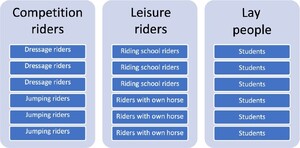
A cross-sectional study was performed based on focus group interviews with three categories of participants aged 18-25 years (born 1995-2002). All interviews were conducted in Swedish. In total, 18 focus group interviews were held: six groups with people identifying themselves as competition riders (with professional engagement), six groups with people identifying themselves as leisure riders (non-professional engagement) and six groups with lay people (Figure 1, 5-8 people/group, number of people in total = 28, 33 and 39, respectively). The six groups of competition riders included three subgroups of dressage riders and three subgroups of show-jumping riders. In the latter groups, there were a few riders who primarily identified themselves as eventing riders, but also competed in show-jumping. The groups of leisure riders consisted of three subgroups of riders attending a riding school and three subgroups of riders owning or borrowing their own horse (Figure 1). Lay people were students in sectors other than the green sector, except in one group where two students were from a polytechnic in the green sector. The green sector was defined as schools in the fields of forestry, horticulture, animals, food or gardening. The participants in the group of lay people identified themselves as ‘non-horse people’ and did not have any contact with horses on a daily basis. The selection process for competition and leisure riders as well as lay people was based on a strategic selection using contact persons (trainer, stable manager, teacher or the like). The interview groups for all categories were formed after participants had been asked in person and recruited by the contact persons. Every contact person had to ask approximately six to eight people to be able to form an interview group of five. Thereafter, they were contacted by email, given information about the interviews, and asked to fill in the background survey and consent to participate. Participation was completely without an incentive. The process of selecting the participants is further described in Supplementary Material SM2.

Categories (competition and leisure riders and lay people) and groups (6 groups/category). Each group consisted of 5-8 people, aged 18-25 years.
Citation: Comparative Exercise Physiology 21, 5 (2025) ; 10.1163/17552559-bja10063
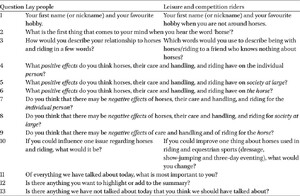
The interviews were conducted with open-ended questions (Table 1) and the design and questions had been evaluated on other people prior to the study (see below) A short background questionnaire was used to collect basic information about the participants (Supplementary Material SM3). Interviews with seven groups of competition and leisure riders (six leisure rider groups and one competition rider groups) were conducted during physical meetings in the riders’ home stable environment in early 2020. The stable environment was chosen to facilitate the riders’ possibility to participate in the study. Due to the outbreak of Covid-19, the remaining interviews (six with lay people groups, 5 with leisure rider groups) were conducted as digital interviews.
Set of open-ended questions used in group interviews with lay people and riders
Citation: Comparative Exercise Physiology 21, 5 (2025) ; 10.1163/17552559-bja10063
The participants were provided with information about the aim of the study and participation requirements via an invitation. Those who participated in a physical meeting signed a consent form, and the digital participants were able to express their consent in the background questionnaire. The participants were informed that participation was confidential. In compliance with the GDPR, the contact details were not saved.
Interviews
Each group was interviewed for 40-60 minutes by one consistent interviewer. The interviewer had equestrian background but approached the interviews as an observer and intervened only if the participants spoke outside the topic, for example about horses that are used for other than show jumping, dressage or three-day-eventing. The interviews were performed inspired by Krueger and Casey (2014) with open-ended questions, and including opening, main and closing questions. The main questions on positive and negative effects of equestrian sports (questions 4-9 in Table 1) were the same for groups of both riders and lay people. An even sample of positive and negative questions were used. Three of the opening and closing questions were adapted to be relevant for lay people and both categories of riders, respectively. The initial plan was to report responses to the main questions only, but it turned out that some of the other questions gave interesting answers. Three short opening questions (questions 1-3 in Table 1) gave all participants the opportunity to speak directly (results only presented for question 2, for further details, see Supplementary Materials SM4). The interview was ended with four closing questions (questions 10-13 in Table 1), but only sporadic answers and discussions were obtained for three of these questions (11-13) and therefore these results were omitted from the analysis. For question 10, the results were presented (for further details, see Supplementary Materials SM5).
Pre evaluation of the questionnaire and interview design
The questionnaire questions were tested in four rounds, on other respondents than recruited for the interviews. In round 1, the questions were answered in writing by riders at different levels of education (from primary school, 1st-9th grade, to university) and riding experience (from hobby level to advanced level) (n = 8) and by lay people with different levels of education (from primary school to university) (n = 5). In round 2, riders and lay people from round 1 were randomly selected (riders n = 3, lay people n = 3) and interviewed about their experience of the survey. In round 3, slightly modified questions were evaluated in six individual interviews with new respondents. The respondents were riders of different ages and levels of education (from primary school to university) and riding experience (from hobby level to advanced level). In round 4, the questions were evaluated in group interviews with 5-8 participants (two groups of riders, one group of lay people). A background questionnaire with questions about background, demography, etc., was tested on all participants in all rounds.
Data collection
All interviews were carried out during February to December 2020. The physical interviews were recorded with a dictaphone (model H2N Handy Recorder), equipped with an SD memory card. The digital interviews were recorded directly in the cloud-based video conferencing service Zoom (Zoom Communications, Inc., San Jose, CA, USA), and a back-up recording was made with the dictaphone referred to above. Two interviews, one physical and one digital, were rejected due to poor sound quality and new interviews were conducted with two other groups.
A form containing the background questions was created using the cloud service Google Docs and distributed via a link that could be opened on a computer, tablet or mobile phone.
Data processing and qualitative content analysis
The interviews were transcribed verbatim. For analysis of responses to the main questions (4-9) and questions 2 and 10, QSR International’s NVivo 12 PRO qualitative data analysis Software (QSR International Pty Ltd., Version 12 PRO, 2021) was used. Codes were identified both deductively and inductively (Graebner et al., 2012; Skjott Linneberg and Korsgaard, 2019). Qualitative content analysis (Graneheim and Lundman, 2004; Kvale and Brinkman 2009) of the transcripts began after the 13th focus group interview. The codes ‘horse welfare related to the rider’, ‘unsatisfied natural needs’, ‘responsibility’ and ‘youth recreation center and sanctuary’ were identified based on previous research (the two former based on Uldahl and Clayton, 2018; Horseman et al., 2015; Dubois et al., 2018a; the two latter based on Forsberg, 2012). Codes were developed with both a deductive and an inductive approach (Graebner et al., 2012; Skjott Linneberg and Korsgaard, 2019). Qualitative content analysis (Graneheim and Lundman, 2004; Kvale and Brinkman, 2009) of the transcripts began after the 13th focus group interview. In accordance with an inductive approach, other codes emerged during the analysis. Depending on what the respondents talked about, new codes were identified. Throughout the first cycle coding, where descriptive coding was used, the descriptive segments evolved from phrases to more distinct codes (Skjott Linneberg and Korsgaard, 2019). The second cycle coding was carried out with pattern coding codes (Skjott Linneberg and Korsgaard, 2019). Pattern coding was a logical consequence of descriptive coding and patterns became themes (Skjott Linneberg and Korsgaard, 2019). Coding was performed by the same person who attended the interviews.
Statistical analysis
To analyse differences in the number of times a code was mentioned in the interviews, Poisson regression was used (procedure GLIMMIX in Statistical Analysis Systems package 9.4 (SAS Institute Inc., Cary, NC, USA). To account for overdispersion, residual variance was estimated separately, using the random residual statement. The model included fixed effects of categories of participants (lay people, leisure riders, competition riders), codes and the interaction between category of participant and code, with group as random effect. The type III test of fixed effects and information on generalized chi-square/DF are shown in Supplementary Materials SM6. Differences were considered significant at
3 Results
Demographics and backgrounds of participants
The competition riders were 93% (n = 26) women and 7% (n = 2) men and the leisure riders were 97% (n = 32) women and 3% (n = 1) men, which is representative for the gender demographics in the sport (Svenska Ridsportförbundet, 2023). The lay people were 56% (n = 22) men and 44% (n = 17) women. Among competition and leisure riders, 57.1 and 45.5%, respectively, reported having worked professionally with horses for up to 5 years, 10.7 and 21.2 % for 6-10 years, and 32.1 and 33.3%, respectively, had not worked with horses. Participants were mainly from the south and central Sweden (for further details see Supplementary Material SM 1).
Responses and codes
A total of 42 codes were identified from the main questions, but six of these had too many zero values to run the analysis and were therefore excluded (Table 2). Groups of lay people talked less (
Number of times (and in number of groups) a code was mentioned in focus group interviews with lay people, leisure and competitions riders, respectively1,2
Citation: Comparative Exercise Physiology 21, 5 (2025) ; 10.1163/17552559-bja10063
Groups of leisure riders talked more about ‘shortcomings in turnout’ than competition riders (
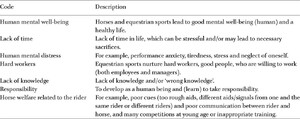
The most discussed codes (in total, irrespective of participant category) were human mental well-being (n = 54), lack of time (n = 49), human mental distress (n = 47), hard workers (n = 45), lack of knowledge (n = 43), responsibility (n = 42) and welfare related to the rider (n = 39) (Table 3).
The most frequently discussed codes (in total, irrespective of participant category)
Citation: Comparative Exercise Physiology 21, 5 (2025) ; 10.1163/17552559-bja10063
4 Discussion
Overall, there were only minor differences in views between young adult lay people and young adult leisure and competition riders, and most of the groups had a positive view of equestrian sports. Thus, the starting hypothesis that there would be an overall positive view but some differences, was supported. The two major findings were that groups of lay people talked less about ‘human mental distress’ and ‘horse welfare related to the rider’ than groups of leisure riders. The discussions among leisure riders about ‘human mental distress’ predominantly related to performance anxiety and bullying. The discussions were although mostly in a positive context and the code ‘human mental well-being’ was the most frequently discussed and referred to both handling and riding horses and spending time in the stable. Lay people’s perception about riders, when counted in soft values, was that this group has good quality of life, with high psychological well-being. In general, the results indicated that equestrian sports may have high acceptance among young adult lay people in relation to the welfare perspective for both humans and horses.
Groups of both rider categories talked about the stable as a sanctuary, where one can be oneself. Participants in a study by Malchrowicz-Mośko et al. (2020) also pointed out the positive effect of equestrian sports on mental health, and they suggested that this might be an effect of the relationship with an animal. Activities with horses and dogs outdoors and in nature are generally a source of wellbeing, enjoyment and self-confidence (Schwarzmüller-Erber et al., 2020). The fact that the most mentioned code, ‘human mental well-being’ was closely followed by ‘mental distress’ might be explained by the complexity of equestrian activities (sport and hobby), which are often seen as a lifestyle by practitioners. Another significant finding of this study was that groups of leisure riders talked more about ‘human mental distress’ than groups competition riders. It was mentioned that their positive traits, could change to negative traits, e.g. they might work too many hours and judge themselves too harshly, instead of working hard and being enterprising and struggling. Riders also talked about lack of time and external or internal expectations about spending time with family and friends, and that people around them considered themselves affected by the riders’ lack of time. Horses and riding as a hobby were also mentioned as time-consuming by some lay people.
The fourth significant finding of this study was a difference in the mentioning of shortcomings in turnout, where groups of leisure riders mentioned this more than groups of both lay people and competition riders. Turnout was a key question when discussing horse welfare and both rider categories talked about muddy fields, better and/or larger fields or paddocks, and more hours in the field or paddock. Both rider categories also mentioned the risk of injury. Similarly, the greatest concern among interviewees in Horseman et al. (2016) was inappropriate turnout. Also, Furtado et al. (2021) discussed the importance of looking at how horses live their lives outside the indoor arena, i.e. ‘the other 23 hours’. A statement mentioned in groups of both competition and leisure riders in our study, was that horses must be allowed to ‘be horses’, and they mentioned horses’ needs, i.e. feeding, housing, caretaking and exercise. In several groups of lay people it the importance of meeting the natural needs of horses was also mentioned, for example grazing with conspecifics. Some riders mentioned that horses need to be taken care of by humans, and that horses like exercise and the bond between human and horse. The question of whether horses should be ridden or not arose within some of the groups in all three participant categories. The question ‘what’s in it for the horse?’ was engaging, and the participants had discussions about interactions with horses (i.e. riding). The riders discussed this from a practical perspective, formulating ideas about when and how riders engage with their horses. In groups of lay people, human-horse interactions were viewed from a more ethical and philosophical perspective. In these groups it was also mentioned that horses (and the bond human horse) belong to Swedish culture, history and society and some envisaged a picture of horses on a field, often with a red cottage next to the field. A difference in perspectives between riders and lay groups also glimpsed in the response to question 2 (What is your first thought when you hear the word horse?). The initial response were the same irrespective of category, and was ‘a horse’. However, the context differed and both competition and leisure riders talked about ‘a horse’ or just ‘horse’ in the context of ‘human well-being – ride – my horse – stable – life/lifestyle’, while lay people talked about ‘a horse’ in terms of an example of an animal (Supplementary Materials SM4).
The code ‘horse welfare related to the rider’ included issues such as use of the cues, communication between rider and horse, too many competitions at a young age and inappropriate training. Cues in this context were considered too rough aids and different aids/signals from one and the same rider or different riders. Several of the respondents in Horseman et al. (2016) considered inappropriate use of training aids (e.g. whips) to be a problem for horse welfare and the use of spurs and whips was also mentioned in groups of lay people in the present study. In groups of competition riders, people talked about competitions and how it might affect horse welfare, for example how horses are prepared for competitions and how riders ride during competitions. Both categories of riders mentioned that it is important to choose some competitions, especially for the young horse, and not to compete as much as possible. In groups of leisure riders, some concern about negative humanisation of horses and the overuse of rugs was expressed. The use of the ‘Five Freedoms’ model (i.e. freedom from hunger, pain, discomfort, fear and the freedom to behave normally) as a welfare framework for equestrian sports has been discussed earlier (Campbell, 2016) and the mental state of horses in training and sport (Mellor et al., 2020, within the Five Domains Model).
All three participant categories mentioned acquiring knowledge and spreading knowledge among the two most important issues during discussions in relation to question 10 (‘what would you change/improve’). A type of owner’s licence for owning a horse was mentioned by all three categories. Lack of knowledge was also mentioned during other discussions, for example when injuries, rough or plainly bad riding were discussed. There were also some discussions about where to find ‘the right’ knowledge and who has the mandate to decide which knowledge is most applicable. This is in line with conclusions from a study in Canada by Dubois et al. (2018b) that it is important to help industry members and interested parties to improve their daily routines regarding care and management to enhance the overall equine welfare. Horseman et al. (2016) found that lack of knowledge and financial constraints were perceived barriers to horse welfare in the UK, as did the respondents in Furtado et al. (2021), who pointed out that it might not be as important to improve competition practices as improving the general management and training of horses. In another study in which participants ranked perceived challenges for horse welfare, education was ranked second, after health (out of 68 welfare challenges) (Butler et al., 2019). ‘Lack of knowledgeable experienced staff’ and ‘bad trainers or incompetent trainers’ were perceived as challenges and the participants in this study also suggested a kind of examination for horse owners to ensure a minimum level of knowledge. Concern about inadequate knowledge level of riders was also identified by Marlin et al. (2018) in a study where the Dunning-Kruger effect was found since riders overestimated their knowledge and showed over-confidence. Moreover, the importance of knowledge for the maintenance of the SLO has been emphasised by Douglas et al. (2022). They promoted adopting a holistic, evidence-based approach to the assessment of equine welfare and the ethics of equestrianism, as well as engaging and communicating with stakeholders.
At the time for the interviews, SLO for equestrian sports was maintained within the Swedish society in general. A recent report by the FEI Equine Ethics and Wellbeing Commission (FEI, 2022) about views on equestrian sports also concluded that Sweden as a country has few concerns among lay people about using horses in sports and for leisure, while this was the fourth most important concern among Swedish equestrian interested parties. This is also supported by the discussions of the groups of young adult lay people in the present study. Given that lay people are not sufficiently aware of issues related to the rider or experiences of mental distress amongst riders, it is important for all equestrian interested parties to co-operate to improve both human and horse welfare, and to agree on a sustainable strategy to retain the SLO. Groups of lay people, competition and leisure riders all mentioned perceived negative effects on horses, but their overall perception was positive. This trust in equestrianism is a good starting point to strengthen the SLO of equestrianism. It is important that future research will include both expertise from the horse industry and academia in the work to maintain and strengthen the horse industry’s SLO (Douglas et al., 2022;Williams and Marlin, 2020).
Choice of method
In this study, focus group interviews based on open-ended questions were chosen to get as honest and spontaneous answers as possible (Graebner et al., 2012; Krueger and Casey, 2014; Wenemark, 2017; Wibeck, 2010). The open-ended questions were formulated to cover topics that were not directly listed, but emerged from the participants themselves during the interviews. The main interest was horse welfare and social license to operate, and to be as neutral as possible, an even sample of positive and negative questions were chosen. The answers are therefore both from a horse and a human perspective. Thorough preparation and choice of appropriate questions are crucial for the quality of qualitative studies with focus groups (Krueger and Casey, 2014; Wenemark, 2017; Wibeck, 2010). Therefore, thorough work was performed when formulating the questions in order to inspire off-topic discussions and when conducting test interviews (pre-evaluation, rounds 1-4) to analyse whether or not the questions reached set goals. The focus group format may help respondents begin discussing and to come up with answers to questions not actually asked (Krueger and Casey, 2014; Wenemark, 2017; Wibeck, 2010). Focus group discussions may therefore have made it easier for the lay participants in this study to answer questions on an unfamiliar topic.
Limitations
This study involves a small number of people (in total) and to what extent it reflects the public can be questioned. However, the results align with the report of FEI (2022), which concluded that there are few concerns among lay people in Sweden about using horses in sports and for leisure. However, in our study as well as FEI’s, data collection was performed in the early 2020’s, and attitudes might have changed. Follow up studies would there be of relevance. To what extent our data reflects views on, and within, other equestrian communities in Sweden can only be speculated upon. However, there is an ongoing debate about how heavy riders of the relatively small Icelandic horse can be. Anecdotal observations by us indicate that this debate is most active between different equestrian communities and not (yet) a concern of the public.
A strength with focus group interviews is that it enables an in-depth investigation of participants’ attitudes, beliefs and feelings, but on the other hand, the method involves the risk that individuals with strong opinions dominate the conversation. The fact that seven of the focus group interviews were conducted during physical meetings and 11 in digital meetings (including all lay people groups) could also have affected the results, e.g. some respondents might have found it easier to talk during a physical meeting than a virtual meeting, or vice versa. All participants were young adults, which may limit the relevance of the study to the entire population. However, the thought was to include the young adults who represent the future people in power to examine their view of equestrian sports. The gender imbalance of the study (both categories with riders were mostly women) is representative for the equestrian society in Sweden (Svenska Ridsportförbundet, 2023) and the results are therefore relevant from that perspective.
5 Conclusions
We conclude that there were only minor differences in views between groups of lay people and riders, and overall, all groups described equestrian sports in neutral or positive terms. Thus, there appeared to be acceptance for equestrian sports among young adult lay participants in relation to the welfare perspective (both human and horse welfare), although some negative thoughts were expressed. Both lay people and riders mentioned positive effects of equestrian sports for human mental and physical health but also mentioned the need for life balance in this lifestyle sport. The importance of evidence-based knowledge and meeting the natural needs of horses was mentioned by groups of both riders and lay people.
Corresponding author; e-mail: nina.kansala@slu.se
Acknowledgements
Thanks to Lövsta Stuteri AB who made this study possible by supporting PhD studies for Nina Känsälä. Thanks also to Claudia von Brömssen, for help with the statistical analysis, to Ylva Naeve, for reading and commenting on the manuscript and to Mary McAfee for proof reading.
Authors’ contribution
Conceptualization and methodology, NK, SH, KK, JJ and AJ; data collection, NK; software, NK and AJ; validation, NK; formal analysis, NK; writing-original draft preparation, NK and AJ; writing- review and editing, all authors; supervision, AJ and SH. All authors have read and agreed to the published version of the manuscript.
Conflict of interest
The authors declare no conflict of interest.
Data availability
Data is available upon reasonable request from the corresponding author.
References
Boutilier, R.G. and Thomson, I., 2011. Modelling and measuring the social license to operate: fruits of a dialogue between theory and practice. Available at: https://socialicense.com/publications.html [23-03-05].
Butler, D., Valenchon, M., Annan, R., Whay, R.H. and Mullan, S., 2019. Living the ‘Best Life’ or ‘One Size Fits All’ – Stakeholder perceptions of racehorse welfare. Animals 9: 134. https://doi.org/10.3390/ani9040134
Campbell, M.L.H., 2016. Freedoms and frameworks: How we think about the welfare of competition horses. Equine Veterinary Journal 48: 540-542. https://doi.org/10.1111/evj.12598
Dalarna University, 2023. Hästnäringen i siffror. Available at: https://hastnaringen-i-siffror.se/
Douglas, J., Owers, R. and Campbell, M.L.H., 2022. Social license to operate: What can equestrian sports learn from other industries? Animals 12: 1987. https://doi.org/10.3390/ani12151987
DuBois, C., Nakonechny, L., Derisoud, E. and Merkies, K., 2018a. Examining Canadian equine industry participants’ perceptions of horses and their welfare. Animals 8: 201. https://doi.org/10.3390/ani8110201
DuBois, C., Hambly Odame, H., Haley, D.B. and Merkies, K., 2018b. An exploration of industry expert perception of Canadian equine welfare using a modified Delphi technique. PLoS ONE 13: e0201363. https://doi.org/10.1371/journal.pone.0201363
Fédération Équestre Internationale (FEI), 2022. Equine Ethics and Wellbeing Commission survey about equestrian stakeholders and public view of equestrian sports. Available at: https://equinewellbeing.fei.org/assets/documents/Results%20of%20Equestrian%20Survey%20%E2%80%93%20Equine%20Ethics%20and%20Wellbeing%20Commission%20Report%202022.pdf.
Forsberg, L., 2012. Manegen är krattad: Om flickors och kvinnors företagsamhet i hästrelaterade verksamheter. Doctoral thesis. Luleå University of Technology. Available at: https://www.diva-portal.org/smash/record.jsf?pid=diva2%3A991072anddswid=-4552
Furtado, T., Preshaw, L., Hockenhull, J., Wathan, J., Douglas, J., Horseman, S., Smith, R., Pollard, D., Pinchbeck, G., Rogers, J. and Hall, C., 2021. How happy are equine athletes? Stakeholder perceptions of equine welfare issues associated with equestrian sport. Animals 11: 3228. https://doi.org/10.3390/ani11113228
Graebner, M.E., Martin, J.A. and Roundy, P.T., 2012. Qualitative data: Cooking without a recipe. Strategic Organization 10: 276-284. https://doi.org/10.1177/1476127012452821
Graneheim, U.H. and Lundman, B., 2004. Qualitative content analysis in nursing research: concepts, procedures and measures to achieve trustworthiness. Nurse Education Today 24: 105-112. https://doi.org/10.1016/j.nedt.2003.10.001
Hampton, J.O., Jones, B. and McGreevy, P.D., 2020. Social license and animal welfare: Developments from the past decade in Australia. Animals 10: 2237. https://doi.org/10.3390/ani10122237
Hedenborg, S., Torell Palmquist, G. and Rosén, A., 2021. The emergence of the Swedish horse-riding school from the mid-twentieth century. International Journal of the History of Sport 38: 607-630. https://doi.org/10.1080/09523367.2021.1959321
Horseman, S.V., Buller, H., Mullan, S. and Whay, H.R., 2016. Current welfare problems facing horses in Great Britain as identified by equine stakeholders. PLoS ONE 11: e0160269. https://doi.org/10.1371/journal.pone.0160269
Krueger, R.A. and Casey, M.A., 2014. Focus groups a practical guide for applied research 5th Edition. SAGE Publications Inc., New York, NY, USA.
Kungliga Skogs- och Lantbruks Akademien (KSLA), 2012. Kungliga skogs- och lantbruksakademiens tidskrift 151 (5). Available at: https://www.ksla.se/wp-content/uploads/2012/06/KSLAT-5-2012-H%C3%A4sten-i-centrum1.pdf
Kvale, S. and Brinkmann, S., 2009. Den kvalitativa forskningsintervjun. Studentlitteratur AB, Lund, Sweden.
Malchrowicz-Mośko, E., Wieliński, D. and Adamczewska, K., 2020. Perceived benefits for mental and physical health and barriers to horseback riding participation. The analysis among professional and amateur athletes. International Journal of Environmental Research Public Health 17: 3736. https://doi.org/10.3390/ijerph17103736
Marlin, D., Pal, L., Randle, H. and Williams, J., 2018. Do equestrians have insight into their equine-related knowledge (or lack of knowledge)? In: Proceedings of the International Society for Equitation Science, Rome, Italy, Sept 21-14, 66. Available at: https://researchoutput.csu.edu.au/en/publications/do-equestrians-have-insight-into-their-equine-related-knowledge-o
McGreevy, P., Berger, J., De Brauwere, N., Doherty, O., Harrison, A., Fiedler, J., Jones, C., McDonnell, S., McLean, A., Nakonechny, L., Nicol, C., Preshaw, L., Thomson, P., Tzioumis, V., Webster, J., Wolfensohn, S., Yeates, J. and Jones, B., 2008. Using the five domains model to assess the adverse impacts of husbandry, veterinary, and equitation interventions on horse welfare. Animals 8: 41. https://doi.org/10.3390/ani8030041
Mellor, D.J., Beausoleil, N.J., Littlewood, K.E., McLean, A.N., McGreevy, P.D., Jones, B. and Wilkins, C., 2020. The 2020 five domains model: Including human-animal interactions in assessments of animal welfare. Animals 10: 1870. https://doi.org/10.3390/ani10101870
Morrison, J., 2014. The social license: How to keep your organization legitimate. Palgrave Macmillan, London, UK, pp. 12-28. https://doi.org/10.1057/9781137370723
Schwarzmüller-Erber, G., Stummer, H., Maier, M. and Kundi, M., 2020. Nature relatedness of recreational horseback riders and its association with mood and wellbeing. International Journal of Environmental Research and Public Health 17: 4136. https://doi.org/10.3390/ijerph17114136
Skjott Linneberg, M. and Korsgaard, S., 2019. Coding qualitative data: a synthesis guiding the novice. Qualitative Research Journal 19: 259-270. https://doi.org/10.1108/QRJ-12-2018-0012
Svenska Ridsportförbundet, 2023. Statistik. Available at: https://ridsport.se/om-oss/statistik
Uldahl, M. and Clayton, H., 2018. Lesions associated with the use of bits, nosebands, spurs and whips in Danish competition horses. Equine Veterinary Journal 51: 154-162. https://doi.org/10.1111/evj.12827
Wenemark, M., 2017. Enkätmetodik med respondenten i fokus. Studentlitteratur, Lund, Sverige.
Wibeck, V., 2010. Fokusgrupper: om fokuserade gruppintervjuer som undersökningsmetod. Studentlitteratur, Lund, Sverige.
Williams, J. and Marlin, D., 2020. Foreword – Emerging issues in equestrian practice. Comparative Exercise Physiology 16: 1-4. https://doi.org/10.3920/CEP20x001
Wolframm, I.A., Douglas, J. and Pearson, G., 2023. Changing hearts and minds in the equestrian world one behaviour at a time. Animals 13: 748. https://doi.org/10.3390/ani13040748