Abstract
Many horse breeds are used for a variety of tasks and studies have shown within breed variations in conformation depending on the task. The Icelandic horse is used for several tasks, e.g. leisure riding, competitions and tour riding. Research about conformation and relationship to subjectively assessed performance (usability) in Icelandic horses used by tourist companies and riding schools (TRh) are lacking. Back condition score has been shown to be associated with weight carrying capacity in the breed. However, the association between back condition score and angle and performance in Icelandic horses participating in a breed evaluation field test (BEFTh) and usability in TRh has not been investigated previously. The aim of the study was to compare body measurements in BEFTh and TRh and examine the relationship with riding ability in BEFTh and usability in TRh. Data of height at withers, back and croup, body condition score (BCS) and back angle were collected in 48 BEFTh (age 8 ± 2 years) and 65 TRh (age 14 ± 5 years). Transversal back angle at the 18th thoracic vertebra was determined using a flexible curve ruler. A questionnaire was used to evaluate the relationship between body measurements and owners’ assessment of usability in TRh. The relationship between back condition score and angle and riding ability was evaluated in BEFTh. Compared with TRh, BEFTh had a greater difference between height at withers and height at back and croup, lower BCS and greater back angle (
1 Introduction
Many horse breeds, such as the American Quarter Horse and Swedish Warmblood are used for a variety of tasks, and studies show that there are within breed variations in conformation depending on the task (Holmström et al., 1990; Meira et al., 2013). For example, Swedish Warmbloods used at riding schools have been shown to have a lower height at withers than elite showjumpers of the same breed (Holmström et al., 1990). The Icelandic horse is also a multipurpose breed and it is used for several tasks, e.g. leisure riding, gait competitions, pace races and long-distance trekking tours, but there are no studies investigating a possible variation in conformation related to the use and the importance for performance. Knowledge about the influence of body measurements on performance can be of great relevance when selecting horses for a specific purpose, and thereby for animal welfare, equestrian business economics and breeding. However, in a study by Kristjansson et al. (2016) on Icelandic horses, the performance in a breed evaluation field test (BEFT) was affected by body format (relationship between body length and height at withers). A square body format was ideal for performance in tölt and a rectangular body format was ideal for pace, indicating that there might be variations in conformation depending on the task, also in Icelandic horses.
Weight carrying capacity is important in riding horses and the capacity seems to be associated with back shape (Powell et al., 2008; Stefánsdóttir et al., 2017). In the study by Powell et al. (2008), a negative correlation was found between loin width and muscle soreness after weight carrying in light riding horses. In another study, Icelandic horses with a higher body condition score (BCS) of the back (i.e. broader) were able to carry more weight before they reached the lactate threshold than horses with lower back condition score (Stefánsdóttir et al., 2017). However, the latter was a small study and further studies are needed to determine the importance of back conformation on weight carrying capacity. Many Icelandic horses are used by tourist companies and are expected to carry riders with different weights, although the breed is relatively small (height at withers around 140 cm, Herbrecht et al., 2020; Kristjansson et al., 2016; Stefánsdóttir et al., 2014). High weight carrying capacity is therefore of great importance in these horses. In addition, the Icelandic horse is the only breed available for riders in Iceland, since it is not allowed to import horses into the country (Icelandic Parliament, 1990).
In Icelandic horses participating in a BEFT (BEFTh), back conformation seems also to be important for performance (Albertsdóttir et al., 2008; Rosengren et al., 2021), and a subjective evaluation of back and croup is included in the conformation assessment (FEIF, 2023). To receive the highest score, the horse should have e.g. a broad, well-muscled back that is high in the front, a short loin and a long and well-muscled croup (FEIF, 2023). The score for back and croup has been found to exhibit a moderate genetic correlation to gait quality (Albertsdóttir et al., 2008). Furthermore, a novel quantitative trait loci (QTL) has been associated with both back and croup conformation and lateral gait quality in Icelandic horses (Rosengren et al., 2021). However, the influence of back condition score and angle on riding ability in a BEFT has not yet been studied and knowledge about this can be useful for horse owners and breeders.
To our knowledge, body measurements (i.e. height, back measurements and BCS) and weight carrying capacity of Icelandic horses used by tourist companies and riding schools (TRh) has not been described to date. It would be of interest to know if body measurements differ between TRh and BEFTh, and whether it is linked to subjectively assessed performance (usability) in TRh.
The aims of the present study were thus to (1) compare body measurements between BEFTh and TRh, (2) examine the relationship between body measurements and subjective weight carrying capacity and usability in TRh and (3) examine the relationship between back condition score and angle and riding ability in a BEFT. The hypotheses tested were that body measurements differs in some respects between BEFTh and TRh, and that back condition score and angle are associated with riding ability in BEFTh and subjective weight carrying capacity and usability in TRh.
2 Material and methods
Experimental design
Body measurement and BCS data on two groups of Icelandic horses (BEFTh and TRh) were used in the analysis. These data comprised measurements made during summer (May-September) 2020 and 2021. The data on BEFTh were obtained in two BEFTs, carried out in July 2020 and September 2021 in Romme, Sweden, while the data on TRh consisted of measurements made at five different tour riding companies and riding schools (three in Sweden, two in Iceland). A BEFT comprises three different parts; objective body measurements, subjective conformation assessment and a ridden assessment. The ridden assessment involves a subjective assessment of riding ability, which includes assessments of walk, tölt, slow tölt, trot, pace, gallop, canter, rideability and general impression, with each scored on a scale of 5-10 with 0.5 intervals (FEIF, 2023).
Horses
Forty-eight BEFTh (age 8 ± 2 years; 19 stallions, 3 geldings, 26 mares) and 65 TRh (age 14 ± 5 years; 47 geldings, 18 mares) were included in the study. Of the 65 TRh, 23 horses (age 13 ± 4 years; 17 geldings, 6 mares) were measured in Iceland and 42 horses (age 15 ± 6 years; 30 geldings, 12 mares) were measured in Sweden. Of the 42 horses measured in Sweden all but 16 had at least one parent born in Iceland. All horses had been in active training (a continuous period of ridden training at least 2 days/week) for one month or longer before the measurements, except for one BEFTh that was lame at the time of the measurements and did not participate in the ridden assessment. In total three TRh had been participating 1-2 times in a BEFT previous in life.
Data collection
For BEFTh, body measurements were collected inside a stable (on a concrete floor) in conjunction with objective body measurements performed by a single certified person (ringmaster). The TRh were measured either inside a stable (on a concrete floor) or outside on pasture, on a level surface. Body condition score of all horses was measured on a scale of 1-9 using a modified version of the Henneke scale (Henneke et al., 1983; Jansson et al., 2021; Ringmark et al., 2013), where three different body parts (ribs, back and tail head) are scored individually using a continuous scale. The overall BCS was calculated as a mean value from the three body parts. In addition, a mean value was calculated without the back condition score, since Icelandic horses seem to accumulate less fat along the back than at the other sites assessed (at least in moderately fleshy horses) (Henneke et al., 1983; Jansson et al., 2021). For TRh, height at withers, lowest point of the back and highest point of the croup were measured by two experienced persons using a measuring stick, according to FEIF (2023). For BEFTh, height measurements measured by the ringmaster and the subjective scores for back and croup and riding ability based on assessments by the breeding judges were obtained from WorldFengur (2023).

(A) Measurement of shape of the back with a flexible curve ruler placed at the level of the 18th thoracic vertebra. (B) Illustration of the drawn curve and the angle measured for both sides of the back.
Citation: Comparative Exercise Physiology 20, 1 (2024) ; 10.1163/17552559-20230034
An objective measurement of the shape of the back was performed in both BEFTh and TRh using a flexible curve ruler (60 cm, Donau Elektronik GmbH, Metten, Germany), in addition to subjective back condition scoring (Ringmark et al., 2013; Stefánsdóttir et al., 2017). These measurements were performed by a single person for all horses included in the study. The ruler was positioned to follow the curve of the horse’s back, perpendicular to the dorsal midline and at the level of the 18th thoracic vertebra (T18), identified by palpation of the ribs (Figure 1). The ruler was then removed carefully, placed on paper and the curve was sketched. The angle of the curve was measured using a goniometer placed on the paper at the top of the curve, with the angle measured 2 cm down from the top (Figure 1). The angle was measured for both the left and the right side of the back and a mean value was calculated. The CV was 2.1%, based on duplicate measurements on 68 horses. During the body measurements on BEFTh, the horses’ owners and/or riders were asked how long the horse had been in active training (a continuous period of ridden training at least 2 days/week).
Questionnaire: horse owners’ opinion about the usability of TRh
A questionnaire (Supplementary Materials and methods S1) was distributed to the owners (n = 5) of the 65 TRh, including questions about each horse’s usability as a TRh; horse age and sex; how long it had been used in the present company; and time in active training since the last period of rest. Active training was defined as a continuous period of training 2 days/week or more often.
Using a visual analogue scale (VAS) of 0-10 (Grant et al., 1999), where 0 is ‘very bad’ and 10 ‘very good’, the horse owners were asked to estimate how well each horse managed long-distance tours and their opinion about the general weight carrying capacity of the horse (by adding a cross on a 10 cm line). The last question included a holistic assessment of the general function of the horse as a TRh (combining the owner’s knowledge on the horse’s time in duty, willingness and injury history). The VAS protocols were measured using a ruler with 0.1 cm precision.
Statistical analysis
Statistical analysis was performed in SAS software (version 9.4; SAS Institute Inc., Cary, NC, USA). Conformation traits and BCS in BEFTh and TRh were compared using the GLM (PROC GLM); Y = μ + ai + bj + ck + dl + eijkl, where Y is observation, μ is mean value, ai is the fixed effect of purpose (TRh or BEFTh), bj is the fixed effect of country (measured in Iceland or Sweden), ck is the fixed effect of sex, dl is the continuous effect of age and eijkl is the residuals. For TRh, an additional analysis was performed where two age groups were created, one with horses aged ≤10 years (n = 15), and thus comparable to the age of BEFTh, and one with horses aged ≥11 years (n = 50). The TRh were also divided into three groups based on years of experience (years used in the present company): (1) 0-3 years (n = 21, age 11 ± 5 years), (2) 4-7 years (n = 23, age 13 ± 3 years) and (3) ≥8 years (n = 18, age 17 ± 4 years). When comparing body measurements and BCS between BEFTh and the two different age classes of TRh, and when analysing the association between years of experience and body measurements and BCS, purpose was replaced with age group (BEFTh, TRh age ≤10 years and TRh age ≥11 years) and experience group, respectively. Age (see Materials and methods), judges’ scores for conformation and riding ability and scores from the questionnaire are presented as mean ± standard deviation (SD) and back condition score as mean and range. Other results are presented as least square mean (LSM) and standard error (SE). Pairwise comparisons were performed using a Tukey-Kramer test and the significance level was set at
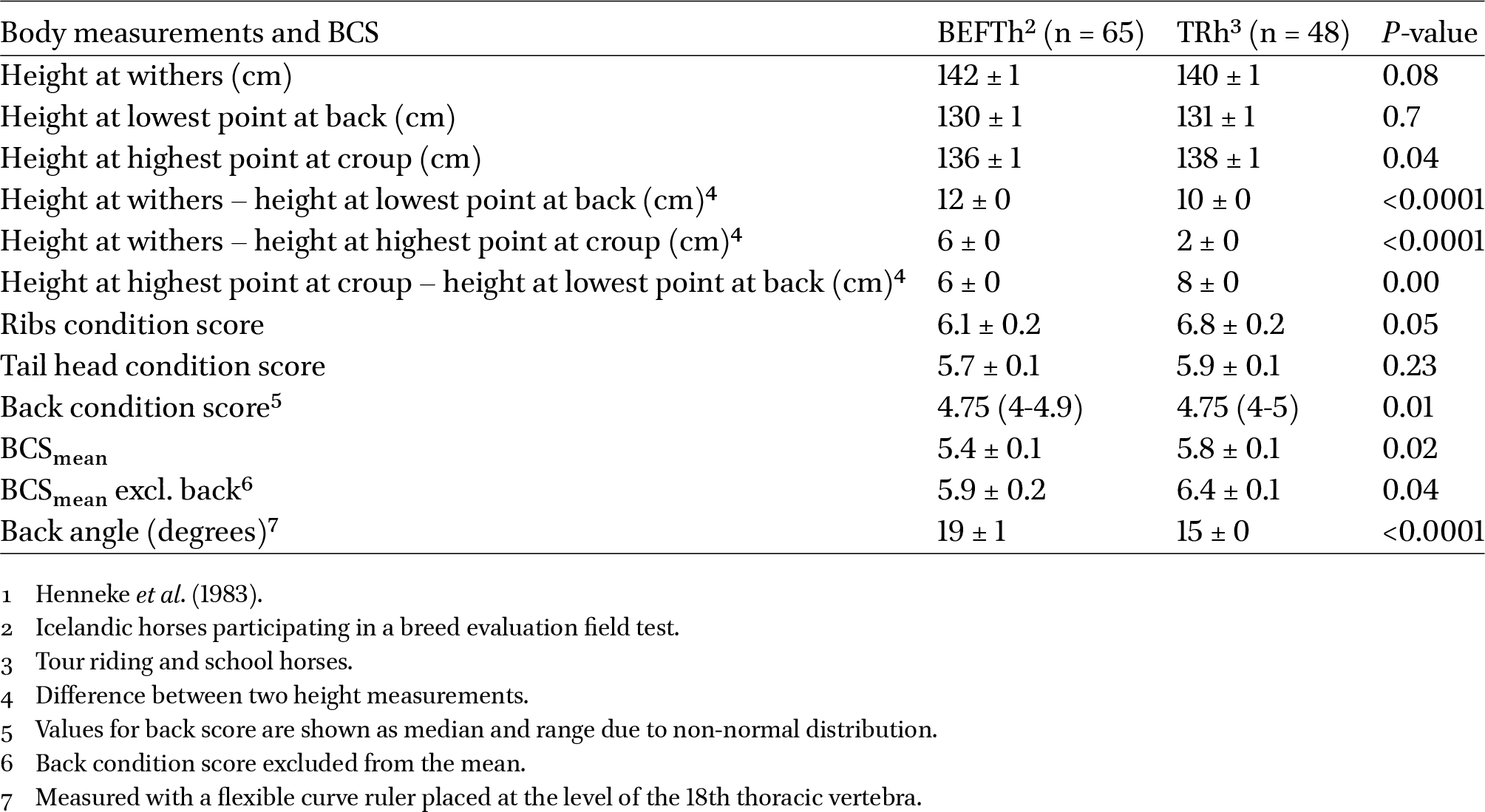
Body measurements and body condition score (BCS)1 recorded for 113 Icelandic horses used for two different purposes (LSM ± standard error, including effects of country, sex and age in the statistical model)
Citation: Comparative Exercise Physiology 20, 1 (2024) ; 10.1163/17552559-20230034
3 Results
Comparison of body measurements and BCS in BEFTh and TRh
Tour riding and school horses had greater height at croup (
Body condition score and back condition score were higher (
Questionnaire: horse owners’ opinion about the usability of TRh
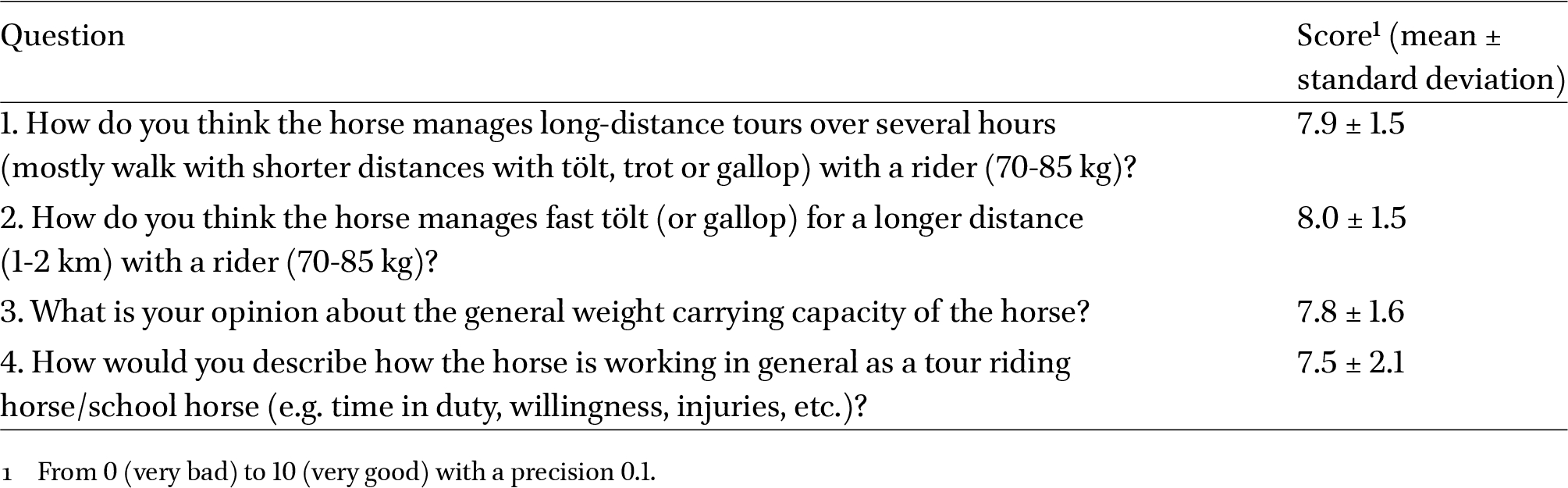
The TRh included in the study had been used in their company for between 3 months and 21 years (median 5 years) and all had been in active training for at least 3 months, except for one horse that was lame and was resting. Around half of the TRh (33/65, 51%) had been in active training for 6 months or longer. Information about how long the horse had been used in the company was missing for three TRh and information about the usability (questions 1-4, Table 2) was missing for one TRh. Answers to question 1 (regarding capacity for long-distance tours in mostly walk, Table 2), were not collected from one company in Iceland, since walk was not used during the tours according to the horse owner. All questions about the usability of TRh were scored ≥7.5 (Table 2).
Questions 1-4 in the questionnaire (in addition to questions about horse age, sex, how long it had been used in the present company and time in active training) and mean score based on answers from five horse owners and a total of 64 tour riding and school horses
Citation: Comparative Exercise Physiology 20, 1 (2024) ; 10.1163/17552559-20230034
There was a positive correlation between height at withers and scores for capacity for long-distance touring in walk and fast tölt (questions 1-2,
Correlations (r) between body measurements and body condition score (BCS)a and owners’ opinion about the usability of 64 tour riding and school horses
Citation: Comparative Exercise Physiology 20, 1 (2024) ; 10.1163/17552559-20230034
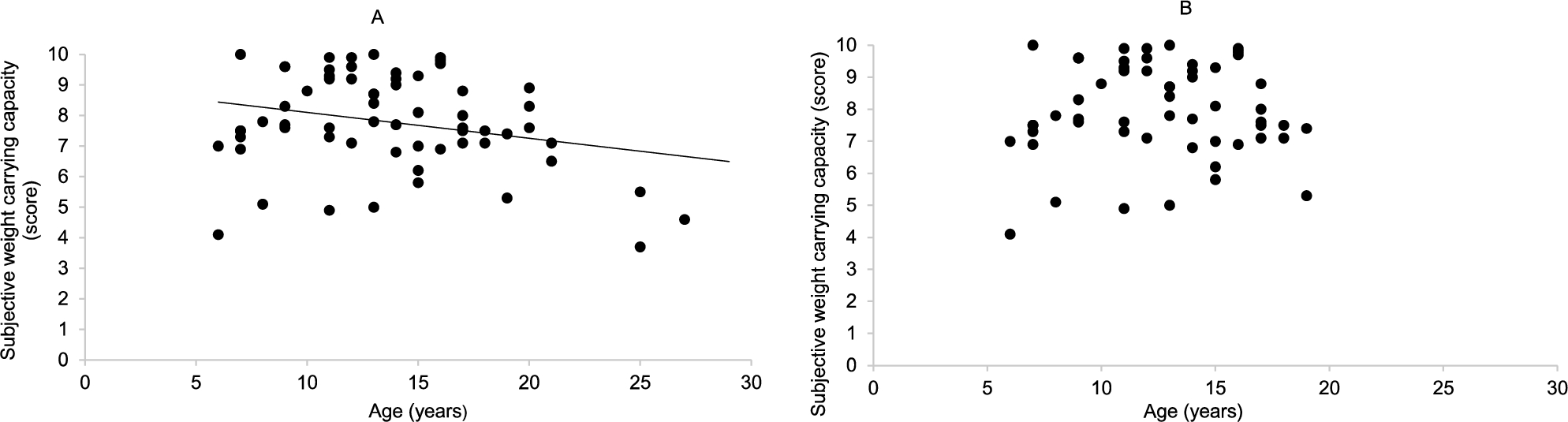
Relationship between horse age and owners’ opinion about weight carrying capacity (question 3 – What is your opinion about the general weight carrying capacity of the horse (scale 0-1)) in (A) 64 tour riding and school horses (r = −0.26,
Citation: Comparative Exercise Physiology 20, 1 (2024) ; 10.1163/17552559-20230034
Association between back shape and performance in a BEFT and subjectively evaluated weight carrying capacity in TRh
Back condition score and back angle were not correlated with the scores from the ridden assessments in BEFT (
4 Discussion
The results showed several differences in body measurements and BCS between BEFTh and TRh. Compared with TRh, BEFTh had a more uphill conformation (greater difference between height at withers and height at back and croup), which is known to be favourable for performance in a BEFT (Kristjansson et al., 2016). In comparison with BEFTh, TRh had a greater back incline (greater difference between height at croup and back, where the croup is higher than the back), which has been shown to be unfavourable for riding ability in a BEFT (Kristjansson et al., 2016). The anatomical reason for the more uphill conformation in BEFTh compared with TRh may be longer front legs, since long legs are desired (although not truly measured in a BEFT) according to the international breeding goal for Icelandic horses (FEIF, 2023). In addition, long and high strides with wide movements are rewarded in the gait assessment in BEFTs, and are presumably facilitated by longer legs. Length of the front legs has also been found to have a positive correlation with speed in walk, canter and pace in a BEFT, where speed was positively correlated with scores for all gaits except slow tölt and canter (Stefánsdóttir et al., 2021). Furthermore, a novel QTL has been associated to leg length and lateral gait quality (Rosengren et al., 2021).
The observed differences in body measurements between BEFTh and TRh are likely due to the theory that BEFTh are pre-selected, particularly based on riding qualities (Albertsdóttir et al., 2011). Of all horses born in Iceland, only about 12% are assessed in a BEFT and a high heritability has been found for the trait ‘participation in a BEFT’ (Albertsdóttir et al., 2011). In the same study, a strong genetic correlation was found between this trait and riding ability. This indicates that BEFTh are not a random sample of the Icelandic horse population. Accordingly, it can be assumed that TRh are often horses perceived to score low in a BEFT (for conformation and riding ability) and are instead used for tour riding and riding lessons due to other traits that are desirable for that task (Sigurðardóttir and Helgadóttir, 2015). Another hypothesis is that body measurements are affected by training, since the uses and work done by BEFTh and TRh differ and, anecdotal evidence suggests that training has effects on conformation. However, the effect of training on conformation traits has, as far we know, never been scientifically studied.
Compared with BEFTh, TRh had higher mean BCS, higher individual scores for ribs and back and smaller back angle. The lower mean BCS in BEFTh compared with TRh was not unexpected, and may be due to riders and owners of BEFTh prioritising lower body condition in order to get higher scores in the BEFT. ‘Good body condition’ is expected (FEIF, 2023), and performance in the ridden assessment in a simulated BEFT has also been shown to be improved in Icelandic horses with lower mean BCS (5.7) compared with horses with higher mean BCS (6.1) (Jansson et al., 2021). The lower back condition score and greater back angle in BEFTh means that BEFTh had a ‘thinner’ back than TRh. This indicates that TRh had more fat deposited along the back or possibly a larger m. longissimus dorsi compared with BEFTh. Ultrasound scans of the back at the site of subjective back scoring and objective measurement of back angle are needed to determine the fat and muscle thickness of the back, but were not performed in this study.
A tendency for a greater height at withers in BEFTh compared with TRh was found in the present study. It has earlier been shown that height at withers has a bell-shaped relationship to performance in a BEFT, with an optimum height of 146 cm (Kristjansson et al., 2016). This indicates that a relatively high height at withers is favourable for performance in a BEFT and is considerably greater than the mean height at withers (around 140 cm) for horses in the present study and in previous studies (Herbrecht et al., 2020; Kristjansson et al., 2016; Stefánsdóttir et al., 2014).
Overall, horse owners were satisfied with the usability of their TRh, based on the relative high scores awarded in responses to all questions (mean score ranging from 7.5 to 8.0 on a scale of 0-10). However, it can be assumed that TRh with low usability have been excluded from the company before this study. A positive correlation was found between height at withers and the owners’ opinion about usability during tours (questions 1-2) and weight carrying capacity (question 3). This indicates that height at withers is important for usability in TRh and not only for performance at breeding tests (Holmström and Philipsson, 1993; Kristjansson et al., 2016; Stefánsdóttir et al., 2021). However, height at withers has not been found to be correlated with weight carrying capacity in previous studies (Powell et al., 2008; Stefánsdóttir et al., 2017). In this study, the usability of the horses was evaluated by the owner and only reflected the owner’s perspective, which might not be the same as the horse’s physiological response during exercise. In addition, horses with greater height at withers are generally perceived to be able to carry larger riders, which may have resulted in owners scoring weight carrying capacity lower in horses with lower height at withers. Height at back and croup was also positively correlated with scores to all questions (questions 1-4), showing that greater height at back and croup was perceived as beneficial for usability in TRh, including weight carrying capacity. Height at croup has been shown to be correlated to performance in a BEFT, but not height at back (Kristjansson et al., 2016). In comparison to findings in horses participating in a BEFT (Kristjansson et al., 2016), the difference between height at withers and height at back and croup did not influence the horse owners’ opinion about usability in TRh.
An interesting finding was that BCS did not influence the owners’ opinion about usability in TRh, since this trait is reported to be important for performance in various breeds and disciplines (Garlinghouse and Burrill, 1999; Jansson et al., 2021; Leleu and Cotrel, 2006).
The relationship between back measurements and performance in a BEFT has earlier been investigated by Kristjansson et al. (2016), but the association between back condition score and back angle and riding ability has not been investigated previously. In the present study, the subjective score for back and croup (obtained from WorldFengur) was positively correlated with riding ability in BEFTh, but no correlations between back condition score and angle and riding ability were found. In this study, no objective measurements of the croup were performed, so the possible association between croup measurements and riding ability in BEFTh and subjective evaluated weight carrying capacity in TRh was not examined. For BEFTh, a back condition score of less than a 4 or above 4.9 were not represented in our study and therefore, the association between an extremely thin or broad back on riding ability was not investigated. Furthermore, owners’ opinion about weight carrying capacity in TRh did not correlate with back condition score and back angle, or with the incline of the back (e.g. an uphill conformation). Since TRh carry riders of different weights, knowledge about conformation traits that are beneficial for weight carrying would make it easier for owners when matching riders with horses. Further studies are therefore needed on this issue.
In the body condition scoring method used in this study (Ringmark et al., 2013, modified from Henneke et al., 1983), the back is given an individual score based on a visual assessment. However, this subjective scoring can lead to between-person differences, so, an objective method to measure the back of the horse is urgently needed. The flexible curve ruler (as we used in the present study) is easy to use, has high repeatability and can be used as a complement to subjective assessment. When the last rib is identified in order to find T18, the middle part of the rib can easily be palpated, except in extremely fat horses. However, it can be more difficult to follow the rib to its proximal part and conjunctive vertebra. As a complement to the flexible curve ruler, an objective method based on three-dimensional (3D) light-scanning could potentially be used in the future to measure cross-sectional area of the back (Tabor et al., 2022).
Some body measurements and BCS data detected in TRh were associated to years of experience (years in the present company). Horses with ≥8 years of experience had a smaller difference between height at withers and height at back, and thus a less uphill conformation than horses with less experience. This did not seem to be affected by age, because no correlation was found between age and the difference between height at withers and height at back (
Some differences in body measurements were also found between TRh measured in Iceland and TRh measured in Sweden, where horses in Iceland had lower height at back and croup than horses in Sweden (
A limitation with the present study was the unequal distribution of sexes and the difference in mean age between BEFTh and TRh. However, age (included in the statistical model) as well as age class for TRh had no effect on body measurements and BCS (
5 Conclusions
Several differences in body measurements and BCS were found between BEFTh and TRh, where BEFTh had a more uphill conformation, thinner backs (greater angle) and lower BCS compared with TRh. The body measurements in BEFTh were similar to that shown previously to be favourable for riding ability. In TRh, greater height at withers, back and croup were perceived favourable for usability and weight carrying capacity. Back condition score and angle were not associated to riding ability in BEFTh or to subjectively evaluated weight carrying capacity in TRh. However, further studies are needed to investigate if the same conformation traits are associated to good performance in BEFTh and usability in TRh.
Corresponding author; e-mail: denise.soderroos@slu.se
Supplementary material
Supplementary material is available online at: https://doi.org/10.6084/m9.figshare.24850569
Materials and methods S1. Questionnaire.
Acknowledgements
We would like to thank the owners of the tour riding and school horses and the owners and riders of horses that participated in the breeding tests. Thanks also to breeding leader Heimir Gunnarsson, to Claudia von Brömssen for statistical advice and to Mary McAfee for language help.
Authors’ contribution
Conceptualisation and Methodology, A.J., D.S. and G.S.; Data curation, A.J., D.S., V.G. and G.S.; Formal analysis, D.S.; Project administration, D.S. and A.J.; Writing – original draft, D.S.; Writing – review and editing, A.J., D.S., V.G., G.S., S.R. and M.R.; Responsibility for the overall content, D.S. All authors have read and agreed to the published version of the manuscript.
Conflict of interest
The authors declare no conflict of interest.
References
Albertsdóttir, E., Eriksson, S., Näsholm, A., Strandberg, E. and Árnason, Th., 2008. Genetic correlations between competition traits and traits scored at breeding field-tests in Icelandic horses. Livestock Science 114: 181-187. https://doi.org/10.1016/j.livsci.2007.04.022
Albertsdóttir, E., Eriksson, S., Sigurdsson, Á. and Árnason, T., 2011. Genetic analysis of ‘breeding field test status’ in Icelandic horses. Journal of Animal Breeding and Genetics 128: 124-132. https://doi.org/10.1111/j.1439-0388.2010.00902.x
Garlinghouse, S.E. and Burrill, M.J., 1999. Relationship of body condition score to completion rate during 160 km endurance races. Equine Veterinary Journal 31: 591-595. https://doi.org/10.1111/j.2042-3306.1999.tb05290.x
Grant, S., Aitchison, T., Henderson, E., Christie, J., Zare, S., McMurray, J. and Dargie, H., 1999. A comparison of the reproducibility and the sensitivity to change of visual analogue scales, Borg scales, and Likert scales in normal subjects during submaximal exercise. Chest 116: 1208-1217. https://doi.org/10.1378/chest.116.5.1208
Henneke, D.R., Potter, G.D., Kreider, J.L. and Yeates, B.F., 1983. Relationship between condition score, physical measurements and body fat percentage in mares. Equine Veterinary Journal 15: 371-372. https://doi.org/10.1111/j.2042-3306.1983.tb01826.x
Herbrecht, V., Waldern, N.M., Ellingsund Mikkelsen, S., Kjaer, M., Dittmann, M.T., Wiestner, T. and Weishaupt, M.A., 2020. Hoof conformation in Icelandic competition horses and its interrelationship with hoof pathologies and tölt performance. Veterinary Journal 259-260: 105462. https://doi.org/10.1016/j.tvjl.2020.105462
Holmström, M., Magnusson, L.-E. and Philipsson, J., 1990. Variation in conformation of Swedish Warmblood horses and conformational characteristics of élite sport horses. Equine Veterinary Journal 22: 186-193. https://doi.org/10.1111/j.2042-3306.1990.tb04245.x
Holmström, M. and Philipsson, J., 1993. Relationships between conformation, performance and health in 4-year-old Swedish Warmblood riding horses. Livestock Production Science 33: 293-312. https://doi.org/10.1016/0301-6226(93)90009-7
Icelandic Parliament, 1990. Lög um innflutning dýra [Laws on import of animals], no 54/1990. Available at: https://www.althingi.is/lagas/nuna/1990054.html
International Federation of Icelandic Horse Associations (FEIF), 2023. FEIF Breeding Rules and Regulations 2023. Available at: https://www.feif.org/breeding-dept/documents/
Jansson, A., Gunnarsson, V.Þ., Ringmark, S., Ragnarsson, S., Söderroos, D., Ásgeirsson, E., Jóhannsdóttir, T.R., Liedberg, C. and Stefánsdóttir, G.J., 2021. Increased body fat content in horses alters metabolic and physiological exercise response, decreases performance, and increases locomotion asymmetry. Physiological reports 9: e14824. https://doi.org/10.14814/phy2.14824
Jensen, R.B., Danielsen, S.H. and Tauson, A.H., 2016. Body condition score, morphometric measurements and estimation of body weight in mature Icelandic horses in Denmark. Acta Veterinaria Scandinavica 58: 59. https://doi.org/10.1186/s13028-016-0240-5
Kristjansson, T., Bjornsdottir, S., Albertsdóttir, E., Sigurdsson, A., Pourcelot, P., Crevier-Denoix, N. and Arnason, T., 2016. Association of conformation and riding ability in Icelandic horses. Livestock Science 189: 91-101. https://doi.org/10.1016/j.livsci.2016.05.010
Leleu, C. and Cotrel, C., 2006. Body composition in young Standardbreds in training: relationships to body condition score, physiological and locomotor variables during exercise. Equine Veterinary Journal 36: 98-101. https://doi.org/10.1111/j.2042-3306.2006.tb05521.x
Meira, C.T., Curi, R.A., Silva, J.A.V., Corrêa, M.J.M., de Oliveira, H.N. and da Mota, M.D.S., 2013. Morphological and genomic differences between cutting and racing lines of quarter horses. Journal of Equine Veterinary Science 33: 244-249. https://doi.org/10.1016/j.jevs.2012.07.001
Powell, D.M., Bennett-Wimbush, K., Peeples, A. and Duthie, M., 2008. Evaluation of indicators of weight-carrying ability of light riding horses. Journal of Equine Veterinary Science 28: 28-33. https://doi.org/10.1016/j.jevs.2007.11.008
Ringmark, S., Roepstorff, L., Essén-Gustavsson, B., Revold, T., Lindholm, A., Hedenström, U., Rundgren, M., Ögren, G. and Jansson, A., 2013. Growth, training response and health in Standardbred yearlings fed a forage-only diet. Animal 7: 746-753. https://doi.org/10.1017/S1751731112002261
Rosengren, M.K., Sigurðardóttir, H., Eriksson, S., Naboulsi, R., Jouni, A., Novoa-Bravo, M., Albertsdóttir, E., Kristjánsson, T., Rhodin, M., Viklund, Å., Velie, B.D., Negro, J.J., Solé, M. and Lindgren, G., 2021. A QTL for conformation of back and croup influences lateral gait quality in Icelandic horses. BMC Genomics 22: 267. https://doi.org/10.1186/s12864-021-07454-z
Sigurðardóttir, I. and Helgadóttir, G., 2015. Riding high: quality and customer satisfaction in equestrian tourism in Iceland. Scandinavian Journal of Hospitality and Tourism 15: 105-121. https://doi.org/10.1080/15022250.2015.1015765
Stefánsdóttir, G.J., Gunnarsson, V., Roepstorff, L., Ragnarsson, S. and Jansson, A., 2017. The effect of rider weight and additional weight in Icelandic horses in tölt: part I. Physiological responses. Animal 11: 1558-1566. https://doi.org/10.1017/S1751731117000556
Stefánsdóttir, G.J., Jansson, A., Ragnarsson, S. and Gunnarsson, V., 2021. Speed of gaits in Icelandic horses and relationships to sex, age, conformation measurements and subjective judges’ scores. Comparative Exercise Physiology 17: 1-10. https://doi.org/10.3920/CEP200039
Stefánsdóttir, G.J., Ragnarsson, S., Gunnarsson, V. and Jansson, A., 2014. Physiological response to a breed evaluation field test in Icelandic horses. Animal 8: 431-439. https://doi.org/10.1017/S1751731113002309
Tabor, G.F., Marlin, D.J. and Williams, J.M., 2022. Use and repeatability of 3D light scanning to measure transverse dorsal profile size and symmetry in the thoracic region in horses. Comparative Exercise Physiology 18 (Suppl. 5): 445-451. https://doi.org/10.3920/CEP220016
WorldFengur, 2023. The studbook of origin for the Icelandic horse. Available at: https://www.worldfengur.com/