Abstract
The major inhibitory neurotransmitter gamma-aminobutyric acid or GABA plays a pivotal role in mood and sleep. GABA exerts sedative and anxiolytic effects both within the central nervous system and through the gut-brain axis, which has generated interest in the potential for gut GABA to modulate mood and sleep. Several bacterial strains can produce GABA, yet their real-world impacts are poorly understood. We investigated the impact of 2 doses of the strain Lactiplantibacillus plantarum Lp815 on anxiety, sleep, mood, quality of life, cognition, heart rate variability and adverse events in adults with mild to moderate anxiety over a 6-week period. The trial was structured as a double-blinded, randomised, placebo-controlled trial with optional open label extension. Participants were blindly assigned to receive either a placebo, 1 billion colony-forming units (CFU), or 5 billion CFU of the oral capsule per day. Participants completed biweekly anxiety, insomnia and cognition measures, daily mood, sleep, and quality of life surveys, and collected wearable heart rate variability. 83 individuals were evaluated, aged 39 ± 13 years, 63% female and 64% Caucasian. Participants receiving 5 billion CFU exhibited significantly lower anxiety (GAD-7) scores at weeks 4 and 6 compared to placebo (Kruskal-Wallis
Trial Registration. The trial was IRB approved and registered with ClinicalTrials.gov (NCT06466603).
1 Introduction
Gamma-aminobutyric acid (GABA) is the major inhibitory neurotransmitter in the human nervous system. GABA plays a critical role in calming anxiety (Kalueff and Nutt, 2007; Lydiard, 2003) and maintaining sleep (Oishi et al., 2023). Deficits in GABA levels can lead to a cascade of disorders ranging from anxiety and stress to low mood (Mann et al., 2014; Valles-Colomer et al., 2019). Many anxiety medications target GABA directly, aiming to increase enzymatic conversion of glutamate to GABA, modulate GABA receptors and reduce GABA degradation (Lu et al., 2024). However, advances in understanding the role of the microbiome in the gut brain axis (GBA) highlight its untapped potential in regulating mood (Margolis et al., 2021) and sleep via neurotransmitter production (Cryan et al., 2019; Valles-Colomer et al., 2019). Although direct oral consumption of GABA can treat anxiety (Hepsomali et al., 2020), probiotics containing strains that naturally produce GABA within the human gut are not currently used in anxiety treatment.
Several Lactobacillus strains, primarily sourced from acidic fermented foods, demonstrate GABA production capabilities (Di Cagno et al., 2010; Dos Reis Lucena et al., 2021; Liu et al., 2018). However, the magnitude of GABA output varies among these strains and their efficacy in GABA synthesis within the human gastrointestinal environment is uncertain (Di Cagno et al., 2010; Dos Reis Lucena et al., 2021; Liu et al., 2018). This stems from the fact that GABA synthesis, typically a pH-stress response, stalls in higher pH environments (Cotter and Hill, 2003; Lin, 2013). Accordingly, it is possible that differences in individuals’ gut pH and resident microbiome may lead to variable responses in GABA production. Despite this anticipated variability, a recent pilot placebo-controlled trial demonstrated reduction in perceived stress using a 2 × 10 billion CFU daily intake of L. plantarum P8 probiotics (Lew et al., 2019; Ma et al., 2021). L. plantarum strains have additionally demonstrated the potential to improve cognitive function in those with cognitive impairment (Rudzki et al., 2019) and symptoms ranging from depression to fatigue and sleep disruption (Chen et al., 2021; Ho et al., 2021). Lactiplantibacillus plantarum Lp815 was isolated, developed, and characterised as a standout among strains tested for GABA production under physiological conditions (Zimmerman et al., in prep). It synthesises a significant amount of GABA within the physiologically relevant pH range (Zimmerman et al., in prep).
Gut GABA’s impact on anxiety may occur via multiple mechanisms. First, GABA modulates vagus nerve activity, which in turn modulates input to the nucleus tractus solitarius (NTS) and further to the amygdala and hypothalamus (Breit et al., 2018). Accordingly, Bravo et al. (2011) demonstrated that L. rhamnosus reduces anxiety- and depression-like behaviours and alters GABA receptor expression in mice. These effects are absent in after vagotomy. Gut GABA also reduces production of TNF-α and IL-6, and therefore may reduce anxiety and depressive symptoms in line with the inflammatory hypothesis of depression (Roohi et al., 2021; Ross, 2023). Newer evidence suggests that interaction among GABA, neuromodulator levels and the HPA axis may combine to alleviate anxiety. Lactobacillus brevis-fermented GABA ameliorates depression- and anxiety-like behaviours in stressed mice by activating the BDNF-TrkB signaling pathway, increasing serotonin and dopamine levels, and reducing stress hormones and inflammatory mediators (Kim et al., 2024). Together, supplemented GABA in the gut may alter vagal input to the CNS, reduce inflammation, and potentially alter neuromodulators and stress axis activity.
The present study evaluated the impacts of 1 and 5 billion CFU/day encapsulated L. plantarum Lp815 in people with mild to moderate anxiety. We incorporated participant reported outcomes on anxiety, sleep, mood and cognition, as well as the use of a wrist-worn device to explore the objective digital outcome measure of heart rate variability (HRV). As this captured real-world evidence, all study activities were conducted in a decentralised manner throughout the participants’ everyday lives. We hypothesised that the GABA-producing strain would decrease symptoms of anxiety and insomnia, with the higher dose (5 billion CFU) exerting a greater impact than the lower dose (1 billion CFU).
2 Materials and methods
Eligibility
Participants who self-reported mild to moderate anxiety were included if they met the following inclusion criteria: (i) aged at least 18 years old, (ii) Generalized Anxiety Disorder 7 Item (GAD-7) score of mild to moderate (5-14) at screening, (iii) if taking any over the counter (OTC) or other products for anxiety and/or sleep (e.g. magnesium, melatonin, anticholinergics), the participant must have been on a stable dose for at least 4 weeks prior to randomisation and maintain the stable intake for the duration of the study, (iv) willing to do a 4-week washout from any systemic antibiotic use prior to randomisation. Any participants reporting regular cannabis use were required to maintain a stable dose.
Participants were also required to meet several lifestyle and behavioural inclusion criteria, including general good health at screening (investigator discretion), English fluency, ability to provide informed consent, use a personal smartphone, receive the study product and a wearable device, and complete study assessments over the course of up to 7 weeks.
Participants were excluded if they were taking prescription medication for anxiety and/or sleep (e.g. Benzodiazepines) or receiving any investigational treatments within 30 days prior to randomisation. The following diagnoses and co-morbidities were excluded: (a) Diagnosed Generalized Anxiety Disorder that was uncontrolled and severe (b) diagnosed Inflammatory Bowel Disease (e.g. Crohn’s Disease or Ulcerative Colitis) or Irritable Bowel Syndrome, (c) diagnosed Narcolepsy, Restless Leg Syndrome, Circadian Rhythm Disorders, Panic Disorder, (d) diagnosed dyslexia or severe learning disability that may impact the ability to complete cognitive assessments, (e) current or prior history of Psychotic Disorder, (f) current diagnosis of Substance Abuse Disorder, (g) known hypersensitivity or previous allergic reaction to rice maltodextrin, (h) women who were currently pregnant, planning to become pregnant in the next month, or breastfeeding. Final exclusion was at the investigator’s discretion and could occur for any reason associated with being unable to comply with the trial or unsuited for evaluating outcomes of the trial.
Study design
The present study was a decentralised, randomised, placebo-controlled, double-blinded trial with optional open label extension (OLE). Participants completed up to a 16-week study consisting of a screening period, randomisation and shipping period, a baseline period, a 6-week product/placebo use period and an optional 4-week OLE.
Participants were randomised to one of 3 groups A, B or C: (A) Placebo, (B), GABA Lp815 (1 billion CFU/day), (C) GABA Lp815 (5 billion CFU/day). All interventions were encapsulated in hydroxypropyl methylcellulose vegetarian capsules. In vitro experimentation of Lp815 under gut-like conditions demonstrated that 100 mg of GABA were produced per 1 billion CFU within 24 h, suggesting that a dose of 1-5 billion CFU daily would deliver 100-500 mg of GABA (Zimmerman et al., in prep). These doses are within range for safe exogenous GABA administration (Hepsomali et al., 2020; Oketch-Rabah et al., 2021; Yoto et al., 2012), and are relatively lower than the CFU used in previous studies of GABA-producing probiotics (Chen et al., 2021; Ho et al., 2021; Lew et al., 2019).
The investigators, the study team and participants were blinded to group assignment. Participants received the study product or placebo and study supplies after randomisation. Demographic and medical history data, including concomitant medications, were collected during the screening period. Survey data, as described below, were collected during baseline, use of the study product/placebo, and optional OLE. Additionally, participants were sent a wrist-worn health tracking wearable device (Fitbit Charge 6, Fitbit, San Francisco, CA, USA) to measure sleep duration and HRV from baseline and through the end of the study product/placebo use period, and optionally during the OLE period. All subjective data were collected through a mobile research app, the Consumer Health Learning & Organizing Ecosystem (Chloe) (People Science, Inc., Los Angeles, CA, USA), described below.
Participants collected anxiety (GAD-7) and insomnia severity index (ISI) symptom data at biweekly intervals. Participants additionally reported daily mood, subjective sleep quality, and intervention adherence. Finally, participants collected 3 time points of performance on a validated spatial reasoning and fluid intelligence test, Sandia’s Progressive Matrices (Harris-Watson et al., 2020).
Recruitment, consent, and enrolment
Participants were recruited through social media channels and researcher networks. Recruitment outreach consisted of IRB approved advertising by email, digital marketing channels and word of mouth. The IRB-approved study landing page on the People Science website led to an IRB-approved pre-screening questionnaire to determine individual qualification and to collect participant name and contact. Prospective participants received further instructions by email to determine qualification and continue through the enrolment process.
Virtual electronic informed consent, including a study specific privacy authorisation and the California Experimental Subject’s Bill of Rights (as applicable) were provided through the HIPAA-compliant cloud-based platform Chloe. Eligible participants who provided virtual electronic consent were automatically registered into the study by the platform.
Data management system
All data was securely stored on Chloe Amazon Web Services HIPAA compliant servers. The Chloe platform contains modules for building and managing surveys, study landing pages, marketing outreach with tracking tools for recruitment, audited electronic consent forms, data management and analytics using an integrated relational database. Additionally, the platform contains a user-facing mobile app for participants that delivers surveys, study instructions, calendar reminders, communication with study team, and personal data reports at study culmination. Data from completed assessments was automatically collected for analysis.
Study timeline and activities
Participants’ activities were as follows (see Table 1). During screening, participants gave Informed Consent and completed demographics, medical history, concomitant medications and the GAD-7 (Dhira et al., 2021). Qualifying participants were randomised to GABA Lp815 (1 billion CFU/day), GABA Lp815 (5 billion CFU/day), or matching placebo. All qualifiers confirmed shipment receipt before proceeding to the study. Participants completed a 1-week baseline as described in Table 1, followed by six weeks of product or placebo use. Participants were prompted to report any adverse events (AEs) weekly or could reach out to the study team at any other time to report an AE. After completing the main study, those who had opted into OLE began consumption of study product GABA Lp815 (1 billion CFU). Optional wearable use continued throughout the period. Participants completed a final GAD-7, intervention adherence survey, and feedback survey at the end of OLE.

Data evaluability, analysis and statistics
Participants were required to fill out their baseline and at least 2 out of 3 of their product or placebo use period GAD-7 surveys and to not miss a consecutive week or more of study product/placebo use during the study period. Participants were withdrawn from the study if they needed to take antibiotics or new behavioural medications during the product use window, as antibiotics disrupt the gut microbiome and as behavioural medications may impact anxiety. Finally, participants who reported a substantial life change that relieved stress unrelated to the study product (e.g. a long vacation during product use) were omitted from data analysis. Individual days of data were excluded during the presence of transient confounders that impact overall quality of life, including reported flu and migraine. These exclusions were made prior to unblinding. All analyses were conducted using Python Jupyter Notebooks (Project Jupyter, Berkeley, CA, USA). Non-parametric statistics were used throughout, as the data were not normally distributed. Normality was assessed using the Shapiro-Wilk (SW) test. Dunn’s corrected Kruskal-Wallis (KW) tests were used to assess differences among the three study groups, with Holm’s correction applied to the final P-values. Fisher’s exact tests were used to evaluate differences between percent improvers per group. Mann-Kendall (MK) tests were used to evaluate potential trends over time in daily data.
Study onboarding flow.
Citation: Beneficial Microbes 16, 5 (2025) ; 10.1163/18762891-bja00073
3 Results
Recruitment and conduct
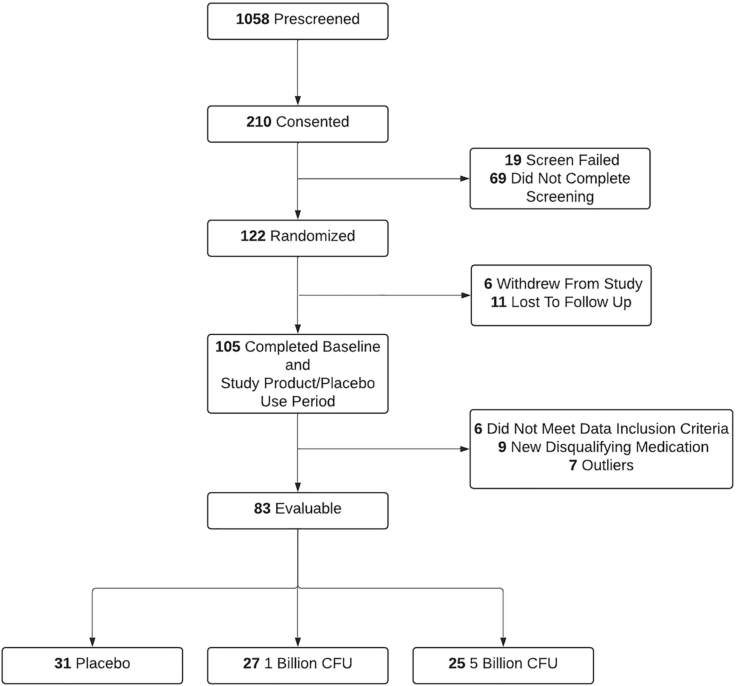
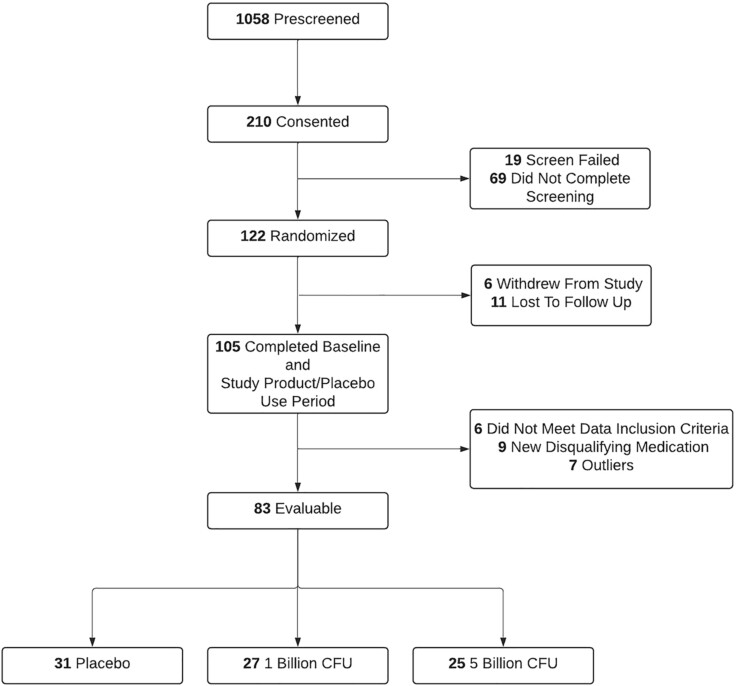
This study was approved by the Institutional Review Board Advarra (Pro00077016) and registered with ClinicalTrials.gov (NCT06466603). All participants gave informed consent. Onboarding flow is described in Figure 1.
Demographics and sample size
Of 105 participants who completed the study, n = 83 were evaluable (Placebo = 31, 1 billion CFU = 27, 5 billion CFU = 25), with a 94.7% intervention adherence rate (see Supplementary Table S3). The cohort was 62.7% female (n = 52), 36.1% male (n = 30) and 1.2% trans (n = 1). Mean age was 39 ± SD of 13 years. The cohort was 63.9% Caucasian (n = 53), 13.3% Asian American (n = 13), 9.6% African American (n = 8), 8.4% Hispanic (n = 7), 1.2% Pacific Islander (n = 1), and 3.6% other (n = 3). Participant medications are described in Supplementary Table S2.
Anxiety
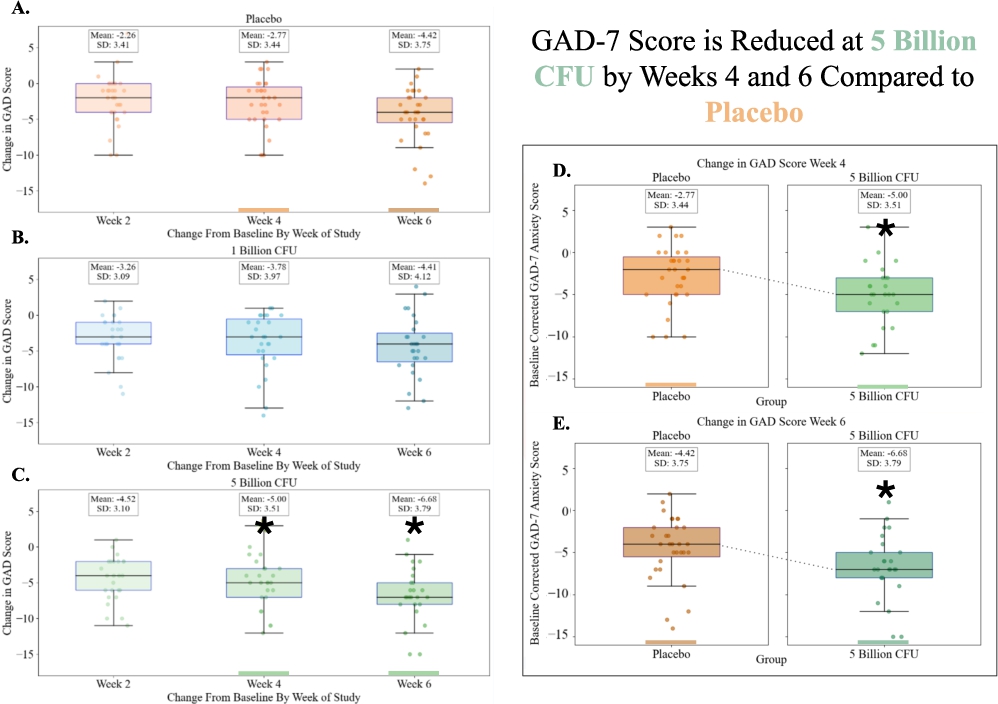
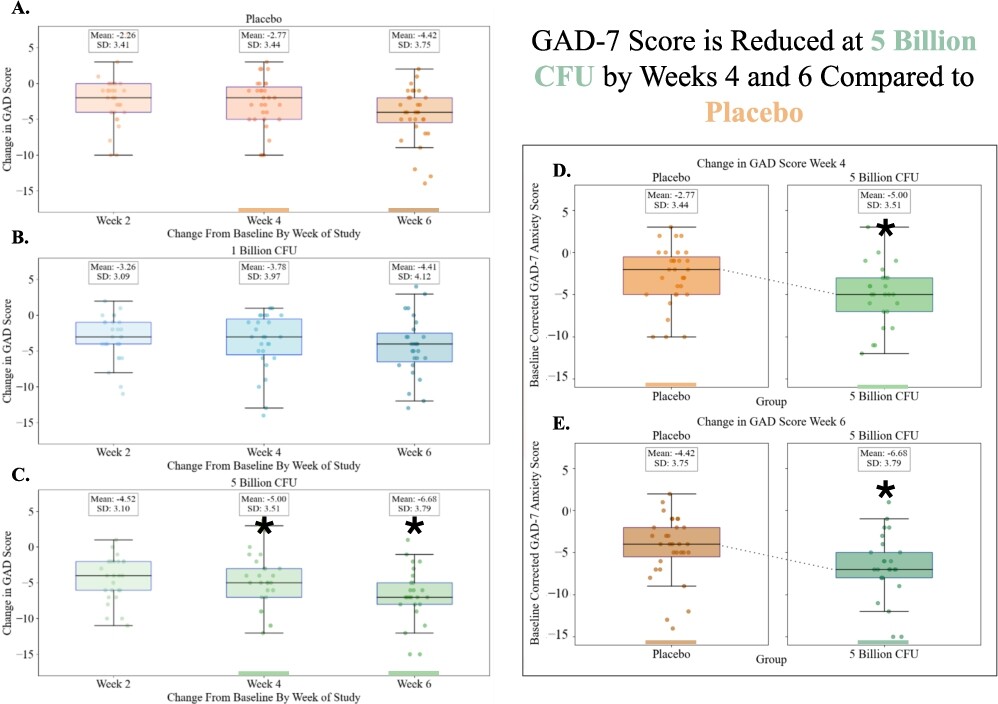
Within-individual reduction in GAD-7 score was of significantly greater magnitude in the 5 billion CFU cohort at weeks 4 and 6 compared to placebo (−5.0 ± 3.5 week 4 vs −2.8 ± 3.4 and −6.9 ± 3.8 vs −4.2 ± 3.8 week 6, for 5 billion CFU vs placebo, Holm’s corrected KW
Within-individual reduction in GAD-7 score is greatest in the 5 billion CFU cohort. Box and whisker plots overlaid with individual data representing change in GAD-7 score from baseline to weeks 2, 4 and 6 of the study (A-C). Boxes over each plot depict group timepoint mean and standard deviation. Blow up (D-E) compares groups that differed significantly, placebo and 5 billion CFU at weeks 4 (D) and 6 (E). Horizontal coloured bars along x-axes indicate what data from (A and C) are compared in (D-E). Stars in C, D, and E indicate significant differences between placebo and 5 billion CFU. Placebo is depicted in orange, 1 billion CFU in blue, and 5 billion CFU in green.
Citation: Beneficial Microbes 16, 5 (2025) ; 10.1163/18762891-bja00073
Adverse events
Six mild AEs were deemed possibly related to study participation. Four occurred in the 1 billion CFU group, with 2 counts of constipation, 1 instance of diarrhoea, and one instance of self-reported decreased mood in a participant with a history of depression. Two AEs, both acid reflux, were reported during 5 billion CFU use. An additional 2 AEs were reported on placebo: one instance of constipation and one severe stomach flu. All reported AEs resolved except for the participant with depression, who was withdrawn out of caution and contacted their existing clinical support for care. Additionally, n = 18 reported AEs were deemed unlikely to be related to study participation (e.g. COVID-19, cold, flu, back injury. Supplementary Table S1).
Insomnia severity index
ISI decreased across the study period in all groups. Although decreases in ISI were greater in the 1 billion CFU group than placebo, and greater in the 5 billion CFU group than either 1 billion CFU or placebo, the difference was not statistically significant (
GAD-7 total score means ± SD by week
Citation: Beneficial Microbes 16, 5 (2025) ; 10.1163/18762891-bja00073
Change in total ISI score from baseline by week of product use
Citation: Beneficial Microbes 16, 5 (2025) ; 10.1163/18762891-bja00073
Treatment groups trend toward greater reduction in ISI. Change in ISI score from baseline at weeks 2, 4, and 6. Box plots are overlaid with dots representing within-individual change in ISI score from baseline. Means and SDs represent change for that group at that time point. Placebo is depicted in orange (top), 1 billion CFU in blue (middle), and 5 billion CFU in green (bottom). Scattered dots represent individual participants’ data points.
Citation: Beneficial Microbes 16, 5 (2025) ; 10.1163/18762891-bja00073
Daily mood, subjective sleep quality, and quality of life
Daily survey responses varied widely among individuals and no statistical differences were observed among groups. Notably, groups maintained distinct ordering of subjective sleep quality, daily mood, and daily quality of life. Throughout the treatment period, all three raw daily measures were lowest in the placebo group, slightly higher in the 1 billion CFU cohort, and slightly higher still in the 5 billion CFU cohort. Measures did not trend up or down across the study period (Mann-Kendall
Wearable metrics
HRV varied widely among participants and neither differed significantly by group nor trended by time during the study (placebo mean (SD) of 35.0 (21.6), 1 billion CFU = 35.4 (19), 5 billion CFU 36.6 (21.0)). Fitbit sleep metrics did not differ by group or study week (see Supplementary Figures S5-S7).
Cognitive tests
Change in cognitive test score did not differ statistically by group over a 6-week period (
Sex differences
No statistical differences were observed by sex.
4 Discussion
The present study demonstrates that consumption of Lp815, a strain known to produce GABA under physiological conditions, is associated with a significant and meaningful reduction in anxiety by 4 and 6 weeks. This reduction may be dose dependent, as the percentage of individuals improving more than one anxiety category rises from 26% in placebo, to 37% with 1 billion CFU, to 68% with 5 billion CFU. The feeling of anxiety incorporates a host of emotions, including irritability and annoyance. Irritability and anxiety frequently appear not just in the general population during anxious times, but in paediatric and aging populations as well (Crum et al., 2021; Segel-Karpas, 2024). Interestingly, the impact of the probiotic was most notable in reducing the feeling of irritability and annoyance. These results suggest that utilisation of Lp815 may benefit other populations experiencing irritability, such as those dealing with chronic pain (Jha et al., 2021), premenstrual dysphoric disorder (Marean et al., 1998), and fatigue (Cooklin et al., 2012). Additionally, participants taking the probiotic exhibited a trend toward better sleep with a greater reduction in ISI (not significant), and significantly greater rate of improvement in the high dose cohort compared to placebo. The probiotic was safe and well-tolerated by participants. Adverse events mostly consisted of mild digestive disturbance which resolved during the study.
This study was a decentralised clinical trial, intentionally designed to collect evidence during the everyday lives of a diverse set of participants. Decentralised trials have historically raised some concerns about the potential for selection bias or data quality in comparison to in-person trial recruitment and data collection. However, recent research suggests that decentralised clinical trials (DCTs) can collect high quality subjective and objective data and can more efficiently recruit people in the desired study population (de Jong et al., 2022; Dimitrova et al., 2023; Jakkula et al., 2021). Moreover, by moving data collection to everyday life rather than the artificial setting of the clinic, DCTs may remove the bias (e.g. anxiety, unfamiliar environment) of data collection in the clinic (de Jong et al., 2022; Dimitrova et al., 2023; Jakkula et al., 2021). In this case, a participant sample was recruited nationally to represent a variety of people who may choose to consume a GABA-producing strain. Finally, as the study was double-blinded and placebo-controlled, any low-quality participants not caught during screening or data cleaning would be likely to obfuscate rather than increase differences between the placebo and intervention groups. Together, DCTs can risk low data quality if participants are not carefully screened or intervention adherence is low. However, the present study’s strict screening and data evaluability criteria, the distribution of age, sex, ethnicity and location of participants, and the benefits of real-world data collection increase the likelihood that these results may generalise to people throughout the United States in everyday life.
We did not observe changes in wearable sleep or heart rate variability (HRV). Both the composition of this specific cohort and the measurement device used may have impacted this result. First, although GABA would be expected to improve sleep and increase HRV (Guimaraes et al., 2024), it is possible that people without existing deficits in sleep or HRV do not exhibit further improvement with increased gut GABA. As sleep and HRV were not primary outcomes, participants were not screened for trouble sleeping, low HRV, or additional phenotypes associated with these problems (e.g. menopause, obesity, sedentary lifestyle, high life stress). Although some evidence suggests that direct GABA supplementation can improve HRV (e.g. Guimaraes et al., 2024), the cohort in which this was observed was composed of sedentary and overweight women with low HRV. Finally, the Fitbit device used in the present study provided only summary metrics of estimated sleep duration and average HRV. Use of a wearable device that captures more detailed metrics of sleep (e.g. sleep stage durations, sleep latency, or HRV time series) may reveal trends not visible in nightly means. Future study of cohorts recruited for symptoms of sleep disturbance, stress, or low HRV would more conclusively determine whether Lp815 can impact these metrics.
It is also possible that recruitment for higher baseline levels of sleep disturbance, or higher doses of the probiotic strain would reveal additional differences in measures of sleep or cognition, as previously observed (Chen et al., 2021; Ho et al., 2021; Ma et al., 2021). For instance, Lactiplantibacillus LPB145 demonstrated antidepressive effects in rats (Lozano et al., 2024). Similarly Bifidobacterium bifidum TMC3115 increased intestinal GABA levels and reduced anxiety in mice, potentially acting through GABA receptors on intestinal epithelial cells (Ikegami et al., 2024). A small open label trial of depressed patients found that depressive symptoms dropped after 8 weeks of daily 30 billion CFU Lactiplantibacillus plantarum PS128 supplementation (Chen et al., 2021). Ho et al. (2021) evaluated the same strain and dosage in 40 participants with self-reported insomnia in a double-blind placebo-controlled trial, finding decreases in depression, fatigue, and deep sleep awakenings. Additionally, a study of 103 stressed adults found that 12 weeks of 20 billion CFU daily Lactiplantibacilus plantarum P8 reduced scores of stress and anxiety compared to placebo by 4 weeks, demonstrated reduction in pro-inflammatory cytokines IFN-y and TNF-a, and improved memory and cognition (Lew et al., 2019). Together, studies of model organisms to blinded, placebo-controlled trials demonstrate the ability of GABA-producing strains to improve mood, sleep and stress. These findings are consistent with our demonstration of reduced anxiety in anxious adults in a double-blind, placebo-controlled, decentralised trial with Lp815. Finally, it is possible that the difference between responders and non-responders in this study may be attributed to individual differences in GABA-ergic tone at the start of the study. Future studies that correlate within-individual differences in baseline urinary GABA, within-individual change in urinary GABA throughout the study, as well as screening criteria focused on both clinical anxiety and sleep disturbance may further elucidate the impact of the GABA-producing probiotic Lp815.
5 Conclusions
Daily consumption of 5 billion CFU of Lp815 led to a significant and meaningful reduction in anxiety in a diverse cohort of anxious adults after 4 and 6 weeks. This dose resulted in more individuals categorically reducing both their anxiety and insomnia severity compared to placebo. The probiotic appears safe and tolerable. The GABA producing probiotic Lp815 may offer a natural option for anxiety reduction, and in particular irritability associated with anxiety, in people with mild to moderate anxiety.
Corresponding author; e-mail: noah@peoplescience.health
Co-first authorship.
Authors’ contribution
Study conceptualisation: NC, MCBE, ADG, PLO, CJD, DK, NZ. Data curation: PLO, ADG. Formal data analysis and visualisation: ADG. Funding acquisition: MCBE, NC. Investigation: MCBE, PLO, NC, ADG, JM, VL. Methodology: NC, MCBE, ADG, PLO, CJD, DK, NZ. Project administration: MCBE, PLO, NC, JM, VL. ADG prepared the manuscript with help from MCBE. All authors edited and approved the final manuscript.
Conflict of interest
Co-authors from Verb Biotics had the opportunity to review results generated, but not to eliminate any findings from the report.
Funding
This study was funded by Verb Biotics, LLC.
References
Bravo, J.A., Forsythe, P., Chew, M.V., Escaravage, E., Savignac, H.M., Dinan, T.G., Bienenstock, J. and Cryan, J.F., 2011. Ingestion of Lactobacillus strain regulates emotional behaviour and central GABA receptor expression in a mouse via the vagus nerve. Proceedings of the National Academy of Sciences of the United States of America 108(38): 16050-16055. https://doi.org/10.1073/pnas.1102999108
Breit, S., Kupferberg, A., Rogler, G. and Hasler, G., 2018. Vagus nerve as modulator of the brain-gut axis in psychiatric and inflammatory disorders. Frontiers in Psychiatry 9. https://doi.org/10.3389/fpsyt.2018.00044
Chen, H.-M., Kuo, P.-H., Hsu, C.-Y., Chiu, Y.-H., Liu, Y.-W., Lu, M.-L. and Chen, C.-H., 2021. Psychophysiological effects of Lactobacillus plantarum PS128 in patients with major depressive disorder: a preliminary 8-week open trial. Nutrients 13(11): 3731. https://doi.org/10.3390/nu13113731
Cooklin, A.R., Giallo, R. and Rose, N., 2012. Parental fatigue and parenting practices during early childhood: an Australian community survey. Child: Care, Health and Development 38(5): 654-664. https://doi.org/10.1111/j.1365-2214.2011.01333.x
Cotter, P.D. and Hill, C., 2003. Surviving the acid test: responses of gram-positive bacteria to low pH. Microbiology and Molecular Biology Reviews 67(3): 429-453, https://doi.org/10.1128/MMBR.67.3.429-453.2003
Crum, K.I., Hwang, S., Blair, K.S., Aloi, J.M., Meffert, H., White, S.F., Tyler, P.M., Leibenluft, E., Pope, K. and Blair, R.J.R., 2021. Interaction of irritability and anxiety on emotional responding and emotion regulation: a functional MRI study. Psychological Medicine 51(16): 2778-2788. https://doi.org/10.1017/S0033291720001397
Cryan, J.F., O’Riordan, K.J., Cowan, C.S.M., Sandhu, K.V., Bastiaanssen, T.F.S., Boehme, M., Codagnone, M.G., Cussotto, S., Fulling, C., Golubeva, A.V., Guzzetta, K.E., Jaggar, M., Long-Smith, C.M., Lyte, J.M., Martin, J.A., Molinero-Perez, A., Moloney, G., Morelli, E., Morillas, E., O’Connor, R., Cruz-Pereira, J.S., Peterson, V.L., Rea, K., Ritz, N.L., Sherwin, E., Spichak, S., Teichman, E.M., van de Wouw, M., Ventura-Silva, A.P., Wallace-Fitzsimons, S.E., Hyland, N., Clarke, G. and Dinan, T.G., 2019. The microbiota-gut-brain axis. Physiological Reviews 99(4): 1877-2013. https://doi.org/10.1152/physrev.00018.2018
de Jong, A.J., van Rijssel, T.I., Zuidgeest, M.G.P., van Thiel, G.J.M.W., Askin, S., Fons-Martı́nez, J., De Smedt, T., de Boer, A., Tellez, Y.S.-A., Gardarsdottir, H. and on behalf of the Trials@Home Consortium, 2022. Opportunities and challenges for decentralised clinical trials: European regulators’ perspective. Clinical Pharmacology and Therapeutics 112(2): 344-352. https://doi.org/10.1002/cpt.2628
Dhira, T.A., Rahman, M.A., Sarker, A.R. and Mehareen, J., 2021. Validity and reliability of the Generalized Anxiety Disorder-7 (GAD-7) among university students of Bangladesh. PLoS ONE 16(12): e0261590. https://doi.org/10.1371/journal.pone.0261590
Di Cagno, R., Mazzacane, F., Rizzello, C.G., De Angelis, M., Giuliani, G., Meloni, M., De Servi, B. and Gobbetti, M., 2010. Synthesis of gamma-aminobutyric acid (GABA) by Lactobacillus plantarum DSM19463: functional grape must beverage and dermatological applications. Applied Microbiology and Biotechnology 86(2): 731-741. https://doi.org/10.1007/s00253-009-2370-4
Dimitrova, M., Hristov, R., Djemadan, A. and Gaytandzieva, I., 2023. Decentralised clinical trials – current environment, potential barriers and facilitators for implementation and risk mitigation: a review of the literature. Acta Medica Bulgarica 50(4): 73-78. https://doi.org/10.2478/amb-2023-0047
Dos Reis Lucena, L., Terra Loyola, V., Leopoldino de Bortolli, C., Levy Andersen, M., Tufik, S. and Hachul, H., 2021. Effects of supplementation with Lactobacillus probiotics on insomnia treatment. Alternative Therapies in Health and Medicine 27(S1): 178-184.
Harris-Watson, A., Mcmillan, J., Listyg, B., Matzen, L. and Carter, N., 2020. Measuring intelligence with the Sandia matrices: psychometric review and recommendations for free raven-like item sets. Personnel Assessment and Decisions 6. https://doi.org/10.25035/pad.2020.03.006
Hepsomali, P., Groeger, J.A., Nishihira, J. and Scholey, A., 2020. Effects of oral gamma-aminobutyric acid (GABA) administration on stress and sleep in humans: a systematic review. Frontiers in Neuroscience 14. https://doi.org/10.3389/fnins.2020.00923
Ho, Y.-T., Tsai, Y.-C., Kuo, T.B.J. and Yang, C.C.H., 2021. Effects of Lactobacillus plantarum PS128 on depressive symptoms and sleep quality in self-reported insomniacs: a randomised, double-blind, placebo-controlled pilot trial. Nutrients 13(8): 2820. https://doi.org/10.3390/nu13082820
Ikegami, M., Narabayashi, H., Nakata, K., Yamashita, M., Sugi, Y., Fuji, Y., Matsufuji, H., Harata, G., Yoda, K., Miyazawa, K., Nakanishi, Y. and Takahashi, K., 2024. Intervention in gut microbiota increases intestinal γ-aminobutyric acid and alleviates anxiety behaviour: a possible mechanism via the action on intestinal epithelial cells. Frontiers in Cellular and Infection Microbiology 14. https://doi.org/10.3389/fcimb.2024.1421791
Jakkula, S., Pasupuleti, P., Mujeebuddin, C.S., Gaur, R.P. and Patil, S.S., 2021. Clinical trials tranformation intiative-decentralised clinical trials: a review article. World Journal of Current Medical and Pharmaceutical Research: 107-115. https://doi.org/10.37022/wjcmpr.v3i5.190
Jha, M.K., Schatzberg, A., Minhajuddin, A., Chin Fatt, C., Mayes, T.L. and Trivedi, M.H., 2021. Cross-sectional associations among symptoms of pain, irritability, and depression and how these symptoms relate to social functioning and quality of life: findings from the EMBARC and STRIDE studies and the VitalSign6 project. The Journal of Clinical Psychiatry 82(3): 20m13740. https://doi.org/10.4088/JCP.20m13740
Kalueff, A.V. and Nutt, D.J., 2007. Role of GABA in anxiety and depression. Depression and Anxiety 24(7): 495-517. https://doi.org/10.1002/da.20262
Kim, H., Kim, H., Suh, H.J. and Choi, H.-S., 2024. Lactobacillus brevis-fermented gamma-aminobutyric acid ameliorates depression- and anxiety-like behaviours by activating the brain-derived neurotrophic factor-tropomyosin receptor kinase B signaling pathway in BALB/C mice. Journal of Agricultural and Food Chemistry 72(6): 2977-2988. https://doi.org/10.1021/acs.jafc.3c07260
Lew, L.-C., Hor, Y.-Y., Yusoff, N.A.A., Choi, S.-B., Yusoff, M.S.B., Roslan, N.S., Ahmad, A., Mohammad, J.A.M., Abdullah, M.F.I.L., Zakariab, N., Wahide, N., Sunf, Z., Kwokf, L.-Y., Zhangf, H. and Lionga, M.-T., 2019. Probiotic Lactobacillus plantarum P8 alleviated stress and anxiety while enhancing memory and cognition in stressed adults: a randomised, double-blind, placebo-controlled study. Clinical Nutrition 38(5): 2053-2064. https://doi.org/10.1016/j.clnu.2018.09.010
Lin, Q., 2013. Submerged fermentation of Lactobacillus rhamnosus YS9 for γ-aminobutyric acid (GABA) production. Brazilian Journal of Microbiology 44(1): 183-187. https://doi.org/10.1590/S1517-83822013000100028
Liu, Y.-W., Liong, M.-T. and Tsai, Y.-C., 2018. New perspectives of Lactobacillus plantarum as a probiotic: the gut-heart-brain axis. Journal of Microbiology 56(9): 601-613. https://doi.org/10.1007/s12275-018-8079-2
Lozano, J., Fabius, S., Fernández-Ciganda, S., Urbanavicius, J., Piccini, C., Scorza, C. and Zunino, P., 2024. Beneficial effect of GABA-producing Lactiplantibacillus strain LPB145 isolated from cheese starters evaluated in anxiety- and depression-like behaviours in rats. Beneficial Microbes 15(5): 465-479. https://doi.org/10.1163/18762891-bja00024
Lu, Y., Yuan, J. and Zhang, X., 2024. Targeting GABA to Cure Anxiety Disorder in Various Methods.
Lydiard, R.B., 2003. The role of GABA in anxiety disorders. The Journal of Clinical Psychiatry 64(3): 21-27.
Ma, T., Jin, H., Kwok, L.-Y., Sun, Z., Liong, M.-T. and Zhang, H., 2021. Probiotic consumption relieved human stress and anxiety symptoms possibly via modulating the neuroactive potential of the gut microbiota. Neurobiology of Stress 14: 100294. https://doi.org/10.1016/j.ynstr.2021.100294
Mann, J.J., Oquendo, M.A., Watson, K.T., Boldrini, M., Malone, K.M., Ellis, S.P., Sullivan, G., Cooper, T.B., Xie, S. and Currier, D., 2014. Anxiety in major depression and cerebrospinal fluid free gamma-aminobutyric acid. Depression and Anxiety 31(10): 814-821. https://doi.org/10.1002/da.22278
Marean, M., Fox, E.E., Cumming, C.E. and Cumming, D.C., 1998. Irritability and sociability in women with symptomatic premenstrual change. Women and Health 27(3): 65-71. https://doi.org/10.1300/J013v27n03_05
Margolis, K.G., Cryan, J.F. and Mayer, E.A., 2021. The microbiota-gut-brain axis: from motility to mood. Gastroenterology 160(5): 1486-1501. https://doi.org/10.1053/j.gastro.2020.10.066
Morin, C.M., Belleville, G., Bélanger, L. and Ivers, H., 2011. The insomnia severity index: psychometric indicators to detect insomnia cases and evaluate treatment response. Sleep 34(5): 601-608.
Oishi, Y., Saito, Y.C. and Sakurai, T., 2023. GABAergic modulation of sleep-wake states. Pharmacology & Therapeutics 249: 108505. https://doi.org/10.1016/j.pharmthera.2023.108505
Oketch-Rabah, H.A., Madden, E.F., Roe, A.L. and Betz, J.M., 2021. United States Pharmacopeia (USP) safety review of gamma-aminobutyric acid (GABA). Nutrients 13(8): 2742. https://doi.org/10.3390/nu13082742
Roohi, E., Jaafari, N. and Hashemian, F., 2021. On inflammatory hypothesis of depression: what is the role of IL-6 in the middle of the chaos? Journal of Neuroinflammation 18(1): 45. https://doi.org/10.1186/s12974-021-02100-7
Ross, K., 2023. Psychobiotics: are they the future intervention for managing depression and anxiety? A literature review. Explore 19(5): 669-680. https://doi.org/10.1016/j.explore.2023.02.007
Rudzki, L., Ostrowska, L., Pawlak, D., Małus, A., Pawlak, K., Waszkiewicz, N. and Szulc, A., 2019. Probiotic Lactobacillus Plantarum 299v decreases kynurenine concentration and improves cognitive functions in patients with major depression: a double-blind, randomised, placebo controlled study. Psychoneuroendocrinology 100: 213-222. https://doi.org/10.1016/j.psyneuen.2018.10.010
Segel-Karpas, D., 2024. Anger and anxiety in older adults: a cross-lagged examination. Aging & Mental Health 28(9): 1209-1215. https://doi.org/10.1080/13607863.2024.2320137
Valles-Colomer, M., Falony, G., Darzi, Y., Tigchelaar, E.F., Wang, J., Tito, R.Y., Schiweck, C., Kurilshikov, A., Joossens, M., Wijmenga, C., Claes, S., Van Oudenhove, L., Zhernakova, A., Vieira-Silva, S. and Raes, J., 2019. The neuroactive potential of the human gut microbiota in quality of life and depression. Nature Microbiology 4(4): 623-632. https://doi.org/10.1038/s41564-018-0337-x
Yoto, A., Murao, S., Motoki, M., Yokoyama, Y., Horie, N., Takeshima, K., Masuda, K., Kim, M. and Yokogoshi, H., 2012. Oral intake of γ-aminobutyric acid affects mood and activities of central nervous system during stressed condition induced by mental tasks. Amino Acids 43(3): 1331-1337. https://doi.org/10.1007/s00726-011-1206-6
Zimmerman, K., Stanley, S.Y., Delebecque, C.J., Beckmann, C. and Zimmerman, N.P., in prep. Development of a High GABA Producing Lactiplantibacillus Plantarum Strain.