Abstract
Probiotic supplementation in childhood serves as an additional source of bacterial colonisers and represents an opportunity to beneficially manipulate the intestinal microbiome. Differences in the ability of probiotic strains to colonise the gut may be related to the variously diversified gut microbiome. We report the results of the association between composition of the gut microbiome and the colonisation capacity of the probiotic strain Escherichia coli A0 34/86 (CNBÂ â Colinfant New Born supplement) in the cases of three healthy children in different development stages (infant, toddler, and pre-school), as a preliminary insight to possible future prospective studies of this subject. Microbiome composition was estimated by 16S rRNA gene sequencing of 55 stool samples collected during approximately 3.5-13 months long periods. Detailed characterisation of the E. coli population was performed using colony PCR to detect 33 E. coli genetic determinants. In all children, genetic determinants typical for the probiotic E. coli A0 34/86 strain were detected immediately after administration of the probiotics. Analysis of the initial sample composition (the last sample taken before the probiotic administration) showed that the gut microbiome of infant and toddler with lower bacterial diversity was more successfully colonised by the probiotic strain. In our case report of three children, we showed for the first that supplementation with CNB probiotics in early infancy and toddlerhood was associated with high E. coli A0 34/86 colonisation and a significant change in the composition of the gut microbiome. Our results indicate that administration of CNB for its recommended duration might be efficient only in very early childhood.
1 Introduction
The administration of probiotics has a wide range of beneficial effects and numerous indications for use in the paediatric populations. Probiotics have been successfully used in preterm and high-risk children to prevent antibiotic-associated diarrhoea, to reduce the risk of necrotising enterocolitis, to lower the incidence of eczema, and in healthy children to prevent a variety of diarrheal illnesses and allergies (Davis et al., 2020; Irwin et al., 2020; Sansotta et al., 2019; Sjazewska, 2011).
Currently, the most administered probiotic strains belong to Bifidobacterium, Lactobacillus, and Saccharomyces boulardii (Davis et al., 2020). However, certain Escherichia coli probiotics are also available in some European countries (Henker et al., 2008; Wassenaar, 2016). E. coli strains form the basis of three commercially available probiotic preparations: Colinfant New Born (CNB), Mutaflor, and Symbioflor (Wassenaar, 2016). CNB supplement containing E. coli strain A0 34/86 (O83:K24:H31) is marketed for non-breastfeeding and preterm infants, as well as healthy children for prevention of gastric and intestinal disorders (LodinovaÌ-ZaÌdinovaÌ et al., 1991, 2003; Wassenaar, 2016). Although the genus Escherichia is considered an opportunistic pathogen due to its pro-inflammatory effects, different epidemiological studies have shown that early-life colonisation with this genus is associated with a lower risk of atopic eczema and asthma and immune modulation (Alsalah et al., 2015; De Muinck et al., 2011; Kuang et al., 2016; Mukhopadhya et al., 2012; Rudi et al., 2012).
However, inconsistent results are observed regarding the influence of probiotics on the gut microbiome composition. The observed differences could be explained by different probiotic dosages, varying duration of administration, or the initial composition of the gut composition (Bazanella et al., 2017; Davis et al., 2020; Vendt et al., 2006; Wu et al., 2016). While the impact of various Bifidobacterium and Lactobacillus preparations on the composition of the faecal microbiome of children (from newborns to 18 years) has been extensively studied (Davis et al., 2020), information about the effects of administering E. coli probiotic strains is limited. Previously, we described the colonisation ability of the E. coli CNB probiotic strain and the turnover of E. coli strains in stool samples isolated from one infant during the first year of life (MicenkovaÌ et al., 2020).
In this follow-up study, we assess the difference in the colonisation capacity of E. coli A0 34/86 strain after administration of the same dose of the probiotic CNB to three healthy children of different ages (infant, toddler, and pre-school child). Samples were taken from the infantâs stools during the first 13 months of life and from the toddlerâs and pre-school childâs stools during a period of approximately 3.5 months. Stool microbial composition was assessed by 16S rRNA gene sequencing. Colony PCR for the detection of 33 E. coli genetic determinants characterised the overall E. coli population in detail.
2 Materials and methods
Stool samples
The criteria for inclusion of the childrenâs samples in the project were as follows. The children were selected within the framework of the First Years of Life (FYOL) project, the aim of which was to map the dynamics of oral or gut microbiome composition during the first years of life with respect to selected factors such as antibiotic or probiotic usage, mode of delivery, etc. These variables were recorded in the questionnaires filled in by the mothers at the time of sampling. If the child was receiving the probiotic preparation CNB, he/she was included in this sub-project focusing on the effect of CNB consumption on the composition of the microbiome and the colonisation capacity of the probiotic strain E. coli A0 34/86.
Stool samples (n = 56) from three children of different ages (infant, toddler, and pre-school child) were collected at different time points before, during, and after the CNB administration. Twenty-one stool samples were collected from one infant (female) during the first 13 months of life from 31 March 2018 to 14 April 2019 (Brno, Czech Republic) (Supplementary Table S1). Twenty samples were collected from a two-year-old toddler (male; born on the 4th of February 2017) from 3 April to 16 July 2019 (Brno, Czech Republic). Moreover, one sample was collected after more than two years (15th of June 2021 â this sample was used only for the cultivation and PCR experiments). Fourteen stools were collected from a four-year-old pre-school child (male; born on the 3rd of March 2015) from the 3rd of April to the 17th of July 2019 (Brno, Czech Republic). The toddler and the pre-school child are siblings living in the same household. Samples were collected at home by mothers, who were instructed to follow a specific collection protocol. Mothers were given stool sampling kits consisting of FLOQSwabs (Copan, Italy), disposable gloves, and hand and surface disinfectant wipes for more comfortable sampling. The mother of infant was instructed to collect stool samples from the same spot in the diaper, and the mother of toddler and pre-school child was instructed to collect all stool samples from the same spot. Samples were stored immediately at â20 °C. At the same time, we monitored the following variables: child health status and medication, breastfeeding, solid food introduction, probiotic consumption, and motherâs antibiotic intake. The study was approved by the ELSPAC Steering Committee (Ref. No: CELSPAC/EK/1/2018), Masaryk University, and all samples were collected after the mother signed informed consent.
Colinfant New Born probiotics dosage
The orally administered probiotic preparation Colinfant New Born (Dyntec, Czech Republic) is designed specially to prevent hospital infections, gastrointestinal diseases of various origins, disorders of the composition of the intestinal microbiota, and others. This probiotic containing the E. coli criodesiccata A0 34/86 (O83:K24:H31) (from 0.8 à 108 to 1.6 à 108 bacterial cells per dose) was supplemented to all healthy children in 12 doses for approximately 2 to 4 weeks (Supplementary Table S1). CNB was prescribed by the childrenâs physician and with the mothersâ consent for the prevention of various diarrhoeal diseases and allergies. The probiotic dose was recommended by a physician and also discussed by an immunologist. CNB was added to the breastfeeding infantâs diet during the 2nd and 3rd months of life. In the infant, the probiotic supplement was administered by syringe without a needle directly to the root of the tongue to prevent the baby from spitting out the probiotics. The infant has been exclusively breastfed for approximately the first five months of life (samples 1-15); starting on the 25th of August 2018 (samples 16-21), the breastfeeding was complemented with solid food. During the CNB studied periods (between, during and after CNB consumption), the infant was exclusively breastfed. All children had a balanced omnivorous diet. The children did not suffer from diarrhoea or other digestive complications that could affect composition of the microbiome during the studied periods. The 4-year-old pre-school child had a pollen allergy (from April to the end of May 2019). Supplementary Table S1 provides detailed information about the monitored external variables (diet, medication, probiotic consumption, etc.).
Characterisation of Escherichia coli isolates
Isolation of E. coli from childrenâs stool was performed using selective MacConkey agar. ENTEROtest16 (Erba Lachema, Czech Republic) was used for biochemical identification of enterobacterial species. Approximately one stool sample per month was selected for cultivation (in total, thirteen samples from the infant, eight from the 2-year-old toddler, and six from the 4-year-old pre-school child), covering periods before, during, and after the CNB administration (Supplementary Table S1).
E. coli isolates were confirmed by the detection of chromosomal gene tonB (Supplementary Table S2). In addition, the distribution of 32 E. coli colonisation/virulence and bacteriocin encoding genes (Supplementary Table S2) was screened to identify individual E. coli strains. The most common E. coli colicin (types: B, E1, Ia, Ib, Js, K, L, M, N, and S4) and microcin (types: mB17, mC7, mJ25, mH47, mM, and mV) encoding genes were selected and tested as described previously (MicenkovaÌ et al., 2014, 2016, 2017, 2020; SÌmajs et al., 2010).
Additionally, three cyclomodulin encoding genes (cnf1, cdt, and pks); adhesin-encoding genes (afaI, sfa, pap, and fimA); siderophore genes (aer, iucC, fyuA, and fepC); α-hemolysin (α-hly) gene, and genes associated with diarrheagenic E. coli strains (ial, lt, st, and bfpA) were tested. Primer pair sequences, PCR product lengths, and PCR protocols used in this study were previously described (Supplementary Table S2) (GoÌmez-Moreno et al., 2014; Gordon and OâBrien, 2006; Johnson and Stell, 2000; Kuhnert et al., 1997; LoÌpez-Saucedo et al., 2003; MartıÌnez et al., 1994; MicenkovaÌ et al., 2014; Okeke et al., 2004; SÌmajs and Weinstock, 2001; Yamamoto et al., 1995).
The E. coli A0 34/86 (O83:K24:H31) strain, cultivated directly from CNB probiotic preparation, was used as the positive PCR control for the detection of virulence and bacteriocin genes typical for this strain. This strain was positive on virulence genes fimA, α-hly, cnf1, sfa, pap, fyuA, and fepC and microcin determinants H47, and M (MicenkovaÌ et al., 2020). Positive controls for PCR detection of tonB, bacteriocin, and virulence encoding genes were taken from our laboratory stock and were previously published (MicenkovaÌ et al., 2014, 2017; SÌmajs et al., 2010).
The previously described triplex PCR method based on the combination of the chuA and yjaA genes and the TSPE4 DNA fragment was used to assign E. coli isolates to one of the four major phylogenetic groups (A, B1, B2, and D) (Clermont et al., 2000).
DNA isolation from stools, PCR amplification, and sequencing of the 16S rRNA gene
DNA isolation of 55 stool samples was performed using a PowerLyzer® PowerSoil® DNA Isolation kit (Qiagen, Hilden, Germany), according to the manufacturerâs protocol. Isolated DNA was used as a template in PCR reactions targeting the hypervariable V4 region (EMP 515-806) of the bacterial 16S rRNA gene according to the 16S Metagenomic Sequencing Library Preparation protocol (Illumina, San Diego, CA, USA) (Supplementary Table S2). Sequencing was performed using MiSeq Reagent Kits v2 on a MiSeq 2000 sequencer according to the manufacturerâs instructions (Illumina).
Bioinformatics and statistical analysis
The raw sequence reads were preprocessed by the following pipeline. The first step of the pipeline was demultiplexing of reads in sequencing pools into individual samples. The next step in the pipeline was trimming of low-quality end of each read.
Both demultiplexing and length filtering were performed by an in-house tool written in Python 3. Forward and reverse reads were denoised using the DADA2 amplicon denoising R package (Callahan et al., 2016). Following denoising, the forward and reverse reads were joined using the fastq-join read joining utility (Aronesty, 2011). Finally, chimeric sequences were removed from the joined reads using the removeBimera function of the DADA2 R package. The taxonomy was determined using the usearch-consensus algorithm from the microbiome analysis toolkit QIIME (v 1.9.1) (Caporaso et al., 2010). For each input sequence, the three closest organisms were found in the Silva v.123 reference database (Quast, 2013). Their taxonomies were combined into the final taxonomic assignment using the least common ancestor (LCA) algorithm. Using the genus-level Silva v. 123 reference database, the taxonomy was assigned down to genus-equivalent level. Clusters that did not contain the sequences of the described genera were named at the lowest taxonomic level that could be assigned as a genus-level group.
After quality filtering and chimerasâ removal, the number of reads ranged from 10,841 to 83,542, with a median of 28,833 reads per sample (Supplementary Table S3).
Statistical analysis of bacterial compositions was performed at the genus level. The Shannon diversity index was chosen to estimate the bacterial diversity and uniformity of the microbial community. Data were treated as compositional and before all statistical analyses were transformed using centred log-ratio (CLR) transformation (Aitchison, 1986). All zeroes in original data were replaced using the count zero multiplicative approach (Martin-Fernandez et al., 2015). Only genera with an abundance of minimally 0.3% of the total number of reads of the least sequenced sample, at least in three samples, were included in the transformation process and additional statistical analysis of the microbiome to avoid high sparsity in data.
Non-parametric Kruskal-Wallis test (with Dunns post-hoc; for infant samples) and Mann-Whitney U (for toddler and pre-school child samples) test with Benjamini-Hochberg (BH) adjustment for multiple testing were used to test the differences among periods before, within, and after using CNB probiotics. Results were considered significant at FDR of 5% (q < 0.05).
The samples used for the analysis of microbial differences before, during, and after the administration of the CNB probiotics were taken from timepoints homogenous in terms of monitored external variables across all these periods of interest (Supplementary Table S1). This resulted in a shorter âafter the CNB probiotics administrationâ period of the infant. We could not collect more than one sample before the CNB administration from the toddler and pre-school child.
All statistical analyses were performed in R, version 4.0.3. (R Core Team 2020) using R packages zCompositions; version 1.3.4 (zero replacement) (Martin-Fernandez et al., 2015), compositions; version 2.0-1 (CLR transformation) (Van den Boogaart et al., 2019), ggplot2; version 3.3.2 (Wickham, 2016), UpSetR; version 1.4.0 (2019). UpSetR: A More Scalable Alternative to Venn and Euler Diagrams for Visualizing Intersecting Sets. R package) and ggpubr; version 0.4.0 (2020). ggpubr: âggplot2â Based Publication Ready Plots. R package version 0.4.0. (https://CRAN.R-project.org/package=ggpubr) (version 1.4.0. https://CRAN.R-project.org/package=UpSetR).
3 Results
The probiotic supplement CNB containing E. coli A0 34/86 strain (O83:K24:H31) was administrated in twelve doses over a period of approximately 2-4 weeks to three healthy children of different ages (infant, toddler, and pre-school child) to prevent various diarrheal illnesses and allergies. Stool samples were collected during the first 13 months of the infantâs life and from the toddlerâs and pre-school childâs stools during a period of approximately 3.5 months. In addition, one toddlerâs stool sample was collected more than two years after CNB administration and used only for the cultivation experiments.
Influence of the initial gut microbial composition and diversity on the colonisation capacity of the CNB probiotic E. coli A0 34/86 strain
Our objective was to assess the differences in the initial microbial composition among children and identify the children who were successfully colonised by probiotic strains. To this end, we focused on the microbial composition, diversity, and abundance of genus Escherichia in the initial samples (the last samples collected before the CNB administration) estimated by 16S rRNA gene sequencing with the E. coli population composition characterised by the cultivation experiments. E. coli isolates were cultivated from childrenâs stool samples approximately once a month (Supplementary Table S1). A set of 33 E. coli genetic determinants was used to detect probiotic E. coli A0 34/86 and other E. coli isolates with different genetic content.
The microbial diversity and uniformity of the initial samples (as estimated by the Shannon index) and the number of identified genera increased from infant to pre-school child (Table 1).

Bacterial composition of the initial stool sample â last sample before the Colinfant New Born (CNB) administration
Citation: Beneficial Microbes 15, 1 (2024) ; 10.1163/18762891-20220049
Only 12 genera were detected in the infantâs initial sample, with Bifidobacterium predominating (85.4%), followed by Streptococcus (11.2%) and Lactobacillus (1.2%) (Table 1). The observed abundance of the genus Escherichia was 1.04%. An E. coli isolate containing genetic determinants (phyloB2; fimA, colicin Ia) was detected in the initial sample and in all stool samples (used for cultivation) from birth to the beginning of the CNB administration period (Figure 1A). During the administration of the CNB probiotics, this original E. coli isolate was replaced by the probiotic strain. The CNB strain containing genetic determinants (phyloB2; fimA, α-hly, cnf1, sfa, pap, fyuA, fepC, mH47, mM, and mV) colonised the infantâs intestinal tract from the start of CNB supplementation (2nd month of life) until the end of the study (13th month of life).
The effect of Colinfant New Born (CNB) administration on the microbiome composition, diversity, Escherichia abundance, and colonisation capacity of the probiotic strain Escherichia coli A0 34/86. (A) Infant, (B) Toddler, (C) Pre-school child. Cultivation â analysis of E. coli isolates turnover. Sequencing â the abundance of genus Escherichia â in the periods âbefore, during, and afterâ the CNB administration, and dynamics of the relative bacterial abundance at the genus level. Genus Escherichia plus genera with relative abundance higher than 5% are visualised (taxa lower than 5% are displayed as âOthersâ; all sequencing results are listed in Supplementary Table S4). * Stool samples used only for the cultivation experiments. ** Period of CNB administration â CNB was supplemented in 12 doses to all children. *** E. coli isolates were cultivated from stool samples collected in approximately month periods and analysed by colony PCR.
Citation: Beneficial Microbes 15, 1 (2024) ; 10.1163/18762891-20220049
In the initial toddler sample, 55 genera were detected with the dominance of Bacteroides (33.9%), Bifidobacterium (7.1%), and Streptococcus (6.8%) (Table 1). The proportion of Escherichia genus was lower compared to the infant (0.00026%), and no E. coli were successfully cultivated. During the CNB administration period, the probiotic strain colonised the intestinal tract and was detected in all subsequent samples, including the sample collected more than two years later (Figure 1B).
In the initial samples of the pre-school child, 65 genera were detected, with three dominant genera Faecalibacterium (17.4%), Bacteroides (16.8%), and Lachnospiraceae â unassigned (7.9%) (Table 1). The genus Escherichia accounted for 0.004% of the sample (Table 1), and an E. coli isolate belonging to phylogroup B2 containing gene fimA was identified (Figure 1C). Both E. coli (phylogroup B2, fimA) and CNB E. coli were identified during the consumption of the probiotics, but after this period no E. coli isolates were successfully cultivated until the end of the study. In this case, the probiotic strain was not capable of resident/longitudinal colonisation.
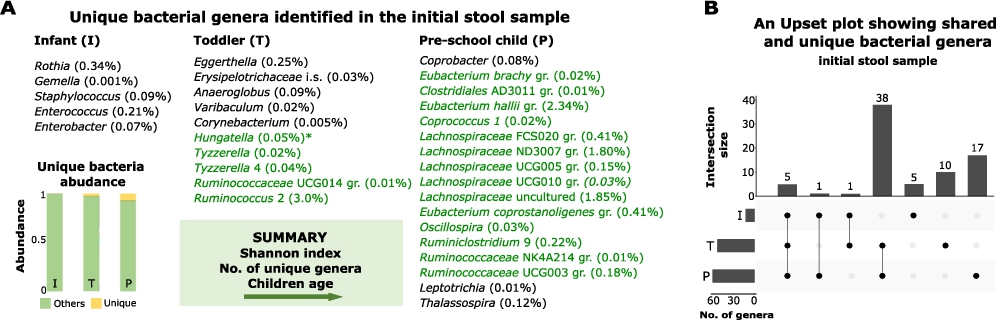
The most striking differences between the childrenâs initial microbiome composition were in the higher occurrence of different genera (Eubacterium, Ruminiclostridium, Ruminococcaceae, and Lachnospiraceae groups) from Clostridia class, which were enriched in the pre-school childâs initial stool sample (Figure 2A). The increase of the microbial diversity, as represented by increased uniformity and the number of new unique genera in the initial sample, was linked to children age. More unique bacterial genera were identified in pre-school child compared to infant and toddler (Figure 2B).
Influence of the initial gut microbiome composition and diversity on the colonisation capacity of the Colinfant New Born (CNB) probiotic Escherichia coli A0 34/86 strain. (A) Detailed characterisation of the initial stool sample (last sample before the CNB administration) in three children. (B) An Upset plot showing shared and unique bacterial genera between the three children and individual unique bacterial genera identified in the initial sample. * Different genera from the Clostridia class are highlighted in green.
Citation: Beneficial Microbes 15, 1 (2024) ; 10.1163/18762891-20220049
Effect of Colinfant New Born administration on the microbial composition and diversity
We were also interested in whether CNB administration affected overall microbial composition and diversity, as measured by 16S rRNA gene sequencing. A limitation of this analysis was that we have only one sample in the âbefore CNB administrationâ period in the toddler and pre-school child. Bacterial genera with relative abundances higher than 5% are visualised in Figure 1 (taxa with abundances lower than 5% are shown as âOthersâ); all sequencing results are listed in Supplementary Table S4.
In the younger children, an increase in diversity was detected during the CNB supplementation (infant) or after the administration (toddler) (Figure 3). In the 4-year-old, consumption of probiotics led to lower microbial diversity.
Influence of the Colinfant New Born (CNB) consumption on the bacterial diversity. Comparison of the Shannon diversity index âbefore, during, and afterâ the CNB administration.
Citation: Beneficial Microbes 15, 1 (2024) ; 10.1163/18762891-20220049
Significant changes in the abundance of individual bacterial genera during or after the period of CNB probiotics administration were identified only in the infant and the 2-year-old toddler stool samples (Figure 4). In the toddler samples, the only significant differences were observed during the period of CNB administration. In the infant, the effect of the CNB consumption lasted longer and resulted in an increased abundance of Lactobacillus, Streptococcus, and Haemophilus (q < 0.05). The influence of the CNB consumption on the overall Escherichia abundance was most evident also in the younger children. In the toddler, an increase of Escherichia (q < 0.05) was detected during the supplementation and in the infant after the consumption (q = 0.06). In the 4-year-old child, we could only detect the Escherichia genus before and during the CNB administration period.
Statistically significant changed bacterial genera after the Colinfant New Born administration. Bacterial genera with abundance (at least in three samples) minimally 0.3% of the total number of reads of the least sequenced sample were included in the statistical analysis. * Only statistically significant results are visualised. For all results, see Supplementary Table S5.
Citation: Beneficial Microbes 15, 1 (2024) ; 10.1163/18762891-20220049
4 Discussion and conclusions
The human gut microbiome develops over early childhood, and bacterial colonisation is influenced by mode of delivery, diet, antibiotics or probiotic administration, and other factors (Guittar et al., 2019; Koenig et al., 2011; Reyman et al., 2019). Supplementation with probiotics during infancy and childhood represents an opportunity to beneficially manipulate the intestinal microbiome (Davis et al., 2020).
The biology of E. coli in its primary niche, the human intestinal tract, is poorly explored (Lasaro et al., 2014). Successful colonisation of the intestinal tract with E. coli depends on the competition for nutrients with a dense and diverse microbiome and on the E. coli genetic content (Conway and Cohen, 2015; Schierack et al., 2008). In our study, we analysed for the first time how the initial composition of the microbiome affects the colonisation of the intestinal tract with the probiotic E. coli CNB strain. Initial sample composition revealed that younger children (infant and toddler) with lower bacterial diversity and number of unique genera detected were successfully colonised with the probiotic E. coli strain.
We observed E. coli isolates with different genetic content. Ecological studies of commensal E. coli revealed one dominant E. coli strain per host, but this dominance is temporary and more competitive E. coli strains displace less competitive ones (Apperloo-Renkema and Van der Waaij, 1991; Souza et al., 2002). In our previously published pilot study with one infant, the CNB strain, successfully colonised the intestinal tract the day after probiotic administration and established in the intestinal tract during the first year of life (MicenkovaÌ et al., 2020).
In this follow-up study, the resident CNB probiotic strain was again a great competitor in the infant intestinal tract and replaced the original E. coli detected after the delivery, which contained fewer genetic determinants (phyloB2, fimA, colicin Ia).
In the 2-year-old toddler, the first detected E. coli originated from the probiotic preparation. Also in this case, the ability to colonise was remarkably high, and the probiotic strain was cultivated from the toddlerâs sample collected more than two years after the CNB supplementation. No other E. coli strains were successfully cultivated from the infantâs and 2-year-old toddlerâs stool samples after the CNB administration till to the end of the experiment. We hypothesise, that the probiotic strain CNB is the one providing a huge colonisation resistance to other E. coli strains. The mixture of various fimbriae types (genes fimA, sfa, and pap), factors for competition for vital elements within microbial communities in the environment body (e.g. siderophores genes fyuA, and fepC) and bacteriocins (antimicrobial agents; mH47, and mM) makes from this strain a successful competitor and resident coloniser (MicenkovaÌ et al., 2020). A similar property was previously described for other probiotic strain of E. coli. E. coli Nissle 1917 has multiple properties for better gut colonisation, including Curli, type 1, and F1C fimbriae, and it also successfully competes with the microbiota for trace metals. For example, it protects mice from infection with pathogenic Salmonella in an iron-dependent manner (Sorbara and Pamer, 2019). In the 4-year-old child, the CNB strain has passed through the gastrointestinal tract without colonising the intestinal tract. Despite the genetic relatedness and the same household of toddler and pre-school child, the effect of CNB administration was different, probably due to the differences in age and initial microbial composition before supplementation. The microbial ecosystem develops early in life until about 3-5 years of age, when a relatively stable adult-like microbiota is established (RodrıÌguez et al., 2019). Before this state is reached, the gut microbiota is more susceptible to modulation by external factors (Laursen, 2021; Laursen et al., 2017; Milani et al., 2017) and may be more suitable for successful colonisation by CNB. In our study, the most striking difference between the childrenâs initial microbiome composition (the last samples collected before the CNB administration) was the increasing number of different genera from Clostridia class from infant to the pre-school child. The gut microbiome of the pre-school child was characterised by specific microbiota communities enriched with taxa belonging to the family Lachnospiraceae, Ruminococcaceae, genus Eubacterium, and other members of the class Clostridia. These bacteria typically settle in the mucosal layer of the intestine (Belzer et al., 2017; Chen et al., 2020). Also, experiments with the probiotic E. coli Nissle 1917 strain showed that it strongly adheres to human and porcine intestinal epithelial cells (Barth et al., 2009). These observations probably point to the same intestinal ecological niche of strongly adherent probiotic E. coli strains and different genera from Clostridia. An intestinal environment colonised by a diverse population of Clostridia together with the presence of another E. coli strain (phylo B2; fimA) before the CNB supplementation probably led to colonisation resistance in the 4-year-old pre-school child.
While human clinical studies have analysed the effects of Bifidobacterium and Lactobacillus administration on the composition of gut microbiome, the impact of E. coli probiotic strains supplementation is unknown (Davis et al., 2020; Derrien and Van Hylckama Vlieg, 2015). In our study, three different age-related effects were observed. In the infant, the effect of increased diversity and uniformity during the CNB consumption was followed by a significant increase of Lactobacillus, Haemophilus, and Streptococcus after the consumption. In the toddler, the opposite effect was observed with changes in microbiome composition during CNB supplementation, followed by an increase in diversity and uniformity after the consumption. In pre-school child, lower diversity was found after consumption of CNB with no statistically significant effect on microbial composition. Comparable results were observed in the experiments with newborns and children up to 18 years of age (Davis et al., 2020). Some probiotic strains of Lactobacillus and Bifidobacterium affected the abundance of different bacterial taxa, while others did not (Davis et al., 2020). These conflicts may also be related to childrenâs age, duration of the administration, and other factors (Garcia Rodenas et al., 2016).
Supplementation with CNB E. coli A0 34/86 probiotics affected the composition of gut bacteria, particularly in infant and toddler, and we hypothesise that this was probably due to lower diversity of the initial microbiome compared to the older pre-school child. In our study with three children of different ages, we demonstrated for the first time that supplementation of the microbiome at an early age during infancy and toddlerhood with CNB probiotics might be associated with high colonisation capacity of E. coli strain A0 34/86. It seems that the administration of CNB in its recommended duration is efficient only very early in childhood. We could only speculate whether prolonging the administration period would help the colonisation capacity of E. coli A0 34/86 in the older children. We are aware of the small sample size of our pilot study, and more extensive longitudinal studies are needed to confirm our observations.
Corresponding author; e-mail:Â lenka.micenkova@sci.muni.cz
Supplementary material
Supplementary material is available online at: https://doi.org/10.6084/m9.figshare.24999404
Table S1. Complete list of DNA samples isolated from stools of three children and detected E. coli strains.
Table S2. List of primers and the length of PCR products.
Table S3. Samples types analysed by 16S rRNA gene sequencing and the number of reads after quality filtering and chimeras removing.
Table S4. Diversity and relative abundance of the bacterial population analysed from the sequencing of 16S rRNA gene in DNA samples isolated from children at the genus level.
Table S5. Influence of the Colinfant New Born administration on the bacterial population in children. Statistical significance and the mean relative values during the studied periods.
Acknowledgements
Authors thank the Research Infrastructure RECETOX RI (No LM2023069) financed by the Ministry of Education, Youth and Sports, and Operational Programme Research, Development and Education â project CETOCOEN EXCELLENCE (No CZ.02.1.01/0.0/0.0/17_043/0009632) and project CETOCOEN PLUS (CZ.02.1.01/0.0/0.0/15_003/0000469) for supportive background. This project was supported by the European Unionâs Horizon 2020 research and innovation programme under grant agreement No 857560. This work was supported by the project National Institute of Virology and Bacteriology (Programme EXCELES, ID Project LX22NPO5103) â Funded by the European Union â Next Generation EU (authors LM, KB and DS). This publication reflects only the authorâs view, and the European Commission is not responsible for any use that may be made of the information it contains.
Authorsâ contribution
Conceptualization: LM, EB; methodology: KB, JB, DSÌ; analysis: PA, SS; writing and editing: LM, EB, SS, JB, DSÌ. All authors have read and agreed to the published version of the mansucript.
Conflict of interest
The authors declare that they have no conflict of interest.
Data availability
All data generated or analysed during this study are included in this published article (and its supplementary information files).
References
Aitchison, J., 1986. The statistical analysis of compositional data. In: Monographs on statistics and applied probability. Chapman and Hall Ltd., London, UK.
Alsalah, D., Al-Jassim, N., Timraz, K. and Hong, P.Y., 2015. Assessing the groundwater quality at a Saudi Arabian agricultural site and the occurrence of opportunistic pathogens on irrigated food produce. International Journal of Environmental Research and Public Health 12: 12391-12411. https://doi.org/10.3390/ijerph121012391
Apperloo-Renkema, H.Z. and Van der Waaij, D., 1991. Study of colonization resistance for Enterobacteriaceae in man by experimental contamination and biotyping as well as the possible role of antibodies in the clearance of these bacteria from the intestines. Epidemiology and Infection 107: 619-626. https://doi.org/10.1017/s0950268800049311
Aronesty, E., 2011. ea-utils, Command-line tools for processing biological sequencing data. Available at: https://github.com/ExpressionAnalysis/ea-utils.
Barth, S., Duncker, S., Hempe, J., Breves, G., Baljer, G. and Bauerfeind, R., 2009. Escherichia coli Nissle 1917 for probiotic use in piglets: evidence for intestinal colonization. Journal of Applied Microbiology 107: 1697-1710. https://doi.org/10.1111/j.1365-2672.2009.04361.x
Bazanella, M., Maier, T.V., Clavel, T., Lagkouvardos, I., Lucio, M., Maldonado-GoÌmez, M.X., Autran, C., Walter, J., Bode, L., Schmitt-Kopplin, P. and Haller, D., 2017. Randomized controlled trial on the impact of early-life intervention with bifidobacteria on the healthy infant fecal microbiota and metabolome. American Journal of Clinical Nutrition 106: 1274-1286. https://doi.org/10.3945/ajcn.117.157529
Belzer, C., Chia, L.W., Aalvink, S., Chamlagain, B., Piironen, V., Knol, J. and De Vos, W.M., 2017. Microbial metabolic networks at the mucus layer lead to diet-independent butyrate and vitamin B12 production by intestinal symbionts. mBio 8: e00770-17. https://doi.org/10.1128/mBio.00770-17
Callahan, B.J., McMurdie, P.J., Rosen, M.J., Han, A.W., Johnson, A.J. and Holmes, S.P., 2016. DADA2: high-resolution sample inference from Illumina amplicon data. Nature Methods 13: 581-583. https://doi.org/10.1038/nmeth.3869
Caporaso, J.G., Kuczynski, J., Stombaugh, J., Bittinger, K., Bushman, F.D., Costello, E.K., Fierer, N., PenÌa, A.G., Goodrich, J.K., Gordon, J.I., Huttley, G.A., Kelley, S.T., Knights, D., Koenig, J.E., Ley, R.E., Lozupone, C.A., McDonald, D., Muegge, B.D., Pirrung, M., Reeder, J., Sevinsky, J.R., Turnbaugh, P.J., Walters, W.A., Widmann, J., Yatsunenko, T., Zaneveld, J. and Knight, R., 2010. QIIME allows analysis of high-throughput community sequencing data. Nature Methods 7: 335-336. https://doi.org/10.1038/nmeth.f.303
Chen, Y.S., Chen, I.B., Pham, G., Shao, T.Y., Bangar, H., Way, S.S. and Haslam, D.B., 2020. IL-17-producing γ δ T cells protect against Clostridium difficile infection. Journal of Clinical Investigation 130: 2377-2390. https://doi.org/10.1172/JCI127242
Clermont, O., Bonacorsi, S. and Bingen, E., 2000. Rapid and simple determination of the Escherichia coli phylogenetic group. Applied and Environmental Microbiology 66: 4555-4558. https://doi.org/10.1128/AEM.66.10.4555-4558.2000
Conway, T. and Cohen, P.S., 2015. Commensal and pathogenic escherichia coli metabolism in the gut. Microbiology Spectrum 3: 10. https://doi.org/10.1128/microbiolspec.MBP-0006-2014
Davis, E.C., Dinsmoor, A.M., Wang, M. and Donovan, S.M., 2020. Microbiome composition in pediatric populations from birth to adolescence: impact of diet and prebiotic and probiotic interventions. Digestive Diseases and Sciences 65: 706-722. https://doi.org/10.1007/s10620-020-06092-x
De Muinck, E.J., Oien, T., Storrø, O., Johnsen, R., Stenseth, N.C., Rønningen, K.S. and Rudi, K., 2011. Diversity, transmission and persistence of Escherichia coli in a cohort of mothers and their infants. Environmental Microbiology Reports 3: 352-359. https://doi.org/10.1111/j.1758-2229.2010.00231.x
Derrien, M. and Van Hylckama Vlieg, J.E., 2015. Fate, activity, and impact of ingested bacteria within the human gut microbiota. Trends in Microbiology 23: 354-366. https://doi.org/10.1016/j.tim.2015.03.002
Garcia Rodenas, C.L., Lepage, M., Ngom-Bru, C., Fotiou, A., Papagaroufalis, K. and Berger, B., 2016. Effect of formula containing Lactobacillus reuteri DSM 17938 on fecal microbiota of infants born by cesarean-section. Journal of Pediatric Gastroenterology and Nutrition 63: 681-687. https://doi.org/10.1097/MPG.0000000000001198
GoÌmez-Moreno, R., Robledo, I.E. and Baerga-Ortiz, A., 2014. Direct detection and quantification of bacterial genes associated with inflammation in DNA isolated from stool. Advances in Microbiology 4: 1065-1075. https://doi.org/10.4236/aim.2014.415117
Gordon, D.M. and OâBrien, C.L., 2006. Bacteriocin diversity and the frequency of multiple bacteriocin production in Escherichia coli. Microbiology 152: 3239-3244. https://doi.org/10.1099/mic.0.28690-0
Guittar, J., Shade, A. and Litchman, E., 2019. Trait-based community assembly and succession of the infant gut microbiome. Nature Communications 10: 512. https://doi.org/10.1038/s41467-019-08377-w
Henker, J., Müller, S., Laass, M.W., Schreiner, A. and Schulze, J., 2008. Probiotic Escherichia coli Nissle 1917 (EcN) for successful remission maintenance of ulcerative colitis in children and adolescents: an open-label pilot study. Zeitschrift fur Gastroenterologie 46: 874-875. https://doi.org/10.1055/s-2008-1027463
Irwin, N., Davis, D. and Currie, M., 2020. Probiotic supplementation in well children: a scoping review. Journal of Child Health Care 24: 386-401. https://doi.org/10.1177/1367493519864750
Johnson, J.R. and Stell, A.L., 2000. Extended virulence genotypes of Escherichia coli strains from patients with urosepsis in relation to phylogeny and host compromise. Journal of Infectious Diseases 181: 261-272. https://doi.org/10.1086/315217
Koenig, J.E., Spor, A., Scalfone, N., Fricker, A.D., Stombaugh, J., Knight, R., Angenent, L.T. and Ley, R.E., 2011. Succession of microbial consortia in the developing infant gut microbiome. Proceedings of the National Academy of Sciences of the USA 108: 4578-4585. https://doi.org/10.1073/pnas.1000081107
Kuang, Y.S., Li, S.H., Guo, Y., Lu, J.H., He, J.R., Luo, B.J., Jiang, F.J., Shen, H., Papasian, C.J., Pang, H., Xia, H.M., Deng, H.W. and Qiu, X., 2016. Composition of gut microbiota in infants in China and global comparison. Science Reports 6: 36666. https://doi.org/10.1038/srep36666
Kuhnert, P., Hacker, J., Mühldorfer, I., Burnens, A.P., Nicolet, J. and Frey, J., 1997. Detection system for Escherichia coli-specific virulence genes: absence of virulence determinants in B and C strains. Applied and Environmental Microbiology 63: 703-709. https://doi.org/10.1128/aem.63.2.703-709.1997
Lasaro, M., Liu, Z., Bishar, R., Kelly, K., Chattopadhyay, S., Paul, S., Sokurenko, E., Zhu, J. and Goulian, M., 2014. Escherichia coli isolate for studying colonization of the mouse intestine and its application to two-component signaling knockouts. Journal of Bacteriology 196: 1723-1732. https://doi.org/10.1128/JB.01296-13
Laursen, M.F., 2021. Gut microbiota development: influence of diet from infancy to toddlerhood. Annals of Nutrition and Metabolism 30: 1-14. https://doi.org/10.1159/000517912
Laursen, M.F., Laursen, R.P., Larnkjær, A., Michaelsen, K.F., Bahl, M.I. and Licht, T.R., 2017. Administration of two probiotic strains during early childhood does not affect the endogenous gut microbiota composition despite probiotic proliferation. BMC Microbiology 17: 175. https://doi.org/10.1186/s12866-017-1090-7
LodinovaÌ-ZaÌdnıÌkovaÌ, R., Cukrowska, B. and Tlaskalova-Hogenova, H., 2003. Oral administration of probiotic Escherichia coli after birth reduces frequency of allergies and repeated infections later in life (after 10 and 20 years). International Archives of Allergy and Immunology 131: 209-211. https://doi.org/10.1159/000071488
LodinovaÌ-ZadnikovaÌ, R., Tlaskalova, H. and Bartakova, Z., 1991. The antibody response in infants after colonisation of the intestine with E. coli 083. Artificial colonisation used as prevention against nosocomial infections. Advances in Experimental Medicine and Biology 310: 329-333. https://doi.org/10.1007/978-1-4615-3838-7_42
LoÌpez-Saucedo, C., Cerna, J.F., Villegas-Sepulveda, N., Thompson, R., Velazquez, F.R., Torres, J., Tarr, P.I. and Estrada-GarcıÌa, T., 2003. Single multiplex polymerase chain reaction to detect diverse loci associated with diarrheagenic Escherichia coli. Emerging Infectious Diseases 9: 127-131. https://doi.org/10.3201/eid0901.010507
Martin-Fernandez, J.A., Hron, K., Templ, M., Filzmoser, P. and Palarea-Albaladejo, J., 2015. Bayesian-multiplicative treatment of count zeros in compositional data sets. Statistical Modelling 15: 134-158. https://doi.org/10.1177/1471082X14535524
MartıÌnez, J.L., Herrero, M. and De Lorenzo, V., 1994. The organization of intercistronic regions of the aerobactin operon of pColV-K30 may account for the differential expression of the iucABCD iutA genes. Journal of Molecular Biology 238: 288-293. https://doi.org/10.1006/jmbi.1994.1290
MicenkovaÌ, L., BenÌovaÌ, A., FrankovicÌovaÌ, L., BosaÌk, J., Vrba, M., SÌevcÌıÌkovaÌ, A., KmetâovaÌ, M. and SÌmajs, D., 2017. Human Escherichia coli isolates from hemocultures: septicemia linked to urogenital tract infections is caused by isolates harboring more virulence genes than bacteraemia linked to other conditions. International Journal of Medical Microbiology 307: 182-189. https://doi.org/10.1016/j.ijmm.2017.02.003
MicenkovaÌ, L., BosaÌk, J., Smatana, S., NovotnyÌ, A., BudinskaÌ, E. and SÌmajs, D., 2020. Administration of the probiotic Escherichia coli strain a0 34/86 resulted in a stable colonization of the human intestine during the first year of life. Probiotics and Antimicrobial Proteins 12: 343-350. https://doi.org/10.1007/s12602-019-09548-3
MicenkovaÌ, L., BosaÌk, J., Vrba, M., SÌevcÌıÌkovaÌ, A. and SÌmajs, D., 2016. Human extraintestinal pathogenic Escherichia coli strains differ in prevalence of virulence factors, phylogroups, and bacteriocin determinants. BMC Microbiol 16: 218.
MicenkovaÌ, L., SÌtaudovaÌ, B., BosaÌk, J., MikalovaÌ, L., LittnerovaÌ, S., Vrba, M., SÌevcÌıÌkovaÌ, A., WoznicovaÌ, V. and SÌmajs, D., 2014. Bacteriocin-encoding genes and ExPEC virulence determinants are associated in human fecal Escherichia coli strains. BMC Microbiology 14: 109. https://doi.org/10.1186/1471-2180-14-109
Milani, C., Duranti, S., Bottacini, F., Casey, E., Turroni, F., Mahony, J., Belzer, C., Delgado Palacio, S., Arboleya Montes, S., Mancabelli, L., Lugli, G.A., Rodriguez, J.M., Bode, L., de Vos, W., Gueimonde, M., Margolles, A., van Sinderen, D. and Ventura, M., 2017. The first microbial colonizers of the human gut: composition, activities, and health implications of the infant gut microbiota. Microbiology and Molecular Biology Reviews 81: e00036-17. https://doi.org/10.1128/MMBR.00036-17
Mukhopadhya, I., Hansen, R., El-Omar, E.M. and Hold, G.L., 2012. IBD-what role do Proteobacteria play? Nature Reviews Gastroenterology and Hepatology 9: 219-230. https://doi.org/10.1038/nrgastro.2012.14
Okeke, I.N., Scaletsky, I.C., Soars, E.H., Macfarlane, L.R. and Torres, A.G., 2004. Molecular epidemiology of the iron utilization genes of enteroaggregative Escherichia coli. Journal of Clinical Microbiology 42: 36-44. https://doi.org/10.1128/JCM.42.1.36-44.2004
Quast, C., 2013. The SILVA ribosomal RNA gene database project: improved data processing and web-based tools. Nucleic Acids Research 41: D590-D596. https://dx.doi.org/10.1093%2Fnar%2Fgks1219
Reyman, M., Van Houten, M.A., van Baarle, D., Bosch, A.A.T.M., Man, W.H., Chu, M.L.J.N., Arp, K., Watson, R.L., Sanders, E.A.M., Fuentes, S. and Bogaert, D., 2019. Impact of delivery mode-associated gut microbiota dynamics on health in the first year of life. Nature Communications 10: 4997. https://doi.org/10.1038/s41467-019-13014-7
RodrıÌguez, J.M., Murphy, K., Stanton, C., Ross, R.P., Kober, O.I., Juge, N., Avershina, E., Rudi, K., Narbad, A., Jenmalm, M.C., Marchesi, J.R. and Collado, M.C., 2019. The composition of the gut microbiota throughout life, with an emphasis on early life. Microbial Ecology in Health and Disease 26: 26050. https://doi.org/10.3402/mehd.v26.26050
Rudi, K., Storro, O., Oien, T. and Johnsen, R., 2012. Modelling bacterial transmission in human allergen-specific IgE sensitization. Letters in Applied Microbiology 54: 447-454. https://doi.org/10.1111/j.1472-765X.2012.03229.x
Sansotta, N., Peroni, D.G., Romano, S., Rugiano, A., Vuilleumier, P., Baviera, G. and Italian Society of Pediatric Allergy, Immunology (SIAIP), Microbiota Committee, Italy, 2019. The good bugs: the use of probiotics in pediatrics. Current Opinion in Pediatrics 31: 661-669. https://doi.org/10.1097/mop.0000000000000808
Schierack, P., Walk, N., Ewers, C., Wilking, H., Steinrück, H., Filter, M. and Wieler, L.H., 2008. ExPEC-typical virulence-associated genes correlate with successful colonization by intestinal E. coli in a small piglet group. Environmental Microbiology 10: 1742-1751. https://doi.org/10.1111/j.1462-2920.2008.01595.x
SÌmajs, D. and Weinstock, G.M., 2001. The iron- and temperature-regulated cjrBC genes of Shigella and enteroinvasive Escherichia coli strains code for colicin Js uptake. Journal of Bacteriology 183: 3958-3966. https://doi.org/10.1128/JB.183.13.3958-3966.2001
SÌmajs, D., MicenkovaÌ, L., SÌmarda, J., Vrba, M., SevcÌıÌkovaÌ, A., ValisÌovaÌ, Z. and WoznicovaÌ, V., 2010. Bacteriocin synthesis in uropathogenic and commensal Escherichia coli: colicin E1 is a potential virulence factor. BMC Microbiology 10: 288. https://doi.org/10.1186/1471-2180-10-288
Sorbara, M.T. and Pamer, E.G., 2019. Interbacterial mechanisms of colonization resistance and the strategies pathogens use to overcome them. Mucosal Immunology 12: 840. https://doi.org/10.1038/s41385-019-0151-7
Souza, V., Castillo, A. and Eguiarte, L.E., 2002. The evolutionary ecology of Escherichia coli. American Scientist 90: 332-341. https://doi.org/10.1511/2002.4.332
Szajewska, H., 2011. Short- and long-term effects of probiotics administered early in life. NestleÌ Nutrition Institute Workshop Series. Pediatric program 68: 65-78. https://doi.org/10.1159/000325665
Van den Boogaart, K.G., Tolosana-Delgado, R. and Bren, M., 2019. Compositions: compositional Data Analysis. R package version 1.40-3. Available at: https://CRAN.R-project.org/package=compositions
Vendt, N., Grünberg, H., Tuure, T., Malminiemi, O., Wuolijoki, E., Tillmann, V., Sepp, E. and Korpela, R., 2006. Growth during the first 6 months of life in infants using formula enriched with Lactobacillus rhamnosus GG: double-blind, randomized trial. Journal of Human Nutrition and Dietetics 19: 51-58. https://doi.org/10.1111/j.1365-277X.2006.00660.x
Wassenaar, T.M., 2016. Insights from 100 years of research with probiotic E. coli. European Journal of Microbiology and Immunology 6: 147-161. https://doi.org/10.1556/1886.2016.00029
Wickham, H., 2016. ggplot2: elegant graphics for data analysis. Springer-Verlag, New York, NY, USA.
Wu, B.B., Yang, Y., Xu, X. and Wang, W.P., 2016. Effects of Bifidobacterium supplementation on intestinal microbiota composition and the immune response in healthy infants. World Journal of Pediatrics 12: 177-182. https://doi.org/10.1007/s12519-015-0025-3
Yamamoto, S., Terai, A., Yuri, K., Kurazono, H., Takeda, Y. and Yoshida, O., 1995. Detection of urovirulence factors in Escherichia coli by multiplex polymerase chain reaction. FEMS Immunology and Medical Microbiology 12: 85-90. https://doi.org/10.1111/j.1574-695X.1995.tb00179.x