Abstract
Many animal species perform elaborate displays that represent honest signals of their physical qualities to potential mates and competitors. As such, these displays are targeted towards a specific audience and sensitive to their perception. But what happens when the signaller has a fundamentally different acoustic experience of the display as compared to their putative audience? We report observations from Fongoli, Senegal, of chimpanzees entering inside hollow baobab trees and performing acoustic displays. Only one chimpanzee enters at a time, and the sound to an outside audience appears dampened as compared to vocal and percussive signals performed on the outside of trees. We speculate that the sound may be modified and amplified within a hollow tree, so that the performer has a different experience of their display than does their audience, and encourage future empirical assessment. This behaviour represents one of only a few examples of nonhuman animals using objects or environmental features to modify their acoustic communication and is described for the first time in chimpanzees. Future research should address the motivations underlying chimpanzee baobab displays with a view to understanding potentially self-directed aspects of these performances.
1. Introduction
An individual’s physiology, and in particular their vocal apparatus, limits the volume, frequency, and range of sounds that they can vocally produce. As a result, vocalisations are often associated with honest indications of physical size or strength (Ey et al., 2007; Bowling et al., 2017), and primate vocal production has traditionally been viewed as relatively fixed (Townsend & Manser, 2013). However, recent work considering vocal performance more holistically (for example, the order and structure of vocal sequences: Leroux et al., 2021; Girard-Buttoz et al., 2022; Zanoli et al., 2023; the context of vocal signal production: Seyfarth & Cheney, 2018; Taylor et al., 2022) has revealed increasing flexibility, particularly in terms of behavioural function (Dezecache et al., 2021; Taylor et al., 2023), but also in their ability to accommodate to the calls of social partners (Burkart et al., 2022; Lameira et al., 2025; Mathevon et al., 2025). An effective means of adjusting voiced calls is the use of objects and environmental features, expanding the performance space as well as allowing individuals greater flexibility in the sounds that they can produce. Humans cup our hands around our mouths, design theatres, and use megaphones to modify our voices. But there is currently very limited evidence of other species modifying their vocal communication in similar ways.
Some species incorporate the use of detached objects to produce sounds, for example western chimpanzees (Pan troglodytes verus; also named as demoun
We add a new example of a nonhuman species using their physical environment to modify their acoustic communication, describing a behaviour by western chimpanzees (Pan troglodytes verus) at Fongoli, Senegal, who modulate the sound of their displays by drumming and vocalising into and inside hollow baobab trees. Their pant hoot vocalisations seem dampened to outside observers, but the acoustic characteristics of small, enclosed spaces can reshape sounds for the signaller. So not only does a hollow tree modify the call, but it does so differentially from the perspectives of audience and performer.
2. Methods
Fongoli is located in the Kédougou region of southeastern République du Sénégal. The habitat type is savanna woodland mosaic, with fields, grassland, bamboo woodland, woodland, and ecotone and gallery forest (Pruetz et al., 2002; Bogart & Pruetz, 2008). The largest tree in this region is the African baobab (Adansonia digitata), and in the Dar Salam locality within the Kédougou region the average baobab height is 24.6 m and average DBH is 1.4 m (
Chimpanzee pant-hoots are comprised of four phases (although they can be produced with a subset of these): the introduction (low intensity tonal elements), build-up (low intensity voiced inhale and exhale elements), climax (variable, but includes high intensity voiced elements such as screams), and let down (also variable, but characterised by decreasing and low intensity voiced and tonal elements; Marler & Hobbett, 1975; Goodall, 1986; Fedurek et al., 2016). Typical pant-hoots last between 7 and 11 s (Marler & Hobbett, 1975; Arcadi, 1996), and typical drums 1 to 4 s (Arcadi et al., 1998; Eleuteri et al., 2025). In western chimpanzees, drumming is typically isochronous (the beats are regularly spaced) and, when accompanying a pant-hoot vocalisation, starts before or during the climax phase (Arcadi et al., 1998; Eleuteri et al., 2025).
JP and MFS have conducted observational research on chimpanzees at the Fongoli research site since 2001 and 2008, respectively. Over this period, the Fongoli chimpanzee community has consisted of a total of 21 adult males and 14 adult females, alongside subadults, juveniles, and infants. To supplement written long-term data, KEG collected video data from May 25 to June 26, 2023, comprising 20 days of direct observation. During KEG’s study period, the community included 10 adult males, 8 adult females, 6 adolescents, 5 juveniles, and 5 infants. Discussions with a film crew (Wildstar) on site during KEGs fieldwork, revealed that they had also observed this behaviour and they shared footage (long lens camera, no audio available) of chimpanzees exploring the baobab hollows. Some of KEG and Wildstars’ videos are described below. In January to February 2024, KEG and CH conducted interviews with JP and MFS to ask questions about chimpanzee use of baobab trees during communicative displays.
2.1. Ethics
Data collection for JP and MFS was approved by Iowa State University and Texas University Institutional Animal Care and Use Committees; and for KEG and CH was approved by the University of St Andrews Animal Welfare and Ethics Committee. Data collection at Fongoli is permitted by Sénégal’s Directorate of Water, Forestry, Hunting and Soil Conservation.
3. Behavioural descriptions
3.1. Interviews
3.1.1. Observations of baobab use by age and sex class
Between 2006 and 2024, JP and MFS observed almost all adult males from the Fongoli community enter the hollows of baobab trees and drum and vocalise on the inside, usually producing the pant-hoot vocalisation. JP has observed adolescent males performing this behaviour (MFS stated that they may have but he has not observed it). During the interview in 2023, it was unclear whether the female chimpanzees also perform this behaviour; MFS had observed them drumming on hollow baobabs but not entirely inside them. Approximately 5-months after the interview was conducted, on June 12, 2024, MFS observed one adult female (TM) and one adolescent female (MT) drumming inside a hollow baobab tree; suggesting that, while relatively rare, prior uncertainty may be a result of sex-specific differences in sampling effort at Fongoli, rather than an absence from the female behavioural repertoire.
3.1.2. Observations of use across baobab trees
A survey by Lindshield et al. (2017) identified 304 baobab patches within the Fongoli chimpanzee range. Of these, between 2006 and 2024, JP and MFS observed chimpanzees drumming and vocalising inside eight individual baobab trees; five of which have hollows at ground-level and three of which have hollows higher up the trunk. More research is needed to determine whether these are the only available hollow baobab trees in their range, or whether they have a preference for these particular eight trees. JP shared that the chimpanzees seem to detour when travelling to pass by these specific trees, and MFS shared that males seem to particularly use them when searching for others.
3.2. Videos
3.2.1. Baobab use while calling and drumming
Fongoli chimpanzees typically start their pant-hoot display outside of the tree or away from the hollow, moving inside or facing into the hollow (Videos 1–3 in the Supplementary material) or deep fold (Video 5 in the Supplementary material) during the build-up, with the high intensity climax and let down (if present) phases produced inside or closely facing the hollow. Chimpanzees either approached at a slow walk (Video 3 in the Supplementary material) or displayed from a static (Videos 2 and 5 in the Supplementary material) or hanging (Video 4 in the Supplementary material) position. The pant-hoot drumming displays we recorded varied between 8.5 (Video 1 in the Supplementary material) and 13.5 s (Video 3 in the Supplementary material), overlapping with and slightly extending the duration range of reported displays. Drumming bouts started towards the end of the build-up phase, shortly before or at the onset of the climax (Videos 1–3 and 5 in the Supplementary material).

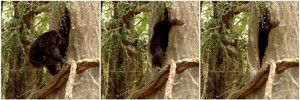
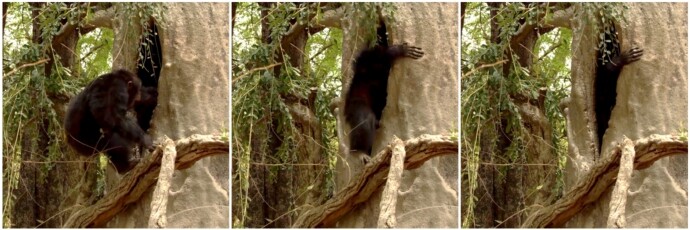
Still images from Video 4 in the Supplementary material, filmed by a team from Wildstar Films, showing Mike starting to build-up to display outside the baobab then entering the hollow baobab for the display climax.
Citation: Behaviour 163, 5 (2026) ; 10.1163/1568539X-bja10359
On June 9, 2023, Lex travelled away from the party that he had been travelling with that afternoon. From 17:40–17:55, he drummed and pant-hooted on at least five different trees as he travelled. One of them was a hollow baobab (Video 1 in the Supplementary material). Whether he entered or faced the cavity was obscured from sight by dense vegetation; however, there appears to be a noticeable change in volume and tone of the vocalization as he makes the first drum beats on the baobab (at 14 s).
On June 17, 2023, at 15:33, while travelling with the group, Lupin approached a baobab tree and started to sway. He held onto the side of the baobab hollow with his head partially inside and started to pant-hoot. He fully entered the baobab tree and drummed on it from the inside while continuing to vocalise, although did not produce the pant-hoot climax (Supplementary Video 2).
On Dec 20, 2025, at 17:19 (Video 3 in the Supplementary material), Mike was travelling with the group and was roughly 50 m apart from them. He ascends a log towards a hollow baobab and appears to take leaves from vines nearby to leaf clip, sways back and forth, and drums on the exterior then the interior of the hollow while pant-hooting.
One short clip (Figure 1; Video 4 in the Supplementary material, May–June 2023, exact date and time unknown, no audio available), shows Mike approach the hollow partway up a baobab tree, building up his display before entering the hollow for the display climax, then exiting and resting near the hollow.
3.2.2. Other tree species use while calling and drumming
While not an enclosed cavity, the deep folds of buttress roots may also provide chimpanzees with opportunities to exploit natural features that similarly adjust the acoustic properties of their displays. In a final video example (Supplementary Video 5), on June 11, 2023 at 08:14, Siberut drums on the deeply folded buttress of a taba (Cola cordifolia) tree and performs a pant-hoot vocalisation directly into the fold (note that there is another individual off camera pant-hooting at the start of the video).
4. Discussion
Savannah chimpanzees are known to use features of their environment, such as caves, to improve thermoregulation (Pruetz, 2007; Pruetz & Bertolani, 2009). Here, we describe adult chimpanzees in Fongoli making use of another environmental feature, baobab trees, to modify their drumming and vocalisations. Chimpanzee pant-hooted and drummed by fully or partially entering hollows in baobab trees, and by facing towards deep external folds in the buttresses of other species. These displays were as long or slightly longer than previously reported pant-hoot drumming display durations and, consistent with other reports of western chimpanzee displays (Arcadi et al., 1998; Eleuteri et al., 2025), drumming started during the build-up phase. Use of the hollow, either by entering entirely or facing closely, was associated with the high intensity climax and let down phases, which overlapped with the production of drumming.
Environmental modification of sounds produced through vocalization allows for potentially greater flexibility, as the signaller is no longer as strictly limited to the flexibility allowed by their vocal apparatus. It is also possible that making use of environmental features encodes specific information about the location of the signaller — if baobab trees reliably modify calls in a particular way, or even in individually tree-specific ways then, in principle, the audience could deduce that the individual is in a nearby baobab tree, and perhaps even the specific tree itself. Chimpanzees have highly detailed mental maps of key resource trees (Janmaat et al., 2013), and baobabs are an important food for the Fongoli community. Thus, if they can recognise the acoustic signature of baobab-modified calling and drumming, it would provide a precise real-time indication of the caller’s location.
The use of tree buttresses to drum on is widespread across chimpanzee populations (Eleuteri et al., 2025), and chimpanzees appear sensitive to the material properties of the buttress roots on which they drum (Fitzgerald et al., 2022; Wilhelm et al., 2024). The use of large resonant buttress surfaces is suggested to enhance the long-distance function of chimpanzee drumming signals (Eleuteri et al., 2022; Fitzgerald et al., 2022), which can travel for well over a kilometre (Boesch, 1991); however, preferential use of some soft-wood species is suggestive of alternative functions, or individual preferences (Wilhelm et al., 2024). Baobab trees present an unusual combination of characteristics that potentially modify acoustic performance in highly distinctive ways: the extraordinary large trunk diameters of mature specimens (the current record holder is the Sagole baobab Champion tree in South Africa, DBH = 10.8 m; Department of Forestry, Fisheries and the Environment, 2018) in combination with the tendency to produce hollow cores (both as a result of wood decay and as a structural property of stem growth) creates small enclosed spaces with the potential for resonance. These conditions are known to substantially distort sound transmission, particularly at low frequencies (Fuchs et al., 2001), which are characteristic of chimpanzees drumming (Arcadi et al., 1998; Eleuteri et al., 2022). At the same time, baobab wood density is very low (0.09–0.17 g/cm3; Chapotin et al., 2006; vs 0.22–0.82 g/cm3, buttress drumming tree ranges; Wilhelm et al., 2024), which typically slows the speed that sound travels through the material and increases absorption (Wegst, 2006); diminishing volume, but also creating a distinctive rich timbre, which is sometimes sought out in the construction of human instruments (drums; Omeja et al., 2004; soundboards; Wegst, 2006). Use of the hollows appears particularly associated with both the drumming bout and the climax phase of the pant-hoot; these high-intensity acoustic features are typically considered the ‘long-distance’ elements of the display and encode information on signaller identity and activity (Marler & Hobbett, 1975; Arcadi et al., 1998; Fedurek et al., 2016; Eleuteri et al., 2022). The decision to produce them within the hollow, where both their volume and tone appear to be impacted, likely has implications for both the information content and efficacy of any functional components of the display, offering an opportunity for future empirical testing.
This behaviour also raises questions about communicative perspective taking: from outside the baobab tree, the vocalisation sounds dampened, but we suggest that inside the tree it is likely to be amplified — perhaps substantially (Fuchs et al., 2001). The use of resonant spaces to modify communication is observed in other species (Lardner & Lakim, 2004; De Boer et al., 2015), but these cases are typically suggested to enhance the effect of the signal on its audience (Tan et al., 2014). The chimpanzees who perform drumming and pant hoots inside the tree have all also heard others do the same. Do they know that their acoustic experience inside the tree is different to their audience outside the tree? And if so, are they performing for the audience or perhaps for their own experience? The production of the highest intensity elements of the display (the drum and climax phase) under resonant conditions could provide a powerful physical stimulus. Our observation of them seeking out deep folds in the buttress roots of other species may provide further support: parallel structures can form an ‘acoustic trap’, reflecting sounds back towards the performer, rather than an external audience.
If true, this raises an intriguing possibility that there is a self-directed aspect to these performances — and that the performer is producing them, at least in part, for their own experience. In language, metalepsis describes a narrative structure in which the author (i.e. signaller) — as compared to the audience — is directly united with their work (Genette, 1980). We already have evidence that chimpanzees can consider multiple audiences in their signalling (Hobaiter et al., 2013; Fedurek et al., 2015,) and recognise that others’ knowledge may differ from their own (Krupenye et al., 2016). The study of comparative communication may benefit from integrating concepts from the study of language, beyond the nuts and bolts of units and how they are combined (von Bertalanffy, 1967). Just as primate social interactions were usefully conceptualised as exhibiting simple narrative structure in ways that may have scaffolded syntax (Seyfarth et al., 2005), baobab drumming may provide a useful stimulus for investigating the origins of other cognitive-linguistic capacities. Empirical measurement of the ways in which baobab hollows shape the acoustic properties of pant-hoots and drumming is an essential next step. These should include investigation of the signals as produced by the signaller’s body (e.g., Stoeger et al., 2012; Eleuteri et al., 2022; Lameira et al., 2025), and of their form as these signals are transmitted through the environment (e.g., Lardner & Lakim, 2004; Hardus et al., 2009a). For example, it is an open question as to whether any change in the perceived sound of calling and drumming in a baobab hollow is the result of modifications made by the signaller, by the interaction of the signal and acoustic environment, or both. Moreover, work to also establish how often the behaviour is performed when alone as compared to a social setting, as well as information on the responses of others to pant-hoots and drumming displays performed within and outwith baobab trees will be key to furthering our understanding of why these displays are performed and how they are perceived. Observations that support potential self-directed performance would enrich our ideas of how chimpanzees see themselves.
Corresponding authors, e-mail addresses: kirstygrahamcuny@gmail.com; clh42@st-andrews.ac.uk
Acknowledgements
Many thanks to the Fongoli research staff Jacques Keita, Nazaire Bonang, Jérémie Bindia, Dondo “Johnny” Kante, and the Camara family. Also to the team from Wildstar Films who captured the behaviour while filming at Fongoli. We thank the Editor and two anonymous reviewers for their constructive suggestions that improved the manuscript. This research received funding from the European Union’s 8th Framework Programme, Horizon 2020, under grant agreement no 802719. Research at Fongoli has been supported by the National Geographic Society, National Science Foundation, Leakey Foundation, Wenner-Gren Foundation for Anthropological Research, American Society of Primatologists, Primate Conservation Inc., Ape Cognition Institute, Iowa State University and Texas State University.
References
Arcadi, A.C., Robert, D. & Boesch, C. (1998). Buttress drumming by wild chimpanzees: Temporal patterning, phrase integration into loud calls, and preliminary evidence for individual distinctiveness. — Primates 39: 505-518.
Arcadi, A.C. (1996). Phrase structure of wild chimpanzee pant hoots: patterns of production and interpopulation variability. — Am. J. Primatol. 39: 159-178.
Boesch, C. (1991). Symbolic communication in wild chimpanzees? — Hum. Evol. 6: 81-89. DOI:10.1007/BF02435610.
Bogart, S.L. & Pruetz, J.D. (2008). Ecological context of savanna chimpanzee (Pan troglodytes verus) termite fishing at Fongoli, Senegal. — Am. J. Primatol. 70: 605-612.
Bowling, D.L., Garcia, M., Dunn, J.C., Ruprecht, R., Stewart, A., Frommolt, K.H. & Fitch, W.T. (2017). Body size and vocalization in primates and carnivores. — Sci. Rep. 7: 41070.
Burkart, J.M., Adriaense, J.E.C., Brügger, R.K., Miss, F.M., Wierucka, K. & Van Schaik, C.P. (2022). A convergent interaction engine: vocal communication among marmoset monkeys. — Philos. Trans. Roy. Soc. Lond. B: Biol. Sci. 377: 20210098.
Chapotin, S.M., Razanameharizaka, J.H. & Holbrook, N.M. (2006). A biomechanical perspective on the role of large stem volume and high water content in baobab trees (Adansonia spp.; Bombacaceae). — Am. J. Bot. 93: 1251-1264.
De Boer, B., Wich, S.A., Hardus, M.E. & Lameira, A.R. (2015). Acoustic models of orangutan hand-assisted alarm calls. — J. Exp. Biol. 218: 907-914.
Department of Forestry, Fisheries and the Environment (2018). State of the Forests Report: 2018 South Africa. — Government of the Republic of South Africa, Pretoria. Available at https://www.gov.za/sites/default/files/gcis_document/202208/stateofforestssouthafricareport2018.pdf.
Dezecache, G., Zuberbühler, K., Davila-Ross, M. & Dahl, C.D. (2021). Flexibility in wild infant chimpanzee vocal behavior. — J. Lang. Evol. 6: 37-53.
Eleuteri, V., Henderson, M., Soldati, A., Badihi, G., Zuberbühler, K. & Hobaiter, C. (2022). The form and function of chimpanzee buttress drumming. — Anim. Behav. 192: 189-205.
Eleuteri, V., van der Werff, J., Wilhelm, W., Soldati, A., Crockford, C., Desai, N., Fedurek, P., Fitzgerald, M., Graham, K.E., Koops, K., Pruetz, J., Samuni, L., Slocombe, K., Stoeger, A., Wilson, M.L., Wittig, R.M., Zuberbühler, K., Camara, H.D., Mamy, G., Ravignani, A. & Hobaiter, C. (2025). Chimpanzee drumming shows rhythmicity and subspecies variation. — Curr. Biol. 35: 2448-2456.
Ey, E., Pfefferle, D. & Fischer, J. (2007). Do age- and sex-related variations reliably reflect body size in non-human primate vocalizations? A review. — Primates 48: 253-267.
Fedurek, P., Slocombe, S.E. & Zuberbühler, K. (2015). Chimpanzees communicate to two different audiences during aggressive interactions. — Anim. Behav. 110: 21-28.
Fedurek, P., Zuberbühler, K. & Dahl, C.D. (2016). Sequential information in a great ape utterance. — Sci. Rep. 6: 38226.
Fitzgerald, M., Willems, E.P., Gaspard Soumah, A., Matsuzawa, T. & Koops, K. (2022). To drum or not to drum: Selectivity in tree buttress drumming by chimpanzees (Pan troglodytes verus) in the Nimba Mountains, Guinea. — Am. J. Primatol. 84: e23382.
Fuchs, H.V., Zha, X., Zhou, X. & Drotleff, H. (2001). Creating low-noise environments in communication rooms. — Appl. Acoust. 62: 1375-1396.
Genette, G. (1980). Narrative discourse an essay in method. — Cornell University Press, Ithaca, NY.
Girard-Buttoz, C., Bortolato, T., Laporte, M., Grampp, M., Zuberbühler, K., Wittig, R.M. & Crockford, C. (2022). Population-specific call order in chimpanzee greeting vocal sequences. — iScience 25: 104851.
Goodall, J. (1986). The chimpanzees of Gombe: Patterns of behavior. — Harvard Univeristy Press, Cambridge, MA.
Hardus, M.E., Lameira, A.R., Van Schaik, C.P. & Wich, S.A. (2009a). Tool use in wild orang-utans modifies sound production: a functionally deceptive innovation? — Proc. Roy. Soc. Lond. B: Biol. Sci. 276: 3689-3694.
Hardus, M.E., Lameira, A., Singleton, I., Knott, C.D., Morrogh-Bernard, H., Ancrenaz, M., Utami-Atmoko, S.S. & Wich, S.A. (2009b). A description of the orangutan’s vocal and sound repertoire, with a focus on geographic variation. — In: Orangutans (Wich, S., Utami, S., Setia, T. & Van Schaik, C., eds). Oxford University Press, Oxford, p. 49-64.
Heinsohn, R., Zdenek, C.N., Cunningham, R.B., Endler, J.A. & Langmore, N.E. (2017). Tool-assisted rhythmic drumming in palm cockatoos shares key elements of human instrumental music. — Sci. Adv. 3: e1602399.
Hobaiter, C., Byrne, R.W. & Zuberbühler, K. (2017). Wild chimpanzees use of single and combined vocal and gestural signals. — Behav. Ecol. Sociobiol. 71: 1-13.
Janmaat, K.R., Ban, S.D. & Boesch, C. (2013). Chimpanzees use long-term spatial memory to monitor large fruit trees and remember feeding experiences across seasons. — Anim. Behav. 86: 1183-1205.
Kalan, A.K., Carmignani, E., Kronland-Martinet, R., Ystad, S., Chatron, J. & Aramaki, M. (2019). Chimpanzees use tree species with a resonant timbre for accumulative stone throwing. — Biol. Lett. 15: 20190747.
Krupenye, C., Kano, F., Hirata, S., Call, J. & Tomasello, M. (2016). Great apes anticipate that other individuals will act according to false beliefs. — Science 354: 110-114.
Lameira, A.R., Caneco, B., Kershenbaum, A., Santamaría-Bonfil, G. & Call, J. (2025). Generative vocal plasticity in chimpanzees. — iScience 28: 112381.
Lardner, B. & Lakim, M.B. (2004). Female call preferences in tree-hole frogs: why are there so many unattractive males? — Anim. Behav. 68: 265-272.
Leroux, M., Bosshard, A.B., Chandia, B., Manser, A., Zuberbühler, K. & Townsend, S.W. (2021). Chimpanzees combine pant hoots with food calls into larger structures. — Anim. Behav. 179: 41-50.
Lindshield, S., Danielson, B.J., Rothman, J.M. & Pruetz, J.D. (2017). Feeding in fear? How adult male western chimpanzees (Pan troglodytes verus) adjust to predation and savanna habitat pressures. — Am. J. Phys. Anthropol. 163: 480-496.
Marler, P. & Hobbett, L. (1975). Individuality in a long-range vocalization of wild chimpanzees. — Z. Tierpsychol. 38: 97-109.
Mathevon, N., Keenan, S., Stevens, J.M., Zuberbühler, K. & Levréro, F. (2025). Vocal accommodation in bonobos. — Anim. Behav. 219: 123014.
Omeja, P., Obua, J. & Cunningham, A.B. (2004). Regeneration, density and size class distribution of tree species used for drum making in central Uganda. — Afr. J. Ecol. 42: 129-136.
Pal, A. & Sinha, A. (2022). Beyond food for thought: tool use and manufacture by wild nonhuman primates in nonforaging contexts. — Curr. Opin. Behav. Sci. 47: 101201.
Pruetz, J.D. (2007). Evidence of cave use by savanna chimpanzees (Pan troglodytes verus) at Fongoli, Senegal: implications for thermoregulatory behavior. — Primates 48: 316-319.
Pruetz, J.D. & Bertolani, P. (2009). Chimpanzee (Pan troglodytes verus) Behavioral responses to stresses associated with living in a savanna-mosaic environment: Implications for hominin adaptations to open habitats. — Paleoanthropology: 252-262.
Pruetz, J.D., Marchant, L.F., Arno, J. & McGrew, W.C. (2002). Survey of savanna chimpanzees (Pan troglodytes verus) in southeastern Senegal. — Am. J. Primatol. 58: 35-43.
Rubis, J. (2020). The orang utan is not an indigenous name: Knowing and naming the maias as decolonizing epistemology. — Cult. Stud. 34: 811-830.
Sanogo, D., Badji, M., Diop, M., Samb, C.O., Tamba, A. & Gassama, Y.K. (2015). Évaluation de la production en fruits de peuplements naturels de Baobab (Adansonia digitata l.) dans deux zones climatiques au Sénégal. — J. Appl. Biosci. 85: 7838-7847.
Seyfarth, R. & Cheney, D. (2018). Pragmatic flexibility in primate vocal production. — Curr. Opin. Behav. Sci. 21: 56-61.
Seyfarth, R., Cheney, D. & Bergman, T.J. (2005). Primate social cognition and the origins of language. — Trends. Cogn. Sci. 9: 264-266.
Stoeger, A.S., Mietchen, D., Oh, S., de Silva, S., Herbst, C.T., Kwon, S. & Fitch, W.T. (2012). An Asian elephant imitates human speech. — Curr. Biol. 22: 2144-2148.
Tan, W.-H., Tsai, C.-G., Lin, C. & Lin, Y.K. (2014). Urban canyon effect: storm drains enhance call characteristics of the Mientien tree frog. — J. Zool. 294: 77-84.
Taylor, D., Clay, Z., Dahl, C.D., Zuberbühler, K., Davila-Ross, M. & Dezecache, G. (2022). Vocal functional flexibility: what it is and why it matters. — Anim. Behav. 186: 93-100.
Taylor, D., Gustafsson, E., Dezecache, G. & Davila-Ross, M. (2023). Vocal functional flexibility in the grunts of young chimpanzees. — iScience 26: 107791.
Townsend, S.W. & Manser, M.B. (2013). Functionally referential communication in mammals: the past, present and the future. — Ethology 119: 1-11.
Van Schaik, C.P., Ancrenaz, M., Borgen, G., Galdikas, B., Knott, C.D., Singleton, I., Suzuki, A., Utami, S.S. & Merrill, M.Y. (2003). Orangutan cultures and the evolution of material culture. — Science 299: 102-105.
Van Schaik, C.P., Van Noordwijk, M. & Wich, S.A. (2006). Innovation in wild Bornean orangutans (Pongo pygmaeus wurmbii). — Behaviour 143: 839-876.
Von Bertalanffy, L. (1967). General theory of systems: application to psychology. — Soc. Sci. Inf. 6: 125-136.
Wegst, U.G.K. (2006). Wood for sound. — Am. J. Bot. 93: 1439-1448.
Wilhelm, W., Eleuteri, V., Koops, K., Fitzgerald, M., Zuberbühler, K. & Hobaiter, C. (2024). Selectivity in buttress drumming tree properties among the chimpanzees (Pan troglodytes schweinfurthii) of the Waibira community in Budongo Forest, Uganda. — Am. J. Primatol. 87: e23712.
Zanoli, A., Raimondi, T., De Gregorio, C., Valente, D., Carugati, F., Torti, V., Friard, O., Miaretsoa, L., Giacoma, C. & Gamba, M. (2023). “The song remains the same”: not really! Vocal flexibility in the song of the indris. — Anim. Cogn. 26: 2009-2021.