Abstract
The legacy of Frans de Waal reshaped our understanding of animal sociality, demonstrating that culture in nonhuman primates extends beyond learned acts to encompass the organization of social life itself. Building on this foundation, I conjecture that the primary evolutionary unit of culture is not the discrete social tradition â such as the grooming handclasp in chimpanzees or eye-poking in capuchins â but the social culture: the shared, enduring norms that regulate conflict, affiliation, and cooperation within groups. Evidence from de Waalâs work on macaques and Sapolskyâs long-term studies of baboons reveals that tolerant or despotic social styles can be socially learned, transmitted across generations, and maintained even after membership turnover. Such cultures may alter rates of aggression, reconciliation, stress physiology, and survival, thereby potentially exerting direct fitness effects. I outline several research priorities for uncovering the behavioural mechanisms of social cultural transmission â female-mediated social induction, developmental social inheritance, cultural tipping points, and individual variation in norm adoption. Reframing primate culture in this way shifts focus from the replication of behaviours to the inheritance of social systems, linking proximate processes of social learning with the ultimate selection pressures that favour social stability. This perspective, inspired by de Waalâs enduring insights, endeavours to situate social culture as the most evolutionarily consequential expression of culture in nonhuman primates and a key precursor to the moral and institutional cultures of humans.
1. Introduction
In 1993, Frans de Waal and Denise Johanowicz conducted a landmark study demonstrating that species-typical social styles in macaques are not fixed, but can be modified through social experience (de Waal & Johanowicz, 1993). The authors focused on post-conflict reconciliation, a behaviour expressed at very different frequencies across macaque species and referring to friendly contact between former opponents that occurs soon after aggression and serves to reduce tension (De Waal & Yoshihara, 1983; Aureli et al., 1989; Thierry, 2000). Rhesus macaques (Macaca mulatta) are typically more despotic and reconcile infrequently, whereas stump-tailed macaques (Macaca arctoides) are socially tolerant and show high reconciliation rates (Thierry, 2000, 2007).
To test whether these differences reflect rigid species traits or flexible, socially learned styles, juvenile rhesus macaques were co-housed in mixed-species groups with stump-tailed macaques for several months (de Waal & Johanowicz, 1993). During this period, the rhesus juveniles were repeatedly exposed to the stump-tailsâ frequent and peaceful reconciliation patterns. Strikingly, the respective rhesus monkeys began to engage in reconciliation at much higher rates, approaching those of the stump-tailed macaques. Crucially, when the species were later separated, the rhesus macaques maintained the elevated reconciliation levels within their own species groups, demonstrating that the change was not merely a momentary response to the presence of more tolerant partners, but a stable shift in their own social behaviour.
This experiment was one of the first to show that key features of social style â sometimes thought to be largely genetically determined (Thierry, 2013) â can be shaped by social environment and transmitted through interaction (also see Sinha, 2005). As such, it provided powerful evidence that macaque social systems can exhibit plasticity, setting the stage for later research on primate social culture and the mechanisms by which tolerant or despotic styles may emerge and persist within groups (e.g., Dubuc et al., 2012; Cronin et al., 2014; Kaigaishi et al., 2019).
Later on, in 1996, de Waal continued his studies into social cultures and examined how patterns of affiliation in rhesus macaques are transmitted across generations, arguing that social network structure itself can be culturally inherited (de Waal, 1996). Building on the idea that primate societies transmit dominance rank from mothers to daughters, de Waal asked whether more subtle aspects of social life â such as grooming preferences and affiliative partners â also show continuity due to social experience rather than genetics alone. To address this, he followed 23 captive female rhesus macaques from birth to adulthood and recorded their affiliative interactions with same-age peers, while also documenting kinship relationships and the rank distances between their mothers. Using multivariate analyses, he then tested how strongly a daughterâs social ties resembled those of her mother, and whether this resemblance could be explained by kinship or rank alone.
The findings were striking: maternal affiliative patterns predicted up to 64% of the variance in daughtersâ affiliative relationships before any controls were applied. While a substantial portion of this resemblance was due to kinship â offspring tend to affiliate with individuals who are closely related to their mothers â maternal influence remained significant even after statistically controlling for kinship. This indicates that daughters are not merely forming ties based on genetic relatedness, but are also likely adopting their mothersâ social preferences through observation, association, or active facilitation. Interestingly, this pattern held for femaleâfemale relationships but not for affiliations with male peers, suggesting that cultural transmission of social structure is especially relevant to the female matrilineal core of macaque societies (de Waal, 1996).
De Waal interpreted these results as evidence that social networks can be socially learned and perpetuated over time, effectively forming a kind of âsocial cultureâ within macaque groups. While dominance hierarchies are the most visible element of inherited social structure, this study highlighted that affiliative styles â the softer architecture of who interacts peacefully with whom â can also be passed down through social mechanisms. De Waal concluded that group-specific social styles are not fixed products of biology, but can be maintained and transmitted through social learning. In this way, his study complemented their earlier experimental work with Johanowicz by showing that not only can rhesus macaques acquire more tolerant social styles through exposure, but even within a single species, the specific configuration of affiliative networks can be culturally reproduced across generations.
In his thinking and writing, Frans de Waal was substantially influenced by scientific reflections from Japanese scholars, in particular Kinji Imanishi (de Waal, 2001). Imanishi was first known in the Anglo-Saxon world by a translated abstract of his seminal work on the evolution of humanity (Imanishi, 1952). In his essay, Imanishi proposed that the roots of culture lie not in isolated innovations but in the collective life of social groups. Kinji Imanishiâs conception of culture â formulated in mid-20th-century Japanese primatology â treated culture as differences in âways of lifeâ between groups of the same species, sustained through social transmission rather than genetic divergence (Nakamura & Nishida, 2006; Matsuzawa & McGrew, 2008). This view was embedded in a broader Japanese intellectual tradition that emphasizes continuity among living beings, interdependence within communities of life, and the emergence of group-specific patterns from long-term cohabitation rather than individualistic competition. Accordingly, Japanese primatology, influenced by Imanishi, developed a relational perspective on animal societies: individuals are understood as nodes in a collective social field, and group-level styles of living become central objects of study (Nakamura & Nishida, 2006; Matsuzawa & McGrew, 2008; DeTroy et al., 2023).
Frans de Waal explicitly embraced this framework, crediting Japanese primatology â and Imanishi in particular â for broadening the Western perspective on culture. In The Ape and the Sushi Master (2001), he defined culture as âa way of life shared by the members of one group but not necessarily with the members of other groups of the same speciesâ (de Waal, 2001:31), a formulation that echoes Imanishiâs emphasis on group-level patterns rather than isolated behaviours. De Waal argued that what matters is the socially learned fabric of knowledge, habits, skills, and preferences that characterize a community. In later work with Kristin Bonnie, he reiterated that culture is best understood not as a set of discrete traditions but as a socially generated, group-specific orientation to the world â an entire style of life that arises from sustained social learning and interaction (de Waal & Bonnie, 2009).
Contemporary research on animal culture has largely focused on delineated behavioural traditions â discrete, cross-group differences in tool use, gestures, feeding techniques, or other traits (e.g., Whiten et al., 1999; Perry et al., 2003; van Schaik et al., 2003; Leca et al., 2007; Santorelli et al., 2011; Robbins et al., 2016; Pascual-Garrido, 2019). This trait-based approach has been invaluable for implicating the presence of cultural processes across species. Yet, it can obscure what both Imanishi and de Waal highlighted: the potency of social cultures as relational systems. Culture, on this broader view, is not simply a list of traditions but a social ecology â a matrix of tolerance, learning opportunities, shared histories, and interactional styles that scaffold the emergence, diffusion, and transformation of recognizable traditions. Re-engaging with this conceptualization invites us to study animal cultures not merely as clusters of traits but as group-level ways of being, from which traditions arise and through which they gain their meaning (also see Cantor & Whitehead, 2013). A (slowly) growing body of work indeed hints at the presence and consequences of such emergent social cultures in animal societies.
2. Pacific cultures in baboons
Robert Sapolsky and Lisa Shareâs seminal study of the âForest Troopâ of wild olive baboons provides perhaps one of the clearest demonstrations of socially transmitted culture shaping the overall social climate of a primate group (Sapolsky & Share, 2004). In the mid-1980s, this troop experienced a tuberculosis outbreak that disproportionately killed the most aggressive high-ranking males. The result was an unusually peaceful social environment in which the remaining males displayed lower aggression, higher rates of grooming, reduced dominance intimidation, and markedly lower physiological stress, especially among subordinates. What makes the finding remarkable is that this tolerant âpacificâ social style persisted long after the original males died or dispersed. Over the next decade, entirely new immigrant males â who had never experienced the original mortality event â entered the troop and nonetheless adopted the same affiliative, low-aggression behaviour. Rather than reverting to the typical despotic baboon pattern, the Forest Troop maintained this tolerant social atmosphere across generations of males, even though male baboons typically disperse and are not philopatric (Sapolsky & Share, 2004; Sapolsky, 2006).
Sapolsky and Share argued that the key to the persistence of this culture lay in the behaviour of resident females and the social expectations they imposed. New males entering the troop were met not with submission or hostility, but with affiliative interactions initiated by females, effectively âtrainingâ them into the local norms (Sapolsky & Share, 2004). Through social pressure, observation, and reinforcement, the troop reproduced a peaceful style of interaction without any genetic changes or continued presence of the original tolerant males. This makes the Forest Troop a strong case of group-level culture: a stable, transmissible pattern of social life that shapes stress physiology, dominance structures, and behavioural strategies in a way not reducible to ecology or heredity (Sapolsky, 2006).
Sapolskyâs baboon studies provide a powerful field-based complement to the earlier-mentioned findings on social styles in macaques (de Waal & Johanowicz, 1993; De Waal, 1996). Whereas de Waal showed that individuals can adopt tolerant behaviours through exposure and that social networks can be transmitted matrilineally, Sapolsky demonstrated that an entire group-level social climate can be culturally maintained in the wild. Together, these studies converge on a transformative insight: primate social systems are not rigid, genetically preprogrammed entities but culturally dynamic structures in which reconciliation patterns, affiliative preferences, dominance style, and even stress physiology can be shaped, transmitted, and stabilized by social processes. This challenges long-standing assumptions about the relative inevitability of species-typical social behaviour (van de Waal, 2018; Kaufhold & van Leeuwen, 2019) and may position primates, especially macaques and baboons (but also see recent indications of social cultures in other primate species: Borgeaud et al., 2016; van Leeuwen et al., 2018; Kerjean et al., 2024; van Leeuwen et al., 2024), as key models for understanding the evolutionary roots of socially learned group norms and cultural variation (Whiten, 2011, 2021; Whiten & van de Waal, 2018; Howard-Spink et al., 2025).
3. Rethinking cultural units: from social traditions to social culture
As alluded to before, much of primate cultural research over the past three decades has focused on material and social traditions, i.e., distinct, observable behaviours such as the grooming handclasp in chimpanzees (McGrew et al., 2001; van Leeuwen et al., 2012), the social âeye-pokingâ in capuchins (Perry et al., 2003; Perry, 2011), or specific tool-use variants across great ape communities (Whiten et al., 1999; Luncz, et al., 2012). Here, I would like to explore whether they arguably represent only the surface texture of cultural variation: discrete acts that can be socially transmitted and mapped as behavioural âpatchesâ across populations. By contrast, the forms of social culture referred to by de Waal, Johanowicz, and Sapolsky concern not particular acts, but the underlying structure and tone of social life that shape how conflicts are resolved, how alliances are formed, and how individuals coexist.
In group-living species, individuals typically inhabit patterned networks of interaction rather than random aggregations (Whitehead, 2008). These social structures form the fabric from which the very opportunities (and constraints) for interaction emerge (Kappeler, 2019). Increasing evidence suggests that certain forms of social structure not only make groups organized to learn (van Boekholt et al., 2021), but also stabilize cooperation and affiliative care, possibly generating substantial fitness advantages (e.g., see Silk, 2007; Cheney et al., 2016).
Key features of social structure â such as dominance gradients, kinship, social tolerance, and repeated affiliative interactions â determine who has access to whose knowledge (Coussi-Korbel et al., 1995; van Boekholt et al., 2021). In tolerant primate societies where multiple models are available and interactions are predictable, naive individuals may be able to more efficiently acquire complex behavioural skills and social norms, or at least these probabilities are heightened. This aligns with the cultural intelligence hypothesis, which proposes that selection favoured primates that rely heavily on social information to acquire adaptive skills (van Schaik & Burkart, 2011). Access to social learning is not evenly distributed; individuals who are central, well-connected, or embedded in stable relationships disproportionately influence the spread of information, turning social structure into an information-processing system in which high-quality connections accelerate learning while fragmented networks constrain it (Brooker et al., in press). The density, clustering and diversity of social ties further influence the benefits of information flow and coordination, with groups or populations possessing stable, well-connected networks exhibiting more rapid and reliable transmission of knowledge and enhanced group-level competencies (Kurvers et al., 2014; Pasquaretta et al., 2014).
Furthermore, stable affiliative bonds (across mammals and birds) seem to be consistently associated with higher survival and reproductive success, enabled through coalitionary support, stress buffering, communal infant care, cooperative feeding, and increased access to social partners (Silk, 2007; Berghänel et al., 2011; Thompson, 2019). Many of these cooperative mechanisms are reinforced by norms of tolerance, grooming, food sharing, or alloparental investment (Thompson, 2019). In multi-level societies â social systems structured into nested layers of organization such as stable core units, intermediate clusters, and larger community-level groupings (Grueter et al., 2020) â individuals distribute cooperative effort across nested layers (e.g., dyads, cliques, bands, and larger aggregations) creating resilient collective structures; when socio-cultural norms promote affiliation and prosociality across these layers (Cantor et al., 2015), groups become more cohesive, better coordinated, and more stable under ecological uncertainty (Kurvers et al., 2014; Dakin & Ryder, 2020). In this way, social structure and culture form coupled systems that transform groups from mere collections of individuals into coordinated, caring collectives, yielding efficiency, resilience, and reduced conflict â key selective advantages in the evolution of sociality across species, including our own (Bell et al., 2009; Cantor & Whitehead, 2013).
Hence, the distinction between (social) traditions and social culture is not semantic but fundamental. Where social traditions are content-specific, describing what individuals do differently across groups; social cultures are structural and normative (sensu the ethological viewpoint, defined as âsocially maintained patterns of behavioural conformity within a communityâ; Andrews et al., 2024; Westra et al., 2024), describing how individuals relate to one another within a group. A grooming handclasp or eye-poking gesture, however idiosyncratic, has limited bearing on the social organization of the group. It is a stylistic convention â a marker of cultural identity perhaps (McGrew, 1992), but not necessarily a determinant of fitness. In contrast, a tolerant or despotic social culture directly modulates rates of aggression (Sapolsky & Share, 2004), reconciliation (de Waal & Johanowicz, 1993), coalition support, and stress physiology (Sapolsky, 2006) â variables that have immediate consequences for survival and reproduction. Whereas traditions illustrate that primates can copy behaviour, social cultures reveal that they can inherit social systems.
Empirically, these two cultural domains operate on different causal scales. Social traditions propagate through observational learning (Bandura, 1971; Hoppitt & Laland, 2013), sometimes maintained by forms of conformity (Haun et al., 2013) and modle-specific learning biases (Henrich & Gil-White, 2001; Horner et al., 2010; Kendal et al., 2015; van Leeuwen & Hoppitt, 2023). Social cultures, by contrast, are likely the resultant of recurrent interactional feedback loops â where behaviours are both responses to and reinforcements of shared expectations (i.e., socialisation; van Schaik & van Duijnhoven, 2016). This difference in mechanism leads to a difference in stability: a tradition can vanish when innovators disappear (de Waal & Seres, 1997), but a social culture persists as long as the interactional equilibrium is maintained, even after the original instigators are gone. Sapolskyâs âForest Troopâ retained its pacific climate despite complete turnover of adult males, which may be hard (not impossible; van Leeuwen, 2021) for a delineated tradition, especially when the main proponents pass away.
Conceptually, prioritizing social culture as the unit of analysis shifts the evolutionary question from âhow do animals copy acts?â to âhow do animals construct and sustain cohesive and cooperative units?â This reframing matters because selection acts on functional outcomes, not on the specific behavioural forms that instantiate them. A troopâs tolerant culture reduces injury rates, cortisol levels, and infant mortality; these are clear fitness advantages. The precise gesture through which reconciliation is achieved or by which primates affiliate with one another is evolutionarily secondary. This is notwithstanding the functional relevance of certain cultural traditions when instrumental, e.g., nut-cracking in chimpanzees (Boesch et al., 1994), although even here the specific variant may not be the locus of evolutionary adaptation (Luncz et al., 2018). Thus, in this line of thinking, while behavioural traditions remain informative for documenting learning capacities, they are not necessarily the evolutionary currency of culture. It is the organization of social relations â the collective patterns of trust (Engelmann & Herrmann, 2016; Kaigaishi et al., 2019), conflict management (Aureli & Waal, 2000) and alliances (Silk et al., 2003; Silk, 2007) â that shape adaptive success.
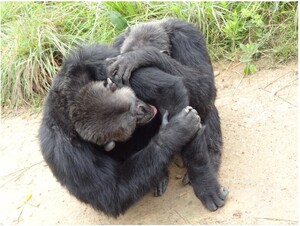
Reorienting cultural research toward social culture as the primary unit of inheritance restores attention to what culture fundamentally is: a shared system of interactional norms that governs how individuals coordinate, compete, and care (Enfield & Levinson, 2006; Boyd & Richerson, 2009; Henrich, 2015). Such systems are the most plausible precursors to human moral orders and institutional cooperation (Enfield & Levinson, 2006; Levinson & Jaisson, 2006; Chudek & Henrich, 2011). They show that before hominins fashioned tools or rituals, their primate ancestors were already transmitting ways of being social (McGrew, 2004) â and it may be these socially transmitted ways of life, rather than their emergent traditions, that most directly illuminate the evolutionary origins of culture (Figure 1).

Two chimpanzees engage in social grooming, a core affiliative behaviour embedded within group-specific social cultures. Such social cultures can emerge and be maintained through mechanisms including behavioural contagion, third-party policing, and conformity to local norms, yet the population-level dynamics and fitness consequences of these processes remain poorly understood. Closer empirical scrutiny of these cultural mechanisms in non-human primates may shed light on the adaptive landscape in which primates live and help situate human cultural capacities within a broader primate context (© Edwin van Leeuwen).
Citation: Behaviour 163, 3-4 (2026) ; 10.1163/1568539X-bja10348
Of course, social culture does not unfold in a vacuum. Any theory of biological adaptation has to reckon with the fact that individuals live in a force field of interacting determinants, as for instance emphasised in socio-ecological theories and sociology more broadly (Sterck et al., 1997; Koenig et al., 2013; Moscovice et al., 2020): resource distributions, predation risk, social and demographic structure, intergroup relations, and power asymmetries all shape the fitness landscape. In the same mix are genetic predispositions (e.g., Staes et al., 2014; Housman et al., 2025; Ostridge et al., 2025) and founder effects â as in the previously addressed case where historical perturbations in group composition produced a lasting shift in baboon social style (Sapolsky & Share, 2004) â which can all bias the range of trajectories open to a group. Within this multidimensional field, social culture can be viewed as a flexible phenotype, exploring parameter space for configurations that buffer individuals and groups against selection pressures such as intergroup competition, food scarcity, and predation (for humans, see Boyd & Richerson, 2009; Richerson et al., 2016).
An outstanding question, then, is to chart the space in which social culture can achieve such adaptive benefits. Certain cultural regimes of tolerance (van Leeuwen et al., 2023) or conflict management (Brooker et al., submitted) may reduce damaging within-group aggression (Byron et al., 2026) and thus support coalitionary defence; stable coalition practices and grooming markets may buffer variance in access to food or mates; information-sharing norms can increase foraging efficiency in heterogeneous environments. Formally, this amounts to asking which group-level behavioural regularities (e.g. patterns of tolerance, coalition formation, risk-sharing) reliably reduce variance in payoffs or exposure to hazards, and how these benefits scale with group size, population turnover and social network topology (for a recent ecological titration, see Albery et al., 2025).
A further question concerns how such social cultures arise and persist. High-fidelity copying of specific motor patterns, as in some traditions (Call et al., 2005; Horner & Whiten, 2005; Whiten et al., 2005), may not always be necessary. Yet, cognitively simple(r) processes like behavioural contagion or social facilitation (Dindo et al., 2009; Sandars & Clay, 2025) are unlikely to sustain a culture under demographic turnover or repeated shocks (akin to the washing out of behavioural signatures in the absence of conformity in models of human cultural evolution, see Henrich & Boyd, 1998). This suggests the need for mechanisms that stabilise group-typical patterns. One such mechanism may be policing, as documented in pigtailed macaques (Macaca nemestrina), where a small set of high-power individuals intervene âimpartiallyâ in emerging conflicts (Flack et al., 2006). These low-cost interventions reduce escalation, dampen conflict cascades, and preserve the connectivity and predictability of the social network, thereby making cooperative equilibria more robust to perturbations (Flack et al., 2005).
A complementary angle is to treat these stabilised patterns explicitly as normative phenomena. On the account recently developed by Westra, Andrews and colleagues (Andrews et al., 2024; Westra et al., 2024), the primary explanandum is not an internal ânorm moduleâ, as often referred to in human studies (Henrich et al., 2006; Herrmann et al., 2008), but normative regularities â socially maintained patterns of behavioural conformity in a community, often sustained by expectations and sanctioning, and possibly implemented by many different underlying processes (from emotions and learning to social network structure and ecological constraints). This provides a bottom-up, ethologically grounded normative framework where one starts from observable regularities in primate societies (e.g., standard ways of resolving conflicts, tolerated levels of aggression, customary responses to violations) and then asks which mix of mechanisms â attentional biases (e.g., Kret et al., 2016), reinforcement histories (e.g., de Waal & Luttrell, 1988; Dakin & Ryder, 2020), social expectations (e.g., Clay et al., 2016; Engelmann et al., 2017), emotional responses to deviation (e.g., von Rohr., 2010; Bethell et al., 2012), third-party interventions (e.g., Flack et al., 2006; von Rohr et al., 2012) â sustain them. On this view, primate social cultures are not merely clusters of shared habits but constellations of normative regularities that regulate interaction, structure expectations, and help maintain adaptive social orders in the face of ecological and demographic challenges.
4. Future directions: why social culture matters
The early studies by Frans de Waal and colleagues on macaques and by Sapolsky and Share on baboons point to the intriguing yet largely overlooked possibility that the most potent and consequential forms of primate culture may not be discrete traditions, but enduring social cultures. These findings challenge the traditional emphasis on behavioural traditions and warrant a shift of focus in animal culture research. Future research should therefore reorient from cataloguing idiosyncratic behaviours to identifying the mechanisms by which social systems themselves are transmitted and maintained.
While group-specific social dynamics are increasingly documented (e.g., Cantor & Whitehead, 2015; Borgeaud et al., 2016; van Leeuwen et al., 2018, 2024; Kerjean et al., 2024), research on the emergence and maintenance of these group-level signatures remains limited. Thus, one central goal is to uncover the behavioural channels of transmission that stabilize tolerant or despotic social cultures. Female-mediated social induction â where resident females ârewardâ peaceful males and marginalize aggressors â may provide a possible mechanism of continuity, as suggested by the persistence of tolerant climates in both macaque and baboon groups (cf., the self-domestication hypothesis; Hare et al., 2012). Quantitative behavioural tracking in semi-free ranging populations could test this directly by observing how female responses guide immigrant malesâ integration into local sociality.
Another exciting avenue is understanding the persistence and transformation of social states. If social styles are culturally encoded, groups may exhibit path dependence, resisting reversion even when demographic composition changes (e.g., see the counterfactual analyses in DeTroy et al., 2021). Long-term data combined with dynamic state-space modelling could reveal whether for instance social tolerance and despotism represent alternative stable states, each maintained through social feedback loops rather than individual temperaments. This would establish that cultural stability plays a significant role in anchoring group-level social structures.
Equally important is elucidating how social culture is ontogenetically acquired. De Waalâs evidence that daughters replicate their mothersâ affiliative networks points to developmental windows during which young primates internalize social expectations (de Waal, 1996). Fine-grained longitudinal data can test whether such behavioural adoption arises through observational learning, emotional contagion, or direct social facilitation (Sandars & Clay, 2025). These mechanisms would reveal how interactional norms are transmitted across generations and possibly the existence of developmental milestones (Whiten & van de Waal, 2018), like in humans (Tomasello, 1999; Grusec & Hastings, 2008).
Furthermore, experimental approaches may also address cultural tipping points â how small clusters of individuals might shift entire groups into new equilibria. Introducing cohesive, peaceful triads into moderately despotic populations would allow researchers to observe whether localized changes in conflict management propagate through social learning to transform the groupâs overall culture. In macaques, for instance, tolerant post-conflict behaviours such as reconciliation and triadic buffering are thought to spread through observational learning and partner choice (de Waal & Yoshihara, 1983; Aureli & de Waal, 2000). In theory, a carefully placed triad of high-tolerance individuals could therefore model low-aggression norms, prompting others â especially juveniles and low-ranking adults â to adopt similar strategies if they experience reduced harassment or more affiliative opportunities around these innovators (also see Sapolsky & Share, 2004). Detecting such nonlinear transitions would provide rare causal evidence for cultural evolution within social systems. If a small, socially cohesive subgroup can alter the groupâs conflict-management norms â leading, for example, to more frequent reconciliation, less intense aggression, or more equitable access to resources â this would mirror the kinds of threshold effects and conformity dynamics documented in both human cultural change (Boyd & Richerson, 1985) and nonhuman primate traditions (Whiten et al., 2005). Demonstrating these dynamics experimentally would show that primate societies can shift between alternative stable states not only through demographic changes or ecological perturbation, but through socially transmitted practices introduced by a minority of cultural âinnovatorsâ.
Finally, an important behavioural frontier lies in understanding individual differences in norm adoption. Cultural transmission operates through variable susceptibility: some individuals conform rapidly to new social climates, while others resist change (Asch, 1956; Efferson et al., 2008; Watson et al., 2018). Testing how variation in traits such as rank-related assertiveness, vigilance or social anxiety, and histories of winning or losing conflicts influences an individualâs willingness to adopt new social practices could reveal how micro-level learning biases could accumulate to generate group-level cultural traditions.
Across these directions, the unifying theme is that social culture â not the presence or absence of isolated traditions â may represent the most biologically and evolutionarily meaningful form of culture in nonhuman primates. Social cultures organize power, cooperation, and emotional regulation; they alter stress physiology and injury rates; and, by doing so, they may affect survival and reproductive success. By contrast, behavioural traditions, while representative of a certain social learning capacity, are often functionally neutral and thus evolutionarily peripheral (at least the variant forms of them). Recognizing this distinction reframes the comparative study of culture itself. It shifts attention from copying acts to inheriting social orders; from the distribution of gestures to the transmission of ways of being social. In doing so, it bridges proximate behavioural mechanisms with ultimate evolutionary outcomes, much like Imanishi and de Waal envisioned (Imanishi, 1952; de Waal, 1999, 2001). Understanding how tolerant, cooperative, or despotic social cultures are formed, transmitted, and selected may not only illuminate scope and the adaptive value of social learning in primates but also trace the evolutionary continuum leading from primate social systems to the moral and institutional cultures of humans.
Authorâs e-mail address: e.j.c.vanleeuwen@uu.nl
Acknowledgements
My gratitude goes out to the team of scholars who joined us in discussing the original work by Kinji Imanishi (in our recent project: âEvolution of Humanity: English Translation of the Original Essay by Kinji Imanishi. Including Commentaries by Contemporary Scholarsâ)Â â the unfolding conversation, including the late Frans de Waal, was very insightful and inspiring for our current endeavours revolving around cultural evolution. IÂ am furthermore thankful to the members of the Primate Culture Origins Group at Utrecht University for taking the study of animal culture seriously and for providing critical feedback on thoughts expressed in this manuscript. EJCvL was funded by the European Union under ERC Starting Grant no. 101042961Â â CULT_ORIGINS and by the NWO Talent Programme Vidi (VI.Vidi.231G.071) which is (partly) financed by the Dutch Research Council (NWO) under the grant no. 19628.
Footnotes
In honour of Frans de Waalâs vision of sociality, empathy, and cultural continuity
References
Albery, G.F., Becker, D.J., Firth, J.A., De Moor, D., Ravindran, S., Silk, M., Sweeny, A.R., Vander Wal, E., Webber, Q., Allen, B., Babayan, S.A., Barve, S., Begon, M., Birtles, R.J., Block, T.A., Block, B.A., Bradley, J.E., Budischak, S., Buesching, C., Burthe, S.J., Carlisle, A.B., Caselle, J.E., Cattuto, C., Chaine, A.S., Chapple, T.K., Cheney, B.J., Clutton-Brock, T., Collier, M., Curnick, D.J., Delahay, R.J., Farine, D.R., Fenton, A., Ferretti, F., Feyrer, L., Fielding, H., Foroughirad, V., Frere, C., Gardner, M.G., Geffen, E., Godfrey, S.S., Graham, A.L., Hammond, P.S., Henrich, M., Heurich, M., Hopwood, P., Ilany, A., Jackson, J.A., Jackson, N., Jacoby, D.M.P., Jacoby, A.-M., Ježek, M., Kirkpatrick, L., Klamm, A., Klarevas-Irby, J.A., Knowles, S., Koren, L., Krzyszczyk, E., Kusch, J.M., Lambin, X., Lane, J.E., Leirs, H., Leu, S.T., Lyon, B.E., Macdonald, D.W., Madsen, A.E., Mann, J., Manser, M., Mariën, J., Massawe, A., McDonald, R.A., Morelle, K., Mourier, J., Newman, C., Nussear, K., Nyaguthii, B., Ogino, M., Ozella, L., Packer, C., Papastamatiou, Y.P., Paterson, S., Payne, E., Pedersen, A.B., Pemberton, J.M., Pinter-Wollman, N., Planes, S., Raulo, A., RodrÃguez-Muñoz, R., Rudd, L., Sabuni, C., Sah, P., Schallert, R.J., Sheldon, B.C., Shizuka, D., Sih, A., Sinn, D.L., Sluydts, V., Spiegel, O., Telfer, S., Thomason, C.A., Tickler, D.M., Tregenza, T., VanderWaal, K., Walmsley, S., Walters, E.L., Wanelik, K.M., Whitehead, H., Wielgus, E., Wilson-Aggarwal, J., Wohlfeil, C. & Bansal, S. (2025). Density-dependent network structuring within and across wild animal systems. â Nature Ecol. Evol. 9: 2002-2013.
Andrews, K., Fitzpatrick, S. & Westra, E. (2024). Human and nonhuman norms: a dimensional framework. â Philos. Trans. Roy. Soc. Lond. B: Biol. Sci. 379: 20230026.
Asch, S.E. (1956). Studies of independence and conformity. I. A minority of one against a unanimous majority. â Psychol. Monogr. 70: 1-70.
Aureli, F. & de Waal, F.B.M. (2000). Natural conflict resolution. â University of Chicago Press, Chicago, IL.
Aureli, F., van Schaik, C.P. & van Hooff, J.A.R.A.M. (1989). Functional aspects of reconciliation among captive long-tailed macaques (Macaca fascicularis). â Am. J. Primatol. 19: 39-51.
Bandura, A. (1971). Social learning theory. â General Learning Press, New York, NY.
Bell, A.V., Richerson, P.J. & McElreath, R. (2009). Culture rather than genes provides greater scope for the evolution of large-scale human prosociality. â Proc. Natl. Acad. Sci. USA 106: 17671-17674.
Berghänel, A., Ostner, J., Schröder, U. & Schülke, O. (2011). Social bonds predict future cooperation in male Barbary macaques, Macaca sylvanus. â Anim. Behav. 81: 1109-1116.
Bethell, E.J., Holmes, A., MacLarnon, A. & Semple, S. (2012). Evidence that emotion mediates social attention in rhesus macaques. â PLoS ONE 7: e44387.
Boesch, C., Marchesi, P., Marchesi, N., Fruth, B. & Joulian, F. (1994). Is nut cracking in wild chimpanzees a cultural behaviour? â J. Human Evol. 26: 325-338.
Borgeaud, C., Sosa, S., Bshary, R., Sueur, C. & van de Waal, E. (2016). Intergroup variation of social relationships in wild vervet monkeys: a dynamic network approach. â Front. Psychol. 7: 915.
Boyd, R. & Richerson, P.J. (1985). Culture and the evolutionary process. â University of Chicago Press, Chicago, IL.
Boyd, R. & Richerson, P.J. (2009). Culture and the evolution of human cooperation. â Philos. Trans. Roy. Soc. Lond. B: Biol. Sci. 364: 3281-3288.
Brooker, J.S., Goldsborough, Z., van Leeuwen, E.J.C., Kordon, S., Webb, C.E. & Clay, Z. (submitted). Reassuring body contact promotes social tolerance in bonobos and chimpanzees. â Proc. Roy. Soc. Lond. B: Biol. Sci.
Brooker, J.S., van Leeuwen, E.J.C. & Clay, Z. (in press). Social structure as a form of collective intelligence: a new framework. â Philos. Trans. Roy. Soc. Lond. B: Biol. Sci.
Byron, E., Roth, T.S., Torfs, J.R.R., Eens, M., van Leeuwen, E.J.C. & Staes, N. (2026). Chimpanzees are not more aggressive than bonobos but target sexes differently. â Sci. Adv. 12: eadz2433.
Call, J., Carpenter, M. & Tomasello, M. (2005). Copying results and copying actions in the process of social learning: chimpanzees (Pan troglodytes) and human children (Homo sapiens). â Anim. Cogn. 8: 151-163.
Cantor, M. & Whitehead, H. (2013). The interplay between social networks and culture: theoretically and among whales and dolphins. â Philos. Trans. Roy. Soc. Lond. B: Biol. Sci. 368: 20120340.
Cantor, M. & Whitehead, H. (2015). How does social behavior differ among sperm whale clans? â Mar. Mammal Sci. 31: 1275-1290.
Cantor, M., Shoemaker, L.G., Cabral, R.B., Flores, C.O., Varga, M. & Whitehead, H. (2015). Multilevel animal societies can emerge from cultural transmission. â Nature Commun. 6: 8091.
Cheney, D.L., Silk, J.B. & Seyfarth, R.M. (2016). Network connections, dyadic bonds and fitness in wild female baboons. â Roy. Soc. Open Sci. 3: 160255.
Chudek, M. & Henrich, J. (2011). Culture-gene coevolution, norm-psychology and the emergence of human prosociality. â Trends Cogn. Sci. 15: 218-226.
Clay, Z., Ravaux, L., de Waal, F.B.M. & Zuberbühler, K. (2016). Bonobos (Pan paniscus) vocally protest against violations of social expectations. â J. Comp. Psychol. 130: 44-54.
Coussi-Korbel, S. & Fragaszy, D.M. (1995). On the relation between social dynamics and social learning. â Anim. Behav. 50: 1441-1453.
Vronin, K.A., van Leeuwen, E.J.C., Vreeman, V. & Haun, D.B.M. (2014). Population-level variability in the social climates of four chimpanzee societies. â Evol. Human Behav. 35: 389-396.
Dakin, R. & Ryder, T.B. (2020). Reciprocity and behavioral heterogeneity govern the stability of social networks. â Proc. Natl. Acad. Sci. USA 117: 2993-2999.
de Waal, F.B.M. (1996). Macaque social culture: development and perpetuation of affiliative networks. â J. Comp. Psychol. 110: 147-154.
de Waal, F.B.M. (1999). Cultural primatology comes of age. â Nature 399: 635-636.
de Waal, F. (2001). The ape and the sushi master: cultural reflections by a primatologist. â Basic Books, New York, NY.
de Waal, F.B.M. & Bonnie, K.E. (2009). In tune with others: the social side of primate culture. â In: The question of animal culture (Laland, K.N. & Galef, B.G., eds). Harvard University Press, Cambridge, MA, p. 19-40.
de Waal, F.B.M. & Johanowicz, D.L. (1993). Modification of reconciliation behavior through social experience: an experiment with two macaque species. â Child Dev. 64: 897-908.
de Waal, F.B.M. & Luttrell, L.M. (1988). Mechanisms of social reciprocity in three primate species: symmetrical relationship characteristics or cognition? â Ethol. Sociobiol. 9: 101-118.
de Waal, F.B.M. & Seres, M. (1997). Propagation of handclasp grooming among captive chimpanzees. â Am. J. Primatol. 43: 339-346.
de Waal, F.B.M. & Yoshihara, D. (1983). Reconciliation and redirected affection in rhesus monkeys. â Behaviour 85: 224-241.
DeTroy, S.E., Ross, C.T., Cronin, K.A., van Leeuwen, E.J.C. & Haun, D.B.M. (2021). Cofeeding tolerance in chimpanzees depends on group composition: a longitudinal study across four communities. â iScience 24: 102175.
DeTroy, S.E., Hirata, S., Nakamura, M., Haun, D.B.M. & van Leeuwen, E.J.C. (2023). Evolution of humanity: English translation of the original essay by Kinji Imanishi. including commentaries by contemporary scholars. â Int. J. Primatol. 45: 360-387.
Dindo, M., Whiten, A. & de Waal, F.B.M. (2009). Social facilitation of exploratory foraging behavior in capuchin monkeys (Cebus apella). â Am. J. Primatol. 71: 419-426.
Dubuc, C., Hughes, K.D., Cascio, J. & Santos, L.R. (2009). Social tolerance in a despotic primate: co-feeding between consortship partners in rhesus macaques. â Am. J. Phys. Anthropol. 148: 73-80.
Efferson, C., Lalive, R., Richerson, P.J., McElreath, R. & Lubell, M. (2008). Conformists and mavericks: the empirics of frequency-dependent cultural transmission. â Evol. Human Behav. 29: 56-64.
Enfield, N.J. & Levinson, S.C. (2006). Roots of human sociality: culture, cognition and interaction. â Routledge, Abingdon.
Engelmann, J.M. & Herrmann, E. (2016). Chimpanzees trust their friends. â Curr. Biol. 26: 252-256.
Engelmann, J.M., Clift, J.B., Herrmann, E. & Tomasello, M. (2017). Social disappointment explains chimpanzeesâ behaviour in the inequity aversion task. â Proc. Roy. Soc. Lond. B: Biol. Sci. 284(1861): 20171502.
Flack, J.C., Girvan, M., de Waal, F.B.M. & Krakauer, D.C. (2006). Policing stabilizes construction of social niches in primates. â Nature 439: 426-429.
Flack, J.C., Krakauer, D.C. & de Waal, F.B.M. (2005). Robustness mechanisms in primate societies: a perturbation study. â Proc. Roy. Soc. Lond. B: Biol. Sci. 272: 1091-1099.
Grueter, C.C., Qi, X., Zinner, D., Bergman, T., Li, M., Xiang, Z., Zhu, P., Migliano, A.B., Miller, A., Krützen, M., Fischer, J., Rubenstein, D.I., Vidya, T.N.C., Li, B., Cantor, M. & Swedell, L. (2020). Multilevel organisation of animal sociality. â Trends Ecol. Evol. 35: 834-847.
Grusec, J.E. & Hastings, P.D. (2008). Handbook of socialization: theory and research. â Guilford Press, New York, NY.
Hare, B., Wobber, V. & Wrangham, R. (2012). The self-domestication hypothesis: evolution of bonobo psychology is due to selection against aggression. â Anim. Behav. 83: 573-585.
Haun, D.B.M., van Leeuwen, E.J.C. & Edelson, M.G. (2013). Majority influence in children and other animals. â Dev. Cogn. Neurosci. 3: 61-71.
Henrich, J. (2015). The secret of our success: how culture is driving human evolution, domesticating our species, and making us smarter. â Princeton University Press, Princeton, NJ.
Henrich, J. & Boyd, R. (1998). The evolution of conformist transmission and the emergence of between-group differences. â Evol. Human Behav. 19: 215-241.
Henrich, J. & Gil-White, F.J. (2001). The evolution of prestige: freely conferred deference as a mechanism for enhancing the benefits of cultural transmission. â Evol. Human Behav. 22: 165-196.
Henrich, J., McElreath, R., Barr, A., Ensminger, J., Barrett, C., Bolyanatz, A., Cardenas, J.C., Gurven, M., Gwako, E., Henrich, N., Lesorogol, C., Marlowe, F., Tracer, D. & Ziker, J. (2006). Costly punishment across human societies. â Science 312: 1767-1770.
Herrmann, B., Thöni, C. & Gächter, S. (2008). Antisocial punishment across societies. â Science 319: 1362-1367.
Hoppitt, W. & Lala, K.N. (2013). Social learning: an introduction to mechanisms, methods, and models. â Princeton University Press, Princeton, Nj.
Horner, V. & Whiten, A. (2005). Causal knowledge and imitation/emulation switching in chimpanzees (Pan troglodytes) and children (Homo sapiens). â Anim. Cogn. 8: 164-181.
Horner, V., Proctor, D., Bonnie, K.E., Whiten, A. & de Waal, F.B.M. (2010). Prestige affects cultural learning in chimpanzees. â PLoS ONE 5: e10625.
Housman, G., Arner, A., Longtin, A., Gagnon, C., Durvasula, A. & Lea, A. (2025). Addressing missing context in regulatory variation across primate evolution. â Curr. Opin. Genet. Dev. 93: 102374.
Howard-Spink, E., Tennie, C., Mitra Setia, T., Perawati, D., van Schaik, C., Barrett, B., Whiten, A. & Schuppli, C. (2025). Culture is critical in driving orangutan diet development past individual potentials. â Nature Human Behav.: 1-12.
Imanishi, K. (1952). Evolution of humanity. â In: Man (Imanishi, K., ed.). Mainichi-Shinbun-sha, Tokyo, p. 36-94.
Kaigaishi, Y., Nakamichi, M. & Yamada, K. (2019). High but not low tolerance populations of Japanese macaques solve a novel cooperative task. â Primates 60: 421-430.
Kappeler, P.M. (2019). A framework for studying social complexity. â Behav. Ecol. Sociobiol. 73: 13.
Kaufhold, S.P. & van Leeuwen, E.J.C. (2019). Why intergroup variation matters for understanding behaviour. â Biol. Lett. 15: 20190695.
Kendal, R.L., Hopper, L.M., Whiten, A., Brosnan, S.F., Lambeth, S.P., Schapiro, S.J. & Hoppitt, W. (2015). Chimpanzees copy dominant and knowledgeable individuals: implications for cultural diversity. â Evol. Human Behav. 36: 65-72.
Kerjean, E., van de Waal, E. & Canteloup, C. (2024). Social dynamics of vervet monkeys are dependent upon group identity. â iScience 27: 108591.
Koenig, A., Scarry, C.J., Wheeler, B.C. & Borries, C. (2013). Variation in grouping patterns, mating systems and social structure: what socio-ecological models attempt to explain. â Philos. Trans. Roy. Soc. Lond. B: Biol. Sci. 368: 20120348.
Kret, M.E., Jaasma, L., Bionda, T. & Wijnen, J.G. (2016). Bonobos (Pan paniscus) show an attentional bias toward conspecificsâ emotions. â Proc. Natl. Acad. Sci. USA 113: 3761-3766.
Kurvers, R.H.J.M., Krause, J., Croft, D.P., Wilson, A.D.M. & Wolf, M. (2014). The evolutionary and ecological consequences of animal social networks: emerging issues. â Trends Ecol. Evol. 29: 326-335.
Leca, J.-B., Gunst, N. & Huffman, M.A. (2007). Japanese macaque cultures: inter- and intra-troop behavioural variability of stone handling patterns across 10 troops. â Behaviour 144: 251-281.
Levinson, S.C. & Jaisson, P. (2006). Evolution and culture: a Fyssen Foundation symposium. â MIT Press, Cambridge, MA.
Luncz, L.V., Mundry, R. & Boesch, C. (2012). Evidence for cultural differences between neighboring chimpanzee communities. â Curr. Biol. 22: 922-926.
Luncz, L.V., Sirianni, G., Mundry, R. & Boesch, C. (2018). Costly culture: differences in nut-cracking efficiency between wild chimpanzee groups. â Anim. Behav. 137: 63-73.
Matsuzawa, T. & McGrew, W.C. (2008). Kinji Imanishi and 60 years of Japanese primatology. â Curr. Biol. 18: R587-R591.
McGrew, W.C. (1992). Chimpanzee material culture: implications for human evolution. â Cambridge University Press, Cambridge.
McGrew, W.C. (2004). The cultured chimpanzee: reflections on cultural primatology. â Cambridge University Press, Cambridge.
McGrew, W.C., Marchant, L.F., Scott, S.E. & Tutin, C.E.G. (2001). Intergroup differences in a social custom of wild chimpanzees: the grooming hand-clasp of the Mahale Mountains. â Curr. Anthropol. 42: 148-153.
Moscovice, L.R., Sueur, C. & Aureli, F. (2020). How socio-ecological factors influence the differentiation of social relationships: an integrated conceptual framework. â Biol. Lett. 16: 20200384.
Nakamura, M. & Nishida, T. (2006). Subtle behavioral variation in wild chimpanzees, with special reference to Imanishiâs concept of kaluchua. â Primates 47: 35-42.
Ostridge, H.J., Fontsere, C., Lizano, E., Soto, D.C., Schmidt, J.M., Saxena, V., Alvarez-Estape, M., Barratt, C.D., Gratton, P., Bocksberger, G., Lester, J.D., Dieguez, P., Agbor, A., Angedakin, S., Assumang, A.K., Bailey, E., Barubiyo, D., Bessone, M., Brazzola, G., Chancellor, R., Cohen, H., Coupland, C., Danquah, E., Deschner, T., Dotras, L., Dupain, J., Egbe, V.E., Granjon, A.-C., Head, J., Hedwig, D., Hermans, V., Hernandez-Aguilar, R.A., Jeffery, K.J., Jones, S., Junker, J., Kadam, P., Kaiser, M., Kalan, A.K., Kambere, M., Kienast, I., Kujirakwinja, D., Langergraber, K.E., Lapuente, J., Larson, B., Laudisoit, A., Lee, K.C., Llana, M., Maretti, G., MartÃn, R., Meier, A.C., Morgan, D., Neil, E., Nicholl, S., Nixon, S., Normand, E., Orbell, C., Ormsby, L.J., Orume, R., Pacheco, L., Preece, J., Regnaut, S., Robbins, M.M., Rundus, A., Sanz, C., Sciaky, L., Sommer, V., Stewart, F.A., Tagg, N., Roscelin Tédonzong, L., van Schijndel, J., Vendras, E., Wessling, E.G., Willie, J., Wittig, R.M., Yuh, Y.G., Yurkiw, K., Vigilant, L., Piel, A.K., Boesch, C., Kühl, H.S., Dennis, M.Y., Marques-Bonet, T., Arandjelovic, M. & Andrés, A.M. (2025). Local genetic adaptation to habitat in wild chimpanzees. â Science 387: eadn7954.
Pascual-Garrido, A. (2019). Cultural variation between neighbouring communities of chimpanzees at Gombe, Tanzania. â Sci. Rep. 9: 8260.
Pasquaretta, C., Levé, M., Claidiere, N., van de Waal, E., Whiten, A., MacIntosh, A.J.J., Pelé, M., Bergstrom, M.L., Borgeaud, C., Brosnan, S.F., Crofoot, M.C., Fedigan, L.M., Fichtel, C., Hopper, L.M., Mareno, M.C., Petit, O., Schnoell, A.V., Di Sorrentino, E.P., Thierry, B., Tiddi, B. & Sueur, C. (2014). Social networks in primates: smart and tolerant species have more efficient networks. â Sci. Rep. 4: 7600.
Perry, S. (2011). Social traditions and social learning in capuchin monkeys (Cebus). â Philos. Trans. Roy. Soc. Lond. B: Biol. Sci. 366: 988-996.
Perry, S., Baker, M., Fedigan, L., Gros-Louis, J., Jack, K., MacKinnon, K.C., Manson, J.H., Panger, M., Pyle, K., Rose, L. & Whiten, A. (2003). Social conventions in wild white-faced capuchin monkeys: evidence for traditions in a neotropical primate. â Curr. Anthropol. 44: 241-268.
Richerson, P., Baldini, R., Bell, A.V., Demps, K., Frost, K., Hillis, V., Mathew, S., Newton, E.K., Naar, N., Newson, L., Ross, C., Smaldino, P.E., Waring, T.M. & Zefferman, M. (2016). Cultural group selection plays an essential role in explaining human cooperation: a sketch of the evidence. â Behav. Brain Sci. 39: e30.
Robbins, M.M., Ando, C., Fawcett, K.A., Grueter, C.C., Hedwig, D., Iwata, Y., Lodwick, J.L., Masi, S., Salmi, R., Stoinski, T.S., Todd, A., Vercellio, V. & Yamagiwa, J. (2016). Behavioral variation in gorillas: evidence of potential cultural traits. â PLoS ONE 11: e0160483.
Sandars, G. & Clay, Z. (2025). Social contagion in primates: moderating factors and significance for individuals and the group. â Neurosci. Biobehav. Rev. 173: 106156.
Santorelli, C.J., Schaffner, C.M. & Aureli, F. (2011). Universal behaviors as candidate traditions in wild spider monkeys. â PLoS ONE 6: e24400.
Sapolsky, R.M. (2006). Social cultures among nonhuman primates. â Curr. Anthropol. 47: 641-656.
Sapolsky, R.M. & Share, L.J. (2004). A pacific culture among wild baboons: its emergence and transmission. â PLoS Biol. 2: e106.
Silk, J.B. (2007). The adaptive value of sociality in mammalian groups. â Philos. Trans. Roy. Soc. Lond. B: Biol. Sci. 362: 539-559.
Silk, J.B., Alberts, S.C. & Altmann, J. (2003). Social bonds of female baboons enhance infant survival. â Science 302: 1231-1234.
Sinha, A. (2005). Not in their genes: phenotypic flexibility, behavioural traditions and cultural evolution in wild bonnet macaques. â J. Biosci. 30: 51-64.
Staes, N., Stevens, J.M.G., Helsen, P., Hillyer, M., Korody, M. & Eens, M. (2014). Oxytocin and vasopressin receptor gene variation as a proximate base for inter- and intraspecific behavioral differences in bonobos and chimpanzees. â PLoS ONE 9: 113364.
Sterck, E.H.M., Watts, D.P. & van Schaik, C.P. (1997). The evolution of female social relationships in nonhuman primates. â Behav. Ecol. Sociobiol. 41: 291-309.
Thierry, B. (2000). Covariation of conflict management patterns across macaque species. â In: Natural conflict resolution (Aureli, F. & de Waal, F.B.M., eds). University of California Press, Berkeley, CA, p. 106-128.
Thierry, B. (2007). Unity in diversity: lessons from macaque societies. â Evol. Anthropol. 16: 224-238.
Thierry, B. (2013). Identifying constraints in the evolution of primate societies. â Philos. Trans. Roy. Soc. Lond. B: Biol. Sci. 368: 20120342.
Thompson, N.A. (2019). Understanding the links between social ties and fitness over the life cycle in primates. â Behaviour 156: 859-908.
Tomasello, M. (1999). The cultural origins of human cognition. â Harvard University Press, Cambridge, MA.
van Boekholt, B., van de Waal, E. & Sterck, E.H.M. (2021). Organized to learn: the influence of social structure on social learning opportunities in a group. â iScience 24: 102117.
van de Waal, E. (2018). On the neglected behavioural variation among neighbouring primate groups. â Ethology 124: 845-854.
van Leeuwen, E.J.C. (2021). Temporal stability of chimpanzee social culture. â Biol. Lett. 17: 20210031.
van Leeuwen, E.J.C. & Hoppitt, W. (2023). Biased cultural transmission of a social custom in chimpanzees. â Sci. Adv. 9: eade5675.
van Leeuwen, E.J.C., Cronin, K.A., Haun, D.B.M., Mundry, R. & Bodamer, M.D. (2012). Neighbouring chimpanzee communities show different preferences in social grooming behaviour. â Proc. Roy. Soc. Lond. B: Biol. Sci. 279: 4362-4367.
van Leeuwen, E.J.C., Cronin, K.A. & Haun, D.B.M. (2018). Population-specific social dynamics in chimpanzees. â Proc. Natl. Acad. Sci. USA 115: 11393-11400.
van Leeuwen, E.J.C., Staes, N., Brooker, J.S., Kordon, S., Nolte, S., Clay, Z., Eens, M. & Stevens, J.M.G. (2023). Group-specific expressions of co-feeding tolerance in bonobos and chimpanzees preclude dichotomous species generalizations. â iScience 26: 108528.
van Leeuwen, E.J.C., Staes, N., Eens, M. & Stevens, J.M.G. (2024). Group-level signatures in bonobo sociality. â Evol. Human Sci. 6: e48.
van Schaik, C.P. & Burkart, J.M. (2011). Social learning and evolution: the cultural intelligence hypothesis. â Philos. Trans. Roy. Soc. Lond. B: Biol. Sci. 366: 1008-1016.
van Schaik, C.P. & van Duijnhoven, P. (2016). The primate origins of human nature. â Wiley-Blackwell, Hoboken, NJ.
van Schaik, C.P., Ancrenaz, M., Borgen, G., Galdikas, B., Knott, C.D., Singleton, I., Suzuki, A., Utami, S.S. & Merrill, M. (2003). Orangutan cultures and the evolution of material culture. â Science 299: 102-105.
von Rohr, C.R., Burkart, J.M. & van Schaik, C.P. (2010). Evolutionary precursors of social norms in chimpanzees: a new approach. â Biol. Philos. 26: 1-30.
von Rohr, C.R., Koski, S.E., Burkart, J.M., Caws, C., Fraser, O.N., Ziltener, A. & van Schaik, C.P. (2012). Impartial third-party interventions in captive chimpanzees: a reflection of community concern. â PLoS ONE 7: e32494.
Watson, S.K., Vale, G.L., Hopper, L.M., Dean, L.G., Kendal, R.L., Price, E.E., Wood, L.A., Davis, S.J., Schapiro, S.J., Lambeth, S.P. & Whiten, A. (2018). Chimpanzees demonstrate individual differences in social information use. â Anim. Cogn. 21: 639-650.
Westra, E., Fitzpatrick, S., Brosnan, S.F., Gruber, T., Hobaiter, C., Hopper, L.M., Kelly, D., Krupenye, C., Luncz, L.V., Theriault, J. & Andrews, K. (2024). In search of animal normativity: a framework for studying social norms in non-human animals. â Biol. Rev. 99: 1058-1074.
Whitehead, H. (2008). Analyzing animal societies: quantitative methods for vertebrate social analysis. â University of Chicago Press, Chicago, IL.
Whiten, A. (2011). The scope of culture in chimpanzees, humans and ancestral apes. â Philos. Trans. Roy. Soc. Lond. B: Biol. Sci. 366: 997-1007.
Whiten, A. (2021). The burgeoning reach of animal culture. â Science 372: eabe6514.
Whiten, A. & van de Waal, E. (2018). The pervasive role of social learning in primate lifetime development. â Behav. Ecol. Sociobiol. 72: 80.
Whiten, A., Goodall, J., McGrew, W.C., Nishida, T., Reynolds, V., Sugiyama, Y., Tutin, C.E.G., Wrangham, R.W. & Boesch, C. (1999). Cultures in chimpanzees. â Nature 399: 682-685.
Whiten, A., Horner, V. & de Waal, F.B.M. (2005). Conformity to cultural norms of tool use in chimpanzees. â Nature 437: 737-740.