Abstract
Empathy lies at the heart of Frans de Waalâs rich and influential scientific legacy. Integrating comparative and developmental perspectives, this essay examines the evolutionary and ontogenetic foundations of empathy across great apes and human infants. Based on a lecture I gave in honour of Frans de Waalâs legacy, I highlight evidence for deep continuity in the affective and cognitive processes that support empathy and a sensitivity to othersâ emotions, beginning with early-emerging building blocks such as mimicry and emotion contagion. Comparative work with bonobos, chimpanzees and other species reveals that basic affective mechanisms â such as mimicry and contagion â are socially modulated and rooted in long-term, cooperative relationships. Parallel developmental studies across diverse human cultural contexts show that already in their first year of life, human infants exhibit striking emotional responsiveness to othersâ states as well as an emerging understanding of othersâ needs, a cornerstone of emerging prosociality. Research on maternal care and maternal loss in both apes and humans further demonstrates how early social experiences shape Hominid socio-emotional trajectories, influencing later socio-emotional development. Together, these findings underscore the intertwined evolutionary and developmental processes that scaffold empathy and challenge long-standing assumptions about human exceptionalism. By tracing these continuities, the essay honours de Waalâs enduring insight that understanding our moral and social capacities requires looking both across species and across development.
1. Introduction
This essay is based on a lecture I recently gave in Antwerp at the 2025 Cognition, Behaviour and Evolution Network Annual Conference, where I was selected to give the Inaugural Frans de Waal Lecture. IÂ would like to thank the conference organisers for this honour and Fransâs wife, Catherine â Fransâs âfavourite primateâ â for her generous and moving introduction, and to acknowledge the great love and support she gave him, including during the most difficult moments at the end.
By way of introduction, I would like to celebrate the amazing person, scientist, mentor, friend, and colleague that Frans was. Frans meant so many things to so many people and is gone too soon. Frans was larger than life â he moved the field forward as a pioneer, yet he was also gentle and kind. He was a big thinker with a towering intellect, yet he was also a caring, friendly primate who took care of the people he knew and loved. That combination is what made him so special.
Frans broke boundaries and taboos. He was willing to use words that some might accuse of being anthropomorphic, yet there is now increasing acceptance that human-animal boundaries are largely artificial, imposed by our insistence on maintaining a false dualism between humans and other animals. Frans challenged this dualism and advanced our thinking about ourselves and other species. His work lives on, particularly in the Dutch ethological tradition which flourishes today. Many of the research topics he established in the field remain actively studied today, from reciprocity, cooperation, culture, communication, empathy, and peace-making among primates.
Frans was not only a great observer of animals, he was also a great science communicator. What is the point of research findings if we cannot share them with the broader public and community? He managed to do this throughout his career. Even in his early thirties, Frans was willing to step out and write Chimpanzee Politics (1982) based on his PhD research. To produce an award-winning book about doctoral work at such a young age required remarkable scientific bravery. His public science writing also impacted my own research journey â as a teenager, I selected his book The Ape and the Sushi Master (2001) for a school science prize I received for Biology. This full circle moment exemplifies the importance of inspiring younger people through sharing insights and ideas.
2. Darwinian continuity and the study of animal emotions
This essay explores the evolutionary origins of empathy, a topic that lies at the heart of Frans de Waalâs pioneering research with primates and other species. Given that traits like empathy do not fossilise, studying our closest living relatives â the great apes â can offer us a unique window to explore their evolutionary origins. In parallel, I combine this with a developmental approach that encompasses insights from both human infants as well as non-human great apes. Examining a system in its earlier stages of development, before its components are mature of fully functional, allows us to reconstruct its foundations, understand how it is organised and how it may have evolved. Work by Willem Frankenhuis and colleagues, presented at this yearâs CBEN conference, reiterates the importance of studying the nested processes of evolution and development together to understand how they interact to shape the emergence of cognitive and behavioural processes.
While Frans himself has written extensively about animal emotions over the past decades, scientific interest in animal emotions has a long and rich history. Charles Darwin was deeply interested in the emotional lives of animals and believed they possessed rich emotional experiences. Yet he was cautious in stating this openly, waiting over a decade to publish his book on the Expression of the Emotions in Man and Animals (1872) until after On the Origin of Species (1859), by which time he had gained sufficient recognition that such views would seem less radical. This quote from Darwinâs book (1872) provides a useful starting point to illustrate the perceived continuity between species: âAnimals have similar passions, affections and emotions, even the more complex ones; they feel wonder and curiosity; they possess the same faculties of imitation, attention, memory, imagination and reason, though in different degrees.â It is fascinating that Darwin was tackling topics that remain cornerstones of ethology and comparative cognition research today. Many were also exactly what Frans himself studied, and there is still much more to be done.
Emotions play a critical role in social life: they underpin much of what is important to us and imbue our experiences with social meaning. They enable us to respond to and predict our social worlds and to connect with others. The way we express our emotions and respond to those in others highlight the primacy of emotions in our daily lives, as well as reflecting a striking evolutionary continuity in these processes, especially with us and our closest relatives the great apes. This includes how we respond to otherâs distress and orient towards their needs. This brings me to one of our most important emotional capacities- empathy. Broadly speaking, empathy is the sharing and understanding of othersâ emotional states and needs. The sense of being understood by others, caring for and sharing one anotherâs experiences, underpins some of our most profound life experiences.
Practically speaking, a key question then is: how do we study emotional processes like empathy in animals and pre-verbal children, who cannot tell us how they feel and think? Fortunately, we have a growing number of ethical and non-invasive techniques that can help us address such questions. To examine empathy, for example, we can use comparative methods involving voluntary eye-tracking, thermal imaging, and behavioural experiments. For studying humans, we also need to move beyond Western settings and take cultural diversity seriously, expanding beyond Western-biased models of human behaviour and development that have dominated the field.
3. Fransâs Russian Doll model and the nature of empathy
While many conceptions of empathy exist, empathy has been broadly thought to entail cognitive components, for understanding othersâ internal states, and affective components for experiencing or sharing those states. Of course, affect and cognition are not truly separable, and the interactive relationship is being increasingly recognised. Frans had the foresight to understand this when conceptualising empathy.
Frans developed the influential Russian Doll model of empathy (de Waal, 2008), in which emotional and cognitive processes are layered together, like an onion or a Russian doll. At the core of the doll lies the evolutionarily-ancient emotional process of state matching, which involves emotion contagion and mimicry. Across both evolution and development, layers of cognitive and regulatory processes enable more advanced and flexible forms of other-oriented responding, such as sympathetic concern. These are said to entail cognitive distinction between self and other and appraisal of their situation (Preston & de Waal, 2002). Once a more advanced or mature state is reached, where someone can flexibly think about othersâ mental states while managing their own emotional responses, more sophisticated forms of emotional perspective-taking and targeted helping can emerge. Although the Russian Doll model offers a powerful and elegant framework for explaining empathy, its linear structure has been contested, with evidence that affect and cognition dynamically interact across both development and evolution rather than being layered sequentially (Yamamoto, 2017; Adriaense et al., 2020).
Fransâ views on empathy reflected many years of careful observation, biological training and a deep interest in moral philosophy and neuroscience. Through observing the chimpanzee colony at Arnhem Zoo, Frans recognized that empathy was not uniquely human â he saw it unfolding before him within the chimpanzeesâ daily lives, and from there initiated a large and growing field demonstrating that empathy is both evolutionarily ancient and adaptive. Empathy enables individuals to respond to the needs of others, especially those with whom they share strong, dependent, and long-term social bonds â a pattern especially common in mammals, probably originating from the mother-offspring bond. Reflecting this, empathy is socially biased or socially modulated, particularly towards individuals perceived as similar or close.
Since Fransâs pioneering work, there has been growing interest in empathy across the animal kingdom, with evidence of empathic processes in a range of species including elephants, pigs, rodents, canids, marine mammals and potentially even corvids (Brooker et al., 2024). An important unanswered question is whether the mechanisms supporting mammalian empathy are proximately equivalent to forms of other-oriented responding seen in other birds and other animal taxa. Great apes, in particular, seem to display sophisticated forms of empathy not observed in many other animals, which requires further investigation.
4. Empathy and its development in great apes and humans
Like humans, great apes have complex social lives characterized by intricate social relationships and rich social and emotional capacities, including strong emotional orientations to one another. They also experience long periods of offspring dependency and nurturing care and extensive social learning. Given their phylogenetic closeness, great apes can provide insights into what our last common ancestor may have been like, including their socio-emotional orientations. Although there has been considerable interest in differences between chimpanzees and bonobos, we are increasingly finding striking similarities between them, suggesting a deep shared evolutionary history, especially in the emotional domain. When directly comparing them â such as in recent work with my colleague Jake Brooker â we are finding more overlap than people have assumed, a fruitful topic for further research (Brooker et al., 2025a,b).

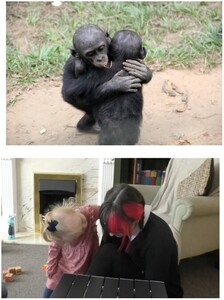
(Top) Two young bonobos engaging in comforting contact at Lola ya Bonobo Sanctuary, DR Congo. (Bottom). AÂ young child comforts and inspects her mother after observing her in pain after falling over, taken from Vreden et al. (2025) with permission.
Citation: Behaviour 163, 3-4 (2026) ; 10.1163/1568539X-bja10342
In great apes and some other species, there is evidence that bystanders sometimes approach others in distress to offer friendly reassuring contact (Fig. 1, top). This appears to be for no obvious selfish benefit, though it is important to first exclude other external motivations that could drive similar-looking behaviour, such as reducing the risk of aggression to oneself or other group members. Once these alternatives are controlled for, consolation appears to be a genuinely prosocial act. This excludes possible intrinsic rewards that they may experience, which is supported by neuroscientific research in humans that compassion and sympathy activate reward networks.
We also see behavioural similarities in human childrenâs responses to othersâ pain and distress. Young children sometimes approach others in distress to offer comforting contact and even give objects such as toys. Giving objects â something not typically observed in apes â likely serves to improve mood or reduce the distress of the recipient. Like we see in apes, we also observe childrenâs social interest in these contexts; children appear to use these friendly encounters to benefit from learning about important social events and othersâ emotional experiences (Fig. 1, bottom).
5. Early building blocks of empathy: mimicry and contagion
In a recent research project, we have been examining evidence for the building blocks of empathy in young human children as well as in great apes. As part of this project, PhD researcher Marie Poiret has spent many months in the rainforests of the DR Congo, observing the socio-emotional development of wild bonobo infants. This has derived some fascinating observations, including of facial mimicry and yawn contagion between offspring and their mothers, even at just a few months old. Though fleeting, early exchanges like this are significant as we think they form the early foundations of socially contingent interactions and emotional engagement, which are critical to healthy socio-emotional development.
We have also been studying these processes experimentally with both human infants and great apes. This includes a recent study on emotion contagion in human infants, led by Carlo Vreden (Vreden et al., 2025). AÂ well-established marker of early emotion contagion is contagious crying, which is when an infant begins to cry upon hearing another baby crying. This phenomenon is especially common in twins, who are socially attuned to one another. Although contagious crying is thought to reflect a sensitivity to otherâs emotional states, it has also been argued that crying in response to another infantâs crying could more simply be due to its aversive nature, i.e. infants are just upset by the unpleasant sound (Ruffman et al., 2017).
To test this, we conducted a playback experiment in which we used the emerging method of infrared thermal imaging. Thermal imaging measures autonomic nervous system activity by detecting changes in skin temperature on the face in response to emotional stimuli. Skin temperature changes, particularly in the nose, provide an indicator of underlying arousal states related to activity of the autonomic nervous system (Fig. 2). Thermal imaging is especially valuable in comparative affective science because it can be applied to primates, children, and indeed any animal with visible skin. In our experiment, infants heard crying stimuli while their behavioural and thermal reactions were measured. We were interested in the extent to which contagion might be shaped by cultural and environmental processes, so we conducted this research in three diverse cultural settings: rural and urban Uganda and the UK. Along with crying, infants also heard laughing stimuli, to measure evidence of positive emotion contagion and a more neutral social stimulus â babbling. They also heard a harsh artificial sound acoustically matched to the properties of crying. If their response to crying was purely due to its aversive nature, we should observe similar thermal and behavioural responses to both the artificial sound and crying. However, if their response reflected social sensitivity to anotherâs emotional state, we should see stronger responses to crying compared to the artificial sound, as well as to other social sounds such as laughing and babbling.
Thermal imaging measures changes in facial skin temperature, which inform about underlying emotional states. Image taken from a study reported in Vreden et al. (2025) with permission.
Citation: Behaviour 163, 3-4 (2026) ; 10.1163/1568539X-bja10342
Over 300 ten-month-olds took part in our study, the largest study of its kind so far. When we analysed thermal temperature changes in infantsâ nose tips, we found that crying elicited a stronger thermal response relative to baseline than the artificial stimulus. This supports evidence of emotion contagion, in that infants are responding to the signalâs emotional content, not only its aversive nature. Laughing and babbling also elicited stronger responses than the aversive non-social stimulus, further supporting this interpretation. When we analysed behavioural responses, crying also elicited stronger reactions than the aversive sound. Contagious crying was however relatively rare, challenging the view that infants are unable to manage their emotions in the face of otherâs distress. Crucially, we found similar overall patterns of effects across our three cultural groups. This continuity suggests that sensitivity towards othersâ emotions begins early in life and appears to be developmentally robust across diverse cultural settings. We consider these forms of emotion contagion to represent the foundations for empathy.
Research on empathy-related processes like emotion contagion typically focus on responses to negatively-valenced behaviours, like fear or distress (reviewed by Sandars & Clay, 2025). However, positively-valenced states and behaviours, like laughter and play, are known to spread contagiously too. Recently, we showed that affiliative social behaviours like grooming and play spread contagiously in chimpanzees (Sandars et al., 2025b). In this study, led by PhD researcher Georgia Sandars, we showed that after observing chimpanzees are much more likely to start playing or grooming themselves after observing others playing or grooming â in this sense, they share the mood to play or groom. Consistent with the social bias of empathy, play and grooming contagion were socially modulated, being stronger in response to socially close individuals, likely due to an attention bias. This again reveals that basic yet powerful affective processes like contagion can shape social interactions in important ways.
6. The role of maternal care in ape and human socio-emotional development
Early life experiences are known to impact socio-emotional development in both humans and other animals, including great apes. Since first starting to work with Frans on this topic in 2011, I have been conducting ongoing research examining this with bonobos and more recently, humans too. In a recent study, we have also been examining the relationship between maternal care and infant socio-emotional development with wild bonobos. This includes looking at key aspects of maternal caregiving including how mothers respond to their infantâs distress and to what extent they provide affectionate care, such as cuddling and grooming. Analyses suggest that maternal care is important for shaping developmental outcomes in bonobos, including play and other social interactions, as well as markers of their emotional development, like anxiety and emotion regulation. This work represents one of the first systematic examinations of how naturalistic variation in maternal care shapes socio-emotional development in wild bonobos, complementing an extensive literature on humans and captive primates.
Research with humans has likewise shown that variation in caregiver responsiveness to childrenâs socio-emotional signals affects a range of developmental outcomes, including their socio-emotional skills. However, much of this research has focused on high-income educated families from the Global North, despite these not being representative of most of the worldâs population. To address this, we recently conducted a cross-cultural study in Uganda and the UK to investigate variation in maternal responsiveness and its effect on infant emotional outcomes (Vreden et al., 2025b). In Uganda, there is strong emphasis on collectivism and interdependence, while Western settings like the UK tend to emphasise autonomy and independence. We examined how this might shape maternal caregiving behaviour, as well as infant socio-emotional development. We assessed how mothers spontaneous responded to their infantâs distress and how this related to infant emotional recovery. Although maternal responsiveness was crucial for infant recovery across both settings, there was striking cross-cultural variability in how this happened, suggesting that the type of maternal soothing may matter more than just the speed of maternal response. In the UK, although mothers tended to react more quickly to infant distress, Ugandan infants recovered faster, we think largely because their mothers tended to rely more consistently on tactile strategies, such as breastfeeding. By contrast, UK mothers incorporated other comfort strategies, especially as infants got older, such as verbal reassurance. These findings highlight cultural differences in caregiving interaction styles and challenge Western assumptions that promptness alone drives effective emotion regulation. They also highlight that tactile comforting can play a central role in how infants manage their emotions. By capturing spontaneous naturalistic interactions, our study underscores the need for culturally inclusive models of early caregiving and emotional development.
7. Maternal loss and its impact on empathy
Along with the role of maternal care, maternal loss can adversely impact socio-emotional development. IÂ studied this question as part of my postdoctoral work with Frans, where we compared the socio-emotional skills of young bonobos raised with and without their biological mothers. Unfortunately, many young great apes in both Africa and Asia are at risk from the illegal bushmeat and pet trades, resulting in many becoming orphaned and trafficked. Thanks to the tireless efforts of great ape sanctuaries, some of these orphans are rescued from being trafficked and taken to safe havens to rehabilitate and, in some cases, be reintroduced into the wild. The existence of ape orphanages, while tragic, provides a natural opportunity to study the effects of maternal loss on ape development. We hope these findings can also help sanctuaries better manage orphan welfare and rehabilitation.
The author with Frans de Waal, at Lola ya Bonobo Sanctuary, DR Congo (2019), as part of their long-term study on bonobo socio-emotional development.
Citation: Behaviour 163, 3-4 (2026) ; 10.1163/1568539X-bja10342
I have had the privilege of spending many years studying the bonobos of Lola ya Bonobo sanctuary, a beautiful forested sanctuary in the DR Congo which is the worldâs only bonobo sanctuary (see Fig. 3). Little bonobo orphans that have been rescued often arrive in very poor condition, suffering from neglect, malnutrition, and abuse in addition to maternal loss. At the sanctuary, they are cared for loving human surrogates and veterinarians before being socialized and introduced into larger social groups. The sanctuary also houses bonobos that have been born there to mothers living in the groups, now spanning over three generations! This enables us to compare the effects of these two rearing conditions in a similar environmental setting.
In this study, we examined the tendency for young orphaned and mother-reared bonobos to console others in distress, a marker of empathy as well as their general social and emotional skills. We found that mother-reared juveniles were much more likely to comfort others than age-matched orphans (Clay & de Waal, 2013a,b). They also showed higher social and emotional competence than did orphans, which correlated with this consolatory tendency. AÂ particularly striking data point in our study was the young son of the alpha female, who showed the highest sociality scores as well as a strong tendency to console others. AÂ coincidence? Well, ten years later, this male became the dominant adult male presiding over his group, in alliance with his mother, still an alpha female. While only an individual case, this example seems to reflect an apparent relationship between other-orientation and social skill development as well as the impact that maternal behaviour and sociality has on infant social development, something I discuss more below.
Since these first studies, we have conducted follow-up longitudinal work with researcher Stephanie Kordon and have found that these patterns persist across the lifespan, especially for male orphans who lack maternal support (Kordon et al., 2024). When we looked across a ten-year period, we also found that comforting behaviour declines with age, but only in mother-reared individuals. By comparison, orphans show a reduced yet stable pattern in their consolatory tendencies across age, which demonstrates that while reduced, they are still able to display key socio-emotional skills. This suggests that even if maternal loss appears to disrupt the typical developmental trajectory, sanctuaries may help to circumvent the damaging effects of maternal loss through rehabilitative care, to enable orphans to manage their daily social interactions.
8. Altercentrism and the development of other-orientation
The developmental decline described above in bonobo consolation has also been found in chimpanzees (Webb et al., 2017). While initially puzzling, it may be consistent with the human developmental theory of altercentrism which argues that other-orientation represent the initial baseline state of infants, prior to the development of self-recognition, the separation of self and other and the advent of egocentrism. This theory has been put forward by several scholars, particularly Victoria Southgate (Southgate, 2020), who studies human infant social cognition. Though requiring further investigation, this view appears to correspond with evidence discussed here of a strong early orientation towards othersâ states â potentially even a merging of those states â that declines as self and other become increasingly distinct.
To examine these processes further in human infants, we have been conducting cross-cultural work exploring the development of comforting and sympathetic concern in young infants in Uganda and the UK (Vreden et al., 2025c). In this experimental study, led with colleagues Carlo Vreden, Katie Slocombe and Joanna Buryn-Weitzel, infants at 9 and then 18 months observed someone hurting themselves, such as by tripping over, and then expressing mild pain. Interestingly, despite large differences in lifestyles and culture between Uganda and the UK, we did not find strong site differences in comforting offered by infants in this task. In both settings, infants were more likely to comfort their mothers as compared to an experimenter, and that comforting increased with age, as expected. At both sites, we did however already see evidence of comforting and concern at 9 months, which is striking given that this is well before children start to show evidence of self-recognition, such as the Mirror test. One interpretation is that like bonobos, infant comforting behaviour might reflect a baseline other-oriented tendency, potentially more emotionally driven and less sensitive to cultural learning effects. AÂ next step is to examine how comforting tendencies start to become shaped by cultural learning processes as children assimilate into their cultural communities. Taken together, results from these studies with great apes and young infants in diverse cultural settings suggest that the immediacy of responding to anotherâs situation in an emotionally charged moment is evolutionarily preserved.
9. Cognitive components: understanding othersâ needs
While affective sensitivity is thought to form a foundation for empathy, providing an effective prosocial response towards anotherâs emotional state also requires cognitive understanding to recognize that others have needs and that those needs can be fulfilled through specific actions. An important question is therefore: what are the developmental and evolutionary origins of this cognitive capacity? Are human infants and closely related species, like apes, able to understand othersâ needs?
To investigate this, we have been building on an elegant eye-tracking paradigm developed by Moritz Köster and colleagues (Köster et al., 2012). This work has demonstrated that, already from around nine months of age, infants show implicit expectations about helping behaviour. They anticipate that agents needing help will be helped and show surprise (measured through longer looking times) when agents who do not need help are helped instead. Recently, we have been extending this work cross-culturally to examine whether this early cognitive capacity is culturally robust or shaped by specific rearing practices. Preliminary findings from an eyetracking study we have conducted with a large sample of infants in Uganda and the UK highlights evidence for this early understanding of othersâ needs develops and its relation to later prosocial behaviour, including instrumental helping. Building on the work of Koester and colleagues, we have also been examining the role that motor and social skills play in enabling infants to translate this understanding into action. While important, recognising that someone needs help still requires the physical and social capabilities to provide the assistance. This work highlights that as multiple skills and systems are maturing together, it is essential to consider their interaction in shaping the emergence of prosocial behaviour.
A parallel question concerns whether, like infants, apes understand othersâ needs and are emotionally aroused by them. This is important because while we know that apes readily cooperate and help each other, the underlying mechanisms of this behaviour remain unclear. Are apes simply responding to behavioural cues, such as requests to help, or do they have genuine cognitive understanding of and emotional reactions to othersâ needs?
To address this, we have been employing non-invasive gaze-tracking techniques, including pupillometry, which measures pupil dilation in response to socially arousing events. Pupils change size in response to many factors, including to light and sound, however they also respond to arousing stimuli too. By controlling for lower-level perceptual factors like luminance and shape, pupil responses can reveal important information about emotional arousal. Working together with Chris Krupenye and Moritz Koester, we have recently adapted paradigms used with human infants to examine whether apes might understand otherâs needs by discriminating between situations where an agent can or cannot achieve their goal, and whether they show arousal patterns consistent with understanding othersâ needs. Such research is needed to consider the interplay between cognitive understanding and emotional arousal in ape and human responses to othersâ needs, and how such processes shape prosocial behaviour. Such work can help clarify whether the mechanisms underlying prosociality in apes are similar to or distinct from those in humans, and whether differences reflect cognitive capacities, emotional sensitivities, or both.
10. Conclusion: building on Fransâs legacy
Building on Fransâs seminal work and ideas about empathy and social cognition, research that I have examined here reveals the deep evolutionary and developmental roots of empathy. Empathy entails many rich and complex elements entailing cognitive, perceptual and affective processes that interact and change across evolution and development. Developmental research in humans and other species highlights the important role that caregivers and early life experiences play in shaping cognitive and socio-emotional processes, with significant impacts from maternal care as well as from maternal loss. Crucially, emerging evidence suggests that both apes and infants possess early capacities to understand and effectively respond to othersâ needs, highlighting a shared capacity for empathy. Even in their first years of life, humans and apes orient towards otherâs emotions and can even comfort others in distress.
Building on Darwinâs principles of continuity, such research continues in Fransâ footsteps by breaking down the perceived boundaries between humans and other animals. This is aided by the advent of new ethical techniques that can help us probe underlying processes. The comparative and developmental approach championed by Frans continues to yield insights into the biological foundations of our social and moral lives, while highlighting the profound ways in which early experiences shape our capacity for connection with others.
Of course, I could not end this essay without honouring the great Frans de Waal, to whom this essay is dedicated. Frans leaves us with a remarkable legacy. In his own words (2014): âWe always end up overestimating the complexity of what we do. Thatâs how you can sum up my career â Iâve brought apes a little closer to humans, but Iâve also brought humans down a bit.â
Authorâs e-mail address: zanna.e.clay@durham.ac.uk
Acknowledgements
I would like to thank Mariska Kret and the 2025 CBEN organisers for warmly hosting me and for allowing me the honour of presenting the Inaugural Frans de Waal Lecture. IÂ thank Catherine Marin and BRILL for establishing this honorary Lecture and de Waal Doctoral Prize to support the continuation of Fransâ legacy. IÂ would like to thank all the many wonderful people, apes, and funders who have inspired and enabled this work. This includes support from the European Research Council H2020 Starting Grant (802979) and the Templeton World Charity Foundation Diverse Intelligences Framework.
References
Adriaense, J.E.C., Koski, S.E., Huber, L. & Lamm, C. (2020). Challenges in the comparative study of empathy and related phenomena in animals. â Neurosci. Biobehav. Rev. 112: 62-82.
Brooker, J.S., Webb, C.E., de Waal, F.B.M. & Clay, Z. (2024). The expression of empathy in humanâs closest relatives, bonobos and chimpanzees: current and future directions. â Biol. Rev. 99: 1556-1575.
Brooker, J.S., Webb, C.E., Kordon, S., de Waal, F.B.M. & Clay, Z. (2025a). Within-species variation eclipses between-species differences in Pan consolation. â Evol. Human Behav. 46: 106682.
Brooker, J.S., Webb, C.E., Van Leeuwen, E.J., Kordon, S., de Waal, F.B.M. & Clay, Z. (2025b). Bonobos and chimpanzees overlap in sexual behaviour patterns during social tension. â Roy. Soc. Open Sci. 12: 242031.
Clay, Z. & de Waal, F.B.M. (2013a). Bonobos respond to distress in others: consolation across the age spectrum. â PLoS ONE 8: e55206.
Clay, Z. & de Waal, F.B.M. (2013b). Development of socio-emotional competence in bonobos. â Proc. Natl. Acad. Sci. 110: 18121-18126.
Darwin, C. (1859). On the origin of species. â Lippincott Williams & Wilkins, Philadelphia, PA.
Darwin, C. (1872). The expression of the emotions in man and animals. â John Murray, London.
de Waal, F.B.M. (1982). Chimpanzee politics: power and sex among apes. â Johns Hopkins University Press, Baltimore, MD.
de Waal, F.B.M. (2001). The ape and the sushi master: cultural reflections of a primatologist. â Basic Books, New York, NY.
de Waal, F.B.M. (2008). The âRussian dollâ model of empathy and imitation. â In: On being moved. John Benjamins, Amsterdam, p. 49-69.
Kordon, S., Webb, C.E., Brooker, J.S., de Waal, F.B.M. & Clay, Z. (2024). Factors shaping socio-emotional trajectories in sanctuary-living bonobos: a longitudinal approach. â Roy. Soc. Open Sci. 11: 240435.
Köster, M., Ohmer, X., Nguyen, T.D. & Kärtner, J. (2016). Infants understand othersâ needs. â Psychol. Sci. 27: 542-548.
Preston, S.D. & de Waal, F.B.M. (2002). Empathy: its ultimate and proximate bases. â Behav. Brain Sci. 25: 1-20.
Ruffman, T., Lorimer, B. & Scarf, D. (2017). Do infants really experience emotional contagion? â Child Dev. Perspect. 11: 270-274.
Sandars, G. & Clay, Z. (2025). A review of social contagion in primates: moderating factors and significance for individuals and the group. â Neurosci. Biobehav. Rev. 173: 106156.
Sandars, G., Brooker, J.S. & Clay, Z. (2024). ChimpanSEE, chimpanDO: grooming and play contagion in chimpanzees. â PLoS ONE 19: e0312467.
Southgate, V. (2020). Are infants altercentric? The other and the self in early social cognition. â Psychol. Rev. 127: 505.
Vreden, C., Renner, E., Ainamani, H.E., Crowther, R., Forward, B., Mazari, S., Tuohy, G., Ndyareeba, E. & Clay, Z. (2025a). Contagious crying revisited: a cross-cultural investigation into infant emotion contagion using infrared thermal imaging. â Dev. Sci. 28: e13608.
Vreden, C., Atim, S., Buryn-Weitzel, J.C., Di Gregorio, G., Donnellan, E., Hoffman, M., Jurua, M., Knapper, C.V., Marshall, S., Paricia, J., Tusiime, F., Wilke, C., Slocombe, K.E. & Clay, Z. (2025b). Maternal responsiveness to infant distress: A cross-cultural investigation in Uganda and the United Kingdom. â Dev. Psychol: in press.
Vreden, C., Buryn-Weitzel, J.C., Atim, S., Donnellan, E., Hoffman, M., Holden, E., Jurua, M., Knapper, C.V., Lahiff, N.J., Marshall, S., Paricia, J., Tuncgenc, B., Tusiime, F., Wilke, C., Slocombe, K.E. & Clay, Z. (2025c). Early empathy development: concern and comforting in 9-and 18-month-old infants from Uganda and the UK. â PLoS ONE 20: e0320371.
Webb, C.E., Romero, T., Franks, B. & De Waal, F.B.M. (2017). Long-term consistency in chimpanzee consolation behaviour reflects empathetic personalities. â Nature Commun. 8: 292.
Yamamoto, S. (2017). Primate empathy: three factors and their combinations for empathy-related phenomena. â WIREs Cogn. Sci. 8(3): e1431.