Abstract
This translation forms a triptych with the following two articles in this double special issue: Gu Man, Zhou Qi, and Liu Changhua, “Techniques for Piercing the Mai Recorded in the Laoguanshan Han Tomb Bamboo Slips” and Zhou Qi, “Research on the Lacquered Channel Figurine Excavated from a Han Tomb in Tianhui.” Here you can read an entire Tianhui Laoguanshan text in translation on the subject of therapeutic piercing. The contribution by Gu, Zhou, and Liu positions the therapy in relation to ideas and techniques in other manuscript texts contemporary to the one translated here and the printed classics of Chinese medicine. These articles are accompanied by opinion pieces written by current practitioners of Chinese medicine as expert witnesses to the evolution of the techniques and their relevance, or not, to modern practice. Together, we present an interdisciplinary analysis that we hope will engage the reader actively in the process of multifocal interpretation. The text here is introduced by a translator’s introduction that reflects broadly on the unique challenges of rendering this fascinating work into English.
Translator’s Introduction
It is thanks to the extraordinary work of manuscript collation and transcription of the team at the Chinese Academy of Chinese Medical Sciences (hereafter the “Academy Team”) that it has been possible to undertake this preliminary translation of the Tianhui

Facsimile of the text on piercing
Citation: Asian Medicine 18, 1-2 (2023) ; 10.1163/15734218-12341532
Photo by the authorInitially, this prolegomenon to the translation was intended to be just a kind of linguistic introduction to the issues encountered in translating texts excavated from tombs, written within some two hundred years around the turn of the first millennium. Ultimately, it became impossible to talk about the text and its meanings without discussing the context and, specifically, the intertextuality of at least four groups of manuscripts excavated from Han dynasty tombs. The earliest manuscripts recovered from three of the tombs were interred within perhaps thirty years of each other. These three tombs were positioned along the course and hinterland of the Yangzi River. The site of the fourth set of excavations was a tomb closed over a century later than the Laoguanshan tomb, discovered at Wuwei in Gansu, some 2,000 kilometers away. The texts from all three tombs share themes, and many are versions of a similar piece of writing. Each text in Chinese medicine is “multiply dialogical,” not only in the ancient world in this way, but also “as specific authors explain the meaning of illness concepts by strategically weaving a whole network of quotes from classic and modern texts and indexing multiple historical conversations into a particular inscription.”3
The introductory section of Piercing Methods ends with a fascinating reference to the social determinates of the state of the patient: in treatment, it opines, “rich and poor each requires its own methods.” Sadly, the text doesn’t elaborate. But luckily, this statement echoes statements in two near-contemporary texts that uniquely bear their original titles on the verso of the first slip: the Book of the Channels (Maishu
Poor people, in contrast, become ill from their labors, hunger and thirst, and exposure to the elements. They also do not know how to deport themselves when under physical stress. The Book of the Channels, like the Tianhui Laoguanshan text translated here, contains a long list of illnesses, in this latter case linked to appropriate piercing techniques and the number of piercings to administer.5 The multiple parallels, such as these, that can be found between excavated and recovered texts from tombs spanning West and Eastern Han (closed around the turn of the first millennium) allow a valuable interdiscursivity that opens windows onto medical ideas in rapid transition.
In advance of any detailed analysis, I present the text in its entirety to provide a complete reading experience of at least one of the manuscripts to help the reader come to their own conclusions about its significance. I hope this will permit a greater engagement with the text according to specific interests. Since Asian Medicine is designed to attract a variety of readers with different expectations of and interests in reading early Chinese medical texts, this translation has been undertaken with raised awareness of diversity in the target audiences. It is necessarily dialogic and has to consider not only the plural interdisciplinary readership “with their desires, their demands, and their language always shaping translation decisions” but also the work of other translators and the solutions they have chosen when meeting similar challenges.6 With a few exceptions, translators of Chinese medical texts have not tended to examine their overall translation strategies critically as a core part of their published work except in the minutiae of word and phrase choices.
When the source concerns medical practice, for example, as with the following translation, which has a quasi-surgical nature, there is a particular ethical responsibility toward the practitioner-reader. It would be clearly irresponsible for practitioners to copy ancient techniques simply because they have some historical authenticity. Yet, as with any medicine styled “traditional,” new translations of original practices inevitably shape modern expectations of the tradition to the imagination of the past. Achieving technical accuracy involves choosing styles of technical expression. How does one communicate dexterity in handling surgical equipment, for example? It is all too easy for practitioner-translators to assume that we know, but do we (and who are we anyway)? With bloodletting being an early Chinese practice, it would be all too easy to read it into this text, but we are told explicitly, “Do not let the blood come out” and to press with the fingers and, in one case, to use fat to block the hole.7
Where the ancient medical ideas seem to resonate closely with modern practice, there is pressure to domesticate the text for a modern practitioner audience. This has led to state-sponsored attempts to standardize modern traditional Chinese medical terminology and control the Traditional Chinese Medicine (TCM) narrative as it crosses international boundaries. Most recently, the drive to standardize teaching and communication has evolved into a productive collaboration with the World Health Organization, where teams from the big TCM universities, particularly in Shanghai and the World Federation of Acupuncture Societies, have been actively involved.8
I understand the importance of improving communication cross-culturally when it comes to teaching traditional medicine. As a historian, however, I am wary of how the pressure on the translator to produce accessible text obscures more nuanced historical meaning. How does one then satisfy cultural historians who require that the text be situated within its unique contexts and that differences, rather than similarities, be highlighted across time? We are fortunate to have a range of expertise on hand. Much textual interpretation is provided in the companion article by three members of the Academy Team, lessening the need for explanatory footnoting here, except in some cases with the translation of obscure illness terminology or terms for which there is significant ambiguity, and I have chosen to translate differently from the team.
Other considerations, quite distinct from simple language choices, come to bear on what Pritzker calls “living translation,” “a living, breathing process, or meta-process encompassing multiple ongoing processes.”9 We might imagine the function of the text relates to medical pedagogy, which also has a bearing on how one perceives the skopos of the translation. Perhaps the manuscript was indeed used at the point of practice, in the passing on of practical knowledge. On the other hand, the understanding of practice for a twenty-first-century acupuncturist might be at odds with the original purpose of the text, complicating the processes of translation. One, therefore, finds oneself “participating in an elaborate conversation that spans both space and time. Within this network, specialized Chinese medical terminology, built out of complex Chinese characters and combinations of characters, accumulates its characteristic polysemy and heteroglossia.”10
Perhaps the original purpose of committing a text to silk or bamboo was not about training at the point of practice at all. Maybe it was about recording and preserving a medical culture by scholars unconcerned with healing and medicine or part of a rite to mark a disciple’s progress. Where, in the Han period, texts with similar contents were represented as having been transmitted at the end of a period of training, in acknowledgment of a student having achieved a certain proficiency,11 they take on significance beyond the words themselves and function as part of a kind of celebratory ritual of knowledge in the transfer of knowledge as power. That power was also a feature of theories of medicine becoming a significant theme in writing, a fact to which the very high proportion of surviving and transmitted medical texts testifies. During the Han period, the culture of committing medicine to written text and the concomitant emergence of an official medicine produced manuscripts that comprised a large portion of the holdings in the imperial library and many manuscript caches excavated from tombs.
The idea of a “living translation” evokes the polysemic nature of Chinese medical terminology. The Tianhui texts are thought to have been transcribed during the period from the Lühou
In interpreting the text, I have benefited from the patient guidance of Gu Man and Shelley Ochs, and, indeed, key parts of the introductory section were already translated by Ochs for the article in this issue by Gu Man, Zhou Qi, and Liu Changhua, “Techniques for Piercing the Mai Recorded in the Laoguanshan Han Tomb Bamboo Slips.” Their article gives a fine and contextualized analysis of the content, meaning, and application of the therapies described in this text. Their generosity has made light work of this task of translating early Han dynasty piercing therapy. Penelope Barrett is, as always, a constant companion and adviser in matters of translation and editing.
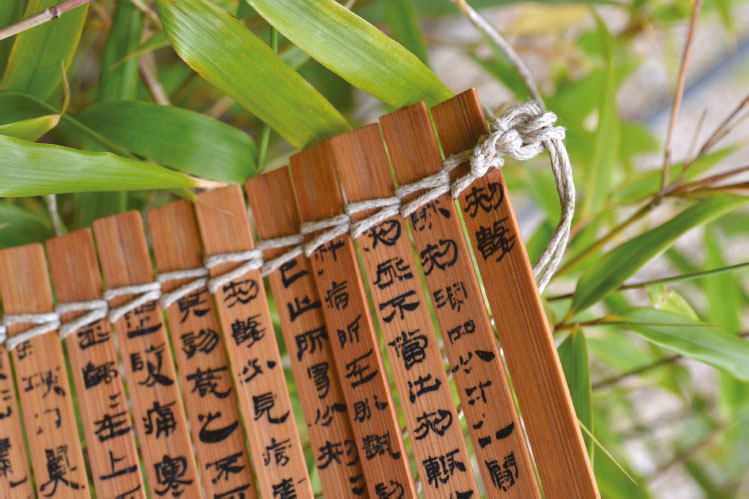
In 2019 the Academy Team presented me with the most exquisite and treasured photo facsimile of the manuscript translated here, printed on bamboo slips cut to the size of the originals. It is held together with three braided, probably hemp, bindings toward the top, bottom, and center, just like the original, although without the notches. Despite modern photo printing technology, handling a manuscript produced in this way gives a tactile sense of its materiality and replicates the reading experience much more viscerally than reading on screen or from a modern book. It has also given me a chance to get on with this translation in advance of receiving the published Wenwu volume with full photographs and transcription.12
Unlike the excavated original, each of the twenty-three damaged bamboo strips is presented intact in the facsimile, and the modern title, as newly attributed by the team, is copied on the recto of the first slip. It lacks the markings deliberately incised across the back of the manuscript and the notches for connecting bindings that have allowed the collators to reconstruct the original order of the slips, but – following these traces of collation from 2,000 years ago – otherwise, and particularly in relation to the script, it is a faithful copy.
Working with scholars from the Academy evokes a kind of nostalgia in me for my PhD years, which were spent poring over the critical editions of the medical manuscripts excavated from the Mawangdui
The text reflects the standardization of the clerical script that was well on its way when the texts were likely transcribed.15 Nevertheless, at each stage of preparing a critical edition – identifying the signifying graph, then the signified etymon, determining the reading, and finally translation – we make judgments that can be challenged. This is why I style this translation as a preliminary offering that should and will be revised at many different levels by scholars in the fullness of time.
Beyond personal nostalgia, I have a profound sense of linguistic familiarity when reading the transcription. Much of the terminology is consistent with the slightly earlier Mawangdui manuscripts and the even earlier medical manuscripts excavated from the Zhangjiashan tomb. The latter texts I translated for my PhD thesis some thirty years ago.16 My translations of the Zhangjiashan manuscripts remain forthcoming at Brill (expected before I retire) and since 2014 as working documents on the Needham Research Institute website.17 As I reflect on the way ahead, it seems unwise to wait that long to publish again! Besides, this text on therapeutic piercing of the body shares terminology concerned with illness and disease, body parts, pathological physiology, and medical theory with both the aforementioned caches of excavated texts.
The burning question for translation is since, taken together, they testify to rapid theoretical, cultural, and political transitions in all of these areas of healing and medicine, do these same graphs perform the same function or refer to the same thing in all three witnesses to Western Han dynasty medical textual production? We also cannot assume the levels of standardization from one place to another that we might expect in our own hyperconnected age. Triangulated, however, the three sets of mortuary texts from the three tombs from the Western Han period, which were copied perhaps some thirty years apart, describe the channels and vessels of the body and their therapy. While it would distort the evidence to look for lineal progress toward a mature Chinese medical theory, the text collections provide invaluable testimony to the situated processes of knowledge transmission and medical innovation in the early Western Han dynasty.
My own translation here also references the excellent translations of all of the Mawangdui medical manuscripts produced by my friend and mentor, Donald Harper. Harper’s 1998 Early Chinese Medical Literature was a groundbreaking work. For the first time, it showcased the range and rich diversity of healing cultures of early China before they were shaped by the myriad editors, not necessarily doctors or healers themselves, who contributed to the formation of the classics.18 How we understand the excavated texts to relate to the formation of the classics, now generally thought to have coalesced in the Eastern Han (25–220 CE), is an important factor in the choice of translations for many of the terms below and throughout this special issue. For their English texts of the classics, which incorporate later embellished editions of some of the Han mortuary texts, the Academy Team began with and adapted the mega-translation work of Paul U. Unschuld and his team, lately of Berlin, particularly Herman Tessenow and Zheng Jinsheng.
The polysemic nature and, therefore, flexibility of the medical terminology over these centuries of the Han dynasty is well acknowledged and has led to an extraordinary range of translations for some of the basic terms rendered here. I have discussed the terms mai, yin, and yang in detail in the editorial introduction to this special issue. I will not rehearse those observations and arguments again, except to say that these three terms have such a flexible relationship with the signified during the period in question that it is wise to leave them untranslated here.
How the two translators cited above, Harper and Unschuld, approach their work is quite different, although they are both inclined toward cultural translation in different measures. Unschuld’s project aims to “reproduce a text in a target language as close to its original format and meaning as possible, without omissions and anachronistic interpretations and additions.”19 For that reason, he eschews modern biomedical terminology, preferring vernacular terminology for translating specific and common organs and substances such as the “liver” or “blood,” literally translating Chinese etyma, where a term alludes to a culturally specific phenomenon. See the translation of zangfu
The translation of other terms is critical to understanding this particular text, including ci
Piercing Locations
Citation: Asian Medicine 18, 1-2 (2023) ; 10.1163/15734218-12341532
Created by the authorThe tools used for piercing therapy require detailed analysis. Medical techniques in the early Han period required sharpened stone lancets, stones for cauterizing, and for hot pressing. Even in the received classics, only one or two of the piercing devices described as the “Nine Needles” (jiu zhen
The earliest extant evidence for body piercing at strategic points to normalize the flow of qi through the body is found in a text that, unusually, has a surviving original title, the Maishu (Book of the Channels) from Zhangjiashan. The tool was a sharpened bian
The channels are valued by the sages. As for qi, it benefits the lower and harms the upper; it follows heat and distances coolness. So, the sages cool the head and warm the feet. Those who treat illness take the surplus and supplement the insufficiency. So, if qi goes up, not down, then when you see the channel that is in excess, apply one cauterization where it meets the articulation. When the illness is intense, apply another cauterization at a place two cun above the articulation. When the qi rises at one moment and falls in the next, pierce it with a stone lancet at the back of the knee and the elbow.23 Using a stone to open the channel must be as in this style.24
夫脈者,聖人之所貴殹。氣者,利下而害上,從煖而去清,故聖人寒 頭而煖足。治病者取有徐(餘)而益不足,故氣上而不下,則視有過之 脈,五七當環而久(灸)之。病甚而上於環二寸益為一久(灸)。氣壹上 壹下,當 (郄)與胕(跗)之脈而
(砭)之。用
A tendency to pierce the channel, or a point or constellation of points, at locations given the same name as the channel, such as the tai yang
Piercing that comes close to what we now understand as acupuncture is first seen in the account of treatment on the transporter points (shuxue
In contrast, the evidence from the Laoguanshan manuscript, which sits temporally between those from Mawangdui, Zhangjiashan, and Wuwei, gives us piercing on the mai, on the divisions between muscles, and directly into fluid swellings. Interestingly, despite the flavor of minor surgery that pervades the text, there is no evidence here of bloodletting and simply a concern to seal the place of insertion with the fingers, presumably to prevent bleeding after therapeutic intervention. We also see ten interventions on the luo
The text here is not concerned with systematically associating the illnesses with yin and yang body structures, as seen in the Mawangdui and Zhangjiashan texts on the mai-channels. In the latter texts, the illnesses are listed after an anatomical description of each yin and yang channel. The symptoms of illness themselves, however, are rather similar to those we find in this text. Only three of the forty-two entries in the Piercing Methods involve culturally specific phenomena in that they relate to syndromes that involve concepts peculiar to the Chinese context: bi syndrome, jue, and Wind. Bi syndrome is a serious illness glossed in the list of illnesses in the Zhangjiashan Book of the Channels as “in the body; when dull-witted, □ and doesn’t recognize others, this is bi.”29 It is a progressive and potentially terminal syndrome characterized as being caused by wind, cold, or dampness and traveling from the outer body into the internal organs. Jue relates to a pathological movement often of reversing qi, sometimes associated with serious and potentially fatal heart problems.30 Wind, conceived as a cause of disease, is pervasive throughout Asia. Here it refers to a symptom located in the head. It often results in extreme symptoms such as stroke, which are subject to rapid change.
Each of the forty-two entries in the Piercing Methods might involve a range of symptoms, by far the greatest proportion of which are sensory complaints that only the patient would know about easily.31 Pain, abdominal discomfort, and problems of locomotion stand out. There are three instances of displacement where the womb is out of place or signs of hernia, two cases of skin disease, and one of tooth decay. There is one entry for convulsion and one for “craziness,” a behavioral disorder. Interestingly, the symptoms are not listed in order from head to toe as they often are in medical texts from across the ancient world. In contrast, this order is strikingly the case in the Book of the Channels text from Zhangjiashan.
Finally, the Academy Team has decided to translate the shu
Translation of the Piercing Methods
Slip 653
Mai piercing, needle to a depth of a quarter of a cun,33 space apart one-seventh of a cun. [In] mai piercing, the needle is as large as a border or hemming needle. Division piercing, □ large □, space apart the small half of a cun [one- third]. Piercing water [swelling], the needle is as large as a knitting needle □ three cun.
Citation: Asian Medicine 18, 1-2 (2023) ; 10.1163/15734218-12341532
Slip 650
Pierce, but do not let the blood come out; whenever piercing, press it with your fingers immediately. Use [animal] fat to block it, and do not let □. This is done.
Strip 652
[Determine] the location of the illness. [If the mai] is hot, it will be agitated and is not like the other one; and [on the corresponding] hand, [the pulse] is also fast. [When it is flourishing], it will be agitated, and the [pulse at the] corresponding hand is fast; if it is depleted, then [the pulse will be] slow. The illness will not end and will return the day after; the illness
Strip 669
will come to an end and stop. What is named “division piercing” is [piercing] between the flesh divisions. For the number of piercings, one must observe the characteristics of the illness and determine the location of the illness.
Strip 670
For the number of piercings,34 one must observe the characteristics of the illness and palpate the site of the ailment, and then you might [follow with the hand and inspect]. Illnesses look very similar yet are actually different and have a plethora of names; inspect, examine, and diagnose the illness before piercing. [In this way], illness can be cured. If one does not inspect
Citation: Asian Medicine 18, 1-2 (2023) ; 10.1163/15734218-12341532
Strip 667
for diagnosis, then piercing will not affect a cure. Treating rich and poor each requires its own methods.
Strip 661
When the lower back and abdomen hurt, with cold and heat. [Pierce] the Yang Brightness and the Lesser Yang35 on the two shins; five times each.
Strip 658
Bloody tooth decay [abscess of the teeth]; in the upper [teeth], [pierce] Lesser Yang in front of the two ears; in the lower [teeth], [pierce] the Yang Brightness in the cheeks; five times each.
Strip 629
The neck, the nape, [the eyes], and the nose … hurt, [tears] come out, stuffed up nose, nose bleed. [Pierce] the nape Great Yang; five times each [side].
Citation: Asian Medicine 18, 1-2 (2023) ; 10.1163/15734218-12341532
Strip 630
Inguinal36 hernia, bulge,
Citation: Asian Medicine 18, 1-2 (2023) ; 10.1163/15734218-12341532
Strip 631
The heart hurts with anxiety. [Pierce] Great Yin of the two arms and the shins; five times each. As with the heart luo collateral.
Strip 604
Blood. Follow where the blood is and, according to the severity, determine the number [of piercings].
Strip 598
The heart and abdomen are [full]. □ [Pierce?] the heart luo collateral; five times each. [Or] the Foot and Hand Great Yin.
Citation: Asian Medicine 18, 1-2 (2023) ; 10.1163/15734218-12341532
Strip 649
Convulsions illness. [Pierce] the two arms and shin Yang Brightness, and the Great Yang at the nape; five times each.
Strip 651
Throat bi.38 Two places: the collateral channels of the Yang Brightness of the two shins and the Yang Brightness of the two shoulders; the Great Yang luo collateral; □times each.
Citation: Asian Medicine 18, 1-2 (2023) ; 10.1163/15734218-12341532
Strip 668
Bi syndrome. According to the location, determine the number in relation to the severity.
Strip 665
The diaphragm [blocked] at the center. The Great Yin of the two arms and the two shins; five times each, as well as the central line.39
Strip 666
Jue.40 Yang Brightness of the two shins; five times each. Also, according to location.
Strip 660
The lower back and the back hurt. [Pierce] the knee and the back Great Yang; five times each.
Strip 659
Swallowing hurts. When one cannot swallow, and it is not severe, pierce the Yang Brightness of the arm and the Yang Brightness of the shin; five times each. When it is severe, and there is sputum, [the number of times you pierce should be] according to that.
Citation: Asian Medicine 18, 1-2 (2023) ; 10.1163/15734218-12341532
Slip 66341 (Ten Strips)
Flea sores.42 [Pierce] between the two tendons on the inside of the arm and where the shins cross; five times each.
Citation: Asian Medicine 18, 1-2 (2023) ; 10.1163/15734218-12341532
In the center of a woman’s belly, it is like a fist. [Pierce] on the two Jue Yin of the shins, on the big toe where there is a clump of hair; five times each.
Citation: Asian Medicine 18, 1-2 (2023) ; 10.1163/15734218-12341532
Counterflow qi: [Pierce] on the Yang Brightness of the two arms and shins; five times each, as well as the central line.
Muscle spasm. Foot Great Yang collateral [channels]; five times each.
Mouth Sores. Follow [where the symptoms manifest] and pierce it eight times.
 (胗)。因㓨(刺)之八。
Wind. Pierce the head Great Yang where it presses on the cheekbones
Citation: Asian Medicine 18, 1-2 (2023) ; 10.1163/15734218-12341532
Shortness of breath. Do not pierce.
Citation: Asian Medicine 18, 1-2 (2023) ; 10.1163/15734218-12341532
Head hurts. [Pierce] Lesser Yang in front of the ear. If it is the head, [pierce] the Great Yang where it presses on the cheekbones; five times each.
Wasting. Follow where it is. [Pierce the] ten [fingers and toes], and the hands and feet all at Lesser Yang, Yang Brightness.
Dizziness: Great Yang at the nape and Yang Brightness on the shin; five times each.
Strip 639
Tears come out. [Pierce] Arm Yang Brightness, Great Yang at the nape; five times each.
Strip 662
Coughing and rising qi. [Pierce] the Two-Arm Yang Brightness; five times each. The same for the heart luo collateral.
Strip 646
Abdominal swelling. As for swelling in the abdomen, and below the navel is hurting, there is a blockage. Follow where the illness is located, and pierce it five times.
 <積>。因病在所,㓨(刺) 之五。
Strip 664
The knee cramps and hurts. Follow the places it hurts and determine the number according to the severity.
Citation: Asian Medicine 18, 1-2 (2023) ; 10.1163/15734218-12341532
Strip 656
The skin is swollen. [Pierce] Foot Great Yin and Yang Brightness; each five times.
Strip 645
Exhaustion.43 The Two-Arm Great Yin and the Two-Arm Yang Brightness of the shin; each five times.
Strip 638
Masses.44 According to where they are located, and pierce the head three times.
Strip 607
Intermittent fever45 illness with frequent lying down. [Pierce] the Yang Brightness and Lesser Yang of the two shins; each five times.
Citation: Asian Medicine 18, 1-2 (2023) ; 10.1163/15734218-12341532
Strip 654
Deafness. The two Lesser Yang of the Arm; each five times.
Strip 657
The body is too full. Pierce at the muscular divisions, at the shins. Pierce the shins.
Strip 644
The mouth is locked. [Pierce] the Lesser Yang of the Head, each five times.
Strip 642
Sounds from the middle of the knee. Follow where the sounds are located and pierce there.
Strip 640
It hurts under the heel. Follow where the illness is located and pierce there four times.
Strip 606
Craziness. [Pierce] the two arms and Yang Brightness of the two shins; each five times.
Strip 637
Water [swelling]. [Pierce] where the Great Yang luo collateral and the Yang Brightness luo collateral of the abdomen meet; each seven times.
Citation: Asian Medicine 18, 1-2 (2023) ; 10.1163/15734218-12341532
Strip 634
Retention,46 which doesn’t get to come out. [Pierce] the two Foot Lesser Yin, Great Yang luo collateral; each five times.
Strip 636
The bowels hurt, and there is cold in the center. There is diarrhea and bowel flushing,47 and a tendency to blockage of the bowels and boils on the tongue. [Pierce] the Lesser Yin of the two shins; each five times.
 (癰)。 兩胻少陰, 各五。
Strip 643
Stiff Neck. [Pierce] the Great Yang luo collateral of the back; each five times.
Author Biography
Vivienne Lo
Bibliography
Primary Sources
Anon. (ca. Han dynasty, 202–220 BCE). (1956) 1963. Huangdi neijing lingshu 黃帝內經靈樞. Edited by Wang Bing 王冰 (ca. 710–805). Beijing: Renmin weisheng chubanshe. Translated by Paul U. Unschuld as Huang di nei jing ling shu: The Ancient Classic on Needle Therapy – The Complete Chinese Text with an Annotated English Translation, Berkeley: University of California Press, 2016.
Anon. (ca. Han dynasty, 202–220 BCE). (1956) 1963. Huangdi neijing suwen 黃帝內經素問. Edited by Wang Bing 王冰 (ca. 710–805). Beijing: Renmin weisheng chubanshe. Translated by Paul U. Unschuld and Hermann Tessenow as Huang Di nei jing su wen, Berkeley: University of California Press, 2011.
Jiangling Zhangjiashan hanjian zhengli xiaozu 江陵張家山漢簡整理小組. 1989. “Jiangling Zhangjiashan hanjian maishu shiwen” 江陵張家山漢簡脈書釋文. Wenwu 7: 72–74.
Lü Buwei 呂不韋 (292–235 BCE). 1984. Lüshi chunqiu jiao shi 呂氏春秋校釋. Edited by Chen Qiyou 陳奇猷. Shanghai: Xuelin chubanshe.
Sima Qian 司馬遷 (145–87 BCE). 1982. Shiji 史記. Beijing: Zhonghua shuju.
Tianhui yijian zhenglixiaozu 天回医简整理小组. 2023. Tianhui yijian (shangxia ce) 天回医简(上下册). Beijing: Wenwu chubanshe.
Xu Shen 許慎 (ca. 58–147 CE). 2007. Shuowen jiezi zhu 說文解字注. Edited by Duan Yucai 段玉裁 (1735–1815). Nanjing: Fenghuang chubanshe.
Zhangjiashan 247 hao Hanmu zhujian zhengli xiaozu 張家山247號漢墓竹簡整理小組. 2006. Zhangjiashan Hanmu zhujian (247 hao mu) 張家山漢墓竹簡 (二四七號墓). Beijing: Wenwu chubanshe.
Secondary Sources
Boyanton, Stephen. 2022. “The Canonicity of the Yellow Emperor’s Inner Classic: Han through Song.” In Routledge Handbook of Chinese Medicine, edited by Vivienne Lo, Michael Stanley-Baker, and Dolly Yang, 120–132. London; New York: Routledge.
Brown, Miranda. 2015. The Art of Medicine in Early China: The Ancient and Medieval Origins of a Modern Archive. Cambridge: Cambridge University Press.
Galambos, Imre. 2006. Orthography of Early Chinese Writing: Evidence from Newly Excavated Manuscripts (490–221 BC). Budapest: Eötvös Lorán University, Department of East Asian Studies.
Harper, Donald. 1998. Early Chinese Medical Literature: The Mawangdui Medical Manuscripts. London; New York: Kegan Paul International.
Gansusheng bowuguan 甘肅省博物館 and Wuwei xian wenhuaguan 武威縣文化館. 1975. Wuwei Handai Yijian 武威漢代醫簡. Beijing: Wenwu chubanshe.
Gu Man, Zhou Qi, and Liu Changhua. 2023. “Techniques for Piercing the Mai Recorded in the Laoguanshan Han Tomb Bamboo Slips.” Translated by Shelley Ochs. Asian Medicine 18, nos. 1–2: 193–228.
Harper, Donald, and Marc Kalinowski, eds. 2017. Books of Fate and Popular Culture in Early China. Leiden: Brill.
Hsu, Elisabeth. 2010. Pulse Diagnosis in Early Chinese Medicine: The Telling Touch, Cambridge: Cambridge University Press.
Kuriyama, Shigehisa. 1995. “Interpreting the History of Bloodletting.” Journal of the History of Medicine and Allied Sciences 50, no. 1: 11–46.
Lo, Vivienne. 1998. “The Influence of ‘Yangsheng’ Culture on Early Chinese Medicine.” PhD diss., School of Oriental and African Studies, University of London.
Lo, Vivienne. 1999. “Tracking the Pain: Jue and the Formation of a Theory of Circulating Qi through the Channels.” Sudhoffs Archiv 83: 191–210.
Lo, Vivienne. 2014. “How To Do the Gibbon Walk: A Translation of the Pulling Book (ca. 186 BCE).” Needham Research Institute Working Papers 3, Cambridge, Needham Research Institute. http://www.nri.org.uk/yinshu.pdf. Accessed April 28, 2023.
Lo, Vivienne. 2023. “Looms of Life: Weaving a New Medical Imaginary.” Asian Medicine 18, nos. 1–2: 148–166.
Ma Jixing 馬繼興. 1992. Mawangdui guyishu kaoshi 馬王堆古醫書考釋. Hunan: Hunan kexue jishu chubanshe.
Mawangdui boshu zhengli xiaozu 馬王堆帛書整理小組. 1985. Mawangdui Hanmu Boshu 馬王堆漢墓帛書. Vol. 4. Beijing: Wenwu chubanshe.
Pritzker, Sonya. 2012. “Living Translation in US Chinese Medicine.” Language in Society 41, no. 3: 343–363.
Pritzker, Sonya. 2014. Living Translation: Language and the Search for Resonance in U.S. Chinese Medicine. New York; Oxford: Berghahn.
Pritzker, Sonya. 2022. “Translating Chinese Medicine in the West: Language, Culture, and Practice.” In Routledge Handbook of Chinese Medicine, edited by Vivienne Lo, Michael Stanley-Baker, and Dolly Yang, 613–622. London; New York: Routledge.
Unschuld, Paul U., and Hermann Tessenow, with Zheng Jinsheng 鄭金生. 2011. Huang Di nei jing suwen: An Annotated Translation of Huang Di’s Inner Classic – Basic Questions. Berkeley: University of California Press.
Woolf, Deborah. 2022. “The Importance of Numerology, Part 1.” In Routledge Handbook of Chinese Medicine, edited by Vivienne Lo, Michael Stanley-Baker, and Dolly Yang, 72–89. London; New York: Routledge.
World Health Organization. 2022. “WHO International Standard Terminologies on Traditional Chinese Medicine.” March 3, 2022. https://www.who.int/publications/i/item/9789240042322.
Yang, Yong and Miranda Brown. 2017 “The Wuwei Medical Manuscripts: A Brief Introduction and Translation.” Early China 40: 241–301.
Zhao Ping’an. 2005. “Comments on the Problem of ‘Transcription’ in the Dunhuang Medical Manuscripts.” In Medieval Chinese Medicine: The Dunhuang Medical Manuscripts, edited by Vivienne Lo and Christopher Cullen, 59–76. London: Routledge Curzon.
Tianhui yijian zhenglixiaozu 2023.
Slip 670. Unless otherwise stated, translations are the author’s.
Pritzker 2012, 345.
Zhangjiashan 247 hao Hanmu zhujian zhengli xiaozu 2006, 124–25, 185.
Ibid., 115–18. Each disease entry in the Tianhui text is arranged in an internally coherent passage, written on separate slips. The lack of anything but thematic linkages between the texts on each slip would have made for some difficulty in determining their sequence had there not have been markings across the verso of the manuscript. These transverse markings served to facilitate the reordering of the forty-eight slips.
Pritzker 2014, 93.
Slip 650. For an analysis of bloodletting in early China, see Kuriyama 1995.
World Health Organization 2022.
Pritzker 2022, 619.
Pritzker 2014, 92.
Hsu 2010, 71–72.
Tianhui yijian zhenglixiaozu 2023.
Ma 1992.
Zhao 2005.
Galambos 2006, 31–64.
Lo 1998.
Lo 2014.
Harper 1998; Boyanton 2022. A substantial amount of the writing, editing, and bibliographic work that went into the formation of the classics was the work of scholars, bibliographers, and government-sponsored employees. Brown 2015, 63–86.
Unschuld and Tessenow 2011, 13.
Ibid., 136–41.
Ibid., 9–14.
Lingshu (1956) 1963, 1–4; trans. Unschuld 2016, 35–52.
The Zhangjiashan collation team read the graph as fu
Lo 1998, 92, 340; Jiangling Zhangjiashan hanjian zhengli xiaozu 1989; Zhangjiashan 247 hao Hanmu zhujian zhengli xiaozu 2006, 125.
For a translation of the case histories, see Hsu 2010.
Shiji 105 (Sima Qian 1982, 2785–2820).
Gansusheng bowuguan and Wuwei xian wenhuaguan 1975; Yang and Brown 2017, 267–69.
See Lo, “Looms of Life: Weaving a New Medical Imaginary” in this issue (Lo 2023).
See n. 36.
See n. 38.
See n. 39.
Woolf 2022, 80–81. Harper and Kalinowski 2017, 86–87.
One cun
In the next article the Academy Team translate this as “to [appropriately] apply piercing techniques,” thus translating shu
The multiple needling suggested here appears to be along the course of the channel, Yang Brightness, rather than at any specific point.
For an analysis of tui  , see Harper 1998, 259n3. See the Zhangjiashan Book of the Channels on inguinal swellings, “When there is an abscess of the scrotal sac, it is ‘blood collapse in the groin;’ if its abscess makes a calling sound as it goes up and down, it is an inguinal hernia.” Lo 1998, 335; Zhangjiashan 247 hao Hanmu zhujian zhengli xiaozu 2006, 116.
Lun
As noted in the introduction, bi
See Zhangjiashan 247 hao Hanmu zhujian zhengli xiaozu 2006, 115, 117. Suwen 43 “Bilun”
One must resist the temptation to translate, “and the Du [mai],” what is generally translated as the Governor Vessel. At this time there was no dumai. According to Gu Man, du here suggests a “central line,” as we can see with the term “central hem” (du feng
By the time of the Tianhui manuscripts, the symptom known as jue was well established. In 239 BCE, the Spring and Autumn of Master Lü (Lüshi chunqiu 
This slip is one of ten cataloged under the same number.
See the Zhangjiashan Book of the Channels. The illness list includes sao
Shuowen (Xu 2007: 615) glosses dan
See the section on the differential diagnosis of masses in the illness list in the Zhangjiashan Book of the Channels. Lo 1998, 153–54, 334–35. The Book of the Channels differentiates tumorous, blood, qi, fat, and loose fecal masses.
The illness list in the Zhangjiashan Book of the Channels lists the symptoms of nue, “When the body is cold and hot, there is thirst and the four limbs hurt.” Lo 1998, 336.
The illness list in the Zhangjiashan Book of the Channels lists the symptoms of bi
Changpi