Abstract
The 13 graves excavated in 1894 by Sam Wide at Aphidna only attracted sporadic attention during the first decades, even though he exposed unusually rich burials. However, over the last 20 years, there has been increased interest, but still with most focus on only one grave, Pithos Grave III. This article combines information from several sources to get a more comprehensive picture, including a thorough re-read of Wideâs original publication in German, an examination of his preserved correspondence and notes, also with a newly discovered original photo taken during the excavation. In addition, recent colour photos of the finds kept in the National Archaeological Museum in Athens are provided. This approach may, in a sense, be termed âarchaeology in reverseâ. Wide was a pioneer in Greek prehistoric studies and the first to identify a then-unknown phase between the Early and the Middle Bronze Age, based on the Aphidna finds. His detailed descriptions of the excavation, including the large bowls placed outside the pithos graves, also contribute to reconstructing burial rites. After 130 years, with many new contemporary sites now available, new insights into regional perspectives can be gained.
1 Introduction
The tumulus at Aphidna, in northern Attica, is from the transitional period between the Early and the Middle Bronze Age.1 This period has left only sparse traces in the archaeological record. Therefore, Aphidna is of special interest, given both the number of graves and the amount of grave gifts.
The earliest known work at Aphidna was a rather superficial investigation by the philhellene George Finlay in 1837. The tumulus was fully excavated by the Swedish archaeologist Sam Wide [vÃ:de] in the autumn of 1894, as part of the earliest Swedish excavations in Greece, including the summer excavation at Kalaureia on Poros.
Wide timely reported his results from Aphidna (Wide 1896).2 But except for an article centred more on Wideâs life by Christian Calmer (1953), the site received only sporadic mentioning during the following decades, until the symposium at the centenary celebration of the Swedish excavations in 1994 (Hielte-Stavropoulou & Wedde 2002).
There Robin Hägg, then Director of the Swedish institute at Athens (SIA), presented Sam Wide as the one who, through his excavation at Aphidna, âbrought to light the remains of a hitherto unknown phase of the Greek Bronze Age, to be dated before the Mycenaean cultureâ (for reference and full quotation, see Section 4).
Since then, information has been available from several sources, including Forsén (2010), Whittaker (2014) and Berg (2016). See also Aphidnaâs official website at SIA.3 Proceedings from conferences like Mesohelladika. La Grèce continentale au Bronze Moyen 2006 (printed in 2010) and the newly published Athens and Attica in prehistory 2015 (2020) give a detailed description of many aspects of prehistoric life throughout Attica.
The existing finds from Aphidna, stored at the National Archaeological Museum in Athens,4 are described in detail by Forsén (2010), but a more complete and unified description has not been given of the grave structures within the tumulus with their accompanying grave gifts, almost half of which were only cursory listed by Wide and never further accounted for.
The present article is based on the above work and a thorough re-read of Wideâs (1896) original article in German5 and a study of archived material relating to Wide at the Uppsala and Lund University Libraries. Such an approach to the study of old excavations may be termed âarchaeology in reverseâ, as Yannis Galanakis and Andrew Shapland suggested in an article published in Archaeological Reports (AR 66, 2020, 3). By considering the available material related to the excavation, including the field notes and other information from the people involved, one gets an enhanced picture of what actually went on, thereby being able to supplement and improve what was eventually published. There are many examples of this in archaeology; one of the most notorious is the various re-interpretations of Heinrich Schliemannâs work (e.g. Traill 1995).
In the present case, for example, the search at the Uppsala University Library revealed a very useful but hitherto unknown photo taken during the excavation (cf. Fig. 8). Also, the many letters from Wide to his parents and colleagues in Sweden show his close affiliation with the German Institute in Athens and his friendly relationships with its prominent members. This included the head of the institute at the time, the renowned Wilhelm Dörpfeld, who even gave him lessons in field drawing in private. Such information clearly strengthens the confidence in Wideâs work.
Following the approach âarchaeology in reverseâ, the author also finds it interesting to investigate the fate of the missing finds. This is usually not addressed. But, first, in the present case, the missing finds would have improved our view of Aphidna (see Section 3 and, in particular, Tables 1â3). Second, there is in this case, in total, sufficient information available to narrow down what could have happened.
1.1 The Outline of the Article
Firstly, the article presents a site description of Aphidna, located about 35 km northeast of Athens, close to where the Charadra River enters Lake Marathon (Section 2.1). Next, an outline of the archaeological environment that Wide entered in Greece at the end of the 19th century is provided (Section 2.2), together with a description of Wideâs preparations and relevant circumstances related to the excavation (Section 2.3).
The main part (Section 3) describes the excavation with its grave structures and all the finds, based on Wideâs verbatim text. Of the preserved finds at NAM, the large bowls are outstanding, but the exhibition and the museumâs storerooms also include pottery, several mineral beads, spindle whorls, silver and gold rings, which deserve more attention, shown in colour here for the first time. Then follows some reflections on the aftermath of the Aphidna excavation and Wide as a pioneer in Greek Bronze Age studies (Section 4).
Sections 5 and 6 introduce the regional picture. A map (Fig. 1) shows the broader region around Aphidna with many approximately contemporary archaeological sites. Most of these were unexplored 130 years ago and thus unknown to Wide and his contemporaries.

Map of the region showing the location of Aphidna and archaeological sites attributed to the Early and Middle Bronze Ages mentioned in the text.
Citation: Acta Archaeologica 92, 2 (2021) ; 10.1163/16000390-20210033
https://commons.wikimedia.org/wiki/File:Greece_large_topographic_basemap.svg, with alterations by the present authorIn Sections 5.1 and 5.2, the graves and the finds are discussed. The missing finds are considered, and burial rites are reviewed in Section 5.3. Then, the chronological aspects of Aphidna are discussed. Finally, Section 6 reflects on Aphidna in a regional context and social interactions at the end of the third millennium and the beginning of the second millennium BC.
2 Background for the Excavation
2.1 Site Description
In Classical times, Aphidna was one of the twelve demes in Attica and a stronghold protecting its northern border. Todayâs hill of Kotroni (366 m.a.s.l), close to where the Charadra River enters what is now Lake Marathon (Figs. 2 & 3), rises steeply from the surrounding valley and has a strategic position in the landscape.
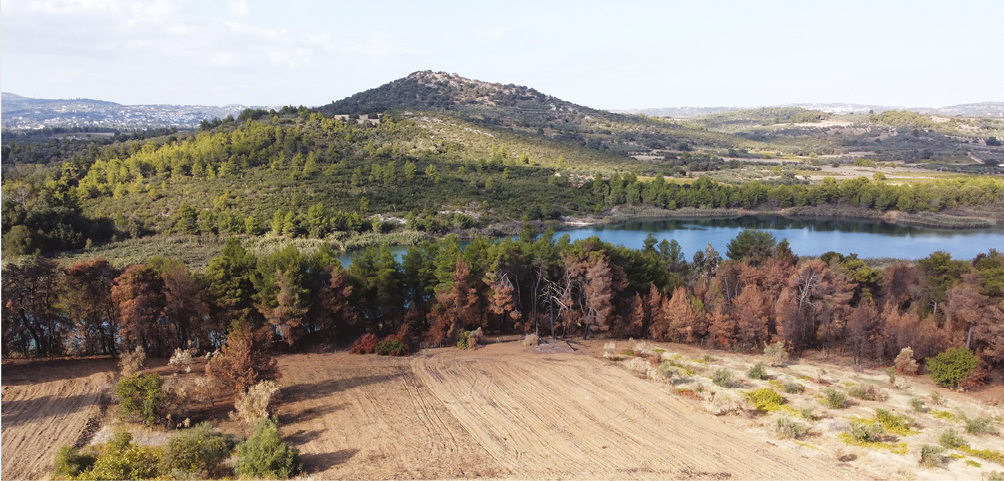
The area of the necropolis of prehistoric Aphidna, south of where the Cháradra river enters the northwestern corner of the present-day Lake Marathon. The highest hill in the centre with the little church on top is Kotroni Hill, the alleged Acropolis of ancient Aphidna. In the background, to the north, is the modern village of Kapandriti and, far in the northwest, the natural passage over to Boeotia. Behind the mountains in the photoâs northeastern corner, at about the same distance as down to Marathon Bay, is the early Bronze Age harbour and castle of Rhamnous, guarding the entrance to the South Euboean Gulf. The photo was taken in October 2021, after the summer catastrophic fires.
Citation: Acta Archaeologica 92, 2 (2021) ; 10.1163/16000390-20210033
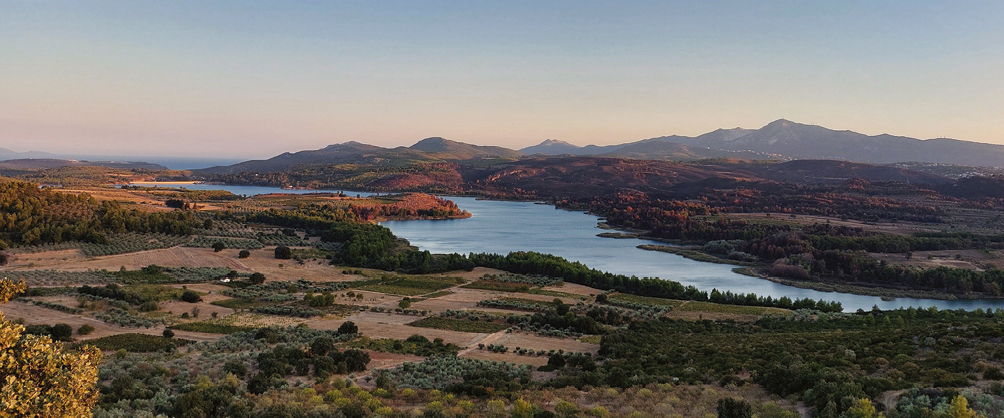
Photo: Joakim StavrópoulosThe reverse view from Kotroni Hill itself. Far to the southeast and beyond the dam barrier is a glimpse of Marathonâs plain and bay. There reside the archaeological sites of Vrana, Tsepi and Plasi. In the south â the Penteli Mountains. The area with the prehistoric graves excavated by Wide is in the right corner on the south bank. The Cháradra river has its sources in the Parnitha mountain area (to the west-northwest with an elevation of about 1 400 m) and, together with some tributaries, flows into Marathon Lake.
Citation: Acta Archaeologica 92, 2 (2021) ; 10.1163/16000390-20210033
Photo: Nils Damm Christophersen, December 2016The village closest to Kotroni hill today is Kapandriti to the north. The modern village of Aphidna is situated c.3 km northwest of the hill. The artificial water reservoir, âthe Marathon Lakeâ, is a construction from 1929 built to manage Athensâ water supply after the refugee influx from Asia Minor. The dam is 54 m high, and the lake covers an area of about 2.5 km2.
Except for the submerged area and the impact of modern agriculture, the larger landscape surrounding the tumulus may have remained fairly unchanged since Wideâs time.6 He attaches particular importance to the perennial water supply: âThe area is beautiful, hilly terrain with coniferous forest, pierced by a small, narrow river. A good spring is nearbyâ.7
Unfortunately, due to agricultural activities at the tumulus site itself, no clearly visible remains can be seen on the surface today (Fig. 2), but early testimonies tell of several grave monuments. The first known description is from the philhellene George Finlay in 1837 (sic): âLast week I opened the small tumulus on my property near Aphidna. It had been opened before & the bones were near the surface. On one side, however, I found a large vase 5 feet high and 3 feet broad filled with fragments of other vases. It was lying on its side and broken to pieces but bound with lead riveted through the vase with leaden nails. I have preserved all those pieces of the vase which had lead in them and the pieces of lead found around it. I am now engaged in opening the larger tumulus.â This evidence came to light over 100 years after Wideâs excavation in Jane Husseyâs publication in 1995 of The Journals and Letters of George Finlay, information that was impossible for Wide to know in 1894.8
In 1889, Arthur Milchhoefer wrote: âThat it (the river Charadra) kept roughly the old direction, some burial mounds seem to show this. ⦠Particularly stately is the large, western tumulus (on the map: grave with wall edging) with a flatter, southern tumulus next to it, which is crowned by a large, stunted spruce. The traces of the wall seem to indicate a square border. To semi-encircle the mound took about 70 steps. An excavation shaft has been dug down from the top, but hardly to sufficient depth; as I was told in Kapandriti, the attempt came from Finlay (the former owner of Liossia); among whose finds were mentioned two clay jugs [pithoi] with lead mendingsâ.9
In a letter of August 1894 to Oscar Montelius, Wide informed: âAfter walking for a while [from Kotroni Hill] we came to a site where there were three graves, which judging from the form and location (on a gentle slope in the terrain, which lowers itself down towards a river, just like at Vaphio and Menidi), seem to have been âKuppelgräbenâ. Next to them was a tumulus tomb with a stone circle around the base. I have already been granted permission by the Greek government to excavate these tombs and will probably go down there in 10â12 daysâ.10
Eighty-five years after the excavation, in 1979, Richard Hope Simpson and O.T.P.K. Dickinson wrote: âAbout 1.5 km to SSW of the acropolis [Kotroni], disturbed remains of an MH tumulus were excavated, containing burials in cists, pits, and huge pithoi, surviving goods were relatively rich, including some unusual pottery and rings of silver and gold. The pottery seems earlier than that of the MH tumulus at Marathon [Vrana] (F 49). There is a similar mound c.100 m. NW of the tumulus and a series of smaller mounds to NE, on lower slopes leading down to the lakeâ (Gazetteer (F 54), 220). This extract demonstrates that Simpson and Dickinson not only read Wideâs report but also visited the area.
We thus have four accounts of the site from G. Finlay (1837), A. Milchhoefer (1889), S. Wide (1894), and R.H. Simpson & O.T.P.K. Dickinson in their Gazetteer (1979). These accounts do not agree on all points, but they show that Aphidna was a necropolis of some scope. The account in Gazetteer 1979 proves that the tumulus and the alleged other graves had not been engulfed by the artificial lake constructed 30 years after Wideâs excavation. Thus, the dam altered the landscape in a significant way but without submerging the tumulus.
Following the river downstream, one comes to the plain of Marathon, where excavations started in the 1970s with the large EH IâII necropolis of Tsepi, the MH tumuli necropolis of Vrana, the MH tumulus of Klopa and the Helladic settlement of Plasi. Tumulus I at Vrana, with its ten graves, is roughly contemporary with Aphidna.
In brief, Aphidna offered a fertile landscape with a perennial source of water and the Kotroni hill, where fortifications would offer protection during turbulent times. As today, with the modern Greek highway M1 passing close by, Aphidnaâs location in antiquity was at the crossroad between southern Attica on the one hand and Boeotia and Thessaly further to the north on the other hand. Note Aphidnaâs strategic position on maps in Athens and Attica in prehistory (2020), and especially on Sylvian Fachard & Alex R. Knodellâs Maps 2â6 (2020, 410â415), which explicitly refer to the âAphidna corridorâ.
2.2 Greece in the 1890s
To assess Wideâs work and get an impression of his character, it is interesting to briefly describe the environment he entered when he arrived in Greece in September 1893. Ingrid Berg (2016) has an extensive description of Wide, his background and his work in Greece. However, this is from more of a sociological perspective, where Wide emerges as well-connected, tough, hardy, self-centred and boastful of his stamina in the patriarchal society at the time. This is in contrast to his less robust partner Lennart Kjellberg.11 But the angle taken here is simply: How does Wideâs character relate to the quality of his work at Aphidna?
Wide, born in 1861, was 32 years when he came to Greece. He stayed for the better part of two years at the German Archaeological Institute at Athens (DAI â Deutsches Archäologisches Institut, Abteilung Athen), founded in 1874 and becoming a leading institution at the time.
Athens was an exciting place for a young archaeologist in the 1890s. Three other foreign schools, the French (1846), American (1881), and British (1886), were also in operation. The pioneering period was still underway. Heinrich Schliemann had died just three years before Wide arrived. Arthur Evans was in town in 1893, ready to start at Knossos. Large excavations had been undertaken, uncovering famous ancient sites such as Troy, Mycenae, Tiryns and Olympia. The full excavation at Delphi was just underway, starting in 1892 under the French School.
Wide already knew many of the German archaeologists from his study periods in Berlin in 1883â84 and 1887. In Athens, he came into close contact with Wilhelm Dörpfeld, the director of DAI and a well-known architect and archaeologist, who worked at several sites around the Mediterranean and with Schliemann at Troy. Dörpfeld developed a proper field stratigraphy in contrast to Schliemannâs more superficial methods. On the private level, Dörpfeld gave Wide personal lessons in field drawing in the autumn of 1893.12
Another person of particular importance to Wide, who also became his close friend, was the assistant director at DAI, Paul Wolters. He was also the editor of Mitteilungen des Deutschen Archäologischen Instituts, Athenische Abteilung (AM), where Wide published his results. In addition, Wide became friends with the young archaeologist Heinrich Bulle and also Gerhard Lolling. Lolling, studying epigraphy, knew Greece well and was a regular contributor to the guidebook Griechenland: Handbuch fur Reisende, published by Baedekerâs in Berlin.13 Lolling fell ill with pneumonia after a field trip to Mesogaia in East Attica. During his return to Athens, he had to wait in the rain and cold for a delayed train coming from Laurion. He died in Wideâs arms at DAI in February 1894.14 Wide had tended him together with Wolters for several days, and that tragic experience seems to have created a special bond between the two.
Wide was, therefore, well-integrated at DAI. He also took part in DAIâs excavations around Athens and was encouraged to give public lectures.15
In addition, he took eagerly part in the hectic social life in Athens, where archaeologists certainly enjoyed a higher status than today, with Schliemann at the apex in his grand mansion at Panepistimio Street, close to the royal castle.16 His wife Sophia maintained her celebrity status also after Schliemannâs death.17 Importantly, Wide also travelled quite extensively under the rather primitive conditions in Greece at the time. To do this effectively, he needed to learn how to ride and therefore took riding lessons. As a beginner, in autumn 1893, he travelled to Delphi, where the French-Greek excavation was underway. Wide started his journey by taking the train from the Peloponnese Railway Station in Athens.18 He travelled via Corinth to Aigeion where a boat took him over the Corinthian Gulf to Itea. That excursion involved riding from the port of Itea in difficult terrain for ten hours. At Itea, he was met by the French archaeologist Louis Couve who accompanied him on the c.10 km ride up to Delphi. âIt was rainy and cold, and the roads were so steep so that one almost fell off the saddle due to the inclination of the horseâs backâ.19 From Delphi, he rode on horseback all the way down to Athens via Boeotia (Fig. 1). He improved his skills and proudly talked about different trips. In a letter he describes an excursion to the Peloponnese: âAfter a 4-day ride through Arcadia, I galloped as the second man next to Dörpfeld, at the head of a cavalcade of 30 men into Olympia last nightâ.20
From this, Wide certainly seems a resourceful, ambitious, and socially well-adapted young man, showing a certain hardiness under primitive field conditions.
2.3 Reconnaissance Trip to Aphidna in August 1894
After completing the summer excavation at Kalaureia on Poros, conducted in partnership with Kjellberg (Wide & Kjellberg), Wide took sole responsibility for the coming work at Aphidna. The excavation was planned to be carried out later in autumn 1894, but already at the beginning of August, he began his reconnaissance. âOn Monday the 6th, I made my excursion to the fortress Aphidna in Attica. I brought with me my friend from the institute Dr Bulle. We first travelled 1 hour by railway to Kephisia (north of Athens) and then on a rough and shaking farm cart for 2½ hours further northâ.21
To his mentor Oscar Montelius he writes: âAt the beginning of this month, I examined the Attic Aphidna, which is about 3 hours northeast of Kephisia. For a long time, I had my eyes fixed on this place, which for decades does not seem to have been visited by any archaeologist. The role that Aphidna plays in Theseus and Helenaâs legends led me to assume that it would be a very old, perhaps even Mycenaean âAussiedlungâ. I invited Dr Bulle from the German Institute to accompany me and check my examination. We found that Aphidna was a Mycenaean fortress because Mycenaean sherds were found there. I then told Bulle: Now we also have to find âKuppelgräbenâ [Tholos tombs]. After a short walk, we came to a place where there were 3 graves, which in shape and location (on a slight slope towards the river, just like at Vaphio and Menidi) seem to have been âKuppelgräbenâ. Next to them was a tumulus with a stone circle around the base. I have already received permission from the Greek Government to examine these tombsâ.22
Thanks to the skills of the trusted foreman at Kalaureia, Pankalos (first name unknown), there was some money left over from that expedition, and the Swedish Minister of Education, Gustaf Gilljam, sent 500 francs to Wide, in support of the Aphidna project.
The surface finds Wide found on 6 August 1894 are shown in Figure 4. They have been preserved at Gustavianumâs Collection of Classical Antiquities at Uppsala University.23
Four of the eight ceramic fragments that Wide found on the surface during his reconnaissance trip to Aphidna on 6 August 1894.
Citation: Acta Archaeologica 92, 2 (2021) ; 10.1163/16000390-20210033
Photo: John Worley, Gustavianum, Uppsala, 2021Since interpretation upon interpretation can gradually change the originality and spirit of a text written over 125 years ago, I have found it appropriate to let Wideâs voice be heard by using his own words as far as possible.24
3 The Excavation
Two days before the excavationâs official start, on Tuesday 16 October 1894, Wide had paid a short Sunday visit to Dörpfeld at his summer house in Kifissia, possibly to obtain some last advice25 and to get recommendations needed towards the Greek authorities.26
3.1 The Fieldwork
In his first letter from Aphidna to his parents, Sunday 21 October 1894, sitting on his bed in his tent since he did not yet have a table, Wide writes: âOn Tuesday, I finally got permission to go to Aphidna. The last days I had to go to the Minister of War and ask for a third tent, since the workers cannot sleep outside at night, and then pick up the tent in Piraeus. Friday, I travelled [to Aphidna] with the governmentâs ephor. ⦠Right now, a rumour is coming to my hidden corner in the mountains that the Russian tsar died yesterday. The rumour speaks of poisoningâ.27
The equipment had been transported to Aphidna under the supervision of Pankalos.28 There is no information on how many workmen took part in the excavation, but due to the limited funds and bad weather conditions, Wide was probably lucky if he could get help from a handful of local workers.29 In addition, Wide worked with Pankalos and also Barba Georgi, another trusted man from the Kalaureia excavation.30 The first ten days consisted of effective digging.
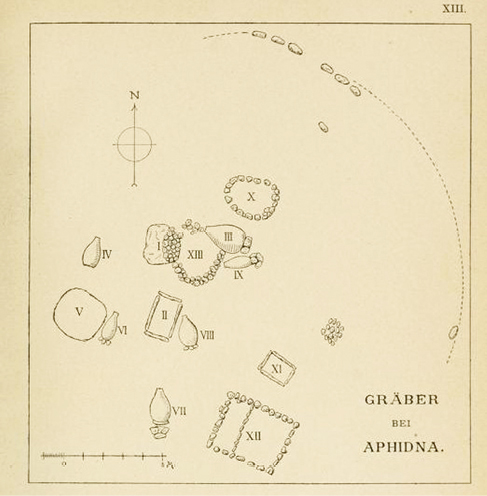
The tumulus seems to have been bordered by a single row of elliptical stones. The seven boulder stones visible in Wideâs drawing (Fig. 5) seem to have been unusually large, perhaps up to 30â35 cm.31
Wideâs plan of the tumulus with the 13 excavated graves.
Citation: Acta Archaeologica 92, 2 (2021) ; 10.1163/16000390-20210033
After Wide 1896, Pl. 13First, the team started the excavation by opening a 24 m long trench across the tumulus, diametrically from east to west.
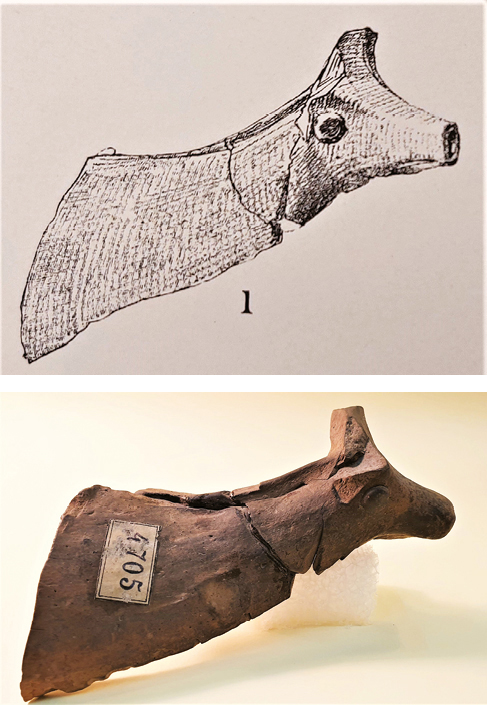
About the work in the trench, Wide wrote:32 âVarious fragments of clay were found in it. These consisted partly of coarse, brown-red clay and partly of remnants of monochrome grey vessels with incised geometric decorations. A calf head (Rindkopf) (Fig. 6, NAM P4705) made of grey clay was found about 8 m from the eastern border, which probably formed the mouth of one of these monochrome vessels. Next to it lay a spindle whorl made of grey clay and various vase fragments made of the same material. The calf head is 13 cm long; the snout is pierced so that an opening in size of about 5 mm leads through it, which may have served as a spout.â
A: Wideâs drawing of the âRindkopfâ. After Wide 1896, Pl. 15.1. B: The same fragment (NAM P4705) photographed in 2021.
Citation: Acta Archaeologica 92, 2 (2021) ; 10.1163/16000390-20210033
Photo: M. Hielte. © Hellenic Ministry of Culture and SportsJeannette Forsén suggests a possible Early Bronze Age II date for the zoomorphic fragment NAM P4705 and that it is a part of an askos turned into a rhyton (Fig. 7).33 The Aegean Bronze Age vessel called a rhyton was used in ritual libations. Vassilis Petrakis points out that the pouring of liquids as offerings constitutes the core of ritual practices and can be performed by using various pouring or drinking-shaped vessels (2016, 47).34 The custom of libations is well known in other Bronze Age cultures. In Babylonian ritual offerings to the dead, it seems that only water was used (Black & Green 1992, 117).
A: The hole in the muzzle of NAM P4705 was made from the outside. BâC: Close-ups of the zoomorphic head NAM P4705 showing the fabric and how the animalâs mane on the back, the chin beard under the jaw and the pellet eyes have been put on after the first moulding.
Citation: Acta Archaeologica 92, 2 (2021) ; 10.1163/16000390-20210033
Photo: M. Hielte, 2021. © Hellenic Ministry of Culture and SportsGeographically, a close comparison to NAM P4705 (Fig. 6) but from a later date, are the two MH bull-shaped rhyta from the West Cemetery at Eleusis. They have holes on their backs but no opening in the muzzle (Cosmópoulos 2015, 67, Fig. 27; Misch 1992).
Next, Wide placed a point of reference, a âNullpunktâ (point Zero), at the remnants of the stone ring in the NNE (see Figs. 5 & 25), from where he took his elevation measurements.
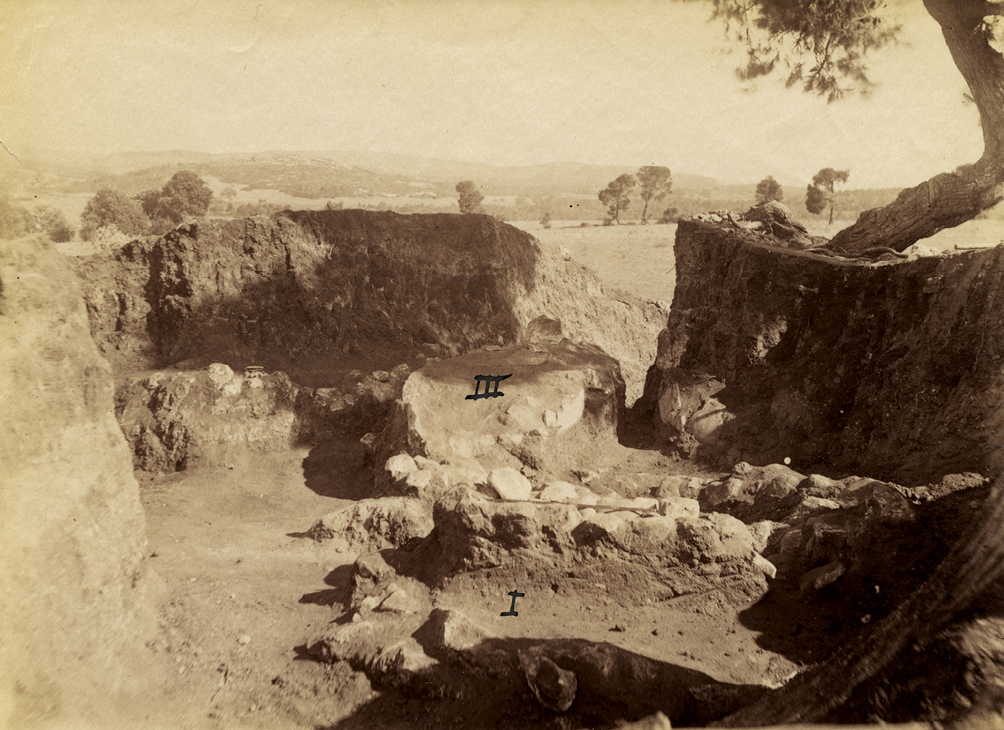
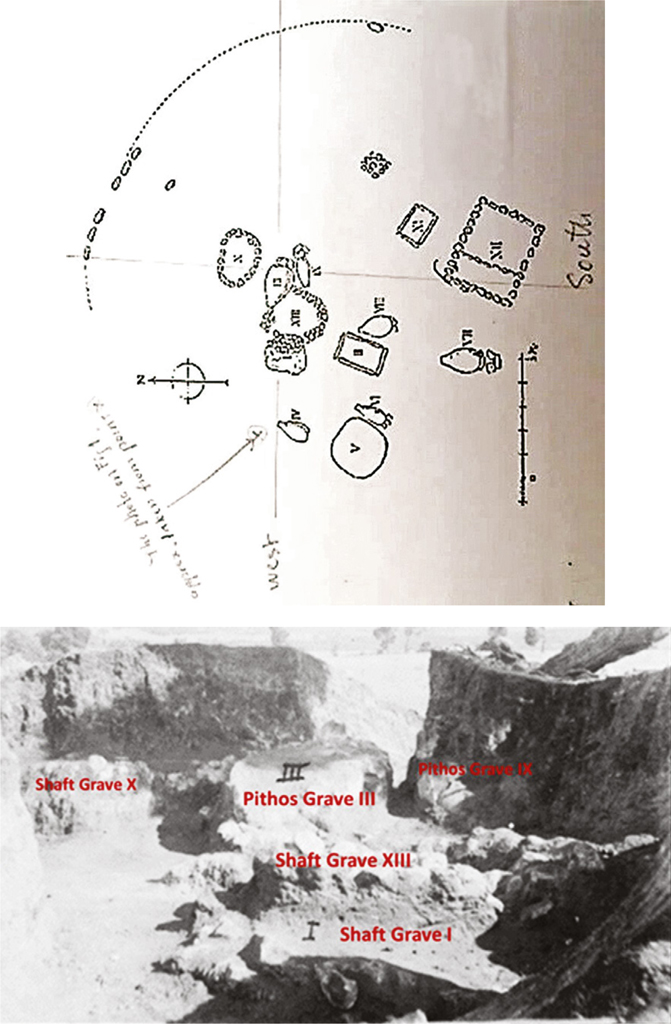
The photo in Figure 8 is the only one known so far from the Aphidna excavation.35 As can be seen in the photo, the ground is dry, so most of the graves must have been excavated before the cold, and wet autumn weather started at the end of October. The bold marks I and III on the photo are probably made by the excavator himself to mark the location of the richest burials, Shaft Grave I and Pithos Grave III, before Wide, one of the last days discovered and excavated Shaft Grave XIII. He found this grave deep between Graves I and III and considered its position so important that he would probably also have marked it with a bold XIII.
Photo taken from the inside of the tumulus of Aphidna, with large, stunted spruce. Is it the one mentioned by Milchhoefer in 1889 as âGrosse verkrÏ ppelte Fichteâ? Outside the tumulus can be seen a glimpse of the surrounding landscape, the valley before the artificial lake was constructed.
Citation: Acta Archaeologica 92, 2 (2021) ; 10.1163/16000390-20210033
Photo: Unknown photographer, probably WideOn 28â29 October, Wide took a break over the weekend and rode down to Athens to check his mail and fetch provisions. Perhaps he took the opportunity and transported the most valuable finds to safety in Athens, not leaving them in the tents. He was invited to the Wolters family Sunday evening.36 We can assume that the main theme around the dinner table was the ongoing excavation at Aphidna. Wide appreciated Wolterâs experience37 and surely asked for his opinion, perhaps showing him the notebook with his sketches (Fig. 9).38
AâC: Hastily drawn sketches in a notebook in Wideâs archive (Box NC:548 UUB).
Citation: Acta Archaeologica 92, 2 (2021) ; 10.1163/16000390-20210033
Photo: M. Hielte, 2021On Wideâs invitation, Paul Wolters paid a visit to Aphidna three days later, on Thursday, 1 November. To Wideâs surprise, his partner from the Kalaureia excavation, Lennart Kjellberg, had returned unannounced to Greece from his more than three months-long stay in Germany and came to the excavation together with Wolters. Kjellberg and Wolters both returned to Athens the same day.
Kjellberg came back to Aphidna on Sunday evening, 4 November, only to return to Athens the following Wednesday. The bad weather conditions with lots of mud prevented further digging. Wide laid in his tent to keep warm. In a letter to his friend Alfred Westholm39 Wide described the situation: âDear Brother Alfred! On Thursday, the 8th, the big autumn manoeuvres in North Attika ended. â¦. The last eight days were difficult. I (we) stayed in tents during the cold and persistent four days of rain. Fire could not be made for several days to cook food. Snow fell and covered the mountains. The German Institute became worried about my fate and sent Lennart Kjellberg with provisions (brandy and wine) to my rescueâ, and on 5 January 1895: âThe excavation in Aphidna lasted for 20 days and ended on November 8. I then found 13 prehistoric graves. Since then, I have been in Athens. I am currently working on a study of the Dipylon styleâ.40
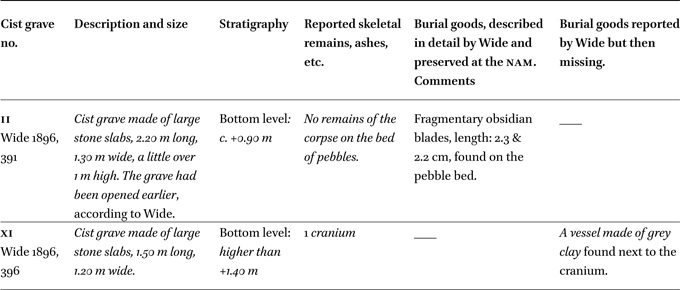
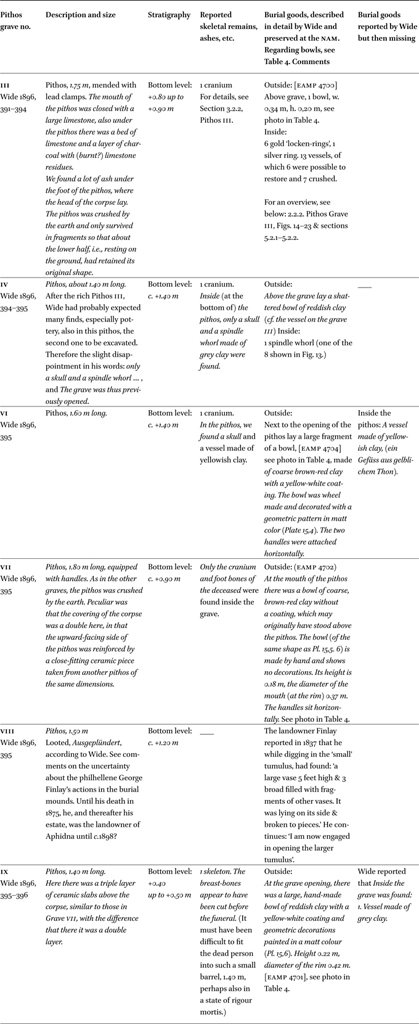
In the Aphidna publication (1896), Wide listed all the finds from graves containing grave goods (Tables 1â3). However, his article subsequently described and discussed only about half of the finds in detail while leaving the other half without any further explanation. The finds that were described and discussed were handed in to the NAM in Athens, where they still are stored. The other half of the finds, 13 of a total of 26 vases from six graves, including bronze and silver fragments, were never fully published and disappeared into oblivion.
To the author, this seems more like a conundrum. Paul Wolters, the editor of Athenishe Mitteilungen (AM), knew the excavation intimately from his own visit to the site and the many discussions with Wide. What happened? At first glance, it can seem like a sloppy, if not bad, practice, but that is hard to reconcile with what we know about Wide and Wolters. The question is taken up in Section 5.2.5, but it is important to take all finds into account when considering the entirety of Aphidna. Based on what little information Wide gives, the missing finds are included in a separate column in Tables 1â3.
Description of five shaft graves discovered by S. Wide in Aphidna and their inventories. For stratigraphic information, see Figure 25 and note 61.
Citation: Acta Archaeologica 92, 2 (2021) ; 10.1163/16000390-20210033
Description of two cist graves discovered by S. Wide in Aphidna and their inventories. For stratigraphic information, see Figure 25 and note 61.
Citation: Acta Archaeologica 92, 2 (2021) ; 10.1163/16000390-20210033
Description of six pithos graves discovered by S. Wide in Aphidna and their inventories. For stratigraphic information, see Figure 25 and note 61.
Citation: Acta Archaeologica 92, 2 (2021) ; 10.1163/16000390-20210033
3.2 The Graves
It seems logical that Wide numbered the graves in the order they were discovered, but in the present account, the graves are listed in the three categories: shafts, cists, and pithoi, based on Wideâs descriptions (1896, 390â397)41 and supplemented with his drawings (1896, Pls. 13â15).42 Shaft Grave I and Pithos Grave III are the two wealthiest burials that have received the most attention by Wide.
3.2.1 Shaft Grave I
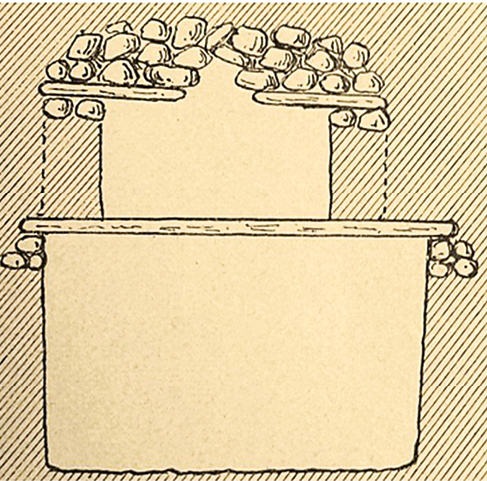
The elaborately built Shaft Grave I was, according to Wide (1896, 390â391), well equipped with six spindle whorls, jewellery in the form of crystal beads, three bronze rings, four ceramic vessels, and bronze and silver fragments. The grave had an unusual construction with an extra chamber on top of the central tomb (Fig. 10).
âThe walls (of the main chamber) were provided with a stone setting on top of which a large covering slab rested. This was 1.90 m long and 1.50 m wideâ [ca. 2.85 m2. Wide does not mention the thickness]. âAbove this slab was another oblong stone setting 0.50 m high, 1.50 m long and 0.9 m wide (see the drawing in plate 13 (Fig. 10), which tries to give an approximate picture of the longitudinal section). Its ceiling was only made of well-joined smaller field stones, which were supported by underlying, horizontal, greenish slabs of schist. This stone setting rested on the ground, not directly on the stone slabâ.
Wideâs drawings of Shaft Grave I.
Citation: Acta Archaeologica 92, 2 (2021) ; 10.1163/16000390-20210033
After Wide 1896, Pl. 13âIt has not been possible to determine whether it was the earth piled up over the main chamber in which this upper cavity was made or whether this stone setting was supported by small walls made of unfired bricks. A difference between this and the surrounding soil has not been observed. In the drawing, it is indicated by the vertical dotted lines how strong such walls, if they existed, should have beenâ.43
âAt the opening of this stone installation, we believed we had a tomb in front of us, but there was only loose, apparently trailing earth and no trace, neither of a skeleton nor of the usual grave goods. The idea of an earlier plundering should be rejected because of the solid compound of the stones. A comparison is the superstructure of one grave in Vurvá (AM 1890, 319, Taf. 9 and 13, 1. 2) [excavated by Valerios Stais], where one is reminded of our construction by the field stones on top so that one is tempted to assume development of the one from the other. In the grave itself, about 1 m below the large stone slab, we found a bed of pebbles on which the dead body lay, of which, of course, only a few decayed bones were left. It was not possible to determine the position of the head. As far as the condition of the bones could be judged, the dead did not appear to have been burned.â
âThe grave goods were as followsâ (according to Wideâs text in AM 21 1896, 390â391) (Table 1):
âBy the north wall: Three bronze rings. Six spindle whorls made of grey clay. Various pierced beads made of transparent, in places (stellenweise), slightly blue-green coloured minerals, probably crystal.â
âBy the west wall: Silver fragments. Three vessels made of grey clay.â
âBy the south wall: Various remnants of bronze. A vessel made of grey clay.â
Suggested chronology for Shaft Grave I: Most of the spindle whorls are probably from an early MH date, but some can be of an EH III date (Forsén 2010, 231). Since only six are from inside Grave I, we do not know which of the eight was associated with the burial.
The unique construction of Shaft Grave I gives the ceiling the impression of being an early form of corbelling (Fig. 10). Wide points out that âthe idea of an earlier plundering must be rejected because the stones are solidly joined together (⦠des festen Zusammenschluss der Stein)â.
The situation with the many missing finds is unfortunate for the interpretation of Shaft Grave I,44 but the extraordinary architectural structure of the tomb, the crystal beads (Figs. 11â12), and a large number of spindle whorls (Fig. 13) show that the buried individual most likely held a special position in the community.
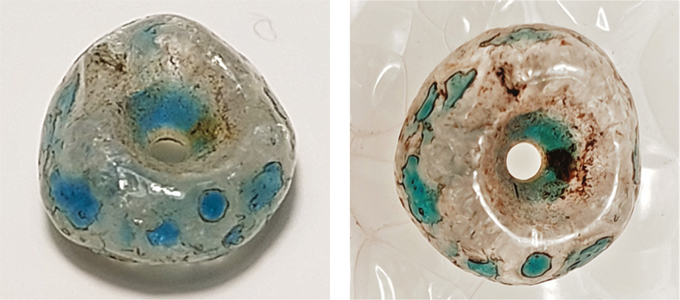
Various pierced beads (NAM P4707.1â11) from Shaft Grave I, made from transparent, sometimes light blue-green coloured minerals, some probably crystal. From left: the large black bead (no. 1) weighs 0.38 g, the little black bead (no. 2) weighs 0.04 g, the large white bead (no. 3) weighs 0.65 g, and the greenish-blue spotted bead (no. 6) weighs 0.25 g.
Citation: Acta Archaeologica 92, 2 (2021) ; 10.1163/16000390-20210033
Photo: M. Hielte 2019. © Hellenic Ministry of Culture and SportsBead NAM P4707.6 with a greenish-blue deposit on the surface and in the hole. The beadâs diameter is 6.5 mm. The same bead is shown in Figure 11 (no. 6 from left).
Citation: Acta Archaeologica 92, 2 (2021) ; 10.1163/16000390-20210033
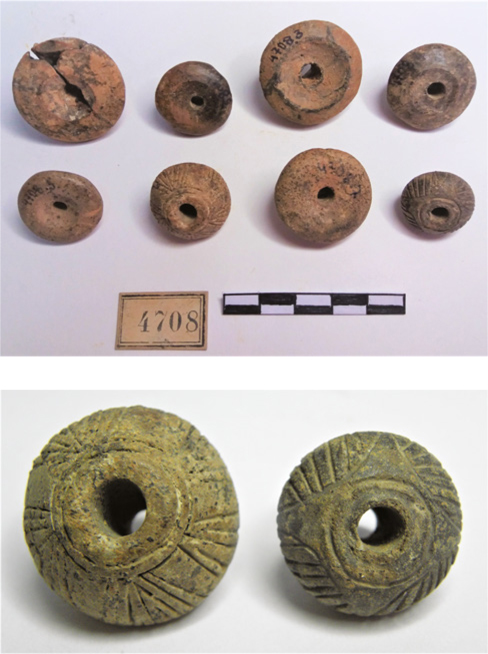
Photo: M. Hielte 2021. © Hellenic Ministry of Culture and SportsA: Spindle whorls (NAM P4708.1â8), of which six come from Shaft Grave I. Of the other two, one was found in the fill next to the âRindkopfâ (Figs. 6â7) and one in Pithos Grave IV. B: Close-up photo of the engraved spindle whorls.
Citation: Acta Archaeologica 92, 2 (2021) ; 10.1163/16000390-20210033
Photo: M. Hielte 2019. © Hellenic Ministry of Culture and Sports3.2.2 Pithos Grave III
Grave III (Fig. 14) was, according to Wide (1896, 391â394): âa large lying pithos, 1.75 m long, greatest width 1 m. The mouth of the pithos was closed with a large limestone, also under the pithos there was a bed of limestones and a layer of charcoal with (burnt?) limestone residues. We found a lot of ashes under the foot of the pithos ⦠The pithos had been crushed by the earth and only survived in fragments so that roughly the lower half, i.e., the half resting on the ground, had retained its original shape. In several places this pithos, like some of the others, was patched with lead, which shows that it was previously used for other purposes.â
Wideâs drawing shows details such as the location of the finds inside Pithos Grave III.
Citation: Acta Archaeologica 92, 2 (2021) ; 10.1163/16000390-20210033
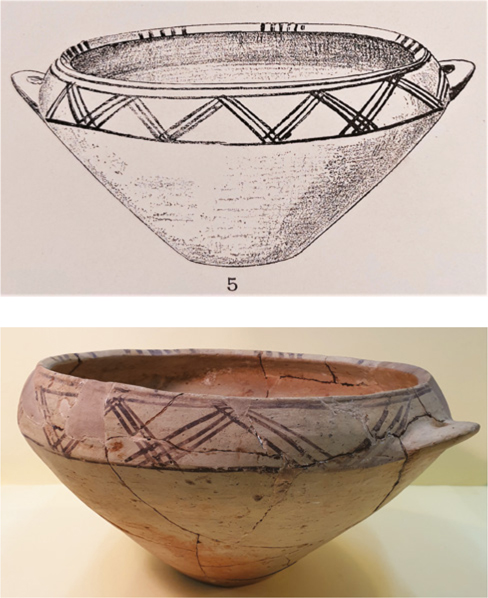
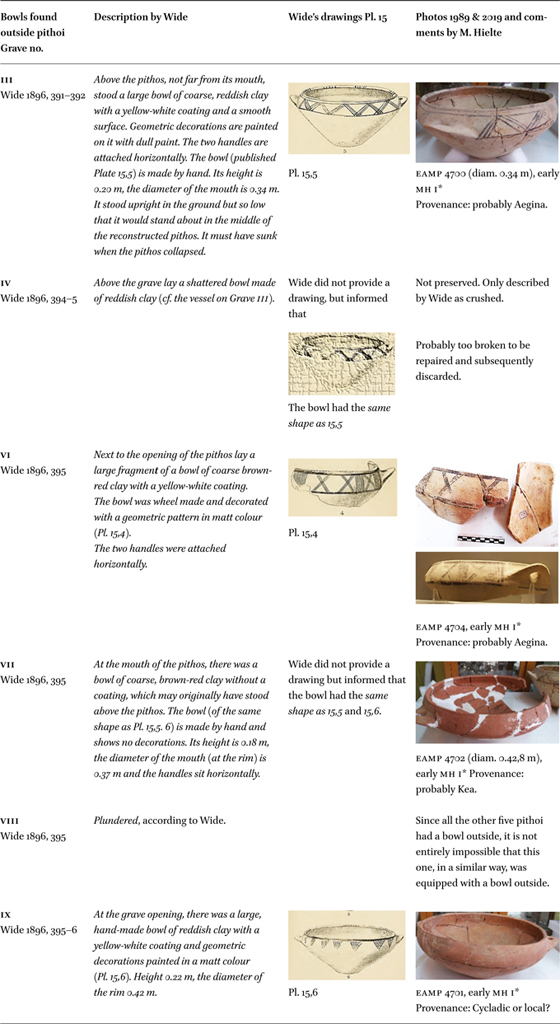
After Wide 1896, Pl. 13âAbove the pithos, not far from its mouth, stood a large bowl (Fig. 15; NAM P4700) of coarse, reddish clay with a yellow-white coating and a smooth surface. Geometric decorations are painted on it with dull paint. The two handles are attached horizontally. The bowl (published on plate 15,5) is made by hand. Its height is 0.20 m and the diameter of the rim 0.34 m. It stood upright in the ground but so deep that it would be roughly in the middle of the reconstructed pithos. It must have sunk when the pithos collapsed. This grave, which is richer in grave goods and more characteristic than all the others, contained (according to the diary; cf. the drawing, plate 13)â on the left side of the body, at Wideâs findspots nos. 1, 2 and 3 (cf. Fig. 14) âshards of three identical clay vessels with bones that seemed to have been burnedâ. At no. 5: âGray clay vessel in shardsâ. At nos. 6, 7 and 8: âShards of three identical clay vessels. Here the shards of the upturning side of the pithos were close to the lower part, with the shards of the crushed vessels and bone fragments in between.â
A: Matt painted bowl from Pithos Grave III, height 20 cm, width 34 cm. After Wide 1896, Pl. 15,5. B: Photo of the same bowl (NAM P4700).
Citation: Acta Archaeologica 92, 2 (2021) ; 10.1163/16000390-20210033
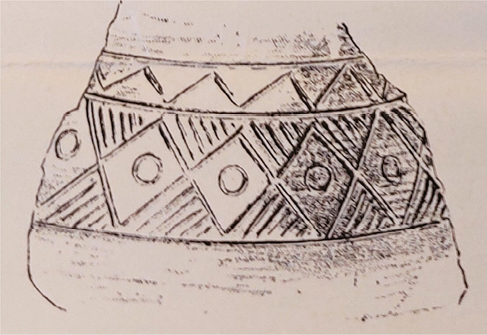
Photo: M. Hielte 1989. © Hellenic Ministry of Culture and SportsWide reported findspots for all 13 vessels from inside Pithos Grave III, of which seven were found crushed and beyond repair, and in addition, two incised shards that once were part of whole vessels. Both shards, from unknown locations within the pithos, are unfortunately lost but are well drawn by Wide on Plates 15,3 and 15,2 (Figs. 16â17).
Drawing of a shard discovered in Pithos Grave III.
Citation: Acta Archaeologica 92, 2 (2021) ; 10.1163/16000390-20210033
After Wide 1896, Pl. 15,3Drawing of a shard discovered in Pithos Grave III.
Citation: Acta Archaeologica 92, 2 (2021) ; 10.1163/16000390-20210033
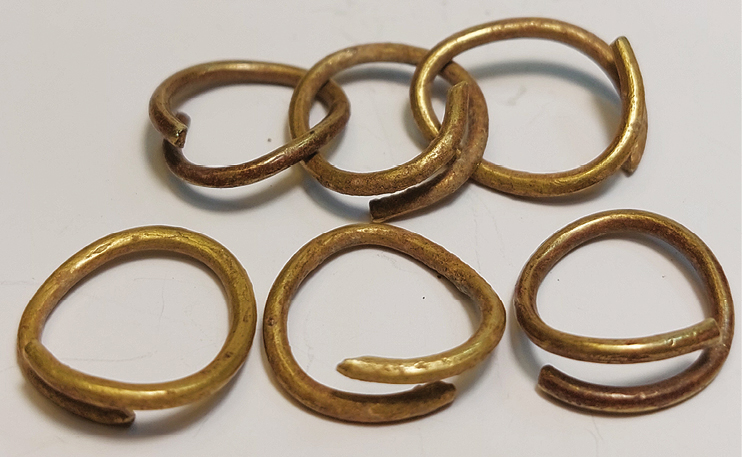
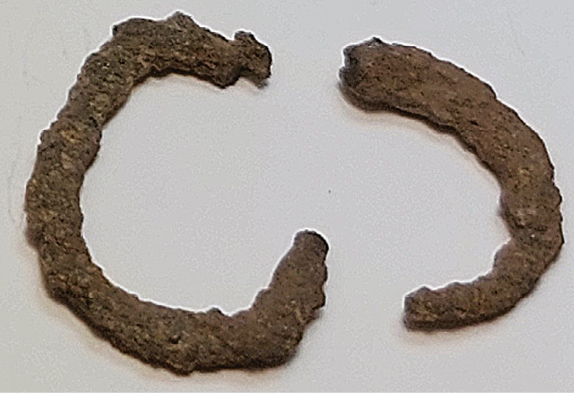
After Wide 1896, Pl. 15,2The head of the dead lay at findspot no. 4, in the inner part of the pithos. âRemains of the skull [4], and next to it six rings of gold, one of silver. Diameter on average 12 mm and thickness about 1 mm, so that the ends overlap about 8 mm and the rings are not completely closed. Three of them seem to have been combined to form a small chain that could be thought of as earringsâ (Fig. 18). âThe silver ring is of a very similar shapeâ (Fig. 19).
The six gold rings (NAM P4706) weigh together 5.34 g, with an average weight of 0.89 g ranging between 0.85â0.92 g. The golden wire is 1.2 mm thick, and the diameter of the rings is between 1.2â1.4 cm.
Citation: Acta Archaeologica 92, 2 (2021) ; 10.1163/16000390-20210033
Photo: M. Hielte 2021. © Hellenic Ministry of Culture and SportsBadly corroded silver ring broken in two halves (NAM P4706) weighs 0.93 g (0.59 and 0.34 g) in total.
Citation: Acta Archaeologica 92, 2 (2021) ; 10.1163/16000390-20210033
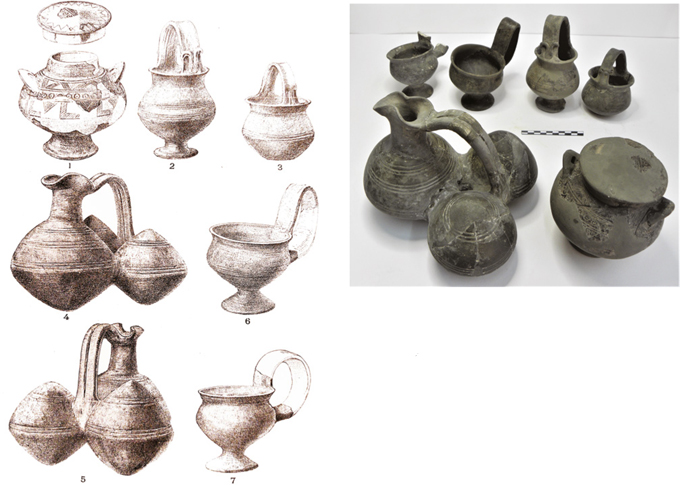
Photo: M. Hielte 2021. © Hellenic Ministry of Culture and SportsOnly six of the 13 vessels could be reconstructed. They were found near the opening, on findspots nos. 9â14 (see Fig. 14) and are all drawn by Wide 1896 in his Plate 14 (Fig. 20).
A: Wideâs drawing in AM 21, 1896, Pl. 14,1â7. B: Photo of the pottery assembly shown in Wide 1896, Pl. 14. These vessels â four small ones in the upper row from left (NAM P4693, P4694, P4697 and P4696), the multiple vessel (NAM 4695) and the footed spherical pyxis (NAM 10749) were discovered inside Pithos Grave III and near the opening of the ceramic coffin. All are well-preserved and stored at the NAM.
Citation: Acta Archaeologica 92, 2 (2021) ; 10.1163/16000390-20210033
Photo: M. Hielte 2019. © Hellenic Ministry of Culture and SportsâI am drawing the vases of this grave here (plate 14) as far as they could be put together in Athens National Museum. As a result of the badly shattered and often disintegrated condition of the vases and the bad weather during the investigation of this grave, it was not possible to sharply separate all the individual vases ⦠They are all made with the disc, even if, in some cases, with little skill. Most of them show a smooth, almost shiny, dark grey exterior, which is not achieved by external colouring, but by carefully smoothing the surface of the grey clayâ (1896, 393).
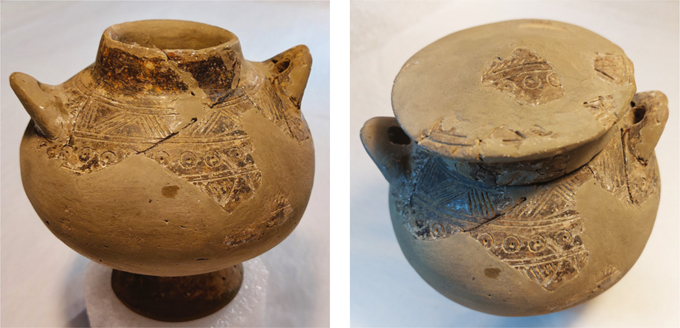
Findspot no. 13 in Figure 14 (Fig. 20a, no. 1 & Fig. 21), the Pyxis NAM P10749: âOnly incompletely preserved vessel with a foot, a wide belly, and a slightly retracted mouth (height about 0.10 m), to which a lid made from small remains must belong. ⦠The uppermost stripe has a kind of zigzag ornament, the middle a series of circles with pressed-in centres, the lowest meander hook with alternating triangles (all incised)â (1896, 394).
Footed pyxis (NAM P10749), height 11.5 cm. The lid (height 3.2 cm, diameter 8.5 cm) is decorated similarly to the vessel.
Citation: Acta Archaeologica 92, 2 (2021) ; 10.1163/16000390-20210033
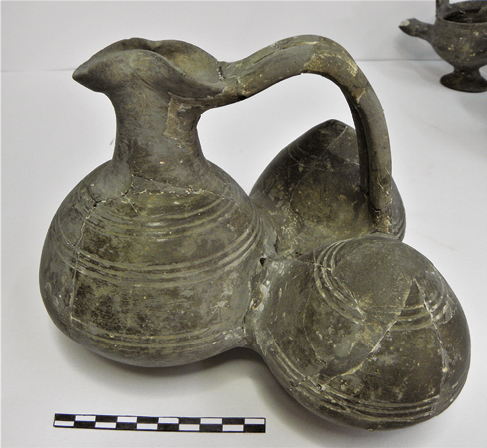
Photo: M. Hielte 2021. © Hellenic Ministry of Culture and SportsThe multiple vessel NAM P4695, findspot no. 9 (Fig. 14), in Wideâs Plate 14, 4.5 (Figs. 20a, 4â5, 20b & 22): âStrange vessel, consisting of a jug with a cloverleaf-shaped mouth on which two completely closed, rounded vessels with a point at the top are attached to the back as a support for the handle. Height 0.16 m, largest diameter of the jug 0.12 m, each of the round parts 0.09 m. The handle goes from the back of the cloverleaf mouth in two strands to the junction of the two rounded approaches. Horizontal stripes on the abdomen are pressed fairly flat into the soft clay with the help of the wheelâ (1896, 393).
Findspots nos. 10, 11, 12 and 14 in Wideâs drawing (see Fig. 14) are most probably the following vessels: NAM P4693 (Fig. 20a, 2): âSmall, spherical, bulbous vessel with a handle ⦠A decorative calyx (Blutenkelch) is glued to one end of the handle, at the corresponding point on the other side only its attachment point, which is no longer preserved. Depressed horizontal stripes on the abdomen, as in 14, 4.5 (NAM P4695). Height 0.11 m (including the handle 0.16 m). Largest diameter 0.09m.â
NAM P4694 (Fig 20a, 3): âVery similar vesselâ (as NAM P4693). âH. 0.07 m, with the handle 0.11 m high, only distinguished by the lack of the foot. The calyxes are preserved on both sides. Depressed stripes like in ⦠the composite vesselâ NAM P4695 (see Fig. 32).
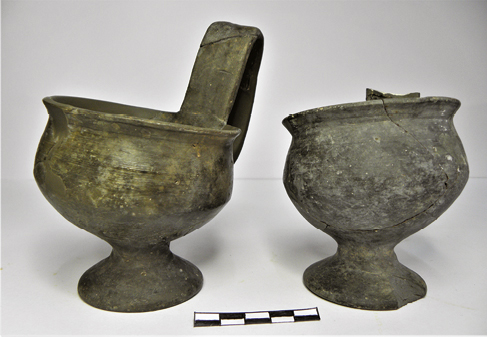
NAM P4696 (Fig 20a, 6): âDrinking vessel with foot and Kantharos handle, without ornaments. Height 0.08 m, diameter of the mouth 0.09 m.â According to Jeannette Forsén, the height with handle is 13.8 cm, without the handle â 7.6â9.8 cm, diameter of the mouth is 9.1 cm, and that of the foot is 6.1 cm (2010, 229).
NAM P4697 (Fig. 20a, 7): âA second, almost identical (as NAM P4696) vessel is 0.09 m high, the diameter of the mouth 0.085 mâ.
âAmong the vase fragments belonging to this grave, which could not be combined into a whole, are the above already mentioned fragment of a similar vaseâ (as the pyxis NAM P10749) âwith incised geometrical decorations, pl. 15, 3) (Fig. 16) ⦠Finally, the shard of grey, not fine clay depicted on plates, pl. 15, 2 (Fig. 17) with a pattern impressed into the still moist vessel, should also be mentioned here. ⦠The two vessels ⦠belong to a different genus? Their clay is reddish-grey, soft and very crumbly. The surface of the vessels is coloured black and then polished to a shine after drying but before firing. In well-preserved places, the vessels almost give the impression of being varnished. The decorations consist of incised lines. Since such a polish of the surface disappears again with strong firing, as I have been assured, these vessels are badly fired, very fragile, and therefore very poorly preserved, in contrast to those that are thoroughly grey in colour.â 45
4 The Aftermath of Aphidna
One of Wideâs contemporary colleagues was the renowned Greek archaeologist Chrestos Tsountas. There is a surprising statement about Aphidna in his book The Mycenaean Age from 1897. He wrote: âa tumulus of ten graves in which were found human bones inurned in pithoi as at Thoricus, as well as eleven old Mycenaean vases, including two of pure gold, and three gold earringsâ.46 Tsountasâ text was then copied by William Ridgeway (1901, 190), in his book on The Early Age of Greece.
The composite, multiple vessel (NAM P4695) made of three parts, height 15.3 cm.
Citation: Acta Archaeologica 92, 2 (2021) ; 10.1163/16000390-20210033
Photo: M. Hielte 2019. © Hellenic Ministry of Culture and SportsFooted cups with vertical handles connected to the rim. The left cup (NAM P4696) has a marked difference in height. Without its handle, it varies between 7.6â9.8 cm due to the fact that the whole vessel is skewed. The right cup (NAM P4697) has the same skewness, height 8.1â9.1 cm. Traces of the potterâs wheel visible under the foot, with clear wheel marks on the interior.
Citation: Acta Archaeologica 92, 2 (2021) ; 10.1163/16000390-20210033
Photo: M. Hielte 2019. © Hellenic Ministry of Culture and SportsThe idea of finding âgold vasesâ in a Mycenean context was not unrealistic47 but mingled among Aphidnaâs rather primitive pottery from around 2000 BC, what would have been a sensation. If these âgold vasesâ had really existed, Wide would surely have used such an extraordinary find to improve his reputation. That might have secured his future academic position. For a man who could occasionally not resist boasting, one would assume that he would use such finds for what they could be worth. Where the story about the gold cups originated is a bit mysterious, not least because Dörpfeld himself wrote a long and rather critical foreword to Tsountasâ book without mentioning this.
Wideâs scientific work at Aphidna received little attention in the decades following his publication in 1896. But 50 years after the excavation, Alan Wace wrote in his article âThe prehistoric exploration of the Greek Mainlandâ: âIn northern Attica the outstanding site is Aphidna. Here the hill on which stands the chapel of the Zoodochos Pege is obviously an important prehistoric acropolis. The pottery of all three Helladic periods is plentiful on the surface, and a terrace and other walls can be observed. To the south lies the remains of the Middle Helladic tumulus excavated by Wide. Recent ploughing has levelled this still more and shown that other cist graves (now destroyed) existed here, besides those which the Swedish Expedition discoveredâ (1946, 633).
In 1964, Emily Vermeule, in her chapter âThe Opening of the Middle Bronze Ageâ, paid attention to the site and wrote: âAphidna in northern Attica, â¦, is even more peculiar [than Samikon]; a stone wall enclosed thirteen graves in a precinct â some cists, some pithos burials, and some which almost qualify as proper shafts; the pottery is quite unorthodox Minyan (1964, 81)â. Then came Olivier Pelon in 1976 with his Tholoi, tumuli et cercles funéraires, followed in 1979 by Richard Hope Simpson and O.T.P.K. Dickinson in their Gazetteer (F54, 220).
The first modern presentation of Aphidna was a paper with the title: âSam Wideâs Excavation at Aphidna â Stratigraphy and Findsâ by Hielte-Stavropoulou and Wedde (2002). It was part of the centennial celebration of the first Swedish excavations in Greece, held at the Swedish Institute in Athens in 1994. Robin Hägg (2002) stated in his introduction: âSome money was left over [after the summer excavation on Kalauria], and Wide decided that an excavation at the prehistoric site of Aphidna in northern Attica would be a worthy finale to his activities in Greece. Although the fieldwork lasted only 14 days in October and November 1894, this excavation may be considered even more important than the one at Kalaureia since it brought to light the remains of a hitherto unknown phase of the Greek Bronze Age, to be dated before the Mycenaean culture which had already been thoroughly uncovered by Schliemann and othersâ.48 Also, Nordquist (2019) confirms that Wide was the first to identify the Middle Helladic culture based on the Aphidna finds.49
Remarkably, Wide himself correctly dated the Aphidna tumulus to around 2000 BC. In 1915, Wide wrote in his personal notebook: âDuring my excavations in Aphidna, northern Attica in the autumn of 1894, I discovered a hitherto virtually unknown culture from the time around 2000 BC. It is characterized by a geometric decoration with matt colours as opposed to the familiar geometric style from around the year 1100 BC. This culture has since been observed in several places in Greeceâ.50
But during his lifetime (until his sudden death in 1918), he did not seem to have much support from his contemporary colleagues. For example, the internationally well-known Swedish archaeologist Oscar Montelius wrote: âMr Wide supposes that the burials in the tumulus date from the Pre-Mycenaean period or the first part of the Mycenaean period. In my opinion, they are contemporary with the last period of Mycenaean civilizationâ (1924, 158).51
After Aphidna, Wide published a couple of influential studies on Geometric pottery from Greece, an area which was marked by his experience.52 He was eager to understand how geometric patterns had arisen, and in the last ten pages of his 1896 report, he discusses different ideas like braiding and weaving, Flechterei und Weberei, of indigenous people of central Brazil as one possible common source.53 He also argued that the Geometric patterns and style should be regarded as a domestic development on Mycenean pottery rather than as a consequence of a Doric invasion, and in an article on finds from Salamis, he coined the term protogeometrisch (âGräberfunde aus Salamisâ 1910, 17â36).
Besides patterns on Geometric pottery, his great interest was Greek mythology. From the early years, both in Germany and in Uppsala, he had prepared his monograph Lakonische Kulte, printed in Leipzig in 1893. On page 322, he writes: âAphidnos (Fidnos) ⦠the âruthlessâ, is just another name for the underworld ruler, ⦠and his castle is of course called ÎÏίδναι. This castle or city does not need to be proven geographically, it perhaps only existed in the laconic popular conception as a city or castle of the underworldly powersâ.54 So, even before Dörpfeld, in the spring of 1894, officially suggested Aphidna as a suitable excavation site for Wide, they had probably discussed the place thoroughly. Also, during his earlier years of study in Germany, Wide had probably followed Ernst Curtius, Johann Kaupert and Arthur Milchhoefer in the preparation of their extensive work Karten von Attika.
In Sweden, Wide, as the first professor of Classical archaeology and ancient history at Uppsala University, included Aphidna in his teaching. His thorough knowledge of Greek mythology made him dare to question the correctness of old established interpretations. For example, he was convinced that the Helen in Theseusâ myth was Helen of Rhamnus and not the Helen who later was involved with the Trojan war. In his introduction to his excavation report 1896, he writes about Aphidna: âwhose role is known in the oldest ancient legends, was one of the most important fortresses in Attica in the classical period. The legend which related the abduction of Helen by Theseus was partly localized in Aphidna. ⦠Helen, who is hidden in Aphidna and forms the centre of the Aphidnean war, is certainly not the laconic girl, the daughter of Tyndareus and Leda, but Helen of Rhamnus, the daughter of Nemesis ⦠Anyone who knows the localities in North Attica a little closer will admit that Helen of Rhamnus is more correctly associated with the North Attic Theseus legend than the laconic kingâs daughter of the same name ⦠If Theseus is at home in one of the castles of the Tetrapolis, the abduction of Helen of Rhamnus becomes a legend, as it may be taken from the feuds of neighbours common among the old lords of the castle. It is true that the Helen of Rhamnus was obscured by the laconic Helen, like Aphidna and the Tetrapolis by Athensâ (1896, 386â387).55
Regarding these reflections on the myth of Helen, Oscar Montelius seems here to have supported Wide;56 in contrast to the question of Aphidnaâs chronology (see note 51).
Sam Wide would certainly have enjoyed reading the recently published article by Konstantinos Kalogerópoulos on the Early Helladic Acropolis in Rhamnous, and the enigma of the disappearance of its people without a trace (Kalogerópoulos 2020). Can we see any connection with Aphidna?
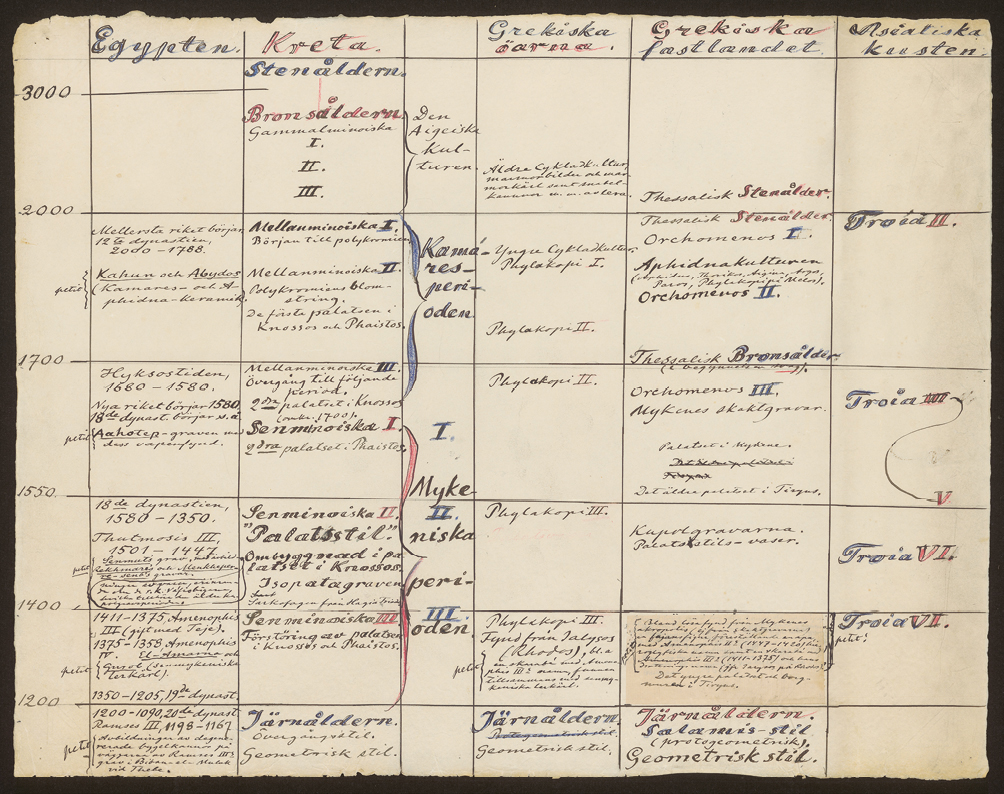
Regarding Wideâs teaching in âKlassisk fornkunskap och antikens kulturâ, he probably used the large handwritten chart (Fig. 24).57 According to Wideâs Lecture Diary at Uppsala University (UUB) for the spring semester of 1912, he did it thoroughly and held three lectures a week, plus seminar exercises. He started on January 17 with the Society of Dilettanti (founded in 1734) and Stuart & Revett. On February 29, he talked about The German excavations between Acropolis, Aeropagos and Pnyx. On March 7, the lecture title was: The Excavations at Aphidna and Thorikos. March 15: The excavations at Dimini and Sesklo ⦠etc.
Chronological list of cultures 3000â1000 BC known at the end of the 19th century. The chart, 62 Ã 49 cm, was probably made by Wide himself and used in his teaching as a professor at Uppsala University during the years up to his death in 1918.
Citation: Acta Archaeologica 92, 2 (2021) ; 10.1163/16000390-20210033
Source: Wideâs archive box no 545 at UUBThe period 2000â1800 BC in Mainland Greece (Grekiska fastlandet) between Orchomenos I and II is on the chronological chart in Figure 24 called the Aphidna culture and includes Aphidna, Thorikos, Aigina, Argos, Paros and Phylakopi on Melos. This view of Aphidna is, of course, no longer valid, but Wideâs chronology chart shows how he and perhaps some of his contemporaries once looked at Aphidna. In his chart, Aphidna is presented as a pre-Mycenaean centre, including other contemporary sites, between Orchomenos I and II.58
Some of Wideâs students continued his early work within ancient Greek religion, for example, the well-known Martin P. Nilsson,59 and for many decades, generations of Swedish researchers like Axel W. Persson continued Wideâs work in prehistory. It was sad that he died prematurely60 so that he never got to see the great interest in Aegean Prehistory that followed after Aphidna.
Some decades after Wideâs excavation, the interest in dating pre-Mycenaean material grew, and articles like âThe Pottery Called Minyan Wareâ (Forsdyke 1914) and âOn the Date and Origin of Minyan Wareâ (Childe 1915) tried to illuminate the culture behind the pottery. Alan Wace and Carl Blegen published their much-referenced article, âThe Pre-Mycenaean Pottery of the Mainlandâ (Wace & Blegen 1916â1918). Carl Blegen conducted excavations of the prehistoric settlement at Korakou, several kilometres west of Corinth on the Peloponnese, and his publication from 1921 remained for half a century one of the best analyses of the MH pottery. Today, Korakou is best known for its Early Helladic II material, c.2650â2200 BC. The so-called Korakou EH II culture was on Peloponnese, followed by the EH III Tiryns culture, Early Helladic III c.2200â2000 BC. At the end of EH II, the Leukandi culture flourished on the island of Euboea and in East Mainland. Aphidna is geographically located in the middle, between Tiryns and Leukandi (see Fig. 1).
Beyond ceramics, R.J. Howellâs article on âThe Origins of the Middle Helladic Cultureâ (1973) was for the author, as a student, one of the best and most comprehensive accounts about this diffuse but intriguing period.
In recent times, there is a renewed interest in fieldwork at Aphidna. The University of Athens started in 2005 a field survey on Kotroni Hill â the Acropolis of Aphidna (Papadimitrou-Grammenou et al. 2011), focussing on the Mycenaean and Classical eras. Over the years, the team has carried out excavations on the hilltop, an oval flat area of c.200 m by 40 m about 1.5 km to the NNE of the tumulus. In 2017, a renewed five years research program started. The focus has been along the eastern fortification wall, around the church. The results show that rows of houses were built adjacent to the wallâs interior. Mycenaean, but also some Middle Helladic potsherds have been found in these trenches inside the fortification (Platon Petridis, personal communication 2018).
More recently, in 2019, the Kotroni Archaeological Survey Project (KASP) started under the supervision of Eleni Andrikou (Ephorate of Antiquities of Eastern Attica), Anastasia Dakouri-Hild (University of Virginia) and Stephen Davies (University College Dublin). The project uses advanced techniques to systematize and digitize the available information on the site and acquiring new data using non-invasive and minimally invasive techniques.
Wide and his contemporaries were pioneers 130 years ago, with access to almost no comparative material.
The map in Figure 1 shows Aphidna and the nearby region with many approximately contemporary archaeological sites known to us today and mentioned in the text.
5 Discussion
As noted, Shaft Grave I and Pithos Grave III are the two richest ones and are given the most attention by Wide (Sections 3.2.1 & 3.2.2 and Tables 1 & 3). This part provides a more detailed discussion of some of the other graves within the tumulus and may also indicate how burial rites could have taken place.
Firstly, the structure of the tumulus and each grave type (cist, shaft, pithos) is discussed (Section 5.1), followed by the find inventories, including the pottery, beads, spindle whorls, and metal fragments and describing the search for the missing finds (Section 5.2). In Section 5.3, elements of the burial rites are reviewed. Finally, Aphidnaâs position from a chronological perspective is considered.
5.1 The Graveyard with Its Cists, Shafts and Pithos Graves
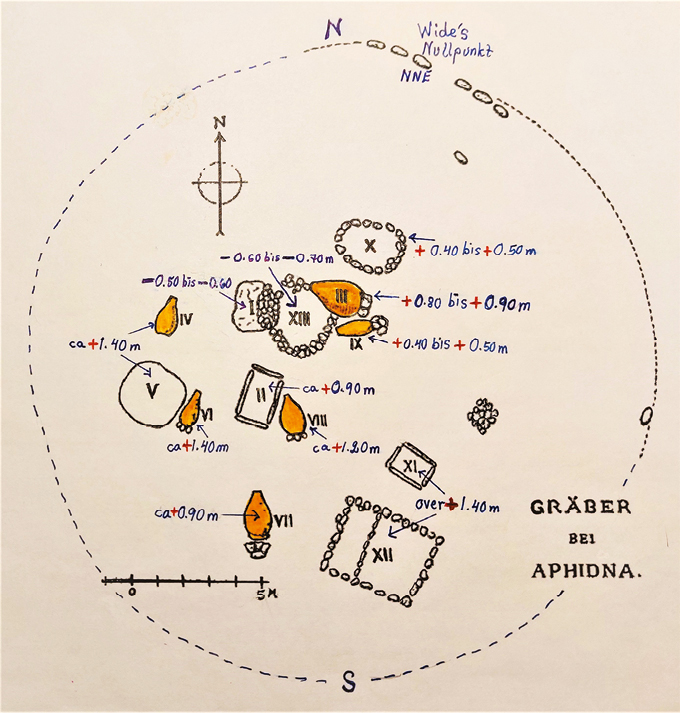
Using Wideâs elevation measurements given in his report (1896, 396â397)61 (Fig. 25) attempts to illustrate the gravesâ positions in relation to each other and how the tumulus must have sloped downwards, from south to north.
The blue â (minus sign) indicates the depth below the reference point, and the red + (plus sign) shows the depth above the reference point âNullpunktâ.
Citation: Acta Archaeologica 92, 2 (2021) ; 10.1163/16000390-20210033
The sketch is redrawn by the present author from Figure 5 (Wideâs plan 1896, Pl. 13)The graves in the southern part of the tumulus were mostly destroyed or plundered. They had been in a higher position (see Fig. 25), due to the slope of the terrain, perhaps near the surface and therefore more visible. As can be seen in Tables 1â3, the excavation team found eleven crania in nine of the graves.62 They all seem to have been inhumations in single graves, except for Shaft Grave V, which contained three crania and various bones.
5.1.1 The Cist Graves
They are often regarded as simple constructions, but considering the difficulty of finding suitably large stones and shaping them, the effort is probably underestimated. It shows great care to build such a grave for the dead. In Cist Grave XI, â1.50 m à 1.20 mâ, the only remains were a âcraniumâ and a âvessel made of grey clayâ.
The large Cist Grave II, â2.20 m à 1.30 mâ (Fig. 25 & Table 2), may be one of the oldest graves in the tumulus. It contained fragmentary obsidian blades (Fig. 26),63 found on the pebble floor, but no remains of a corpse and was probably looted: âThe grave had been opened earlierâ, according to Wide.
Two obsidian blades (NAM P4709.1 & 4709.2) from Cist Grave II. Length: 2.3 and 2.2 cm.
Citation: Acta Archaeologica 92, 2 (2021) ; 10.1163/16000390-20210033
Photo: M. Hielte 2021. © Hellenic Ministry of Culture and Sports5.1.2 The Shaft Graves
Aphidnaâs five so-called Shafts I, V, X, XII & XIII (Fig. 25, for contents, see Table 1), are large pits bordered by stones to hold the large covering slabs in place. Some graves are large, e.g., Grave X with the size of â2.90 m à 2.40 mâ. The remarkably large stone slab covering Grave V, â2.50 à 2.20 mâ, had a size of over 5 m2 and must have required an unusually large effort to get in place. Shaft Grave I stands out with its unique construction of double compartments and a corbelled cover (Fig. 10). Stone-built graves in Attica from the Early Bronze Age are found at both nearby Tsepi and Agios Kosmas (Mylonas 1959; Weiberg 2013, 42â43). In Northwest Syria, stone-built, corbel-vaulted burial chambers appear to have been introduced during the third quarter of the third millennium BC, sometimes within tumuli (Burk 2020).
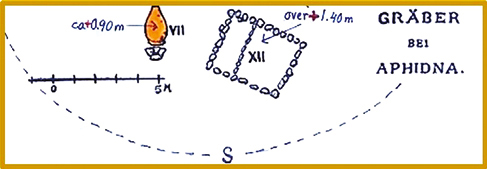
The nearly 10 m2 large construction called Shaft Grave XII, located in the upper south end of the precinct (Fig. 27), could be a candidate for an area intended for the preparation of the dead and rituals. Grave XII was previously opened and plundered, according to Wide, but nothing is mentioned about skeletal remains or other finds. âThe construction is 3.80 m long, 2.60 m wide, the upper edge of which was bordered with stones, covered with slabs. The tomb was divided into two unequal halves by a partition made of stones.â But one may question if this was really a grave âcovered with slabsâ all over the 10 m2?
Detail of Figure 25 showing Grave XII.
Citation: Acta Archaeologica 92, 2 (2021) ; 10.1163/16000390-20210033
Most probably what Wide called Grave XII was the bordered square mentioned by Milchhoefer (see note 9): âa flatter, southern tumulus next to it [next to âthe larger tumulusâ?], which is crowned by a large, stunted spruce. The traces of the wall seem to indicate a square border.â (A suggestion for Structure XII as a Mortuary house will be presented in section 5.3. Burial Customs.)
5.1.3 The Pithos Graves
In the Aphidna tumulus, about half of the burials were in pithoi. If we add the one (or two?) that George Finlay mentions, there were at least seven pithoi, maybe eight. The size of the Aphidna pithoi ranged between 1.80 m to 1.40 m, with an average length of c.1.60 m. They were all found in a horizontal position. Some were mended with lead clamps.64
Pithoi and other large clay vessels were used in Greece as early as the Neolithic period (Zavadil 2019, 233). Isolated pithos burials are known from the EH II period, but it is from the transition from EH III to Middle Bronze I that they became quite common (Whittaker 2014, 105).
Before their use as burial coffins, they probably had served as storage vessels, as silos, in an upright position, covered with a flat large cist stone. Even today, on some Greek farms, large pithária65 are used as silos dug down and hidden in the fields. The difficult task of producing large pithoi was most likely to start at the bottom and to build up the vessel, layer by layer, by using long coils of clay and then smoothing the surface. Next, to build a temporary kiln from stone slabs around it and fire it. Putting on handles, like the ones on pithos from Pithos Grave VII, made it easier to move or tilt the vessel if people needed to get the content out.
For the Pithos Graves III, IV, VI, VII, IX and perhaps also VIII (Fig. 25 & Table 3), there is an interesting feature with big bowls placed outside the graves. These large ceramic vessels are presented here in this context for the first time in Table 4. Wide reported them but probably did not think further about their significance for the interpretation of rituals around the tombs. But they may give us important information in this respect. They are outstanding finds, discovered just outside, or above, the pithos graves.
Bowls discovered outside pithoi in Aphidna. Photos © Hellenic Ministry of Culture and Sports
Citation: Acta Archaeologica 92, 2 (2021) ; 10.1163/16000390-20210033
5.1.4 The Location of the Graves inside the Graveyard
Both Shaft Grave I and Pithos Grave III were regarded by Wide as closed finds, i.e., he considered them to have been intact before the excavation and that the contents were thus to be regarded as âclosed contextâ.
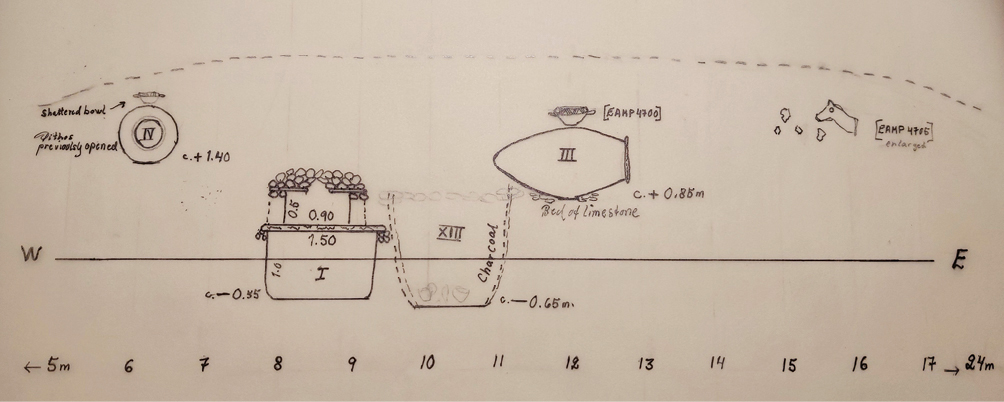
Shaft Grave XIII is probably the oldest one. It is located at a deeper level, ââ0.60 m down to â0.70 mâ, midway between the two richest furnished burials, Shaft Grave I and Pithos Grave III (cf. the photo in Fig. 28 & the sketch in Fig. 29). Its stone setting was partially destroyed when Graves I and III were created. Wide mentioned nothing about skeletal remains in Shaft Grave XIII, but here and there, especially on the walls, there were remains of charcoal (âKohlenresteâ).
A: For comparison of the positions of some of the centrally located graves, Wideâs drawing (handwritten notes by the present author, cf. Fig. 5) is turned 90° to have the same direction as the camera angle in B: The photographer must have stood somewhere behind Pithos Grave IV.
Citation: Acta Archaeologica 92, 2 (2021) ; 10.1163/16000390-20210033
West-East cross-section of the Aphidna tumulus based on Wideâs excavation map shown in Figure 5 with the indication of Wideâs depth measurements of the bottom levels of the graves, Figure 25.
Citation: Acta Archaeologica 92, 2 (2021) ; 10.1163/16000390-20210033
The sketch is an attempt by the present author to illustrate the spatial relationship of the three central graves I, XIII and IIIFrom Shaft Grave XIII Wide reported: âIn the grave were found:
1. Vessel made of grey clay with incised geometrical decorations, âgeometrischen eingeritzten Verzierungenâ.
2â3. Two vessels made of coarse, brownish clay.
4. Vessel made of grey clay without incisions.â
Unfortunately, these four vessels are among the missing ones. Particularly vessel no. 1, with incised decoration, feels like a great loss since it could have told us about the initiation moments of the tumulus.
5.2 The Finds and Comparisons with Contemporary Materials
At Aphidna, ten of the 13 excavated graves, all of a relatively early date, contained some kind of grave gifts (Hielte 2004a, 6). However, these estimates can only be approximate since some graves have been âearlier opened and robbedâ.
Some of the following interpretations may seem a bit unconventional, but it can be a mistake to underestimate the knowledge that the group of people living at Aphidna around 2000 BC may have had about the outside world. Even if they did not travel themselves, the objects found in their graves show that they came in contact with traders, who may have told them about distant places and foreign customs.66
5.2.1 Pottery
Aphidnaâs diagnostic early pottery seems to have traits found on the Cyclades and in Anatolia, but some of the large matt-painted bowls were probably imports from Kolona on the island of Aegina. However, concerning the provenance of the large red bowl restored with white plaster (NAM P4702) found outside the opening of Pithos Grave VII, see the photo in Table 4, Kalliope Sarri suggests that it can be Keian due to the typical white-yellowish slip at the handle.67 Some of the pottery may also be locally made. Boeotia to the north do not seem to have had its own production of matt-painted pottery prior to a developed stage of the MH period (Sarri 2007, 163).
5.2.1.1 The Pyxis
For the pyxis NAM P10749, the closest known parallel comes from Kerameikos in Athens, with a lidded handmade spherical pyxis (Inv. no. 643) with incised and plastic decoration, height c.12.5 cm and estimated diameter of the rim 7.7 cm. The lid on the Kerameikos pyxis (missing today from the Kerameikos museum) had a diameter of 10 cm. It was handmade, with incised decoration on the top (Balitsari & Papadopoulos 2019, 125â128, Figs. 9â10). The Aphidna pyxis (Figs. 21 & 30), displays more variation in the decoration, with circles and hatched L-shaped patterns.
A: The pyxis (NAM P10749), the height of the vessel â 11.5 cm and the height of the lid â 3.2 cm. B: Close-up of the decoration.
Citation: Acta Archaeologica 92, 2 (2021) ; 10.1163/16000390-20210033
Photo: M. Hielte 2019. © Hellenic Ministry of Culture and Sports5.2.1.2 Vessels with Possible Potterâs Marks
A marking system came into use at the same time as the pottery industry began to be organized for export, especially on Aegina in early MH (Lindblom 2001) (Fig. 31). But already in EH II, some potterâs marks seem to have been identified from Lihtares in Boeotia (Tzavella-Evjen 1980, 93â95). There are also finds among the EH pottery at Zygouries (Blegen 1928, 107, Fig. 92) and in many other places.
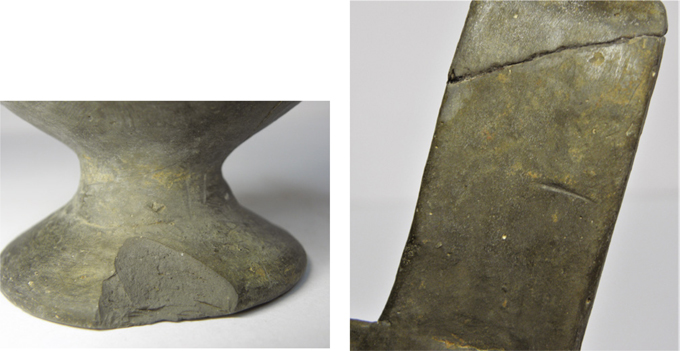
A: Detail of the foot of the small drinking vessel (NAM P4697) with incisions. Is it an intentional mark â a so-called potterâs mark on the stem? An added small lump on the stem to the left on the photo seems to be the potterâs unsuccessful attempt to improve the balance (cf. Fig. 23). B: Can the nail stripe on the handle of the other drinking vessel (NAM P4696) be an intentional potterâs mark?
Citation: Acta Archaeologica 92, 2 (2021) ; 10.1163/16000390-20210033
Photo: M. Hielte 2019. © Hellenic Ministry of Culture and Sports5.2.1.3 Small Jars with Decorations on Handles
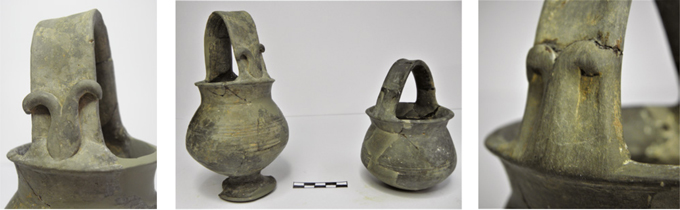
Wide describes the decorations found on the handles (Fig. 32) as âdecorative calyx (Blutenkelch)â, (petals of a flower). He notes about NAM P4693 that âat the corresponding point on the other side, only its attachment point, but it (the calyx) is no longer preservedâ. About the flat-based jar with basket handle NAM P4694: âthe calyxes are preserved on both sidesâ (1896, 393). The attached decorations on the two jars are made with different techniques. On the footed basket, it is put on separately, in contrast to the footless basket, where both sides of the handle have decorations mouldered out of the clay.
The small jars (NAM P4693 & 4694) from Pithos Grave III showing details of the decorations on the basket handles.
Citation: Acta Archaeologica 92, 2 (2021) ; 10.1163/16000390-20210033
Photo: M. Hielte 2019. © Hellenic Ministry of Culture and SportsForsén calls the decoration for âplastic anchor-shaped ornamentsâ and refers to parallels both in a Middle Bronze Age layer in Thebes and also at Kolona on Aegina of an EB III date (2010, 227). Vrana has a similar small basket in Tumulus I with plastic ornaments (Philippa-Touchais & Balitsari 2020, 389, Fig. 1).
A noteworthy question is the purpose of these attached decorations. They may be a sign that the small baskets contained something special, such as narcotic substances and that the decorations were apotropaic, with the intention to protect the contents.68
5.2.1.4 The Impressed Sherd of a Possible Early Date
The sherd, already shown in Figure 17, comes from an unspecified location within Pithos Grave III and has, according to Jeannette Forsén (2010), exact parallels in Phylakopi I pottery, c.2300â2000 BC. It seems to be a common pattern in the Early Bronze Age III since it is also found on the pyxis from Kerameikos, on a lid from Aegina and on several vessels from Agios Kosmas in Attica (Forsén 2010, 226). Unfortunately, we do not know the size of this lost sherd, but if we turn it upside down, it has some resemblance to the pattern on a giant jar no. 518, found among a collection of pottery from the ruins of an apsidal structure destroyed by fire during the EB III at Lerna. It was decorated with plastic and impressed ornaments (Rutter 2008, 464, note 15 & Fig. 14). Since the functional forms of pottery most probably reveal their practical purposes (Rutter 2008; Sherratt 2011, 263), the Lerna jar 518 could have served as a kind of punch-bowl.
In social gatherings, like, for instance, at feasts and funerals, the impressive drinking and pouring vessels may have been admired, but it was their contents that mattered. The participants perhaps sucked up the contents through straws or drinking cups made from perishable materials such as wood, leather and even fig leaves. Alcohol could have functioned as a social lubricant, expressing hospitality.
Wild grapes, Vitis sylvestris, do not contain enough sugar to ferment, but cultivated vines, Vitis vinifera, carry both sufficient sugar and natural yeast. Wine could have been produced from the 4th millennium BC (Sherratt 1987). Sherratt also points out that new features that distinguish EH III from the preceding EH II culture are striking and that there is a spread of a âdrinking complex â a common emphasis on sets of vessels, often combined in gravesâ (1987, 89â90; Rutter 2008, n. 39).
My suggestion for Aphidna is that the assembly of pottery found inside the opening of Pithos Grave III, shown in Figure 20 and the remaining piece (Fig. 17) could be a part of such a tradition; a last farewell to the dead before closing the grave with a stone slab (for the description of how the burial in Pithos Grave III could have taken place, see section 5.3.3).
From the Classical period, there are texts telling us about rites in the orgiastic religion of Dionysus, the god of wine and fertility. Directly upon the graves of the dead, they vented their despair, grief and ecstasy coming together (Burkert 1987, 38). An anthropological comparison comes from some regions of Africa, where much beer is consumed in relation to the ancestor cult.69 Valamotiâs findings of beer brewing at the Bronze Age sites of Argissa in Thessaly and Archondiko in Macedonia (near Xeropigado, Fig. 1) can be used to argue for a similar function of the beer in the late 3rd millennium BC (Valamoti 2018).
5.2.2 Beads
The eleven beads in Shaft Grave I NAM P4707.1â11 (Figs. 11â12) are probably from a necklace or bracelet that adorned the dead. They are so tiny, so most likely, many beads can still be hiding in between the pebbles that covered the floor of the grave. Since antiquity, varieties of quartz have been the most commonly used minerals in making jewellery.70 Inclusions of the mineral dumortierite within quartz pieces often result in silky-appearing splotches with a blue hue (Fig. 12). Beads can also be glass coated with copper alloy (Burke et al. 2020, 459).71 A thorough study by an expert in gemology would be highly desirable for the remaining beads from Aphidna.
At Vrana, Tumulus I, Grave 1 held a large bead of rock crystal (D 458); also, Tumulus IV, Grave 3 contained beads of cornelian, sardonyx and faience (Marinatos 1970, 357). Glass beads seem to have been common in childrenâsâ graves: For example, in Asine (Nordquist & Ingvarsson-Sundström 2005), and it also occurred in, e.g., Orchomenos (Sarri 2010, 49)72 where the child had been equipped with a necklace made of glass beads. Forsén thoroughly described the beads from Aphidna (2010, 231, Fig. 3.13).
5.2.3 Spindle Whorls
One explanation for the abundance of spindle whorls deposited in graves is that they were metaphors for wealth gained in trade, symbolizing wealth from the new commodity of soft woollen textiles.
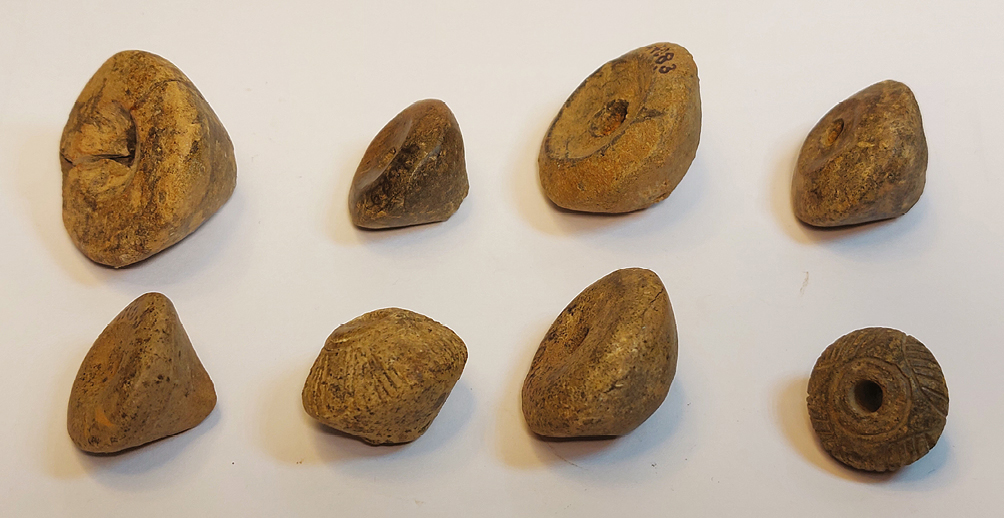
The oldest of Aphidnaâs spindle whorls is probably NAM P4708.1 with a tentative date of EH III, and the incised spindle whorls NAM P4708.6 and 4708.8 are dated to either EH III or MH (Figs. 13 & 33) (for details about the spindle whorls from Aphidna see Forsén 2010, 230â231). The nearest contemporary examples come from Vranaâs Tumulus I, with two spindle whorls in Grave 2, of which one has incised decoration and is dated to MH I. Of the two pieces in Vranaâs Grave 4, the bigger one has a concave bottom (Pantelidou Gofa et al. 2020, 444).
Spindle whorls discovered in Aphidna (NAM P4708.1â8; for scale, see Figure 13).
Citation: Acta Archaeologica 92, 2 (2021) ; 10.1163/16000390-20210033
Photo: M. Hielte 2021. © Hellenic Ministry of Culture and SportsA study of spindle whorls in Bronze Age Cyprus shows that it is highly likely that it was the women that did the spinning. But it is important to note that there may have been instances when spinning was carried out by men (Crewe 1998, 36). Besides sheep wool, textiles can also be made from the fibres of hair of camel, goat, horse, ox or other animals. The earliest examples of spindle whorls in Greece are from the Franchthi Cave in southeastern Peloponnese, between c.6000â5300 BC (Jones 2015, 7).
An earlier technique for producing textiles that may still have continued, especially among nomads, was felting. It was produced not by the interleaving of weft and warp but by the interlocking and fusion of free woollen fibres. Felted fabrics keep out the cold and are waterproof, excellent for covering huts, etc. (Hielte 2004b, 27 & 61).
Examples of early woollen textiles come from one of the fifty tumuli found at Kupres in Bosnia Herzegovina, about 40 km east of the Cetina River. In Tumulus no. 16, a man was laid down in an exquisite coffin made of wood. His body was covered with animal hide, and the grave is also reported to have been equipped with woollen textiles. Tumulus no. 37 at Kupres contained an oval cenotaph grave measuring 1.85 m à 1.60 m with tiny traces of burned woollen textiles. A mound of monumental dimensions covered the bodiless grave, c.35 m in diameter and up to 4 m high. Two daggers 25.5 cm and 23.4 cm in length, made of wood, must have been symbolic grave goods (Benac 1986).
We know from the MH times that there is evidence of a change in husbandry compared to earlier periods. Studies of sheep bones in Greece had shown that earlier when sheep were kept mainly for meat and milk, very few males survived infancy. For animals more than one-year-old, we have rates like one male to 28 females in the Final Neolithic. In EH, the rates are one male to six females. New breeding made a marked increase in the size of sheep and a woollier variety, possibly from the 3rd millennium BC (Halstead 1981; Hielte 2004b, 36). From MH times, there are about equal rates, and since the male sheep produce 25% more wool than females, it is only natural to suspect that woollen textiles had made their appearance as an important economic factor.
In the Aegean, early woollen textiles come from, e.g., Akrotiri on the island of Santorini and later from Eleon in Boeotia. In Tomb 10 (SWA1b) at Eleon, there were remains of a child, partially covered or draped in a woollen textile (Burke et al. 2020, 458). Over the last 15â20 years, textile studies have moved from being a specialised niche at the academic periphery towards the centre stage of archaeological and historical research (e.g. Randsborg 2011).
5.2.4 Metals
Three bronze rings and various remnants of bronze were found in Shaft Grave I.
Lead, mentioned by both Finlay and Wide, was associated with the pithoi and probably used for mending the big barrels.
The silver ring NAM P4706 in Pithos Grave III (Fig. 19), made of a wire with a thickness of 2â2.2 mm, was broken in two halves because of mineralization. In the Aegean, the use of silver can be traced back to the early 4th millennium BC (Maran 2021, 197). As an early example from nearby EH Tsepi, a silver band with dotted decoration was recovered in situ on a skull in Tomb 12. The preserved piece was found above the right ear, indicating that the deceased was buried while wearing the band as a diadem around the head (Prevedorou 2020, 247, Fig. 2). There is evidence that lead and silver metallurgy took place in Laurion as early as the 3rd millennium BC with small scale mining (Nazou 2020, 210; Kayafa 2020). Attica seems to have fully developed silver production around 2000 BC (Georgakopoulou et al. 2020, 185â192). At Aphidna, in addition to the already mentioned silver ring in Pithos Grave III (Fig. 19), there were also silver fragments in Shaft Grave I (Wide 1896, 390â391), which should be taken into account for a full assessment of Shaft Grave I and the tumulus.
Both gold and silver are not useful for practical purposes, like making tools or weapons. In Mesopotamia, silver became a form of currency from around the middle of the 3rd millennium BC and had, according to Susan Sherratt, a value of about one-tenth of the gold value (Sherratt 2018, 99). An utterly opposite situation prevailed in Egypt, dependent on the economic rule of supply and demand. The rarity of native silver deposits in Egypt, but with good access to gold from Nubia, gave silver in periods a greater value than gold. One example is the exquisite silver bracelet from the tomb of Queen Hetepheres73 (Sowada 2009, 184â189). After a sharp decline of the Old Kingdom around 2200 BC (Bell 1971), at about the same time as the drastic material (and social?) change that occurred in Greece between EH II and EH III, silver seems to have become less valuable than gold.
Concerning the six gold rings NAM P4706 (Fig. 18), three of them were found linked together like a chain, but most probably the other three rings had been connected in the same way. Wide suggests that it was perhaps used as âOhrgehängeâ, an earring (Wide 1896, 391â392). But most probably, the gold rings were a decoration used for keeping the hair together behind the head. The dead individual in Pithos Grave III had possibly been buried contracted on the right side, in other words, potentially of male gender, according to Florian Ruppensteinâs observations (2010, 436).
Among the olive trees at Steno in the Nidri plain on the island of Leukas in NW Greece (Fig. 1), Dörpfeld and his team excavated 28 EH tumuli (out of 33) in the years 1903â1913 (Dörpfeld & Goessler 1927; Kilian-Dirlmeier 2005).74 Some of the tombs were strikingly rich, with both metal weapons and jewellery in silver and gold. For instance, in Tumulus R 24, they found âBronze sheet and silver wireâ, and below in an expansion of c.1.50 m à 2 m, the charcoal layer contained bone remains, weapons (a sword and a dagger, both of copper), an obsidian knife and six gold wire rings, three by three, connected probably to hold the hair together. These six gold rings from Leukas are about the same size and form as the Aphidnaâs six (Fig. 18), also linked together in chains. To use the excavator Wilhelm Dörpfeld & Peter Goesslerâs verbatim text: âSechs goldene Drahtringe, je drei zu einer Gruppe verbunden, verm
Another touching find from Leukas is the contents of Tomb 15b. The excavators tell us about the bones of a young female found in a crouching position on her left side, her head towards the opening of the pithos (Dörpfeld & Goessler 1927, 235, Pls. 60: 3,4,7,8 & 63: C3). All the jewellery seemed to be intact, three large and 76 small hollow gold beads, the majority of which are biconical, others more spherical; three golden earrings or hair rings, which thicken angularly towards the bottom; two silver spiral bracelets with thickened ends, both still attached on the forearm bones of the dead girl. There were also two small obsidian knives (cf. Fig. 26 from Cist Grave II at Aphidna).75
A similar number of small gold rings were found by Tsountas in Grave 25 in Sesklo (Goessler 1927, 289). Gold earrings and gold hair ornaments were also reported from Drachmáni-Eláteia in Boeotia (Whittaker 2014, 247). For a full account of the so-called âGoldene Lockenringeâ, including the Adriatic sites northwest of Leukas see Kilian-Dirlmeier (2005, 118â120). Similar finds from Bulgarian are presented by Alexandrov (2018). Vasileva has attempted to reconstruct EBA hairstyles by examining the development and significance of the metal hair rings in Early Bronze Age Thrace.76 Jewellery may be a key to understanding the way prehistoric people, in particular the local elites, viewed themselves and constructed their identities.
5.2.5 Comments on Missing Finds
Wide remarks very clearly that there were no metal weapons to be found in the graves. If we allow ourselves to speculate freely, one might suggest incidents in insecure times when it was legitimate to go down and pick up the weapons from an ancestorâs grave in order to use their power to defend the lives and interests of the family and clan. Weapons may also have been directly inherited by the firstborn sons as a token of their new responsibility for the family. There may have been instances, but not yet attested in Greece, that a replica in wood was placed in the grave (cf. section 5.2.3 (Benac 1986) regarding the two symbolic daggers in Tumulus no. 37 at Kupres).
Many soft items, or of perishable material, once laid down as gifts in the graves may have been destroyed by the ravages of time. Concerning the missing finds of endurable material, cf. Tables 1â3, the following items are only mentioned by Wide but never further accounted for:
Shaft Grave I:
At the north wall: âThree bronze ringsâ (where also the 11 beads and six spindle whorls were found),
At the west wall: âSilver fragments. Three vessels made of grey clayâ,
At the south wall: âVarious remnants of bronze. Vessel made of grey clayâ.
Pithos Grave VI: âVessel made of yellowish clayâ.
Pithos Grave IX: âVessel made of grey clayâ.
Shaft Grave X: âTwo monochrome grey clay vesselsâ.
Cist Grave XI: âVessel made of grey clayâ.
Shaft Grave XIII: âVessel made of grey clay with incised geometrical decorations. Two vessels made of coarse, brownish clayâ and (a fourth) âvessel made of grey clay without incisionsâ.
As noted previously, it is hard to see if this is caused by sloppy or poor practice. Similarly, one may dismiss that Wide simply fabricated these finds to make his results more impressive, one reason being Woltersâ close involvement in the work. Another possibility could be that these finds were simply dumped back into the graves, as was common with undiagnostic finds in the 19th century. However, there was at least one diagnostic vessel with incised decorations (Shaft Grave XIII). This vessel and the metal finds from Shaft Grave I (three bronze rings and various bronze and silver fragments) would certainly be considered valuable. A third possibility could be that the finds were lost during the transport back to Athens. However, Wideâs general ability to tackle difficult conditions, as well as his cautious attitude, speaks against this. An example is a transport from Piraeus to Athens of the material from the earlier excavation at Kalaureia. He tells his parents that on Sunday, 19 August 1894: âI walked after the carriage, to guard the things, for two hours in the blazing hot sun, from 12 til 2 PM. Once arrived at the German Institute, the off-loading beganâ.77 In addition, if the finds from Aphidna were, in fact, lost during the difficult conditions on 7 and 8 November, it may not have been too hard even for Wide to admit this in his publication.
We are then left with the possibility that the finds in question actually reached Athens. However, they were not registered at the NAM, at least not according to my recent enquiries at the museum. Very helpful Greek colleagues have checked the storeroom registers of the museum as well as the state archives but were unable to find anything.78
As a final possibility, one may speculate that Kjellberg, at a certain point, was meant to contribute in some way to the publication of the results from Aphidna but that this eventually did not happen. In this connection, it is intriguing that Wide writes: âTogether with my countryman, Mr L. Kjellberg, I undertook an archaeological investigation at the end of October and beginning of November 1894 at Aphidnaâ (Wide 1896, 388).79 As we know, this does not correspond to reality. It was Wide alone who planned, carried out and was responsible for the Aphidna excavation and the subsequent publication. So why did he write the above statement? Perhaps they believed that it could make it possible for Kjellberg to declare and publish the remaining materials at a later point? One should remember that the Aphidna excavation was partly financed with money left from their common Kalaureia project. In addition, we know that Kjellberg and his brother had promised to contribute 1000â2000 francs on the condition that Kjellberg would participate (cf. note 22). But we do not know if, in the end, any contribution was made.
As a final check, I have had contact with four museums in Sweden: The National Museum, The Mediterranean Museum and the Historical Museum, all in Stockholm, and the Gustavianum in Uppsala. They were very helpful and searched their archives but found nothing relevant for prehistoric Aphidna, except for the few surface sherds stored at Gustavianum from Wideâs reconnaissance trip on 6 August 1894 (Fig. 4). So, at present, the finds are still not accounted for, and we may most likely consider them as lost.
5.3 Burial Customs
In the absence of written evidence from prehistoric burials in Greece, the touching request of the Hittite king Hattusilis I, c.1650â1620 BC, speaks of the universality of human needs: âWash my body, as is seemly; hold me to thy bosom, and at thy bosom bury me in the earthâ (Gurney 1952, 168).
The first moments after death has occurred, come the laments, the preparation of the body and vigil over the dead person. Through all these difficult stages, the mourners are helped by the performance of certain death rituals. Anthropological research has shown that people seem to feel reassured if they can release their grief in a safe and ordered milieu through a mourning ritual that will allow them not to drown in horror and helplessness (Bell 1997, 240).
The funeral procession is the most certain ritual, but difficult to show for the Early and Middle Bronze Age, since we do not have any material evidence. It must have been conducted because of the very necessity to transport the body in a dignified way to the grave. This creates the need for people to act together, in other words, to form a procession.
5.3.1 Structure XII as a Possible Mortuary House?
Can the 10 m2 large so-called Grave XII have been a kind of funeral chapel intended for the preparation of the dead and for ritual activities (Figs. 25 & 27)? Such structures seem to have been quite common, e.g., on Crete, where burials could have taken place in two steps, first in a âmortuary houseâ (Soles 1992). House-like structures, probably used as cult houses in connection with cemeteries, appear in prehistoric times to have been a fairly universal phenomenon throughout Eastern, Central and Northern Europe (Hielte 2001, 109). Eating and drinking at the burial site may have been rather common already during EH II (Weiberg 2013).
5.3.2 The Human Remains
If we, to the eleven dead reported by Wide, add the graves reported as looted and perhaps also some graves found by George Finlay under his preceding surveys, the individuals buried in the necropolis area may have been a larger group of adults, possibly family members from several generations.80 Wide does not mention that any of the crania found in the tumulus were small-sized, so the children may have been buried elsewhere, perhaps intramural, which seems to be the most common burial practice for children during the MH I period.
In most cases, Wide had difficulty assessing the original position of the bodies in the graves. In general, in pithoi, as in Pithos Grave III (Fig. 14), the body was placed with the head towards the bottom (Whittaker 2014, 109). The clay vessel itself might have been considered a womb. At Alishar Hüyük, two of the urns were modelled with conical âbreastsâ (Schmidt 1932, 72). The symbolic aspect of a vessel, a container, can be that it represents the womb of the Goddess (Bacvarov 2004, 152). The meaning of the contracted body position can be seen as embryonic. So, the people of Aphidna may have regarded their pithos tombs as a special treatment of the dead. As a comparative example, the entrance of the megalithic tombs in Northern Europe was, according to Gräslund, viewed as the divine vagina, and bringing the dead body into the tomb imitated an act of impregnation (1994, 22 ff.). The rituals at Aphidna may have symbolized a hope of re-creation and rebirth.
For the directions of the grave opening positions, for example, in relation to sunrise, there is only one clear case registered. The opening of Pithos Grave III and the feet of the buried person point to the east. One more pithos, Grave IX, also has an opening to the east, while the other four were facing south. Otherwise, for other shaft graves and cists, it was impossible to determine the position of the buried individual (see Tables 1â3 and Figs. 10 & 25).
About ashes and charcoal found within the tumulus, Wide writes: âEven if the decayed bones in graves I and III seemed to have been partly attacked by fire (Knochen die von Feuer angegriffen) it would be daring to try to establish cremation. Rather, this circumstance, as well as the traces of coal and ashes that occurred particularly outside the pithoi, can be traced back to burnt offeringsâ (Wide 1896, 398). Under and around Pithos Grave III, Wide found (burnt?) limestone (plaster?). Also, in Shaft Grave X: In addition to âthe dead person who lay on a bed of pebbles, traces of charcoal were found about 0.60 m below the upper edge of the graveâ (Wide 1896, 396).
5.3.3 Imagining the Funeral in Pithos Grave III
The community must probably have considered it essential to use a pithos for the burial. Otherwise, a large cist or a shaft grave, with more space, would have been suitable for such a revered person with so many grave gifts. When we consider the sheer number of vessels laid down neatly around the body (Fig. 14), the pithos must, in all likelihood, have been prepared with the lower half resting on the ground and the upper half placed on top afterwards, sealing the pithos with lead clamps. If so, the pithos acted more like a ceramic coffin with a lid on top. Assuming this, we can imagine that the body was laid down first, contracted on its right side with the hair kept together behind the head by the six gold rings, probably of male gender according to Ruppensteinâs observations (2010, 436). Afterwards, members of the community, and in this case, possibly even groups beyond, honoured the dead with various grave gifts, filling almost completely the remaining space in the lower half of the pithos. In addition to the pottery, possibly also leather bags, wooden objects, food, and floral tributes, all disintegrated now, were part of the burial ceremony. Then the upper part would have been put in place.
Speculating further, the six vessels found near the opening, including two cups and small baskets, the exclusive multiple vessels and the pyxis (see Figs. 14â23 and Figs. 30â32), could have been put into the pithos through the opening in a special ritual, after the sides were joined together â the last farewell-drink, before the vessels being left as a gift to the dead person or even âfeastingâ (see Rutter 2008 and Section 5.2.1.4) until the very last moment.
At the very end of the burial ceremony, the pithos opening was closed by a large limestone, and finally the large bowl was placed above the grave, ready for offerings.
There is evidence that in some prehistoric societies, newly deceased persons were often treated as if they were still alive and had the same needs as the living, receiving food and company81 in the form of regular visits paying homage. In such a case, the Aphidna tumulus must have been left open in the middle for a while after the funerals to make it possible to go around the graves. At the same time, the large bowls (Table 4) can have served as grave markers intended for sacrificial rites in memory of the dead. These bowls deserve special attention when trying to interpret burial customs.
The phenomenon of placing vessels or parts of vessels adjacent to grave monuments, such as the large bowls in Aphidna (Table 4), also occurs at, e.g., Drachmáni-Eláteia, c.115 km northwest of Aphidna (Map in Fig. 1), where a large, decorated jar with a height of 60 cm was placed on top of the MH tumulus (Sotiriades 1906; Papakonstantinou 2011, 395â396; Whittaker 2014, 247). In nearby Vrana, indications of possible libations to the dead may be the necks of small vessels standing upright as if ready to receive offerings, both at the âthresholdâ to the inner circle of Tumulus I and possibly also at the âthresholdâ of Tumulus IV (Marinatos 1970b, Pls. 12b & 23b; Hielte 2004a, 14, 19, Figs. 3â4).
It is, of course, impossible to detect ritual activity in cases where offerings and libations had been deposited in vessels of perishable materials like, for instance, wooden cups or bags made of leather and textiles. Thus such ritual behaviour could have been a much more widespread custom than we can establish (Hielte 2004a, 20).
At this point, I find it of interest to quote a few lines from the Epic of Gilgamesh, Tablet XII and the Sumerian poem known to the ancients as âIn those days, in those far-off daysâ. The ruler of the city of Uruk, King Gilgámesh, asks the ghost (the shade) of his dead friend EnkÃdu about the conditions in the Netherworld:82
Summing up, the author believes that we already here in Aphidna, around the transition between the Early to Middle Bronze Age, see the signs of ritual activities at the graves. Honouring the ancestors may have been a most important duty. We have several indications for rituals, the large bowls outside the pithos graves, and Wideâs description of carbon residues and traces of charcoal and ashes, both inside and around the graves. Also, the fact that many elaborate graves were constructed implies that great care was taken in deposing the dead.
From the Shaft grave period onwards, libations were, according to Robin Hägg, one of the best-attested religious practices of the Mycenaean culture (1990, 177), and later in antiquity, pouring libations, burning incense, and giving offerings were central at the graves. These rituals took place in a designated area in front of the tombs. Food and drink were provided for the dead and offered to the gods of the underworld. Performing the correct rituals for the dead was essential for assuring their successful passage into the afterlife. Unhappy ghosts could be provoked by failures of the living to attend properly to either the rite of passage or continued maintenance through graveside libations and offerings. The dead were commemorated at certain times of the year, a tradition still ongoing today in Greek cemeteries.
5.4 Tumuli and Aphidnaâs Chronological Position
The tradition of building tumuli as landmarks in Greece started, according to Papakonstantinou, at the end of the Early Bronze Age II (2011, 391â399). For substantial work on the subject, see Müller-Celka (1989; 2011, 416, Fig. 1) and Whittaker (2014, 92â115, 211â248).
After Aphidnaâs excavation in 1894, there were only a few tumuli sites explored during the next sixty years, e.g., on the southern slope of Athens in 1902, in Drachmáni-Eláteia in 190683 and Stenó-Nidri on Leukas.84 Since 1952, after the second world war and the civil war, archaeological excavations have revealed many more sites. Most excavated tumuli are on the western Peloponnese (Korres 2011). Discoveries in recent years include two tumuli at Kastroulia north of Kalamata, with rich grave goods dated to MH I (Rambach 2011; Whittaker 2014, 98, 239).
The common characteristic of tumuli is the accumulation of earth and stones over and around a single grave or a group of graves (Cavanagh & Mee 1998, 34). But there, the conformity stops. To borrow Vassilis Petrakisâ words: âAlmost every example belongs to a category of its own (monotypic pattern)â (2010, 407).
Aphidnaâs tumulus, as well as the nearby Vrana Tumulus I, have earlier been considered to be from around MH II, but Maran drew already three decades ago attention to the fact that these dates needed to be looked at more closely (Maran 1992, 320). Thanks to Forsénâs update in 2010 of the finds of Aphidna at the NAM and the work of the Vrana team (Pantelidou Gofa et al. 2014; 2015; 2020, 446), this can now be corrected. It makes East Attica an area with two important extramural cemeteries existing already from the EH IIIâMH I, a period that seems to be the beginning of a new culture after dramatic events that brought about great changes (see note 1). Precisely what happened at the end of EH II is still an enigma which attracts active research.
Based on his long experience within Aegean prehistory, Rutter points to the need for a whole new analytical method to identify mobile groups: âThe Early Helladic III period, at least in the Peloponnese, may have been populated largely by mobile groups who only gradually and rather irregularly became sedentary over a period of some half-a-dozen generations in the regions that we presently know and understand best (that is, the Corinthia and the Argolid)â (2017, 21). The early burial mounds with single graves, not only on Peloponnese but scattered all over the Greek Mainland, probably belong to the tumuli category where the position was chosen based on strategic points, important passageways between the coast and the inland, signalling ownership of pastures and hunting grounds. A cluster of small chiefdoms may have existed in competition with each other, showing off wealth and power. Impressive monumental burial mounds, presented as the tombs of the ancestors, gave legitimacy, perhaps especially important for people living in perishable simple dwellings (Hielte 2004b).
Some of the pottery from the tumulus at Aphidna can be of a late Early Helladic IIâEH III date and the rest of the early MH period (Forsén 2010). Taking into account that some of the earliest pottery can be heirlooms, this means that the tumulus may have been in use over a period of about 250â300 years, between 2200/2100 to 1900 BC and covered at least 10â12 generations.85
Wide explicitly writes that no later, i.e. Mycenaean, finds were found (1896, 400). It thus appears that the tumulus was âsealedâ after its last burial.
6 Reflections on Aphidna in a Regional Context
To bring the past closer, it helps to be aware of the fact that only about 120 generations separate us from the people living in the Aphidna valley around 2000 BC (Gräslund 2005, 2).
The many imported objects found in the graves of Aphidna show that at least part of the population had extensive contacts through trade and barter. In this context, we must assume that people living in Attica and their contemporaries further away followed the very human practice of creating networks and alliances through exchanges of gifts and intermarriages. Gräslund argues for the generality of such practices also from an essentially biological perspective.86 With the existence of diverse networks, tensions and disagreements would invariably arise, resulting in shifting conflicts and alliances over time. The destruction of Rhamnous (see section 4) could be a case in point.
As noted, much of the pottery at Aphidna could have come from the islands of Aegina and Kea and even from Lefkandi (Nazou 2017, 116). In particular, Kolona on Aegina seems to have become the main site for the production and distribution of ceramics in the late EHâMH.87 The ceramics from Aegina are quite easily recognizable due to the glittering grains of mica baked into the clay. At Aphidna, the wheel-made bowl NAM P4704 found fragmented next to the opening of Pithos Grave VI (Table 4) had gold mica inclusions, so it probably comes from Aegina. The same goes for the matt-painted bowl NAM P4700 above Pithos Grave III (Table 4, Fig. 15) (Forsén 2010, 231).
More locally, pottery could also have been produced at the kilns in Plasi c.550 m southeast of the MH tumulus at Klopa on the Marathon plain (Fig. 1) or by itinerant ceramists (Kapsali 2019).88 The nearest source for metal objects like lead, silver and copper is the Laurion area, thus the exquisite gold rings NAM P4706 (Fig. 18), the small obsidian knives in fragments NAM P4709 (Fig. 26), and perhaps also the beads NAM P4707 (Figs. 11â12), indicate an extended network.
Regarding domestic manufacturing at Aphidna, the unusually high number of spindle whorls (six) in the elaborately built Shaft Grave I (Figs. 13 & 33) can be interpreted as a sign of wool production. Wool would have been a valuable commodity in the barter market in the form of yarn and woven or felted textiles. Wool is easily dyed using plant colours, unlike the earlier linen clothes. Colourful garments, invisible in the archaeological record, may have given a coveted status.
Ancient man travelled far and wide. Recent research has shown that already at the end of the 4th and during the 3rd millennium BC, a complex âcrisscrossingâ took place over the Pannonian basin, the central Balkans and the Greek peninsula (Bulatovic et al. 2020, 1186). Locally in Attica, the distance from Aphidna to the contemporary Athenian Kerameikos is about 35 km.89 To attend religious festivals, weddings, and other events, the travel to Kerameikos and other sites spread out on the southwest coast of Attica, such as Eleusis,90 would have taken a couple of days. In times of crisis and emergency, people on a forced march could cover such a distance in a day or less. A Greek soldier in the fourth-century BC needed about 10 minutes/km for a forced march (Ober 1985, n. 23).
Similarly, along the southeastern coast of Attica down to Thorikos with Laurionâs metal mines, one finds the EH II settlement of Raphina with its two kilns, where blacksmiths probably smelted the ore and processed the metal (Theocharis 1952, 130â135; Rutter 1993, 771).91 Inland, going from Aphidna to Thorikos, there are many newly discovered EH IIIâMH sites (Andrikou 2020, 3â18).
Modern research has shown that MH settlements existed along the entire Attic coast from Megara and all the way up to Oropos, but fewer in number compared to EH (Krapf 2020, 401; Papadimitriou 2010, 244â245). Communities to the north beyond Thebes and the southwest on the Peloponnese could also easily be part of land-based networks, including Aphidna.
To travel by boat92 to Kea or further south in the Cyclades, people from Aphidna would probably first have to go down to the Gulf of Marathon, since the port of Pazaraki, about 2 km south of Rhamnous, had been destroyed and abandoned together with Rhamnous in EH II (Kalogeropoulos 2019; 2020). Keaâs proximity to Attica functioned as a bridge between the Cyclades and the Mainland, and the island was presumably involved in the metal trade from Laurion. A possible comparative cultural phenomenon with Aphidnaâs impressive large bowls (Table 4) is the grey-ware bowl found on Kea, on top of the burial chamber in the little grave circle just outside the wall at Ayia Irini, near the entrance (Whittaker 2014, 233). Incidentally, similar burial customs have been observed both at Drachmáni-Eláteia (see note 83) and in Thebes, on the Ampheion Hill and the North Cemetery/Archaeological Museum, with seven vases marking the area where the dead lay (Whittaker 2014, 226â227, 247).
For destinations to the north or to cross over to Euboea, the harbour at Oropos, Skala Oropou,93 would be a natural point of departure (Fig. 1). This site is reached from Aphidna by going over the semi-mountainous area of Mavrinora. Some kilometres before Oropos, one would have to cross the Mavrodilesi stream at a point where, in classical times, the important healing sanctuary dedicated to the Bronze Age hero Amfiaraios was strategically positioned.94
Lefkandi on Euboea (excavated by the British from 1964) is a key site, occupied from the Early Bronze to the end of the Iron Age (Dickinson 1977). The whole island is still quite unexplored archaeologically,95 with many potentially interesting sites (Krapf 2017).96 Kaloyerovrisi, with its extensive Early Bronze Age necropolis, had a mixture of Cycladic and EH, but also MH, material (Sampson 1993).
During the last decades, new interesting EH IIIâMH I sites on the mainland have been excavated along the northern Euboean Gulf: Atalanti with a 15 m tumulus with burials in pithoi (Papakonstantinou 2011; 2018)97 and Mitrou (Maran & Van De Moortel 2014).98 The tumulus of Pelasgia is further up north, at the entrance of the Melian Gulf.99 In the bay area of Volos, with the important Neolithic sites of Sesklo and Dimini, there are the newly excavated Kastraki (near Almiros) and the important site of Pefkakia in Thessaly.100
Further up north, either travelling by boat along the coast or going through the inland of Thessaly, passing Mount Olympus on its western slopes, (see map in Fig. 1) one comes to the large EBAâMBA necropóleis of Xeropigado (Maniatis & Ziota 2011) and Logkas Elatis (Clemente et al. 2021).
One reason for including these northern Greek sites, situated between Southern Greece and the Balkans, with comparative regional studies of Aphidna, is that modern scientific methods have been employed in the investigations. This allows for more information on aspects of chronology, demography, and living conditions during the EBAâMBA. Also, and quite unusual, several domesticated animals were found buried with presumably their human masters at Logkas Elatis.
The excavation at Xeropigado was carried out as a rescue operation in 1995â1998 by Maniatis and Ziota (2011). No settlement could be associated with the burials in the necropolis, dated to the period 2420â1730 BC by the 14C method. Spread over an area of 1500 m2, the 214 excavated graves contained skeletal remains of at least 222 individuals. These single inhumation burials were surrounded by rows of limestone, but also cists, pits and pithoi were used as sepulchres. It must have been an important necropolis for many generations, most frequently used between 2200â1850 BC. Men were placed on their right side and women on their left. Most of the undisturbed burials had some gifts, usually 1â3 vessels placed near the head. In some graves, there were tools made of copper, bone and stone, but also jewellery from silver, gold and seashells. Three circular earrings found at Xeropigado were of a rare alloy of 58% gold, 37% silver and 5% copper (Maniatis & Ziota 2011, 462; Ziota 2007). Can it be a naturally occurring electrum, cf. the chains of the interconnected gold rings NAM P4706 (Fig. 18) from Aphidna?101
The low incidence of caries as well as analyses based on stable nitrogen isotopes and microwear on teeth indicate a diet based mainly on meat. The analyses also suggest that the people of Xeropigado breastfed their infants up to the age of 18 months (Triantaphyllou 2010, 971â973).
The necropolis of Logkas-Elatis on the south banks of the Haliakmon river was explored in 2011â2012 by a team led by Georgia Karamitrou-Mentesidi (2012). The large necropolis was excavated as a rescue operation before the construction of the Ilariona dam, which flooded the whole area and created todayâs Ilariona Lake. The team surveyed 231 enclosures with 362 burials out of a total of 432 burials.
Domesticated animals were also found buried among the human graves at Logkas-Elatis, including eight donkeys (Equus asinus), two horses (Equus caballus), two other equids and one dog. The animals were carefully laid down, mainly on the outskirts of the necropolis. Some of the animals were surrounded by round stone enclosures, in some cases, buried close to their human masters (Gkotsinas 2018).
The equids indicate that horses and donkeys would have been used both for domestic work and as pack animals in carrying goods. A well-built donkey can carry up to 40â60 kg, and this would greatly have increased the capacity of the trading networks at the time. From the period of our Aphidna people in Central Greece, bones of equids also appear on Peloponnese. In Lerna IV, an equid larger than an ass but smaller than a true horse has been excavated, and evidence for true horses has been found in EH III levels at Tiryns (Daniel Pullen 1992, 48). In the wider area, it is known from the Near East that donkeys were kept as beasts of burden for pulling carts, carrying, and ploughing and also used by shepherds rearing their flocks (Clutton-Brock 1992). Old Assyrian documents report donkey caravans in which especially the Amorites were involved, moving between Mesopotamia and Kanesh/Karum in Anatolia during the Middle Bronze Age. Earlier evidence comes from Azor in Israel, where a small clay figurine of a laden donkey has been found in an EB I context. It has large cargo baskets on its back (Silver (Lönnqvist) 2014, 338, 341, Fig. 1; Amira 1985). The equids pulling heavy carts on the well-known Sumerian decorated wooden box, the so-called Standard of Ur from c.2600 BC (British Museum number: 121201), are probably the highly valued kungas, a hybrid between domestic donkeys and onagers (with the characteristic thick tails).
Two individuals from Logkas-Elatis were selected by an international team comprising many Greek scientists as part of a genetic study of people from the Aegean bronze age (Clemente et al. 2021). Based on the 14C dating, these two individuals had lived between 2007â1915 BC (Log04) and 1924â1831 BC (Log02), respectively. The team started with 70 individuals from different sites and managed to perform whole genome extractions on six people. In addition to the two individuals from Logkas-Elatis, the other four were from an earlier period (dated to EB IâII, 2832â2349 BC) and came from Manika on Euboea, Petras on Crete and Koufonisi island in the middle of the Cyclades. The research team stated that these last four EBA Aegeans were similar to other Bronze Age Aegean and Anatolian populations but quite distinct from Balkan populations (Clemente et al. 2021, 2569). They considered it a surprising discovery, according to Malaspinas, co-director of the project, since this period for the rest of Europe is associated with gene flow from people from the Pontic steppes (Malaspinas 2021). The genomic EBA homogeneity across cultures in the Aegean and parts of Anatolia may indicate that Aegean populations used the sea as a route to interact, not only culturally but also genetically.
The study concludes that genetically the individuals from Logkas-Elatis were different from the four other individuals in that they had a substantial contribution from Pontic-Caspian steppe-related genes. This corresponds well with present-day Greeks, who also carry a steppe-related component and share 90% of their ancestry with the Logkas-Elatis individuals. In fact, the researchers also conclude that the Logkas-Elatis individuals were, in a sense, genetically closer to present-day Greeks than the Late Bronze Age Mycenaeans, as analysed by Lazaridis et al. (2017). As Clemente et al. (2021, 2576) note, these findings call for further investigations of more people from the EBAâMBA period on mainland Greece to see if there could be some kind of continuity with the present population.
However, many archaeologists today would still be sceptical about the meaning of such results based on genetics (Callaway 2018; Furholt 2018; Merkyte 2020). The field of âarchaeogeneticsâ is a rather young and controversial area. However, the use of genetic techniques has come to stay in archaeology. Over time, one would expect that such methods and others from the natural sciences (e.g., stable isotopes in addition to 14C) would contribute significantly to our understanding of the Aegean Bronze Age, not least because, as this article has shown, there is now a growing amount of EH IIIâMH material from numerous sites in different parts of Greece.
7 Conclusions
The aim of this article has been to present a comprehensive review of the Aphidna tumulus with all its 13 graves based on information collected from several sources. Sam Wide and his excavation team found burials of at least eleven individuals, based on the number of skulls. The grave goods that accompanied the dead persons inside the graves were unusually rich for this early period: 26 vessels, 11 crystal beads, eight spindle whorls, six small gold rings, one silver and three bronze rings. In addition, there were some bronze and silver fragments. Wide expressly noted that there were no metal weapons, only two small obsidian blades. Unfortunately, about half of these finds went missing, and my recent investigation into this led to no new evidence.
Outside or above five of the six pithos graves, large bowls were found. In preliterate societies, newly deceased persons were often treated as if they were still alive and had the same needs as the living, receiving food and company through regular visits paying homage. In such a case, the Aphidna tumulus could have been left open in the middle for a while after the funerals to make it possible to go around and visit the different graves. The large bowls (Table 4) can have served both as grave markers and as sacrifice vessels, ready to receive offerings. One special find, significant for conducting burial rites, is the fragment of the âzoomorphic clay rhytonâ in the shape of a calf head (Figs. 6â7), found in the tumulus fill. Clusters of tombs, surrounded by a border of carefully chosen stones, created a special delimited area, a sacred place.
Significantly, Wide was the first to identify the early Middle Helladic culture, precisely on the basis of the Aphidna finds (cf. above). He writes in his conclusions: âPoverty102 is not the characteristic of these graves (see the grave goods in Pithos Grave III), but it is the primitiveness that strikes us mostâ.
On a regional basis, a considerable number of sites from around the EH IIIâMH I transition period have now been excavated in Greece, and it would be interesting to carry out multidisciplinary studies across several sites to get a better picture of the interaction between the different groups.
As noted above, the present study is based on information from several sources, also including Wideâs letters and notes from 1893â1895, to get an impression of how the work was carried out. In a sense, this is to conduct âarchaeology in reverseâ. It can be a useful approach when trying to re-interpret and improve the reliability of results from old excavations. Of course, with a larger material comprising many diaries and reports, etc., one will have to digitize what is available.
Acknowledgements
I warmly thank the National Archaeological Museum (NAM) in Athens for granting me permission to study Wideâs material and the Swedish archaeological institute in Athens. This study has been a long time in the making due to many unexpected circumstances. Originally, the former director of the Institute, â Robin Hägg, suggested in 1989 that I take on the responsibility for a re-publication of the Aphidna tumulus. Today, I would like to thank Professor Bo Gräslund in Uppsala for his positive evaluation of my project, as well as the friendly staff at the Nordic library in Athens; at present, Patrick Talatás and Jens Mangerud and also Evi Charitoúdi (now head librarian at the BSA), who all these years provided a pleasant environment and always found me a good place to work. Special thanks are due to the former heads of the Prehistoric Collection at the NAM, Katie Dimakopoúlou, Lena Papázoglou-Manioudáki and especially the current head, Konstantinos Nikoléntzos, for granting permission to publish the 31 photographs taken at the NAM. The curators of the NAM, Katerina Voutsá and Katya Mantéli, offered encouraging help as well as the staff working in the NAMâs storerooms.
I am grateful to my kindred spirit in the interest of Aphidna, Jeannette Forsén, for her thorough analysis of the finds stored at the NAM. And I also want to thank Gullög Nordquist, who first introduced me to the Middle Helladic culture and now for her help and support in answering my often detailed inquiries. Thanks are also due to many colleagues over the years. Much help was given by the staff at the Archive Departments at University libraries both in Uppsala and Lund and by museums in Sweden for their search for the missing finds from Aphidna. I especially appreciated the help from à sa Henningsson at the University Library in Uppsala. The comments of the anonymous reviewers and the help of the editors are also greatly appreciated. I dedicate this article to my husband, Nils Damm Christophersen, for his never-ending support and encouragement. Any errors and misunderstandings are my own responsibility.
Bibliography
For abbreviations, see https://www.ajaonline.org/sub missions/abbreviations. Some Greek publications not on AJAâs list are given with a title and abbreviation in brackets.
Primary Sources
Ancestral Landscapes 2011: Borgna, E. & S. Müller-Celka (eds.). 2011. Ancestral Landscapes. Burial mounds in the Copper and Bronze Ages (Central and Eastern Europe â Balkans â Adriatic â Aegean, 4thâ2nd millennium B.C.). Proceedings of the International Conference held in Udine, May 15thâ18th 2008. www.persee.fr/issue/mom_2259-4884_2012_act_58_.
Athens and Attica in prehistory 2020: Papadimitriou, N., J.C. Wright, S. Fachard, N. Polychronakou-Sgouritsa & E. Andrikou (eds.). 2020. Proceedings of the International Conference Athens, 27â31 May 2015. Oxford (Archaeopress Publishing).
Gazetteer 1979: Hope Simpson, R. & O.T.P.K. Dickinson. Gazetteer of Aegean civilization in the Bronze Age. SIMA 52. Jonsered/Göteborg (Paul à ström).
Mesohelladika 2010: Philippa-Touchais, A., G. Touchais, S. Voutsaki & J. Wright (eds.). Mesohelladika. La Grèce continentale au Bronze Moyen. Actes du colloque international organisé par lâÃcole française dâAthènes, en collaboration avec lâAmerican School of Classical Studies at Athens et le Netherlands Institute in Athens, Athènes, 8â12 mars 2006. (BCH, Suppl. 52). Paris-Athènes.
Peloponnesian Sanctuaries and Cults 2002: Robin Hägg (ed.). 2002. Proceedings of the Ninth International Symposium at the Swedish Institute at Athens, 11â13 June 1994. (ActaAth-4°). Stockholm (Skrifter utgivna av Svenska Institutet i Athen).
Secondary Sources
Alexandrov, S. 2018. The Early and Middle Bronze Age in Bulgaria: Chronology, Periodization, Cultural Contacts and Precious Metal Finds. Alexandrov et al. 2018. 85â96.
Alexandrov, S., Y. Dimitrova, H. Popov, B. Horejs & K. Chukale (eds.). 2018. Metals, Technologies and Interregional Contacts in the Eastern Balkans during the Bronze Age. Sofia (National Archaeological Institute with Museum Bulgarian Academy of Science).
Amira, R. 1985. Canaanite Merchants in Tombs of the Early Bronze Age I at Azor. Atiqot XVII. 190â192.
Andrikou, E. 2020. East Attica: The Prehistoric finds in the 21st Century. Îthens and Attica in Prehistory. 2020. 3â18.
Aravantinos, V. & K. Psaraki. 2011. Tumuli over Dwellings. The transformation of domestic Space to Community Monuments at EH II Theses, Greece. Ancestral Landscape. 399â413.
Armada X.-L., M. Murillo-Barroso & M. Charlton (eds.). 2018. Metals, Minds and Mobility: Integrating Scientific Data with Archaeological Theory. Oxford & Philadelphia (Oxbow Books).
Bacvarov, K. 2004. The Birth-giving Pot. Neolithic Jar Burials in Southeast Europe. Nikolov et al. 2004. 151â160.
Baedeker guide. 1888. Griechenland: Handbuch fur Reisende, von Karl Baedeker, 2nd edition. Leipzig.
Balitsari, A. 2022. âÎοÏÏια με λίÏεÏâ. Unexpected circumstances revealed in investigating a Bronze Age tumulus at Klopas, Marathon. Athens University Review of Archaeology â AURA 5. http://epub.lib.uoa.gr/index.php/aura/article/view/2268.
Balitsari, A. & J.K. Papadopoulos. 2019. A Middle Helladic Tomb in the Athenian Kerameikos and some Thoughts on the Early Connections of Attica. BSA 114. 119â143.
Bell, B. 1971. The Dark Ages in Ancient History. I. The First Dark Age in Egypt. AJA 75, 1. 1â26.
Bell, C. 1997. Ritual: perspectives and dimensions. Oxford (Oxford University Press).
Benac, A. 1986. Paistorijski Tumuli na Kupreskom Poljuâ. DJELA KHJIGA LXIV. Sarajevo.
Berg, I. 2016. Kalaureia 1894: A Cultural History of the First Swedish Excavation in Greece. Stockholm (Stockholm Studies in Archaeology 69). https://www.diva-portal.org/smash/get/diva2:950719/FULLTEXT01.pdf.
Berger, L. & W. Gauss. 2016. Early Bronze Age Aegina Kolonna. The View from a Southwest Aegean Centre.
Black, J. & A. Green. 1992. Gods, demons and symbols of ancient Mesopotamia. An illustrated dictionary. London (British Museum Press).
Blegen, C.W. 1921. Korakou. A Prehistoric Settlement Near Corinth. Boston, New York. (American School of Classical Studies at Athens). http://www.worldcat.org/title/korakou-a-prehistoric-settlement-near-corinth/oclc/370467&referer=brief_results.
Blegen, C.W. 1928. Zygouries. A prehistoric settlement in the valley of Cleonae. Cambridge, Massachusetts (American School of Classical Studies at Athens).
Blegen, C.W. & A. Wace. 1931. Middle Helladic Tombs. Symbolae Osloenses 9. 28â37.
Borgna, E. & S. Müller-Celka (eds.). 2011. Ancestral Landscapes. Burial Mounds in the Copper and Bronze Ages (Central and Eastern Europe â Balkans â Adriatic â Aegean, 4thâ2nd mil- lennium BC). TMO 61, Travaux de la Maison de lâOrient et de la Méditerranée. Série recherches archéologiques No. 58. Lyon.
Bulatovic A., M. Gori & M. Vander Linden. 2020. Radiocarbon dating. The 3rd millennium BC in the Central Balkans: A re-examination of the Early Bronze Age sequence. Radiocarbon 62, 5. 1163â1191.
Bulle, H. 1907. Orchomenos. 1, Die älteren Ansiedelungsschichten. München (Verlag der k. B. Akademie der Wissenschaften).
Burk, A. 2020. The Amorites and the Bronze Age Near East. The making of regional identity. Cambridge (Cambridge University Press). https://doi.org/10.1017/9781108856461.
Burke, B. et al.2020. Fieldwork at Ancient Eleon in Boeotia, 2011â2018. AJA 124, 3. 441â476.
Burkert, W. 1997. Oldtidens mysteriekulter. Oslo. (Norwegian translation of Ancient mystery cults. 1987). Cambridge, Massachusetts & London (Harvard University Press).
Callaway, E. 2018. Divided by DNA: The uneasy relationship between archaeology and ancient genomics. Nature 555. 573â576. https://doi.org/10.1038/d41586-018-03773-6.
Callmer, Ch. 1953. Sam Wide und die Ersten Schwedischen Ausgrabungen in Griechenland. Opuscula Atheniensia 1953. 208â223.
Cavanagh, W. & Ch. Mee. 1998. A Private Place: Death in Prehistoric Greece. SIMA 125. Jonsered/Göteborg (Paul à ström).
Childe, G. 1915. On the Date and Origin of Minyan Ware. JHS 35. 196 ff.
Clemente et al. 2021. The genomic history of the Aegean palatial civilizations, Cell 184. https://doi.org/10.1016/j.cell.2021.03.039.
Cline, E.H. (ed.). 2010. The Oxford Handbook for the Bronze Age Aegean. Oxford (Oxford University Press).
Clutton-Brock, J. 1992. Horse Power. A history of the horse and the donkey in human societies. London (National History Museums Publications).
Cosmopoulos, M.B. 2015. Bronze Age Eleusis and the Origins of the Eleusinian Mysteries. Cambridge (Cambridge University Press).
Crewe, L. 1998. Spindle Whorls. A study of form, function and decoration in prehistoric Bronze Age Cyprus. SIMA-PB 149. Jonsered/Göteborg (Paul à ström).
Crossland, R.A. & A. Birchall (eds.). 1973. Bronze Age migrations in the Aegean; Archaeological and linguistic problems in Greek prehistory: Proceedings of the first International Colloquium on Aegean Prehistory, Sheffield. London (Duckworth).
Curtius, E. & J.A. Kauperts (eds.) 1895â1903. Karten von Attika. Berlin.
Dakouri-Hild, A. & S. Sherratt (eds.). 2005. AUTOCHTHON: Papers presented to O.T.P.K. Dickinson on the occasion of his retirement. BAR Intern. Series 1432. Oxford (BAR Publishing). https://doi.org/10.30861/9781841718682.
Dickinson, O.T.P.K. 1977. The Origins of the Mycenaean Civilisation. SIMA 49. Jonsered/Göteborg (Paul à ström).
Dörpfeld, W. 1927. Alt-Ithaka: Ein Beitrag zur Homer-Frage, Studien und Ausgrabungen aus der insel Leukas-Ithaka. München.
Dörpfeld, W. & P. Goessler. 1927. Abschnitt V: Die 33 Königsgräber bei Steno. Die Ergebnisse der Ausgrabungen auf Leukas und die Einzelfunde der Ausgrabungen. (Sonderdr. aus: W. Dörpfeld, Alt-Ithaka) München-Gräfelfing. 217â250.
Erkanal, H., H. Hauptmann, V. ÅahoÄlu & R. Tuncel (eds.). 2008. The Aegean in the Neolithic, Chalcolithic and the Early Bronze Age. Proceedings of the International Symposium The Aegean in the Neolithic, Chalcolithic and the Early Bronze Age October 13thâ19th 1997, Urla â Ä°zmir (Turkey). ANKUSAM Publication No. 1. Ankara (Ankara University Press).
Fachard, S. & A.R. Knodell. 2020. Out of Attica: Modeling mobility in the Mycenaean Period. Athens and Attica in Prehistory. 407â415.
Felten, F., W. Gauss & R. Smetana-Scherrer (eds.). 2007. Middle Helladic pottery and synchronisms: proceedings of the International Workshop held at Salzburg, October 31st â November 2nd, 2004. Contributions to the chronology of the Eastern Mediterranean, vol. 14. Denkschriften der Gesamtakademie / OÌsterreichischen Akademie der Wissenschaften, Band 42; AÌgina-Kolonna, Forschungen und Ergebnisse, Band 1. Wien (Verlag der OÌsterreichischen Akademie der Wissenschaften).
Finlay, G. 1838. Letter on the Position of Aphidna. William Martin Leake presented the text in London, which was then printed in Transactions of the Royal Society of Literature III (1839), 396â405. (Printed in German 1848).
Finlay, G. 1869. ΠαÏαÏηÏήÏÎµÎ¹Ï ÎµÏί ÏÎ·Ï ÎµÎ½ ÎλβεÏία και Îλλάδι ÏÏοÏÏÏοÏÎ¹ÎºÎ®Ï ÎÏÏαιολογίαÏ, in Greek. (Observations on Prehistoric Archaeology in Switzerland and Greece). Athens.
Finlay, G. 1995. The Journals and Letters of George Finlay. Vol. II, Finlay-Leake and other Correspondence. Hussey 1995.
Forsén, J. 1992. The Twilight of the Early Helladics: A Study of the Disturbances in East-Central and Southern Greece Towards the End of the Early Bronze Age. SIMA-PB 116. Jonsered/Göteborg (Paul à ström).
Forsén, J. 2010. Aphidna in Attica revisited. Mesohelladika. 223â234.
Forsdyke, J. 1914. The Pottery Called Minyan Ware. JHS 34. 126ff.
French, E.B. & K.A. Wardle (eds.). 1988. Problems in Greek prehistory: papers presented at the centenary conference of the British School of Archaeology at Athens, Manchester, April 1986. Bristol (Bristol Classical Press).
Furholt, M. 2018. Massive Migrations? The Impact of Recent aDNA Studies on our View of Third Millennium Europe. European Journal of Archaeology 21, 2. 159â191.
Galanakis, Y. & A. Shapland. 2020. Introduction & Overview. AR 66.
GauÃ, W., M. Lindblom, R. Angus, K. Smith & J.C. Wright (eds.). 2011. Our Cups Are Full: Pottery and Society in the Aegean Bronze Age. Papers Presented to Jeremy B. Rutter on the Occasion of his 65th Birthday. Oxford (Archaeopress).
George, A. 2020. The Epic of Gilgamesh. The Babylonian Epic Poem and Other Texts in Akkadian and Sumerian. 2nd ed. London (Penguin Classics).
Georgakopoulou, M., K. Douni, M. Ginalas, O. Kakavogianni & I. Bassiakos. 2020. Recent Finds from Final Neolithic and Early Bronze Age Silver Production Sites in Southeastern Attica. Athen and Attica in Prehistory. 185â192.
Gkotsinas, A. 2018. ÎνÏαÏιαÏμοί ζÏÏν ÏÏο νεκÏοÏαÏείο ÏÎ·Ï Î ÏÏÎ¹Î¼Î·Ï ÎºÎ±Î¹ ÎÎÏÎ·Ï ÎÏοÏÎ®Ï ÏÎ¿Ï Î§Î±Î»ÎºÎ¿Ï ÏÏην ÎλάÏη, θÎÏη ÎογκάÏ. ΠαÏÎ¿Ï ÏίαÏη ÏαÏÏν και ÏÏοκαÏαÏκÏικÏν αÏοÏελεÏμάÏÏν ζÏοαÏÏÎ±Î¹Î¿Î»Î¿Î³Î¹ÎºÎ®Ï Î¼ÎµÎ»ÎÏηÏ. (Animal burials in the Early and Middle Helladic cemetery of Logkas Elatis. Presentation of the burials and preliminary results of the zooarchaeological study. Summary in English on page 79). (Το ÎÏÏÎ±ÎµÎ¿Î»Î¿Î³Î¹ÎºÏ ÎÏγο ÏÏην ÎÎ½Ï Îακεδονία) AEAM 3, 2013. 65â79.
Goessler, P. 1927. Abschnitt VI: Die Einzelfunde der Ausgrabungen. Die Ergebnisse der Ausgrabungen auf Leukas und die Einzelfunde der Ausgrabungen. (Sonderdr. aus: W. Dörpfeld, Alt-Ithaka). 275â338. München-Gräfelfing.
Goldman, H. 1931. Excavations at Eutresis in Boeotia. Cambridge, MA. (Harvard University Press).
Gräslund, B. 1994. Prehistoric soul beliefs in Northern Europe. Proceedings of the Prehistoric Society 60. 15â26.
Gräslund, B. 2005. Early Humans and Their World. London (Routledge).
Gurney, O.R. 1952. The Hittites. Harmondsworth-London (Penguin).
Hägg, R. 1990. The Role of Libations in Mycenaean Ceremony and Cult. Hägg & Nordquist 1990. 177â184.
Hägg, R. 1997. Did the Middle Helladic People Have Any Religion? Kernos 10 (Varia). 13â18. http://journals.openedition.org/kernos/641.
Hägg, R. 2002. Swedish Archaeology in Greece, 1894â1994. Peloponnesian Sanctuaries and Cults. 9â14.
Hägg, R & G.C. Nordquist (eds.). 1990. Celebrations of Death and Divinity in the Bronze Age Argolid: Proceedings of the Sixth International Symposium at the Swedish Institute at Athens, 11â13 June 1988. (ActaAth-4°, 40). Stockholm.
Halstead, P. 1981. Counting sheep in Neolithic and Bronze Age Greece. Hodder et al. 1981. 307â339.
Hielte (-Stavropoulou), M. 2001. The Horseshoe-shaped and other structures and installations for performing rituals in funeral contexts in Middle Helladic and Early Mycenaean times. Laffineur & Hägg 2001. AEGAEUM 22. 103â111.
Hielte (-Stavropoulou), M. 2004a. Traces of ritual in Middle Helladic funeral contexts including an assessment of geographical location. Wedde 2004. 9â33. (2018 update available: https://www.academia.edu/36878754/).
Hielte, M. 2004b. Sedentary Versus Nomadic Life-Styles: The âMiddle Helladic Peopleâ in Southern Balkan, Late 3rd & First Half of the 2nd Millennium BC. ActaArch 75. 27â94.
Hielte (-Stavropoulou), M. & M. Wedde. 2002. Sam Wideâs Excavation at Aphidna â Stratigraphy and Finds. Peloponnesian Sanctuaries and Cults. 21â24.
Hodder, I., G. Isaac & N. Hammond (eds.). 1981. Pattern of the past: studies in honour of David Clarke. Cambridge & New York (Cambridge University Press).
Hope Simpson, R. & O.T.P.K. Dickinson. 1979. Gazetteer of Aegean civilization in the Bronze Age. SIMA 52. Jonsered/ Göteborg (Paul à ström).
Howell, R.J. 1973. The Origins of the Middle Helladic culture. Crossland & Birchall 1973. 73â106.
Hussey, J.M. 1995. Editor of The Journals and Letters of George Finlay, Vol. I & II. (Porphyrogenitus).
Jerem E. & P. Raczky (eds.). 2003. Morgenrot der Kulturen. Frühe Etappen der Menschheitsgeschichte in Mittel- und Südosteuropa. Festschrift für Nándor Kalicz zum 75. Geburtstag. Archaeolingua 15. Budapest.
Jones, B.R. 2019. Ariadneâs threads. The construction and significance of clothes in the Aegean Bronze Age, AEGAEUM 38. Annales dâarchéologie égéenne de lâUniversité de Liège et UT-PASP. Leuven-Liege.
Kalogeropoulos, K. 2019. Î ÏÏÏοελλαδική κεÏαμική αÏÏ Ïο ΠαζαÏάκι ΡαμνοÏνÏÎ¿Ï (Early Helladic pottery from Pazaraki Ramnountos). ArchEph 158. 131â194.
Kalogeropoulos, K. 2020. Ἡ ÏÏÏÏοελλαδικὴ á¼ÎºÏÏÏολη ÏοῦΡαμνοῦνÏÎ¿Ï (Protoelladikà akrópoli toú Ramnoúntos). ArchEph 159. 91â148.
Kalogeropoulos, K., D. Vassilikou & M. Tiverios (eds.). 2021. Sidelights on Greek Antiquity. Archaeological and Epigraphical Essays in Honour of Vasileios Petrakos. Berlin (De Gruyter).
Kakavogianni, Î., K. Douni & F. Nezeri. 2008. Silver Metallurgical Finds Dated from the End of the Final Neolithic Period until the Middle Bronze Age in the Area of Mesogeia. Tzachili 2008. 45â57.
Kapsali, P. 2019. Two Middle Bronze Age Pottery Kilns at Plasi, Marathon. Athens University Review of Archaeology â AURA 2. 19â63.
Karadimas, N. 2009. Prolegomena to Aegean Archaeology; from the Renaissance until 1875. PhD thesis. Bristol. (University of Bristol).
Karamitrou-Mentesidi, G. 2012. âÎ ÎÏÎµÏ Î½Î± ÏÏη ÎÎ±Ï ÏοÏηγή και ÏÏο ÏÏάγμα ÎλαÏίÏνα καÏά Ïο 2012 (The research in Mavropigi and the Hilarion dam, in 2012). Το ÎÏÏÎ±ÎµÎ¿Î»Î¿Î³Î¹ÎºÏ ÎÏγο ÏÏη Îακεδονία και Ïη ÎÏάκη 26. 47â88.
Kayafa, M. 2020. The Metal Resources of Laurion during the Early Bronze Age. A Synthesis of the Archaeological and Archaeometric Data. Athens and Attica in Prehistory. 193â201.
Kilian-Dirlmeier, I. 1997. Alt-Ãgina IV, 3: Das mittelbronzezeitliche Schachtgrab von AÌgina (mit einem Beitrag von Sotiris K. Manolis und Anastasios A. Neroutsos). Mainz.
Kilian-Dirlmeier, I. 2005. Die bronzezeitlichen Gräber bei Nidri auf Leukas: Ausgrabungen von W. Dörpfeld 1903â1913. Mainz. (Monographi 62, Römisch-Germanisches Zentralmuseum).
Kjellberg, L. 1890. De Cyclo Epico. Quaestiones Selectae. Diss. Uppsala.
Kjellberg, L. 1932a. Das äolische Kapitell von Larisa. Lund. Skrifter utgivna av Svenska Institutet i Rom 4. 238â245.
Kjellberg, L. 1940. Larisa am Hermos II: Die Architektonischen Terrakotten. Stockholm. Kungl. Vitterhets Historie och Antikvitets Akademien-Archäol. Monografies 28.
Koehl, R.B. 2006. Aegean Bronze Age Rhyta. Prehistory Monographs 19. Philadelphia.
Korres, G. 2011. Middle Helladic Tumuli in Messenia. Ethnological Conclusions. Ancestral Landscapes 2011. 585â596.
Korres, G., N. Karadimas & G. Flouda (eds.). 2012. Archaeology and Heinrich Schliemann â A Century after his Death. Assessments and Prospects. Myth â History â Science. Athens.
Krapf, T. 2017. Middle Helladic (central) Euboea and its cultural connections: the state of research. TankosiÄ et al. 2017. 145â156.
Krapf, T. 2020. Regionality in the Middle Helladic Period: Replacing Attica in its Wider Context, Athens and Attica in Prehistory. 399â406.
Lachenal, T., R. Roure & O. Lemercier (eds.). 2020. Demography and Migration Population trajectories from the Neolithic to the Iron Age: Proceedings of the XVIII UISPP World Congress (4â9 June 2018). Oxford (Archaeopress Archaeology).
Laffineur, R. & R. Hägg (eds.). 2001. Potnia: Deities and Religion in the Aegean Bronze Age. Proceedings of the 8th International Aegean Conference Göteborg, Göteborg University, 12â15 April 2000. AEGAEUM 22. Annales dâarchéologie égéenne de lâUniversité de Liège. Liège /Austin.
Lazaridis et al.2017. Genetic origins of the Minoans and the Mycenaeans. Nature 548 (7666). 214â218.
Leshtakov, K. 2011. Bronze Age mortuary practices in Thrace. A prelude to studying the long-term tradition. Ancestral Landscapes 2011. 567â578.
Leshtakov, K.P. & M. Andonova (eds.). 2018. Galabovo in SE Europe and beyond: Cultural interactions during the 3rdâ2nd millennium BC. International Archaeological Conference Galabovo 2018. Galabovo/Sofia.
Lindblom, M. 2001. Marks and makers: appearance, distribution, and function of middle and late Helladic manufacturersâ marks on Aeginetan pottery. SIMA 128. Jonsered/Göteborg (Paul à ström).
Litwin, J. (ed.). 2017. The Baltic and Beyond. Proceedings of the 14th International Symposium on Boat and Ship Archaeology, September 21â25, 2015. GdaÅsk (National Maritime Museum).
Makkay, J. 2012. The altar over shaft grave IV at Mycenae in a wider perspective. Korres et al. 2012. 93â103.
Malaspinas, A.-S. 2021. When genetics makes ancient civilisations speak. Press release: https://www.sib.swiss/about-sib/news/10847-when-genetics-makes-ancient-civilisations-speak.
Maniatis, Y. & Ch. Ziota. 2011. Systematic 14C Dating of a unique Early and Middle Bronze Age Cemetery at Xeropigado Koiladas, West Macedonia, Greece. Radiocarbon 53, 3. 461â478.
Maran, J. 1992. Die Deutschen Ausgrabungen auf der Pevkakia- Magula in Thessalien III. Die Mittlere Bronzezeit. Beiträge zur Ur- und Frühgeschichtlichen Archäologie des Mittelmeer- Kulturraumes 30â31, 2 Vols. Bonn (Dr. Rudolf Habelt).
Maran, J. 1998. Kulturwandel auf dem griechischen Festland und den Kykladen im späten 3. Jahrtausend v. Chr. Studien zu den kulturellen Verhältnissen in SO-Europa und dem zentralen sowie östlichen Mittelmeerraum in der späten Kupfer- und frühen Bronzezeit. Bonn (Dr. Rudolf Habelt Verlag).
Maran, J. 2021. Attica and the Origins of Silver Metallurgy in the Aegean and the Carpatho-Balkan Zone. Kalogeropoulos et al. 2021. 197â226.
Maran, J. & A. Van De Moortel. 2014. A Horse-Bridle Piece with Carpatho-Danubian Connections from Late Helladic I Mitrou and the Emergence of a Warlike Elite in Greece During the Shaft Grave Period. AJA 118, 529â548.
Marinatos, S. 1970a. Further discoveries at Marathon. AAA 3. 349â357.
Marinatos, S. 1970b. ÎναÏκαÏαί ÎαÏαθÏνοÏ. Prakt 1970. 5â2.
Merkouri Ch. & M. Kouli. 2012. The Spatial Distribution and Location of Bronze Age Tumuli in Greece. Ancestral Landscapes 2011. 203â217.
Merkyte, I. 2020. Studies of Ancient DNA. The Race for the Ultimate Answer. Lietuvos archeologija 46. 293â304. doi: 10.33918/25386514-046011.
Milchhoefer, A. (Milchhöfer). 1889. Heft VI Marathon. Curtius & Kaupert. Karten von Attika. Berlin.
Misch, P. 1992. Die Askoi in der Bronzezeit. Eine Typologische Studie zur Entwicklung askoider GefäÃformen in der Bronze- und Eisenzeit Griechenlands und angrenzender Gebiete. SIMA-PB 100. Jonsered/Göteborg (Paul à ström).
Montelius, O. 1924. La Grèce préclassique (première partie). (Posthumously edited and published by Otto Frödin). Stockholm (Kungl. Vitterhets Historie och Antikvitets Akademien).
Müller, S. 1989: Les tumuli helladiques: ouâ? quand? comment? BCH 113, 1â42.
Müller-Celka S. 2011. Burial Mounds and âRitual Tumuliâ of the Aegean Early Bronze Age. Ancestral Landscape 2011. 415â428. https://www.persee.fr/doc/mom_2259-4884_2012_act_58_1_3481.
Mylonas, G. 1959. Aghios Kosmas. An Early Bronze Age settlement and cemetery on Attica. Princeton/New Jersey (Princeton University Press).
Mylonas, G. 1975. Eleusis. Τὸ Î´Ï Ïικὸν νεκÏοÏαÏεá¿Î¿Î½ Ïá¿Ï á¼Î»ÎµÏ Ïá¿Î½Î¿Ï. 3 vols. Îιβλιοθήκη ÏÎ·Ï ÎµÎ½ ÎÎ¸Î®Î½Î±Î¹Ï ÎÏÏÎ±Î¹Î¿Î»Î¿Î³Î¹ÎºÎ®Ï ÎÏαιÏÎµÎ¯Î±Ï ÎÎÎ 81. Publications of the Archaeological Society at Athens.
Nazou, M. 2017. Euboean connections with Attica and Kea: A view from Final Neolithic and late Early Bronze Age II pottery. TankosiÄ et al. 2017. 111â120.
Nazou, M. 2020. Thorikos in the Neolithic and the Early Bronze Age: A View from the Mine 3 Pottery. Îthens and Attica in prehistory. 203â212.
Nikolov, V., K. BuÌchvarov & P. Kalchev (eds.). 2004. Prehistoric Thrace: Proceedings of the International Symposium in Stara Zagora 30.09â04.10.2003. Stara Zagora (Institute of Archaeology with Museum â BAS, Regional Museum of History).
Nordquist, G. 1987. A Middle Helladic village: Asine in the Argolid. Boreas 16. Uppsala (Uppsala Studies in Ancient Mediterranean and Near Eastern Civilizations).
Nordquist, G. 2002. A better time cannot be found. Peloponnesian Sanctuaries and Cults 2002. 15â20.
Nordquist, G. & A. Ingvarsson-Sundström. 2005. Live Hard, Die Young: Mortuary Remains of Middle and Early late Helladic Children from the Argolid in Social Context. Dakouri-Hild & Sherratt 2005. 156â174.
Ober J. 1985. Fortress Attica: Defence of the Athenian Land Frontier, 404â322 B.C. Mnemosyne, Supplements. Leiden (Brill).
Oikonomakou, M. 2010. ÎεÏοελλαδικÎÏ Î¸ÎÏÎµÎ¹Ï ÏÏη ÎÎ±Ï ÏεÏÏική και Ïη νοÏιοαναÏολική ÎÏÏική (Middle Helladic sites in Laureotiki and southeastern Attica). Mesohelladika. 235â242.
Oikonomidis, S., A. Papayiannis & A. Tsonos. 2018. The burial custom of tumulus along the Ionian and Adriatic Coast as a cultural and social phenomenon (in Greek). Athens University Review of Archaeology â AURA 1. 25â59.
Pantelidou Gofa, Î., G. Touchais, A. ΦίλιÏÏα-Touchais & Î. ΠαÏαδημηÏÏÎ¯Î¿Ï . 2014. ÎελÎÏη αναÏκαÏÎ®Ï ÎÏανά ÎαÏαθÏνοÏ. Prakt 2014. 29â59.
Pantelidou Gofa et al.2015. ÎελÎÏη ÏÏοÏÏÏοÏικÏν ÏÏμβÏν ÎÏανά ÎαÏαθÏνοÏ. Prakt 2015. 25â70; Prakt 2016. 27â56; Prakt 2017. 29â58.
Pantelidou Gofa, M., A. Philippa-Touchais & N. Papadimitriou. 2020. The Prehistoric Tumuli of Vranas, Marathon: The Study of Spyridon Marinatosâ Excavations. Athens and Attica in Prehistory. 437â448.
Papadimitriou, N. 2018. Counting Individuals, Reconstructing Groups. A Critical Review of Bioarchaeological Data from Middle Helladic and Mycenaean Graves. Schmitt et al. 2018. 159â188.
Papadimitriou, N., J.C. Wright, S. Fachard, N. Polychronakou- Sgouritsa & E. Andrikou (eds.). 2020. Îthens and Attica in Prehistory: Proceedings of the International Conference Athens, 27â31 May 2015. Oxford (Archaeopress Publishing).
Papadimitrou-Grammenou A., P. Petridis & P. Georgiou-Geka. 2011. ÎοÏÏÏνι ÎαÏανδÏιÏÎ¯Î¿Ï ÎÏÏικήÏ: ÎÏολογιÏμÏÏ ÏενÏαεÏÎ¯Î±Ï 2005â2009 (Kotroni, Kapandriti, Attica: Report for the five years 2005â2009). Symposium Excavation and Research VIII: From the Research Project in the field of Archaeology and Art History, University of Athens.
Papakonstantinou, M.-Ph. 2011. Bronze Age Tumuli and Grave Circles in Central Greece. The current state in research. Ancestral Landscapes 2011. 391â399.
Papakonstantinou, M.-Ph. 2018. ΤαÏικÏÏ ÏÏÎ¼Î²Î¿Ï ÏÎ·Ï ÏÏÏÎ¹Î¼Î·Ï ÎµÏοÏÎ®Ï ÏÎ¿Ï ÏÎ±Î»ÎºÎ¿Ï ÏÏην ÎÏαλάνÏη (Early Bronze Age burial mound in Atalánti). Papakonstantinou et al. 2018. 257â280.
Papakonstantinou, M-Ph., Ch. Kritzas & I.P. Tothratsóglou (eds.). 2018. Î ÏÏÏα. ÎελÎÏÎµÏ Î³Î¹Î± Ïην αÏÏαιολογία ÏÏην ÎενÏÏική Îλλάδα ÏÏÎ¿Ï Ïιμήν ÏÎ·Ï Î¦Î±Î½Î¿Ï ÏÎ¯Î±Ï ÎακοÏÏνια (Pyrra. Archaeological studies in Central Greece in honor of Fanouria Dakoronia). Athens.
Pelon, O. 1976. Tholoi, tumuli et cercles funéraires: recherches sur les monuments funéraires de plan circulaire dans lâÃgée de lââge du Bronze (IIIe et IIe millénaires av. J.-C.) Athens. (Ecole Francaise DâAthenes).
Pernicka, E., S. Ãnlüsoy & S.W.E. Blum (eds.). 2016. Studia Troica Monographien 8. Bonn.
Petrakis, V.P. 2010. Diversity in form and practice in Middle Helladic and early Mycenaean elaborate tombs: An approach to changing prestige expression in changing times. Mesohelladika 2010. 403â416.
Petrakis, V.P. 2016. The arrival of the rhyton in Early Mycenaean Greece. Journal of Prehistoric Religion. 47â63.
Philippa-Touchais, A., G. Touchais, S. Voutsaki & J. Wright (eds.). 2010. Mesohelladika. La Grèce continentale au Bronze Moyen. Actes du colloque international organisé par lâÃcole française dâAthènes, en collaboration avec lâAmerican School of Classical Studies at Athens et le Netherlands Institute in Athens, Athènes, 8â12 mars 2006. BCH. Suppl. 52. Paris-Athènes.
Philippa-Touchais, A. & A. Balitsari. 2020. Attica in the middle: Middle Helladic pottery traditions and the formation of cultural identity. Athens and Attica in Prehistory. 387â398.
Popham, M.R. & L.H. Sackett. 1968. Excavations at Lefkandi, Euboea, 1964/1966. A Preliminary Report. London (Thames and Hudson).
Prevedorou, E.-A. (Eleanna). 2020. Bioarchaeological Approach to Early Helladic Attica: The Human Skeletal Remains from Tsepi at Marathon (1970â1973 Excavations). Athens and Attica in Prehistory. 245â250.
Pullen, D.J. 1992. Ox and Plow in the Early Bronze Age Aegean. AJA 96. 45â54.
Rambach, J. 2007. Investigations of two MH I Burial Mounds at Messenian Kastroulia (Near Ellinika, Ancient Thouria). Felten et al. 2007. 137â150.
Rambach, J. 2011. Die Ausgrabung von zwei Mittelhelladisch I-zeitlichen Grabtumuli in der Flur Kastroulia bei Ellinika (Alt-Thouria) in Messenien. Ancestral Landscapes 2011. 463â474.
Randsborg, K. 2011. Bronze Age Textiles: Men, Women and Wealth. London (Bristol Classical Press).
Reden, S. von & J.P. Best. 1981. Auf der Spur der ersten Griechen. Woher kamen die Mykener? Neue archäologische Erkenntnisse uber die Herkunft der Griechen. Köln (DuMont Buchverlag).
Ridgeway, W. 1901. The Early Age of Greece. Vol 1. Cambridge (Cambridge University Press).
Roure, R., T. Lachenal & O. Lemercier. 2020. Demography and migration: an introduction. Session XXXII-2. Transitions démographiques. Mythes et réalités du Néolithique à lââge du Bronze. & Session XXXIV-8 Peuples, migrations, colonisations : des approches historico-culturelles aux analyses génétiques en archéologie protohistorique, de la néolithisation à la fin de lââge du Fer. Lachenal et al. 2020. 1â4.
Ruppenstein, F. 2010. Gender and regional differences in Middle Helladic burial customs. Mesohelladika 2010. 431â439.
Rutter, J.B. 1979. Ceramic Change in the Aegean Early Bronze Age: The Kastri Group, Lefkandi I and Lerna IV: A Theory Concerning the Origin of Early Helladic III Ceramics. Los Angeles. (UCLA Institute of Archaeology Occasional Papers 5).
Rutter, J.B. 1988. Early Helladic III Vase painting, Ceramic Regionalism and the Influence of Basketry. French & Wardle 1988. 73â90.
Rutter, J.B. 1993. Review of Aegean Prehistory II: The Prepalatial Bronze Age of the Southern and Central Greek Mainland. AJA 97, 4. 745â797.
Rutter, J.B. 1995. Lerna: A Preclassical Site in the Argolid: results of excavations conducted by the American School of Classical Studies at Athens. Volume III: The Pottery of Lerna IV. Princeton, N.J (American School of Classical Studies at Athens).
Rutter, J.B. 2008. The Anatolian Roots of Early Helladic III Drinking Behavior. Erkanal et al. 2008. 461â481.
Rutter, J.B. 2017. The temporal slicing and dicing of Minyan culture: a proposal for a tripartite division of a lengthier Greek Middle Bronze Age and the issue of nomadism at its beginning. Wiersma & Voutsaki 2017. 16â31.
Sampson, A. 1993. Îaloyerovrysi. A settlement of the Early Bronzes Age at Phylla / ÎαλογεÏοβÏÏÏη, ÎÎ½Î±Ï Î¿Î¹ÎºÎ¹ÏμÏÏ ÏÎ·Ï Î ÏÏÎ¹Î¼Î·Ï ÎºÎ±Î¹ ÎÎÏÎ·Ï Î§Î±Î»ÎºÎ¿ÎºÏαÏÎ¯Î±Ï ÏÏα ΦÏλλα ÏÎ·Ï ÎÏβοιαÏ. Athens (Department of Palaeoanthropology and Speleology).
Sampson, A. 2019. Palaeolithic and Mesolithic sailors in the Aegean and the Near East. Newcastle (Cambridge Scholars Publishing).
Sarri, K. 2007. Aeginetan Matt-Painted Pottery in Boeotia. Felten et al. 2007. 151â165.
Sarri, K. 2010. Orchomenos IV. Orchomenos in der mittleren Bronzezeit. München. Bayerische Akademie der Wissenschaften. Philosophisch-historische Klasse: Abhandlungen Neue Folgen 135.
Schallin, A.-L. (ed.). 2013. Perspectives on ancient Greece. Papers in celebration of the 60th anniversary of the Swedish Institute at Athens. Skrifter utgivna av Svenska Institutet i Athen, 8°, 22. Stockholm.
Schmidt, E.F. 1932. The Alishar Hüyük, I. Seasons of 1928 and 1929. Oriental Institute Publications 19. Chicago.
Schmitt, A. & S. Déderix (eds.). 2018. Gathered in Death. Archaeological and Ethnological Perspectives on Collective Burial and Social Organisation. Louvain (Presses Universitaires de Louvain).
Seth, I. 1948. Svenska män och kvinnor. Stockholm (Biographical lexicon).
Shaw, J.W. 2007. Sequencing the EH II âCorridor Housesâ. BSA 102. 137â151.
Sherratt, A.G. 1981. Plough and pastoralism: aspects of the secondary products revolution. Hodder et al. 1981.
Sherratt, A.G. 1987. Cups that cheered. The Introduction of Alcohol to Prehistoric Europe. Waldren & Kennard 1987. 81â106.
Sherratt, A.G. 1997. Economy and society in prehistoric Europe: changing perspectives. Edinburgh (Edinburgh University Press).
Sherratt, A.G. 2003. The Baden (Pécel) culture and Anatolia: perspectives on a cultural transformation. Jerem et al. 2003. 415â429.
Sherratt, S. 2011. Learning to Learn from Bronze Age Pots: A Perspective on Forty years of Aegean Ceramic Studies in the Work of J.B. Rutter. Gaus et al. 2011. 257â266.
Sherratt, S. 2018. Why was (and is) silver sexy? Silver during the 4thâ3rd millennia in the Near East and Mesopotamia. Armada et al. 2018. 97â106.
Silver, M. 2014. Equid Burials in archaeological contexts in the Amorite, Hurrian and Hyksos cultural intercourse. ARAM 26. 335â355.
Soles, J. 1992. The Prepalatial Cemeteries at Mochlos and Gournia and the House Tombs of Bronze Age Crete. Hesperia Supplement 24. Princeton. (American School of Classical Studies at Athens).
Sotiriades, G. 1906. Bericht über die Ausgrabungen in Lokris Hesperia und in Phokis. AM 31. 392â404.
Sowada, K. 2009. Egypt in the Eastern Mediterranean during the Old Kingdom. An Archaeological Perspective (with a contribution by P Grave). Zurich Open Repository and Archive: www.zora.uzh.ch.
Spyropoulos, T. 1970. Fhtiotis-Pelasgia. ArchDelt 25 B1. 234â245.
Stais, V. 1890. ΠΤÏÎ¼Î²Î¿Ï ÎµÎ½ ÎÎ¿Ï Ïβά. ÎÎ 15. 318â329.
Theocharis, D.M. 1952. Excavation at Arafina. (in Greek). Prakt 1952. 129â151.
Traill, D. 1995. Schliemann of Troy: Treasure and Deceit. New York (St. Martinâs Press).
TankosiÄ, Z., F. Mavridis & M. Kosma (eds.). 2017 An Island between two Worlds. The Archaeology of Euboea from Prehistoric to Byzantine Times. Proceedings of International Conference, Eretria, July 2013. Athens. Papers and Monographs from the Norwegian Institute at Athens 6.
Triantaphyllou, S. 2010. Aspects of Life Histories from the Bronze Age cemetery at Xeropigado Koiladas, Western Macedonia. Mesohelladika. 969â974.
Tsountas, Ch. & J.I. Manatt. 1897. The Mycenaean age: a study of the monuments and culture of pre-Homeric Greece. Chicago.
Tzachili, I. (ed.). 2008. Aegean Metallurgy in the Bronze Age: Proceedings of an International Symposium Held at the University of Crete, Rethymnon, Greece, on November 19â21, 2004. Athens (Ta Pragmata Publications).
Tzavella-Evjen, H. 1980. Pottersâ marks from Lithares. Berlin (De Gruyter).
Valamoti, S.M. 2018. Brewing beer in wine country? First archaeobotanical indications for beer making in Early and Middle Bronze Age Greece. Vegetation History and Archaeobotany 27, Suppl. 1. doi: 10.1007/s00334-017-0661-8.
Van de Moortel, A. 2017. A New Typology of Bronze Age Aegean Ships: Developments in Aegean Shipbuilding in their Historical Context. Litwin 2017. 263â268.
Van de Moortel, A., E. Zahou & J.B. Rutter. 2018. Mitrou and Proskynas in Prehistoric East Lokris. Chronology, Interconnections, and Society. Papakonstantinou et al. 2018. 169â193.
Vasileva, Z. 2017. The Early Bronze Age Rings of Type Leukas â New Considerations regarding their Origin, Distribution and Function. Archaeologia Bulgarica 21. 1â13.
Vasileva, Z. 2018. Worn to impress? Development and significance of the metal hair-rings in Early Bronze Age Thrace. Leshtakov et al. 2018. 24â27.
Vermeule, E. 1964. Greece in the Bronze Age. Chicago & London (The University of Chicago Press).
Voutsaki, S. 2010. Middle Bronze Age. Mainland Greece. Cline 2010. 99â112.
Voutsaki, S., A. Ingvarsson-Sundström & S. Dietz. 2012. Tumuli and social status: a re-examination of the Asine tumulus. Ancestral landscapes 2011. 445â461.
Wace, A.J.B. 1946. The prehistoric exploration of the Greek mainland. BCH 70. 628â638.
Wace A. & C. Blegen. 1916â1918. The Pre-Mycenaean Pottery of the Mainland. BSA 22. 175â189.
Waldren, W.H. & R.C. Kennard (eds.). 1987. Bell Beakers of the Western Mediterranean: definition, interpretation, theory and new site data. The Oxford international conference 1986. (Int. Ser. S331). Oxford (British Archaeological Reports).
Wedde, M. (ed.). 2004. Celebrations: sanctuaries and the vestiges of cult activity. Selected papers and discussions from the Tenth Anniversary Symposium of the Norwegian Institute at Athens, 12â16 May 1999. Papers of the Norwegian Institute at Athens 6. Bergen.
Weiberg, E. 2007. Thinking the Bronze Age. Life and Death in Early Helladic Greece. Uppsala Studies in Ancient Mediterranean and Near Eastern Civilizations. Boreas 29. Uppsala.
Weiberg, E. 2013. An Early Helladic burial â connecting the living and the dead. Schallin 2013. 29â47.
Weingarten, J. 1997. Another Look at Lerna: An EH IIB Trading Post? Oxford Journal of Archaeology 16. 147â166.
Whittaker, H. 2010. Some thoughts on Middle Helladic religious beliefs and ritual and their significance in relation to social structure. Mesohelladika 2010. 535â543.
Whittaker, H. 2014. Religion and Society in Middle Bronze Age Greece. Cambridge (Cambridge University Press).
Wide, S. 1888. De sacris Troezeniorum, Hermionensium, Epidauriorum commentatio academica. Diss. Uppsala University.
Wide, S. 1893. Lakonische Kulte. Leipzig. (B.G. Teubner). Re-published in 1973 by B.G. Teubner in Stuttgart, as a Reprint of the Leipzig 1893 edition.
Wide, S. 1894. Inschrift der Iobakchen. AM 19. 248â282.
Wide, S. 1895. Epigraphische Miscellen. AM 20. 207â215.
Wide, S. 1896. Aphidna in Nordattika. AM 21. 385â409, Pls. 13â15. https://archive.org/stream/mitteilungen21deut#page/n3/mode/2up.
Wide, S. 1897. Nachleben Mykenischer Ornamente. AM 22. 233â258.
Wide, S. 1899. Geometrische Vasen aus Griechenland. JdI 14. 26â43 & 188â215. https://digi.ub.uni-heidelberg.de/diglit/jdi1900/0009.
Wide, S. 1900. Geometrische Vasen aus Griechenland. JdI 15. 49â58.âhttps://digi.ub.uni-heidelberg.de/diglit/jdi1900/0009.
Wide, S. 1910. Gräberfunde aus Salamis. AM 35. Eleutherudakis & Barth 1910. 17â36.
Wide, S. & L. Kjellberg. 1895. Ausgrabungen auf Kalaureia. AM 20. 267â326. https://digi.ub.uni-heidelberg.de/diglit/am1895/0279.
Wiersma, C.W. & S. Voutsaki (eds.). 2017. Social change in Aegean prehistory. Oxford (Oxbow Books).
Wolters, P. 1889. Mykenische Vasen aus dem Nordlichen Griechenland. AM 14. 262â270, Pls. 7â11. https://doi.org/10.11588/diglit.29490.33.
Wolters, P. 1894. Mykenische Gräber in Kephallenia. AM 19. 486â490.
Zavadil, M. 2019. Remembering Old Graves? Jar Burials in the Mycenaean period. AEGAEUM 43. 233â242.
Ziota Ch. 2007. ΤαÏικÎÏ Î ÏακÏικÎÏ ÎºÎ±Î¹ ÎοινÏÎ½Î¯ÎµÏ ÏÎ·Ï ÎÏοÏÎ®Ï ÏÎ¿Ï Î§Î±Î»ÎºÎ¿Ï ÏÏη ÎÏ Ïική Îακεδονία. Τα νεκÏοÏαÏεία ÏÏην Îοιλάδα και ÏÏÎ¹Ï ÎοÏÎ»ÎµÏ ÎοζάνηÏ, in Greek (Bronze Age Burial Practices and Societies in Western Macedonia. The cemeteries in the Koilada and in Goules, Kozani). PhD Thesis. University of Thessaloniki. http://thesis.ekt.gr/thesisBookReader/id/14671#page/1/mode/2up.
The Aegean Bronze Age culture on the Greek Mainland, including Peloponnese, is usually called Helladic and is generally understood as Greek Bronze Age. The different phases of the Helladic culture are approximately contemporary with the Minoan (M) and Cycladic (C) cultures and are abbreviated in a similar manner: EH-MH-LH for Early Helladic-Middle Helladic-Late Helladic/ Mycenaean, compared to EM-MM-LM and EC-MC-LM.
Sam Wide, 1896, âAphidna in Nordattikaâ in Athenische Mitteilungen (AM 21, 385â409, Pls. 13â15); https://archive.org/stream /mitteilungen21deut#page/n3/mode/2up;âhttps://archive.org /details/mitteilungen21deut/page/385/mode/2up?view=theater.
The National Archaeological Museum in Athens is hereafter abbreviated as âNAMâ, and the finds from Aphidna stored at the NAM have the designation âNAM Pâ, which replaces the previous âEAMPâ designation with the same inventory numbers (NAM P = National Archaeological Museum Prehistoric collection). All 31 photos of the finds from Aphidna, presented in this article, are under the copyright of Greek authorities: © Hellenic Ministry of Culture and Sports.
English translation by the author. Wideâs text is presented in italic (with quotation marks). Wideâs detailed description of 13 graves in his report on pages 390â396, signed in March 1896, gives the impression of being verbatim excerpts from Wideâs diary kept during the excavation of Aphidna in Octoberâ November 1894. AM 21: https://archive.org/details/mitteilungen 21deut/page/390/mode/2up?view=theater.
About 2.5 km southeast of Aphidna, where the river Charadra joined the creek from Varnava before the dam was constructed, was a natural lakelet or pond, but without significance for the excavation area upstream.
From the letter to Wideâs parents on 21 October 1894. Also, in Wideâs Report of 1896, 385: âThe Aphidna plain is very fertile and particularly rich in water. The Cháradra (river), which does not dry up even in midsummer, flows through the plain. ⦠In its distant course, the Cháradra flows through the Marathon area and forms a comfortable and natural connection between the two plains, insofar as the path between Aphidna and Marathon today, and probably also from ancient times, goes along the bank of the Cháradra.â
Jane Husseyâs publication of 1995, 543, of The Journals and Letters of George Finlay. George Finlay (1799â1875), philhellene, lawyer, and author of the seven volumes of A History of Greece. From Its Conquest by the Romans to the Present Time, B.C. 146 to A.D. 1864. Finlay arrived in Greece in 1823, where he joined lord Byron and assisted in the war of independence alongside with Captain Frank Hastings and other philhellenes. He then lived in Athens for the rest of his life and was an astute observer of political life, being also a correspondent for The Times in London. Finlayâs dream was to introduce modern agriculture and to get roads built for the farmers to transport their products to the markets to promote the economic development of the new Greek nation. He bought land in Athens, where the Parliament and National Garden is today, to start an agronomic school. The project failed since the land was confiscated when the Royal Palace was built in 1836. His well-intentioned criticism, and his attempts to persuade the authorities to secure the peasantsâ safety against brigands and robbers who terrorized in the countryside, made him unpopular among the elite, who he thought exploited the political and economic situation of the new country. Disappointed by the failure of his efforts, he instead turned to historical research. He was also a pioneer in Greek prehistoric research (Finlay 1869; Karadimas 2009). From 1830, Finlay owned the land around Aphidna, and on 23 April 1837, he wrote the quoted information in a letter to his friend and topographer W.M. Leake. The present author has not found any mention in Finlayâs Journals and Letters that reveals Finlayâs further activity in Wideâs âlargerâ tumulus. Or was Finlayâs tumulus the larger one? Cf. Gazetteer (F 54), 220.
Arthur Milchhoefer, Heft VI Marathon, 59: âDafs dieselbe ungefähr die alte Richtiung bewarht, scheinen enige Grabh
Wide wrote this letter on 30 August 1894 to his older colleague (and probably mentor), the Swedish archaeologist Oscar Montelius (1843â1921) (Berg 2016, 100). Note that Wide, before the excavation, talks about âthese tombs (dessa grafvar)â in plural, but nothing later in his report 1896.
Lennart Kjellberg, born in 1857, was a fellow student from Uppsala and four years older than Wide. He is described by Ivar Seth in the biographical lexicon Svenska män och kvinnor (Stockholm 1948): âHe appeared as a typical professor from the classical epoch of learning. His lectures were often so deep and detailed that the whole picture was lost. His knowledge was immense both in terms of texts and monuments.â See also Gullög Nordquist 2002, 15â20.
In a letter to his parents on 25 November 1893, Wideâs archive, Box NC:549 in Uppsala University Library, from now on abbreviated to âUUBâ. Letters between Greece and Sweden took about 7â8 days to arrive. Sam wrote touchingly often to his parents back home. One of the reasons may have been that he had two older siblings who died at an early age, and he was now their only child (personal communication Ingrid Berg).
The Baedeker guides were conveniently sized to fit in a pocket. The 2nd edition 1888, Griechenland: Handbuch fur Reisende, contained âeinem Panorama von Athen, 6 Karten, 14 Plänen und andern Beigabenâ.
Letter to his parents on Lollingâs death, 22 February 1894.
In 1893 and 1894, Dörpfeld was in charge of excavations both in Troy and Athens. To the west of the Acropolis, German archaeologists and Greek workmen were excavating in the area of the Pnyx (Berg 2016, 69).
Schliemann is a highly controversial person, and some would say he was rather searching for treasures than seeking new archaeological evidence (David Traill 1995; personal communication 2015).
In a letter dated 16 January 1894 to his friend A. Westholm in Sweden, he writes about the New Year 1894: âAnd now I have been to Schliemannâs marble palace and have danced both with Mrs S. and with Andromache and shaken the pawn of Agamemnon. That was the day before yesterday. Yesterday I was at the Royal ball, where I, with glad heart, danced with opulent oriental beauties and had the honour to be presented to His Majesty the King, Prime Minister Trikoupis, Prof. Hatzidakis and other lively fellows. Iâm living in a whirl of amusements, out every evening, last night I went to bed at 3 oâclock in the morning, today at 4.15 am. Today I took a field walk for 5 hours to Menidi (Acharnai), had dinner out in the open air in a village. Marvellous spring day with the clear air of Attica, without parallel anywhere, blue sky and snow-topped mountainsâ (Nordquist 2002, 20).
The building from 1889 is modelled after the âChemins de Fer Orientauxâ in Constantinople.
Travel account, Wideâs archive, Box NC:549, UUB, also Berg 2016, 129, note 367.
The letter was to his friend Alfred Westholm on 8 April 1894: âEfter 4 dagars ridt genom Arkadien sprängde jag som andra man näst Dörpfeld i spetsen för en kavalkad af 30 man i förgÃ¥r afton in i Olympiaâ (Wideâs archive, Box NC:549, UUB, also Berg 2016, 215, Note 350).
Wideâs letter to his parents, written at Kalaureia on 12 August 1894 (Sunday): âMy beloved parents! Today I will, in all probability, send the last letter from the glorious Kalaureia since the work here ends on Tuesday or Wednesday ⦠On Monday the 6th,â.
Wide to Montelius, 30 August 1894 (Monteliusâ archive, E1a:42, ATA, Berg 2016, 99). Also, in Wideâs copy of the same letter, 30 August 1894, to Montelius at Lund University Library, the questions about money for the excavations are discussed. Kjellberg and his brother had promised to contribute 1000â2000 francs on the condition that Kjellberg would participate, but Kjellberg was still in Germany. He had left Greece on July 21, in the middle of the ongoing Kalaureia excavation, and Wide was very surprised when Kjellberg, in November 1894, returned to Greece and came up to Aphidna the very last days of the excavation. In the same letter, Wide asks Montelius for a loan of another 100â200 francs, just to be sure.
I thank Gullög Nordquist who made me aware of the existence of the eight sherds stored in Gustavianumâs Collection of Classical Antiquities at Uppsala University and helped make them available for study.
Wideâs words, as mentioned above, are consistently presented in italics; this is intentional to distinguish this first source material from my interpretations and quotations from other researchers. As mentioned earlier, Wideâs description of graves and finds gives the impression of being a direct excerpt from a diary kept during the excavation, which he then used as a basis for his report. It then unfortunately disappeared, except for the few drawings in Figures 9aâc. As a clear indication of the existence of such a diary, and not a construction of the results afterwards, he writes, for example, about Grave III: âDiese Grab, das an Beigaben reicher und charakteristischer ist als alle übrigen, enhielt (nach dem Tagebuche; vgl die Skizze Taf. 13)â (AM 1896, 392) (see the Internet link in note 5). The importance of saving diary entries from excavations as documents for use in the future was unfortunately not fully realized in the 1890s.
Wide gives no more information as to why he went to Dörpfeld, Sunday 14 October, but continues: âAt the same time, I paid a visit to my friend Dr Karl Buresch [epigrapher and cartographer] who also has a villa in Kephisia. I left at 3 AM and was back at 7 PM.â Wide in a letter to his parents, Monday 15 October 1894. Wideâs archive, Box NC:549, UUB.
To make the authorities and public opinion home in Sweden realizing the importance of establishing Classical Archaeology at Swedish universities, it was important for Wide to appear as a resourceful pioneer. Therefore, he writes sparingly about all the help he must have received from both the Greek institutions and his German colleagues.
âI tisdags fick jag äntligen tillÃ¥telse att begifva mig till Aphidna. I torsdags afgick min vän Pangalos med packlasset. I fredags reste jag själv i väg med regeringens ephoros â¦. Den sista dagen mÃ¥ste jag begifva mig till krigsministern och bedja om ett tredje tält, enär arbetarna ej kunna sofva ute om nätterna, och afhemta tältet i Piraeus. ⦠Just nu kommer till min undangömda vrÃ¥ bland bergen ett rykte, att ryska tsaren dött igÃ¥r. Ãven talar ryktet om förgiftning.â Wideâs archive, Box NC:549, UUB. Alexander III Alexandrovitj, died Nov. 1, 1894. Wide dated his letters to Sweden according to the Gregorian calendar, while Russia and Greece still used the Julian calendar, hence the time difference.
Pankalos was born in Asia Minor. He had worked for DAI at Olympia (excavated from the 1870s) and was an experienced field archaeologist (Berg 2016, 92).
As a comparison, when Dörpeldt returned to Athens in September 1993 after his 12 weeks long campaign at Troy, Wide had been very impressed to hear that he had used an excavation crew of around 250 people. At the summer excavation at Kalaureia, there had been about 20 Greek workers and a young boy to cook for them in addition to Pankalos (Berg 2016, 20).
âIâm surrounded by old associates, Pankalos and Barba Georgi from Poros. (Jag är omgifven af gamla bekanta [medarbetare], Pankalos och Barba Georgi frÃ¥n Poros)â Letter to his parents Sunday 21 October 1894, Wideâs archive, Box NC:549, UUB.
Cf. Lernaâs stone circle from an EBA II date, where the stones are 25â30 cm. Wide does not write explicitly that the stone edging went all the way around the tumulus.
âIn ihm wurden verschiedene Thon Fragmente gefunden. Diese bestanden teils aus grobem, braunrotem Thon, teils waren es Reste monochromer grauer Ware mit eingeritzten geometrischen Verzierungen. Etwa 8 m von der östlichen Mauereinfassung entfernt wurde ein Rindkopf aus grauem Thon gefunden, der wahrscheinlich die Mündung eines dieser monochromen Gefässe bildete. Daneben lag ein Spinnwirtel aus grauem Thon und verschiedene Vasenfragmente aus demselben Material. Der Rindkopf (abgeb. Taf. 15, 1) ist 13 cm lang; die Schnauze ist durchbohrt, so dass durch sie in das Innere eine etwa 5 mm grosse Ãffnung führt, die als Ausguss gedient haben kannâ (Wide 1896, 389).
Jeannette Forsénâs measurements of the fragment; preserved length 13.4 cm and the opening in the muzzle 6 mm (2010, 225 & 228).
The importance of rhyta in cult practice was stressed by Robin Hägg (1990), who once told me that if I could prove the clay fragment from Aphidna to be a part of a rhyton, it would be one of the first zoomorphic on Mainland Greece. According to Robert Koehl, rhyta occurs for the first time on Crete in Early Minoan II, both in settlement and funerary contexts (Koehl 2006).
In Wideâs personal notebook from February 1893, in the archive of Lundâs University Library, he writes about his journey from Sweden to Italy/Greece: âIn Berlin, I bought myself a good camera (I Berlin köpte jag mig en god fotografiapparat).â Since the photo in Figure 8 is the only one known so far, it is unique, but we can only hope that more will show up. I found it in August 2019, in one of Wideâs many archive boxes at the University Library in Uppsala. It was hiding in a completely unexpected place, between some commercial postcards. I wish to thank à sa Henningsson, Deputy Head of the Department of Special Collections at the University Library at Uppsala, for all her help with this photo.
âYesterday morning I rode from Aphidna to Athens. In the evening I was with Wolters. Today I return to Aphidna where I intend to stay another ten days. (I gÃ¥r morse red jag frÃ¥n Aphidna till Athen. PÃ¥ kvällen var jag hos Wolters. Idag Ã¥tervänder jag till Aphidna där jag ämnar stanna ännu 10 dagar).â Letter to the parents 29 October 1894.
Paul Wolters had many years of experience in prehistoric pottery: AM 1889, âMykenische Vasen aus dem Nordlichen Griechenlandâ, and AM 1894 âMykenische Gräber in Kephalleniaâ.
During my search in 2019 for an excavation diary, I found a notebook with only a few sketches in the middle (see Fig. 9aâc).
The first page starts with the bowl NAM P4700 found above Grave III and a description of a peculiar, engraved vase, also Wideâs sketch no. 1, continuing on the second page. Did this vase really have a foot? Also, the height measurement provided by Wide of 18 cm is puzzling. Since its bottom was peaked, he probably suspected that the vessel had lost its foot, so he added that to his drawing. Most probably, it is the main piece without a foot of the composite, multiple vessel NAM P4695 (Fig. 22). Wide realized later that this vessel consists of three parts, with the two smaller 9 cm high beehive-shaped rear parts, no. 6 in his notebook. (cf. Wide 1896, Tafel 14, 4 & 5). The âEngravertâ (engraved) small baskets, nos. 4 and 5 in Figure 9, are probably NAM P4693 & P4694. Unfortunately, this notebook which appears to have been a kind of field diary, contained no more useful information. I counted the pages and compared them with Wideâs other similar notebooks purchased from the same paper store in Athens c.1894, but it is not obvious that any pages are missing.
Alfred Emanuel Westholm (1862â1945) was a close friend of Sam Wide from his student years in Uppsala (Berg 2016). For the purpose of public education and to make himself known, Wide had published many adapted travelogues about Greek customs and antiquity in Swedish magazines, but it is through the frequent correspondence between the two friends, Wide and Westholm, that we can learn what Wide really thought. Wideâs friend Alfred is not to be confused with his son, also named Alfred Westholm, that took part in the Swedish Cyprus Expedition and the excavations in Asine in the 1920s and 1930s.
Letters to A. Westholm, 12 November 1894 and 5 January 1895.
In Wideâs publication, âAphidna in Nordattikaâ AM 21, 1896, 385â409, only eight pages contain details from the actual excavation (390â397).
For modern drawings of the finds, see Michael Weddeâs illustrations from 1994 in Hielte-Stavropoulou & Wedde 2002, reprinted with minor adjustments by Jeannette Forsén in 2010.
With the dotted lines in his drawing of Shaft grave I, Fig. 10, Wide wanted to show that the upper stone setting may have rested on mudbrick walls, âungebrannten Ziegelnâ (1896, 390). His hesitation in determining that is understandable since, at that time, in 1894, he did not know of any comparative examples. Today we know, for instance, that at nearby Thebes in Boeotia, the so-called Amphion Hill and also the North Cemetery grave next to the Archeological Museum of Thebes, both contemporary with Aphidna, had grave constructions by irregularly shaped mudbricks (Aravantinos & Psaraki 2012, 402â405; Whittaker 2014, 226â227).
The missing finds from Shaft Grave I are: âBy the north wall: Three bronze rings. By the west wall: Silver fragments. Three vessels made of grey clay. By the south wall: Various remnants of bronze. Vessel made of grey clay.â
For a modern analysis of the finds, still existing and stored at NAM, with comparanda from EH IIâEH III, see Forsén 2010.
Chrestos Tsountas and J. Irving Manatt, 1897, The Mycenaean Age: a study of the monuments and culture of pre-Homeric Greece, 386.
It was Tsountas that had found the famous Vapheio golden cups in his excavation in 1889 outside Sparta, masterpieces with a remarkable decoration of Creto-Mycenaean metalwork.
Hägg, R. 2002, âSwedish Archaeology in Greece, 1894â1994â, 10. This was, of course, before the extensive fieldwork conducted at Kalaureia by the Swedish Institute over the last two decades (Berg 2016).
Personal communication 2019. About Wideâs plans in Greece, Gullög Nordquist writes: âWide also had further ideas for Swedish excavations in Greece. They concerned, for example, a tumulus on Salamis or excavations on Thera and even Dimini. ⦠On Staïsâs invitation, Wide took part in the Dimini excavations for some days in May 1901. However, the lack of money stopped further Swedish archaeological undertakings until the start of the work at Asine in 1922â (2002, 19).
In a private Note of 17 January 1915, preparing for a newspaper article in Sweden, Wide writes: âVid mina grävningar i Aphidna, norra Attika hösten 1894, upptäckte jag en dittills sÃ¥ gott som okänd kultur frÃ¥n tiden omkr. 2000 f. Kr. Den utmärker sig för en geometrisk dekoration med matta färger i motsats till den välbekanta geometriska vasstilen med ..ärnissfärger? frÃ¥n och med omkring Ã¥r 1100 f. Kr. Denna kulturen har sedan konstaterats pÃ¥ flera ställen i Greklandâ (Wideâs archive, UUB).
âM. Wide suppose que les sépultures du tumulus datent de la période prémycénienne ou de la première partie de la période mycénienne. Dans mon opinion, elles sont contemporaines de la dernière période de la civilisation mycénienneâ (Montelius 1924, in the chapter âAvant le Fer. La Grece Continentaleâ, 158). (Upon Monteliusâ death in November 1921, the Swedish archaeologist Otto Frödin promised to arrange for the publication).
Wide: âIt is true that the geometric style in Hellas seems to have been independent and autochthonous, as I suspected in the essay on Aphidna in North Atticaâ (Wide âGeometrische Vasen aus Griechenlandâ. JdI 15. 1900, 49â58, also âGeometrische Vasen aus Griechenlandâ in JdI 14. 1899.)
For a modern discussion about the influence of basketry in EH III vase painting, see Jeremy Rutter 1988, 73â90.
âÎÏÎ¯Î´Î½Î¿Ï (ΦίδνοÏ) ⦠âder Schonungslose ist nur ein anderer Name fur der Unterweltsherrscher, ⦠und seine Burg heisst naturlich ÎÏίδναι. Diese Burg oder Stadt braucht nicht geographisch nachgewiesen zu werden, sie existierte vielleicht nur in der lakonischen Volksvorstellung als eine Stadt oder Burg der unterweltlichen Mächte.â
âDiese Burg, deren Rolle in den ältesten altischen Sagen bekannt ist, war in der klassischen Zeit eine der wichtigsten Festungen in Attika. Die Sage, welche den Raub der Helena durch Theseus erzählte, war zum Teil in Aphidna lokalisirt â¦. Helena, welche in Aphidna verborgen wird und den Mittelpunkt des aphidnäischen Krieges bildet, ist sicher nicht das lakonische Mädchen, die Tochter des Tyndareos und der Leda, sondern die Helena von Rhamnus, die Tochter der Nemesis, ⦠Wer die Ãrtlichkeiten in Nordattika etwas näher kennt, wird zugestehen, dass die Helena von Rhamnus mit viel besserem Recht zu der nordattischen Theseussage gezogen wird, als die gleichnamige lakonische Königstochter, ⦠Wenn Theseus in einer der Burgen der Tetrapolis zu Hause ist, so wird der Raub der Helena von Rhamnus ein Sagenmotiv, wie es den unter den alten Burgherren gewöhnlichen Nachbarfehden entnommen sein mag. Zwar ist die Helena von Rhamnus von der lakonischen Helena verdunkelt worden, so wie Aphidna und die Tetrapolis von Athenâ (Wide 1896, 386â387).
Sam Wide seems to have discussed his idea with Oscar Montelius, who apparently found it reasonable, since he writes in his La Grèce préclassique that the city mentioned in the legend of Helena is probably another [Rhamnous?] than that of Sparta (1924, 156).
The large handwritten chart (breadth 62 cm à height 49 cm), courtesy à sa Henningsson UUB, was found in 2019 in Wideâs archive box no. 545 at UUB.
Orchomenos was known to Wide since Schliemannâs excavations in 1880. Twenty-five years later, a Bavarian archaeological mission in 1903â05 under the leadership of Wideâs friends Heinrich Bulle and Adolf Furtwängler conducted successful new excavations at Orchomenos.
M.P. Nilsson (1874â1967), known for his thorough and profound studies on the subject, for instance, Minoan-Mycenaean Religion, and Its Survival in Greek Religion (Lund 1927, and in many new editions).
Sam Wide passed away from cancer at the age of 55. His death was fast and unexpected. Lennart Kjellberg took his place in the Professorial chair in Uppsala (Berg 2016, 107).
Wide placed a point of reference, a âNullpunktâ in the NNE (see Fig. 25), from where he took his measurements: Grave I â0.5 bis â0.6 m; II etwa +0.9 m; III +0.8 bis +0.9 m; IV etwa +1.4 m; V etwa +1.4 m; VI etwa +1.4 m; VII etwa +0.9m; VIII etwa +1.20 m; IX +0.4 bis +0.5 m; X +0.4 bis +0.5 m; XI over +1.4 m; XII over +1.4 m; XIII â0.6 bis â0.7 m (1896, 396â397).
Wide regrets that he did not have suitable height measuring instruments (1896, 396): âThe heights of the different graves could only be approximated because I lacked height measuring instruments. With my information, it is only the altitude, the level of the underside of the pithoi and the bottom of the graves, that I defineâ (highlighting by the present author).
All the skeletal remains from Aphidna have probably been lost. My inquiries in 1989 and in 2017, both at the DAI and NAM gave no results. On the other hand, at this time, the main interest in prehistorical research was to find metal, interesting pottery, etc. Wide does not mention anything of the fate of all these human remains. Let us hope that the excavation team left the remains of these eleven dead individuals in their graves or respectfully reburied the remains.
Two obsidian blades were also found on the floor of Grave 2 in nearby Tumulus I at Vrana (Pantelidou Goufa et al. 2017). Obsidian seems to have been more frequently used in previous periods. For example, Erika Weiberg draws our attention to Mylonaâs excavation at Aghios Kosmas on the Atticas SW coast, where obsidian chips and blades were found around every grave wherever the original fill had been preserved. And especially by Grave 3 at Aghios Kosmas, where there were 94 blades and 200 chips and, in addition, an incised pyxis filled with an unknown but large number of pieces of obsidian (2013, 35). So, these two fragments found in Aphidnaâs Cist grave II are modest.
About Pithos Grave III, Wide writes: âIn several places this pithos, like some of the others, was patched with lead, which shows that it was formerly used for other purposes.â (About the philhellene George Finlay, see note 9). In a letter of 23 April 1837, Finlay wrote to his friend and topographer W.M. Leake: âLast week I opened the small tumulus on my property near Aphidna. It had been opened before, and the bones were near the surface. On one side, however, I found a large vase 5 feet high and 3 feet broad filled with fragments of other vases. It was lying on its side and broken to pieces but bound with lead riveted through the vase with leaden nails. I have preserved all those pieces of the vase which had lead in them and the pieces of lead found about it. I am now engaged in opening the larger tumulusâ, The Journals and Letters of George Finlay, 543. My search 180 years later for these lead clamps in the museum of the British School in Athens, in the hope to get them analyzed, led to no result. Wide 1896, 389 Note 1: âSuch Πίθοι are to be understood under the âtwo clay jugs with lead closuresâ that Finlay is said to have found there.â
The ancient Greek word pithos (pithoi in plural) for large clay vases, correspond to the modern Greek word pithári.
Cf. the vivid anecdotes about people and their foreign customs that the Greek historian Herodotus told after his alleged travels in the decades around 450 BC, with the aim of providing background for his history of the Persian Wars. In his Histories, Herodotus gives, for instance, a rather detailed description of both Cheops and his then 2000-year-old Great Pyramid. Regarding innovative interpretations, the farsighted prehistorian Andrew Sherratt (1946â2006) is known for being brave enough to extrapolate reasonable reconstructions in the belief that âthe evidence will catch up in its own timeâ. He authored the saying âlife is too short for faint-heartednessâ (2003, 419).
Personal communication based on a photograph the author shared with Kalliope Sarri in 2019.
The difference between a talisman and an apotropaion is that a talisman can be kept hidden, but an apotropaion must be displayed openly to frighten off evils. Even today in modern Greece, the evil eye, âmátiâ (that can be bought in any tourist shop), or the Egyptian Eye of Horus, are similar symbols of protection.
To get drunk in the cult of ancestors is considered a duty. It looks like a disorder, but it actually helps to keep order. When the participants get drunk, it helps them to behave in a disorderly manner, which makes the ancestors, i.e. themselves being in an already disorderly state caused by death, to accept communication with the living relatives (Burkert 1997, 38).
The ancient Greeks referred to quartz as
From a later (LH I?) assemblage of finds from Tomb 11 (SEA1c) at Eleon in Boeotia. In addition to nine beads at Eleon, six spindle whorls (one incised), eight complete vessels and a small Gray Minyan pyxis (Brendan Burke et al. 2020, 459).
K. Sarri 2010, Orchomenos IV. Orchomenos in der mittleren Bronzezeit, 49. In Grave P 78, âdas Kind war eine Halskette aus Glasperlen beigegebenâ.
Mother of King Khufu (known to the Greeks as the pyramid- builder Cheops). The bracelet is today in the Museum of Fine Arts in Boston and has decorations of butterflies inlaid in turquoise, lapis lazuli and carnelian, dating from the Old Kingdom (the reign of Sneferu-Khufu (2575â2528 BC)). The bracelet appears as solid, but the silver is actually only a cover of very thin metal (Sowada 2009, 189).
The so-called R-graves are 33 tumuli built like round platforms of very different sizes but so close to each other that they often nearly touch each other. Most of these grave circles contained so-called cremation areas, in some cases without human bones. For the discussion, if there were cremations at Leukas, or possibly post-burial funeral rituals with burned bones and grave goods, see Whittaker 2014, 65 & 234â236 and Müller-Celka 2011, 418. Some graves are now believed to be of a somewhat later date than the Early Bronze Age II period, perhaps the beginning of the Middle Bronze. Can the neatly built platform-shaped round R-graves have functioned as a ceremonial area, as well as a place for burials?
The tombs of Leukas often contained weapons, unlike Aphidna. For a list of the contents in all graves, see Whittaker 2014, 234â236 & Kilian-Dirlmeier 2005.
Relevant archaeological materials from the Balkans give new opportunities to examine the fashion and the direction of influences in Early Bronze Age jewellery production. Vasileva advocates for a Balkan origin of, e.g., gold rings of Leukas-type (Vasileva 2017).
After Lennart Kjellberg had interrupted his participation in the Kalaureia excavation on 21 July 1894 to go to his wife Anna von Reden in Germany, Wide continued, with the help of the architect Sven Kristenson. In a letter to his parents on 20 August 1894, Wide writes: âLast Friday and Saturday I was busy with the preparations for departure and finished my notes on the excavations. Yesterday, Sunday (19 August), in the afternoon, the goods were transported down to Poros and taken on board the steamer Aigina. The last few days I have had a lot of trouble. You should know that it is not so easy to transport excavation material: first the finds (the smaller ones), which are packed in large boxes and sent to Athens, then wheelbarrows, picks, shovels, household equipment, personal items, etc. All this could not fit onto a single boat (as is well known, the steamboats do not anchor by the quay in the South, but you have to have a skipper who transports things to and from the steamboatsâ. [When they arrived at the port in Piraeus], âKristenson took the train to Athens, but I walked after the carriage, to guard the thingsâ (Box NC:549, UUB; Berg 2016, 96). Greeceâs first steam-powered railway ran from 1869 on the same line as todayâs Metro between Piraeus and Thissio station, extended to Omonia in 1895.
Many sincere thanks go to the Greek colleagues at the National Archaeological Museum in Athens, and especially Dr Katerina Voutsa, who kindly helped to search both the storerooms and got me in touch with the Head of the Historical Archive Management Department, Dr Athina Chartzidimitriou.
âZusammen mit meinem Landsmann, Herrn L. Kjellberg, unternahm ich Ende Oktober and Anfang November 1894 eine archäologische Untersuchung bei Aphidna)â.
Nikolas Papadimitriou 2018, 166, Fig 8.3: âTumuli were clearly used by small groups, whose composition points to the structure of nuclear familiesâ. He points out that this needs to be tested with more samples than hitherto available.
Helène Whittaker has in her book Religion and Society in Middle Bronze Age Greece, listed possible offerings, remains of food found in graves from other sites. It can, for example, be bones from sheep or goat, fish bones, carbonized beans and peas, in other words, ordinary everyday food. As a later example of offerings, in Grave Iota in Circle B in Mycenae, there was a vessel soaked with olive oil. There were also traces of flour in the same grave (Hielte 2004a, note 30).
Andrew George 2020, 150, lines 149â153. Gilgámesh was possibly a historical king during the Early Dynastic period in Mesopotamia. About 500 years later, he became an important figure in Sumerian legend during the Third Dynasty of Ur, c.2100â2000 BC. Gilgámeshâs and EnkÃduâs dialogue about the conditions in the Underworld expresses that âthe more sons a man has, the more his thirst in the afterlife will be relieved by the vital offerings of fresh water made periodically by his familyâ.
The tablets from Ur, which give lessons on how to care for the dead, originated probably in the city-state of Girsu. A team from the British Museum has started renewed excavations at Tello/ancient Girsu in southern Iraq.
âEnkÃdu reports that the shades of the âsons of Sumer and Akkadâ, and particularly of Girsu, have been overrun by Amorite tribesmen, who keep them away from the places in the Netherworld where the libations of fresh water are received from the world above and force them to make do with foul, polluted water. The passage clearly alludes to the situation that obtained in Sumer in the late third millennium BC, when the state ruled by the Third Dynasty of Ur collapsed under the pressure of Amorite incursions and Elamite invasion, and the settled people of the cities of lower Mesopotamia suddenly found themselves governed by Amorite dynasts of nomadic descentâ (George 2020, 132â133).
A putative jar as a grave marker at Drachmani-Elateia had a height of 60 cm and was possibly of Aeginetan matt- painted fabric. Nearby was a pit containing ashes, charcoal and burnt grain. Underneath was a centrally placed single rich burial containing gold earrings and gold hair ornaments, a bronze knife and Minyan and matt-painted pottery (Whittaker 2014, 247).
See note 74, Wilhelm Dörpfeld, 1927, Alt-Ithaka. Influenced by Schliemannâs fascination for the Homeric Saga, Dörpfeld started visiting Ithaka in 1896 but soon abandoned his project there. He believed more that the bay of Nidri on the eastern coast of Leukas was the real Ithaca of Odysseus, so in 1901 he started excavations at Steno, in the plain of Nidri. Dealing with the difficult landscape, he and his team uncovered the so-called R-Graves, EH II stone-built tumuli, in which many contained burials in pithoi. Some burials, mostly partly cremations, contained an overflow of gold and other rich grave goods, described in detail in Whittaker (2014, 234) and Kilian-Dirlmeier (2005).
Early Helladic III (Tiryns-Leukandi I) approx. 2200/2150â 2050/2000 BC = c.150 years or 6â7 generations. Middle Helladic I, approx. 2050/2000â1950/1900 BC = c.100 years or 4â5 generations (Hielte 2004b, 28).
Personal communication 2002, also in Bo Gräslundâs book from 2005, 17 ff.: âEvolution progress is dependent of genetic variation and avoidance of inbreeding. For a long time biological vitality, at least 300â500 individuals are an absolute minimum to provide a stable long-term gene pool. The damaging effects of inbreeding have been observed to spread rapidly among humans in groups of 75â100 individualsâ.
The material culture at Kolonna on Aegina in the EH III period, is totally different from the preceding EH II period. Throughout most of the EH III period external connections seem to have been limited mainly to the Greek mainland (Berger & Gauss 2016).
At Klopa, there is a MH tumulus made of river stones. It covered a cist grave, which was surrounded by three concentric stone enclosures, with a skeleton in a contracted position. The sides of the tomb were covered with large slabs, while the bottom was paved with pebbles on which the dead person had been laid. Outside the tomb in the inner courtyard, there was a burial in a large pithos (Oikonomakou 2010, 236, Fig. 4; Andrikou 2020, 7, 9). For a new review of Klopa and proposals for an earlier chronology, see Balitsari 2022.
In an early MH inhumation grave at Kerameikos, Tomb B (HTR 28 excavated in 1936), there was a lidded spherical pyxis (Inv. no. 643), which can be compared with the pyxis in Aphidnaâs Pithos Grave III, NAM P10749. The Kerameikos specimen has no foot, but since more than half of the vessel is restored with plaster (mended from approx. 72 fragments) the foot may have been overlooked. Unfortunately, the lid is missing today but is said to have had incised decorations (Balitsari & Papadopoulos 2019, 128, Figs. 9.3 &10).
The western cemetery on Eleusis, with many MH graves, was systematically excavated in 1952â1956 (Mylonas 1975; see also Cosmopoulos 2015).
Pottery contemporary with Aphidna, probably of EH III or early MH date, was found in bothroi at Raphina, Gazetteer 1979 [F 45], 217.
The early use of obsidian was quite widespread, which means seafaring to its source in distant Melos, the southwesternmost island among the Cyclades in the Aegean Sea. Sampson suggests a network between the islands already in the 9th down to the end of the 8th millennium BC, Palaeolithic and Mesolithic sailors in the Aegean and the Near East (Sampson 2019, Fig. 1). Incised representations of early longboats are found on the Cyclades, on so-called frying pans, and on an EH II sherd at Orchomenos in Boeotia. Recently found images show that the construction of highly seaworthy ships with sails was introduced via the East Aegean already by c.2599/2400â2200 BC (Van de Moortel 2017, 6).
Oropos, with its small acropolis on the hill Louberdi (50 m high), is still an important port on the South Euboean Gulf, opposite Eretreia on Euboea. A few EH III sherds were found, also some MH Grey Minyan and Matt-painted, Gazetteer 1979 [F 57], 221.
The ownership of the sanctuary was often questioned, alternating continuously between the Athenians and the Thebans.
Euboea is, in fact, the second largest island in Greece after Crete. Euboea encompasses 3.680 km2, which is several times larger than its Cycladic neighbour Kea with 128 km2. In comparison, Attica encompasses 3.808 km2 and Aegina 87 km2.
A. Sampson located 148 other prehistoric sites on Euboea in the 1970s. Most of them dated to the Neolithic and EH periods, but 12 new MH sites have also been discovered (Krapf 2017, 147).
Atalanti has a tumulus with an estimated diameter of 15 m. At the centre was a pithos burial containing skeletal remains and three vases. Two of the vases had a decoration in light on dark style. The burial is dated to Early Bronze III. Only a quarter of the tumulus has been excavated since the rest has been destroyed by later constructions. Traces of a second pithos were found in its northwestern part (Papakonstantinou 2011, 395; 2018).
Mitrou is the easiest to reach by boat up the North Euboean Gulf. It has an uninterrupted occupation from at least EH IIB until late Protogeometric, c.2400â900 BC, including the rarely attested EH IIIâMH I transition (Maran & Van De Moortel 2014, 529). About the systematic excavations 2004â2008 on the islet of Mitrou and with EH II material excavated from 1996 to 2000 at the neighboring site Proskyna, see Van de Moortel, Zacho & Rutter 2018.
In the tumulus at Pelasgia, a thick layer of ash was identified. Pelasgia is located on the seafaring route to the north of Aphidna (Fig. 1), on the top of a low hill at the entrance of the Melian Gulf. Finds of Grey Minyan and handmade pottery indicate that Pelasgia is to be dated to the early Middle Bronze period. Close to the tumulus was a rectangular stone construction. In addition to the tumulus, this construction was also filled with a thick layer of ash. It could have been used in religious or funerary ceremonies (Spyropoulos 1970; Papakonstantinou 2011, 395; Whittaker 2014, 248).
Joseph Maranâs work has made Pefkakia near Volos in Thessaly a key site when it comes to suggest affiliations and chronologies on Mainland Greece, equivalent to Lerna with the same function on the Peloponnesian Peninsula.
Other examples of âlockenringsâ from Greece are at Drachmani-Elateia (supra n. 83) and on Leukas (see note 76) (Whittaker 2014, 234, 247).
âArmot (ArmÏth=poverty) ist nicht das Charakteristische fÏr diese Gräber (vgl die Beigaben im Grab III), sondern es ist die Primitivität, welche uns am meisten in die Augen fälltâ (Wide 1896, 400).