Abstract
This article presents the results of a comprehensive investigation of FÃ¥rdrup and Valsømagle-type shafthole axes from Denmark and southern Sweden. The combination of artefact style and typology with trace element and lead isotope data in the analysis has provided new insights into the chronological relationship between these two axe types. This way, we open a new window to long-standing debates surrounding these artefact types. Did FÃ¥rdrup and Valsømagle type axes evolve parallel, or did they replace each other chronologically in evolutionary progression? The archaeometallurgical dataset presented in this article includes more than 70 axes. Four axes have been analysed for this article. This large set of data is then assessed against a background of metal analyses which trace the long and winding evolution of the use of bronze in Scandinavia c.2300â1400 BC. Combining these two datasets shows the provenance of the metals and, thus, provides insights into metallurgical developments at the onset of the Nordic Bronze Age (NBA, c.1600 BC). In particular, the shafthole axes offer new evidence of the use of a novel type of copper from the East Alpine region based on chalcopyrite ores. The first occurrences of this low-impurity copper in southern Scandinavia appeared around 1700 BC. However, it would eventually become dominant in c.1600 BC, when the local production of shafthole axes began. Significantly, a fraction of the shafthole axes â FÃ¥rdrup and Valsømagle-types alike â consist of low impurity copper most likely derived from the Italian Alps (Trentino), which was absent in earlier periods. By NBA II 1500â1300 BC, most metal objects can be related to this northern Italian copper. We interpret this in terms of chronology: FÃ¥rdrup (âKoszider) and Valsømagle (âTumulus B1) consisted of similar types of copper, which had declined by the onset of NBA II, all indicating that FÃ¥rdrup and Valsømagle style objects flourished before the beginning of NBA II (c.1500 BC). The small influx of north Italian copper in the axes indicates that its arrival began before the breakthrough of NBA II. Therefore, while the results of the metal analyses cannot exclude chronological differences between the two shafthole axe types over the 16th century BC, it is probable that their timelines coincided. In summary, our results display correlations between societal developments and thresholds on the one hand and metal provenances and trade routes on the other.
1 Introduction
The Nordic region in the Bronze Age depended on one crucial exogenous resource: metal. While research has shown that prehistoric Scandinavians did not exploit local metal ores (Ling et al. 2012), the amount of metal in circulation within the region rose by a factor of 400 from 2350 BC to 1500 BC (Vandkilde 2017, Fig. 93). The first significant growth of metal usage in southern Scandinavia becomes visible in the Late Neolithic II (LN II) period from 2100/2000 BC to 1700 BC. Recent publications demonstrated that Scandinavians traded metals which originated in the British Isles, the Slovakian Ore Mountains and the east Alpine Inn Valley (Nørgaard et al. 2019a; 2021). Here, âfahloreâ type copper (present in 88% of the analysed LN II material) predominates among the imported metals. Three fahlore types were identified, and two had significant quantities of nickel (Ni), indicating a copper ore body with Ni-mineralisations. Through exclusion and comparison with lead isotope ratios, the Slovakian Ore Mountains were likely the Ni-containing fahlore copper provider. Another fahlore group without Ni was identified as Ãsenhalsring copper. Lead isotope analysis (LIA) indicated a match with the mining region of Schwaz-Brixlegg in the Austrian Inn valley (Nørgaard et al. 2019a; see also Vandkilde 2017) for this Ni-free metal (Ãsenhalsring copper).
Furthermore, the LN II period is characterised by high-tin bronzes related to Welsh mines in western Europe, as suggested by both typological examinations and the lead isotope data (Nørgaard et al. 2019a). Southern Scandinavia was one of the largest importers of Anglo-Irish axes at the turn of the second millennium BC (Vandkilde 1996; Vandkilde 2017; Harbison 1969; Burgess & Schmidt 1981; Needham 1983). These imported artefacts confirm the presence of Welsh copper and tin in southern Scandinavia and the re-use of these imported artefacts for local bronze production.
In the succeeding NBA IA (1700â1600 BC), the use of metal continued to grow on a moderate scale. This period demonstrates the arrival of a distinct type of non-fahlore copper from copper ores rich in chalcopyrite, most likely located in the eastern Alpine region (Nørgaard et al. 2019a; 2021). Additionally, British and Welsh signatures are still visible in the local axes of Torsted and Virring types (see Vandkilde 1996), indicating the active mixing and re-use of artefact metal in local production. Towards the end of NBA IA, the use of copper from British ores and the high-impurity copper from the Slovakian Ore Mountains petered out. Within this period (1700â1600 BC), the first evidence appeared for a comprehensive re-arrangement of metal-driven trade.
NBA IB, the period from 1600â1500 BC, marked the beginning and the initial rise of the Nordic Bronze Age. 1600 BC was a significant turning point in this region; new weapon types, such as the sword, appeared within the Nordic Bronze Age material culture (Vandkilde 1996). In Central Europe, previously dominant cultural groups disappeared, allowing the north to open connections to the south (Risch & Meller 2013). These changes increased human mobility, lately highlighted by strontium isotope studies (i.e., Frei et al. 2019). These changes are also visible from a metallurgical perspective. The diversity of copper types identified by their trace element patterns from the preceding period ceased altogether in southern Scandinavia after 1600 BC. From NBA IB onwards, the metals used for local production exhibit homogenous trace elemental compositions with nickel and arsenic as significant impurities and a tin content of around 7â8% in NBA IB and 9.4% in NBA II (Nørgaard et al. 2021). However, isotopic analyses revealed that the metals were not as homogeneous as they had seemed at first; they derive from ores from different sources and regions. Changes in trade routes near the 1600 BC milestone testify to the decline of known networks and the formation of new, previously absent connections to the south (Nørgaard et al. 2021; Ling et al. 2019; Melheim et al. 2018). One specific artefact group, namely the Nordic shafthole axes, shall illuminate this shift and the establishment of new trade networks. This material group is well-suited for an investigation of these changes. Since they can be positively identified as local Nordic style and craftsmanship, we can exclude the possibility that they were imported (and would, therefore, potentially contain raw materials from sources outside of what was available for local production). Thus, our study concentrates on provenancing the metal used to craft Nordic shafthole axes. Furthermore, it will illuminate the relationship between the FÃ¥rdrup and Valsømagle-type axes in chronology and the provenance of the raw materials used in their production.
Identifying the origins of these artefactsâ metal is crucial to understanding trade networks across Europe and will make it possible to trace the approximate time trade relations took a new direction. Certainly, a more detailed chronological knowledge of the extension of trade networks to the south would promote a far better understanding of the palette of trans-European contacts and influences which resulted in the establishment of the Nordic Bronze Age.
2 Material
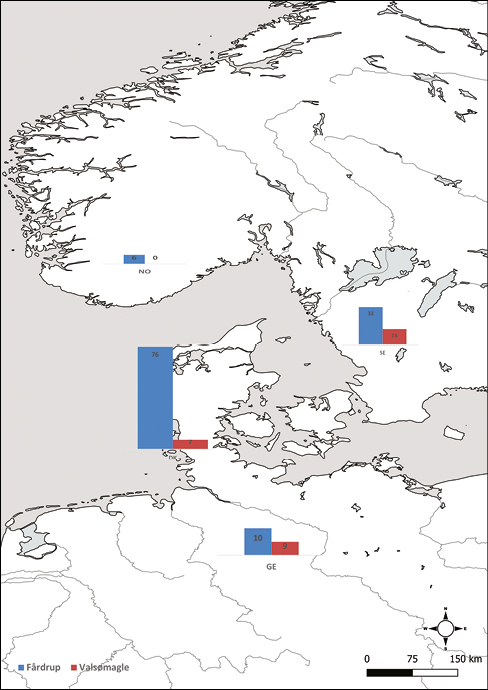
From approximately 1600 BC to c.1500 BC, bronze shafthole axes made their remarkable entry into NBA material culture (Table 1). Many kilograms of bronze went into the production of these heavy axes. Bronze shafthole axes can be divided into the more frequent FÃ¥rdrup-type and the potentially slightly later, more refined and less frequent Valsømagle-type. To the authorsâ knowledge, to date, 120 FÃ¥rdrup-type axes have been found from 108 locations, and 23 Valsømagle-type axes have been recovered from 21 locations (Fig. 1) in Denmark and southern Sweden (Malmer 1989; Oldeberg 1974; Broholm 1943; Broholm 1952; Vandkilde 1996; Aner & Kersten 1973â2014). Besides, six FÃ¥rdrup-type axes have been found in Norway. However, some additional shafthole axes have yet to be stylistically investigated and may eventually be allocated to one of these axe types (Engedal 2010; Althin 1954). A further twenty axes are known from northern Germany. Of these, eleven are FÃ¥rdrup-type axes (or are comparable with this type), and nine axes are similar to the Valsømagle-type (Hachmann 1957; Aner & Kersten 1978; 1979; 1991; 1993; Aner et al. 2005; 2011; Schubart 1972; Kersten 1936; 1958). The distribution of the known axes highlights a concentration in Denmark (see Fig. 1, axes without a known find location are not included). In terms of the different shafthole axe types, it is interesting to note that only 8% of the Danish axes are of the Valsømagle-type, while in Germany, this type makes up nearly 50% of all axes recovered. In Sweden, Valsømagle counts for almost 30% of the total, while in Norway, Valsømagle axes have not yet been found (Fig. 2).

Distribution of the shafthole axes in Northern Europe. Crosses indicate axes that have been examined through chemical and isotopic analyses.
Citation: Acta Archaeologica 92, 2 (2021) ; 10.1163/16000390-20210036
Background maps are provided by Natural Earth (public domain) under a CC BY 4.0 license. Map: H.W. Nørgaard using QGIS open-access softwareRatio of the distribution of Fårdrup-type and Valsømagle-type shafthole axes by country.
Citation: Acta Archaeologica 92, 2 (2021) ; 10.1163/16000390-20210036
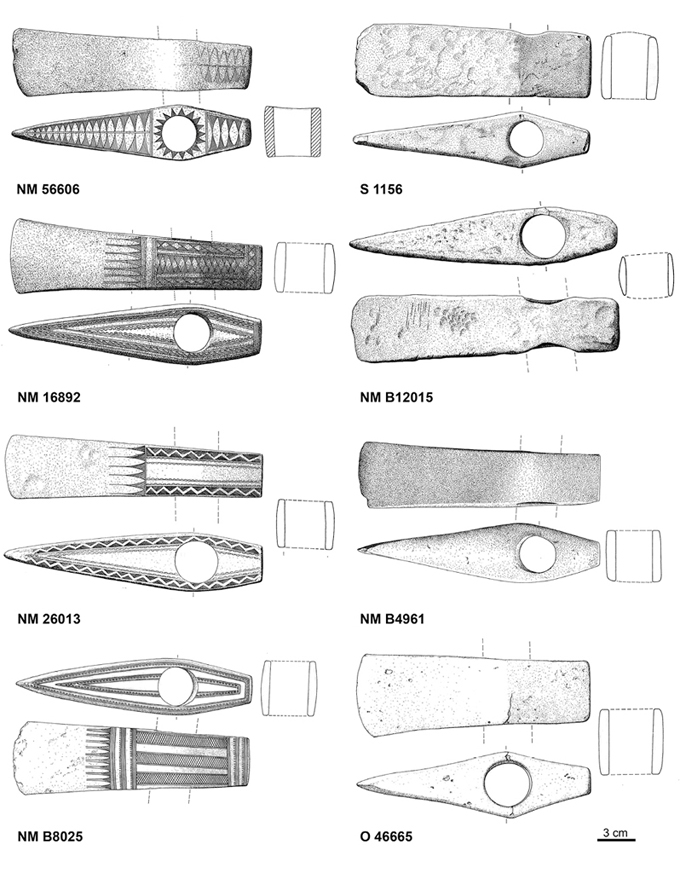
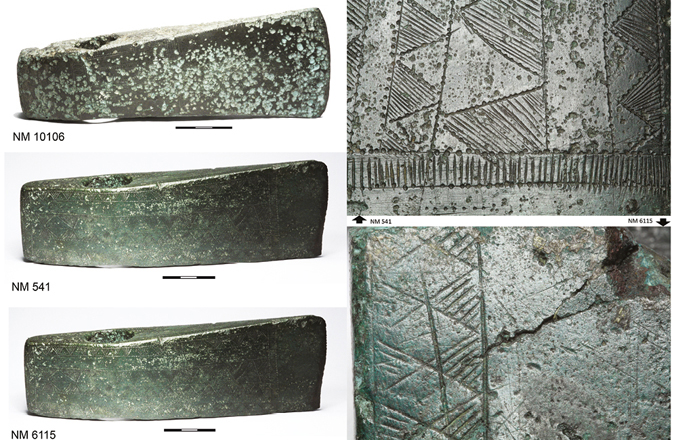
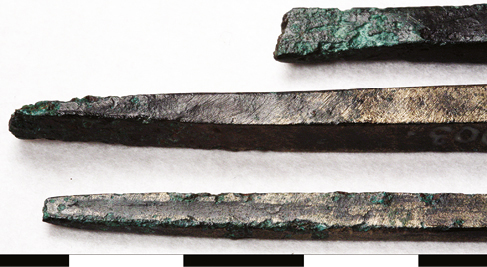
Map images are provided by Natural Earth (public domain) under a CC BY 4.0 license. Map: H.W. Nørgaard using QGIS open-access softwareAs a rule, FÃ¥rdrup-type axes (Fig. 3) were either undecorated or were decorated with more or less elaborate post-cast geometric decoration, including the ogival V figure found on Hajdúsámson-type swords and daggers (Nørgaard 2018; David 2002; Vandkilde 2014). Occasionally, the decoration on FÃ¥rdrup axes has been interpreted as part of a model cast via cire perdue. However, a craft technological investigation of three FÃ¥rdrup-type axes (namely axe NM B10106 from Juellinge, Maribo County (Cat. no. 46), and two axes NM 541 and NM 6115 without provenance from Denmark stored at the National Museum in Copenhagen, Denmark) could prove that the objectsâ geometric decorations were added post-casting using chisel-like punches (Fig. 4). Besides the fact that the line-decoration exhibits severe overlap, the contrast between the only weakly recognisable curved ornaments and the deep rectilinear lines supports the results of the technological investigation, namely that the decoration was applied post-casting. The majority of the line decoration shows signs of a two-part working process, in which a dotted line was first laid with small round punches to outline the decoration. Following this, a rectangular narrow chisel-like tool (such as it is known from finds like Annebjerg Skov (NM B1004, Fig. 5) could have been used to connect the dotted line and insert the geometric fill.
Selection of decorated and undecorated FÃ¥rdrup-type axes from Denmark. From top left to bottom right: NM56606 â Dragstrup, Frederiksborg municipality (Cat.-no. 32); S 1156 â Sandholm, Holbæk municipality (Cat-no. 65); NM16892 â HoltegÃ¥rd, København municipality (Cat.-no. 42); NMB12015 â Pillemark, Holbæk municipality (Cat.-no. 60); NM26013 â TÃ¥rnholm, Sorø municipality (Cat.-no. 70); NMB4961 â Gislinge, Holbæk municipality (Cat.-no. 39); NMB8025 â VÃ¥lse, Maribo municipality (Cat.-no. 75); O46665 â Højme, Odense municipality (Cat.-no. 44).
Citation: Acta Archaeologica 92, 2 (2021) ; 10.1163/16000390-20210036
Data from Aner & Kersten 1973â1977, drawings by Eva Koch and othersDecoration on the shafthole axes is applied post-casting, as can be seen on the three axes from the collection of the Danish National Museum in Copenhagen. A: Three investigated axes from Juellinge, Maribo Amt (NM B10106) and unknown find locations in Denmark (NM 541 & NM 6115). B: Example of the overlap in the geometric decoration on the two axes with unknown find locations NM 541 (top) and NM 6115 (bottom).
Citation: Acta Archaeologica 92, 2 (2021) ; 10.1163/16000390-20210036
Photo: H.W. Nørgaard with permission from the National Museum of DenmarkTools from a hoard found in Annebjerg Skov near Nykøbing Sjælland, Denmark, dated to the Nordic Bronze Age II.
Citation: Acta Archaeologica 92, 2 (2021) ; 10.1163/16000390-20210036
Photo: H.W. Nørgaard with permission from the National Museum of DenmarkIn this context, it should be noted that the decorative elements present on this type of artefact could, in principle, have been part of a model without being crafted via cire perdue. However, the decoration on the axes investigated above demonstrates characteristics of post-cast working (see Nørgaard 2018).
FÃ¥rdrup-type assemblages have been linked to the Carpathian Koszider period (Hajdúsámson-Apa-Ighiel- Zaita) (Vandkilde 1996; 2014; David 2002). FÃ¥rdrup-type shafthole axes were mainly deposited as single objects. Nonetheless, a few hoards are known in which more than one such axes were deposited, or another NBA IB artefact accompanied the axe. Examples include Højsted (Cat. no. 45), the eponymous FÃ¥rdrup (Sorø, Zealand, Cat. no. 37), Bækbølling (Cat. no. 30) and Egelund Ãby (Jutland, Cat. no. 33) (i.e. Vandkilde 1996; Poulsen & Grundvad 2019), all indicate a relative dating of the FÃ¥rdrup-type axes safely within NBA IB, a date which can be confirmed by the ornamentation shared by Bagterp-type spearheads and Hajdúsamson-Apa derived swords and daggers.
In general, FÃ¥rdrup-type axes are thought to have been deposited most often in wet contexts. However, a closer look reveals that only 17 axes were directly recovered from a river or bog, and most of these axes were discovered in fields (mostly on slopes and valleys). A potential link to deposition in a wet environment was assumed because finders, especially archaeologists, could attest to the presence of a patina typical of deposition in bogs on most of the finds. Interestingly, deposition habits seem related to the region or cultural affiliation of the persons who placed them. Based on the contextual information from the literature, FÃ¥rdrup axes were more likely deposited in wet environments in Denmark and the Danish Isles than those deposited in Germany, Norway or Sweden (Table 2) (i.e. Aner 1962; Aner & Kersten 1973â2014; Vandkilde 1996; Oldeberg 1974; Kersten et al. 1958; Schubart 1972; Engedal 2010; Hachmann 1957).
These heavy shafthole axes are interpreted as bronze skeuomorphs of contemporaneous local stone shafthole axes, which often feature decoration deriving from Carpathian Basin bronze axes, daggers, and swords (Vandkilde 1996, 227â229). FÃ¥rdrup-type decorated stone axes have been found in Sweden in Vreta and Läby träsk, Uppland, and Lövsta, Lärke (see Oldeberg 1974). Due to the striking similarities between stone and bronze shafthole axes, the bronze versions are widely accepted as Nordic products.
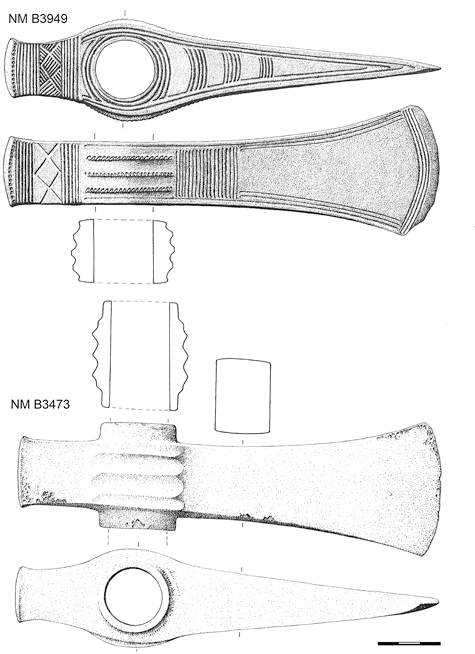
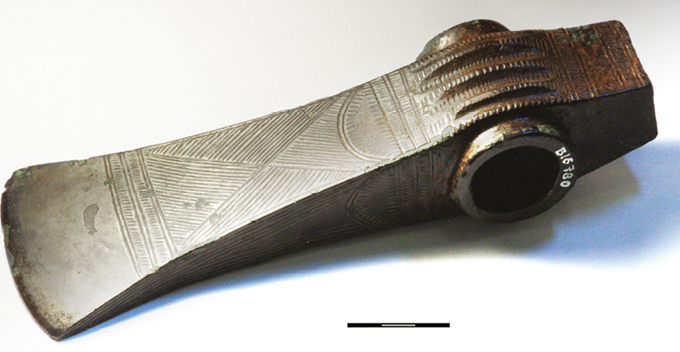
By contrast, the elegant and sculpted Valsømagle-type shafthole axes are primarily undecorated. However, a few transitional axes with geometric decorations seemingly integrate both axe categoriesâ characteristics (Figs. 6 & 7), suggesting either a chronological sequence (moving from early FÃ¥rdrup to late Valsømagle axes) or even that the two types were contemporaneous (Lomborg 1960; 1966; Vandkilde 1996; Randsborg & Christensen 2006). We pursue this question in greater detail below via many novel metal analyses. These axesâ few accompanying finds and broader associations indicate parallel development over the century-long NBA IB (Vandkilde 1996).
Valsømagle-type axes are characterised by their sculpted shape and an extended shafthole. Geometric decoration applied post-casting is rare, while protruding decorative elements appear more often. The two axes displayed are from the eponymous Valsømagle hoard I.
Citation: Acta Archaeologica 92, 2 (2021) ; 10.1163/16000390-20210036
Data from Aner and Kersten 1976, 1097, drawings by Eva Koch and othersDecorated Valsømagle-type shafthole axe from Engemarken, Roskilde, Copenhagen municipality (B16780). Excluding the Valsømagle hoard itself, geometric decoration on Valsømagle-type axes is rare; the axe from Engemarken is one of the few examples exhibiting such decoration.
Citation: Acta Archaeologica 92, 2 (2021) ; 10.1163/16000390-20210036
Photo: H.W. Nørgaard with permission of the National Museum in DenmarkValsømagle-type assemblages have been linked to the earliest Middle Danube Tumulus Culture Br. B1 (Vandkilde 1996; 2014; David 2002). Valsømagle-type shafthole axes occur in the twin eponymous weapon hoards at Valsømagle (Sorø, Zealand) and are firmly associated with warrior burials in the first grand burial mounds. It may be relevant to consider the possibility that the outstanding Valsømagle-type metalwork and exclusive Valsømagle-type assemblages appeared around 1550 BC or during the latter half of the 16th century BC as part of the formation process of the elite group who initiated the building of large burial mounds. Current 14C-based schemes place the beginning of NBA II at c.1500 BC, hence postdating the Valsømagle group (Vandkilde et al. 1996; Bergerbrant 2007; Olsen et al. 2011). Regarding deposition, Valsømalge-type axes were not treated differently from the Fårdrup-type axes presented above.
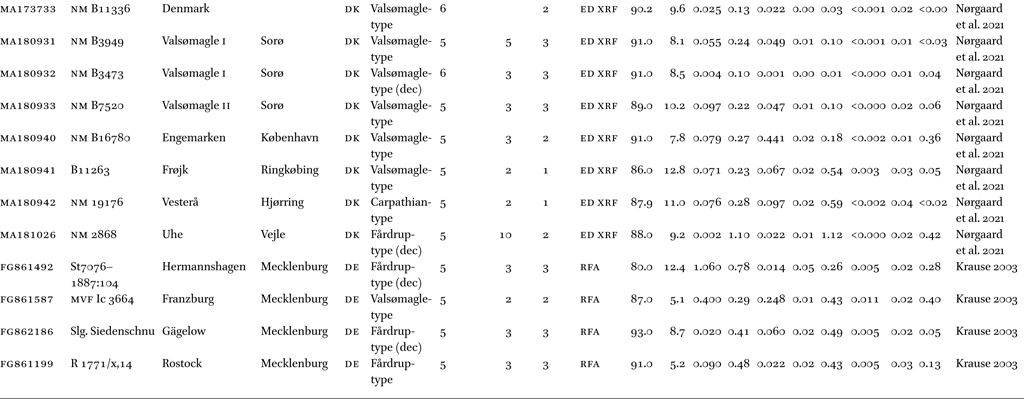
This study discusses the chemical and lead isotope analyses of 68 shafthole axes from Denmark (Nørgaard et al. 2021), three from Sweden (Ling et al. 2012; Ling et al. 2014; Melheim et al. 2018) and four new and unpublished analyses from Germany, from an archaeological perspective. Archaeometallurgical data are thus available for over 50% of the artefacts of these two types currently known. Among other objectives, the analyses aim to clarify whether the recognised stylistic similarity of Fårdrup-type axes was the result of crafting within a similar craft community (analytical workshop, see Nørgaard 2017; 2018) that got its material from one primary copper source, or whether these axes have a higher degree of complexity in terms of provenance patterns which could indicate different workshops or different trade networks existing in parallel. Furthermore, we also discuss the relationship between Fårdrup-type and Valsømagle-type axes related to the copper used in their production to clarify whether they appeared simultaneously or successive. We aim to examine how far the archaeometallurgical fingerprint of these two types allows us to speak of similar or different stylistic traditions in production.
3 Methodology
As all sample material was taken from the sample archive at the Curt-Engelhorn-Zentrum Archäometrie, Germany (published by Junghans et al. 1960; 1968; 1974; Cullberg 1968; Krause 2003), additional sampling (and, thus, the possibility of the artefacts incurring slight damage) was not necessary. Sample preparation included tracing and sorting the samples, as these were taken mainly by C. Cullberg between 1959 and 1962 for the SAM project (Studien zu den Anfängen der Metallurgie) during his dissertation work (Cullberg, 1968). Any corroded material (if present) was carefully removed under a microscope before minor and trace element analysis.
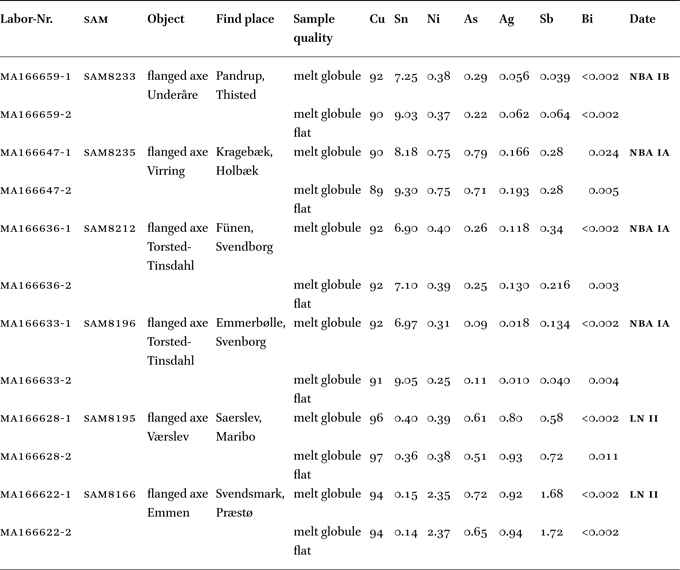
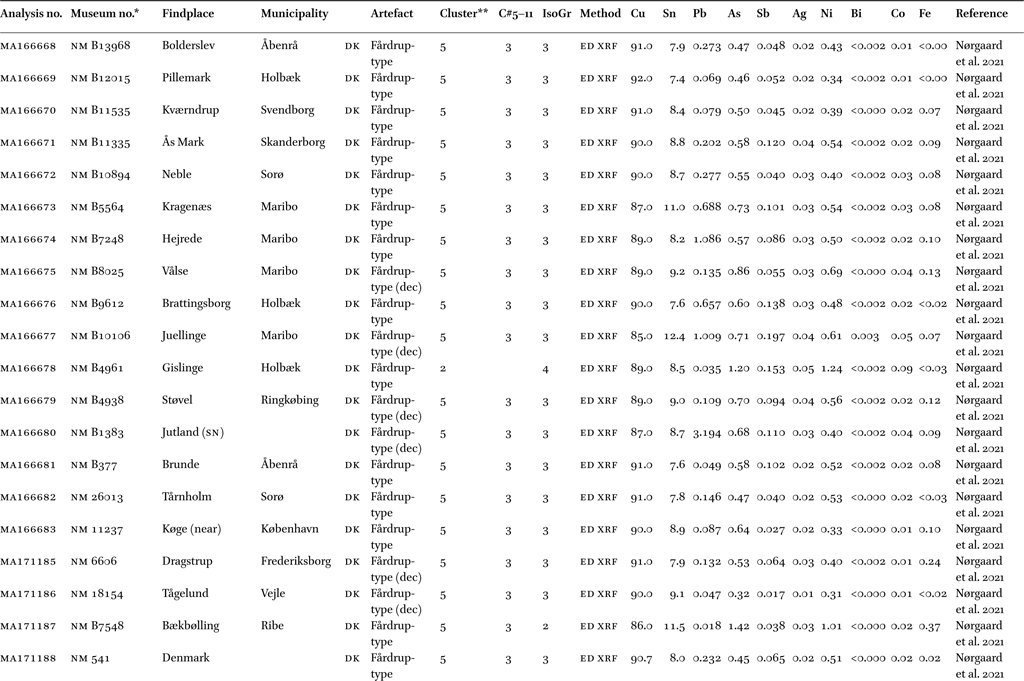
In some cases, the material remains of the sample took the form of a small metal globule of about 1â2 mm, representing the remains of the sample preparation for spectral analysis during the SAM project (see Pernicka 1984; Junghans et al. 1954), which included melting of the drill shavings. As these remaining samples had developed a casting skin and were sometimes slightly corroded on the surface, it would have been possible that a surface analysis of the globules would show different trace element concentrations than the original drill shavings. However, previous studies have shown (Pernicka 1984; Duberow et al. 2009) that the bulk chemical composition of the melt globules has not changed significantly. To analyse the melt globules with an energy-dispersive X-ray fluorescence spectrometer (EDXRF, ARL Quant X, Thermo Scientific) with a 20-position sample changer (typically used to analyse drill shavings), we needed to account for the shape of the globules. The device cannot precisely measure the tiny surface exposed to the X-rays with such metal globules (Duberow et al. 2009). Accordingly, these samples were subjected to a manual pre-treatment by flattening with a goldsmithing hammer and anvil, covered with chemically resistant sample paper to avoid contamination by the tools. This little pre-treatment resulted in a significantly larger, flat area that could be exposed to the X-ray, allowing for greater accuracy. Additionally, oxidised material on the surface was removed, and the deformation compensated for any possible enrichment of single elements on the surface (Table 3).
All samples were analysed for the concentrations of the elements Fe, Co, Ni, Zn, As, Se, Ag, Sn, Sb, Te, Au, Pb, and Bi at the CEZA in Mannheim, Germany. Measuring was performed with two exposures of 600 seconds each, following a modified version of the procedure by Lutz and Pernicka (Lutz & Pernicka 1996). Eighteen samples could thus be measured within less than eight hours in one run. Two reference materials obtained from the Bundesanstalt für Materialprüfung in Berlin (BAM211 and BAM376) were included in each run. The detection limits are 0.05% for Fe, around 0.01% for Co, Ni, and As, and about 0.005% for Ag, Sb, Sn, Au, Pb, and Bi. Se and Te were also measured but were below 0.005% in all samples, and Zn was below the detection limit of 0.1% in all samples.
The results of the trace element analysis were evaluated in connection with an extensive study on metals from the Nordic Bronze Age, 2000â1300 BC, using average-link cluster analysis. Based on logarithmic concentrations of arsenic (As), antimony (Sb), silver (Ag), nickel (Ni), and bismuth (Bi), this analysis of the extended dataset revealed eleven compositional groups (the whole dataset is published in Nørgaard et al. 2019a; 2021). The shafthole axes discussed here were part of the low-impurity copper clusters C#5 and C#6. This specific methodology was chosen due to several of the advantages it offers with regards to provenance studies: 1) the cluster analysis facilitated sorting the large dataset according to trace element patterns for the following evaluations, and 2) in contrast to more recently suggested methodologies by Pollard and colleagues (Bray et al. 2015; Pollard et al. 2018), the whole concentration ranges of the elements were used. In this way, accumulations of samples at different concentrations could be identified, thereby identifying compositional groups. If one used an arbitrary fixed concentration threshold as was practised by Pollard and colleagues, this would not be possible, and it could eventually result in the division of compositional groups that belong together.
To visualise these results, elements proven useful for provenance analysis, such as silver, nickel, arsenic and antimony (Pernicka 1990, 1999), are displayed in logarithmic diagrams. These have the additional advantage of varying large ranges of concentration values (Pernicka 1999; Duberow et al. 2009). Most elements characteristic of specific ore bodies are only present at very low concentrations. Values below 0.1% are compressed in a linear diagram, resulting in misleading illustrations. On the contrary, a presentation of the data in a logarithmic diagram âcorresponds to the natural distribution of trace elements and to the physical laws that govern the distribution of elements between slag and metalâ (translated by Duberow et al. 2009, 430, based on Pernicka 1990).
The lead isotope ratios were determined with a Thermo Scientific Neptune Plus mass spectrometer (a multiple-collector inductively-coupled plasma mass spectrometer,âMC-ICP-MS)âatâtheâCurt-Engelhorn- Zentrum Archäometrie (CEZA) in Mannheim, Germany. The pre-treatment of the samples was based on standard methodologies (Niederschlag et al. 2003; Dunstan et al. 1980). Solutions with a lead concentration of 100 ng/ml were prepared after the dissolution of the solid samples and the chemical separation of the lead. For the lead separation, the samples were rinsed with dilute HNO3 to remove surface contamination and then dissolved in half-concentrated HNO3 in an ultrasonic bath (70°C) for several hours. Insoluble residues were removed by decantation from the resulting solution and diluted with deionised water. Columns were prepared with PRE filter resin and Sr resin and preconditioned with 500
4 Results and Discussion
4.1 The Results of the Trace Element Analysis
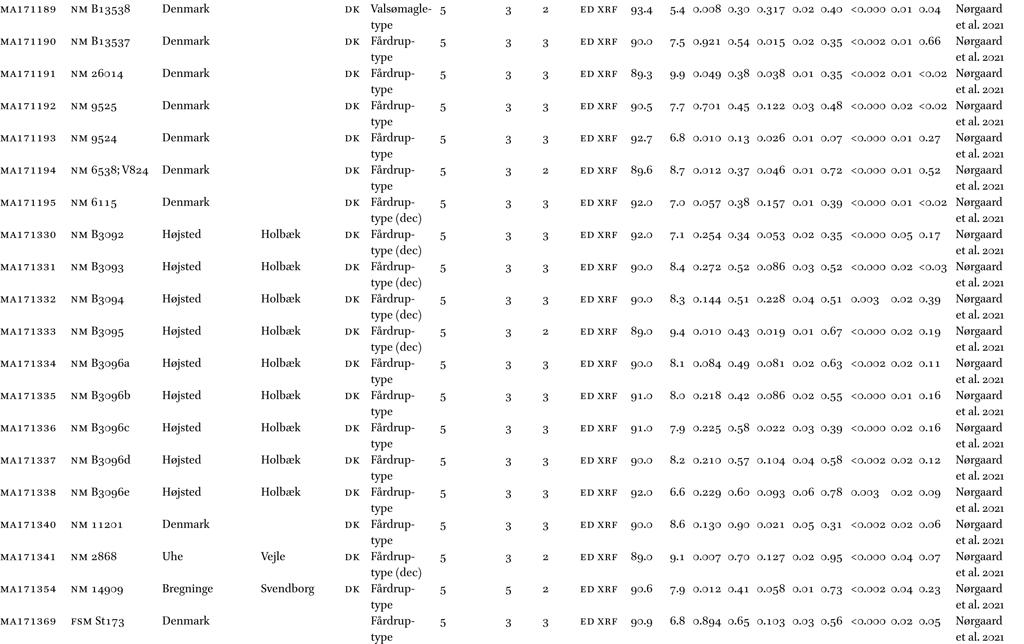
In general, it seems that the metal used for local production in southern Scandinavia from NBA IB onwards was homogenous in its trace element composition with nickel and arsenic as major impurities and a tin content of around 7.8% in NBA IB and 9.4% in NBA II (Nørgaard et al. 2021). The majority of the shafthole axes revealed a homogeneous trace element pattern with Ni ~ As in the per mill range and minor impurities of Ag and Sb (Table 4) between 0.01â0.3%, and an average of 8.3% Sn, which is typical for Cluster C#5 and C#6 low-impurity metals. Two artefact signatures were identified as high-impurity (fahlore) metals from Cluster C#2.
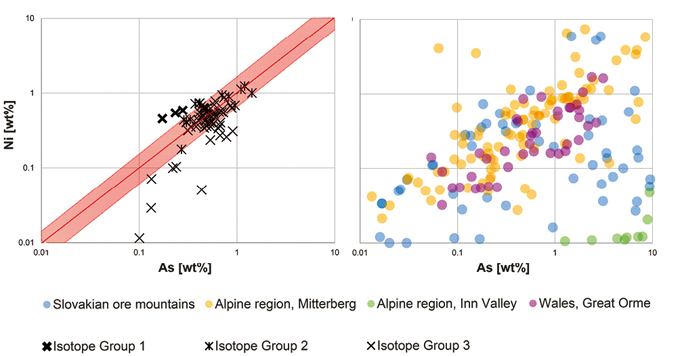
Low-impurity metal was revealed as the dominant metal type from NBA IB onwards. These low impurity metals belong to Cluster C#5 (Nørgaard et al. 2021). Interestingly, a subdivision of this low-impurity copper cluster revealed that the large group of shafthole axes was nearly exclusively identified as subcluster C#5-11-3, characterised by a distinct Ni ~ As balance (Fig. 8). This Ni ~ As balance may denote a specific copper source with gersdorffite, which is a nickel-arsenic sulphide mineral of the formula NiAsS, which frequently occurs as an accessory mineral in east Alpine copper deposits, as has already been suggested previously for Mitterberg (Weisgerber & Goldenberg 2004; Pernicka et al. 2016; Nørgaard et al. 2019a). However, after 1600â1500 BC, alternative sources for compositionally similar ores became available in the major Alpine region (OâBrien 2015). Mining regions like the Alto Adige, Trentino and Veneto in the Italian Alps of South Tyrol (AATV) (Artioli et al. 2016; Nimis et al. 2012) came within reach of the Nordic zone. Additionally, as recent research has demonstrated (Melheim et al. 2018; Williams 2014; 2018; Williams & Le Carlier de Veslud 2019), the Great Orme mining area in Wales shows a similar nickel and arsenic relationship. Our previous results revealed that despite the lack of typologically-identifiable British imports in NBA IA, evidence for British metal in the production of local Nordic artefacts was still present; this was especially visible in the increased tin values of the more elaborate axes (Nørgaard et al. 2019a; 2019b). To summarise, the AATV-mining region, the Great Orme mining area in Wales and regions within the Slovakian Ore Mountains exhibit a similar mineralogically determined relationship between nickel and arsenic, as well as the Mitterberg deposits in the Eastern Alps.
The relationship of arsenic versus nickel for the 71 shafthole axes (left). The diagonal red line indicates the Ni = As balance, and the shadowed area is the range in which measurements meet the criteria of a balanced ratio. Several European ore deposits have revealed a trace element pattern with an equivalent Ni = As balance (left).
Citation: Acta Archaeologica 92, 2 (2021) ; 10.1163/16000390-20210036
Ore data from Schreiner 2007; Modarressi-Teherani et al. 2016; Pernicka et al. 2016; Höppner et al. 2005In summary, the remarkable uniformity of the trace element composition alone does not allow for educated conclusions regarding the provenance of the copper ores used for crafting the shafthole axes. Despite the results and information available, like gersdorffite in the ore body, lead isotope analysis needs to be conducted to provide more data. In addition, due to the strong similarities in values, the potential mixing of ores or artefacts should also be considered regarding interpretation.
4.2 Lead Isotope Analysis Reveals Three Isotope Groups
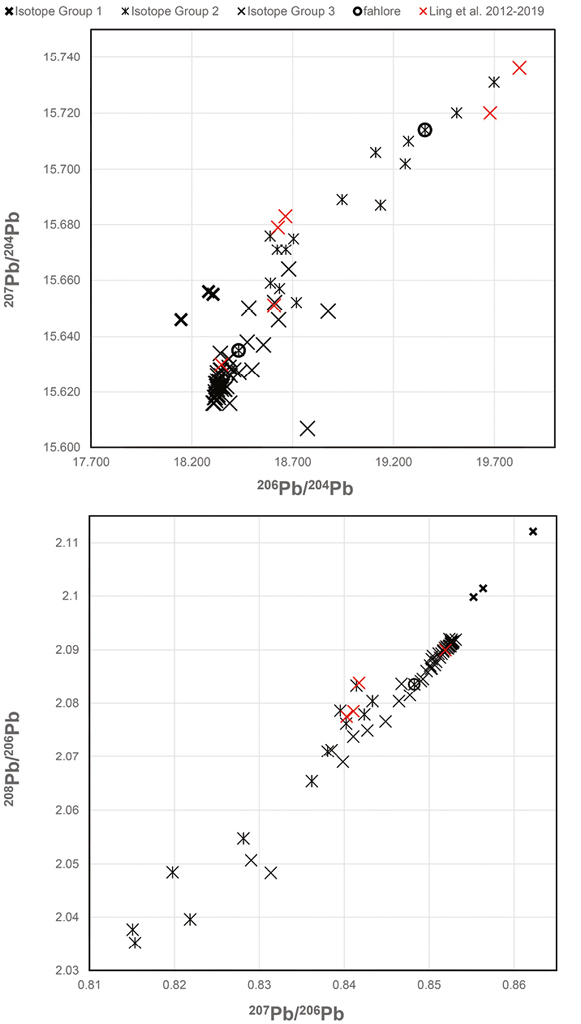
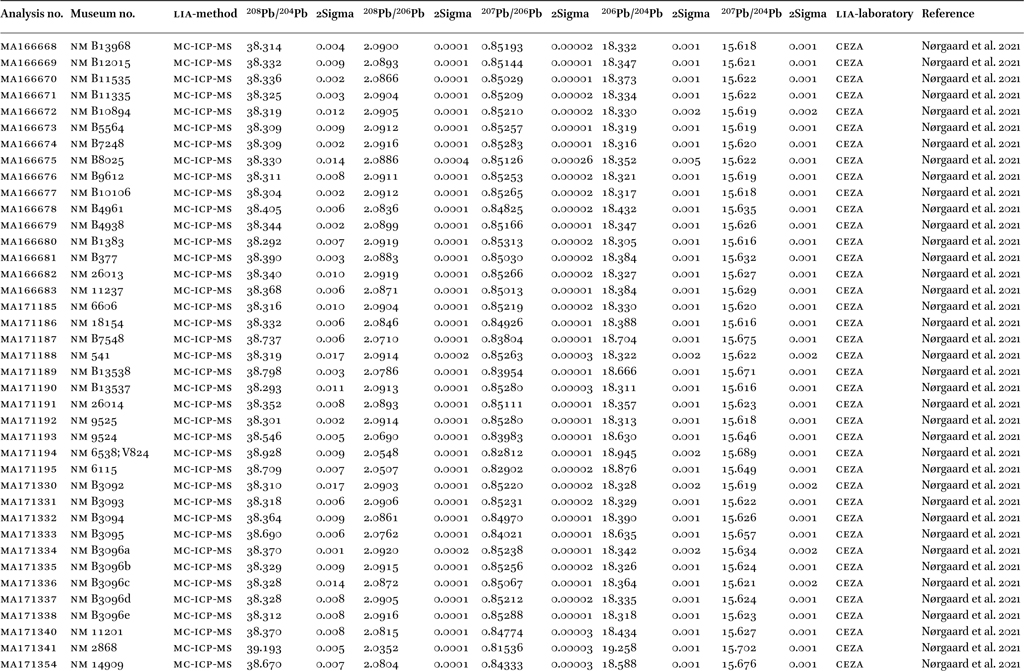
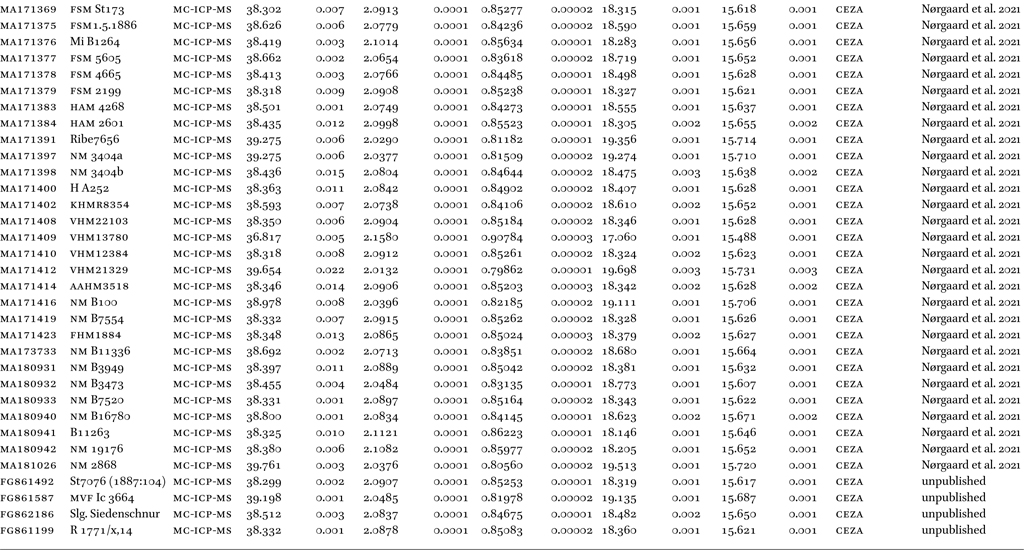
In contrast to the uniformity of trace element concentrations, the lead isotope ratios suggest several subdivisions. Three isotope groups can be identified among the 71 Nordic shafthole axes, each notably comprising members of both axe types (Table 5) (Fig. 9).
Lead isotope ratios of the shafthole axes dated to the Nordic Bronze Age IB. The three isotopic groups defined are recognisable in both the 204Pb and the conventional diagram.
Citation: Acta Archaeologica 92, 2 (2021) ; 10.1163/16000390-20210036
Isotope Group 1 included three axes (4.5% of the artefacts analysed). In the diagram shown, the ratios for 206Pb/204Pb plot between 18.14 and 18.31 and for 206Pb/204Pb between 15.64 and 15.65, forming a very distinct group. The conventional diagram supports the group character with 207Pb/206Pb isotope ratios between 0.855â0.862 and 208Pb/206Pb ratios above 2.099.
Isotope Group 2 comprises 17 axes, covering 24% of the total amount of artefacts analysed. This dataset has a much more extended range from 2.035â2.083 208Pb/206Pb, 0.815â0.843 207Pb/206Pb and 18.58â19.69 206Pb/204Pb that includes radiogenic lead with negative model ages.
Isotope Group 3 is a very dense and separated group and does not exceed values of 18.55 206Pb/204Pb and 15.63 207Pb/204Pb. The separation from the two other groups is even more apparent in the conventional diagram, where the ratios for 207Pb/206Pb are between 0.829â0.853 and for 208Pb/206Pb between 2.048â2.091, forming a dense group towards the higher values. Fifty-one artefacts (counting for 72% of all analysed shafthole axes) can be included in this group. However, a small number of axes from both Isotope Groups 2 and 3 plot in between or at the edge of the defined data clouds.
To most effectively evaluate the original copper deposits from which the ores were mined, it is unnecessary to include all available comparative ore source data. For instance, it is improbable that Southeast Asian sources were exploited to furnish Bronze Age European forges with the material. For this reason, only deposits in Europe and the Mediterranean that are known to have been exploited in the Bronze Age were considered for comparison (OâBrien 2004; 2013; 2015; Williams 2014; Williams & Le Carlier de Veslud 2019; Gale 1990; Timberlake 2009; 2017; Timberlake & Craddock 2013; Timberlake & Prag 2005; Pernicka et al. 2016; Höppner et al. 2005; Artioli et al. 2016; Cattin et al. 2007). Nevertheless, some ore bodies (such as the Slovakian Ore Mountains) have provided only sparse evidence for Bronze Age mining activities (Žebrák 1995). However, comparative studies have shown that isotope and trace elemental signatures match Early Bronze Age artefacts from the Slovakian region and the Nordic Bronze Age zone (Bunnefeld 2016; Nørgaard et al. 2019a). Lastly, the possibility that prehistoric persons mixed different ores or artefacts to assemble the required amount of material for crafting is also considered. It was shown that the Nordic Bronze Age metalworkers actively re-used artefact metal to craft local artefacts, possibly due to the desired sheen which characterised foreign high tin bronzes (Nørgaard et al. 2019a).
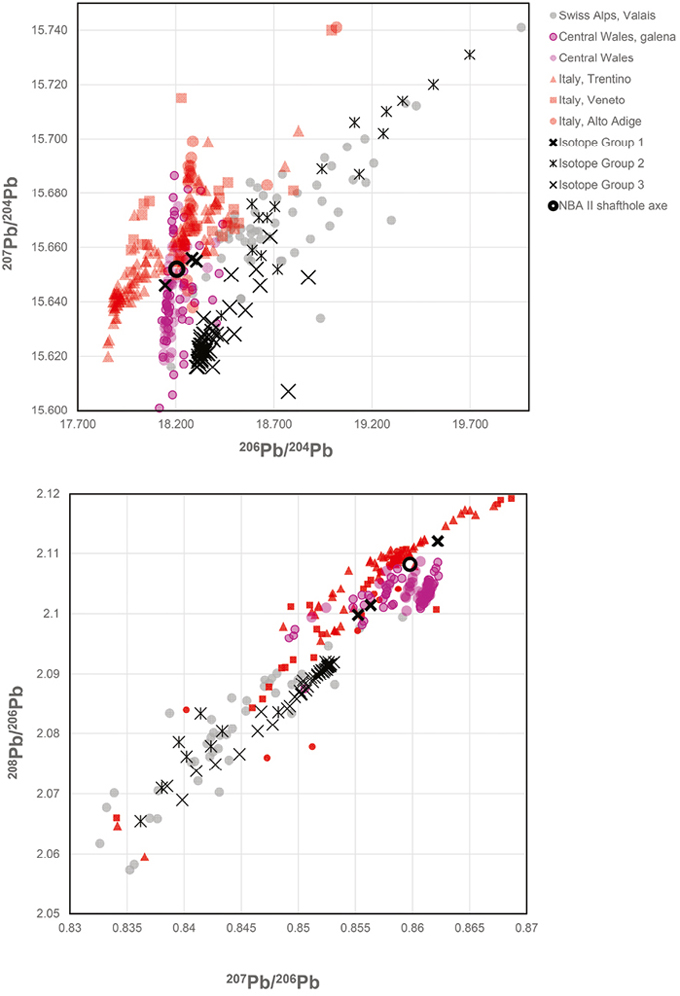
With this strategy, our results suggest that the ores from the Alto Adige, Trentino and Veneto mining regions in the Italian Alps of South Tyrol (Artioli et al. 2016) and the ores from the Central Welsh mining sites (Rohl 1996) match the signatures of Isotope Group 1 quite well. However, the isotope ratios of copper ores from the Swiss Valais also overlap with the values of these axes (Cattin et al. 2011) in one diagram, while this region can be excluded in the conventional 206Pb diagram. After all, the AATV mining region in northern Italy (Addis et al. 2016; Artioli et al. 2016; Nimis et al. 2012; Addis 2013) provides the best match for Isotope Group 1 even if a possible relationship to the Central Welsh mining region needs further study (Fig. 10).
204Pb and 206Pb isotope ratios of the shafthole axes from Isotope Group 1 compared with possible ore sources. The ore data are from these areas: A mining region in Wales (Rohl 1996; Rohl & Needham 1998; Fletcher et al. 1993), the Italian AATV mining region (Addis 2013; Artioli et al. 2016; Artioli et al. 2015; Nimis et al. 2012) and Valais, Switzerland (Cattin et al. 2007; Cattin et al. 2011). The comparative artefact data is from Nørgaard et al. 2021. The size of the symbols is larger than the analytical uncertainties.
Citation: Acta Archaeologica 92, 2 (2021) ; 10.1163/16000390-20210036
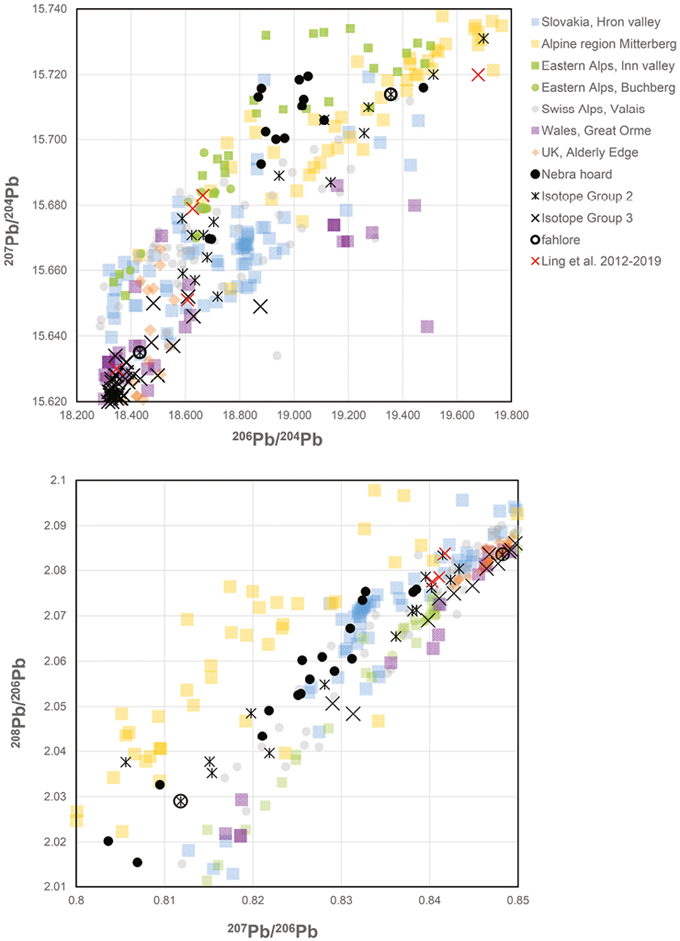
Comparable values to those of Isotope Group 2 are found in the ore bodies of the Slovakian Ore Mountains (Schreiner 2007; Modarressi-Teherani et al. 2016), the eastern Alps (Höppner et al. 2005; Pernicka et al. 2016) and the Swiss Valais (Cattin et al. 2011). British and Welsh ores (Rohl 1996; Rohl & Needham 1998; Williams 2014; 2018) are comparable in the 206Pb diagram. However, they are not (e.g. in the case of Alderley Edge) or are only partly (in the case of the Great Orme mining region) related to the signatures of Isotope Group 2 axes in terms of the 204Pb ratios. Deposits from the Inn Valley and the Valais are mostly fahlore and can be excluded as sources for this low-impurity copper. The best match for Isotope Group 2 is Slovakian ores and eastern Alpine ores from Mitterberg (Fig. 11).
204Pb and 206Pb isotope ratios of the shafthole axes from Isotope Group 2 compared with possible ore sources. The analyses of shafthole axes from Sweden (Ling et al. 2012; Ling et al. 2014; Melheim et al. 2018) and the contemporaneous Nebra hoard (Pernicka 2010) are also included in the plot. The ore data are from these areas: The Slovakian Ore Mountains (Schreiner 2007; Modarressi-Teherani et al. 2016), the eastern Alpine region (Pernicka et al. 2016; Höppner et al. 2005), the Great Orme Mining region (Williams 2014; 2018; Rohl 1996), Alderley Edge in Britain (Rohl 1996; Rohl & Needham 1998) and Valais, Switzerland (Cattin et al. 2007; Cattin et al. 2011). The size of the symbols is larger than the analytical uncertainties.
Citation: Acta Archaeologica 92, 2 (2021) ; 10.1163/16000390-20210036
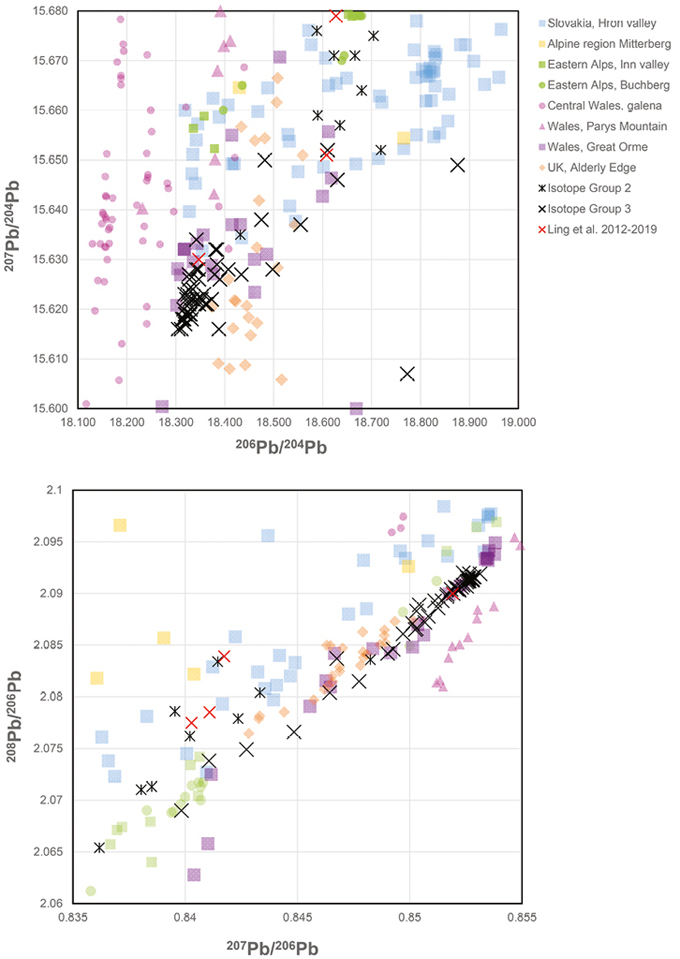
The characteristic signatures from Isotope Group 3 are in Europe only matched by English and Welsh mining areas (Williams 2018; Rohl 1996). While the eastern Alpine ores from Inn Valley in the 206Pb diagram are within the range of the signatures measured for the axes, they show no overlap in the 204Pb diagram. In addition, they are dominated by fahlores and, thus, will not be considered in the discussion below (Fig. 12).
204Pb and 206Pb isotope ratios of the shafthole axes from Isotope Group 3 compared with possible ore sources. The analysis of shafthole axes from Sweden (Ling et al. 2012; Ling et al. 2014; Melheim et al. 2018) is also included in the plot. The artefacts identified as probably of Welsh/British origin using trace element analysis are highlighted in this plot. The ore data are from: Slovakian Ore Mountains (Schreiner 2007; Modarressi-Teherani et al. 2016), the eastern Alpine region (Pernicka et al. 2016; Höppner et al. 2005), the Welsh Mining region (Williams 2014; 2018; Rohl 1996), and Alderley Edge in Britain (Rohl 1996; Rohl & Needham 1998). The size of the symbols is larger than the analytical uncertainties.
Citation: Acta Archaeologica 92, 2 (2021) ; 10.1163/16000390-20210036
4.3 Provenancing the Copper of the Nordic Shafthole Axes
The above-identified possible matches for the isotope ratios measured within each group have helped narrow down the most likely metal sources for the Nordic shafthole axes. Thus, the three isotope groups identified for the shafthole axes have several possible sources of origin.
Isotope Group 1, with its three artefacts, was shown to have the same isotope range as the copper deposits in the AATV mining region in northern Italy. In addition, four high-flanged axes from the same period were also identified as including AATV copper, namely two Oldendorf-type (Vandkilde 1996) flanged axes from the Christiansminde hoard (B14365, B14366) on Zealand, another axe of similar type (B8703) found at the Limfjord in Jutland and one axe (B6980) from southernmost Jutland. Moreover, one Carpathian-style shafthole axe (see Fig. 10) exhibits a geochemical pattern similar to those of the three Nordic axes from Isotope Group 1. This relatively small group of items seems to be the first evidence for the extension of metal trading networks across the Alps. Italian AATV metals most likely appeared sometime between 1600â1500 BC in southern Scandinavia, a short time after the downfall of the ÃnÄtician culture (Risch & Meller 2013) and contemporary with the increase of mobility towards the north (compare Frei et al. 2019). Evidence of metal from areas further south or southwest could not be confirmed before or during this period (Nørgaard et al. 2021 versus Ling et al. 2012; Ling et al. 2014; Melheim et al. 2018). Contemporary with the central European Tumulus Culture period Br. B, the first attempt to establish trade networks with the south became recognisable around 200 years before they gained their full impetus. Exchanges with the Aegean world increased around 1400 BC.
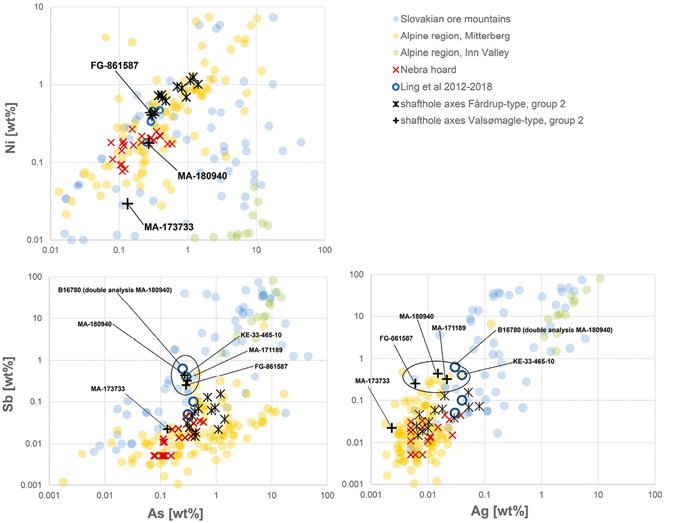
To distinguish between east Alpine and Slovakian copper for the production of Isotope Group 2 shafthole axes, we used the trace element concentrations of both deposits and contemporary artefacts with a confirmed origin, such as the Nebra hoard metals (Pernicka 2010) as points of comparison. Recent research has shown that the Slovakian copper deposits delivered high-impurity fahlore copper during the Late Neolithic and Early Bronze Age to southern Scandinavia; in the Early Bronze Age, low-impurity copper (likely from a new branch or deeper level of the same ore deposit) also made its way northwards (Nørgaard et al. 2019a). The eastern Alpine deposits mostly contain low-impurity copper (mainly chalcopyrite, see Pernicka et al. 2016). For this reason, trace element comparison makes it possible to distinguish between these sources. The respective diagrams (Fig. 13) highlight the relationship of the Nebra bronzes with the ores from Mitterberg. The shafthole axes from Isotope Group 2 seem to derive from a similar ore, which was likely also from Mitterberg, especially highlighted in the Ag/Sb diagram (Fig. 13). In light of the current state of research (see Schreiner 2007; Modarressi-Teherani et al. 2016), the Slovakian Ore Mountains should be excluded as a supplier of copper for the Nordic shafthole axes.
Diagrams of Ni/As, Sb/As and As/Ag concentrations of Isotope Group 2 axes identified through the lead isotope data. The similarity to the Nebra hoard (data from Pernicka 2010) is distinct, and especially the Sb/Ag diagram allows to exclude the Slovakian Ore Mountains as a possible source for the majority of the shafthole axes. The Valsømagle-type axes MA171189, MA180940 (including the double analysis), MA173733 and KM33-465-10 are separated from the bulk, especially in the Sb plots. The ore data are from: Mitterberg ore district (Pernicka et al. 2016), Hron Valley, Slovakia (Schreiner 2007; Modarressi-Teherani et al. 2016), Inn Valley and Buchberg, Alpine region (Höppner et al. 2005; Schubert & Pernicka 2013). The analytical uncertainties are smaller than the size of the symbols.
Citation: Acta Archaeologica 92, 2 (2021) ; 10.1163/16000390-20210036
Nevertheless, a few examples cast doubt over an overall interpretation of these axesâ purely eastern Alpine origin. In addition to 13 FÃ¥rdrup-type axes, this isotope group contains three Valsømagle-type axes. Additionally, three axes (two FÃ¥rdrup-type and one Valsømagle-type axe) were analysed by Ling and colleagues (Ling et al. 2012; Ling et al. 2014, Melheim et al. 2018). These axes were included in the data evaluation presented here, as they were allocated to southwest European or Mediterranean deposits (Ling et al. 2012, Ling et al. 2014). This conclusion was contested by the authors of this paper (Nørgaard et al. 2019a; 2021), making a new evaluation necessary because the two FÃ¥rdrup-type axes from Frändefors (GAM1255) and ÃdsmÃ¥l (GAM5289), Sweden, show compositional values consistent with eastern Alpine metal.
By contrast, the Valsømagle-type axe KM33-465-10 from Löt, Sweden, deviates from this pattern. In addition, the Valsømagle-type axes MA171189, MA180940 and MA173733 presented here (the latter one is of C#6 metal) have trace element ratios that differ from the values of the Fårdrup axes (see Fig. 13; Table 5). Fahlore copper and low-impurity copper from the Slovakian Ore Mountains were actively used in northern Europe in NBA IB, though their share later declined (see Bunnefeld 2016; Melheim et al. 2018; Nørgaard et al. 2021). The shafthole axe MA166678 from Gislinge consists of Slovakian fahlore metal and highlights the possibility that selected shafthole axes could have been made of low-impurity metal from Slovakia. In a recent article (Nørgaard et al. 2021), we could further show that fahlore copper was still used alongside Slovakian low-impurity copper in a small group of NBA IB high-flanged axes. Thus, the Valsømagle-type axes from Isotope Group 2 could come from a different batch of metal from a different mine at Mitterberg or a different ore body, such as Slovakian low-impurity copper (Fig. 13).
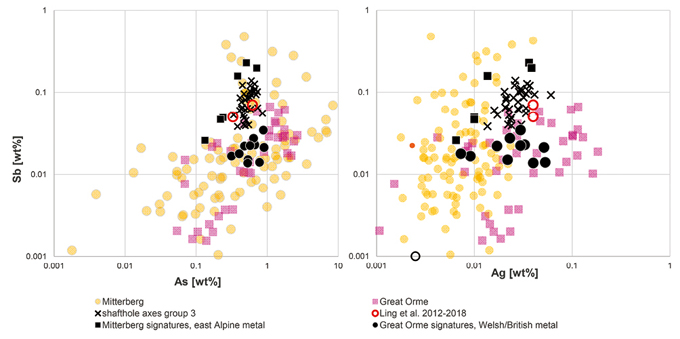
It was already demonstrated that several English and Welsh sources have lead isotope signatures consistent with Isotope Group 3 axes. However, trace element concentrations suggest a possible relationship to the east Alpine copper deposits from Mitterberg (Fig. 14a). Compared with the previously discussed axes, the range of Isotope Group 3 axes is also tightly constrained in terms of trace elements. Furthermore, most artefacts plot in a single data cloud between the higher values of the Mitterberg and Great Orme deposits, a situation which is particularly well-illustrated by the Ag/Sb diagram (Fig. 14b) and suggests that both English/Welsh and east Alpine sources should be considered possible sources for the ores used in producing these axes.
Diagrams showing Sb/As and Sb/Ag concentrations from Isotope Group 3 axes overlap with the trace element ratios measured in the eastern Alpine Mitterberg ores. The C#6 artefacts of low-impurity copper are additionally plotted to illustrate their different compositions. Two FÃ¥rdrup-type axes analysed by Ling and colleagues (Ling et al. 2012; Ling et al. 2014) match the large condensed group. Trace element data for comparison was taken from the Mitterberg mining region (Pernicka et al. 2016) and Great Orme, Wales (Williams 2014; 2018).
Citation: Acta Archaeologica 92, 2 (2021) ; 10.1163/16000390-20210036
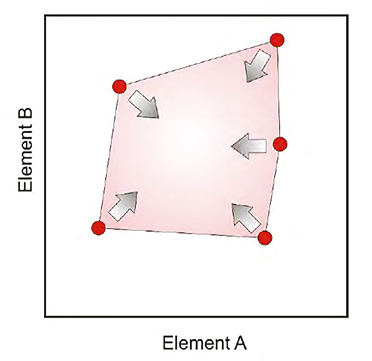
Moreover, concerning the physical principles underlying the mixing of different metals (Fig. 15), we should also consider how far mixing could account for the complexity observed here. Continuous mixing of two different ore bodies would lead to a homogenisation of the trace element contents, resulting in a relatively homogeneous geochemical fingerprint. In terms of isotopes, mixing British/Welsh metal with east Alpine metal would lead to the concentration of many artefacts around the same ratios. The ore body (copper source) with the higher lead content would dominate isotopically. Consequently, considering the respective literature (Pernicka et al. 2016; Williams 2014; 2018; Williams & Le Carlier de Veslud 2019), the values of the Great Orme mine would become dominant over those of the Mitterberg. The elemental data presented in Table 4 for Isotope Group 2 and Isotope Group 3 shafthole axes supports this possibility.
Homogenisation of two or more components as a result of recycling and mixing. Hypothetical diagram of two chemical elements and five metal objects (the dots).
Citation: Acta Archaeologica 92, 2 (2021) ; 10.1163/16000390-20210036
E. Pernicka in RadivojeviÄ et al. 2018Additionally, most Isotope Group 3 shafthole axes show higher Sb-Ag concentrations (Fig. 14) than can be recognised in Great Orme ores and significantly higher values than those measured in the slag prills from Pentrwyn, Llandudno (compare Williams 2014; 2018). Besides, the mixing of metal in the form of artefacts of different origins should also be considered. As stated by the authors in a previous article (Nørgaard et al. 2019a), evidence suggests that metal from artefacts was mixed for local production during the transition from the Neolithic to the Bronze Age in Denmark. The presence of medium-high tin artefacts in local Late Neolithic metalwork and high-tin imports from the British Isles have been the major factors for this assumption.
Based on their archaeometallurgical fingerprint, we suggest that a few axes from this group may be related to English and Welsh ores. Probably, metal from the Alderley Edge mine in England (which was probably in use at least until the first half of 1600 BC; see Rohl 1996; OâBrien 2015; Timberlake & Marshall 2014; Timberlake & Prag 2005) was used for producing the axes from Højme (MA171378), LavesgÃ¥rd (MA171383) and Bækbølling (MA171398).
Based on the evaluation of the existing trace element data for British and Welsh ores (here, it should be noted that only the Great Orme mines have been adequately investigated; see Williams 2018; Williams & Le Carlier de Veslud 2019), we suggest that the other axes may consist of northwest European (British/ Welsh) metal (Fig. 16). The axe MA166683 from Køge, MA171186 from Tågelund, MA171336 from Højsted, MA171400 from Geishede, MA171402 from Brørup and MA171423 from Aalsrode in Denmark and two axes from northern Germany: Hermannshagen (FG861492) and Rostock (FG861199) show signatures characteristic of the Great Orme mines in Wales (based on Williams 2014; 2018). However, another axe (MA171332 from the large Fårdrup axe hoard of Højsted) was likely made of east Alpine copper from the Mitterberg (see Fig. 16), as was also the case for the axe MA166677 from Juellinge, two axes with unknown find locations (MA171193 and MA171195) and two Valsømagle-type axes from the eponymous hoard (MA180931, MA180933).
Trace element ratios of Sb/As and Sb/Ag from Isotope Group 3 compared with the ores sources from the Mitterberg and Great Orme reveal sub-groups that allow conclusions about the provenance of specific artefacts.
Citation: Acta Archaeologica 92, 2 (2021) ; 10.1163/16000390-20210036
Although more detailed knowledge is needed regarding the trace element composition of relevant British sources, it seems that many shafthole axes from Isotope Group 3 were probably cast from mixed metals (probably from artefacts, as there is no indication that copper ores were smelted in southern Scandinavia to any extent), a practice which follows on from a trend already identified in LN II and NBA IA (Nørgaard et al. 2019a; 2021). MA171195, the decorated Fårdrup-type axe, is a clear example, as it would be identified isotopically as Welsh while still mirroring the ores mined from the Mitterberg in terms of chemical composition (see Tables 4 and 5).
5 Conclusion
The typological and geochemical uniformity noted above for FÃ¥rdrup-type shafthole-axes turned out to overprint a complex series of divergent provenance data. We suggest that the largest group (Isotope Group 3 with 51 axes) includes axes consisting of mixed copper from British ores and the Mitterberg in Austria. The detailed study of the trace element concentrations further revealed that single artefacts could be made of ores from only a single copper source. The absence of field evidence for smelting renders it very unlikely that mixed ores from distant sources were smelted in southern Scandinavia. We may consider the possibility that artefacts were re-used to produce new types of metal objects.
While a provenance from Mitterberg is also most likely for the 17 axes from Isotope Group 2, the three axes from Isotope Group 1 showed a pattern which deviated and is instead compatible with Italian AATV copper. Interestingly, the seven Valsømagle-type axes were present in all three groups; however, they deviate slightly from the general picture â most distinctly in Isotope Group 2 â and, thus, add weight to the hypothesis mentioned in the introduction (namely, that the Valsømagle-type axes derive from different craft traditions or workshops).
These results raise questions about whether the data hides a chronological or geographical division, especially for the two artefact types.
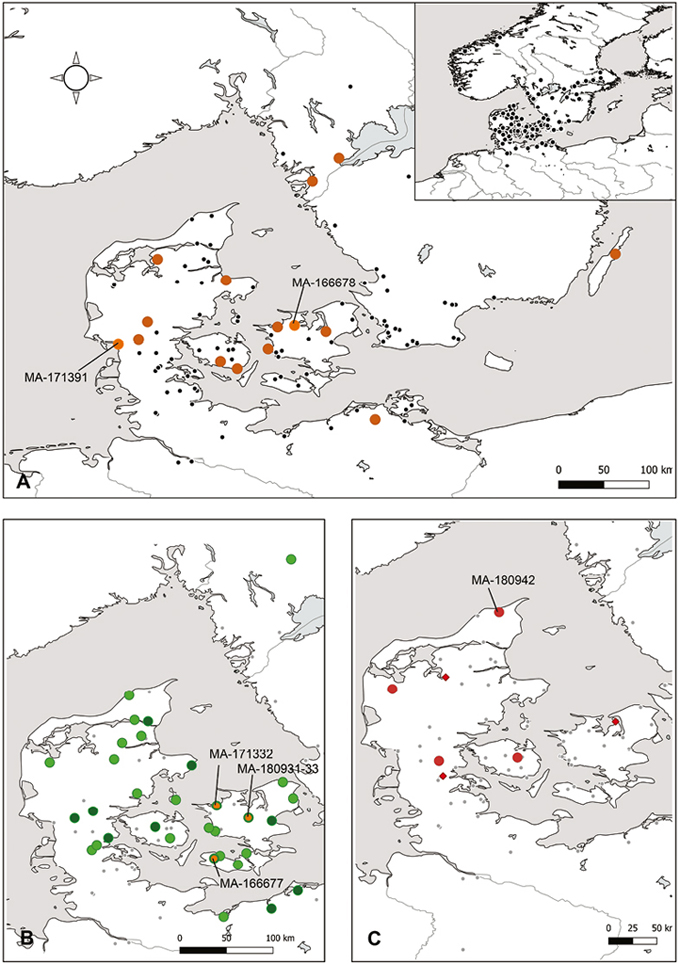
Figure 17 shows the geographical distribution. In studying these, some tendencies become apparent. The east Alpine metal mainly used in Isotope Group 2 axes appears north of the Flensburg Fjord across Denmark, with concentrations in western Zealand and southern central Jutland (Fig. 17a). While instances of Isotope Group 2 artefacts (including the fahlore copper axes) are mainly located near the coastline, Isotope Group 3 axes are distributed primarily in Jutland and inland (Fig. 17b).
The geographical distribution of the shafthole axes investigated and analysed here. A) Isotope Group 2 axes (orange dots) are spread in the same areas as axes MA166678 and MA171391, both made of Slovakian fahlore metal (light orange dots). These axes should be considered partly contemporary with Isotope Group 3 axes and possibly predate the Isotope Group 1 axes. B) Isotope Group 3 axes, interpreted as being of British and east Alpine origin (green dots), have a similar distribution, though their occurrences seem to extend further inland. The axes were identified as pure British metal (dark green dots) and Mitterberg copper (green/orange dots), highlighting metallurgical zones on the Danish Islands and central Jutland. C) The few Isotope Group 1 axes (red dots), including the NBA II shafthole axe from Vesterå MA180942, are found in the respective metallurgical zones, highlighting the west-east axis from central Jutland to Zealand and the importance of northern Jutland in NBA IB. The contemporary high-flanged axes with AATV provenance (red diamonds) join this picture.
Citation: Acta Archaeologica 92, 2 (2021) ; 10.1163/16000390-20210036
Map images are provided by Natural Earth (public domain) under a CC BY 4.0 license. Map: H.W. Nørgaard using QGIS open-access softwareInterestingly, those artefacts consisting of Mitterberg copper in Isotope Group 3 seem to cluster in the western part of Zealand. The axes identified earlier as being of possible British/Welsh origin scatter across a west-east axis from Jutland to the Danish Isles in the centre of the groupâs distribution and along the coast of northern Jutland and northern Germany. It is worth highlighting that large depositions, such as the Højsted Rumperup and Valsømagle hoards (Aner & Kersten 1976, 93, 130.) include axes of both metal types (see Table 4).
The few shafthole axes made of Italian AATV copper display a scattered distribution north of the Flensborg Fjord, mainly on Jutland. Contemporaneous high-flanged axes, also identified as being of AATV provenance (see Fig. 17c), highlight this copper groupâs geographical distribution on the Danish mainland as only one example was found on Fyn and two on Zealand.
This geographical distribution may result from the existence of metallurgical centres; one might be situated on western Zealand, one in central Jutland or/and on Fyn, and another in northern Jutland. Furthermore, this geographical pattern corroborates the hypothesis that copper provided from a limited number of sources was routinely mixed.
Within these metallurgical centres, both English/ Welsh metal and east Alpine metal might have been in use simultaneously, a proposition that finds support in the presence of multi-artefact hoards that include axes of different material groups such as the hoard from Højsted Rumperup (Cat.-no. 45). Slovakian fahlore copper and Welsh high-tin copper were prominent during LN II and were likely imported as artefacts re-melted and cast into new shapes according to local preferences. The re-use of existing metals dominated the subsequent period (NBA IA). Stylistic imports and distinct metal types (such as Ãsenhalsring metal) had already disappeared (Nørgaard et al. 2019a; 2019b). Despite the lack of stylistic evidence, British and Welsh metal signatures are recognisable in the southern Scandinavian metal pool since the onset of intensified metal use (Vandkilde 2017). The amount of Slovakian fahlore copper decreased over time from more than 80% in LN II (Nørgaard et al. 2019a) to less than 5% in NBA IB (Nørgaard et al. 2021). Thus, the fahlore shafthole axes predate the axes made of Italian AATV copper.
However, the data and analytical patterns presented above do not quite settle the highly debated question of the chronological relationship between the two axe types (Vandkilde 1996; Lomborg 1960; 1966). A fine-meshed chronology for the two shafthole axe types is challenging to obtain without new radiocarbon dates.
The degree to which the appearance of a few axes made of Italian AATV copper may be chronologically significant is considered in the following. It is noteworthy that the few Valsømagle-type axes (that have been analysed) appear in all three suggested metallurgical zones and are part of all three isotope groups. Isotope Group 1 of likely AATV provenance includes two Fårdrup-type axes, one from Allerup on Fyn (MA171376) and another from Fyrskov, Haderslev (MA171384) and the Valsømagle-type axe MA180941 from Frøjk, Ringkøbing. Another shafthole axe also belongs to this group, namely a Carpathian-style disc-butted B-type axe stylistically dated to post 1400 BC1 from Vesterå in northern Jutland (MA180942, Nørgaard et al. 2021). This Carpathian-style axe with a similar metal signature and the dominance of northern Italian copper in NBA II bronzes (see Nørgaard et al. 2021) can substantiate a late chronological position for Isotope Group 1.
However, the presence of Valsømagle-type axes, which are less frequent than FÃ¥rdrup-type axes, in all metal groups can indicate contemporaneity between the two. A few Valsømagle-type axes consist of low-impurity metal that slightly differs from the dominant signatures of eastern Alpine metal, and comparative data (Nørgaard et al. 2021) allows us to consider Slovakian low-impurity copper sources here. Additionally, one of the Valsømagle-type axes consists of the new AATV metal. If markedly later than FÃ¥rdrup-type axes and even an evolutionary development of these, the Tumulus-affiliated Valsømagle-type axe would expectedly deviate in their copper and should mirror the dominant copper signatures of the following period (see Nørgaard et al. 2021). The first arrival of the Italian AATV copper happened in NBA IB in the 16th century, the start of a curve rising to complete dominance in NBA II. Valsømagle-type axes and similar-style weaponry should be considered more a specific stylistic peculiarity than a chronologically late group of shafthole axes. The slight differences in the metal composition of Valsømagle and FÃ¥rdrup-type axes (at least in Isotope Group 2) support this axe styleâs association with a specific workshop, perhaps commissioned by the elite group who initiated the building of large burial mounds. If Valsømagle-type axes were distinctly later than FÃ¥rdrup-type metalwork, one might have expected northern Italian AATV-copper to be prominent among Valsømagle items. This study and the thorough analysis of the early Bronze Age southern Scandinavian bronzes (Nørgaard et al. 2019a; 2021) do not corroborate such a conclusion.
6 Summary
Fårdrup and Valsømagle-type shafthole axes are considered to be artefacts of Nordic origin. Their stylistic differences were not mirrored in the results of an intensive metallurgical examination. Instead, these studies resulted in a clear tripartite division of the large group of axes with their isotopic signatures. Studied independently, the trace elemental signatures alone would not have enabled us to reach this conclusion, as they only revealed the use of low-impurity metal with an arsenic-nickel balance. The three groups identified were allocated to the most likely ore sources compared to contemporary artefacts. Additional trace element patterns of ore deposits in Europe and the Mediterranean were known or suggested to have been worked in the period under investigation. The largest group (Isotope Group 3, including 51 axes) revealed evidence for the use of British metal, specifically from the Great Orme mining area in Wales and the Alderley Edge mine in England and east Alpine metal from the Mitterberg region. Some artefacts could be identified both isotopically and by trace element concentrations as being of British/Welsh metal, and others were identified as having Mitterberg origins. However, the majority of signatures suggest that mixing was taking place, also highlighted by the cloud-like accumulation of the data, both in the elemental concentration plots and the isotope ratios. We assume that mixing both copper sources could produce such an analytical result. However, as mixing artefact metal is well known in southern Scandinavia, other scenarios are also possible.
The metal used to produce the artefacts of the second largest group (Isotope Group 2, 17 axes) could be related to East Alpine copper through careful consideration and comparison with the contemporary deposit from Nebra. Here, the Ni ~ As balance (which indicates the nickel-containing mineral gersdorffite as an accessory mineral) enabled identification. However, we also identified three exceptions from the general trend. Four Valsømagle-type axes (including one analysed elsewhere) suggest using copper from the east Alpine region or material from another ore body with a similar trace element composition. This other area could have been the Slovakian Ore Mountains, as a small group of contemporary artefacts has been positively identified as having been made of Slovakian low-impurity copper (Nørgaard et al. 2021).
The few axes from Isotope Group 1 were interpreted as the first evidence of northern Italian copper (or so-called AATV copper) in southern Scandinavia and the first evidence for extending the trade network for metal across the Alps. Despite the lack of radiocarbon dates for shafthole axes, the appearance of artefacts consistent with AATV metal, which became the predominant source of copper only in NBA II, intimates that this new metal may have been introduced already in NBA IB, possibly at the end of this period. Future research and new radiocarbon dates will shed light on this issue.
Moreover, the potential for a geographical or chronological divide between the two types of shafthole axes has long been discussed. At the current state of research, the evaluation of the eight Valsømagle-type axes (compared to 63 Fårdrup-type axes) revealed no apparent differences between these two types in all categories investigated. Future archaeometric investigations of specific Valsømagle-type axes may finally resolve the debate.
Acknowledgements
The research presented in this article is based on results achieved with the support of the Independent Research Fund Denmark under grant agreement DFF-6107-00030. Due to the funding granted by the Ministry of Culture Denmark FORM.2020-0009, we could also include the North-German region and additional analyses in our evaluation. Special thanks to Bernd Höppner, Daniel Berger, Gerhard Brügmann, Sigrid Klaus and Joachim Lutz at the Curt-Engelhorn-Zentrum Archäometrie for providing analytical assistance. Additional thanks to the National Museum, Copenhagen, for the permission to investigate the artefacts.
Appendices
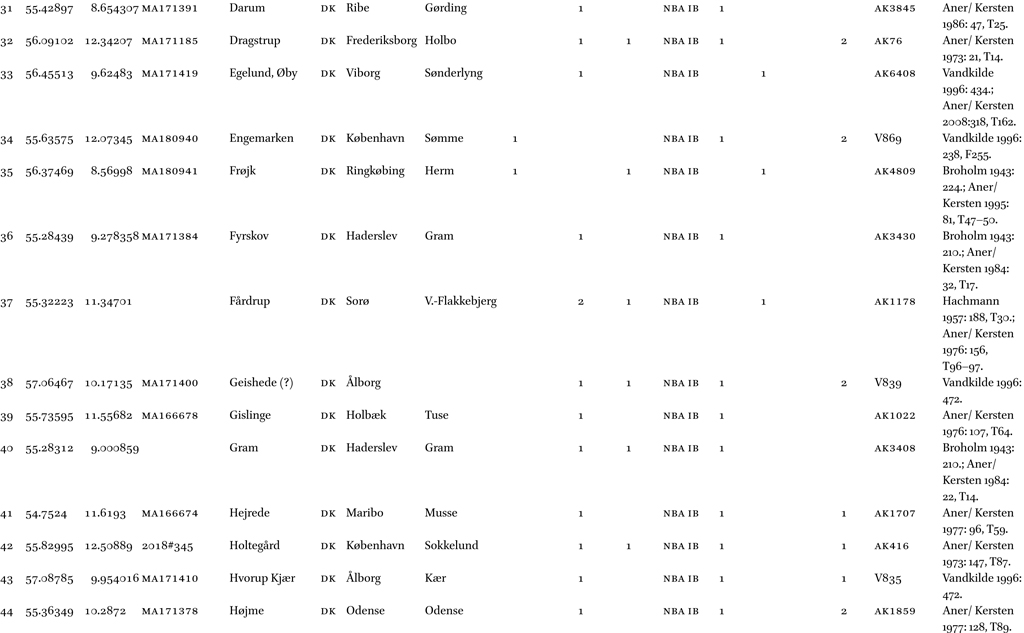
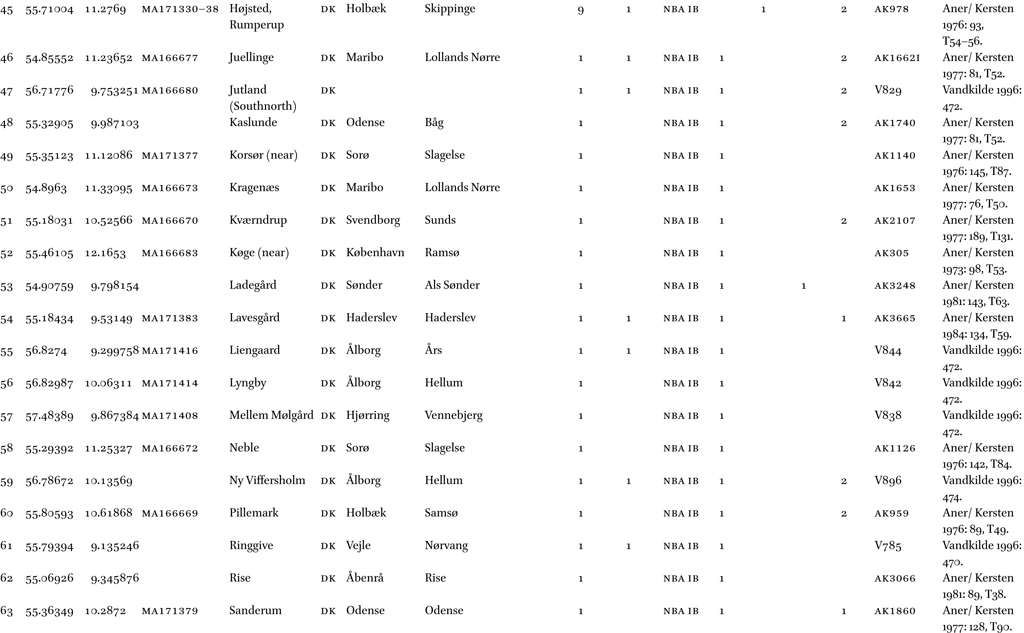
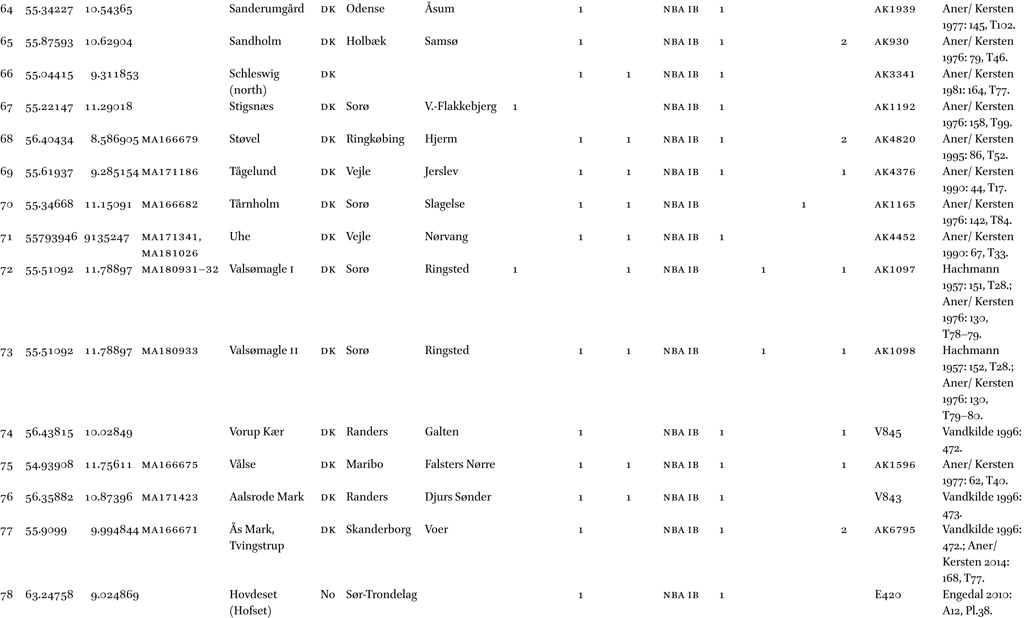
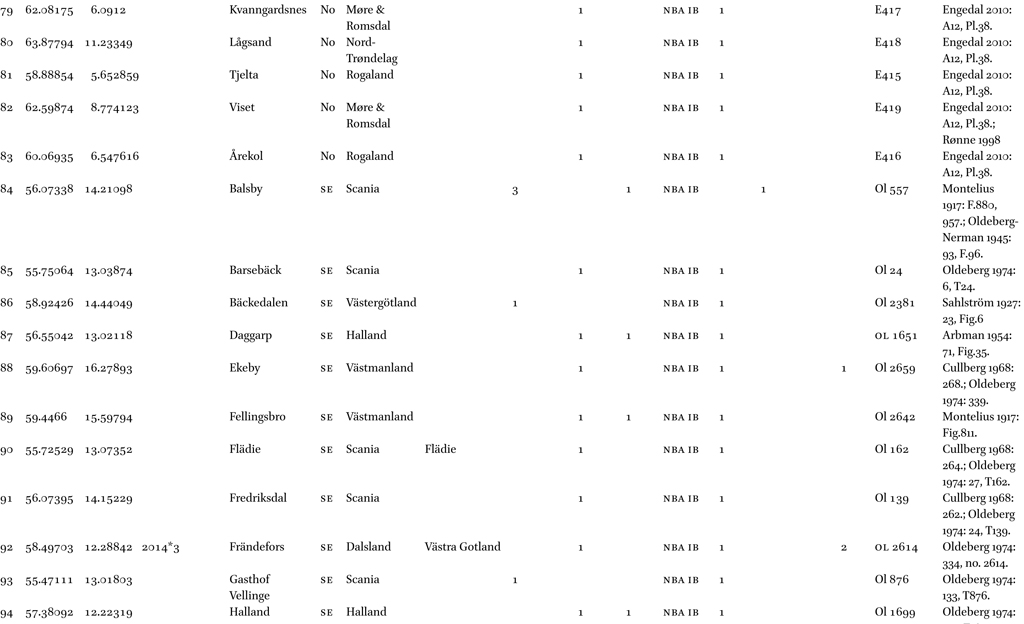
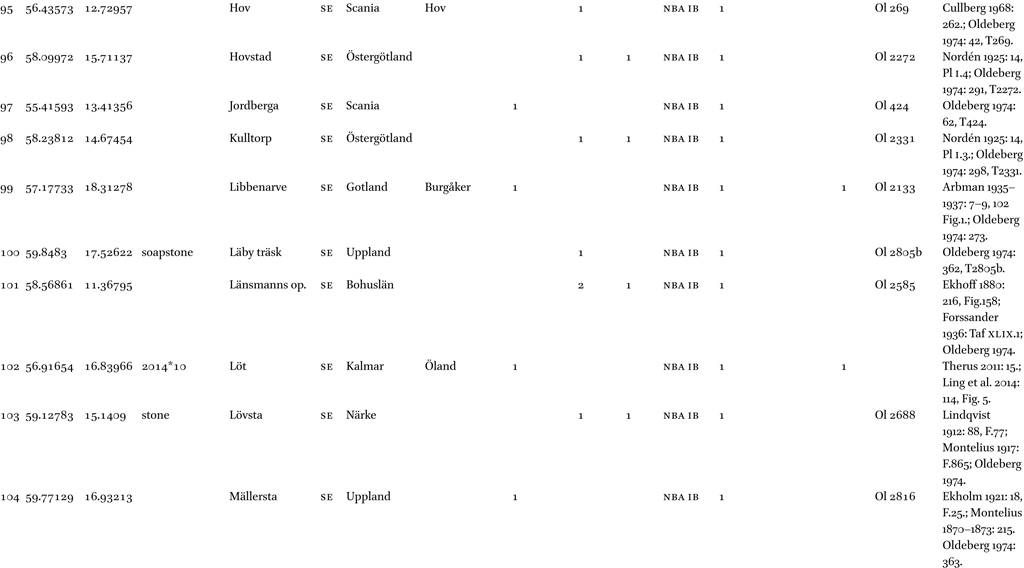
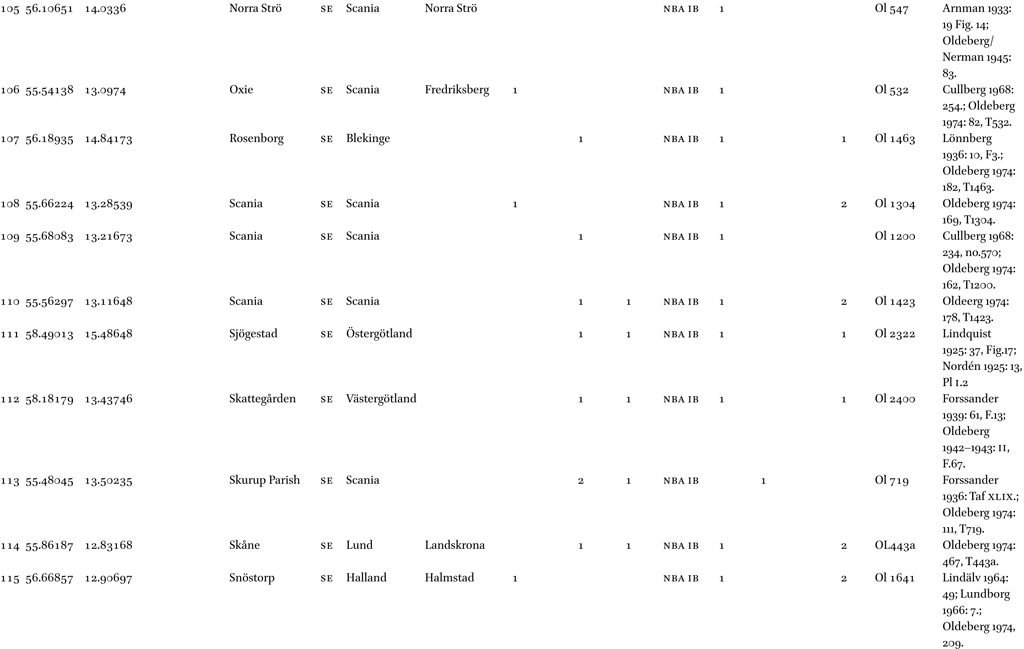
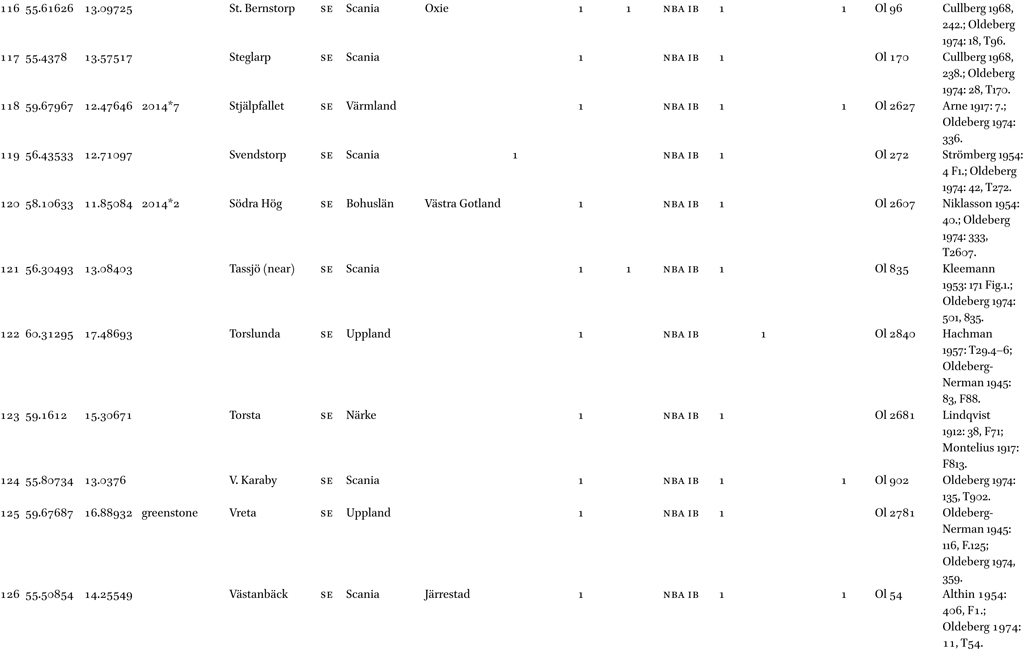
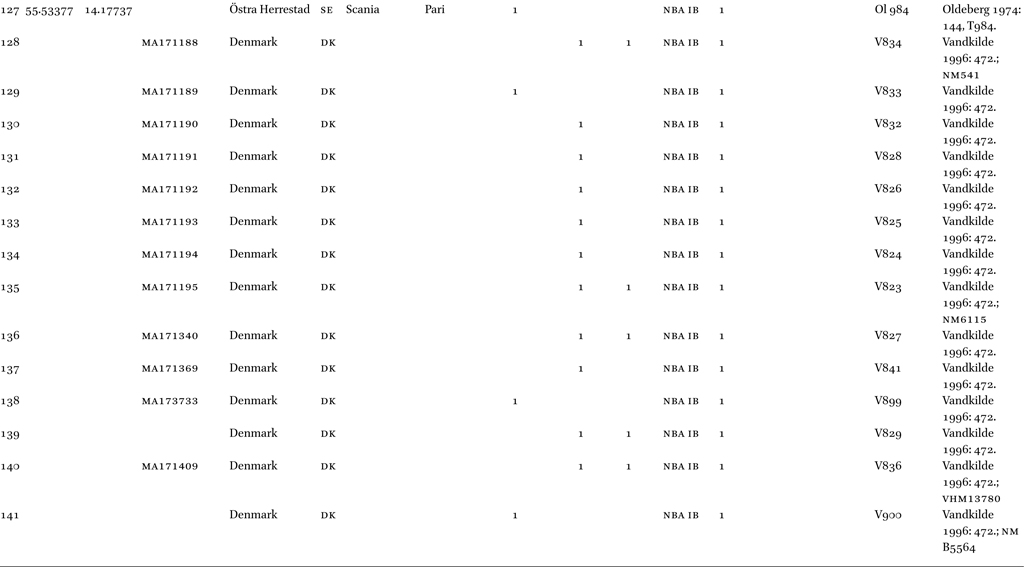
List of shafthole axes found in Northern Europe, including the references to context information, decoration and the investigations executed to date. For artefacts on which chemical and isotopic analyses have been conducted in recent years, the analysis ID number is given.
Citation: Acta Archaeologica 92, 2 (2021) ; 10.1163/16000390-20210036
Shafthole axes and their depositional environments by region and type.
Citation: Acta Archaeologica 92, 2 (2021) ; 10.1163/16000390-20210036
EDXRF measurements of melt globules and flattened melt globules. For the investigation of NBA bronze artefacts from southern Scandinavia, several samples were available only in the form of melt globules, and the samples were subjected to a manual pre-treatment to ensure the most accurate measurements. The measurements are largely comparable, though subtle differences in the element composition brought about by the melting process exist.
Citation: Acta Archaeologica 92, 2 (2021) ; 10.1163/16000390-20210036
The trace element concentrations of 71 shafthole axes from Denmark and northern Germany
Citation: Acta Archaeologica 92, 2 (2021) ; 10.1163/16000390-20210036
Based on data from Nørgaard et al. 2021 and Krause 2003Lead isotope ratios of 71 shafthole axes from Denmark and northern Germany. The isotope ratios measured were 208Pb/206Pb, 207Pb206Pb, and 206Pb/204Pb. The ratios 208Pb/204Pb and 207Pb/204Pb were calculated from the other ratios.
Citation: Acta Archaeologica 92, 2 (2021) ; 10.1163/16000390-20210036
Four analyses are executed for this study (FG861492; FG861587; FG862186, and FG861199); the rest of the data is from Nørgaard et al. 2021.Bibliography
Addis, A. 2013. Late Bronze Age Metallurgy in the Italian Alps: Copper Smelting Slags and Mine Exploitation. Unpublished PhD thesis. Padova (Università degli Studi di Padova).
Addis, A., I. Angelini, P. Nimis & G. Artioli. 2016. Late Bronze Age Copper Smelting Slags from Luserna (Trentino, Italy): Interpretation of the Metallurgical Process. Archaeometry 58, 1. 96â114.
Althin, C.-A. 1954. The Chronology of the Stone Age Settlement of Scania, Sweden. Acta Archaeologica Ludensia 4, 1. Lund (Gleerup).
Aner, E. 1962. Die frühen Tüllenbeile des Nordischen Kreises. Acta Archaeologica 33, 165â217.
Aner, E. & K. Kersten. 1973. Frederiksborg und København Amt. Die Funde der älteren Bronzezeit des nordischen Kreises in Dänemark, Schleswig-Holstein und Niedersachsen. København/NeumuÌnster (Nationalmuseum/Wachholtz).
Aner, E. & K. Kersten. 1976. Holbæk, Sorø und Præstø Amter. Die Funde der älteren Bronzezeit des nordischen Kreises in Dänemark, Schleswig-Holstein und Niedersachsen. København/NeumuÌnster (Nationalmuseum/Wachholtz).
Aner, E. & K. Kersten. 1977. Bornholms, Maribo, Odense und Svendborg Amter. Die Funde der älteren Bronzezeit des nordischen Kreises in Dänemark, Schleswig-Holstein und Niedersachsen. København/NeumuÌnster (National- museum/Wachholtz).
Aner, E. & K. Kersten. 1978. Südschleswig-Ost. Die Funde der älteren Bronzezeit des nordischen Kreises in Dänemark, Schleswig-Holstein und Niedersachsen. København/ NeumuÌnster (Nationalmuseum/Wachholtz).
Aner, E. & K. Kersten. 1979. Südschleswig-West. Die Funde der älteren Bronzezeit des nordischen Kreises in Dänemark, Schleswig-Holstein und Niedersachsen. København/ NeumuÌnster (Nationalmuseum/Wachholtz).
Aner, E. & K. Kersten. 1981. Nordschleswig-Süd: Tønder, à benrÃ¥ und Sønderborg Amter. Die Funde der älteren Bronzezeit des nordischen Kreises in Dänemark, Schleswig-Holstein und Niedersachsen. København/NeumuÌnster (National- museum/Wachholtz).
Aner, E. & K. Kersten. 1984. Nordschleswig-Nord: Haderslev Amt. Die Funde der älteren Bronzezeit des nordischen Kreises in Dänemark, Schleswig-Holstein und Niedersachsen. København/NeumuÌnster (Nationalmuseum/Wachholtz).
Aner, E. & K. Kersten. 1986. Ribe Amt. Die Funde der älteren Bronzezeit des nordischen Kreises in Dänemark, Schleswig- Holstein und Niedersachsen. København/NeumuÌnster (Nationalmuseum/Wachholtz).
Aner, E. & K. Kersten. 1990. Vejle Amt. Die Funde der älteren Bronzezeit des nordischen Kreises in Dänemark, Schleswig- Holstein und Niedersachsen. København/NeumuÌnster (Nationalmuseum/Wachholtz).
Aner, E. & K. Kersten. 1991. Dithmarschen. Die Funde der älteren Bronzezeit des nordischen Kreises in Dänemark, Schleswig-Holstein und Niedersachsen. København/ NeumuÌnster (Nationalmuseum/Wachholtz).
Aner, E. & K. Kersten. 1993. Kreis Steinburg. Die Funde der älteren Bronzezeit des nordischen Kreises in Dänemark, Schleswig-Holstein und Niedersachsen. København/ NeumuÌnster (Nationalmuseum/Wachholtz).
Aner, E. & K. Kersten. 1995. Ringkøbing Amt. Die Funde der älteren Bronzezeit des nordischen Kreises in Dänemark, Schleswig-Holstein und Niedersachsen. København/ NeumuÌnster (Nationalmuseum/Wachholtz).
Aner, E., K. Kersten & K.-H. Willroth. 2001. Thisted Amt. Die Funde der älteren Bronzezeit des nordischen Kreises in Dänemark, Schleswig-Holstein und Niedersachsen. København/NeumuÌnster (Nationalmuseum/Wachholtz).
Aner, E., K. Kersten & K.-H. Willroth. 2005. Kreis Rendsburg- Eckernförde (südlich des Nord-Ostsee-Kanals) und die kreisfreien Städte Kiel und Neumünster. Die Funde der älteren Bronzezeit des nordischen Kreises in Dänemark, Schleswig-Holstein und Niedersachsen. København/ NeumuÌnster (Nationalmuseum/Wachholtz).
Aner, E., K. Kersten & K.-H. Willroth. 2008. Viborg Amt. Die Funde der älteren Bronzezeit des nordischen Kreises in Dänemark, Schleswig-Holstein und Niedersachsen. København/NeumuÌnster (Nationalmuseum/Wachholtz).
Aner, E., K. Kersten & K.-H. Willroth. 2011. Kreis Segeberg. Die Funde der älteren Bronzezeit des nordischen Kreises in Dänemark, Schleswig-Holstein und Niedersachsen. Neumünster (Wachholtz).
Aner, E., K. Kersten & K.-H. Willroth. 2014. Skanderborg und Aarhus Amter. Die Funde der älteren Bronzezeit des nordischen Kreises in Dänemark, Schleswig-Holstein und Niedersachsen. Neumünster (Wachholtz).
Arbman, H. 1933. Zur Geschichte der Nortyckener Ãxte. Prähistorische Zeitschrift 24. 3â21.
Arbman, H. 1936. Människoframställning i vÃ¥r forntida konst. Ur Statents Historiska museums samlingar 4. Stockholm (WahlstroÌm & Widstrand).
Arne, T.J. 1917. Bidrag til Värmlands forhistoria. Fornvännen 12. 1â35.
Artioli, G., I. Angelini, P. Nimis & I.M. Villa. 2016. A lead-isotope database of copper ores from the Southeastern Alps: A tool for the investigation of prehistoric copper metallurgy. Journal of Archaeological Science 75. 27â39.
Artioli, G., I. Angelini, U. Tecchiati & A. Pedrotti. 2015. Eneolithic copper smelting slags in the Eastern Alps: Local patterns of metallurgical exploitation in the Copper Age. Journal for Archaeological Science 63. 78â83.
Bergerbrant, S. 2007. Bronze Age Identities: Costume, Conflict and Contact in Northern Europe 1600â1300 BC. Stockholm Studies in Archaeology. Lindome (Bricoleur Press).
Bergerbrant, S. & A. Wessman (eds.). 2017. New Perspectives on the Bronze Age. Proceedings from the 13th Nordic Bronze Age Symposium, held in Gothenburg 9th June to 13th June 2015. Oxford (Archaeopress).
Bray, P., A. Cuénod, C. Gosden, P. Hommel, R. Liu & A.M. Pollard. 2015: Form and flow: the âkarmic cycleâ of copper. Journal for Archaeological Science 56. 202â209.
Broholm, H.C. 1943. Danmarks Bronzealder: Samlede Fund fra den Ãldre Bronzealder. København (A. Busck).
Broholm, H.C. 1952. Danske Oldsager III. Ãldre Bronzealder. København (Nordisk forlag).
Bunnefeld, J.-H. 2016. Ãlterbronzezeitliche Vollgriffschwerter in Dänemark und Schleswig-Holstein. Studien zu Form, Verzierung, Technik und Funktion. Studien zur nordeuropäischen Bronzezeit 3. Kiel (Wachholtz).
Burgess, C. & P.K. Schmidt. 1981. The Axes of Scotland and Northern England. Prähistorische Bronzefunde IX, 7. München (Beckâsche Verlagsbuchhandlung).
Cattin, F., B. Guénette-Beck, P. Curdy, N. Meisser, S. Ansermet, B. Hofmann, R. Kündig, V. Hubert, M. Wörle, K. Hametner, D. Günther, A. Wichser, A. Ulrich, I.M. Villa & M. Besse. 2011. Provenance of Early Bronze Age metal artefacts in Western Switzerland using elemental and lead isotopic compositions and their possible relation with copper minerals of the nearby Valais. Journal of Archaeological Science 38. 1221â1233.
Cattin, F., I.M. Villa & M. Besse. 2007. The Swiss Alps as a Copper Supply for the Early Bronze Age Metallurgy? A Lead Isotope Analysis. Archaeometallurgy in Europe: 2nd international conference, Aquileia, Italy, 17â21 June 2007. Milano (Published by Associazione italiana di metallurgia). 1â12.
Clark, P. (ed.). 2009. Bronze Age Connections: Cultural Contact in Prehistoric Europe. Oxford (Oxbow Books).
Crew, P. & S. Crew (eds.). 1990. Early Mining in the British Isles. Blaenau, Festiniog (SNPSC).
Cullberg, C. 1968. On Artifact Analysis. A Study in the Systematics and Classification of a Scandinavian Early Bronze Age Material with Metal Analysis and Chronology as Constituting Factors. Acta archaeologica Lundensia 4, 7. Bonn/Lund (Rudolf Habelt/C.W.K. Gleerup).
David, W. 2002. Studien zu Ornamentik und Datierung der bronzezeitlichen Depotfundgruppe Hajdúsámson-Apa- Ighiel-Zajta. Alba Julia (ALTIP).
Duberow, E., E. Pernicka & A. Krenn-Leeb. 2009. Eastern Alps or Western Carpathians: Early Bronze Age Metal within the Wieselburg Culture. Kienlin & Roberts 2009. 336â349.
Dunstan, L.P., J.W. Gramlich, I.L. Barnes & W.C. Purdy. 1980. The absolute isotopic abundance and the atomic weight of a reference sample of thallium. Journal of Research of the National Bureau of Standards 85. 1â10.
Eckhoff, E. & O. Montelius. 1880. Bohuslänska fornsaker från hednatiden. Tredje häftet. Stockholm (Norstedt).
Ekholm, G. 1921. Studier i Upplands bebyggelseshistoria II, Bronsalder. Uppsala (Akademiska Bokhandeln).
Engedal, Ã. 2010. The Bronze Age of Northwestern Scandinavia. Unpublished PhD thesis. University of Bergen.
Fletcher, C.J.N., I.G. Swainbank & T.B. Colman. 1993. Metallogenic evolution in Wales: constraints from lead isotope modelling. Journal of the Geological Society 150, 1. 77â82.
Fokkens, H. & A.F. Harding (eds.). 2013. Oxford Handbook of the European Bronze Age. Oxford (Oxford University Press).
Frei, K.M., S. Bergerbrant, K.-G. Sjögren, M.L. Jørkov, N. Lynnerup, L. Harvig, M.E. Allentoft, M. Sikora, T.D. Price, R. Frei, K. Kristiansen. 2019. Mapping human mobility during the third and second millennia BC in present-day Denmark. PLoS One 14, 8. e0219850.
Forssander, J. 1936. Der ostskandinavische Norden während der ältesten Metallzeit Europas. Skrifter Utgivna av kungl. Humanistiska Vetenskabssamfundet Lund. Lund (C.W.K. Gleerup).
Gale, D. 1990. Prehistoric stone mining tools from Alderley Edge. Crew & Crew 1990. 47â48.
Hachmann, R. 1957. Die frühe Bronzezeit im westlichen Ostseegebiet und ihre mittel- und südosteuropäischen Beziehungen. Chronologische Untersuchungen. Hamburg (Flemmings).
Hallin, J. (ed.). 1954. Stenungsund. Ur fyra socknars krönika. Göteborg (Rundqvist).
Harbison, P. 1969. The Axes of the Early Bronze Age in Ireland. Prähistorische Bronzefunde. München (C. H. Beck).
Höppner, B., M. Bartelheim, M. Huijsmans, R. Krauss, K. MartÃnek, E. Pernicka & R. Schwab. 2005. Prehistoric Copper Production in the Inn Valley (Austria), and the Earliest Copper in Central Europe. Archaeometry 47, 2. 293â315.
Junghans, S., H. Klein & E. Scheufele. 1954. Untersuchungen zur Kupfer- und Frühbronzezeit Süddeutschlands. Bericht der Römisch-Germanischen Kommission 34. 77â114.
Junghans, S., E. Sangmeister & M. Schröder. 1960. Metallanalysen kupferzeitlicher und frühbronzezeitlicher Bodenfunde aus Europa. Studien zu den Anfängen der Metallurgie 1, 1. Berlin (Gebr. Mann).
Junghans, S., E. Sangmeister & M. Schröder. 1968. Kupfer und Bronze in der frühen Metallzeit Europas. Die Metallgruppen beim Stand von 12000 Analysen. Studien zu den Anfängen der Metallurgie 2, 1â3. Berlin (Gebr. Mann).
Junghans, S., E. Sangmeister & M. Schröder. 1974. Kupfer und Bronze in der frühen Metallzeit Europas. Studien zu den Anfängen der Metallurgie 2, 4. Berlin (Gebr. Mann).
Keiling, H. 1980. Eine massive Bronzeaxt aus der älteren Bronzezeit von Gägelow, Kr. Wismar. Ausgrabungen und Funde 1980. 122â127.
Kersten, K. 1936. Zur älteren nordischen Bronzezeit. Neumünster (Wachholtz).
Kersten, K. 1958. Die Funde der älteren Bronzezeit in Pommern. Beiheft zum Atlas der Urgeschichte 7. Hamburg (Hamburgisches Museum fuÌr VoÌlkerkunde und Vorge- schichte).
Kersten, K., P. La Baume, H. Jankuhn, E. Dittmer & A. Rust. 1958. Vorgeschichte der nordfriesischen Inseln. Veröffentlichungen des Landesamtes für Vor- und Frühgeschichte in Schleswig. Die vor- und frühgeschichtlichen Denkmäler und Funde in Schleswig-Holstein Bd. 4: Die nordfriesischen Inseln Amrum, Föhr und Sylt (Kreis Südtondern). Neumünster (Wachholtz).
Kienlin, T.L. & B.W. Roberts (eds.). 2009. Metals and Societies. Studies in honour of Barbara S. Ottaway. Bonn (Rudolf Habelt).
Kleemann, O. 1953. Eine neue nordische Schaftlochaxt. Acta Archaeologica 24. 170-173.
Krause, R. 2003. Studien zur kupfer- und frühbronzezeitlichen Metallurgie zwischen Karpartenbecken und Ostsee. Rahden (Marie Leidorf).
Körlin, G., M. Prange, T. Stöllner & Ã. Yalçin. (eds.). 2016. From Bright Ores to Shiny Metals. Festschrift für Andreas Hauptmann. Bochum (Marie Leidorf).
Laux, F. 2000. Die Ãxte und Beile in Niedersachsen I (Flach-, Randleisten- und Absatzbeile). Prähistorische Bronzefunde IX, 23. Stuttgart (F. Steiner).
Lindälv, E. 1964. DepÃ¥tfynd i Varbergsbygden. Offerfynd och skattgömmor i Himle och Viske härader. Varbergs museums Ã¥rsbok 15. 35â74.
Lindqvist, S. 1912. FrÃ¥n Nerikes sten- och bronsÃ¥lder. Meddelanden frÃ¥n Föreningen Ãrebro läns museum 5. Ãrebro.
Ling, J., E. Hjärthner-Holdar, L. Grandin, K. Billström & P.-O. Persson. 2012. Moving metals or indigenous mining? Provenancing Scandinavian Bronze Age artefacts by lead isotopes and trace elements. Journal of Archaeological Science 40. 1â14.
Ling, J., Z. Stos-Gale, L. Grandin, K. Billström, E. Hjärthner- Holdar & P.-O. Persson. 2014. Moving metals II: provenancing Scandinavian Bronze Age artefacts by lead isotopes and elemental analyses. Journal of Archaeological Science 41. 106â132. https://doi.org/10.1016/j.jas.2013.07.018.
Ling, J., E. Hjärthner-Holdar, L. Grandin, Z. Stos-Gale, K. Kristiansen, A.L. Melheim, G. Artioli, I. Angelini, R. Krause & C. Canovaro. 2019. Moving metals IV: Swords, metal sources and trade networks in Bronze Age Europe. Journal of Archaeological Science: Reports 26. 1â34. https://doi.org/10.1016/j.jasrep.2019.05.002.
Lönneberg, E. 1936. Blekinge bronsÃ¥lder. Blekingeboken 14. 9â49.
Lomborg, E. 1960. Donauländische Kulturbeziehungen und die relativen Chronologie der frühen nordischen Bronzezeit. Acta Archaeologica 30. 51â146.
Lomborg, E. 1966. Valsømagle und die frühe nordische Spiralornamentik. Acta Archaeologica 36. 223â232.
Lundborg, L. 1966. De äldsta spÃ¥ren. Tengnäs 1966. 3â37.
Lutz, J. & E. Pernicka. 1996. Energy dispersive X-ray fluorescence analysis of ancient copper alloys: empirical values for precision and accuracy. Archaeometry 38, 2. 313â323.
Malmer, M.P. 1989. FÃ¥rdrup-yxornas metrologi och kronologi â ett preliminärt meddelande. Poulsen 1989. 19â28.
Melheim, L., L. Grandin, P.-O. Persson, K. Billström, Z. Stos-Gale, J. Ling, A. Williams, I. Angelini, C. Canovaro, E. Hjärthner-Holdar & K. Kristiansen. 2018. Moving metals III: Possible origins for copper in Bronze Age Denmark based on lead isotopes and geochemistry. Journal for Archaeological Science 96. 85â105.
Meller, H. & F. Bertemes (eds.). 2010. Der Griff nach den Sternen 1â2. Intern. Symposium Halle (Saale) 16.â21. Februar 2005. Halle (Landesmuseum fuÌr Vorgeschichte, Halle (Saale)).
Meller, H., F. Bertemes, H.-R. Bork & R. Risch (eds.). 2013. 1600 â Kultureller Umbruch im Schatten des Thera- Ausbruchs? 1600 â Cultural Change in the Shadow of the Thera-Eruption? 4th Archaeological Conference of Central Germany, 14â16 October 2011 in Halle (Saale). Halle (Saale) (Landesmuseum fuÌr Vorgeschichte, Halle (Saale)).
Modarressi-Teherani, D., J. Garner & M. Kvietok. 2016. Copper Production in the Slovak Ore Mountains â New Approaches. Körlin et al. 2016. 109â123.
Montelius, O. 1917. Minnen frÃ¥n vÃ¥r forntid. 1. StenÃ¥ldern och bronsÃ¥ldern. Stockholm (Norstedt & SoÌner).
Needham, S. 1983. The Early Bronze Age Axe-heads of Central and Southern England. Unpublished PhD thesis 1â3. Cardiff.
Niederschlag, E., E. Pernicka, T. Seifert & M. Bartelheim. 2003. The determination of lead isotope ratios by multiple collector ICP-MS: a case study of Early Bronze Age artifacts and their possible relation with ore deposits of the Erzgebirge. Archaeometry 45, 1. 61â100.
Niklasson, N. 1954. Fornminnen och forntidsbebyggelse. Hallin 1954. 1â60.
Nimis, P., P. Omenetto, I. Giunti, G. Artioli & I. Angelini. 2012. Lead isotope systematics in hydrothermal sulphide deposits from the central-eastern Southalpine (northern Italy). European Journal of Mineralogy 24, 1. 23â37.
Nordén, A. 1925. Ostergötlands bronsålder. Linköping (Henric Carlssons Bokhandels Förlag).
Nørgaard, H.W. 2017. Bronze Age metal workshops in Denmark between 1500â1300 BC: elite-controlled craft on Zealand. Bergerbrant & Wessman 2017. 127â142.
Nørgaard, H.W. 2018. Bronze Age Metalwork. Techniques and traditions in the Nordic Bronze Age 1500â1100 BC. Oxford (Archaeopress).
Nørgaard, H.W., E. Pernicka & H. Vandkilde. 2019a. On the trail of Scandinaviaâs early metallurgy: provenance, transfer and mixing. PLoS One 14, 7. e0219574.
Nørgaard, H.W., E. Pernicka & H. Vandkilde. 2019b. Correction: On the trail of Scandinaviaâs early metallurgy: Provenance, transfer and mixing. PLoS One 14, 12. e0227504.
Nørgaard, H.W., E. Pernicka & H. Vandkilde. 2021. Shifting Networks and Mixing Metals: Changing metal-trading routes to Scandinavia correlate with Neolithic and Bronze Age transformations PLoS One 16, 6. e0252376.
OâBrien, W. 2004. Ross Island. Mining, Metal and Society in Early Ireland. Bronze Age Studies 6. Galway (National University of Ireland).
OâBrien, W. 2013. Bronze Age Copper Mining in Europe. Fokkens & Harding 2013. 433â449.
OâBrien, W. 2015. Prehistoric Copper Mining in Europe 5500â 500 BC. Oxford (Oxford University Press).
Oeggl, K. & V. Schaffer (eds.). 2013. Cuprum Tyrolense â 5550 Jahre Bergbau und Kupferverhüttung in Tirol. Brixlegg (Edition Tirol).
Oldeberg, A. 1974. Die ältere Metallzeit in Schweden. Stockholm (Kungl. Vitterhets Historie och Antikvitets Akademien).
Oldeberg, A. & B. Nerman. 1945. BronsÃ¥lderen. Tiotusen Ã¥r i Sverige. Stockholm (Statens historiska museum). 94â122.
Olsen, J., K.M. Hornstrup, J. Heinemeier, P. Bennike & H. Thrane. 2011. Chronology of the Danish Bronze Age Based on C-14 Dating of Cremated Bone Remains. Radiocarbon 53. 261â275.
Pernicka, E. 1984. Instrumentelle Multi-Elementanalyse archäologischer Kupfer- und Bronzeartefakte: Ein Methodenvergleich. Jahrbuch des Römisch-Germanischen Zentralmuseums Mainz 31. 517â531.
Pernicka, E. 1990. Gewinnung und Verbreitung der Metalle in prähistorischer Zeit. Jahrbuch des Römisch-Germanischen Zentralmuseums Mainz 37. 21â129.
Pernicka, E. 1999. Trace Element Fingerprinting of Ancient Copper: A Guide to Technology or Provenance? Young et al. 1999. 163â171.
Pernicka, E.. 2010. Archäometallurgische Untersuchungen am und zum Hortfund von Nebra. Meller & Bertemes 2010. 719â734.
Pernicka, E., J. Lutz & T. Stöllner. 2016. Bronze Age Copper Produced at Mitterberg, Austria, and its Distribution. Archaeologia Austriaca 100. 19â55.
Poulsen, J. (ed.). 1989. Regionale forhold i Nordisk Bronzealder. 5. Nordiske Symposium for Bronzealderforskning på Sandbjerg Slot 1987. Aarhus (Jysk arkæologisk selskab).
PetroviÄ, P. & S. ÃurdekanoviÄ (eds.). 1995. Ancient mining and metallurgy in southeast Europe. Bor (Museum of Mining and Metallurgy).
Pollard, A.M., P. Bray, A. CueÌnod, P. Hommel, Y.-K. Hsu, R. Liu, L. Perucchetti, J. Pouncett & M. Saunders. 2018. Beyond provenance. New Approaches to Interpreting the Chemistry of Archaeological Copper Alloys. Studies in Archaeological Sciences 6. Leuven (Leuven University Press).
Poulsen, M.E. & L. Grundvad. 2019. Bronzeøkserne fra Bækbølling og det 16. Ã¥rhundrede f.Kr. i en sydjysk indlandsegn. By, marsk og geest 31. 5â19.
RadivojeviÄ, M., B.W. Roberts, E. Pernicka et al. 2018. The Provenance, Use and Circulation of Metals in the European Bronze Age: The State of Debate. Journal of Archaeological Research 27. 131â185.
Randsborg, K. & K. Christensen. 2006. Bronze Age Oak Coffin Graves. Archaeology and Dendro-Dating. Acta Archaeologica 77. 1â246.
Risch, R. & H. Meller. 2013. Wandel und Kontinuität in Europa und im Mittelmeerraum um 1600 v. Chr. Meller et al. 2013. 597â613.
Rohl, B. 1996. Lead isotope data from the Isotrace Laboratory, Oxford: Archaeometry database 2, galena from Britain and Ireland. Archaeometry 38, 1. 165â180.
Rohl, B. & S. Needham. 1998. The Circulation of Metal in the British Bronze Age: The application of Lead Isotope Analysis. Occasional paper 102. London (British Museum).
Schreiner, M. 2007. Erzlagerstätten im Hrontal, Slowakei. Genese und Prähistorische Nutzung. Forschungen zur Archäometrie und Altertumswissenschaft. Rahden (Marie Leidorf).
Schubart, H. 1972. Die Funde der älteren Bronzezeit in Mecklenburg. Neumünster (Wachholtz).
Schubert, M. & E. Pernicka. 2013. Die frühbronzezeitliche Kupferverarbeitung auf dem Buchberg im Unterinntal, Tirol. Oeggl & Schaffer 2013. 123â152.
Strömberg, M. 1954. Bronzezeitliche Wohnplätze in Schonen. Meddelanden frÃ¥n Lunds Universitets historiska Museeum 1954. 27â109.
Tengnäs, S. (ed.). 1966. Simlångsdalen. Breareds och Snöstorps socknar. Halmstad.
Therus, J. 2011. Deponeringar i en grund vÃ¥tmark. Arkeologisk utredning etapp 2, 2011. Löt 1:1>2, Norrby 2:3>2 och 2:3>6 Löt socken, Borgholms kommun, Ãland. Arkeologisk rapport 2011:6. Kalmar (Kalmar läns museum).
Timberlake, S. 2009. Copper mining and metal production at the beginning of the British Bronze Age. Clark 2009. 94â121.
Timberlake, S. 2017. New ideas on the exploitation of copper, tin, gold, and lead ores in Bronze Age Britain: The mining, smelting, and movement of metal. Materials and Manufacturing Processes 32, 7â8. 709â727.
Timberlake, S. & B. Craddock. 2013. Prehistoric metal mining in Britain: The study of cobble stone mining tools based on artefact study, ethnography and experimentation. Chungara: Revista de Antropologia Chilena 45, 1. 33â59.
Timberlake, S. & P. Marshall. 2014. The beginnings of metal production in Britain: a new light on the exploitation of ores and the dates of Bronze Age mines. Journal of the Historical Metallurgy Society 47, 1. 75â92.
Timberlake, S. & A. Prag. 2005. The Archaeology of Alderley Edge: Survey, Excavation, and Experiment in an Ancient Mining Landscape. Oxford (Archaeopress).
Vandkilde, H. 1996. From Stone to Bronze. The Metalwork of the late Neolithic and earliest Bronze Age in Denmark. Aarhus (Aarhus University Press).
Vandkilde, H. 2014. Breakthrough of the Nordic Bronze Age: Transcultural Warriorhood and a Carpathian Crossroad in the Sixteenth Century BC. European Journal of Archaeology 14. 602â633.
Vandkilde, H. 2017. The Metal Hoard from Pile in Scania, Sweden. Place, things, time, metals, and worlds around 2000 BC. The Swedish History Museum, Studies 29. Stockholm (Swedish History Museum).
Vandkilde, H., U. Rahbek & K.L. Rasmussen. 1996. Radiocarbon Dating and the Chronology of Bronze Age Southern Scandinavia. Randsborg 1996. 183â198.
Randsborg, K. (ed.). 1996. Absolute Chronology. Archaeological Europe 2500â500 BC. København (Munksgaard).
Weisgerber, G. & G. Goldenberg. 2004. Alpenkupfer â Rame delle Alpi. Der Anschnitt. Bochum (Bergbau).
Williams, R.A. 2014. Linking Bronze Age copper smelting slags from Pentrwyn on the Great Orme to ore and metal. Historical Metallurgy 47, 1. 93â110.
Williams, R.A. 2018. Characterising Bronze Age copper from the Great Orme mine in North Wales to determine and interpret its distribution. Unpublished PhD thesis. University of Liverpool.
Williams, R.A. & C. Le Carlier de Veslud. 2019. Boom and bust in Bronze Age Britain: major copper production from the Great Orme mine and European trade, c. 1600â1400 BC. Antiquity 93. 1178â1196.
Young, S.M., Pollard, A.M., Budd, P. & Ixer, R.A. (eds.). 1999. Metals in Antiquity. Oxford (BAR Publishing).
Žebrák, P. 1995. The traces of the primary mining of non-ferrous metals in Slovakia. PetroviÄ & ÃurdekanoviÄ 1995. 13â19.
Personal comment by Wolfang David, April 23, 2020.