Abstract
Though the topic of commercialization in the Qing dynasty cotton industry has been subject of much scholarship, little attention has been given to the improvements of finishing and dyeing in Jiangnan cottons over the course of this period. Using The Cloth Classic, a late eighteenth-/ early nineteenth-century cloth merchantsâ compendium, this paper investigates the material basis and technical processes producing the â72 kindsâ of cloth with particular focus on the expansion of the numbers of dye colors. It argues that three primary factors enabled this expansion: intensified use of certain dyestuffs and mordants; growing deployment of the âset dyeingâ technique; and dyeworks color specialization. All three factors would have contributed to economic growth and improved living standards for those who could afford dyed clothâs higher cost. However, in being enabled by the embodied expertise of the dyer and the middleman, and the organizational structure of the cotton finishing sector, rather than cost-cutting innovations or new materials, all three factors also reveal inherent restrictions to the Jiangnan cotton sectorâs competitiveness.
Introduction
In the 1879 edition of the local gazetteer of Chuansha, a county in Songjiang prefecture, the âLocal Productsâ section described the range of cotton fabrics produced: âthere are so many different kinds they are popularly referred to as the â72 kindsââ.1 These words are frequently quoted by historians, for they suggest extensive quality variations, which are argued to have derived from commercialization in the Qing cotton industry.2 But surprisingly little attention has been devoted to the variations themselves: What exactly were the material basis and technical causes enabling the â72 kindsâ of cottons?
The appearance of colored, fashionable cottons might seem akin to the Qing silk industryâs turn to cheaper silk products to meet the demands of merchant classes and other urbanites, and thus a question for material culture history, but art and textile historians have largely ignored its development, partly because so little cotton fabric survives compared to silk.3 Instead, questions around cotton textile consumption has been considered primarily by economic historians in the context of standard of living debates: for example, Kenneth Pomeranzâs claim, in his influential book, The Great Divergence, that âChinese textile consumption stacked up quite well against Europeâs in the mid to late eighteenth century,â4 was based on the per capita quantity of fiber (produced and consumed) per person in Jiangnan, the wealthiest part of China. However, basing the comparison of Chinese and European textile consumption upon fiber quantities, rather than cloth qualities, leaves important issues outstanding: most critically for the question of the â72 kinds,â it omits the contribution of the finishing sector, a key contributor to the growth of global textile markets from the sixteenth century onwards.5 In early modern England, it was the dyeing, calendaring, pressing, and packing stagesâwhich unlike weaving, were often sited in Londonâthat helped adapt products to the demands of overseas customers. These stages contributed substantial value (around 20â40%) to the woolen cloth made in regional centers and they were central to expanding product variety in textiles, something recent scholarship has underlined as being just as important to improving early modern living standards as classic Industrial Revolution innovations like the spinning jenny.6 The importance of product variety suggests parallels between Jiangnan and early Industrial Revolution Britain, yet little study has been undertaken into the expansion of volume and variety of cotton products in Qing China.
To what extent was the Qing cotton industry adding extra value to cotton cloths? The finishing sector has been claimed as key to allowing Jiangnan, the most developed cotton-producing region, to maintain its success in long- distance trade markets after other provinces developed their own weaving industry for basic cloths by the mid-Qing.7 And several textual sources suggest that cotton dyeing in the Qing period did indeed expand. In a section entitled âChanges in dye colors,â one 1631 gazetteer text from Songjiang, the center of Jiangnanâs cotton industry, identified more than twenty new colors.8 It followed discussion of new types of cotton cloth that were now available, suggesting that these shades became more accessible, an intriguing idea in relation to debates about both the extent of commercialization in the cotton industry and standards of living in mid-Qing China.
Though the spread of cotton, and its displacing and supplementing of earlier clothing fibers like hemp (
In this paper, I investigate the nature and causes of the development of cotton finishing, and its impact on consumption through the material insights offered in The Cloth Classic (
Gender and the Development of the Cotton Finishing Sector
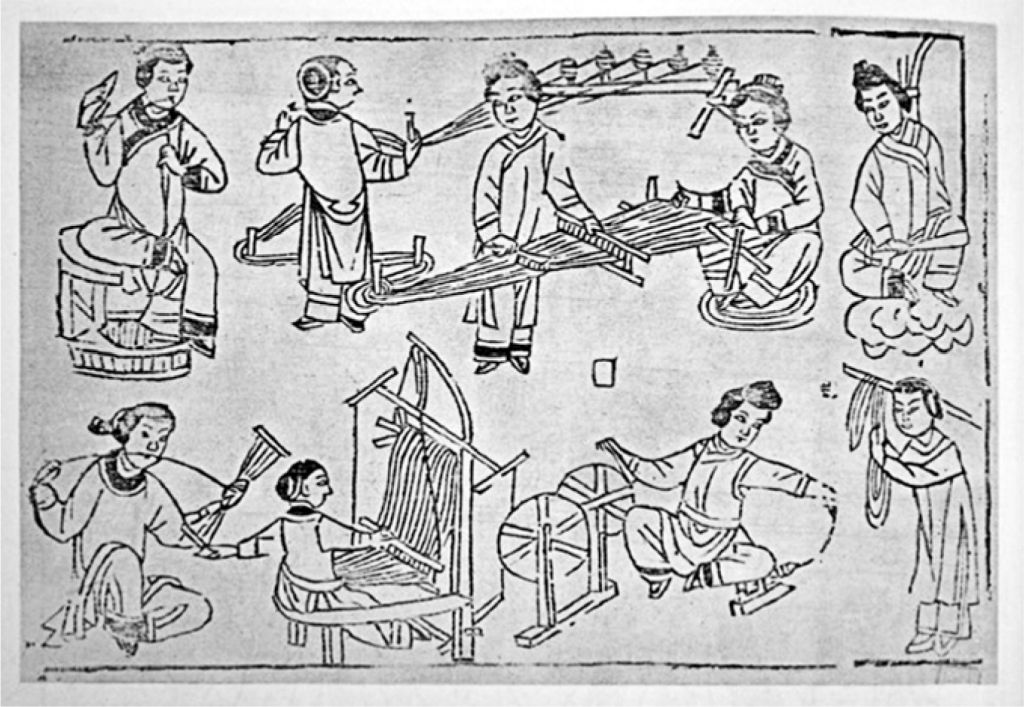
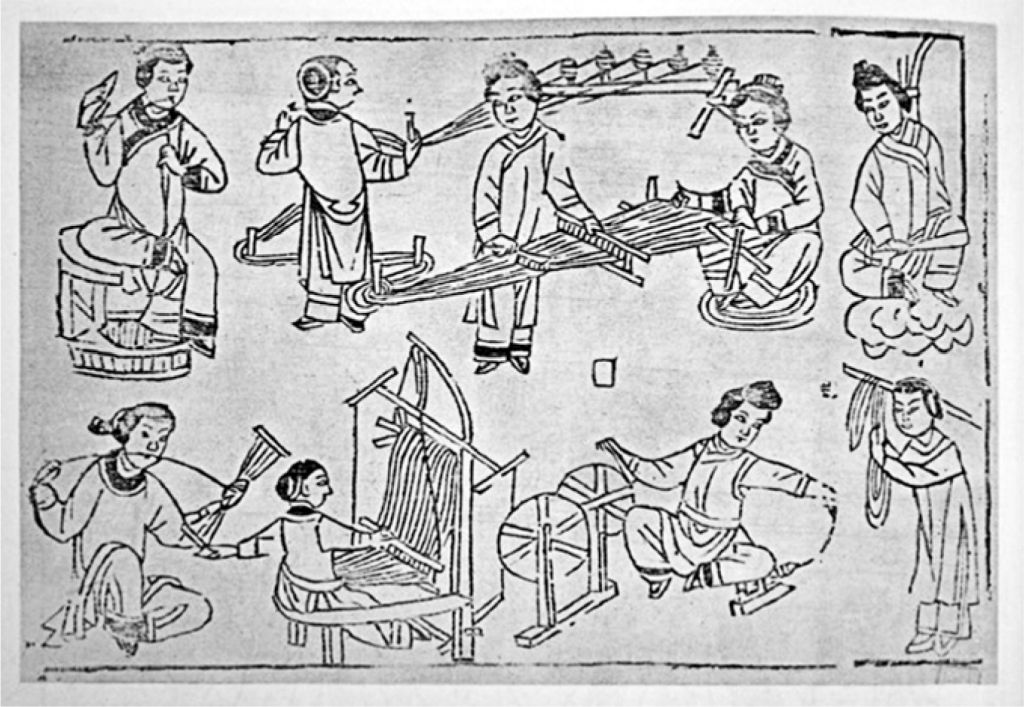
Though it is often used to speak for the entire Qing period, the Chuansha gazetteer text with which we began was actually written in 1876 and some of the cloth types it mentions are specific to a post-Treaty Port market, one in which aniline dyes and foreign machine-woven yarn had entered.20 However, much of the cotton sector remained unchanged from earlier in the Qing. Most steps of cotton production were still rural household activities and the vast majority of Jiangnanâs estimated 45 million bolts were woven by women and girls in villages and market towns and sold to brokers and middlemen. These tasks of ginning, bowing, spinning, sizing the warp, warping the loom, and weaving are visually represented in a woodblock print genre known as the âTen Tasks of Womenâ (Fig. 1).21 Perhaps produced for motivational or valorizing purposes, images like this highlight gender as a crucial determinant of labor and productivity in the cotton sector, something well demonstrated in the Chuansha text:22
Regarding cloth made from cotton: that which is densely woven and narrow is called âsmall clothâ (
å°å¸ ), also known as âreed clothâ (æ£å¸ ), or âmiddle loom clothâ (ä¸æ©å¸ ). Cloth which is slightly wider is known as âlarge clothâ (å¤§å¸ ), or âstandard clothâ (æ¨å¸ ). Cloth with a length of 16 chi is called âpingshaoâ (平梢 ), that of 20 chi is called âset pieceâ (å¥å ).23 A kind of thin cloth (å¸å¸ ) that is slightly wider comes in two kinds: âsingle knotâ (å®æ£ ) and âdouble knotâ (éæ£ ). That which is woven from purple flower (cotton) is called âpurple flower clothâ (ç´«è±å¸ ), those woven from blue and white yarn are called âsnowy inside blue clothâ (éªè£ éå¸ ), âwillow branch clothâ (æ³æ¢å¸ ), âreed mat patterned clothâ (èå¸ç´å¸ ), âspiral patterned clothâ (æç´å¸ ), and âtwill patterned clothâ (æç´å¸ ). That woven from the warp and weft of many colors is called âbean patterned clothâ (è±åè±å¸ ).

âImages of Spinning and Weavingâ (Fangzhi tu 纺ç»å¾ ), Fengxiang county, Shaanxi å¤ç¿å¿ (é西 ), Qing dynasty, woodblock print, 23 à 31cm, after Wang Shucunçæ æ , Zhongguo minjian nianhua shi tulu, shang ä¸å½æ°é´å¹´ç»å² å¾å½ (A Catalogue of Chinese Folk Woodblock Prints) (Shanghai: Shanghai renmin meishu chubanshe, 1991), Vol. 1, p. 161, no. 160
Citation: Journal of the Economic and Social History of the Orient 69, 1-2 (2026) ; 10.1163/15685209-12341666
It is following this list that the â72 kindsâ line is used to summarize the range, though it is of course hyperbolic: only fourteen kinds are actually listed.24 But more interesting than the numerical exaggeration is the following qualification, stating: âAll of these kinds come from womenâs work.â And it continues by describing three more varieties of cotton cloth not made by women:
If made by dying and scraping with a knife to make a napped cloth like a (Tibetan) pulu (woolen fabric), it is known as âscraped nap clothâ (
å®çµ¨å¸ ). That which uses a great stone to press it is known as âcalendered clothâ (è¸å å¸ ). That which uses paper piled in layers like a printing block with the pattern on top and uses lime mortar to print the design is called âprinted clothâ (å°è±å¸ ), and it was originally called âmedicine spot clothâ (è¥æå¸ ). These three kinds are all made by the dyeworks and are transported to markets by merchants: they are not womenâs work.25
The textâs distinction between those cloths produced by women in the home and those produced by professional workshops revolves around the finishing toolsâknife, stone, blockâused in the only stage of cotton production neither done by women, nor done in the home. Instead, these steps took place in sometimes quite large-scale urban workshops, many located in Suzhou.
Finishing workshops for dyeing and calendering first began during the Ming dynasty (1368â1644) in the Songjiang area, especially Jijing
Exactly what scale is hard to pin down, and we lack reliable numbers for labor numbers which would allow us to extrapolate the output of the finishing shops relative to total cloth output.29 A Wanli period (1572â1620) memorial described Suzhou dyeworks as having more than several thousand dyers, but we do not know what proportion dyed cotton and what proportion silk.30 Workshops were likely fiber-specialized and cotton cloth was dyed in the cloth, rather than in the yarn. This differed from silk fabrics, whose dyers either worked with the âraw goodsâ (
The numbers of Suzhou calenderers also grew apace, totalling âno less than 10,000â according to a 1720 guild stele.32 Calendering (
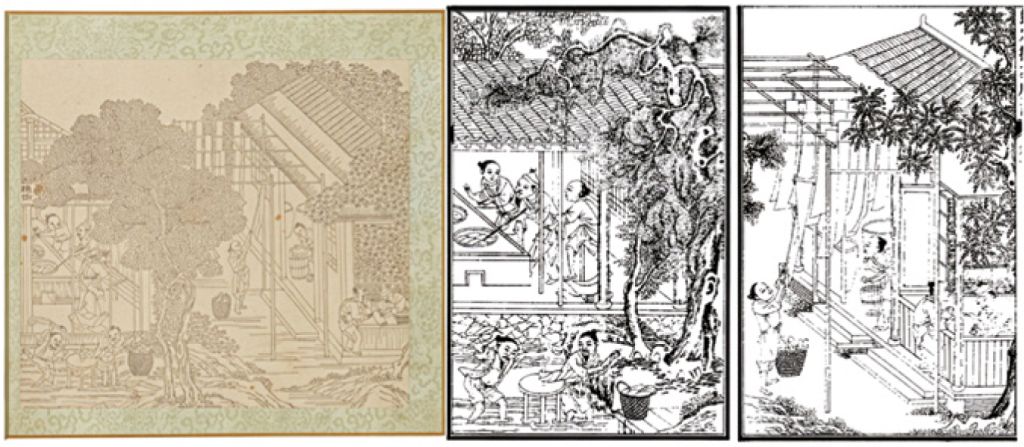
Originally the finishing shops combined dyeing and calendering, as visualized in an image of a dyework (
Qiu Ying ä»è± , âAlong the River at Shangmingâ (Qingming shanghe tu æ¸
æä¸æ²³å ), Detail showing Dyeshop (Ran fang æå ), after Shan Guolin åå½é ed., Zhang Zeduan, Qiu Ying âQing ming shang he tuâ shi huo jie du å¼µæ端, ä»è± â æ¸
æä¸æ²³å¾ â éæè§£è® (An Explanation and Interpretation of Zhang Zeduan and Qiu Yingâs Along the River at Shangming) (Beijing: Wenwu chubanshe, 2020), p. 7
Citation: Journal of the Economic and Social History of the Orient 69, 1-2 (2026) ; 10.1163/15685209-12341666
Fang Guancheng æ¹è§æ¿ , âAn Imperially Inscribed Illustrated Guide to Cottonâ (Yiti mianhua tu 御é¢æ£è±å ), woodblock print, ca. 1765, no. 16. âDyeing clothâ (Lianran ç·´æ )
Citation: Journal of the Economic and Social History of the Orient 69, 1-2 (2026) ; 10.1163/15685209-12341666
Anon, âThe Gods Mei and Geâ (Mei Ge xianweng æ¢
èä»ç¿ ), National Library of China ä¸å½å½å®¶å¾ä¹¦é¦ . http://catalog.digitalarchives.tw/item/00/12/50/d8.html (downloaded 2025/10/16)
Citation: Journal of the Economic and Social History of the Orient 69, 1-2 (2026) ; 10.1163/15685209-12341666
Types of Cotton Fabric
Though the Chuangsha gazetteer text is hyperbolic, there were certainly many kinds of cotton cloth, and sorting the multitude of names and types is challenging.43 One sympathizes with the seventeenth-century editor of the Songjiang Gazetteer who threw up his hands: âthe list is inexhaustible.â44 Still, the work of Nishijima Sadao and Fan Jinmin has enabled detailed analysis and, when read alongside other local gazetteer âlocal productsâ listings, it becomes apparent that the Chuansha textâs cloths were categorised by both kind and market.45
There were three basic criteria by which cotton fabrics were distinguished: dimension, quality, and patterning. Cotton cloth dimensions had initially been a matter of state control, but after the mid-Ming single-whip tax reforms, the cloth collected by the government was converted to silver and measurements stopped being a concern for tax purposes.46 However, as long-distance markets for cloth expanded, cloth dimensions began to be standardized in order to satisfy different marketing regionâs specifications. Thus, âstandard clothâ (also known as âlarge clothâ), a Jiangnan cloth that the early Qing Songjiang writer Ye Menghzu describes being sold to the north (Shanxi, Shaanxi, and Beijing) in considerable quantities, measured 20 chi in length, 1.2 chi in width, and weighed 18â20 liang.47
However, it is evident that there were many variations of dimension. This description, from a late Qing local gazetteer of Jiangsuâs Wujin and Yanghu counties, is typical:
âWide clothâ has a width of 1 chi, 8â9 cun, and it comes from the villages around Wujin. âShop clothâ has a width of 1 chi, 3 cun, and a length of 3 zhang, 6 chi; that called âWestern shopâ is fine, and it comes from the villages around Yanghu. âMenzhuangâ cloth has a width of 9 cun, and a lengthy of 2 zhang, 2 chi, it comes from the villages around north Wujin48
The diversity of dimensions suggests local markets serving smaller marketing radiuses. Consider Zhang Chunhuaâs distinction between different cloths in his Seasonal Folk Songs of Shanghai: âFine cloths are known as âpointedâ and have names like âDragon Glory pointâ and âSeven Treasures pointâ. âDragon Gloryâ is the name of my town. Seven Treasures is now under the jurisdiction of Qingpu.â But he noted, âThat cloth which travels far is known as âStandard clothâ: in Shaanxi and Shanxi provinces, branches have been set up in Yiguang to collect them, and they are called âsitting branchesâ.â49 Zhangâs identification of commercial cloth that âtravels farâ highlights the need to distinguish between different markets, something obscured by the â72 kindsâ nomer. Many cloth types did not get traded beyond local or provincial borders, hence the great number of localized names which did not achieve more widespread repute, and hence the lack of standardization: widespread circulation served to standardize dimensions. Liu Xiushengâs study of local products listings in local gazetteers showed that in the eight provinces where cotton weaving was common, 423 out of 529 counties produced cotton cloth (70.6%), and therefore were self-sufficient without need to import cloth from outside. Of those 423 counties, 332 (78.5%) produced âcommercial clothâ (
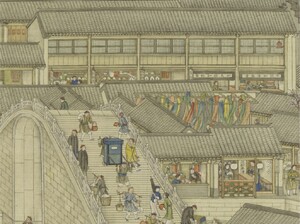
One of the best illustrations of which cotton fabrics did achieve national circulation are the signs found in the sixth Qianlong Southern Inspection Tour scroll, produced by Xu Yang (ca. 1712âafter 1779), between 1764 and 1768 (Fig. 5). The cotton shops use marketing language like âtrue-blueâ (
Xu Yang, âThe Qianlong Emperorâs Southern Inspection Tourâ (Qianlong Nanxun tu ä¹¾éåå·¡å ), Scroll Six: Entering Suzhou along the Grand Canal. dated 1770. Handscroll; ink and color on silk, 27 1/8 à 784 1/2 in. (68.8 à 1994 cm). Metropolitan Museum of Art, Purchase, The Dillon Fund Gift, 1988 (1988.350a-d). Detail showing âOur cloth store dyes cloth in true-blue, extra-long bolts of biaobu, koubu and suobu clothâ (æ¬èå æçéï¼å é·æ¨æ£æ¢å¸ï¼å¸è¡ )
Citation: Journal of the Economic and Social History of the Orient 69, 1-2 (2026) ; 10.1163/15685209-12341666
All three of these were higher-quality cloths, with quality determined by both weave and quality of yarn. The signs do not mention lower-quality cloths like âmiddle loomâ (
In general, cotton fabrics like âthree-shuttle clothâ (also known as âthree yarn clothâ
Cloth was also patterned by weaving with dyed yarn to create colored checks and stripes. The âsnowy inside blue clothâ (
Finally, printing (
Notably, though the Chuansha gazetteer text lists âprinted clothâ, along with âscraped nap clothâ and âcalendered clothâ as marketed by merchants, the Cloth Classic largely focuses on dyed cloth, rather than patterned cloth, perhaps because higher volume could be achieved there. The innumerable local names highlight the difference between local, national, and international markets. Naming was concerned with recognition: Jiangnanâs textile producers could only sell throughout China if they could achieve product repute. Some productsââstandard clothâ or nankeens did achieve this through reliable quality, consistent coloring, and standardized measurements. But the wide range of measurements points to the importance of understanding some of these styles in terms of local products produced for local markets. Of course, the absence of evidence is not evidence of absence, but it is suggestive, especially in contrast with silk fabrics where more sources reveal marketing of color, weave, or producer across long-distance marketing regions.60 For cotton, it is much harder to argue that those cloths that did achieve national or international circulation gained their reach through pattern or fashion. To understand why this should be, we turn to the merchant and their branding strategies.
The Zihao Merchant and the Finishing Workshops
The cotton industry featured various types of merchants, including âguest merchantsâ (
Zihao numbers seem to have peaked around the late Kangxi-Yongzheng period when 76 were recorded in 1697.71 But a later gazetteer of 1761 described the Zihao as follows:
Su cotton is famous throughout the land, those engaged in this business are based around Chang Gate on Upper and Lower Tang streets and they are called zihao: each (production stage) has a specialist: bleaching (
æ¼å¸ ), dyeing (æå¸ ), inspection (çå¸ ), and sales (å¸è¡ ). Often several tens of families depend upon a single zihao for their livelihoods, so only those with money can engage in this trade.72
This is an important passage, for it outlines the different production stages involved, though unfortunately not with much precision. The zihao financed the dyehouseâs capital requirements of cloth, dyestuffs, and workers by providing the cloth and paying a per-piece âwine feeâ, to be divided among the workers after the master dyer or boss had taken 20â30%. Late Qing Shanghai dyers interviewed by historian Du Li in the 1950s described how zihao representative calculated the processing fee in terms of dyestuff and labor per piece with the dyework. A middleman figure known as Baotou was responsible for preparing the equipment, tools, laborers, and location, providing firewood and rice, and controlling the laborers, mostly single men, who came into Suzhou from poorer regions in Northern Jiangsu or Anhui to sell their labor and had a reputation for unruliness.73 The Cloth Classic also attests to this system: it provides the information required to calculate processing fees and negotiate the dyeing contract (âGeneral Principles of the Dye Workshopâ
This last section provides a breakdown of the dyeing costs for âextra-long Beijing blue clothâ showing that dyeing this basic indigo cloth cost 0.08 taels per bolt, including labor, dyestuffs, and water.74 Though this information is helpful in indicating how much value dyeing added, it is of course a single observation and the changing price of cotton fabrics over the course of the Qing dynasty is a larger question beyond the remit of this paper.75 Evidently there were sizable differences depending on the cloth quality: one 1631 Songjiang gazetteer listed a cotton cloth tax quota for fine cloth at 0.61 taels per bolt and coarse cloth rate at 0.3 taels per bolt.76 However it is hard to find examples where one can compare the price of white and dyed cotton cloth at a specific time and place. Thus far, I have found only three examples: In late Qianlong (ca. 1790) Shandong, fish white cloth (
It might have been supposed that those cotton merchants who could invest in dyeworks and thus assert more control over these costs could create added value and so raise prices, an idea expressed concisely in The Cloth Classic: âOf all those hopeful of running a cotton brand business (zihao), only in the dyeshop can unlimited profit be extracted.â81 However the extent to which zihao directly invested in dyeworks is much debated. As one of the few places in the Qing textile industry where labor was concentrated in larger centralized production units, the finishing sector was of considerable interest to âSprouts of Capitalismâ historians who viewed the cloth-processing industry as the location of âembryonic capitalismâ. But there is little evidence of zihao merchants using capital to control raw materials or regulate the production pace: rather merchants made their profits outside the production process by circulating goods in markets.82
Even if the zihao did not directly manage dyeworks, their capital provisions still exerted control: for large orders, the dyeworks owner borrowed funds from the zihao to purchase the dyestuffs and pay the workers, to be repaid after the cloth finishing was completed.83 Unlike spinning and weaving tools (spinning wheels, spools, looms) which were simple, inexpensive, and widely accessible to weaving households; finishing equipment, which included dye vats, bamboo drying racks, stoves, and calendering sets, as well as space to dry the cloth, would have required some investment.84 Du Liâs interview with the wife of the owner of Wang Xiangxing Dyeing Workshop (
Regulatory steles also suggest that many zihao did not invest in finishing workshops. Of the 63 signed dyeing businesses who signed a 1720 stele, only 18 (29%) were operated by zihao cloth merchants.87 Instead it seems that most zihao preferred to subcontract work out to the cloth dyers and calenderers, rather than directly invest in their business. Xu Xinwuâs investigations found that by the late Qing, most of the large zihao had set up their own dyeworks and some certainly did earlier: Fan Jinmin gives the example of one Wanfu zihao (
Expanding the Color Options
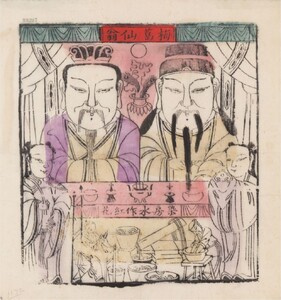
As visualized in Fig. 4, the dyersâ guild gods were Mei Fu and Ge Hong, both historical figures associated with alchemy who were also worshipped by the papermakers, medicine, and pharmacy guilds. The sectors shared the use of pigments and vats, and a reliance on unpredictable substances for which it was desirable to appeal to gods to control; and all grew, in part, due to increased understanding of materials and the expansion of dyestuff trade.91
These dyestuff materials were originally, and to some degree continued to be, rooted in local ecosystems. The âsand greenâ color mentioned in Suzhouâs shop signs was derived from the bark and leaves of a green wood produced in south Wujin and Yanghu.92 Similarly Li Douâs investigation of Jiangnan dyers in The Pleasure Boats of Yangzhou listed numerous examples of dyes that derived their name from producer place name or locally-grown dyestuffs: âHuaiâan redâ (
This is certainly the case for indigo. The huge amounts of indigo needed by Jiangnan dyers meant that local supply was insufficient, nor was it as good quality as that of Fujian. The Cloth Classic describes several different indigos, including Jianning
Baohuixuan zhuren, âChang Gate of Gusuâ (Gusu Changmen tu å§èé¶éå ), 1734, Woodblock print with hand colouring, Umi-Mori Art Museum, Hiroshima, Japan. Detail showing âSappanwood, Alum, Gallnut, and Yellow Cypress Shopâ (Sumu, Fan, Bei, Huangbo hang èæ¨ï¼ç¤¬ï¼å¹ï¼é»æè¡ )
Citation: Journal of the Economic and Social History of the Orient 69, 1-2 (2026) ; 10.1163/15685209-12341666
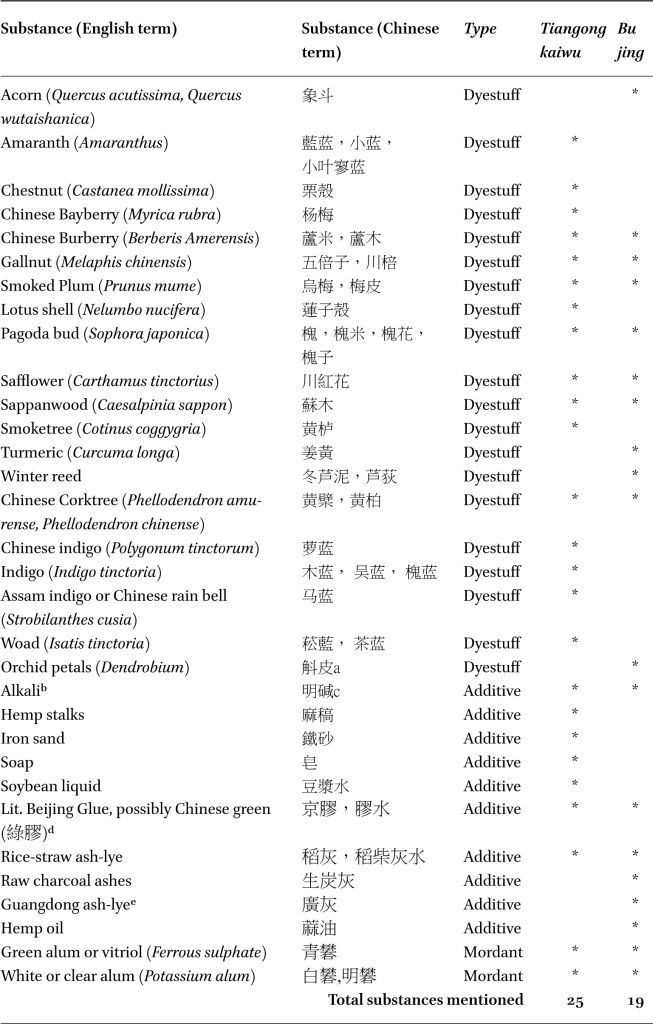
Recipe lists of Dyestuffs, Mordants, and Additives listed in the Bu Jing (ca.1780â1850)
Citation: Journal of the Economic and Social History of the Orient 69, 1-2 (2026) ; 10.1163/15685209-12341666
The intensified use of certain dyestuffs is interesting for considering to what extent the Qing textile sector was sourcing raw materials from outside China, for example through the Nanyang trade with Southeast Asia or the Canton trade with Europe. In fact, most of the six dominant dyestuffs highlighted in The Cloth Classic came from within China.98 The alum mordant, Ferrous sulphate (
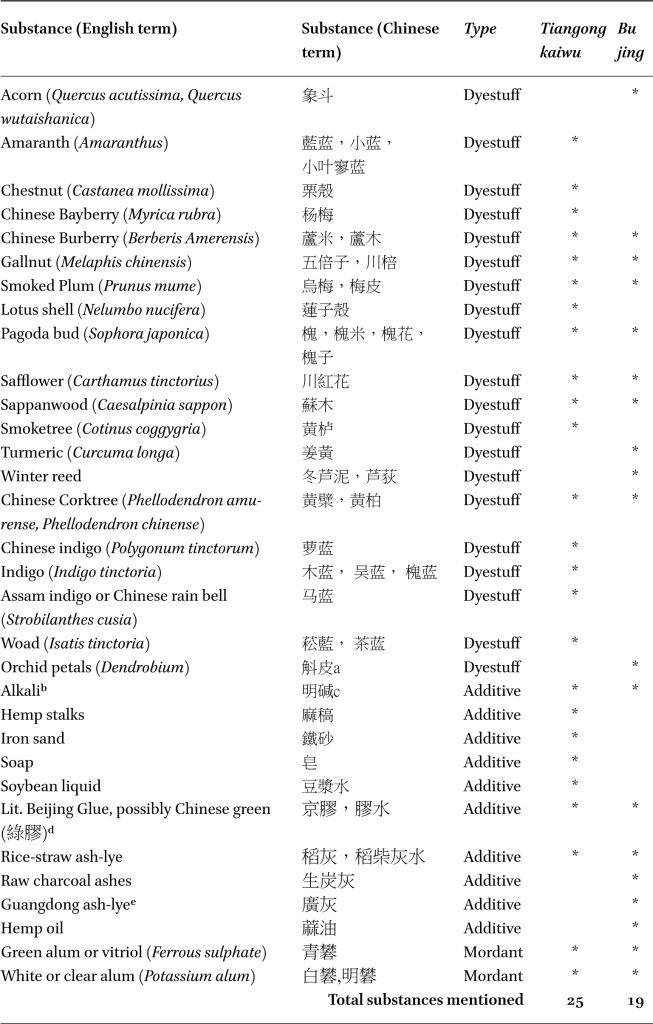
Moreover, though certainly some dyestuffs became obsolete, and others became more popular, in general, when one compares the dyestuffs, mordants, and additives listed in the earlier Exploitation of the Works of Nature of 1637 and late eighteenth-century The Cloth Classic (Table 2), the absence of new substances is quite striking.100 This comparison is not a perfect one. Exploitation covers both silk and cotton, whereas The Cloth Classic only contains recipes for cotton. Exploitation also includes several different kinds of indigo, whereas indigo is not listed as an ingredient in The Cloth Classicâs recipes, for reasons we shall see shortly. All the same, it is apparent that there is no dramatic expansion of the numbers of different types of dyestuffs in the later work. Instead, it seems that the greater number of colors in The Cloth Classic, 68 against 25 in the earlier work, is being achieved through an intensified use of the above dyestuffs, and most especially, an intensified use of mordants.
Dyestuffs, Mordants, and Additives listed in the Tiangong kaiwu (1637) and the Bu Jing (ca. 1780â1850)
Citation: Journal of the Economic and Social History of the Orient 69, 1-2 (2026) ; 10.1163/15685209-12341666
Sources: Anon, Bu jing (n.d.) Anhui Provincial Library ms; Song Yingxing, Tiangong kaiwu, juan shang, zhang shi, part 7, âzhuse zhiliaoâ; Jing Han and Anita Quye, âDyes and Dyeing in the Ming and Qing Dynastiesâ; Zhao Feng, âTiangong kaiwu Zhangshi pianzhong de ranliao he ranseâ; Ernest Watson, The Principal Articles of Chinese Commerce; online writings of Huang SonghuaAlum mordants were used to fix the dye to the fiber to form an insoluble colored compound, and they were vital for cotton dyeing.101 In addition to mordanting, alums were used together with sappanwood and pagoda bud to brighten the color; or with tannin dyes like gallnut, lotus-seed shell, and chestnut bud to darken.102 The Cloth Classic used both âwhite or clear alumâ (
Aside from dyeing, alum had numerous industrial uses in this period: it was used in clarifying water, as an astringent, as an emetic, to make baking powders, and to size and whiten paper. Found in many provinces, it became a substantial trade good in the Country tradeâa âproto-industrial raw materialâ shipped from Canton to Indian port cities near textile centers.104 Its low price made for good profit margins, at least earlier on, and its weight made it good ballast. But by the late eighteenth century, higher purchase prices in China and lower sales prices in India led to squeezed profit margins. Theoretically this would have led to higher prices for the Jiangnan dyers too, though one account commented that âthe supply is literally inexhaustibleâ and it remains unclear how far Canton prices impacted Jiangnan markets.105
So while the dyestuff trade is an important factor in explaining the expansion of colors, there is no dramatic increase in new dyes, especially not when compared to the far more impactful influx of new dyestuffs like cochineal or indigo within the European dye industry. Neither cochineal nor Prussian blue are mentioned in these recipes, though by this point the European traders had been attempting to sell both for some time in Canton. A superficial reading would see this as indicating resistance to new products, which after all required learning new techniques, and perhaps this was a factor. However, evidence elsewhere shows that Chinese manufacturers were quick to copy viable trade products, for example in the late 1820s, a Canton manufacturer developed a substitute dye for Prussian blue (which was popular in painting), terminating European imports and following an import substitution dynamic seen elsewhere in the China trade.106 And a more likely explanation for the lack of adoption of foreign dyestuffs was the higher cost of imported dyestuffs like cochineal.107 But there is also a more interesting observation here: The Cloth Classic evidences expanded product variety, not through the European model of innovation which dominates early modern histories of consumption, in which new processes to achieve color variety are motivated by exposure to new products, but rather through using existing dyestuffs and mordants more intensively.
Indeed, the new colors were being created largely through the expanded use of the âset dyeingâ (
Equally important here however was the increasing specialization of the dyeworks.110 While both Qiu Ying and Xu Yang depict an array of colors (Fig. 2, Fig. 4) as a means of representing Suzhouâs flourishing dyeworks, several sources record workshops specializing in certain colors due to specific dyestuff requirements. Chu Hua divided the dyeworks into blue, red, bleaching, and miscellaneous.111 For example, the inset workshop scene of Figure 4 specifies it is a red workshop, like one described in a Shanghai bamboo ballad poem: âCrimson dyestuffs have specialist dyers, they are called the red workshops, and their colors make bright stuffs. (Whether) silk or cotton thread, yarn, and fabric, all will become as splendidly colored as the rosy clouds.â112 This color specialization on the part of dyeworks meant merchants could subcontract out different dyeing stages, especially to the indigo workshops.
As noted earlier, The Cloth Classic lists 68 dye recipes. Though the term is conventional amongst dye historians, ârecipeâ is something of a misnomer here: it is less a recipe and more a shopping list, for there are no instructions, nor, more importantly, is sequencing provided. Instead, the recipe simply lists the quantities of materials required. So for example, âbright greenâ (
This development of using indigo-dyed cloth as the basis for dyeing other colors is one of the key features distinguishing The Cloth Classic from earlier dyeing texts. Alongside the more intensive use of key dyestuffs and mordants and the expansion of set dyeing, it is the main factor enabling the new cotton colors. Indigo is unique among cotton dyestuffs in being a âsubstantive colorâ, able to permanently fix onto the cloth without a mordant and instead relying on multiple immersions in the dye vat to build up layers. Indigo workshops (
The reliance on indigo explains The Cloth Classicâs careful attention to differences between different indigo, as well as the âcloth-examining friendâsâ skills in examining these shades of blue dyed cloth. It includes sections such as: âMethods for examining blue cloth,â âSecret words on examining green-blue and moon white (cloth).â As one section puts it: âThe dyed cloth (lit. the darkness/ lightness) of each cotton brand is not the same.â âEach is distinctive: whether (called) sun and moon, moon white, moon blue; whether called kingfisher blue, precious blue, pale kingfisher; or capital blue, capital kingfisher; or light treasure, light blue, buddha blue, capital blue; or duck blue and light blue. All these colors are different, and so the person examining the cloth must have their own appropriate method for examining each color.â116 The focus on the merchantâs skills in evaluating these different shades of blue reflects both their dominant position in clothing color and dyersâ use of them to create other colors.
This text corroborates Eyferthâs attention to âmercantile epistemologiesâ, which he defines as the development of a commercial discourse that deployed sensory analysis to establish quality measures.117 He quotes an example from the two-chapter Bu Jing Yaolan on how to assess dyed cloth: âBring along a true color sample to compare. The quality of the daylight is important; an overcast sky is best. White clouds in the sky make the cloth appear brighter; red clouds give it a reddish hue. Always rely on your sample.â118 Many such instructions can be found, often seeking to manage sensory bias in oneâs evaluations: âThe cloth-examining friend needs to adjust to the circumstances, and cannot maintain his own ideas, or listen intimately to other peopleâs words.â Only then could an objective basis for quality judgements be established; otherwise, âIf you only look partially at the color of cloth and insist on talking about it, how is it different from peeping at a leopard through a tube or looking at the sky from the bottom of a well?â119 In this pre-industrial age in which large trading networks were conducted on the basis of amassing hundreds of thousands of bolts produced in dispersed locations by disparate weavers, this discourse speaks to the importance of the cloth-examining friend in standardizing the inherently individual. Perhaps most significantly, in the absence of mercantile capital seeking to more closely control household production and in the absence of innovation at the household level, this middlemanâs skill facilitated the Qing cotton industryâs distinctive production structure in which all woven products could be matched to a suitable market outcome: liaising between product and demand to avoid waste.120
Conclusion
The Cloth Classic attests to the expansion of clothing colors that began in the early Qing, providing an important example of what improved living standards of the Qing period looked like to a non-elite consumer. It demonstrates three main factors enabled greater number of cotton colors: intensive use of key dyestuffs and mordants, the use of set dyeing, and the reliance on pre-dyed fabrics supplied by specialist dyers within the sector. All three represent improvements in the dye sector that potentially produced economic growth and improved living standards for those who could afford their higher costs, but equally, all three came from within the production system, effectively achieved by people doing more with what they had, rather than being stimulated by new products or techniques, and were thus akin to the intensified use of agricultural techniques that increased yield allowing per-capita consumption to be maintained despite increased population.
The Cloth Classicâs account of developing dye techniques in the Qing cotton sector is instructive in three main respects. First, it presents an alternative model of expanded product variety to the European model, in which new products are created through the encounter with global trade, stimulated by new manufacturing techniques, raw materials, or markets.121 Instead of technological innovation or centralized production, the creation of added value and manufacturing growth seen in The Cloth Classic was achieved largely on the basis of embodied expertise of the dyer and the âcloth-watching friendâ responsible for moving the cloth from household to workshop to market. Yet, as Bertucci shows so neatly in regard to the failed transfer of a silk reeler from Piedmont, Italy to Georgia, Colonial America, an individual artisanâs embodied skill was worthless without the legal and sociotechnical systems that validated it.122 These systemsâwhat Bertucci terms the âsocial fabricâ that grounded the artisanâs embodied expertiseâwere just as critical as craft skill in enabling the Jiangnan cotton sector to find ways to satisfy consumer demand for better, more colorful cloth. Indeed, this case study of cotton dyeing highlights the importance of organizational change and specialization in understanding how the textile industry developed over the Qing period. Both the separation of the dyers and the calenderers and the division of dyeworks into certain colors resulted from commercial complexification that increased the number of participants in the finishing sector, at both the higher processing levels of the Suzhou workshops and the lower-level indigo dye workshops, with the cloth-examining friendâs expertise mediating to find new possibilities for color.
Second, and relatedly, this model of creating product variety suggests future research avenues for resolving the conundrum implicit in the history covered in this paper: If, as shown Chinaâs cotton textile consumption complexified through the Qing period, how do we explain its backward position relative to global producers in the early nineteenth century?123 After all, theoretically, valued-added improvements would have allowed those producers who focused upon âstyles, colors and fashion trendsâ to earn greater profits than those who worked with middle-grade cloth.124 Yet this would suggest expanding market demand, which is not well-evidenced. Instead, Songjiang appears to undergo decline from the mid-Qing, even before the Opium Wars and the incursion of industrially produced cloth from Britain, America, and Russia.125 We know that much of this was due to shifts within the domestic cotton market, whereby Jiangnan lost its earlier markets for standard cloth as new provinces produced their own. To some degree Jiangnan could move up the chain to higher-end cloth, but when read with other evidence on pricing, The Cloth Classic suggests that markets for higher-value cloth were limited, and may well have become harder to reach by the late eighteenth century, when real buying power fell, and âprospects for profitable diversificationâ lessened.126 Jiangnanâs cotton finishing sector was circumscribed by these limitations, but it was also hampered by the lack of technical innovation that might have provided its producers the ability to compete on grounds other than its array of colors. In this respect, more work needs to be done to understand how far the socioeconomic and cultural systems of craft knowledge revealed in The Cloth Classic fostered gatekeepers who potentially obstructed the absorption of new knowledge that did not align with existing local paradigms.127
Nonetheless and finally, The Cloth Classic highlights the importance of material culture scholarship in reconstructing accounts of developments in craft technologies and their impact on the living standards of ordinary people. The material lives of non-elites are often overlooked in Chinese material culture history which remains particularly enthralled to art historical paradigms of elite and imperial consumption. But The Cloth Classic reminds us that material culture can be studied even in the absence of the historical object, and it calls for more attention to the many Qing mercantile texts which offer informative, materially attuned insights into little-known developments in consumption history. The new systems of coloring cotton cloth that emerged in the mid-Qing depended on the development of this commercial discourse, but so too does our ability to reconstruct a material culture regime whose objects often did not survive.
Acknowledgments
This paper began life as a presentation at the 2021 Colour of Clothes conference, and I thank the organizers, Giorgio Riello, Ulinka Rublack, and Maria Hayward; as well as BuYun Chen who generously shared sources. Material from the paper was also presented at the Association of Asian Studiesâ Annual Conference (2023), as well as invited talks at the British Museum conference on nineteenth-century China, Princeton University, and the University of Chicago. I would like to thank all these organizers, especially Dora Ching, Jacob Eyferth, Jessica Harrison-Hall, Sue Naquin, and Chenghua Wang. I also thank Lucille Chia, Kent Deng, Ken Pomeranz, Tom Rawski, and You Wang for their input on earlier drafts, and Dong Ye
Bibliography
(Chongzhen, 1631) Songjiang fu zhiæ¾æ±åºå¿ (Suzhou prefecture gazetteer)
(Chongzhen, 1631) Songjiang fuzhiæ¾æ±åºå¿
(Daoguang, 1824) Suzhou fuzhièå·åºå¿
(Guangxu, 1879) Chuansha ting zhiå·æ²å»³å¿ (Chuansha sub-prefecture gazetteer)
(Guangxu, 1879) Chuansha tingzhiå·æ²å»³å¿
(Guangxu, 1882) Jiading Xianzhiåå®ç¸£å¿
(Guangxu, 1879) Wujin Yanghu xianzhiæ¦è¿é³æ¹å¿å¿
(Jiaqing, 1813) Zhuli xiaozhiç éå°å¿å·
(Qianlong, 1746) Baoshan xianzhi寶山縣å¿
(Qianlong, 1753) Changzhou xian zhié·æ´²ç¸£å¿ (Changzhou district gazetteer)
(Qianlong, 1761) Chongxiu Yuanhe xian zhiéä¿®å å縣å¿
(Qianlong, 1751) Jinshan xianzhié山縣å¿
(Qianlong, 1752) Jinshan xianzhié山縣å¿
(Qianlong, 1788) Louxian zhiå¨å¿å¿
(Qianlong, 1791) Nanhui xian xin zhiåæ±å¿æ°å¿
(Qianlong, 1751) Nanhui Xianzhiåå¯å¿å¿
(Qianlong, 1745) Pinghu xianzhiå¹³æ¹å¿å¿
(Tongzhi, 1882) Suzhou fuzhièå·åºå¿
(Zhengde, 1512) Songjiang fuzhiæ¾æ±åºå¿
Allen, Robert C. et al. 2011. Wages, prices, and living standards in China, 1738â1925: in comparison with Europe, Japan, and India. The Economic History Review 64/1: 8â38.
Anon. 1997. Bu jing yaolan er juanå¸ç»è¦è§äºå· (The Essentials of the Cloth Classic in Two Chapters) (1755); Siku Quanshu: Siku weishou shujuan kan ååºæªæ¶ä¹¦è¾å. Beijing chubanshe. jino.10, ce no.12: 581â599.
Anon. ca. 1780â1850. Bu jing å¸ç» (The Cloth Classic). Anhui manuscript.
Bailey, Kate. 2012. A Note on Prussian Blue in Nineteenth-Century Canton. Studies in Conservation 57/2: 116â121.
Berg, Maxine. 2004. In Pursuit of Luxury: Global History and British Consumer Goods in the Eighteenth Century. Past & Present 182: 85â142.
Bertucci, Paola. 2021. Spinnersâ Hands, Imperial Minds: Migrant Labor, Embodied Expertise, and the Failed Transfer of Silk Technology across the Atlantic. Technology and Culture 62/4: 1003â1031.
Bowen, H. V., The East India Company: Trade and Domestic Financial Statistics, 1755â1838 dataset.
Chen BuYun. 2022. The Craft of Color and the Chemistry of Dyes: Textile Technology in the Ryukyu Kingdom, 1700â1900. Technology and Culture 63/1: 87â117.
Chen Xuwen éå¦æ. 1989. Zhongguo fengjian wanqi de shangpin jingji ä¸å½å°å»ºææçååç»æµ (Chinaâs late feudal commodity economy). Hunan: Hunan remin chubanshe.
Cheng Weiji, ed. 1992. History of Textile Technology of Ancient China. NY: Science Press.
Chi Zehui æ± æ¾¤å¯ et al. 1982. Beiping shi gongshangye gaikuang åå¹³å¸å·¥åä¸æ¦åµ (Overview of Commerce and Industry in Beiping). Beiping: Beiping shi shehuiju.
Chiu Pengsheng é±æ¾ç. 2012. âShiba shijiu Su-Song mianbuye de guanli jiagou yu falü wenhuaâ åå «ä¸çºªèæ¾æ£å¸ä¸ç管çæ¶æä¸æ³å¾æå (The management structure and legal culture of the Suzhou and Songjiang cotton cloth industry in the 18th century), Jianghai Xuekan 2: 143â157.
Chiu Pengsheng é±æ¾ç. 2002. âYou fang liao dao gongchang: Qingdai qianqi Suzhou mianbu zihao de jingji yu falu fenxiâ ç±æ¾æå°å·¥å; æ¸ ä»£åæèå·æ£å¸åå·çç»æµä¸æ³å¾åæ (From putting out to factory: an analysis of the legal and economic background of Suzhouâs cotton trademarks during the early Qing), Lishi yanjiu 75: 75â87.
Chu Hua è¤è¯. ca. 1810/2002. Mumian pu æ¨æ£è°± (Treatise on Cotton), in Xuxiu siku quanshu, vol. 977. Reprinted Shanghai: Shanghai guji chubanshe.
de Graaf, Judith J Hofenk. 1969. The Colourful Past: origins, chemistry and identification of natural dyestuffs. Amsterdam: Central Research Laboratory for Objects of Art and Science.
Deng, Kent, and Patrick OâBrien. 2015. Nutritional Standards of Living in England and the Yangtze Delta (Jiangnan), circa 1644âcirca 1840: Clarifying Data for Reciprocal Comparisons. Journal of World History 26/2: 233â267.
Dietrich, Craig. 1972. Cotton Culture and Manufacture in Early Châing China. In Economic Organisation in Chinese Society, ed. W. E. Wilmott. Stanford: Stanford University Press: 109â135.
Du Li æé». 1987. Guanyu Yapian zhanzheng qian SuSong diqu mianbu ranchuaiye de shengchan guanxi å ³äºç¨¿çæäºåèæ¾å°åºæ£å¸æçä¸ççäº§å ³ç³» (On the pre-Opium War period Su and Song regions cotton cloth dyeing industry production structures), Xueshu yuekan 12: 1â8.
Duan Benluo 段æ¬æ´ and Zhang Qifu å¼µå»ç¦. 1986. Suzhou shougongye shi èå·æå·¥æ¥å² (History of Suzhou Handicraft Industry). Nanjing: Jiangsu Guji Chubanshe.
Dunstan, Helen. 1998. Official Thinking on Environmental Issues and the Stateâs Environmental Roles in Eighteenth-Century China. In Sediments of Time: Environment and Society in Chinese History, ed. Mark Elvin and Liu Tsâui-jung. New York: Cambridge University Press: 585â614.
Elvin, Mark, 1972. The High Level Equilibrium Trap: The Causes of the Decline of Invention in the Traditional Chinese Textile Industries. In Economic Organization in Chinese Society, ed. W. E. Willmott. Stanford: Stanford University Press.
Eyferth, Jacob. 2016. Skilled Vision as a Management Technique: The Cloth Classic and its instructions for cloth buyers. Paper presented Workshop on Text and Labor in Asian Handwork, Chicago.
Fan Jinmin ç¯éæ° and Jin Wen éæ. 1993. Jiangnan sichou shi yanjiu æ±å絲綢å²ç 究. Beijing: Nongye Chubanshe.
Fan Jinmin èéæ°. 2002. Qingdai Jiangnan mianbu zihao tanxi æ¸ ä»£æ±åæ£å¸åå·æ¢æ (An investigation into the Qing dynasty Jiangnan cotton zihao), Lishi yanjiu åå²ç 究 1: 88â98.
Fan Jinmin èéæ°. 1998. Ming Qing Jiangnan shangye de fazhan ææ¸ æ±ååä¸ç åå± (The Development of Jiangnan Commerce during the Ming and Qing). Nanjing, Nanjing daxue chubanshe.
Fan Tong èé. 1751/1997. Bu jing ba juan å¸ç»å «å· (The Cloth Classic in Eight Chapters), in Siku Quanshu: Siku weishou shujuan kan ååºæªæ¶ä¹¦è¾å. Beijing chubanshe. ji no.3, ce no. 30: 82â110.
Fang Xing æ¹è¡. 1996. Qingdai Jiangnan nongmin de xiaofei æ¸ ä»£æ±åè¾²æ°çæ¶å¤¤ (Rural Consumption in Qing Dynasty Jiangnan). Zhongguo jingjishi yanjiu 3: 91â98.
Fang Xing æ¹è¡. 1987. Lun Qing dai qianqi mian fangzhi de shehui fengong è®ºæ¸ ä»£åææ£çººç»ç社ä¼åå·¥ (On the divison of labor in early Qing cotton spinning and weaving), Zhongguo jingji shi yanjiu 1: 79â94
Fang Xing et al. 2000. Cloth Processing in Suzhou and Songjiang. In Chinese Capitalism, 1522â1840, ed. Xu Dixin and Wu Chengming. London: Palgrave Macmillan UK: 213â227.
Fang Xing et al. 2000. The Growth of Commodity Circulation and the Rise of Merchant Organisations. In Chinese Capitalism, 1522â1840, ed. Xu Dixin and Wu Chengming. London: Palgrave Macmillan: 165â183.
Feuerwerker, Albert. 1970. Handicraft and Manufactured Cotton Textiles in China, 1871â1910. The Journal of Economic History 30/2: 338â278.
Forbes, Robert Bennet. 1844. Remarks on China and the China Trade. Boston: Samuel N. Dickinson.
Fu Yiling å è¡£å. 1957. Mingdai Jiangnan shimin jingji shitan æ代æ±åå¸æ°ç»æµè¯æ¢ (Exploratory essay on the urban economy of the Jiangnan area during the Ming dynasty). Shanghai Renmin Chubanshe.
Gu Gongxie é¡¾å ¬ç®. 1785/1916â21, Xiaoxia xiangqi zhaichao æ¶å¤é²è®°æé. Reprint Shanghai: Shangwu yinshu guan.
Gu Zhentao 顧é濤. 1843/1999. Wumen biaoyin å³éè¡¨é± (Little known facts about Suzhou). Reprint, Nanjing: Jiangsu Guji Chubanshe.
Hamilton, Gary, and Lai Chi-Kong. 1986. Jinshi Zhongguo shangbiao yu quanguo dushi shichang è¿è§ä¸å½åæ ä¸å ¨å½é½å¸å¸åº (Trademarks and the National Urban Market in Late Imperial China), Proceedings of the Conference on Regional Studies of Modern China. Taipei: Academica Sinica.
Hommel, Rudolf P. 1969. China at Work: An Illustrated Record of the Primitive Industries of Chinaâs Masses, Whose Life is Toil, and Thus an Account of Chinese Civilization. Boston: MIT Press.
Hsiung, C. D. and W. G. Sewell. 1939. General Survey of Dyehouses in Chengtu. Journal of the Society of Dyers and Colourists 55/8: 416â418.
Huang Jingbin é»æ¬æ. 2009. Minsheng yu jiaji: Qingchu zhi minguo shiqi Jiangnan jumin de xiaofei æ°çä¸å®¶è®¡: æ¸ åè³æ°å½æ¶ææ±åå± æ°çæ¶è´¹. Shanghai, Fudan daxue chubanshe.
Huang Miantang é»åå . 1990, Qingshi zhiyao æ¸ å²æ²»è¦ (Matters of Governance in Qing History). Jinan: Shandong Qilu Press.
Imperial Maritime Customs. 1865â1882. Reports on Trade at the Ports of Shanghai, Canton, Swatow, Amoy, Ningpo, Hankow, Kiukiang, Chefoo, and Newchawang for the year 1862. Shanghai: Imperial Maritime Customsâ Press.
Jiangsu sheng bowuguan ed. 1959. Jiangsu sheng Ming Qing yilai beike ziliao xuanji æ±èçææ¸ ä»¥ä¾ç¢å»è³æé¸é (A selection of Ming and Qing period stele inscriptions from the Ming and Qing period). Xinhua shudian.
Jing Han & Anita Quye. 2018. Dyes and Dyeing in the Ming and Qing Dynasties in China: Preliminary Evidence Based on Primary Sources of Documented Recipes. Textile History 49/1: 44â70.
Kang Chao. 1977. The Development of Cotton Textile Production in China. Boston: Harvard University Press.
Lemire, Beverly. 1992. Fashionâs Favorite: The Cotton Trade and the Consumer in Britain, 1660â1800. New York: Oxford University Press.
Li Bin ææ. 1991. Qing dai ranzhi zhuanzhu Bu jing kao æ¸ ä»£æç»ä¸èâå¸ç»âè (A Study of the Qing dynasty dyeing and weaving work, The Cloth Classic), Dongnan wenhua 1: 79â86.
Li Bozhong. 1998. Agricultural development in Jiangnan, 1620â1850. New York: St. Martinâs Press; London: Macmillan Press.
Li Bozhong. 2021. An Early Modern Economy in China. Cambridge: Cambridge University Press.
Li Dou æ鬥. 1793/1960. Yangzhou hua fang lu æå·ç«è«é (The Pleasure Boats of Yangzhou). Reprint, Beijing: Zhonghua Shuju.
Li Qiao æå¬. 1996. Zhongguo hangye shen ä¸åè¡æ¥ç¥ (Chinese Guild Gods). Taibei Xian zhonghe shi: Yunlong chubanshe.
Li Bozhong and Jan Luiten van Zanden. 2012. Beyond the Great Divergence? Comparing the Yangzi Delta and the Netherlands at the Beginning of the Nineteenth Century. The Journal of Economic History 72/4: 956â989.
Liu Xiusheng åç§ç. 1990. Qingdai mianbu shichang de bianqian yu Jiangnan mianbu shengchan de shuailuo æ¸ ä»£æ£å¸å¸åºçåè¿ä¸æ±åæ£å¸ç产çè¡°è½ (Changes in the Qing dynasty cotton fabric market and the decline of Jiangnan cotton), Zhongguo shehui jingjishi yanjiu 2.2: 54â61.
Liu Yongcheng åæ°¸æ. 1959. Shilun Qingdai Suzhou shougongye hanghui 試è«æ¸ 代 èå·æå·¥æ¥è¡æ (A Tentative Discussion on Qing period Suzhou Handicraft industry guilds), Lishi yanjiu 11: 21â46.
Lu Hanchao. 1992. Arrested Development: Cotton and Cotton Markets in Shanghai, 1350â1843. Modern China 18/4: 468â499.
Milburn, William. 1813. Oriental Commerce: Containing a Geographical Description of the Principal Places in the East Indies, China, and Japan, with Their Produce, Manufactures, and Trade. London: Black, Parry & Company.
Mitchell, David. 1995. âGood hot pressing is the life of all clothâ: dyeing, clothfinishing and related textile trades in London, 1650â1700. In Occupational Titles and their Classification: the Case of the Textile Trade in Past Times, ed. H. Diederiks and M. Balkestein. St Katharinen, Max-Planck-Institute für Geschichte: 153â175.
Phipps, Elena. 2013. Global Colors: Dyes and the Dye Trade from the Sixteenth to the Eighteenth Century. In The Interwoven Globe: Worldwide Textile Trade 1500â1800, ed. Amelia Peck. New York: Metropolitan Museum of Art: 28â45.
Pomeranz, Kenneth. 2005. Standards of Living in Eighteenth-Century China: Regional Differences, Temporal Trends, and Incomplete Evidence. In Living Standards in the Past: New Perspectives on Well-Being in Asia and Europe, ed. Robert C. Allen et al. Oxford: Oxford University Press: 23â54.
Pomeranz, Kenneth. 2005. Womenâs Work and the Economics of Respectability. In Gender in Motion, ed. Bryna Goodman and Wendy Larson. Lanham, MD, Rowman and Littlefield: 239â263.
Pomeranz, Kenneth. 2000. The Great Divergence: China, Europe, and the Making of the Modern World Economy. Princeton: Princeton University Press.
Qin Rongguang 秦è£å . 1989. Shanghai xian zhuzhici ä¸æµ·ç¸£ç«¹æè© (Shanghai County Bamboo ballads). Shanghai: Shanghai guji chubanshe.
Raman, Alka. 2025. Before Arsenic: Recovering a Forgotten Indian Technique of Painting with Indigo and its Implications for Knowledge Transfer. Technology and Culture 66/2: 509â534.
Riello, Giorgio. 2013. Cotton: The Fabric that made the Modern World. Cambridge: Cambridge University Press.
Sadao, Nishijima. 1984. The Formation of the Early Chinese Cotton Industry. In State and Society in China: Japanese Perspectives on Ming-Qing Social and Economic History, ed. Linda Grove and Christian Daniels. Tokyo: University of Tokyo Press.
Sewell, W. G. et al. 1939. The Natural Dyes of Szechuan, West China. Journal of the Society of Dyers and Colourists 55/8: 412â415.
Silberstein, Rachel. Threads of Commerce and Consumption: the Qing Foreign Trade in Silk, Cotton, Fur, and Wool, 1644â1860. In The Oxford Handbook of the China Trade. ed. Robert Gardella and Fred Grant. Oxford: Oxford University Press, forthcoming.
Silberstein, Rachel. 2026. The Material Lives of Ordinary People. National Museums Scotland website.
Silberstein, Rachel. 2020. A Fashionable Century: Textile Artistry and Commerce in the Late Qing. Washington: University of Washington Press.
So, Billy K. L. et al. 2005. Overseas Trade and Local Economy in Ming and Qing China: Cotton Textile Exports from the Jiangnan region. In Trade and Transfer across the East Asian âMediterraneanâ, ed. Angela Schottenhammer. Wiesbaden: Harrassowitz Verlag: 163â184.
Song Yingxing å®åºæ. 1637/1936. Tiangong kaiwu 天工å¼ç© (Exploitation of the Works of Nature). Reprinted Shanghai: Shijie shuju.
Souza, George Bryan. 2005. Convergence between Divergence: Global Maritime Economic History and Material Culture. International Journal of Maritime History XVII. 1: 17â27.
Souza, George Bryan. 2004. Country Trade and Chinese Alum: Country Trade and Chinese Alum: Raw Material Supply in Asiaâs Textile Production in the 17th and 18th Centuries. Revista da Cultura 11: 136â153.
Sun Yumiao åé¨è. 2023. âMing Qing shiqi de âGaoli buâ ææ¸ æ¶æç âé«ä¸½å¸,â Gudai wenming 4: 134â141.
Styles, John. 2000. Product Innovation in Early Modern London. Past & Present 168: 124â169.
Timkowski, George (Egor F Timovsky). 1827. Travels of the Russian Mission through Mongolia to China and residence in Peking in the years 1820â1821. London, Longman. 2 vols.
Tsang, Ka Bo. 2005. Touched by Indigo: Chinese Blue-and-White Textiles and Embroidery. Toronto: Royal Ontario Museum.
Wang Yehong çä¸å® et al. 2011. Qingdai zhiranju ranse fangfa ji secai æ¸ ä»£ç»æå±æè²æ¹æ³åè²å½© (Dyeing Methods and Colors in the Qing dynasty Weaving and Dyeing Bureau), Lishi dangâan 2: 125â127.
Wang Tingyu çå»·å . 1993. Lun Ming Qing shiqi Jiangnan mianzhi ye de laodong shouyi ji jingying xingtai 论ææ¸ æ¶ææ±åæ£ç»ä¸çå³å¨æ¶çåå ¶ç»è¥å½¢æ, Zhongguo jingji shi yanjiu 2: 91â98.
Watson, Ernest. 1930. The Principal Articles of Chinese Commerce (import and Export), with a Description of the Origin, Appearance, Characteristics, and General Properties of Each Commodity. Shanghai: Statistical Department of the Inspectionate General of Customs.
Wells Williams, Samuel. 1856. A Chinese Commercial Guide Consisting of a Collection of Details and Regulations Respecting Foreign Trade with China, Sailing Directions, Tables, &c. Office of the Chinese Repository.
Wood, William W. 1830. Sketches of China: with Illustrations from Original Drawings. Philadelphia: Carey & Lea.
Wu Chengming å´æ¿æ and Xu Xinwu 许æ»æ°. 1985. âSu Song mianbu jiagongye Zhong de ziben zhuyi mengyaâ èæ¾æ£å¸å å·¥ä¸ä¸çèµæ¬ä¸»ä¹èè½ (Sprouts of Capitalism in the Suzhoua dn Songjiang cotton processing industry). In Zhongguo ziben zhuyi de mengya ä¸å½èµæ¬ä¸»ä¹çèè½, ed. Wu Chengming å´æ¿æ and Xu Xinwu 许æ»æ°. Beijing: Renmin chubanshe.
Wu Chengming å´æ¿æ. 2002. Wu Chengming ji å´æ¿æé (Collected Papers of Wu Chengming). Beijing: Zhongguo shehui kexue chubanshe.
Wu Shusheng å´æ·ç and Tian Zicheng 天èªä¹. 2019. Zhongguo ranzhi shi ä¸å½æ ç»å². Shanghai: Shanghai renmin chubanshe.
Xu Ke å¾ç. 1917. Qing bai lei chao æ¸ ç¨é¡é (Categorized anthology of Petty Matters from the Qing period). Shanghai: Shangwu yinshuguan.
Xu Weinan å¾èå. 1936. Shanghai mianbu ä¸æµ·æ£å¸ (Shanghai cotton textiles). Shanghai: Shanghai Bowuguan congshu.
Xu Xinwu å¾æ°å¾. 1999. âMing Qing mianbu shangren ziben leixing fenxiâ ææ¸ æ£å¸å人èµæ¬ç±»ååæ, in Zhongguo jingji shiliao kaozheng yu yanjiu ä¸å½ç»æµå²æèè¯ä¸ç 究 (Textual study of and research into historical materials on the Chinese economy): Shanghai: Shanghai shehuikexueyuan chubanshe: 165â194.
Xu Xinwu å¾æ°å¾. 1981. Jiangnan tubu shi æ±ååå¸å² (A History of Jiangnan Homemade Cotton Cloth). Shanghai: Shanghai Classics Press.
Xu Xinwu å¾æ°å¾. 1981. Yapian zhanzheng qian Zhongguo mian fangzhi shougongye de shangpin shengchan yu ziben zhuyi mengya wenti é´çæäºåä¸å½æ£çººç»æå·¥ ä¸çååç产ä¸èµæ¬ä¸»ä¹èè½é®é¢ (The question of commercialization and sprouts of capitalism in the pre-Opium war period Chinese cotton handicraft industry). Nanjing: Jiangsu renmin chubanshe.
Xu Zhongyuan 许仲å . 1828/1996, Sanyi bitan ä¸å¼ç¬è° (Jottings about unusual things). In Biji xiaoshuo daguan. Chongqing chubanshe. ce 12.
Ye Mengzhu è夢æ±. 17th century / 1981. Yue shi bian é±ä¸ç·¨. Reprint, Shanghai: Shanghai guji chubanshe.
Yu Tongyuan ä½åå and Huang Kangjian é»åº·å¥. 2009. âMing Qing Jiangnan zhibu jishu de lilunhuaâ ææ¸ æ±åç»å¸ææ¯çç论å (The Rationalization of Weaving Technology in Jiangnan in the Ming and Qing Dynasties), Gugong xuekan 4: 560â575.
Zhang Chunhua å¼ æ¥å. 1936. Hucheng suishi quge 沪åå²äºè¡¢æ (Seasonal Folk Songs from Shanghai). Shanghai: Shanghai zhanggu congshu.
Zhang Lüping å¼ å±¥å¹³, comp., 1777. Kunde baojian å¤å¾·å¯¶é (Precious Mirror of Feminine Virtues). Yuxiutang é¹ä¿®å edition.
Zhang, Zhongmin. 1990. Shanghai: cong kaifa zouxiang kaifang, 1368â1842 ä¸æµ·ï¼ä»å¼åèµ°åå¼æ¾ (Shanghai from its Development to its Opening). Kunming.
Zhao Feng. 1981. Tiangong kaiwu Zhangshi pianzhong de ranliao he ranseã天工å¼ç©ãå½°æ½ç¯ä¸çææåæè² (Dyestuffs and Dye Colors in the Zhangshi section of Exploitation of the Works of Nature), Nongye kaogu è¾²æ¥èå¤ 1: 354â358.
Zhiwu Chen and Kaixiang Peng. 2022. Production, Consumption, and Living Standards. In The Cambridge Economic History of China, ed. Debin Ma and Richard von Glahn. Cambridge: Cambridge University Press. vol. II, Chap.18: 676â709.
Zuo Xuchu å·¦æå. 2003. Zhongguo jindai shangbiao jianshi ä¸å½è¿ä»£åæ ç®å² (A Short History of Chinese Branding). Shanghai: Xuelin chubanshe.
Zurndorfer, Harriet T. 2011. Cotton Textile Manufacture and Marketing in Late Imperial China and the âGreat Divergence.â Journal of the Economic and Social History of the Orient 54: 701â738.
(Guangxu) Chuansha ting zhi (1879), juan 4, âWuchanâ: 602. Some of this content is reproduced from H. Chu, Mumian pu, in Xuxiu siku quanshu, vol.977 (1810, Reprinted Shanghai: Shanghai guji chubanshe, 2002).
F. Xing et al, âCloth Processing in Suzhou and Songjiangâ. In Chinese Capitalism, 1522â1840, ed. X. Dixin and W. Chengming (London: Palgrave Macmillan UK, 2000): 215.
R. Silberstein, A Fashionable Century: Textile Artistry and Commerce in the Late Qing (Seattle: University of Washington Press, 2020).
K. Pomeranz, The Great Divergence: China, Europe, and the Making of the Modern World Economy (Princeton: Princeton University Press, 2000): 138â142; K. Pomeranz, âStandards of Living in Eighteenth-Century China: Regional Differences, Temporal Trends, and Incomplete Evidenceâ. In Living Standards in the Past: New Perspectives on Well-Being in Asia and Europe, ed. R. C. Allen et al (Oxford: Oxford University Press, 2005): 23â54, 37.
D. Mitchell, ââGood hot pressing is the life of all clothâ: dyeing, cloth-finishing and related textile trades in London, 1650â1700â. In Occupational Titles and their Classification: the Case of the Textile Trade in Past Times, ed. H. Diederiks and M. Balkestein (St Katharinen, Max-Planck-Institute für Geschichte, 1995): 153â175.
J. Styles, âProduct Innovation in Early Modern London.â Past & Present 168 (2000): 124â169; M. Berg, âIn pursuit of luxury: Global History and British Consumer Goods in the Eighteenth Century.â Past & Present 182 (2004): 85â142; B. Lemire, Fashionâs Favorite: The Cotton Trade and the Consumer in Britain, 1660â1800 (New York: Oxford University Press, 1992); G. Riello, Cotton: The Fabric that made the Modern World (Cambridge: Cambridge University Press, 2013).
L. Hanchao, âArrested development: cotton and cotton markets in Shanghai, 1350â1843,â Modern China 18.4 (1992): 468â99, 493; X. Xu, âYapian zhanzheng qian Zhongguo mian fangzhi shougongye de shangpin shengchan (Jiangsu renmin chubanshe, 1981): 99; T. Yu and K. Huang, âMing Qing Jiangnan zhibu jishu de lilunhuaâ, Gugong xuekan 4 (2008): 560â575, 563.
(Chongzhen) Songjiang fu zhi (1631): 7.186a.
K. Chao, The Development of Cotton Textile Production in China (Harvard University Press, 1977): Chap.1; W. Cheng, History of Textile Technology in Ancient China (New York: Science Press, 1992): 435, 437.
X. Xu, Jiangnan tubu zhi (Shanghai: Shanghai Classics Press, 1981): 193â4; B. Li, An Early Modern Economy in China (Cambridge University Press, 2021): 520â2; F. Xing, âQingdai Jiangnan nongmin de xiaofeiâ. Zhongguo jingjishi yanjiu 3 (1996): 91â8.
F. Xing et al, âCloth Processing in Suzhou and Songjiangâ: 174â5.
F. Xing, âGrowth of Commodity Circulationâ. In Chinese Capitalism, 1522â1840, ed. D. Xu and C. Wu (London: Palgrave Macmillan UK, 2000): 171â2.
Z. Chen and K. Peng, âProduction, Consumption, and Living Standards.â In The Cambridge Economic History of China, ed. D. Ma and R. von Glahn (Cambridge University Press, 2022), Vol. II, Chap.18: 676â709, 677, 707; J. Huang, Minsheng yu jiaji: Qingchu zhi minguo shiqi Jiangnan jumin de xiaofei (Shanghai, Fudan daxue chubanshe, 2009).
Anon, Bu jing (n.d.) Anhui Provincial Library ms.
The Anhui library manuscript version features the most detailed sections on cloth dyeing and is the version used here. The two other works are Fan Tong, Bajing bajuan (1751); Anon, Bu jing yaolan er juan (1755). For an overview of the different works, see Eyferth, âSkilled Vision as a Management Technique: The Cloth Classic and its instructions for cloth buyers,â paper presented Workshop on Text and Labor in Asian Handwork, Chicago (2016). B. Liâs short study (âQing dai ranzhi chuanzhu Bu jing kao: âQing dai ranzhi zhuanzhu Bu jing kaoâ. Dongnan wenhua 1 (1991): 79â86) dated the Anhui version to 1795â1850 period due to the frequent mentions of yarn spun using iron ingot spindles (
T. Yu and K. Huang, âMing Qing Jiangnan zhibu jishu de lilunhua.â Gugong xuekan 4 (2009): 560â575.
P. Chiu, â18 shiji Su-Song mianbuye de guanli jiagou yu falü wenhua.â Jianghai Xuekan 2 (2012): 143â57.
J. Eyferth, âSkilled Vision as a Management Techniqueâ.
The lack of affinity between the alkaline nature of plant fibers and acidic nature of most natural dyes inhibited the formation of permanent bonds. See J. Han and A. Quye, âDyes and Dyeing in the Ming and Qing Dynasties: Preliminary Evidence Based on Primary Sources of Documented Recipes,â Textile History 49.1 (2018): 44â70, 51; E. Phipps, âGlobal Colors: Dyes and the Dye Trade: from the Sixteenth to the Eighteenth Century.â In The Interwoven Globe: Worldwide Textile Trade 1500â1800, ed. A. Peck (New York: Metropolitan Museum of Art, 2013): 28â45, 132.
On post-Taiping markets, A. Feuerwerker, âHandicraft and Manufactured Cotton Textiles in China, 1871â1910.â The Journal of Economic History 30.2 (June 1970): 338â78.
Men did sometimes participate in cotton production, depending on how the household determined the best allocation of labor. See Y. Wang, âWomen Till and Women Weave: Rice, Cotton, and the Gendered Division of Labor in Jiangnan.â Late Imperial China 45.1 (2025): 1â40.
B. Li, Agricultural Development in Jiangnan: 1620â1850 (New York: St. Martinâs Press, 1998): 143â151; B. Li and J. Van Zuide, âBeyond the Great Divergence?: Comparing the Yangzi Delta and the Netherlands at the Beginning of the Nineteenth Century,â The Journal of Economic History 72.4 (2012): 956â989.
1 chi
It was common for the âwuchanâ or âtuchanâ section of a local gazetteer to list different kinds of locally produced cloth, but the Chuansha text contains an unusually large number of different kinds. The hyperbolic 72 thus conveys a genuine expansion in the late Qing period, that continues into the early 20th century. Similar lists are seen in (Republican) Wuxian zhi, juan 51 (1933) or Xu Weinanâs
(Guangxu) Chuansha tingzhi, p.602.
Y. Song, Tiangong kaiwu (Reprinted Shanghai: Shijie shuju, 1637/1936), juan shang: 42, âCloth clothingâ; G. Gu, Xiaoxia xiangqi zhaichao (1785, Reprint Shanghai: Shangwu yinshu guan, 1916â21), Zhong juan, âFurong tangâ.
Xing et al, âCloth processing in Suzhou and Songjiangâ: 171â2.
D. Li, âGuanyu Yapian zhanzheng qian SuSong diqu mianbu ranchuaiye de shengchan guanxi,â Xueshu yuekan 12 (1987): 1â8, 1â2.
Xu Xinwu found that a dyer could dye 20â30 bolts of small cloth (20 chi long) a day (Jiangnan tubu shi) (Shanghai: Shanghai Classics Press, 1981: 377), but The Cloth Classic says that a dyer working with pale colors could dye 50 bolts a day. Dyeing productivity per day or bolt is hard to calculate because unlike the discrete task of calendering, dyeing involved several repeated steps (boiling the dyestuff, soaking the cloth, rinsing the cloth, wringing the cloth, hanging it out to dry). For the many steps involved and the long hours worked by the dyers, see Xu, Jiangnan tubu shi: 377; C. S. Hsiung and W. G. Sewell, âGeneral Survey of Dyehouses in Chengtu.â Journal of the Society of Dyers and Colourists 55.8 (1939): 416â8, 416.
Li, âGuanyu Yapian zhanzheng qian SuSong diqu mianbuâ: 1, citing Ming shi lu, juan 361.
Y. Wang et al, âQingdai zhiranju ranse fangfa ji secai.â Lishi dangâan 2 (2011): 125â7; Hsiung and Sewell, âGeneral Survey of Dyehouses in Chengtuâ: 416; X. Chen, Zhongguo fengjian wanqi de shangpin jingji (Hunan: Hunan remin chubanshe, 1989): 109â110.
Li, âGuanyu Yapian zhanzheng qian SuSong diqu mianbuâ: 6, citing Zhejiang Governor Li Wei
R. P. Hommel, China at Work: An Illustrated Record of the Primitive Industries of Chinaâs Masses, Whose Life is Toil, and Thus an Account of Chinese Civilization (Boston: MIT Press, 1969): 191. European calendering used a large mangle box, pulling rollers over on a flat bed, operated either with horsepower (English model) or a man-powered treadmill (Dutch model). See Mitchell, ââGood hot pressing is the life of all clothââ.
Cheng, ed. History of Textile Technology: 342; Yu and Huang, âMing Qing Jiangnan zhibu jishu de lilunhua,â p.567. Calendering is distinct from âfulling clothâ (
Song, Tiangong kaiwu: 42. âCloth clothingâ; Chu, Mumian pu: 16.
Xing et al, âCloth Processingâ: 215; Chao, The Development of Cotton Textile Production: Chap. 3.
Li Bozhong assumes 270 days per year (An Early Modern Economy: 101, n89). Allen et al. assume 250 days of work per year (âWages, prices, and living standards in China, 1738â1925: in comparison with Europe, Japan, and India.â The Economic history review 64. s1 (2011): 8â38, 26). Pomeranz assumes 210 day of work per year, which seems more appropriate given the contingent nature of wage labor in this period (The Great Divergence: Appendix E).
Not all cloth was calendered: if darker shades were calendered, the color would be lost, and so apparently, it was mainly pale colored cloth that was calendered. Similarly, bleached cloth was only minimally smoothed. (Wu and Xu, âSu Song mianbu jiagongye Zhong de ziben zhuyi mengyaâ: 403). There were 3 kinds of calendering: double-faced (
B. Duan and Q. Zhang, Suzhou shougongye shi (Nanjing: Jiangsu Guji Chubanshe, 1986): 60.
(Qianlong) Changzhou xian zhi: juan 11.
Jiangsu sheng bowuguan ed. Jiangsu sheng Ming Qing yilai beike ziliao xuanji (Xinhua shudian, 1959): 60; H. Dunstan, âOfficial thinking on environmental issues, and the Stateâs Environmental Roles in Eighteenth-Century China.â In Sediments of Time: Environment and Society in Chinese History, ed. M. Elvin and T. Liu (New York: Cambridge University Press, 1998): 585â614, 609.
Q. Li, Zhongguo hangye shen (Taibei Xian zhonghe shi: Yunlong chubanshe, 1996): shang juan, 255â8.
Chao, The Development of Cotton Textile Production: 22.
(Chongzhen) Songjiang fu zhi (1631): 6.10b.
N. Sadao, âThe Formation of the Early Chinese Cotton Industry.â In State and Society in China: Japanese Perspectives on Ming-Qing Social and Economic History, ed. L. Grove and C. Daniels (Tokyo: University of Tokyo Press, 1984); J. Fan, âMing Qing Jiangnan shangye de fazhanâ (Nanjing daxue chubanshe, 1998). The following discussion is based on a survey of the following gazetteers: (Zhengde) Songjiang fuzhi (1512): juan 5; (Chongzhen) Songjiang fuzhi (1631): juan 6; (Qianlong) Pinghu xianzhi (1745): juan 1; (Qianlong) Baoshan xianzhi (1746): juan 4; (Qianlong) Jinshan xianzhi (1751): juan 17; (Qianlong) Nanhui xianzhi (1751): juan 15; (Qianlong) Jinshan xianzhi (1752): juan 17; (Qianlong) Louxian zhi (1788): juan 11; (Jiaqing) Zhuli xiaozhi (1813): juan 4; (Daoguang) Suzhou fuzhi (1824): juan 18; (Guangxu) Chuansha tingzhi (1879): juan 4; (Guangxu) Wujin Yanghu Xianzhi (1879): juan 2; (Guangxu) Jiading Xianzhi (1882): juan 8; (Tongzhi) Suzhou fuzhi (1882): juan 20. Also M. Ye, Yue shi bian (17th century, Reprint, Shanghai: Shanghai guji chubanshe, 1981): juan 7.
T. Wang, âLun Ming Qing shiqi Jiangnan mianzhi ye de laodong.â Zhongguo jingji shi yanjiu 2 (1993): 91â98, 91â2, n3; H. Zurndorfer, âCotton Textile Manufacture and Marketing in Late Imperial China.â Journal of the Economic and Social History of the Orient 54 (2011): 701â738.
M. Ye, Yue shi bian: juan 7.
(Guangxu) Wujin Yanghu Xianzhi: juan 2, tuchan, 43 (1879) edition, reproduced Xu, Jiangnan tubu shi: 545â6. 1 zhang = 10 chi. 1 chi = 10 cun.
C. Zhang, Hucheng suishi quge (Shanghai: Shanghai zhanggu congshu, 1936): 19. My italics.
X. Liu, âQingdai mianbu shichang de bianqian.â Zhongguo shehui jingjishi yanjiu 2.2 (1990): 54â61, 56.
See Silberstein, A Fashionable Century: Appendix 2, for a list of the translated shop signs.
On âreed clothâ, see X. Ke, Qing bai lei chao (Shanghai: Shangwu yinshuguan, 1917): âwupin lei,â 85. On âshuttle clothâ, see Chao, The Development of Cotton Textile Production: 49.
Lu, âArrested Developmentâ: 485; Zurndorfer, âCotton Textile Manufactureâ: 713â4; Z. Zhang, Shanghai: cong kaifa zouxiang kaifang, 1368â1842 (Kunming, 1990).
Nankeens were made from a higher quality cotton variety that was harder to grow and yielded half the crop making it more expensive. 60 million bolts of nankeens were exported from Canton between 1736â1833, and rose from 0.38 taels (p/bolt) in 1772 to 0.5â0.6 taels in the late eighteenth century, sometimes reaching 0.7â0.8 taels in the early nineteenth century, once the Americans become dominant buyers. See Silberstein, âThreads of Commerce and Consumptionâ.
Chao, The Development of Cotton Textile production: 71.
Chu, Mumian pu: 14. The term Goryeo cloth originally described a finely-woven ramie cloth imported from Korea as early as the Song period. But it later became a more general term for imported high-quality cotton cloth and was also produced in imitation in Jiangnan. See Y. Sun, âMing Qing shiqi de âGaoli bu.ââ Gudai wenming 4 (2023): 134â141.
Xu, Jiangnan tubu shi: 584.
On printed cottons see Chu, Mumian pu: 14; K. Tsang, Touched by Indigo: Chinese Blue- and-White Textiles and Embroidery (Toronto: Royal Ontario Museum, 2005); Xu, Jiangnan tubu shi: 584; S. Wu and Z. Tian, Zhongguo ranzhi shi (Shanghai: Shanghai renmin chubanshe, 2019): 257â260, 296â299.
For a rare example of cotton cloth wrappers (
Silberstein, A Fashionable Century: 71, 74, 91â100.
X. Xu, âMing Qing mianbu shangren ziben leixing fenxiâ (Shanghai: Shanghai shehuikexueyuan chubanshe, 1999): 165â194.
Ye, Yue shi bian: juan 7. On the development of these different commercial figures and groups, see P. Chiu, âShiba shijiu Su-Song mianbuye de guanli jiagou yu falü wenhua.â Jianghai Xuekan 2 (2012): 143â57; Lu, âArrested developmentâ; B. K. L. So, âOverseas Trade and Local Economy in Ming and Qing China: Cotton Textile Exports from the Jiangnan regionâ. In Trade and Transfer across the East Asian âMediterraneanâ, ed. A. Schottenhammer (Wiesbaden: Harrassowitz Verlag, 2005): 163â84; Zurndorfer, âCotton Textile Manufactureâ.
On changes in cotton output and prices from the late Ming to late Qing, see Li, Agricultural Development: 109; C. Wu, Wu Chengming ji (Beijing: Zhongguo shehui kexue chubanshe, 2002): 206â7, Table 14.
(Qianlong) Yuanhe xian zhi
For examples of branded packaging for silks, see Silberstein, A Fashionable Century: Chap. 3.
Xu Zhongyuan, Sanyi bitan: In Biji xiaoshuo daguan (1828, Reprint, Chongqing chubanshe, 1926) ce 12: juan 3, 19, âCloth Profitsâ (
Wang Yimei appears in a guild dated to KX 32 (1693) (Jiangsu sheng bowuguan ed. Jiangsu sheng Ming Qing yilai beike ziliao xuanji: 36); Z. Gu, Wumen biaoyin, fuji (1943, Reprint, Nanjing: Jiangsu Guji Chubanshe, 1999): 351â2. See translations in Silberstein, A Fashionable Century: Appendix 2, Table D.
Hamilton and Lai, âJinshi Zhongguo shangbiao yu quanguo dushi shichangâ. Here the xingke tiben theft cases are informative. In one case, Zhang Aâyun and his accomplices stole 587 bolts of indigo-blue cloth, detailed as follows: âFuxing Brand Gate low cloth, 57 bolts; Double blue cloth, 1 bolt; Dayuan Brand Bottom Gate cloth, 47 bolts; Double blue cloth, 2 bolts; Gate blue cloth, 80 bolts; Precious blue cloth, 392 bolts; Yongsheng Brand Double blue cloth, 6 bolts; 2 bolts of Kingfisher blue cloth for clothingâ. After stealing the bolts and 12.5 taels of dye money (
For examples, see Chiu, âShiba shijiu Su-Song mianbuyeâ; Xu, âMing Qing mianbu shangren ziben leixing fenxiâ: 172.
The âQizao Tang buye zonggong suo paipuâ is partially reproduced in Xu, Jiangnan tubushi: 362; X. Zuo, Zhongguo jindai shangbiao jianzhi (Shanghai: Xuelin chubanshe, 2003): 122â3.
J. Fan, âQingdai Jiangnan mianbu zihao tanxiâ (Nanjing, Nanjing daxue chubanshe, 2002).
(Qianlong) Chongxiu Yuanhe xian zhi (1761): juan 10, fengsu.
Xu, âMing Qing mianbu shangren ziben leixing fenxiâ: 192; Xing et al, âCloth Processing in Suzhouâ: 223â7; Li, An Early Modern Economy in China: 100. Their necessary strength to engage in the physically-demanding processing of cloth, together with the fact that they were single and without local families, seems to have given them a group consciousness, and a propensity to strike: of the 19 labor disputes recorded in Suzhou steles, 10 involved the calenderers and 5 involved the dyers, many concerned with the use of low-quality silver currency to pay wages. See Chiu, âShiba shijiu Su-Song mianbuyeâ: 156, n.30; also Y. Liu, âShilun Qingdai Suzhou shougongye hanghui.â Lishi yanjiu 11 (1959): 21â46, 37â8. Li, âGuanyu Yapian zhanzheng qian SuSong diqu mianbuâ: 3; C. Dietrich, âCotton Culture and Manufacture.â In Economic Organisation in Chinese Society, ed. W. E. Wilmott. (Stanford: Stanford University Press, 1972): 109â135, 130â1; On the Baotou, see the account by Zhejiang Governor Li Wei
The text reads: â(To dye cloth) extra-long Beijing blue, the dyeing costs are 0.08 taels (8 fen) per bolt. The dyerâs labor is 0.004 taels (4 li) per bolt, for the bajiao soaking and rinsing process, 4 cycles (shuang) altogether requires 10 shao of good vat water (gang shui) and this vat water costs 0.005 taels (5 li) of dye silver per shao, while the foot water (jiao shui) costs 0.002 taels (2 li) per shao. The silver used for the dyes should be reckoned according to the yuansi standard at a rate of 9 mace, 3 candareens to the tael, and the silver used for indigo is reckoned according to the yuansi standard at 8 mace, 8 candareens to the tael.â
That so little work has been done on textile prices, despite their importance in the market, second only to grain in commodity value, is perhaps explained by their challenges. Cloth prices appear in different units: bolts (
Sadao, âEarly Chinese Cotton Industryâ: 53, n.122, citing (Chongzhen) Songjiang fu zhi (1631), 11:34aâ37b.
M. Huang, Qingshi zhiyao (Jinan: Shandong Qilu Press, 1990): 439.
Li, An Early Modern Economy: 174, citing Qinding gongbu junqi zeli, juan 44. During the late Ming and early Qing, the government was likely the biggest customer of blue cloth, purchasing thousands of bolts each year. Government prices were usually lower than market prices. See Duan and Zhang, Suzhou shougongye shi: 59.
Huang, Qingshi zhiyao: 439.
Li, An Early Modern Economy: 333, citing (Tongzhi) Shanghai xian zhi, juan 30.
Bu jng, âKan maotou dalue zongyaoâ (
Zurndorfer, âCotton Textile Manufactureâ: 724; Xing et al, âCloth Processing in Suzhou and Songjiangâ; Li, âGuanyu Yapian zhanzheng qian SuSong diqu mianbuâ: 6.
These calculations were done three times per year. Li, âGuanyu Yapian zhanzheng qian SuSong diqu mianbuâ: 3.
Some looms were marketed: Xu Family looms
Xing, âCloth Processing in Suzhou and Songjiangâ: 223. Most dyeworks recorded in Xu Xinwuâs compilation of historical sources had 20â30 workers (Jiangnan tubu shi: 370).
Li, âGuanyu Yapian zhanzheng qian SuSong diqu mianbuâ: 3; Xing et al, âCloth Processing in Suzhou and Songjiangâ: 224; Hsiung and Sewell, âGeneral Survey of Dyehouses in Chengtuâ: 416. On the cost of the stones, see Xu, Jiangnan tubu shi: 371; Song, Tiangong kaiwu: 42. âCotton clothingâ. A single dye vat would have cost around one shi of riceâaround 2 monthâs salary for a farm worker.
Since most of the steles related to calendering and dyeing are signed by cotton merchants (
Xu, âMing Qing mianbu shangren ziben leixing fenxiâ: 191; Fan, âQingdai Jiangnan mianbu zihao tanxiâ: 92â3.
Also known as âcloth mastersâ (
Bu jing, âGeneral Principles for the Zihao Examining White Clothâ.
Li, Zhongguo hangye shen: shang juan: 255â8; Tsang, Touched by Indigo: 13. Xu, Jiangnan tubu shi: 374, 377; Cheng, History of Textile Technology: 97â103, 310â20, Han and Quye, âDyes and Dyeing in the Ming and Qing Dynastiesâ: 58. Fan and Jin, Jiangnan sichou shi yanjiu (Beijing: Nongye Chubanshe, 1993): 386.
(Guangxu) Wujin Yanghu xian zhi
D. Li, Yangzhou hua fang lu (1793, Reprint, Beijing: Zhonghua Shuju, 1960): juan 1, p. 30, âThe Jiangnan dyeworksâ.
A. Raman, âBefore Arsenic: Recovering a Forgotten Indian Technique of Painting with Indigo and its Implications for Knowledge Transfer,â Technology and Culture 66.2 (2025): 509â534.
Bu jing, n.p. âRenowned indigo-producing places in Jiangxiâ (
The recipe for âCapital redâ (
On Sichuan as a renowned dyestuff producer, see Sewell et al, âThe Natural Dyes of Szechuan, West Chinaâ, Journal of the Society of Dyers and Colourists 55.8 (1939): 412â415, 412. There are an additional six bleaching recipes.
Bu jing, n.p. âPlace names and sources for all kinds of colorsâ (
On sappanwood, see G. Souza, âConvergence between Divergence: Global Maritime Economic History and Material Culture,â International Journal of Maritime History XVII.1 (2005): 17â27.
On obsolete dyes, see Han and Quye, âDyes and Dyeing in the Ming and Qing Dynastiesâ: 56.
On alum as fundamental to the success of cotton dyers throughout Asia, see Chen, âThe Craft of Color: The Craft of Color and the Chemistry of Dyes: Textile Technology in the Ryukyu Kingdom, 1700â1900â Technology and Culture 63.1 (2022): 87â117.
Han and Quye, âDyes and Dyeing in the Ming and Qing Dynastiesâ: 60.
Watson described green alum as impure sulphate of iron obtained by roasting iron pyrites (The Principal Articles of Chinese Commerce: 308). Wells Williams described clear alum as white vitriol, whose crystals were called green alum (Chinese Commercial Guide Consisting of a Collection of Details and Regulations Respecting Foreign Trade with China, Sailing Directions, Tables, &c. (Office of the Chinese Repository, 1856): 263).
According to Exploitation, alum was mostly sourced from Shanxi and Jiangsu, as well as from Hunan and Fujian. Other sources mention Ganhui, Hunan, and Zhejiang where the alum shale was found. The price tripled from 0.6 to 2 taels per picul between 1700 and the 1820s. Souza estimates 5â10,000 piculs were exported per year at the beginning of the eighteenth century, and up to 40,000 piculs by the end. Souza, âCountry Trade and Chinese Alum: Country Trade and Chinese Alum: Raw Material Supply in Asiaâs Textile Production in the Seventeenth and Eighteenth Centuries,â Revista da Cultura 11 (2004): 136â153, 151; Williams, Chinese Commercial Guide: 263; Watson, The Principal Articles of Chinese Commerce: 307.
Imperial Maritime Customs, Reports on Trade at the Ports of Shanghai, Canton, Swatow, Amoy, Ningpo, Hankow, Kiukiang, Chefoo, and Newchawang for the year 1862 (Shanghai: Imperial Maritime Customsâ Press, 1865â1882): 58 (Ningpo).
Bu jing, n.p.; W. Milburn, Oriental Commerce: Containing a Geographical Description of the Principal Places in the East Indies, China, and Japan, with Their Produce, Manufactures, and Trade (Black, Parry & Company, 1813): 2.479; Chen, âThe Craft of Colorâ: 101â102; K. Bailey, âA Note on Prussian Blue in Nineteenth-Century Canton.â Studies in Conservation 57.2 (2012): 116â21; Phipps, âGlobal colors: dyes and the dye tradeâ.
Souza estimated cochineal cost 50â80 times other red dye materials, including sappanwood, in 18th-century Amsterdam (âConvergence before Divergenceâ: 24).
Bu jing, n.p. âA list of the amounts of dyestuffs needed to dye one hundred bolts of cloth in assorted colorsâ (
Han and Quye, âDyes and Dyeingâ: 63â64.
Li, âGuanyu Yapian zhanzheng qian SuSong diqu mianbuâ: 3; Duan and Zhang, Suzhou shougongye shi: 62.
Chu, Mumian pu: 14.
R. Qin, Shanghai xian zhuzhici (Shanghai: Shanghai guji chubanshe, 1989): juan 3, p.146, âRed dyeworksâ.
Bu jing, n.p. âA list of the amounts of dyestuffs needed to dye one hundred bolts of cloth in assorted colorsâ (
(Qianlong) Xu Waigang zhi, juan 4, wuchan, comp. in Xu, Jiangnan tubu shi: 60.
Liu, âQingdai mianbu shichangâ: 57.
Anon, Bu jing yaolan erjuan: 581â599.
Eyferth, âSkilled vision as managementâ. Eyferthâs emphasis on mercantile epistemologies may be compared to Mark Elvinâs argument for commerce as a substitute for management in âThe High-Level Equilibrium Trap: The Causes of the Decline of Invention in the Traditional Chinese Textile Industries.â In Economic Organization in Chinese Society, ed. W. E. Willmott (Stanford University Press, 1972).
Bu Jing yaolan er juan: 594.
Bu jing, âGeneral principles on Matching Clothâ (
On these possible finishing paths, see Eyferth, âSkilled visionâ. I am grateful to Jacob Eyferth for discussion on this point.
Berg, âIn Pursuit of Luxuryâ.
P. Bertucci, âSpinners Hands, Imperial Minds: Migrant Labor, Embodied Expertise, and the Failed Transfer of Silk Technology across the Atlantic,â Technology and Culture 62.4 (2021): 1003â1031.
Silberstein, âThreads of Commerce and Consumptionâ.
Pomeranz, âWomenâs Work and the Economics of Respectabilityâ: 247, n.31; Fan, Ming Qing Jiangnan shangye de fazhan: 69.
Liu, âQingdai mianbu shichangâ. Notably sales of printed cloth also appear to have declined over the mid-late Qing (Xu, Jiangnan tubu shi: 374).
K. Deng and P. OâBrien, âNutritional Standards of Living Nutritional Standards of Living in England and the Yangtze Delta (Jiangnan), circa 1644âcirca 1840: Clarifying Data for Reciprocal Comparisons,â Journal of World History 26.2 (2015): 233â267, 254.
Raman, âBefore Arsenicâ.