Abstract
The growing complexity of value chains leads to an increasing distance between consumers and producers. In anonymized markets, product labels are used to decrease the information asymmetry between producers and consumers, as they replace any form of direct communication. In the context of animal husbandry, we reveal how the distance between consumers and producers is related to consumersâ perceptions of animal welfare and elaborate on the role of knowledge, information, and product labels. A quantitative online survey on consumersâ perceptions of and attitudes towards animal welfare (AW) was carried out in Austria, Germany, Italy, the Netherlands, Norway, Slovakia, Slovenia, and Sweden. Data was analyzed using principal component and cluster analysis, yielding four consumer segments, namely the pragmatists, the AW unconcerned, the indifferent, and the AW concerned. The results indicate that the more contact consumers have with producers/farmers, the higher is consumersâ subjective knowledge of animal husbandry systems and the lower is the need for additional information on animal welfare through a label. Further research is needed to investigate the relation between subjective and objective knowledge, animal welfare concern, and consumersâ alienation from food production places and practices.
1. Introduction
The growing complexity of value chains due to globalization and fragmentation, the trend towards urbanization as well as the decreasing number of people working in the field of agriculture leads to an increasing distance between consumers and producers (Schermer, 2015). There is a wide discrepancy between peopleâs perceptions and expectations around modern agriculture, especially regarding animal production, and agricultural reality (Weible et al., 2016). Moreover, negative media reports on production practices, such as pig tail docking or chick shredding, as well as the occurrence of animal welfare related food scandals further enhances consumersâ distrust and makes them feel even more alienated from animal husbandry systems (Weible et al., 2016). Hence, it is not surprising that 82% of Europeans believe that the welfare of farmed animals needs to be improved (European Commission, 2016).
Animal welfare is a topic that has been studied extensively in past years. Research has especially focused on consumersâ attitudes towards farm animal welfare (Clark et al., 2016), willingness-to-pay a premium for animal welfare products (Clark et al. 2017), a particular welfare aspect or production system (Buller and Roe, 2012), and recently also the relation between meat consumption and value priorities (Hölker et al., 2019; Lund et al., 2021). It has also become apparent that it is important to increase consumersâ knowledge on the production of animal-based foods enabling consumers to act according to their views as citizens. Labeling appears to be the common way to pass information on to consumers and to make production processes more transparent (Alonso et al., 2020), but labeling does not increase knowledge. While labels rather serve as bridges between consumers and producers to reduce the information-asymmetry, they cannot fully replace direct communication and counteract alienation. Hence, the question remains, how consumers and producers of food can be reconnected to effectively build trust and increase consumersâ WTP for animal-friendly food in the long term (Heise and Theuvsen, 2017).
Due to the assumption that there will not be a âone-size-fits-all solutionâ (cf. Buller and Roe, 2014, as well as Hepting et al., 2014), this study employs a segmentation analysis to explore differences between consumer groups concerning their attitudes and perceptions as well as information and policy needs with regard to animal husbandry practices. We have combined survey items from de Graaf et al. (2016) with items from Vanhonacker et al. (2010), which are specifically related to dairy cows and milk consumption, and used them as a basis for our study. The authors of both studies, in line with Buller and Roe (2014) and Hepting et al. (2014), suggest to carry out a segmentation analysis including additional geographical regions to identify characteristics of existing consumer segments with regard to their attitudes towards animal welfare. Hence, the objective of this study is to reveal groups of consumers and to characterize them. Through the collection of data across eight European countries, this study takes respondentsâ sociocultural setting into account and discusses how subjective knowledge, the distance between consumers and producers as well as preferences for labels and policy measures are interlinked. In the following section, we provide a review of research addressing farm animal welfare from the perspectives of citizens and consumers, starting with an overview on the citizen-consumer gap, then covering the role of labels and results from other segmentation studies. Subsequently, we describe the methodological approach of our study and present the findings of the principal component and cluster analyses. Thereupon, we discuss our findings and conclude the contribution with limitations and recommendations.
2. Literature review
2.1 Citizen-consumer gap
A recent review on consumersâ concerns and perceptions of farm animal welfare by Alonso et al. (2020) reports that there is a growing concern among citizens about the consequences of intensified animal husbandry systems, which does not necessarily reflect in the choices that they make as consumers. Their findings suggest that additional product information may play an important role in reducing this citizen-consumer gap. Likewise, Krystallis et al. (2009) conclude that what people think in their role as citizens does not significantly influence their consumption choices for pork. To better align consumersâ purchase decisions with their views as citizens a multi-faceted approach, encompassing interventions that range from education over incentivisation to enablement is necessary (Cornish et al., 2019). Hepting et al. (2014) propose that ethical food, defined here as a generic term summarizing dimensions of food production such as organic, fair trade, and animal welfare, might have the potential to reconnect citizens with the food they eat as well as with the producers of that food, due to the higher food production standards compared to conventional food. De Graaf et al. (2016) base their study on the gap between citizens and consumers and focus on the relation between attitudes and purchase intention for animal-friendly milk. The authors were able to reveal that consumers in general prefer primary product attributes (e.g. health or safety) over those related to moral and sustainability issues (i.e. secondary characteristics). Their findings also show that consumers, who regard secondary characteristics as more important, are more likely to purchase animal-friendly milk. Furthermore, the findings of Vanhonacker et al. (2010) suggest that the reason not to choose an animal-friendly product is related to the dissociation between eating animal products and being informed about the living animal. Respondents were in favor of a label to receive information in a clear and transparent format. In accordance with the dissociation mentioned by Vanhonacker et al. (2010), Harper and Henson (2001) report that some consumers tend to engage in âvoluntary ignoranceâ, in case they do not want to accept responsibility for the circumstances under which their food is produced. Building on this ignorance, many consumers also try to disassociate the consumption of animal-based products from what they know about the (industrialized) production process, engaging in various psychological and behavioral strategies. It is difficult to reach these consumers, as the mere increase of information and provision of additional labels will potentially lead to further dissociation (Harper and Henson, 2001). In contrast to labels, new forms of agricultural co-production achieve higher transparency through direct contact and experience. These networks help to reduce the gap between âconsumers and producersâ or âthe urban and the ruralâ instead of merely bridging it (Schermer, 2014).
2.2 The role of labels
More than half of the respondents (52%) look for labels that identify animal-friendly products in food purchases (European Commission, 2016). This is reflected in the findings by Grunert et al. (2014) that not all consumers perceive product labels as useful and may need additional information to understand the underlying standards. The study by Clark et al. (2017) shows that the willingness-to-pay increases, when consumers are provided with authenticity labels, including on-farm traceability and animal welfare. Since animal welfare is a credence good that cannot be verified through closer inspection or consumption of the product, labels help consumers to obtain information on the production standards and to reduce the information asymmetry between producers and consumers (Guthman, 2022; Raynolds, 2002). Furthermore, the case of fair trade shows, how the information that is conveyed through a label helps to reduce the social distance between consumers and producers, even though the geographical distance is large (Raynolds, 2002). In the same line, Alonso et al. (2020) recommend proper labeling of animal-friendly products because this will enhance the transparency of the production process as well as consumersâ confidence along the complete value chain and will thereby increase consumersâ willingness to pay a premium. Only if consumers know about the animal welfare standards of a product, producers are able to achieve a price premium for their animal-friendly practices, creating a market for animal welfare (Buller and Roe, 2014; Janssen et al., 2016; Kehlbacher et al., 2012; Tonsor and Wolf, 2011). A study by Cornish et al. (2020) among Australian consumers suggests that, next to a product label, additional information about animal welfare standards is necessary, helping consumers to align their personal values and/or concerns for animal welfare with their purchase intentions.
2.3 Consumer segments with regard to animal welfare
De Graaf et al. (2016) as well as Vanhonacker et al. (2010) propose that different segments exist with regard to perceptions of animal welfare. And also Hepting et al. (2014) state that there will not be a âone-size-fits-all solutionâ, since values, opinions and the degree of information differ among consumers. In that line, quite a few segmentation studies on the topic of animal welfare and perceptions of animal husbandry systems have been published in the past. A very recent study, segmenting consumers based on their attitudes towards the purchase of animal welfare products, reveals a very large group of indifferent consumers with low concern for animal welfare (Hyland et al., 2022). In contrast, the engaged consumers are highly motivated to purchase animal welfare products and reveal a better ability to use welfare labels, while the struggling consumers are also very concerned, but do not feel capable of identifying animal welfare foods and using relevant labels. This very small group of struggling consumers is more likely to have never visited a farm in their life time as compared to the other segments (Hyland et al., 2022). Similarly, Weible et al. (2016) identified three consumer clusters, which differed in their attitudes towards pig husbandry, namely the opponents, the moderate and the tolerant. Here, the largest cluster is also the group of moderate consumers, who are indifferent when it comes to modern pig production and do not have a clear opinion on that topic. The smallest cluster is the group of opponents. These consumers question modern pig production and have a very critical perception of farmers. In contrast, the tolerants are much less critical and accept current pig production processes. The authors reveal that people with better knowledge of agriculture were most often found in the opponents group and conclude that merely increasing peopleâs knowledge through information campaigns may have limited or even adverse effects on their acceptance of husbandry systems. Instead, they suggest to foster the dialogue between farmers and processors on the one hand and citizens and consumers on the other hand (Weible et al., 2016). Another study, focusing on perceptions of and attitudes towards pig, cattle and poultry production, identified three very similar clusters, namely the supporters of efficient animal husbandry, the evaluators of pros and cons and the opponents of an efficiency driven animal husbandry. Just like in the study by Weible et al. (2016), the opponents are the smallest group in this study. They are characterized by low support of efficiency in animal husbandry and little trust in experts (Rovers et al., 2018). In contrast, a consumer segmentation based on animal-ethical value profiles, reveals five distinct clusters, of which the cluster rejecting almost all ethical institutions is the smallest. These consumers have little interest in animals or their welfare and appear to be even annoyed by these issues (Hölker et al., 2019). Similarly, Clark et al. (2016) report in their review that there is a subgroup of consumers who factor out their concerns when consuming animal products, indicating some dissonance or coping strategy. However, the authors also identified a subgroup of more concerned consumers, who are ready to change their diet (or already did so) and are less price-sensitive with regard to animal welfare products (Clark et al., 2016). In addition, Heise and Theuvsen (2017) revealed that people, who grew up in the countryside or have had some direct relation to farming, are also willing to pay more for animal welfare products. Hence, people with a higher involvement appear to be a promising target group for more expensive animal products, produced with higher welfare standards. This short overview on different segmentation studies confirms that âthere are not one but several profiles of consumersâ (Roex and Miele, 2005: p. 11), which result from social and cultural differentiation with regards to meat consumption.
3. Materials and methods
The data used for this study were collected through a market research company in Austria, Germany, Italy, the Netherlands, Norway, Slovakia, Slovenia, and Sweden in Spring 2019 via an online survey. A total of 3693 responses were gathered. The sample was nationally representative in each country in terms of gender, age, income, and education. The data was checked for repetitive response patterns, leading to the elimination of 133 responses and a final sample of 3560 responses. The country with the largest subsample is Germany (n=624) and the country with the smallest subsample is Slovenia with 309 respondents. Details on the sample are shown in Table A1 in the Appendix.
At the beginning of the survey, participants were screened not to currently live on a farm with livestock as well as to be non-vegan, milk consumers, and responsible for at least some of the householdâs food purchases. The survey included, amongst others, questions on consumersâ cow milk consumption, the perception of animal welfare, participantsâ knowledge about animal husbandry systems, their overall satisfaction with the food system and current animal welfare standards in general.
The two main analyses of this study, principal component analysis (PCA) and cluster analysis, were mainly based on items adapted from de Graaf et al. (2016) on attitudes towards dairy cows and Vanhonacker et al. (2010, 2012) on information needs related to animal welfare. Graaf et al. (2016) selected 13 out of a set 75 items introduced and applied by Austin et al. (2005) in a study on attitudes towards farm animal welfare. The statements by Vanhonacker et al. (2010, 2012) stem from a mixed methods approach, namely a combination of a survey (conducted in three consecutive years) and focus group discussions, to conceptualize citizensâ views on farm animal welfare and information provisioning. Altogether 29 statements were used for the PCA, which were measured on 5-point rating scales. We used these already existing multi-item scales to ensure the validity of our measures and to also allow for comparisons with previous research. A PCA with Varimax rotation was conducted in SPSS 26. Some items were omitted due to low factor loadings and/or low communalities or because only two items loaded on a single factor with a comparably low Cronbachâs alpha. A list of all 29 items can be found in Table A2 in the Appendix, including the respective reasons for exclusion.
Using the factor scores, a hierarchical cluster analysis was carried out using Ward method and the squared Euclidean distance. The cluster analysis was based on the five factors that resulted from the PCA. Based on the dendrogram and a comparison of the 3-, 4- and 5-cluster solutions, the solution with four clusters was chosen due to better interpretability. The 3-cluster solution would have combined clusters 1 and 2 into one very big cluster. However, these two clusters appear to be very different and hence the 3-cluster solution was rejected. In the 5-cluster solution cluster 3 was split into two clusters, which however only differed in their agreement with the âhealth and welfareâ factor. The four clusters were characterized in terms of respondentsâ sociodemographic characteristics, their consumption behavior with regard to cowâs milk, their satisfaction with the food system and animal welfare standards in the respective home country as well as their perceived effectiveness of certain measure to increase animal welfare (see Table 2 in the Results section). Depending on the types of variables, either Kruskal-Wallis- or Chi2-Tests were carried out. These results were used to describe the four clusters in more detail and highlight the relevant differences.
4. Results
4.1 Principal component analysis
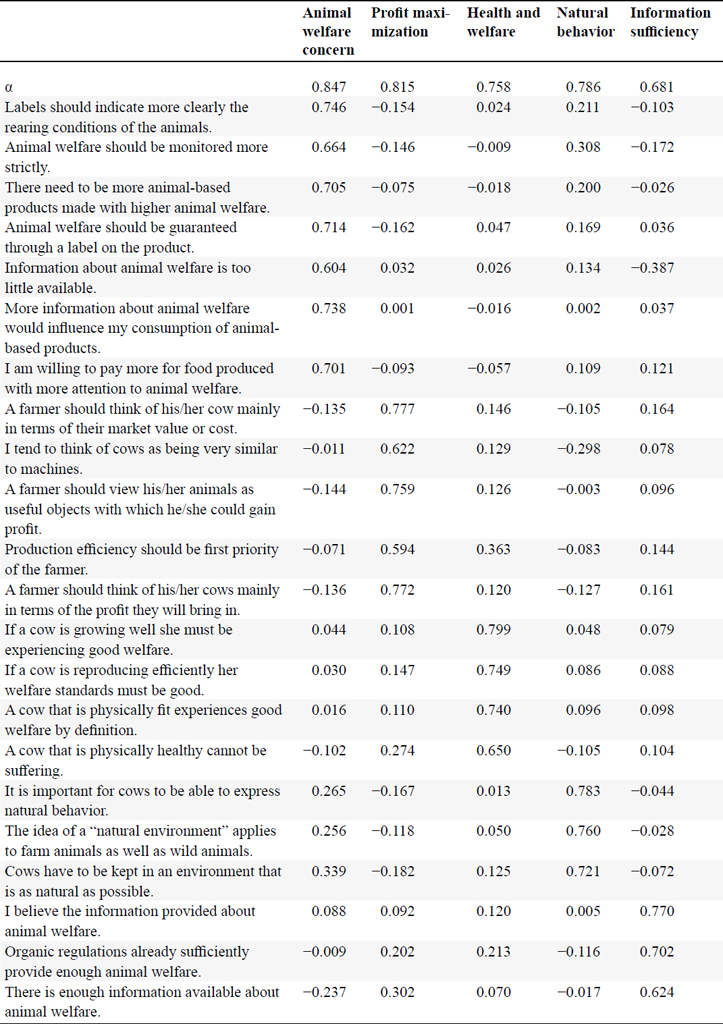
As mentioned in Section 3 above, the first analysis conducted in this study was a PCA to reduce the items on consumersâ attitudes, information needs, and perceived behavior with regard to animal welfare. The scree plot as well as the eigenvalues indicated a five-factor solution. The resulting five factors explained 60.1% of the total variance and the KMO value was 0.907 (significant at p < 0.001). These factors are: animal welfare concern, profit maximization and efficiency, health and welfare, natural behavior, and information sufficiency. Cronbachâs

Overview on the four factors resulting from the PCA and the respective Cronbachâs α values.
Citation: International Food and Agribusiness Management Review 26, 5 (2023) ; 10.22434/ifamr2022.0139
Factor 1 consists of seven items, which are related to consumersâ demand for more animal welfare and a strict monitoring as well as corresponding information on animal-based products. This factor is summarized as âanimal welfare concernâ. The second factor includes five items related to the need of farmers to maximize their profit and the efficiency. Therefore, this factor is named âprofit maximizationâ. In the study by de Graaf et al. (2016) the corresponding factor is called âbusiness orientationâ. The four items that represent factor 3 refer to the association of cowsâ physical well-being as indicators for good welfare. Factor 3 is summarized as âhealth and welfareâ and corresponds to the âfunctioning orientationâ factor in de Graaf et al. (2016). The fourth factor consists of three items that all relate to the keeping of cows in a way that allows for the expression of natural behavior and is therefore named âfocus on natural behaviorâ. This factor is consistent with the ânatural living orientationâ factor (de Graaf et al., 2016). Factor 5 âsufficiency of informationâ summarizes three items related to the information on animal welfare that is already available. Factors 1 and 5 mainly consist of items that were taken from Vanhonacker et al. (2010). As these items were not previously analyzed through a factor analysis, comparisons concerning the factor structure were not possible.
4.2 Cluster analysis
A hierarchical cluster analysis resulted in four clusters. Cluster 1 (âthe pragmatistsâ) is the smallest cluster, consisting of 272 respondents, showing greater agreement than the sampleâs mean with all five factors and the overall strongest agreement with profit maximization, health and welfare as well as information sufficiency. The factors animal welfare concern and focus on natural behavior are the only factors which are not agreed to most strongly by cluster 1. Cluster 2 (âthe animal welfare (AW) unconcernedâ) consists of 747 respondents and reveals considerably lower agreement with the factors animal welfare concern and focus on natural behavior than the sampleâs mean. The agreement with the factors profit maximization and information sufficiency are slightly stronger than the mean. Cluster 3 (âthe indifferentâ) is the largest cluster with 1965 respondents and shows only small deviations from the sampleâs mean for all five factors. Cluster 4 (âthe AW concernedâ) is the second smallest cluster with 576 respondents. It differs from the other clusters, in that it shows the strongest agreement with the factors animal welfare concern and natural behavior and the lowest agreement with the three other factors (Figure 1).
Comparison of the four clusters based on the mean factor deviations from the grand sample mean (deviation from the mean on the y-axis).
Citation: International Food and Agribusiness Management Review 26, 5 (2023) ; 10.22434/ifamr2022.0139
Table 2 summarizes the information used for further profiling of the clusters. Cluster 1 (âpragmatistsâ) consists of consumers, who are pragmatic and knowledgeable, but also animal welfare concerned. As mentioned above, is the pragmatists are different from the other clusters in that their agreement to all five factors is greater than the sampleâs mean. Hence, these respondents assign importance to animal welfare and the ensuring of natural behavior in animal husbandry systems, while recognizing the importance of profit maximization for farmers. They do not perceive those aspects as contradictory. Compared to the other clusters, pragmatists have been on a farm more frequently during the past five years and are more often engaged in hunting than any other cluster. In addition, they are significantly more likely to consume cowâs milk on a daily basis. Pragmatists report a high satisfaction with animal welfare and ascribe themselves high knowledge on animal husbandry systems. While they strongly agree that meat in general is too cheap (in contrast to the other three clusters), the same people also strongly agree that organic meat is too expensive and that the origin of an animal-based product is a better indicator for welfare than a certification label. Pragmatists have higher net incomes on average. Cluster 2 (âAW unconcernedâ) can be described as a rather reluctant or uncaring group of consumers with regard to animal welfare, as these respondents show below average agreement to the factors animal welfare concern and natural behavior. AW unconcerned consumers are less likely to purchase organic, local or âfresh from the farmâ milk than respondents from the other clusters. They are less satisfied with the food system and animal welfare than the pragmatists, but more than respondents belonging to the other two clusters. Cluster 3 (âindifferentâ) is by far the largest cluster. It consists of respondents, who do not have a strong opinion on this topic, as they reveal the smallest deviations from the mean for all five factors. They also assign themselves a low level of knowledge compared to the other clusters. The indifferent consumers are on average older. They are more satisfied with the food system and with animal welfare standards than members of cluster 4, but less satisfied compared to the pragmatists and the unconcerned consumers. People belonging to cluster 4 (âAW concernedâ) appear to have the most sustainable mind-set and care more about animal welfare than the other three clusters. Comparatively low satisfaction with the food system and animal welfare standards as well as a consistently higher perceived effectiveness of (policy) measures (e.g. increase of meat prices, more inspections on farms, and increased transparency through labels that can be traced back to particular farms) to improve animal welfare are characteristic for the concerned consumers. This is in stark contrast to the pragmatists, as significantly fewer pragmatists perceive those measures as effective. Concerning gender differences, the results show that the concerned consumers are more likely to be female, whereas the pragmatists and the unconcerned consumers have equally low shares of female respondents.
Profiling of the four clusters (Note: The same upper case letters indicate that clusters are not significant different from each other at p<0.001)
Citation: International Food and Agribusiness Management Review 26, 5 (2023) ; 10.22434/ifamr2022.0139
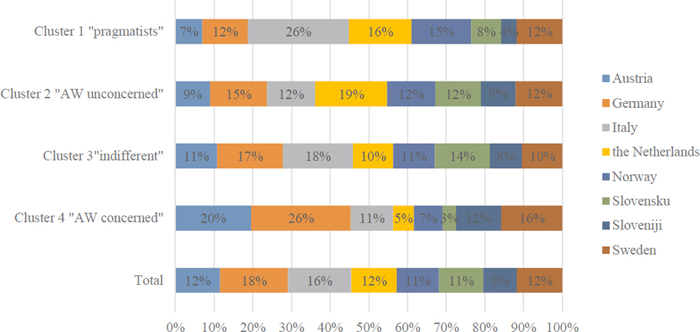
With regard to respondentsâ country of origin, Figure 2 shows the respective shares in the four clusters and the total sample. Table A3 in the appendix includes the cross tabulation of cluster membership and country of origin and reveals significant differences at a 5% significance level. Overall, there is a higher share of Italian consumers and a slightly higher share of Dutch and Norwegian consumers in the âpragmatistsâ cluster compared to the country shares in the total sample. In the âAW unconcernedâ cluster, the share of Dutch respondents is higher than in the total sample. The country shares in the âindifferentâ sample only slightly differ from the shares in the total sample. In the âAW concernedâ cluster, the results reveal larger shares of Austrian and German consumers and slightly larger shares of Slovene and Swedish consumers.
Comparison of clusters based on membersâ country of origin. Note: significant differences are displayed in the corresponding cross-tabulation in Table A3 in the Appendix.
Citation: International Food and Agribusiness Management Review 26, 5 (2023) ; 10.22434/ifamr2022.0139
5. Discussion and conclusion
The âunconcernedâ and the âindifferentâ clusters are the largest groups of respondents in this study. While the unconcerned consumers agree much less to the factors animal welfare concern and natural behavior than the sampleâs mean, the unconcerned respondentsâ agreement with all factors deviates only very slightly from the mean and at the same time they do not perceive themselves as very knowledgeable with regard to animal husbandry. The identification of a very large group of consumers that views animal welfare indifferently, confirms findings from other segmentation analyses (Hyland et al., 2022; Weible et al., 2016), which also identified large indifferent consumer groups. The strongest agreement with three out of five factors (namely profit maximization, health and welfare as well as information sufficiency) compared to the sampleâs mean, can be found among the âpragmaticâ consumers, while the strongest agreement with the remaining two, namely animal welfare concern and natural behavior, is realized for the concerned consumers. Further inspection of the clusters suggests that cluster 1 âthe pragmatistsâ and cluster 4 âthe AW concernedâ are also very distinct regarding the additional variables used for profiling, especially with regard to their perceived knowledge of animal husbandry practices and their satisfaction with the food system and animal welfare standards in their home countries (Table 2).
The pragmatists have a closer relation to nature and agriculture as well as a more realistic view on the economic perspective of a farm. They regard profit maximization and production efficiency as almost equally important as animal welfare. The very sustainability-oriented cluster, however, is dissatisfied with the current food system and animal welfare standards and regards the introduction of (regulatory) policy measures as effective means to improve animal welfare. These differences in their attitudes towards and perceptions of animal welfare might at least partly be explained by some of the sociodemographic information. While the pragmatists are rather male than female, have a higher income on average, and are more likely to hunt, the concerned cluster rather consists of more female than male members and reveals a significantly smaller share of members that has visited a farm during the past five years than in the pragmatic cluster. In line with this finding, Hyland et al. (2022) also revealed that struggling consumers are less likely to have never visited a farm. Interestingly, the pragmatic, animal welfare concerned consumers with higher subjective knowledge (i.e. cluster 1) come to a large share from Italy in our study. This might be explained through the large share of small-scale family farms in Italy, through which people have more frequent contact to farmers and better insights into animal husbandry systems per se. The concerned cluster, in contrast, is characterized by a higher share of respondents from Austria and Germany.
The concerned consumers assign themselves a low level of knowledge on animal husbandry and they also report a low level of satisfaction with the food system in general, but also with animal welfare in particular. Hence, it appears that these consumers feel more alienated from production places and practices than the pragmatic consumers of cluster 1. Accordingly, the concerned consumers view policy measures to improve animal welfare (e.g. increase of meat prices, more inspections on farms, and increased transparency through labels that can be traced back to particular farms) as more effective than the more pragmatic consumers. This finding indicates that consumers, who feel less knowledgeable and more alienated from the places of production, show a stronger need for regulatory measures. This confirms the finding by Hyland et al. (2022) indicating that struggling consumers need more guidance to identify and find animal welfare products. Contrarily, consumers who know more about animal husbandry practices and feel more closely connected to the places of production rather agree that origin is a better indicator for animal welfare than a label. Summing up, these findings suggest that the perception of animal welfare and the acceptance and use of corresponding labels depends on the perceived connectedness with farmers (respectively producers) which in turn depends on the degree of industrialization and the role of agriculture in a specific country or region, as this determines the possibilities to learn about and experience animal husbandry practices. This goes hand in hand with implications from previous research, suggesting that a dialogue between actors along the supply chain is necessary (Weible et al., 2016) and that alternative food networks are a viable path to close the gap between consumers and producers (Schermer, 2014).
As a consequence of globalized production processes, there is an increasing number of consumers who experience alienation from the places of production, which is reflected by the relatively large number of respondents belonging to the group of concerned consumers in this study. Nevertheless, respondents from both consumer segments, independent of their knowledge and the distance to the places of production, perceive that animal welfare and the possibility of animals to act out their natural behavior is very important. Consumers with more knowledge and a more realistic view on animal husbandry systems are expected to be able to better assess animal-friendly practices and hence do not prefer labels to facilitate their food choices. Labels are means to transmit information (e.g. a product has been produced according to certain standards) about credence goods, that can neither be determined through an inspection of the good nor through the consumption/use of the product (Kehlbacher et al., 2012). Therefore, labels help to improve transparency and to reduce the citizen-consumer gap, which in turn may increase consumersâ willingness to pay a premium for the communicated standard (Krystallis et al., 2009, Boaitey and Minegishi, 2020). If the distance decreases and the appreciation for the production standards increases, the willingness to pay a premium will be higher and will most likely be more stable in the long term, ensuring a market for animal welfare (Janssen et al., 2016; Kehlbacher et al., 2012; Tonsor and Wolf, 2011). The search for more and deeper information can be triggered through a label, but it will need individual effort of the consumer to acquire that knowledge and act accordingly. Since production standards and practices are very heterogeneous and depend on the individual producer and his or her interests and beliefs, it is very difficult for consumers to learn and understand how the food they eat is produced. Therefore, it is essential that consumers possess some intrinsic motivation to increase oneâs knowledge and reduce that distance â not only proverbially, but potentially also through the investment of time and money. Consumers who are willing to put effort into animal-friendly food choices, or more generally speaking ethical food choices, are those consumers that are called reflexive consumers by Guthman (2002). They tend to question and think more about production standards as compared to consumers who rather unthinkingly make their food purchase decisions or follow mass tastes. Such a group of consumers was also identified in the segmentation study by Hyland et al. (2022) and was correspondingly called the engaging consumers (as opposed to the struggling consumers).
However, our study, like other previous studies, identifies very large groups of consumers, which are either very indifferent or do not show any concerns with regard to animal welfare. These consumers most likely wonât engage in alternative food networks and also wonât participate in a dialogue with other stakeholders. To reach those consumers, policy measures and regulations are necessary that inhibit animal husbandry systems with low welfare. All other segments can possibly be reached through target-specific marketing measures and on farm activities that close the gap between producers and consumers. As Carolan (2022) states that newly emerging views of mainly urban consumers which criticize current farming practices leads to producers feeling misunderstood and unacknowledged. Hence, it is relevant and important to also examine the consumer-producer link from the producersâ perspective to take both sides of the relation into account. Future research should be designed to compare and align consumersâ and producersâ views on farm animal welfare. In addition, future research could include the development of a consumer alienation scale for food and its application to animal-based food production, as no such scale has been found so far. Thereby it would be possible to measure consumer alienation and to find relations with sociodemographic variables and other consumer characteristics in the agriculture and food context.
The reflection on animal welfare based on the results of a cluster analysis and the conceptualization in the context of consumer-producer relations helps to reveal links between subjective knowledge, consumer alienation, and the need for labels as well as additional policy measures. The cross-country approach yields interesting insights on sociocultural aspects that play a role in consumersâ concern for animal welfare irrespective of national borders.
References
Alonso, M.E., J.R. González-Montaña and J.M. Lomillos. 2020. Consumersâ Concerns and Perceptions of Farm Animal Welfare. Animals 10(3): 385.
Austin, E.J., I.J. Deary, G. Edwards-Jones and D. Arey. 2005. Attitudes to Farm Animal Welfare: Factor Structure and Personality Correlates in Farmers and Agriculture Students. Journal of Individual Differences 26(3): 107â120.
Boaitey, A. and K. Minegishi. 2020. Who are farm animal welfare conscious consumers? British Food Journal 122(12): 3779â3796. DOI: 10.1108/BFJ-08-2019-0634.
Buller, H. and E. Roe. 2012. Commodifying animal welfare. Animal Welfare 2: 131â135.
Buller, H. and E. Roe. 2014. Modifying and commodifying farm animal welfare: The economisation of layer chickens. Journal of Rural Studies 33: 141â149.
Carolan, M. 2022. Ethical eating as experienced by consumers and producers: When good food meets good farmers. Journal of Consumer Culture 22(1): 103â123. DOI: 10.1177/1469540519899967.
Clark, B., G.B. Stewart, L.A. Panzone, I. Kyriazakis and L.J. Frewer. 2016. A Systematic Review of Public Attitudes, Perceptions and Behaviours Towards Production Diseases Associated with Farm Animal Welfare. Journal of Agricultural and Environmental Ethics 29: 455â478.
Clark, B., G.B. Stewart, L.A. Panzone, I. Kyriazakis and L.J. Frewer. 2017. Citizens, consumers and farm animal welfare: A meta-analysis of willingness-to-pay studies. Food Policy 36: 112â127.
Cornish, A.R., J. Jamieson, D. Raubenheimer, and P.D. McGreevy. 2019. Applying the Behavioral Change Wheel to Encourage Higher Welfare Food Choices. Animals 9(8): 524.
Cornish, A.R., D. Briley, B.J. Wilson, D. Raubenheimer, D. Schlosberg and P.D. McGreevy 2020. The price of good welfare: Does informing consumers about what on-package labels mean for animal welfare influence their purchase intentions? Appetite 148: 104577. DOI: 10.1016/j.appet.2019.104577.
De Graaf, S., E. Van Loo, J. Bijttebier, F. Vanhonacker, L. Lauwers, F. Tuyttens and W. Verbeke. 2016. Determinants of consumer intention to purchase animal-friendly milk. Journal of Dairy Science 99(10): 8304â8313. DOI: 10.3168/jds.2016-10886.
European Commission. 2016. Attitudes of Europeans towards animal welfare. Special Eurobarometer 442. European Commission, Brussels. Available online at https://europa.eu/eurobarometer/surveys/detail/2096.
Guthman, J. 2002. Commodified Meanings, Meaningful Commodities: Re-Thinking Production-Consumption Links through the Organic System of Provision. Sociologia Ruralis 42: 295â311.
Grunert, K.G., S. Hieke and J. Wills. 2014. Sustainability labels on food products: Consumer motivation, understanding and use. Food Policy 44: 177â189.
Harper, G.C. and S.J. Henson. 2001. Consumer concerns about animal welfare and the impact on food choice â The Final Report. The University of Reading, Reading.
Heinke, H. and L. Theuvsen. 2017. Consumersâ willingness to pay for milk, eggs and meat from animal welfare programs: a representative study. Journal of Consumer Protection and Food Safety 12: 105â113.
Hepting, D., J.A. Jaffe and T. Maciag. 2014. Operationalizing Ethics in Food Choice Decisions. Journal of Agricultural and Environmental Ethics 27: 453â469.
Hölker, S., M. von Meyer-Höfer and A. Spiller. 2019. Animal Ethics and Eating Animals: Consumer Segmentation Based on Domain-Specific Values. Sustainability 11: 3907.
Hyland J.J., A. Regan, S. Sweeney, C. McKernan, T. Benson and M. Dean. 2022. Consumers attitudes toward animal welfare friendly produce: An island of Ireland study. Frontiers in Animal Science 3: 930930.
Janssen, M., M. Rödiger and U. Hamm. 2016. Labels for Animal Husbandry Systems Meet Consumer Preferences: Results from a Meta-analysis of Consumer Studies. Journal of Agricultural and Environmental Ethics 29: 1071â1100.
Kehlbacher, A., R. Bennett and K. Balcombe. 2012. Measuring the consumer benefits of improving farm animal welfare to inform welfare labelling. Food Policy 37(6): 627â633.
Krystallis, A., M. Barcellos, J. Kügler, W. Verbeke and K.G. Grunert. 2009. Attitudes of European Citizens Towards Pig Production Systems. Livestock Science 126(1â3): 46â56.
Lund, T.B., S. Denver, J. Nordström, T. Christensen and P. Sandoe. 2021. Moral Convictions and Meat ConsumptionâA Comparative Study of the Animal Ethics Orientations of Consumers of Pork in Denmark, Germany, and Sweden. Animals 11: 329.
Raynolds, L.T. 2002. Consumer/Producer Links in Fair Trade Coffee Networks. Sociologia Ruralis 42: 404â424.
Roex, J. and M. Miele. 2005. Farm Animal Welfare Concerns: Consumers, Retailers, and Producers. Welfare Quality Reports No. 1. Cardiff University. Available online at www.welfarequalitynetwork.net/media/1093/wqr1.pdf.
Rovers, A., W.I. Sonntag, N. Brümmer and I. Christoph-Schulz. 2018. Citizensâ Perception of Recent Livestock Production Systems in Germany. German Journal of Agricultural Economics 67(4): 223â233.
Schermer, M. 2014. From âFood from Nowhereâ to âFood from Here:â changing producer-consumer relations in Austria. Agriculture and Human Values 32: 121â132. DOI: 10.1007/s10460-014-9529-z.
Tonsor, G. and C. Wolf. 2011. On mandatory labeling of animal welfare attributes. Food Policy 36(3): 430â437.
Ursachi, G., A. Zait and I. Horodnic. 2015. How Reliable Are Measurement Scales? External Factors with Indirect Influence on Reliability Estimators. Procedia Economics and Finance 20: 679â686.
Vanhonacker, F., E. Poucke, F. Tuyttens and W. Verbeke. 2010. Citizensâ Views on Farm Animal Welfare and Related Information Provision: Exploratory Insights from Flanders, Belgium. Journal of Agricultural and Environmental Ethics 23: 551â569.
Vanhonacker, F., W. Verbeke, E. Poucke, Z. Pieniak, G. Nijs and F. Tuyttens. 2012. The Concept of Farm Animal Welfare: Citizen Perceptions and Stakeholder Opinion in Flanders, Belgium. Journal of Agricultural and Environmental Ethics 25: 79â101.
Weible, D., I. Christoph-Schulz, P. Salamon and K. Zander. 2016. Citizensâ perception of modern pig production in Germany: a mixed-method research approach. British Food Journal 118(8): 2014â2032.
Appendix
Sociodemographic description of the sample
Citation: International Food and Agribusiness Management Review 26, 5 (2023) ; 10.22434/ifamr2022.0139
List of all items used for the PCA and the reasons for excluding items (7 out of 29)
Citation: International Food and Agribusiness Management Review 26, 5 (2023) ; 10.22434/ifamr2022.0139
Cross-tabulation of respondentsâ country of origin and cluster membership
Citation: International Food and Agribusiness Management Review 26, 5 (2023) ; 10.22434/ifamr2022.0139
Corresponding author