


The noble ideas of the Fathers of Securitization Theory, which aimed to extend security research beyond the military realm while maintaining appropriate criteria to distinguish security from other types of policy (Gad and Petersen, 2011: 315), contributed to the observation and efforts to eliminate or reduce numerous significant threats to various aspects of human life. By drawing the attention of security actors to issues beyond military force and deterrence and convincing them that the general well-being of the individual is as crucial as mere survival, these concepts transformed the post-Cold War world. Despite the positive changes brought about by constructivists (and their critics), the instrumental use of theory for contemporary policy purposes was still prevalent. Although political discourse on security issues was often conducted substantively and in a balanced manner, instances arose where references to security were employed to shape perceptions of reality in accordance with the political objectives of the message sender. This frequently involved the manipulation of the political narrative, propaganda, and distortion, exacerbated by populism (Rittel, 2005: 306). This issue was also evident in Poland.
After 1989, Polish politicians recognized the significance of security issues in shaping their image and political standing. Lech Kaczyński’s original approach to managing the Ministry of Justice from 2000 to 2001 focused primarily on responding to irregularities in the courts and prosecutor’s offices reported by the media, particularly issues such as delays in proceedings and dismissals in criminal cases that outraged public opinion, as well as reduced sentences, which earned him the nickname of “sheriff” and contributed to his victory in the elections for the President of Warsaw. Bronisław Komorowski brought the experience gained as Minister of National Defense to the Presidential Palace, where he shaped the command system of the Polish Armed Forces and addressed other military leadership aspects, theoretically under the purview of the Ministry of Defense. Aleksander Kwaśniewski, by engaging the Polish Armed Forces in Iraq and Afghanistan, as well as supporting the Orange Revolution in Ukraine, anticipated elevated international positions in security after his presidency, with speculation about roles such as head of NATO or Secretary-General of the United Nations. Each of them, albeit in different forms, viewed the prioritization of security issues as a pathway to personal success in their political endeavors. Throughout the period under discussion (1989–2020), security issues remained a consistent and comprehensive component of political programs, strategies, debates, and politicians’ speeches.
The main problem raised during the work on this book was the question about the importance of security issues and the dynamics of securitization processes in the Polish political discourse after 1989. Specific research problems related to the following:
Changes in the understanding of the concept of security and its threats over the last 30 years, reflected in political discourse;
Changes in the position of security issues in political discourse;
The level of securitization and riskification of the Polish political discourse;
Understanding and the manner of the use of security issues by different political parties and communities;
Fear and threatening as elements of political discourse;
Distinguishing between securitizations (extending the security category according to the Copenhagen School’s assumptions), naming security issues without a securitization process, and tampering with the concept of security;
Desecuritization of selected areas previously recognized as exceptional issues due to belonging to the sphere of security.
The analysis of electoral programs, speeches by the Prime Ministers and Presidents, and selected parliamentary debates allowed the following conclusions to be drawn:
Security was an important element of Polish political discourse in the area analyzed in this book. In the 1990s, in Poland, as in other parts of the world, it was combined with the establishment of a military force capable of deterring and defending the country. This aim was pursued through both investment in the army and its qualitative transformation, as well as through political activities: first, to leave the Warsaw Pact peacefully and withdraw Soviet troops from Poland, and then to associate with and gain membership in NATO. While this issue was significant, the widespread agreement on the direction established in 1989 meant it did not require securitization. It was a security-related matter, but was implemented by the methods of “ordinary” policy.
In the 21st century in Poland, as in other parts of the world, the category of security has expanded to include economic, social, and political issues. Periodically, issues such as the participation of the Polish Armed Forces in operations outside the country, ensuring energy security, cutting spending during the economic crisis, the perception of the migration crisis through the lens of Poland’s internal security, or, as in 2020–2021, the health of Poles in the context of the COVID-19 pandemic became crucial and were securitized to add importance to them and garner support for their implementation and resolution. Political discourse here has followed global changes in the understanding of security and has responded to current threat scales.
Security issues occupied an important but relatively smaller space in political discourse throughout the analyzed period. On average, the issue covered around a dozen percent of every exposé of the Prime Ministers after 1989 (5.43% being the lowest and 34.04% the highest). In the case of Presidents, an upward trend can be observed (rising from 9.09% in Wojciech Jaruzelski’s speeches to over 24% in both Andrzej Duda’s speeches before the National Assembly). However, it should be noted that the initial speeches were of a different character than the contemporary ones: they were brief and conveyed the general view of the President being sworn into office, rather than outlining plans for specific areas.
Although security issues occupied a comparable “volume” of political discourse in the analyzed 30-year period, the robust intensification of securitization processes can be observed in the 21st century, after 2003 (Table 11, Figure 23).
Comparisons along the left-right spectrum regarding the amount of space devoted to security issues do not reveal a single trend. In the case of Prime Ministers, leaders from right-wing and center-right parties devoted an average of 15.9% of their exposés to security, while representatives of left-wing parties allocated 22.26%. However, in the case of Presidents, the situation is reversed: in the speeches of right-wing Presidents, security issues comprised an average of 20.45% of the programs (statistics were significantly understated by L. Wałęsa), whereas for left-wing Presidents, it was 9.96%.
Left-wing politicians in the post of Prime Minister refer to political security in international terms (relations with other countries, membership in organizations) more often than right-wing politicians do. In the case of Presidents, the situation is the opposite. However, a tendency for addressing issues related to social security cannot be observed among left-wing Presidents to a greater extent than among right-wing Presidents, which is considered to be the mark of the Left. The opposite is true – right-wing Prime Ministers and Presidents are more likely to address these issues. Right-wing politicians in both positions are also more likely to raise the issue of military security than their left-wing counterparts.
Therefore, it cannot be asserted that there were significant differences regarding the issue of security among Polish politicians from different parties in the domestic political discourse.
Security threats were used to instil fear in the audience of discourse. The most striking example is the narrative led by right-wing groups about the potential admission of migrants to Poland under the European relocation program. Possible visitors were portrayed as a diverse threat to Polish society (terrorists, spreaders of diseases, destroyers of Western culture and Christianity, and offensive Muslims). This narrative reflected the social mood at the time (in 2015–2016, 53–61% of respondents to the CBOS survey opposed receiving migrants) and enabled parties that threatened with the migration crisis to win parliamentary and presidential elections.
The discourse of fear also emerged regarding the Iraqi issue – initially, it was claimed that not joining the coalition jeopardises Poland’s security in a situation where it may require assistance in defense, and later that a prolonged presence there exposes not only the deployed soldiers but also the country to potential terrorist attacks.
In other securitized issues, it was also warned what would happen in the absence of the proposed extraordinary measures; however, the intensity of this narrative was lower than in the examples mentioned above.
Simply calling something an issue of security does not constitute securitization. Politicians have repeatedly used this term to emphasize the issue, yet they often fail to propose extraordinary solutions to these security concerns. Sometimes, this is due to the absence of a need for such measures (the norms of ordinary political action suffice), while at other times it occurs because the process is merely rhetorical. The Securitization Theory does not always allow for the clear differentiation of these matters, but references to Just Securitization Theory – with its emphasis on assessing the intentions of the securitizing entity, the objectivity of the threat, and the actions taken – more precisely highlight the difference between genuine securitization and manipulation or compelling rhetoric for the audience. Therefore, the issues outlined in the table above, selected from the broad spectrum of security topics in Polish public discourse, were deemed to be subjected to the securitization process.
-
Desecuritization is a process observed in the analyzed examples of discourse. Sometimes its phase is visible and ends with the uniqueness of the securitized issue, transferring it to the rules of ordinary policy (an example being the collapse of the pension system). At other times, it coincides with the transfer of the issue to the riskification phase. It seems, however, that sooner or later, desecuritization is inevitable, even in cases where issues are still being securitized, such as migration problems and the threat from Russia.

Selected issues of Polish political discourse in light of the Classical Securitization Theory, Just Securitization Theory and Riskification Theory
Source: own development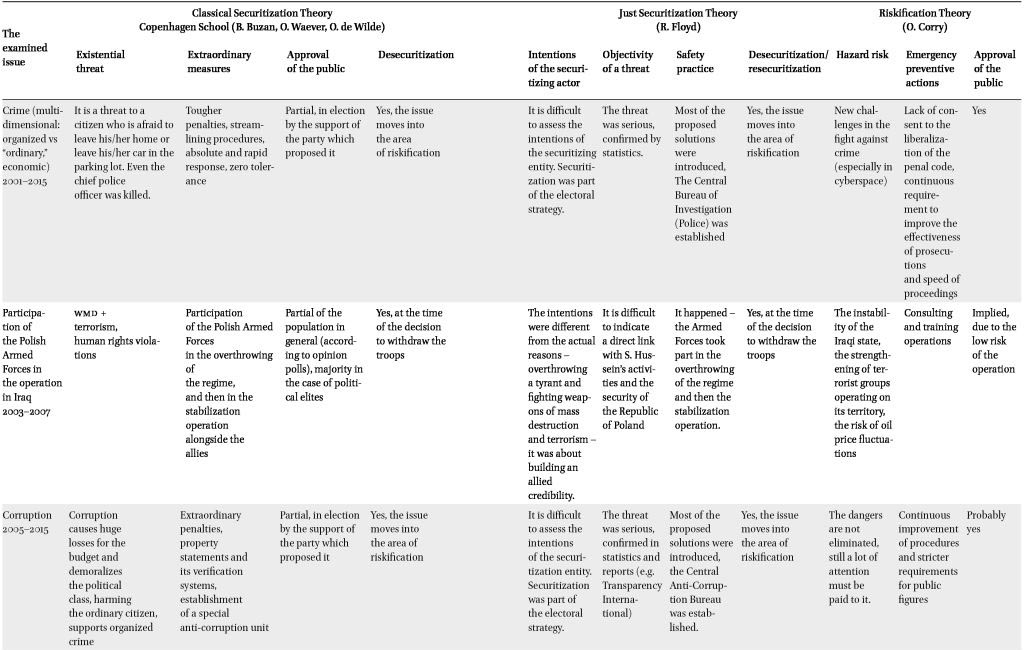
Selected issues of the Polish political discourse in light of the Classical Securitization Theory, Just Securitization Theory and Riskification Theory
Source: own study
Out of the 181 selected areas of security in Polish political discourse, nine are cases related to a securitization mechanism, while one pertains to riskification. The remaining nine issues are referred to as security concerns, but there is no securitization process (no proposals for extraordinary measures or references to public approval). In some instances, such as Poland’s aspiration to become a NATO member and subsequently building a position within the Alliance, there was no need to propose extraordinary actions or seek public opinion, as the issue was recognized as important and acted upon under “ordinary” policy. The chosen direction was not questioned by significant public figures, and there was widespread understanding of the need to join a robust transatlantic alliance, which was ultimately achieved. A similar mechanism occurred in the context of European integration, particularly in its security dimension.
The analyzed discourse also includes situations in which various aspects of social, economic, health, or environmental security are mentioned; however, this is a rhetorical procedure, branding a certain area as a matter of security without transitioning to a securitization act. These initiated and unfinished securitizations often occur with merely the use of the term, lacking any attempt to develop the outlined themes or present them from a security perspective. Frequently, after a title or heading suggesting sectoral security issues, the topic is examined from entirely different perspectives (e.g., the narrative in the electoral programs of the Polish People’s Party (PSL) from the 21st century). Therefore, in quantitative discourse analyses, one should be cautious regarding the use of the term security without conducting a qualitative analysis of the context in which it appears, as this may lead to erroneous conclusions. The meta-operational role of the concept of security, along with the universality of references lacking deeper content, can create a misleading impression that everything is security, which is factually inaccurate.
In nine separate cases of securitization (Table 11), it is noteworthy that most of these situations also underwent a desecuritization process, after which they were either no longer regarded as a security issue or transitioned into the riskification phase. This process is particularly evident in the case of the Polish Armed Forces’ involvement in the operation in Iraq. The issue was heavily securitized at the time the decision was made to send the Polish Armed Forces to confront Saddam and then stabilize Iraq; however, once such operations became standard in NATO policy, it was reclassified as “ordinary” policy (it was desecuritized). Numerous military engagements in Afghanistan and other foreign operations involving Polish soldiers in the 21st century followed the logic of riskification: Poland participates in these projects due to the risk that issues from other parts of the world may also impact Europe.
The transition from securitization to riskification is a common phenomenon in Polish political security discourse. This is especially evident in the case of energy issues, which were strongly securitized during periods of low diversification in raw material supplies. After several years and an increased number of sources for raw materials, these issues entered a riskification phase. As Prime Minister M. Morawiecki pointed out in the speech quoted in Chapter 4, there is no imminent threat of supply interruptions; however, there remains a risk that this process may be disrupted. A similar situation is evident with the COVID-19 pandemic: it transitioned from strong securitization in the spring of 2020 to a riskification phase characterized by months of securitization focused on minimizing the risk of further waves, increased disease cases, the emergence of virus mutations, and so on. As Corry predicted (2012), drawing on examples from health and environmental security, the trend of responding with extraordinary measures (although nominally less intense than securitization) is becoming a significant aspect of shaping long-term security policies. While it is true that two securitized issues – the migration crisis and Russia as a military threat – remain in the process of securitization, they exhibit a volatile and lower intensity than at the outset, showing a tendency to transition into a riskification phase.
The situation described in this chapter raises two problems on which both securitization actors and entities, as well as the public, will have to take a stand. First, since the securitization processes intensified in the 21st century, is there an increased risk that they are conducted not out of pure intentions to solve the problem, but due to political cynicism aimed at gaining and maintaining power under extraordinary conditions? Can violations of the law, including human rights, be justified by the promise of security? How can this be reconciled, especially in Europe, with the concept of an open society? Isn’t it necessary, as Floyd (2019) implies, to consider the moral implications of expanding the category of security to prevent it from being overwhelmed by political populism and aggressive discourse?
And secondly, since security issues under extraordinary conditions increasingly often include not objective, existential threats but risks that may occur in the future (riskification), which indefinitely prolongs emergency states, procedures, and security practices, will everything not become security in a moment, and security itself become nothing? Should we be more concerned about the tyranny of security procedures or rather the lack of elimination of real threats?
(1) Poland’s membership in NATO and the country’s position in the Alliance; (2) strategic partnership with the USA; (3) The European Union as a security guarantor; (4) The Russian Federation as a military threat; (5) the condition of the Armed Forces, their modernization and financing military spending; (6) the threat of a conventional attack on Poland (territorial infringement); (7) involvement in the operation in Iraq; (8) involvement in the operation in Afghanistan and other foreign operations of the Polish Arms; (9) anti-crime policy; (10) corruption and the fight against corruption; (11) economic security of the state; (12) energy security; (13) social security, pension reform; (14) the migration crisis, (15) the economic crisis; (16) production of food in order to ensure national security; (17) environment as a matter of security; (18) COVID-19 pandemic.