Abstract
Science teacher educators have a complex role in preparing future science teachers, giving them the content and pedagogical and technological knowledge. This research examines using a gamified laboratory simulation tool (Labster), where access was given to a cohort of science pre-service teachers (pst s) in the third year of their Initial Teacher Education for a semester. A mixed-method approach was adopted to generate data for this case study. Schulmanâs pedagogical content knowledge provided the theoretical background, whilst Makransky and Petersenâs (2019) framework was deployed to identify factors in implementing Labster, including usability, motivation, and perceived use. The data determined that despite the ongoing engagement and interest in games and gamification in the wider community, the perceived engagement and interest were not reflected in the responses of the undergraduate science pst s in the study. pst s reported that they did not feel that it improved their content knowledge.
Introduction
Gamification is an expanding billion-dollar industry, with reports that in 2020, the global value of gamification is $9.1 billion (Markets and Markets, 2020; Prescient & Strategic Intelligence, 2020). Chang (2021) reported that 80% of US workers believe game-based learning is more engaging, with 85% of employees reporting enjoyment of gamification software solutions at work and making them more productive. For example, Kahoot!, a game-based learning supplier from Norway, quickly breached the 90 million user mark and has a 75% growth rate to become one of the fastest-growing learning brands in the world (Adkins, 2019). Duolingo leverages gamification in teaching languages to users for free via the userâs mobile and has grown its user base to over 300 million in 2020 (Citrusbits, 2020). In schools, game-based learning for children is predicted to be among the leading revenue opportunities for developers from 2019 until 2024, registering a growth of 21.4% and a tripling of revenue (Adkins, 2019). Not unexpectedly, there has been a very high level of growth of virtual reality-based learning games at 51.9%, followed by evaluation and assessment games at 46.2% and language learning games at 41.8% (Adkins, 2019). In Higher Education, it is predicted that game-based learning or gamification will experience growth of 15% from 2019 to 2024, and challenge-based gamification will lead to an increase of 34% in student performance, and this increase was up to 89% when compared to traditional lectures (Legaki et al., 2020). Concerning motivation and engagement, 67% of students found gamified learning more motivating and engaging than traditional courses (OâDonnellan, 2019). Play-based gamification for enjoyment often has the ability for the player to participate with peers and even strangers in the online space, communicating through headsets and collaborating to solve problems related to the âquestâ, leading to gratification. This research considers how the game-based simulation Labster can support learners to develop stem skills, including communication, collaboration, problem-solving, and creativity.
Rationale
E-learning has also been promoted as a paradigm shifter within the tertiary space nearly two decades ago when Bates (2005) promoted E-learning as a âgame changerâ. Indeed, in the case of Learning Management Systems (lms) such as Moodle, Blackboard or Canvas, changed the universitiesâ landscape to enable students to participate deeply in the online space (Instructure, 2008). In our university, Curriculum and Instruction (c&i) units prepare pst s to teach science, mathematics and other topics to students, and Blackboard is the chosen lms (Anthology, 2023).
The rationale for this study is developed from the situation that within the School of Education at the University, there are only two units of c&i designed to teach pst s the specific pedagogical content knowledge (pck) and content knowledge (ck) to teach science to students in secondary schools (Shulman, 1986; Shulman, 2013). It is expected that in 12 weeks of teaching once a week for 2 hours per semester, Teacher educators will provide pst s with the science-appropriate pedagogy to teach science as set out in the teacher standards (Australian Institute for Teaching and School Leadership, 2017). This is a consistent situation throughout Australia, as all Schools of Education are bound by the same aitsl standards (Australian Institute for Teaching and School Leadership, 2017). Teacher educators find that only 12 weeks is challenging to teach in-depth the diverse science content knowledge required for pst s to become secondary educators. pst s are presumed to be developing expertise in content knowledge across all science knowledge to be taught in years 7-10 and their specialist area, e.g., Physics, Chemistry, Biology, Human Biology, Earth and Space Science or Psychology in Years 11 and 12 (Australian Institute for Teaching and School Leadership, 2017).
pst s studying in these units in the School of Education also complete several content units across the first, second and third years in the Faculty of Science and Engineering or Health Sciences. For example, suppose they are planning to teach Senior Secondary Biology, in that case, they choose units from a range of biology-based units, including ecology, marine science, etc. (Australian Institute for Teaching and School Leadership, 2017), so their content knowledge is limited (Shulman, 1986; Shulman, 2013). Consequently, these pst s often reach 2nd year with little expertise in the other science areas; for example, if they are biology-focused, they may lack expertise in chemistry, physics and earth and space sciences (Barbosa, 2013; Kind, 2009). Some pst s have not studied in these areas since they were in Grade 10, so they can have little understanding of the content knowledge they are expected to teach. This perceived lack of background content knowledge impedes their confidence and self-efficacy to teach in the lower secondary areas (Gess-Newsome et al., 2017). Therefore, in the (Lower) Secondary c&i classroom in the School of Education, the pst s can have high levels of knowledge in some science areas and less in others, making remediation challenging as their needs are diverse.
Using a game-based approach, in this case, content-rich gamification software Labster integrated into the Universityâs lms Blackboard may enable pst s to upskill their content knowledge in areas where they felt they lacked the prerequisite knowledge. Labster, a series of immersive virtual labs, was provided to the pst s at the beginning of the semester for them to learn content from. When the pst s went out to schools as part of their first teaching practicum, they were able to showcase the software as a teaching tool (Bonde, 2023). Labster could then also be used to engage and upskill the secondary students in their classrooms (Bonde, 2023).
Gamification and Game-based Learning
In this paper, the definition of effective gamification is considered and how gaming is different from playing. Juul (2003, p. 35) describes a game as âa rule-based formal system with a variable and quantifiable outcome, where different outcomes are assigned different values, the player exerts effort in order to influence the outcome, the player feels attached to the outcome, and the consequences of the activity are optional and negotiable.â While playing is a freeform, creative and open-ended process, gaming is a highly structured process oriented toward discrete, clearly defined goals (Beauchemin, 2018). Gamification in education is about increasing student engagement and learning by including game-like elements in learning (The Department of Education, Skills and Employment, 2020). There are a number of aspects that are found effective in games; typically, these games include a series of goals or progressions, clear rules, elements of the story, high interactivity, and continual feedback, including some kind of reward (Huotari & Hamari, 2017). Some authors propose that âGamification of learning environments may constitute a powerful tool for the acquisition of knowledge, and might enhance important skills such as problem-solving, collaboration, and communicationâ (Dicheva & Dichev, 2015, p. 1147). The games may also incorporate social elements of teamwork and communication (The Department of Education, Skills and Employment, 2020).
There are a number of advantages and limitations of gamification; advantages include that it can be individually delivered to support pst s/studentsâ needs and focused on their level. Some gamification tools can support experimentation, encourage productive failure (Huotari & Hamari, 2017) and promote curiosity. Its limitations include the notion of fun over substance, and the teacher needs to be careful which learning outcomes can be supported. It also can encourage extrinsic rather than intrinsic motivation. In pst literacy education, Karadag (2015) determined that pst were more engaged and perceived to be learning when participating in game-based learning, and this was also the case in research completed by Vu et al. (2016), who reported gains in engagement and participation in their research. An examination of pre-service teachersâ attitudes towards game-based learning, in the Handbook of Research on gaming trends in P-12 education (Sadone (2020) also reported that pst s saw value in the use of educational games in their future classrooms. In tertiary classrooms, Sánchez-Mena (2016) identified learning drivers as attention-motivation, entertainment, interactivity, and ease of learning. This research, however, identified four main barriers to the use of the materials in the tertiary classroom, including lack of resources, students, subjects, and classroom dynamics (Sánchez-Mena, 2016). For tertiary education, there has been some evidence that stem learning, in particular, is enhanced using gamification (Rotiz et al., 2015). However, there has been little research in science teacher education, both on the perceptions of the pst as a learner and as a prospective teacher.
Davis (2021) discusses the potential of games to be used as a pedagogical tool in science education. Davis argues that games can be used to engage students in learning, promote problem-solving skills, and develop an understanding of scientific concepts. Labster fits into these arguments and roles in a number of ways. First, the labs are designed to be engaging and interactive. This is done by using a variety of game-based elements, such as challenges, rewards, and leaderboards. These elements help to keep students motivated and engaged in the learning process. Second, the labs promote problem-solving skills. This is done by requiring students to solve problems in order to complete the labs. The problems are designed to be challenging, but they are also achievable with effort. This helps students to develop their problem-solving skills and to learn how to think critically. Third, the labs help students to develop an understanding of scientific concepts. This is done by providing students with a simulated environment in which they can interact with scientific phenomena. This helps students to understand how the phenomena work and to apply their knowledge to real-world problems.
There has been limited research on the use of gamification as a pedagogical tool for pre-service teachers to enhance the learning of school students in stem or Science education.
Lab Simulation Software -Labster
Labster (www.labster.com) describes itself as a fully interactive advanced lab simulation where psts/students are immersed in 3D environments (Bonde, 2023). The software is extensive and contains more than 200 software simulations in areas mostly in the tertiary space, including medicine, but also in high school physics, chemistry, biology and human biology (Bonde, 2023). Labster can be integrated into the lms and enable participating students in this situation pst s to upskill in the science knowledge areas that they will have to teach. This can include.
A lab area where pst s need to put on their lab coat and then pick up equipment or
in manipulating molecules or atoms or
Out in lakes or other outside areas where pst s participate in excursions.
Each simulation contains a range of questions with a developing rate of complexity around Bloomâs taxonomy, showing recall and increasing levels of question complexity to demonstrate pst sâ understanding. Each of the tasks primarily has a science focus but also has a strong inclusion of mathematics via data generating and interpretation activities. Technology is inherently included via the tools utilisation method but is also present in simulations where students interact with devices and tools in the simulated environment (Bonde, 2023). Engineering is present to a lesser extent, as in some scenarios, students are asked to build circuits and other similar basic engineering concepts are explored. The tool should facilitate learning of stem area knowledge with a predominant focus on science and applied mathematics, with technology and engineering being inherent but not overt elements of the toolâs intended application (Bonde, 2023).
Overall, Labster is a gamified tool that can be used to engage students in learning science, promote problem-solving skills, and develop an understanding of scientific concepts (Bonde, 2023). The platform uses a variety of game-based elements to achieve these goals, and it is aligned with the arguments and roles presented below, which have been adapted from the Labster website and research:
Games as simulations: Labster labs are simulations of real-world scientific phenomena. This allows students to interact with these phenomena in a safe and controlled environment.
Games as problem-solving challenges: Labster labs present students with problems that they need to solve. This helps students to develop their critical thinking and problem-solving skills.
Games as role-playing activities: Labster labs allow students to role-play as scientists. This helps students to develop their understanding of scientific concepts and to develop their teamwork skills (Bonde, 2023).
Theoretical Framework

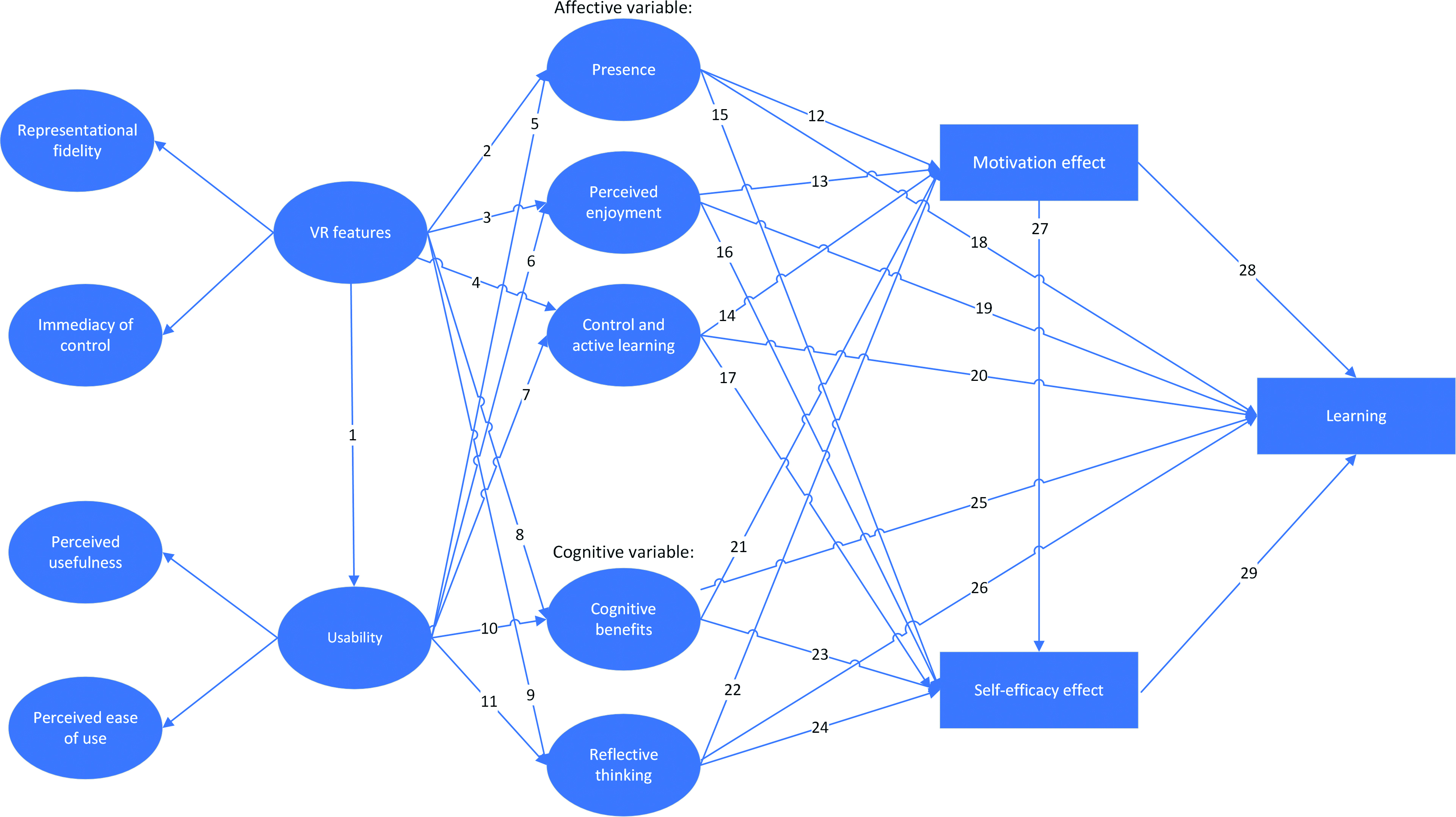
The theoretical framework was adopted for the study (Makransky & Petersen, 2019).
Citation: Innovation and Education 6, 1 (2024) ; 10.1163/25248502-bja00003
The framework from Makransky Petersen (2019) includes the models and relationships from several previous studies examining usability, motivation, self-efficacy, and perceived enjoyment of a virtual environment. These aspects were brought together in the form of questions in the validated questionnaire (Makransky & Petersen, 2019) that was used in this study for quantitative data collection. This framework is developed around the theoretical underpinnings that pst s need content knowledge (ck) and pedagogy (pk) to develop their teaching capacity, and at the intersect of this is pedagogical content knowledge (pck) which in this case is the content knowledge and pedagogical approaches required to teach secondary science to students (Shulman, 1986; Shulman, 2013; (Sheffield et al., 2015; Widodo, 2017).
Research Aim
This project examined the perceived value of the gamification software Labster, including its ease of use, enjoyment, engagement of pst s for their own use and potential use when teaching in science classrooms.
The specific research questions are:
- (1) How have pst s evaluated the game-based simulation in terms of usefulness and ease of use when measured by Maranskyâs 2019 framework?
- (2) How did pst s perceive game-based simulations supporting their learning?
- (3) How did pst s perceive game-based simulations supporting studentsâ learning from the view of a teacher?
Methodology
The project is based on a socio-ecological approach that values the role of individual context interaction for development (Bronfenbrenner & Morris, 2006; Ungar, 2012). It adopts a mixed-method research design which provides: â⦠a framework within which people can respond in a way that represents accurately and thoroughly their points of view about the world â¦â (Patton, 1990, p. 24). Mixed-method research designs are increasingly popular in the field of education, offering a comprehensive approach to understanding complex issues (Pereira-Pérez, 2011). This is particularly relevant in design education, where the integration of qualitative and quantitative data can enhance the rigour of research training (Greene et al., 1989). Greene et al. (1989) further emphasises the benefits of this approach in educational technology, highlighting its ability to harness the strengths of both qualitative and quantitative traditions. Collectively, these studies underscore the value of mixed-method research designs in education, particularly in addressing the multifaceted nature of educational issues. The methodological approach is a phenomenological one that aims to understand the structure and essence of a particular phenomenon, in this case, Labster gamification software, for a group of people, which in this case is preservice educators.
Participants
The sample for this study consisted of 16 pst s who were enrolled in the Lower Secondary c&i unit. Participants were invited to complete a survey as outlined below, and a group of ten pst s were then interviewed to determine their views, experiences and confidence with Labster. Ethics was granted through the University ethics committee, and students were invited to participate and provided with letters outlining the details to ensure informed consent.
Data Collection
Instrument and Procedure
Learning and Gamification. The survey was made available through the universityâs protected survey instrument called Qualtrics, which posed questions on Gamification softwareâs perceived affordances and was completed by 16 pst s. Responses to open-ended questions, e.g. âPlease tell us your thoughts about gamification in science/stem educationâ, on the value of gamification, received 21 responses. The gamification survey has been validated in previous studies by Makransky & Petersen (2019) and included a range of 40 questions.
Interviews. Six semi-structured interviews (Appendix 1) were conducted with ten of the 16 students who participated in the survey. pst s were volunteered to be interviewed either individually or in groups at the conclusion of the semester of engagement with the Labster simulations. Questions focused on their use of the Labster simulation and how they felt they could or could not use it in their science classrooms once they were qualified.
Data Analysis
Quantitative Data: The learning and Gamification survey was administered after pre-service teachers were exposed to the gamification learning strategy, and the results were examined and grouped around the framework nodes from Makransky Petersenâs (2019) framework. These nodes from the previously validated survey included Representational fidelity, Immediacy of Control, Perceived usefulness, Presence, Perceived enjoyment, and Control and active learning. It was felt that these were the aspects of the framework that best suited the experiences of pre-service educators through the validated survey that was used. The data was aggregated on the Likert scales used based on the number of responses/students, and the open responses were coded into themes by all three researchers separately to ensure fidelity.
Qualitative Data: For interview data (thematic) analysis (Grbich, 1999) was employed. Transcribed interviews and online survey transcripts were coded deductively and inductively. The analysis was drawn by a team that consisted of teaching members and members not involved in teaching the units. The interview was coded as follows: First, interviews were transcribed, followed by the line-by-line analysis of data, together with theoretical memos written at the time of data collection (Grbich, 1999; Maguire & Delahunt, 2017). The purpose of open coding was to produce a series of emerging categories and their properties. Secondly, connected each code with selective coding. It is the process by which all categories are unified around a âcoreâ category. All of the processes were reviewed and discussed by the research team (Maguire & Delahunt, 2017). Information identified from the transcript was categorised and structured to create a coherent explanation or description of aspects that contributed to the PST efficacy based on the frequency (Maguire & Delahunt, 2017).
Results
pst s perceptions of the value of gamification (Labster) in science/stem education:
The open-ended question about the value of gamification as reported by pst s was answered by 16 pst s. Responses from four pst s fitted in more than one category making a total number of responses to a total of 26. These responses were grouped into five categories: engagement/motivation, learning (including content and skills), equity, negative response and unsure. The responses from the open-ended questions were categorised by all members of the research team separately and then cross-checked, and categories are based on the frequency of responses.
pst s perceptions of the value of gamification (Labster) in science education with numbers and percentage n=26 responses(4 responses fitting in two categories)
| Category | Number | % | Quotes Example |
|---|---|---|---|
| Motivation (Engagement) | 12* | 46.15 | Allows kids to break away from usual boring writing and learn through game-based education (pst 18) *Gamification in science is the process of involving gaming techniques to enhance learning. Through using a software or online community, students get involved in the process of learning. This is a great way not only to motivate students but help achieve long term participation from the students (pst 20) |
| Learning | 9* | 34.61 | I think it makes the subject more interactive, interesting and can make it more understandable for students to get involved in (pst 10) Science is a subject filled with experiments, involving group work in the form of little games is a great way to engage students in the science learning (pst 20) |
| Unsure | 3 | 11.5 | I donât know much about gamification; however, I would be interested to learn more about this (pst 3) |
| Equity | 1 | 3.85 | I think it can be used as an additional resource for students, especially those who do not have abundant access to laboratories and proper science classrooms (pst 8) |
| Negative | 1 | 3.85 | However, using a point system or competition may damage or hurt another studentâs morale, as it may portray them as bad (pst 5) |
4 in both learning and motivation
pst s perceptions of the game-based simulationsâ usability
Table 2 reports the Usability of the tool taken using the framework proposed by Makransky and Petersen (2019), which has a number of categories, of which only the ones below have been considered. The responses to the Usability questionnaire were collected on a four-point Likert Scale Do Not Agree (da), Neither-Nor (N-N), Agree (A) and Strongly Agree (SA).
representational fidelity,
immediacy of control,
perceived usefulness,
immediacy of control,
perceived ease of use,
presence,
perceived enjoyment,
Control of learning
cognitive benefits
reflective
The Learning and Gamification survey, which was administered at the end of the teaching semester and the frequency of response choices to each of the questions is presented in Table 2.
pstâs response frequency and percentages on the categories of the survey.
| ITEM | DA | N-N | A | SA | ||
|---|---|---|---|---|---|---|
| Representational fidelity | 1 | The realism of the 3-D images in Labster motivates me to learn | 1(6.3) | 8(50) | 6(37.5) | 1(6.3) |
| 29 | I was involved in the experimental task to the extent that I lost track of time. | 1(6.3) | 3(18.8) | 7(43.8) | 5(31.3) | |
| 2 | The ability to change the view position of the 3-D objects makes learning more motivating and interesting. | 1(6.3) | 10(62.5) | 5(31.3) | ||
| Immediacy of Control | 3 | The ability to manipulate the objects (e.g., pick up, cut, change the size) within the virtual environment makes learning more motivating and interesting. | 2(12.5) | 11(68.8) | 3(18.8) | |
| 4 | Labstersâ ability to allow me to manipulate the objects in real-time helps to enhance my understanding | 4(25) | 9(56.3) | 3(18.8) | ||
| Perceived usefulness | 5 | Using this type of virtual reality/computer simulation as a tool for learning will increase my learning and academic performance. | 3(18.8) | 6(37.5) | 6(37.5) | 1(6.3) |
| 6 | Using Labster simulations will enhance the effectiveness of my learning. | 3(18.8) | 8(50) | 4(25) | 1(6.3) | |
| 7 | This type of virtual reality simulation will allow me to progress at my own pace | 5(31.3) | 7(43.8) | 4(25) | ||
| 8 | The Labster simulation is useful in supporting my learning. | 6(37.5) | 5(31.3) | 4(25) | 1(6.3) | |
| Perceived ease of use | 9 | Learning to operate this type of virtual reality program is easy for me. | 6(37.5) | 7(43.8) | 2(12.5) | 1(6.3) |
| 10 | Learning how to use this type of virtual reality program is too complicated and difficult for me. | 8(50) | 4(25) | 4(25) | ||
| 11 | It is easy for me to find information with the virtual reality program. | 2(12.5) | 5(31.3) | 8(50) | 1(6.3) | |
| 12 | Overall, I think this type of virtual reality program is easy to use. | 3(18.8) | 9(56.3) | 4(25) | ||
| Presence | 13 | My interaction with the simulation environment seemed natural. | 1(6.3) | 6(37.5) | 5(31.3) | 4(25) |
| 14 | My experiences in Labsterâs virtual environment seemed consistent with real-world experiences. | 9(56.3) | 4(25) | 3(18.8) | ||
| 15 | I was engaged in the virtual environment experience. | 2(12.5) | 6(37.5) | 6(37.5) | 2(12.5) | |
| 16 | I was involved in the experimental task to the extent that I lost track of time. | 3(18.8) | 4(25) | 9(56.3) | ||
| Perceived enjoyment | 18 | I find using computer simulations enjoyable. | 3(18.8) | 8(50) | 3(18.8) | 2(12.5) |
| 19 | Using computer simulations is pleasant. | 3(18.8) | 8(50) | 3(18.8) | 2(12.5) | |
| 20 | I have fun using computer simulations. | 1(6.3) | 8(50) | 5(31.3) | 2(12.5) | |
| Control and active learning | 17 | This type of virtual reality simulation is useful in supporting my learning. | 1(6.3) | 10(62.5) | 3(18.8) | 2(12.5) |
| 22 | This type of virtual reality program helps me to have a better overview of the content learned. | 2(12.5) | 9(56.3) | 4(25) | 1(6.3) | |
| 23 | This type of virtual reality program allows me to be more responsive and active in the learning process. | 2(12.5) | 8(50) | 5(31.3) | 1(6.3) | |
| 24 | Using Labster allowed me to have more control over my own learning. | 3(18.8) | 7(43.8) | 3(18.8) | 3(18.8) | |
| 25 | Labster helps to get me engaged in the learning activity. | 3(18.8) | 7(43.8) | 5(31.3) | 1(6.3) | |
| Cognitive benefits | 26 | This type of virtual reality program makes comprehension easier. | 2(12.5) | 5(31.3) | 8(50) | 1(6.3) |
| 27 | This type of virtual reality program makes memorisation easier. | 1(6.3) | 4(25) | 8(50) | 3(18.8) | |
| 28 | This type of virtual reality program helps me to better apply what was learned. | 2(12.5) | 11(68.8) | 2(12.5) | 1(6.3) | |
| 30 | This type of virtual reality program helps me to better analyse the problems. | 2(12.5) | 6(37.5) | 6(37.5) | 2(12.5) | |
| Reflective thinking | 31 | Virtual reality simulations enable me to reflect how I learn. | 1(6.3) | 7(43.8) | 6(37.5) | 2(12.5) |
| 32 | Virtual reality simulations enable me to link new knowledge with previous knowledge and experiences. | 3(18.8) | 10(62.5) | 2(12.5) | 1(6.3) | |
| 34 | Virtual reality simulations enable me to become a better learner | 2(12.5) | 6(37.5) | 7(43.8) | 1(6.3) | |
| 35 | Virtual reality simulations enable me to reflect my own understanding. | 2(12.5) | 7(43.8) | 5(31.3) | 2(12.5) |
In the area of Representational fidelity, 75% of pst s agreed or strongly agreed that they lost track of time while working on Labster, and 65% were unsure or disagreed that the realism motivated them to learn. In the area of Immediacy of Control, pst s did not report that any of the features of the Labster simulation made their learning any more motivating or interesting. However, the group did not feel strongly about the negative but were more ambivalent about the capacity of the Labster simulation. In the area of Perceived usefulness, it was clear that the pst s that responded did not feel that the Labster simulation increased their learning, nor did they feel it enabled them to progress at their own pace. In the area of Perceived ease of use, the pst s did not find this type of virtual reality program easy, but they were split about whether the program was too difficult for them to use.
For the area of Presence, pst s again were split about their simulation environment, with half agreeing that the simulation seemed natural. Further to this, half of pst s either agreed they were engaged by the environment, while the other half neither agreed nor disagreed or disagreed that they were engaged. When asked about Perceived enjoyment, the pst s were also ambivalent about their enjoyment and fun whilst using the virtual simulation, with 50% reporting half neither agreeing nor disagreeing and nearly 20% reporting they disagreed. For the area of Control and active learning, pst s were also ambivalent about how the simulation supported their learning. 82% either disagreed or neither agreed nor disagreed that simulation helped them to have a better overview of the content learned. 62% either disagreed or neither agreed nor disagreed. The simulation allowed them to be more responsive and active in the learning process. 62% either disagreed or neither agreed nor disagreed that the simulation allowed them to have more control over their own learning or helped to get them engaged in the learning activity. In the area of Cognitive benefits, over 50% of the pst s determined that Labster made comprehension easier, and 70% of pst s reported that Labster made memorisation easier, but nearly 70% of pst s were not sure that Labster helped them to better apply their learning and pst s were equally split on if Labster helps them analyse the problems. In the area of reflective thinking, 50% of the pst s thought that Labster helped support them in reflecting on their learning and their prior knowledge, but this meant that the majority of pst s were ambivalent again. With 62% of pst s choosing neither/nor to the question âVirtual reality simulations enable me to link new knowledge with previous knowledge and experiencesâ whilst only 18% of pst s agreed that Labster did connect newly gained knowledge in the simulation with their prior learning experiences
stem- pst s Interviews
The interview data was collated around the key questions, and the emerging themes explored are presented in Table 3. pst s were asked to reflect as learners and from a teacherâs perspective if Labster was useful for them, as well as the challenges and the best aspects of Labster (see Table 3). The results were grouped into the categories previously identified in the data, and this is shared here and reviewed in the discussion. The categories are not represented equally here as they depended on the focus of the pst s in the interview. The interviews were examined from a learnersâ perspective, including pst s as learners. The scattering of the single-frequency responses in a number of categories demonstrates the idiosyncratic knowledge displayed.
s- psts Interview Comments as the Learner
| Theme | Sub-Category | Frequency Total | Grand Total |
|---|---|---|---|
| Representational fidelity | Access (+) | 1 | 1 |
| Immediacy of Control | Learning Approach (-) | 1 | 3 |
| Frustration (-) | 1 | ||
| Pretend (+) | 1 | ||
| Perceived usefulness | Filling in content knowledge (+) | 3 | 3 |
| Perceived ease of use | Technical Issues (-) | 1 | 6 |
| Computer Issues (-) | 2 | ||
| Game Issues (-) | 2 | ||
| Frustration (-) | 1 | ||
| Presence | Positive (+) | 2 | 3 |
| Frustration (-) | 1 | ||
| Perceived enjoyment | Positive (+) | 3 | 4 |
| Negative (-) | 1 | ||
| Control and active learning | Flow (+) | 1 | 4 |
| Gate Keeping (+) | 1 | ||
| Kinaesthetic (+) | 1 | ||
| Choice (+) | 1 | ||
| Cognitive benefits and reflective thinking | Knowledge | 6 | 6 |
| 30 |
psts Interview Comments as the teacher
| Theme | Sub-Category | Frequency Total | Grand Total |
|---|---|---|---|
| Representational fidelity | Access (+) | 1s | 1s |
| Perceived usefulness | Filling in content knowledge (+) | 2 | 3 |
| Not useful (-) | 1s | ||
| Perceived ease of use | Too advanced for middle-year students (-) | 1s | 2 |
| Not connected to Australian curriculum (-) | 1s | ||
| Presence | Engaging (+) | 2 | 2 |
| Perceived enjoyment | Fun for the age level of students (+) | 2 | 2 |
| Control and active learning | Gatekeeping (+) | 1s | 2 |
| Prevents behavioural issues (+) | 1s | ||
| Cognitive benefits and reflective thinking | With changes to questions (+) | 1s | 5 |
| Sparingly (-/+) | 1s | ||
| As a Formative tool (+) | 1s | ||
| Complementary to the textbook (+) | 1s | ||
| Negative (-) | 1s | ||
| 15 |
In Tables 3 and 4, the interview data is summarised. pst s reported that there were a number of issues with the running of Labster. As learners, they could see plenty of cognitive benefits, but there were technical issues and issues around the ease of use. The positive comments are represented with a sign (+), while as negative comments have a sign (-) next to them. As teachers, they thought it was not connected to the Australian curriculum and may only be suitable for senior secondary students, although they did think it was fun. pst s also reported a positive, engaging experience for students, and they could see how it could prevent behavioural issues.
Discussion
psts initial perceptions of the value of Gamification (Labster) in Science and stem Education
In this very small sample of pst s who are training to be secondary science educators they initially indicated that they thought that Gamification was a positive option for use in science education, with (12) 54% indicating that it might be good for motivation (Table 1). The comment indicates, âAllows kids to break away from usual boring writing and learn through game student-based educationâ (pst 18). Nine, 40% indicated that they thought it would support students learning. 15% (3) of students were unsure of the value of gamification in science education, and one student was concerned about the negative aspects of gamification. This is significantly lower than the reported data, which determined that gaming engages and supports learning.
Improving pst Content Knowledge (ck)
In the area of active learning (Table 2), only 40% agreed or strongly agreed that Labster supported their learning, and this was supported by four comments about the positive flow of the activities control and active learning, whilst 62% reported they didnât feel it had (neither/nor response). When pst s were asked if âThis type of virtual reality program helps me to have a better overview of the content learnedâ, only 29% reported agreeing or strongly agreeing, with 57% again ambivalent (neither/nor). In the interviews, four students reported positive comments about some simulations, and they reported positives about choice, kinesthetics and flow. With one pst reporting
âI found something very interesting compared to other programmes that Iâve used before when I chose the topic. So that was definitely something very new and interestingâ (pst 3).
In Cognitive learning (Table 9), again, the pst s were divided, and it is noted that this continues to be a relatively small sample. 56% of pst s agreed or strongly agreed that Labster made comprehension easier, and 70% agreed or strongly agreed Labster made memorisation easier. Whilst 50% agreed or strongly agreed that Labster helped them analyse the problem, only 18% of pst s thought they were better able to apply their learned knowledge after using Labster. In Table 4, which asked about reflection and reflective thinking, 50% of pst s reported that they were better learners using Labster, with 37% not sure and 43% of pst s saying that Labster improved their ability to reflect on their learning, whilst 43% were unsure and 21% disagreed. Only 18% agreed or strongly agreed that Labster enabled them to link new knowledge with previous knowledge and experiences; 62% were unsure, and 19% disagreed. In the interviews, six of the 30 comments related to improvement in understanding knowledge.
Pedagogical Content Knowledge
When asking pst s how they would use Labster in their classroom and how they might embed this tool in their classes as part of their pedagogical approach, they responded by examining the tool, and their comments have been grouped into the following categories.
Suitability: Too Advanced for Middle School I know, it wasnât very good for, like, younger years (pst 9)
Even, you know, itâs obviously a resource thatâs used internationally, so it canât be accredited to a specific grade level, but even just a general difficulty indicator would be quite useful (pst 5)
Enjoyment: I think from the studentâs perspective, I think they would enjoy it because the ones I would be teaching would definitely be like, way younger than me, you know, probably in the 13-14 years. (pst 3)
Behavioural Management: So, you canât really do anything bad on it. This is because I think, obviously, you keep relating it to what it would be like in a classroom of year sevens that were trying to move around the lab on this virtual lab and just thinking of all the things that they could try and do. (pst 2)
Use: Iâd also probably use it sparingly because I think it can become quite exhaustive in the way that I guess, from my experience, lots sort of follow a similar structure of questions and all that sort of stuff (pst 5)
As a teacher, I wouldnât replace textbooks with it because thereâs quite a lot of essential stuff in textbooks. And students need to have that in that format for when they do tests and stuff (pst 10).
I think almost a textbook would be more useful just because then you know, like, this is the level of teaching Year 8. Thatâs what they need to know (pst 2).
Content: With the content, I think it covers quite a bit. It covers the basics. And then on top of that, it applies the theory, the content that, you know, with the assessment, I think, instead of just, I think most of it is like multiple choice (pst 9).
pst s identified that they would teach using textbooks as well as Labster and were concerned that Labster would be exhaustive if it was used all the time (Table 5). They did comment that it would keep students on task and control possible behaviour issues, so they recognised this might be a useful learning tool. There was an understanding that if the pst s enjoyed gaming, they would be more likely to use gamification with their student, with one pst reporting.
âI really loved gamification. I played a lot of games, and a lot of them involved a lot of math arbitrarily. Like magical gatherings, for example. And I think gamification is extremely useful in Education generally because itâs all about that engagement, gamification, from what I see of it and what I understand if it really promotes that engagement, which is so criticalâ (pst 6).
Rating by preservice student teachers of the gamification software Labster based on the factors contained in the framework by Makransky & Petersen (2019). The gamification software Labster was reviewed using the criteria from Makransky Petersen (2019). For the Simulation Environment (vr), there were two criteria, including representational fidelity and immediacy of control (Table 4 and 5). With representational fidelity, 44% of pst s reported positively about how they felt motivated to learn using Labster, whereas 50% responded as neither nor and so not impacted nor motivated using Labster. When asked if they were able to keep track of time, however, 87% agreed or strongly agreed that they lost track of time when using Labster. In the immediacy of control, students reported that they neither agreed nor disagreed with how the simulation enabled them to manipulate tools or enhance their understanding. In the interview, there were strongly positive comments and strongly negative ones, including.
âYes, the best aspect is being able to pretend that youâre doing something, so the simulation part is very nice (pst 1), and Iâve had a lot of the experiments that I was doing, did pipette things into different containers. I didnât quite get what they wanted me to do, so I kept stuffing it up and filling up the wrong containers.â (pst 2)
In the area of usability, there are two categories: Perceived Usefulness and Perceived Ease of use. pst s are reported in both Tables 4 and 5. 75% of pst s did not agree that the simulation allowed them to progress at their own pace, and 67% did not agree that Labster supported their learning. 80% of pst s reported that Labster was not easy for them to use, and 50% agreed that it is too complicated and difficult. Finally, to the survey question, âOverall, I think this type of virtual reality program is easy to use,â 75% of pst s reported that it wasnât easy to use. These frustrations were also indicated in the interviews, with 6 of the 30 comments distilled from participating pst s.
âI thought my computer was going to explode. Sounded like an aeroplane. But it did run it. It did run it. So I think definitely having a good computer system to use it on (pst 7). Yes, I didnât like how Dr. One talked a lot. And then you canât fast forward. Itâs like, I think he explains too much. But and I donât really like that I prefer to just be able to refer back to the theoryâ (pst 1).
In the section linked to online Presence, when pst s reported, 56% said that their interaction with the Labster environment seemed natural. However, 56% reported that they were unable to see how Labster was consistent with real-world experiences. When asked about their engagement, pst s were completely split about their engagement, with ½ responding positively and the others neutral to negative.
Finally, pst s reported that they did have fun, with 50% agreeing and strongly agreeing, but when asked if Labster was pleasant and enjoyable, 50% of students were ambivalent, 19% disagreed, and 30% agreed that Labster was pleasant and enjoyable.
Conclusion
The limitation of the study was the small number of students who participated in the survey and the interviews. pst s did not universally feel that Labster improved their science content knowledge (sck) and their capacity to teach students or their pedagogical content knowledge. Whilst some pst s reported that Labster did improve their cognitive experiences and their reflective practice, an equal number were not sure and, therefore, were in the neither/nor category.
pst s reported that although they enjoyed the idea of gamification to support their learning, some of them reported that their experiences with Labster did not match these expectations. This study was polarising, with some pst s reporting that they found that Labster was clunky and difficult to use, and they did not enjoy the linear pathways and lack of control of the learning, whilst another student who did play games found Labster engaging and thought that students would as well, for instance, âI really loved gamification. I played a lot of games, and a lot of them involved a lot of math arbitrarily. And I think gamification is extremely useful in Education generally, because itâs all about that engagement, gamification, from what I see of it and what I understand if it really promotes that engagement which is so criticalâ (pst 6).
Despite the billions of dollars in gaming, most of these funds are in recreational gaming, where there are millions of gamers/users and also millions of observers. Educational gaming is a very poor cousin with much smaller amounts of funds invested into these games. In this case, the reduced funding may have resulted in a less polished game, which is why the game appears less âuser friendlyâ to the users, which impacted the play of experienced gamers and frustrated pst s who are not gamers less experienced. Labster was a single-play simulation where the participant worked in isolation and could not collaborate or communicate with peers; the linear pathway prevented decision-making and creativity, and if the participant was unable to answer a question, the simulation would not proceed. The player was able to use their problem-solving skills to answer the questions.
The authors of this research postulate that whilst Labster has the foundations to allow students to engage with a range of stem knowledge bases, the inability to use the stem-based skills of communication, creativity and collaboration was detrimental to its overall effectiveness. If these stem-related skills were embedded into the play matrix, then this tool would become more engaging and interactive, which may then have engaged the pst s more deeply and provided a more motivating and fulfilling learning experience for both them and their future stem students.
Author Contributions
Conceptualisation, R.K, R.S, C.S Methodology R.K, R.S, C.S Software, R.K, R.S, C.S Validation, R.K, R.S, C.S Formal analysis, R.K, R.S, C.S Investigation R.K, R.S, C.S Resources, R.K, R.S, C.S; Writingâoriginal draft, R.K, R.S, C.S ; Writingâreview & editing, R.K, R.S, C.S; administration, R.K, R.S, C.S.; Funding acquisition, R.S, C.S. All authors have read and agreed to the published version of the manuscript.
Funding
This research received no external funding.
Acknowledgements
The authors acknowledge the internal university funding from Curtin School of Education. This provided the software licences to the participants.
Conflicts of Interest
The authors declare no conflict of interest.
References
Adi Putra, M. J., Widodo, A., & Sopandi, W. (2017). Science Teachersâ Pedagogical Content Knowledge and Integrated Approach. Journal of Physics: Conference Series, 895, 012144. https://doi.org/10.1088/1742-6596/895/1/012144
Anthology. (2023). Blackboard Learn. Anthology. https://www.anthology.com/products/teaching-and-learning/learning-effectiveness/blackboard-learn
Adkins, S. (2019, August 1). The 2019-2024 Global Game-based Learning Market. Metaari
Appleton, K., & Kindt, I. (1999, March). How do beginning elementary teachers cope with science: Development of pedagogical content knowledge in science. National Association for Research in Science Teaching.
Astin, A. W., & Astin, H. S. (2000). Leadership reconsidered: Engaging Higher Education in Social Change. Battle Creek, MI: W.K. Kellogg Foundation.
Australian Bureau of Statistics. (2001, August 22). Australian Standard Classification of Education (asced), 2001 | Australian Bureau of Statistics. www.abs.gov.au. https://www.abs.gov.au/statistics/classifications/australian-standard-classification-education-asced/latest-release
Australian Government Department of Industry, Science and Resources. (2022). advancing women in stem a stem equity monitor Data report 2022. https://www.industry.gov.au/sites/default/files/2022-09/stem-equity-monitor-data-report-2022.pdf
Australian Institute for Teaching and School Leadership. (2017). Australian Professional Standards for Teachers. Australian Professional Standards for Teachers; Australian Institute for Teaching and School Leadership. https://www.aitsl.edu.au/standards
Barbosa, A. D. (2013). The professional knowledge base of science teaching. Journal of Biological Education, 48(3), 172â172. https://doi.org/10.1080/00219266.2013.849287
Bernstein, L. (2019, February 14). New Global Survey Offers Snapshot of Technology in the Classroom. EdTech
Bonde, M. (2023). Labster â A Decade of Research to Improve Science Learning. Www.labster.com. https://www.labster.com/research/decade-of-research-to-improve-science-learning
Brantley-Dias, L. & Ertmer, P. (2013). Goldilocks and tpack: Is the Construct âJust Right?â jrte | Vol. 46, No. 2, pp. 103â128
Bronfenbrenner, U., & Morris, P. A. (2006). The bio-ecological model of human development. In R. M. Lerner (Ed.), Handbook of child psychology (6th ed., Vol. 1, pp. 793-828). John Wiley & Sons.
Catalano, A., Asselta, L., & Durkin, A. (2019). Exploring the Relationship between Science Content Knowledge and Science Teaching Self-Efficacy among Elementary Teachers. iafor Journal of Education, 7(1). https://files.eric.ed.gov/fulltext/EJ1217961.pdf
Chang, J. (2021) 54 Gamification Statistics You Must Know: 2020/2021 Market Share Analysis & Data https://financesonline.com/gamification-statistics/
Charania, A., Davis, N., Wortmann, K., Schoeny, Z. G., Cohen, S., & Alexander, C. (2008). Assessing preservice teachersâ competence as a Virtual Schooling site facilitator. Society for Information Technology & Teacher Education International Conference, 2008(1), 267â272.
Citrusbits (2020, December 3). How Gamification Has Catapulted Duolingo, Strava, and Forest to the Top of their Respective App Categories. Citrusbits
Coyne, I. (2006). Childrenâs Experiences of Hospitalization. Journal of Child Health Care, 10(4), 326â336. https://doi.org/10.1177/1367493506067884
Davis, N. (2021). Gamification in science education: A systematic review of the literature. Educational Technology & Society, 24(3), 171â186.
Dicheva, D. & Dichev, C. (2015). Gamification in Education: Where Are We in 2015? In Proceedings of E-Learn: World Conference on E-Learning in Corporate, Government, Healthcare, and Higher Education (pp. 1445-1454). Kona, Hawaii, United States: Association for the Advancement of Computing in Education (AACE). Retrieved November 2020 from https://www.learntechlib.org/primary/p/152186/.
Fisher, C. R., Thompson, C. D., & Brookes, R. H. (2020). Gender differences in the Australian undergraduate stem student experience: a systematic review. Higher Education Research & Development, 1â14. https://doi.org/10.1080/07294360.2020.1721441
Foundation for Young Australians. (2019). Investing in Young Australians: Fact Sheet. In Foundation for Young Australians. https://www.fya.org.au/wp-content/uploads/2019/01/FYA_Campaign_National-FS_07.pdf
Foundation of young Australians. (2016). the new work mindset 7 new job clusters to help young people navigate the new work order fyaâs New Work Order report series.
Gess-Newsome, J., Taylor, J. A., Carlson, J., Gardner, A. L., Wilson, C. D., & Stuhlsatz, M. A. M. (2017). Teacher pedagogical content knowledge, practice, and student achievement. International Journal of Science Education, 41(7), 944â963. https://doi.org/10.1080/09500693.2016.1265158
Greene, J. C., Caracelli, V. J., & Graham, W. F. (1989). Toward a Conceptual Framework for Mixed-Method Evaluation Designs. Educational Evaluation and Policy Analysis, 11(3), 255â274. https://doi.org/10.3102/01623737011003255
Grbich, C. (1999). Qualitative Research in Health: An Introduction. St Leonards: Allen & Unwin.
Hamari, J., Koivisto, J., & Sarsa, H. (2014). Does gamification work? A literature review of empirical studies on gamification. Proceedings of the 47th Hawaii International Conference on System Sciences, Waikoloa, HI, 6-9 January 2014 (pp. 3025-3034). IEEE Computer Society. https://doi.org/10.1109/HICSS.2014.377
Huotari, K., Hamari, J. (2017). A definition for gamification: anchoring gamification in the service marketing literature. Electron Markets 27, 21â31 (2017). https://doi.org/10.1007/s12525-015-0212-z
Huk, T. (2021). From Education 1.0 to Education 4.0 â Challenges for the Contemporary School. The New Educational Review, 66(4), 36â46. https://doi.org/10.15804/tner.21.66.4.03
Instructure. (2008). Canvas Overview. Instructure. https://www.instructure.com/en-au/canvas
International Education Association of Australia (ieaa). (2022). Learning Abroad in Australian Universities, White Paper, https://www.ieaa.org.au/networks/learning-abroad-white-paper.
Juul, J. (2003). The game, the player, the world: Looking for a heart of gameness. In M. Copier, & J. Raessens (Eds.), Level-up: digital games research conference proceedings (pp. 30â45). The Netherlands: Utrecht.
Karadag, R. (2015). Pre-service Teachersâ Perceptions on Game Based Learning Scenarios in Primary Reading and Writing Instruction Courses. Educational Sciences: Theory & Practice, 15(1), 185â200. https://doi.org/10.12738/estp.2015.1.2634
Kaufman, J. C., & Beghetto, R. A. (2009). Beyond Big and Little: the Four C Model of Creativity. Review of General Psychology, 13(1), 1â12. https://doi.org/10.1037/a0013688
Kind, V. (2009). Pedagogical content knowledge in science education: perspectives and potential for progress. Studies in Science Education, 45(2), 169â204. https://doi.org/10.1080/03057260903142285
Kind, V. (2014). Science teachersâ content knowledge. In H. Venkat, M. Rollnick, J. Loughran, & M. Askew (Eds.), Exploring Mathematics and Science Teachersâ Knowledge Edition: 1 (pp. 2â15). Routledge.
Legaki, N., Xi, N., Hamari, J., Karpouzis, K., & Assimakopoulos, V. (2020, December). The effect of challenge-based gamification on learning: An experiment in the context of statistics education. International Journal of Human-Computer Studies, p. 144. doi: 10.1016/j.ijhcs.2020.102496. ScienceDirect
Lewis, P. J. (2011). Storytelling as Research/Research as Storytelling. Qualitative Inquiry, 17(6), 505â510. https://doi.org/10.1177/1077800411409883
Maguire, M., & Delahunt, B. (2017). Doing a thematic analysis: A practical, step-by-step guide for learning and teaching scholars. aishe-j v, 9(3). (Autumn 2017) 3351.
Marshall, J. A., Erickson, T., & Sivam, K. (2015). Preservice Teachers Exploring the Nature of Science in Simulated Worlds. International Journal of Gaming and Computer-Mediated Simulations, 7(2), 24â45. https://doi.org/10.4018/ijgcms.2015040102
Makransky, G. & Petersen, G. (2019). Investigating the process of learning with desktop virtual reality: A structural equation modelling approach, Computers & Education, 134, 15-30 https://doi.org/10.1016/j.compedu.2019.02.002.
MarketsandMarkets (2020, March). Gamification Market by Component (Solution and Services), Deployment (Cloud and On-premises), Organization Size (sme s and Large Enterprises), Application, End-User (Enterprise-Driven and Consumer-Driven), Vertical, and Region â Global Forecast to 2025 Moog R. S., & Spencer, J. N. (2008). pogil: An Overview. acs Symposium Series, 1â13. https://doi.org/10.1021/bk-2008-0994.ch001
National Science Foundation. (2010). Why Teachersâ Science Content Knowledge Matters: A Summary of Studies. http://www.mspkmd.net/pdfs/blast22/3b1.pdf
OâDonnellan, R. (2019, November 14). Learning via Gamification: Latest Data, Stats & Trends. Intuition
Patton, M. (1990). Qualitative evaluation and research methods (pp. 169â186). Beverly Hills, CA: Sage.
Prescient & Strategic Intelligence. (n.d.). Global personal robots market size, share, development, growth and demand forecast to 2022âIndustry insights by type (cleaning robot, entertainment & toy robot, education robot, handicap assistance robot, companion robot, personal transportation robot, security robot, and others). Retrieved from https://www.psmarketresearch.com/market-analysis/personal-robot-market
Queensland Government. (2022, December 8). swot analysis. Business Queensland. https://www.business.qld.gov.au/running-business/planning/swot-analysis
Rabah, C. R., & Beauchemin, R. (2018, Nov). Gamification in Education: Real Benefits or Edutainment? European Conference on e-Learning; Kidmore End: 489â496, xiii, xix. Kidmore End: Academic Conferences International Limited.
Radloff, J., & Guzey, S. (2016). Investigating Preservice stem Teacher Conceptions of stem Education. Journal of Science Education and Technology, 25(5), 759â774. https://doi.org/10.1007/s10956-016-9633-5
Ray, B. B., Powell, A., & Jacobsen, B. (2014). Exploring Preservice Teacher Perspectives on Video Games as Learning Tools. Journal of Digital Learning in Teacher Education, 31(1), 28â34. https://doi.org/10.1080/21532974.2015.979641
Sheffield, R., Dobozy, E., Gibson, D., Mullaney, J., & Campbell, C. (2015). Teacher education students using tpack in science: a case study. Educational Media International, 52(3), 227â238. https://doi.org/10.1080/09523987.2015.1075104
Sheffield, R., & Koul, R. (2023). Preparing Science Teachers for Tomorrow With Transversal Competencies. In Fostering Science Teaching and Learning for the Fourth Industrial Revolution and Beyond. IGI Global.
Shulman, L. (1986). Those Who Understand: Knowledge Growth in Teaching. Educational Researcher, 15(2), 4â14. https://www.wcu.edu/webfiles/pdfs/shulman.pdf
Shulman, L. S. (2013). Those who Understand: Knowledge Growth in Teaching. Journal of Education, 193(3), 1â11. https://doi.org/10.1177/002205741319300302
The Department of Education, Skills and Employment, (2020) (https://www.dese.gov.au/australian-curriculum/national-stem-education-resources-toolkit/introductory-material
Ungar, M. (2012). Social ecologies and their contribution to resilience. In M. Ungar (Ed.), The social ecology of resilience: A handbook of theory and practice (pp. 13â31). Springer Science + Business Media. https://doi.org/10.1007/978-1-4614-0586-3_2
US Census Bureau (2021, March 23). Measuring Household Experiences during the Coronavirus Pandemic. US Census Bureau
Vu, P., K. Zie Barth-Bovill, J., Fredrickson, S., & Hoehner, P. (2016). An Examination of Pre-Service Teachersâ Attitudes towards Game-Based Learning. In Handbook of Research on Gaming Trends in P-12 Education (p. pp. 294-305.). IGI Global.
Widodo, A. (2017). Teacher pedagogical content knowledge (pck) and studentsâ reasoning and wellbeing. Journal of Physics: Conference Series, 812(1). p. 012119. IOP Publishing.
Zulay Pereira-Pérez. (2011). Mixed Method Designs in Education Research: A Particular Experience. Revista Electrónica Educare, 15(1), 15â29.
Appendix 1
Semi-Structured Interview Questions:
- 1) Do you feel that Labster was a useful tool for you as a student?
Please explain
- 2) Do you feel that Labster was a useful tool for you as a teacher?
Please explain
- 3) What was the best aspect of Labster, and what were the issues with Labster?