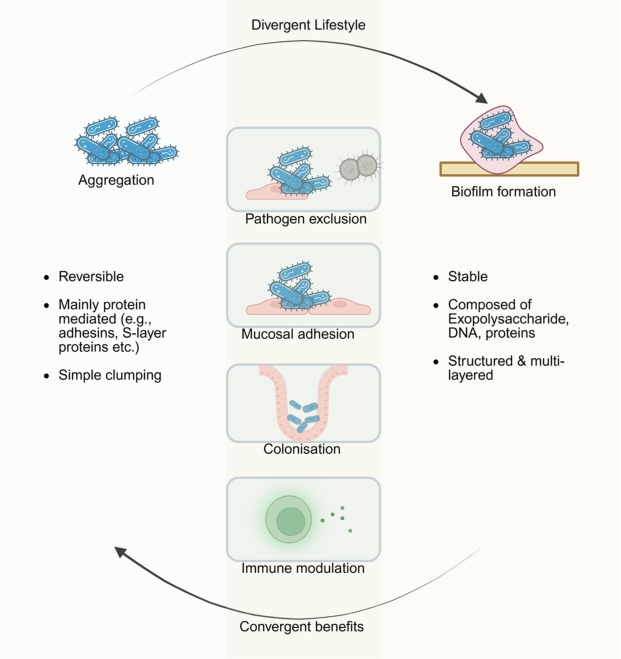
Aggregation in lactobacilli: an unexplored dimension
In: Beneficial MicrobesSearch for other papers by M. Kaur in
Current site
Google Scholar
Search for other papers by C. Forestier in
Current site
Google Scholar
Search for other papers by S. Miquel in
Current site
Google Scholar
Abstract
Autoaggregation is an often-overlooked but critical phenotypic trait in Lactobacillus species that plays a pivotal role in host colonisation, pathogen exclusion, and probiotic functionality. This review explores the molecular mechanisms, surface factors, and environmental cues influencing aggregation, distinguishing it from but also linking it to biofilm formation. While traditionally associated with initial steps in biofilm development, autoaggregation in lactobacilli can occur independently of and sometimes conversely to biofilm production. We assess the contributions of surface proteins, such as S-layer proteins and aggregation-promoting factors, and those of exopolysaccharides, pili, and environmental modulators in shaping aggregation behaviour. In addition, we discuss how aggregation enhances mucosal adhesion, immune modulation, and competitive exclusion of pathogens, making it a promising selection marker for next-generation probiotics and live biotherapeutics. Finally, we stress the need for standardised methods and advanced tools to elucidate the complex interplay between bacterial surface architecture and lifestyle strategies like aggregation and biofilm formation.
Purchase
Buy instant access (PDF download and unlimited online access):
Institutional Login
Log in with Open Athens, Shibboleth, or your institutional credentials
Personal login
Log in with your brill.com account
-
Al-Bakri, A.G., Gilbert, P. and Allison, D.G., 2004. Immigration and emigration of Burkholderia cepacia and Pseudomonas aeruginosa between and within mixed biofilm communities. Journal of Applied Microbiology 96: 455-463. https://doi.org/10.1046/j.1365-2672.2004.02178.x
-
Allison, D.G., McBain, A.J. and Gilbert, P., 2000. Biofilms: problems of control. In: Allison, D.G., Gilbert, P., Lappin-Scott, H.M. and Wilson, M. (eds.) Community structure and co-operation in biofilms. Cambridge University Press, Cambridge, pp. 309-327.
-
Altermann, E., Russell, W.M., Azcarate-Peril, M.A., Barrangou, R., Buck, B.L., McAuliffe, O., Souther, N., Dobson, A., Duong, T., Callanan, M., Lick, S., Hamrick, A., Cano, R. and Klaenhammer, T.R., 2005. Complete genome sequence of the probiotic lactic acid bacterium Lactobacillus acidophilus NCFM. Proceedings of the National Academy of Sciences of the United States of America 102(11): 3906-3912. https://doi.org/10.1073/pnas.0409188102
-
Åvall-Jääskeläinen, S. and Palva, A., 2005. Lactobacillus surface layers and their applications. FEMS Microbiology Reviews 29: 511-529. https://doi.org/10.1016/j.fmrre.2005.04.003
-
Bang, M., Yong, C.C., Ko, H.J., Choi, I.G. and Oh, S., 2018. Transcriptional response and enhanced intestinal adhesion ability of Lactobacillus rhamnosus GG after acid stress. Journal of Microbiology and Biotechnology 28(10): 1604-1613. https://doi.org/10.4014/jmb.1807.07033
-
Beaussart, A., El-Kirat-Chatel, S., Herman, P., Alsteens, D., Mahillon, J., Hols, P. and Dufrêne, Y.F., 2013. Single-cell force spectroscopy of probiotic bacteria. Biophysical Journal 104(9): 1886-1892. https://doi.org/10.1016/j.bpj.2013.03.046
-
Belkaid, Y. and Hand, T., 2014. Role of the microbiota in immunity and inflammation. Cell 157(1): 121-141. https://doi.org/10.1016/j.cell.2014.03.011
-
Bergonzelli, G.E., Granato, D., Pridmore, R.D., Marvin-Guy, L.F., Donnicola, D. and Corthésy-Theulaz, I.E., 2006. GroEL of Lactobacillus johnsonii La1 (NCC 533) is cell surface associated: potential role in interactions with the host and the gastric pathogen Helicobacter pylori. Infection and Immunity 74(1): 425-434. https://doi.org/10.1128/IAI.74.1.425-434.2006
-
Bos, A., van der Mei, H.C. and Busscher, H.J., 1994. Quantitative method to study co-adhesion of microorganisms in a parallel plate-flow chamber – basic principles of the analysis. Journal of Microbiological Methods 20: 289-305. https://doi.org/10.1016/0167-7012(94)90053-1
-
Boonaert, C.J. and Rouxhet, P.G., 2000. Surface of lactic acid bacteria: relationships between chemical composition and physicochemical properties. Applied and Environmental Microbiology 66(6): 2548-2554. https://doi.org/10.1128/AEM.66.6.2548-2554.2000
-
Bradshaw, D.J., Marsh, P.D., Watson, G.K. and Allison, C., 1994. Metabolic cooperation in oral microbial communities during growth on mucin. Microbiology 140: 3407-3412. https://doi.org/10.1099/13500872-140-12-3407
-
Bron, P.A., Grangette, C., Mercenier, A., de Vos, W.M. and Kleerebezem, M., 2004. Identification of Lactobacillus plantarum genes that are induced in the gastrointestinal tract of mice. Journal of Bacteriology 186(17): 5721-5729. https://doi.org/10.1128/JB.186.17.5721-5729.2004
-
Busscher, H.J., van der Mei, H.C. and Bos, R., 1995. Initial microbial adhesion is a determinant for the strength of biofilm adhesion. FEMS Microbiology Letters 128: 229-234. https://doi.org/10.1111/j.1574-6968.1995.tb07529.x
-
Caggia, C., De Angelis, M., Pitino, I., Pino, A. and Randazzo, C.L., 2015. Probiotic features of Lactobacillus strains isolated from Ragusano and Pecorino Siciliano cheeses. Food Microbiology 50: 109-117. https://doi.org/10.1016/j.fm.2015.03.010
-
Carasi, P., Ambrosis, N.M., De Antoni, G.L., Bressollier, P., Urdaci, M.C. and Serradell, M.D.L.A., 2014. Adhesion properties of potentially probiotic Lactobacillus kefiri to gastrointestinal mucus. Journal of Dairy Research 81: 16-23. https://doi.org/10.1017/S0022029913000526
-
Castagliuolo, I., Galeazzi, F., Ferrari, S., Elli, M., Brun, P., Cavaggioni, A., Sturniolo, G.C. and Palù, G., 2005. Beneficial effect of auto-aggregating Lactobacillus crispatus on experimentally induced colitis in mice. FEMS Immunology and Medical Microbiology 43(2): 197-204. https://doi.org/10.1016/j.femsim.2004.08.011
-
Celebioglu, H.U., Ejby, M., Majumder, A., Købler, C., Goh, Y.J., Thorsen, K., Schmidt, B., O’Flaherty, S., Abou Hachem, M., Lahtinen, S.J., Jacobsen, S., Klaenhammer, T.R., Brix, S., Mølhave, K. and Svensson, B., 2016. Differential proteome and cellular adhesion analyses of the probiotic bacterium Lactobacillus acidophilus NCFM grown on raffinose – an emerging prebiotic. Proteomics 16(9): 1361-1375. https://doi.org/10.1002/pmic.201500212
-
Chen, X., Xu, J., Shuai, J., Chen, J., Zhang, Z. and Fang, W., 2007. The S-layer proteins of Lactobacillus crispatus strain ZJ001 are responsible for competitive exclusion against Escherichia coli O157:H7 and Salmonella typhimurium. International Journal of Food Microbiology 115: 307-312. https://doi.org/10.1016/j.ijfoodmicro.2006.11.007
-
Collado, M.C., Meriluoto, J. and Salminen, S., 2007. Role of commercial probiotic strains against human pathogen adhesion to intestinal mucus. Letters in Applied Microbiology 45(4): 454-460. https://doi.org/10.1111/j.1472-765X.2007.02212.x
-
Collado, M.C., Meriluoto, J. and Salminen, S., 2008. Adhesion and aggregation properties of probiotic and pathogen strains. European Food Research and Technology 226: 1065-1073. https://doi.org/10.1007/s00217-007-0632-x
-
Denou, E., Berger, B., Barretto, C., Panoff, J.M., Arigoni, F. and Brüssow, H., 2007. Gene expression of commensal Lactobacillus johnsonii strain NCC533 during in vitro growth and in the murine gut. Journal of Bacteriology 189(22): 8109-8119. https://doi.org/10.1128/JB.00991-07
-
Dhanani, A.S., Gaudana, S.B. and Bagchi, T., 2011. The ability of Lactobacillus adhesin EF-Tu to interfere with pathogen adhesion. European Food Research and Technology 232: 777-785. https://doi.org/10.1007/s00217-011-1443-7
-
Drago, L., Gismondo, M.R., Lombardi, A., De Vecchi, E., Gozzini, L. and Fassina, M.C., 1997. Inhibition of in vitro growth of enteropathogens by new Lactobacillus isolates of human intestinal origin. FEMS Microbiology Letters 153: 455-463. https://doi.org/10.1111/j.1574-6968.1997.tb12610.x
-
Dramé, I., Formosa-Dague, C., Chapot-Chartier, M.-P., Piard, J.-C., Castelain, M., Kulakauskas, S. and Dague, E., 2020. Analysis of homotypic interactions of Lactococcus lactis pili using single-cell force spectroscopy. ACS Applied Materials & Interfaces 12(19): 21411-21423. https://doi.org/10.1021/acsami.0c03069
-
Du, Y., Li, H., Xu, W., Hu, X., Wu, T. and Chen, J., 2023. Cell surface-associated protein elongation factor Tu interacts with fibronectin mediating the adhesion of Lactobacillus plantarum HC-2 to Penaeus vannamei intestinal epithelium and inhibiting the apoptosis induced by LPS and pathogen in Caco-2 cells. International Journal of Biological Macromolecules 224: 32-47. https://doi.org/10.1016/j.ijbiomac.2022.11.252
-
Espino, E., Koskenniemi, K., Mato-Rodriguez, L., Nyman, T.A., Reunanen, J., Koponen, J., Öhman, T., Siljamäki, P., Alatossava, T., Varmanen, P. and Savijoki, K., 2015. Uncovering surface-exposed antigens of Lactobacillus rhamnosus by cell shaving proteomics and two-dimensional immunoblotting. Journal of Proteome Research 14(2): 1010-1024. https://doi.org/10.1021/pr501041a
-
Fernández, M., Smid, E., Abee, T. and Nierop, M., 2015. Characterization of biofilms formed by Lactobacillus plantarum WCFS1 and food spoilage isolates. International Journal of Food Microbiology 207: 23-29. https://doi.org/10.1016/j.ijfoodmicro.2015.04.030
-
Frece, J., Kos, B., Svetec, I.K., Zgaga, Z., Mrša, V. and Šušković, J., 2005. Importance of S-layer proteins in probiotic activity of Lactobacillus acidophilus M92. Journal of Applied Microbiology 98(2): 285-292. https://doi.org/10.1111/j.1365-2672.2004.02473.x
-
Fozo, E.M., Kajfasz, J.K. and Quivey, R.G. Jr., 2004. Low pH-induced membrane fatty acid alterations in oral bacteria. FEMS Microbiology Letters 238(2): 291-295. https://doi.org/10.1016/j.femsle.2004.07.047
-
Frese, S.A., MacKenzie, D.A., Peterson, D.A., Schmaltz, R., Fangman, T., Zhou, Y., Zhang, C., Benson, A., Cody, L.A., Mulholland, F., Juge, N. and Walter, J., 2013. Molecular characterization of host-specific biofilm formation in a vertebrate gut symbiont. PLoS Genetics 9(12): e1004057. https://doi.org/10.1371/journal.pgen.1004057
-
Garrote, G.L., Delfederico, L., Bibiloni, R., Abraham, A.G., Fernando Pérez, P., Semorile, L. and De Antoni, G.L., 2004. Lactobacilli isolated from kefir grains: evidence of the presence of S-layer proteins. Journal of Dairy Research 71(2): 222-230. https://doi.org/10.1017/S0022029904000160
-
Giordano, I. and Mauriello, G., 2023. Ultrasound attenuation improves some surface properties of the probiotic strain Lacticaseibacillus casei ATCC 393. Microorganisms 11(1): 142. https://doi.org/10.3390/microorganisms11010142
-
Goh, Y.J. and Klaenhammer, T.R., 2010. Functional roles of aggregation-promoting-like factor in stress tolerance and adherence of Lactobacillus acidophilus NCFM. Applied and Environmental Microbiology 76(15): 5005-5012. https://doi.org/10.1128/AEM.00030-10
-
Goh, Y.J. and Barrangou, R., 2021. Portable CRISPR-Cas9N system for flexible genome engineering in Lactobacillus acidophilus, Lactobacillus gasseri, and Lactobacillus paracasei. Applied and Environmental Microbiology 87(6): e02669-20. https://doi.org/10.1128/AEM.02669-20
-
Golowczyc, M.A., Mobili, P., Garrote, G.L., Abraham, A.G. and De Antoni, G.L., 2007. Protective action of Lactobacillus kefir carrying S-layer protein against Salmonella enterica Serovar Enteritidis. International Journal of Food Microbiology 118(3): 264-273. https://doi.org/10.1016/j.ijfoodmicro.2007.07.042
-
Golowczyc, M.A., Mobili, P., Garrote, G.L., Serradell, M.D.L.A., Abraham, A.G. and De Antoni, G.L., 2009. Interaction between Lactobacillus kefir and Saccharomyces lipolytica isolated from kefir grains: evidence for lectin-like activity of bacterial surface proteins. Journal of Dairy Research 76(1): 111-116. https://doi.org/10.1017/S0022029908003749
-
Górska-Frączek, S., Sandstrom, C., Kenne, L., Rybka, J., Strus, M., Heczko, P. and Gamian, A., 2011. Structural studies of the exopolysaccharide consisting of a nonasaccharide repeating unit isolated from Lactobacillus rhamnosus KL37B. Carbohydrate Research 346: 2926-2932. https://doi.org/10.1016/j.carres.2011.10.024
-
Granato, D., Perotti, F., Masserey, I., Rouvet, M., Golliard, M., Servin, A. and Brassart, D., 1999. Cell surface-associated lipoteichoic acid acts as an adhesion factor for attachment of Lactobacillus johnsonii La1 to human enterocyte-like Caco-2 cells. Applied and Environmental Microbiology 65(3): 1071-1077. https://doi.org/10.1128/AEM.65.3.1071-1077.1999
-
Granato, D., Bergonzelli, G.E., Pridmore, R.D., Marvin, L., Rouvet, M. and Corthésy-Theulaz, I.E., 2004. Cell surface-associated elongation factor Tu mediates the attachment of Lactobacillus johnsonii NCC533 (La1) to human intestinal cells and mucins. Infection and Immunity 72(4): 2160-2169. https://doi.org/10.1128/IAI.72.4.2160-2169.2004
-
Guzmán-Soto, I., McTiernan, C., Gonzalez-Gomez, M., Ross, A., Gupta, K., Suuronen, E.J., Mah, T.F., Griffith, M. and Alarcon, E.I., 2021. Mimicking biofilm formation and development: recent progress in in vitro and in vivo biofilm models. iScience 24(5): 102443. https://doi.org/10.1016/j.isci.2021.102443
-
Hollmann, A., Delfederico, L., De Antoni, G., Semorile, L. and Disalvo, E.A., 2010. Relaxation Processes in the Adsorption of Surface Layer Proteins to Lipid Membranes. The Journal of Physical Chemistry B 114(49): 16618-16624. https://doi.org/10.1021/jp107062e
-
Hidalgo-Cantabrana, C., Goh, Y.J., Pan, M., Sanozky-Dawes, R. and Barrangou, R., 2019. Genome editing using the endogenous type I CRISPR-Cas system in Lactobacillus crispatus. Proceedings of the National Academy of Sciences of the United States of America 116(32): 15774-15783. https://doi.org/10.1073/pnas.1905421116
-
Horn, N., Wegmann, U., Dertil, E., Gasson, M.J. and Narbad, A., 2013. Spontaneous mutation reveals influence of exopolysaccharides on Lactobacillus johnsonii surface characteristics. PLoS ONE 8(3): e59957. https://doi.org/10.1371/journal.pone.0059957
-
Hymes, J.P., Johnson, B.R., Barrangou, R. and Klaenhammer, T.R., 2016. Functional analysis of an S-layer associated fibronectin-binding protein in Lactobacillus acidophilus NCFM. Applied and Environmental Microbiology 82(9): 2676-2685. https://doi.org/10.1128/AEM.00024-16
-
Ito, M., Kim, Y.G., Tsuji, H., Takahashi, T., Kiwaki, M., Nomoto, K., Danbara, H. and Okada, N., 2014. Transposon mutagenesis of probiotic Lactobacillus casei identifies asnH, an asparagine synthetase gene involved in its immune-activating capacity. PLoS ONE 9(1): e83876. https://doi.org/10.1371/journal.pone.0083876
-
Isenring, J., Geirnaert, A., Lacroix, C. and Stevens, M.J.A., 2021. Bistable auto-aggregation phenotype in Lactiplantibacillus plantarum emerges after cultivation in in vitro colonic microbiota. BMC Microbiology 21(1). https://doi.org/10.1186/s12866-021-02331-x
-
Jankovic, I., Ventura, M., Meylan, V., Rouvet, M., Elli, M. and Zink, R., 2003. Contribution of aggregation-promoting factor to maintenance of cell shape in Lactobacillus gasseri 4B2. Journal of Bacteriology 185: 3288-3296. https://doi.org/10.1128/JB.185.11.3288-3296.2003
-
Jakava-Viljanen, M. and Palva, A., 2007. Isolation of surface (S) layer protein carrying Lactobacillus species from porcine intestine and faeces and characterization of their adhesion properties to different host tissues. Veterinary Microbiology 124: 264-273. https://doi.org/10.1016/j.vetmic.2007.04.029
-
Johnson, B.R. and Klaenhammer, T.R., 2016. AcmB is an S-layer-associated β-N-acetylglucosaminidase and functional autolysin in Lactobacillus acidophilus NCFM. Applied and Environmental Microbiology 82(18): 5687-5697. https://doi.org/10.1128/AEM.02025-16
-
Johnson, B.R., Hymes, J., Sanozky-Dawes, R., Henriksen, E.D., Barrangou, R. and Klaenhammer, T.R., 2015. Conserved S-layer-associated proteins revealed by exoproteomic survey of S-layer-forming lactobacilli. Applied and Environmental Microbiology 82(1): 134-145. https://doi.org/10.1128/AEM.01968-15
-
Juárez Tomás, M.S., Wiese, B. and Nader-Macı́as, M.E., 2005. Effects of culture conditions on the growth and auto-aggregation ability of vaginal Lactobacillus johnsonii CRL 1294. Journal of Applied Microbiology 99(6): 1383-1391. https://doi.org/10.1111/j.1365-2672.2005.02726.x
-
Kankainen, M., Paulin, L., Tynkkynen, S., von Ossowski, I., Reunanen, J., Partanen, P., Satokari, R., Vesterlund, S., Hendrickx, A.P., Lebeer, S., De Keersmaecker, S.C., Vanderleyden, J., Hämäläinen, T., Laukkanen, S., Salovuori, N., Ritari, J., Alatalo, E., Korpela, R., Mattila-Sandholm, T., Lassig, A., Hatakka, K., Kinnunen, K.T., Karjalainen, H., Saxelin, M., Laakso, K., Surakka, A., Palva, A., Salusjärvi, T., Auvinen, P. and de Vos, W.M., 2009. Comparative genomic analysis of Lactobacillus rhamnosus GG reveals pili containing a human-mucus binding protein. Proceedings of the National Academy of Sciences of the United States of America 106(40): 17193-17198. https://doi.org/10.1073/pnas.0908876106
-
Karbowiak, M., Gałek, M., Szydłowska, A. and Zielińska, D., 2022. The influence of the degree of thermal inactivation of probiotic lactic acid bacteria and their postbiotics on aggregation and adhesion inhibition of selected pathogens. Pathogens 11(11): 1260. https://doi.org/10.3390/pathogens11111260
-
Kerry, R.G., Patra, J.K., Gouda, S., Park, Y., Shin, H.-S. and Das, G., 2018. Benefaction of probiotics for human health: a review. Journal of Food and Drug Analysis 26(3): 927-939. https://doi.org/10.1016/j.jfda.2018.01.002
-
Kim, M.S., Yoon, Y.S., Seo, J.G., Lee, H.G., Chung, M.J. and Yum, D.Y., 2013. A study on the prevention of salmonella infection by using the aggregation characteristics of lactic acid bacteria. Toxicological Research 29(2): 129-135. https://doi.org/10.5487/TR.2013.29.2.129
-
Kleerebezem, M., Boekhorst, J., van Kranenburg, R., Molenaar, D., Kuipers, O.P., Leer, R., Tarchini, R., Peters, S.A., Sandbrink, H.M., Fiers, M.W., Stiekema, W., Lankhorst, R.M., Bron, P.A., Hoffer, S.M., Groot, M.N., Kerkhoven, R., de Vries, M., Ursing, B., de Vos, W.M. and Siezen, R.J., 2003. Complete genome sequence of Lactobacillus plantarum WCFS1. Proceedings of the National Academy of Sciences of the United States of America 100(4): 1990-1995. https://doi.org/10.1073/pnas.0337704100
-
Klotz, C., Goh, Y.J., Flaherty, S., Johnson, B. and Barrangou, R., 2020. Deletion of S-layer associated Ig-like domain protein disrupts the Lactobacillus acidophilus cell surface. Frontiers in Microbiology 11. https://doi.org/10.3389/fmicb.2020.00345
-
Kmet, V., Lauková, A. and Guba, P., 1995. Aggregation-promoting factor in pig intestinal Lactobacillus strains. Letters in Applied Microbiology 21: 351-353. https://doi.org/10.1111/j.1472-765x.1995.tb01079.x
-
Kmet, V. and Lucchini, F., 1997. Aggregation-promoting factor in human vaginal Lactobacillus strains. FEMS Immunology and Medical Microbiology 19: 111-114. https://doi.org/10.1111/j.1574-695X.1997.tb01079.x
-
Kobatake, E. and Kabuki, T., 2019. S-layer protein of Lactobacillus helveticus SBT2171 promotes human β-defensin 2 expression via TLR2-JNK signaling. Frontiers in Microbiology 10: 2414. https://doi.org/10.3389/fmicb.2019.02414
-
Kos, B., Šušković, J., Vuković, S., Sı̌mpraga, M., Frece, J. and Matošić, S., 2003. Adhesion and aggregation ability of probiotic strain Lactobacillus acidophilus M92. Journal of Applied Microbiology 94: 981-987. https://doi.org/10.1046/j.1365-2672.2003.01915.x
-
Kragh, K.N., Hutchison, J.B., Melaugh, G., Rodesney, C., Roberts, A.E.L., Irie, Y., Jensen, P.Ø., Diggle, S.P., Allen, R.J., Gordon, V. and Bjarnsholt, T., 2016. Role of multicellular aggregates in biofilm formation. mBio 7(2): e00237-16. https://doi.org/10.1128/mBio.00237-16
-
Lang, C., Bottner, M., Holz, C., Veen, M., Ryser, M., Reindl, A., Pompejus, M. and Tanzer, J.M., 2010. Specific Lactobacillus/Mutans Streptococcus co-aggregation. Journal of Dental Research 89: 175-179. https://doi.org/10.1177/0022034509356246
-
Lebeer, S., Vanderleyden, J. and De Keersmaecker, S.C.J., 2008. Genes and molecules of lactobacilli supporting probiotic action. Microbiology and Molecular Biology Reviews 72(4): 728-764. https://doi.org/10.1128/MMBR.00017-08
-
Lebeer, S., Verhoeven, T.L.A., Francius, G., Schoofs, G., Lambrichts, I., Dufrêne, Y., Vanderleyden, J. and De Keersmaecker, S.C.J., 2009. Identification of a gene cluster for the biosynthesis of a long, galactose-rich exopolysaccharide in Lactobacillus rhamnosus GG and functional analysis of the priming glycosyltransferase. Applied and Environmental Microbiology 75(11): 3554-3563. https://doi.org/10.1128/AEM.02919-08
-
Leccese Terraf, M.C., Mendoza, L.M., Juárez Tomás, M.S., Silva, C. and Nader-Macías, M.E., 2014. Phenotypic surface properties (aggregation, adhesion and biofilm formation) and presence of related genes in beneficial vaginal lactobacilli. Journal of Applied Microbiology 117(6): 1761-1772. https://doi.org/10.1111/jam.12642
-
Lee, K., Lee, H.G., Pi, K. and Choi, Y.J., 2008. The effect of low pH on protein expression by the probiotic bacterium Lactobacillus reuteri. Proteomics 8(8): 1624-1630. https://doi.org/10.1002/pmic.200700663
-
Lee, J., Jo, J., Wan, J., Seo, H., Han, S.-W., Shin, Y.-J. and Kim, D.-H., 2024. In vitro evaluation of probiotic properties and anti-pathogenic effects of Lactobacillus and Bifidobacterium strains as potential probiotics. Foods 13(14): 2301. https://doi.org/10.3390/foods13142301
-
Leenhouts, K., Buist, G., Bolhuis, A., ten Berge, A., Kiel, J., Mierau, I., Dabrowska, M., Venema, G. and Kok, J., 1996. A general system for generating unlabelled gene replacements in bacterial chromosomes. Molecular Genetics and Genomics 253(1-2): 217-224. https://doi.org/10.1007/s004380050315
-
Li, J., Mu, G. and Tuo, Y., 2023. Phenotypic traits and probiotic functions of Lactiplantibacillus plantarum Y42 in planktonic and biofilm forms. Foods 12(7): 1516. https://doi.org/10.3390/foods12071516
-
Liu, L., Chen, X., Yin, X., Yang, Y., Yuan, L., Xiao, H. and Rao, Y., 2023. Differential regulation of host immunity, microbiota, and metabolism by planktonic and biofilm cells of Lactiplantibacillus paraplantarum LR-1. Journal of Functional Foods 109: 105779. https://doi.org/10.1016/j.jff.2023.105779
-
Lorca, G.L., Font de Valdez, G. and Ljungh, A., 2002. Characterization of the protein-synthesis dependent adaptive acid tolerance response in Lactobacillus acidophilus. Journal of Molecular Microbiology and Biotechnology 4(6): 525-532.
-
Luan, C., Jiang, N., Zhou, X., Zhang, C., Zhao, Y., Li, Z. and Li, C., 2022. Antibacterial and anti-biofilm activities of probiotic Lactobacillus curvatus BSF206 and Pediococcus pentosaceus AC1-2 against Streptococcus mutans. Microbial Pathogenesis 164. https://doi.org/10.1016/j.micpath.2022.105446
-
Mackenzie, D.A., Jeffers, F., Parker, M.L., Vibert-Vallet, A., Bongaerts, R.J., Roos, S., Walter, J. and Juge, N., 2010. Strain-specific diversity of mucus-binding proteins in the adhesion and aggregation properties of Lactobacillus reuteri. Microbiology 156: 3368-3378. https://doi.org/10.1099/mic.0.043265-0
-
Malik, S., Petrova, M.I., Imholz, N.C.E., Verhoeven, T.L.A., Noppen, S., Van Damme, E.J.M., Liekens, S., Balzarini, J., Schols, D., Vanderleyden, J. and Lebeer, S., 2016. High mannose-specific lectin Msl mediates key interactions of the vaginal Lactobacillus plantarum isolate CMPG5300. Scientific Reports 6: 37339. https://doi.org/10.1038/srep37339
-
Manvelyan, A., Balayan, M., Miralimova, S., Chistyakov, V. and Pepoyan, A., 2023. Biofilm formation and autoaggregation abilities of novel targeted aqua-probiotics. Functional Foods in Health and Disease 13(4): 179-190. https://doi.org/10.31989/ffhd.v13i4.1093
-
Martinez, R.M., Hulten, K.G., Bui, U., Clarridge, J.E. and Onderdonk, A.B., 2014. Molecular analysis and clinical significance of Lactobacillus spp. recovered from clinical specimens presumptively associated with disease. Journal of Clinical Microbiology 52(1): 30-36. https://doi.org/10.1128/JCM.02072-13
-
Martino, M.E., Bayjanov, J.R., Caffrey, B.E., Wels, M., Joncour, P., Hughes, S., Gillet, B., Kleerebezem, M., van Hijum, S.A. and Leulier, F., 2016. Nomadic lifestyle of Lactobacillus plantarum revealed by comparative genomics of 54 strains isolated from different habitats. Environmental Microbiology 18(12): 4974-4989. https://doi.org/10.1111/1462-2920.13455
-
Mazziotta, C., Tognon, M., Martini, F., Torreggiani, E. and Rotondo, J.C., 2023. Probiotics mechanism of action on immune cells and beneficial effects on human health. Cells 12(1): 184. https://doi.org/10.3390/cells12010184
-
Megur, A., Daliri, E.B., Balnionytė, T., Stankevičiūtė, J., Lastauskienė, E. and Burokas, A., 2023. In vitro screening and characterization of lactic acid bacteria from Lithuanian fermented food with potential probiotic properties. Frontiers in Microbiology 14: 1213370. https://doi.org/10.3389/fmicb.2023.1213370
-
Meng, J., Zhu, X., Gao, S.M., Zhang, Q.X., Sun, Z. and Lu, R.R., 2014. Characterization of surface layer proteins and their role in probiotic properties of three Lactobacillus strains. International Journal of Biological Macromolecules 65: 110-114. https://doi.org/10.1016/j.ijbiomac.2014.01.024
-
Miljkovic, M., Bertani, I., Fira, D., Jovcic, B., Novovic, K., Venturi, V. and Kojic, M., 2016. Shortening of the Lactobacillus paracasei subsp. paracasei BGNJ1-64 AggLb protein switches its activity from auto-aggregation to biofilm formation. Frontiers in Microbiology 7: 1422. https://doi.org/10.3389/fmicb.2016.01422
-
Mobili, P., Serradell, M., Trejo, S.A., Avilés Puigvert, F.X., Abraham, A.G. and De Antoni, G.L., 2009. Heterogeneity of S-layer proteins from aggregating and non-aggregating Lactobacillus kefir strains. Antonie Van Leeuwenhoek 95(4): 363-372. https://doi.org/10.1007/s10482-009-9322-y
-
Nikolic, M., López, P., Strahinic, I., Suárez, A., Kojic, M., Fernández-Garcı́a, M., Topisirovic, L., Golic, N., Ruas-Madiedo, P. and Margolles, A., 2012. Characterisation of the exopolysaccharides (EPS)-producing Lactobacillus paraplantarum BGCG11 and its non-EPS producing derivative strains as potential probiotics. International Journal of Food Microbiology 158: 155-162. https://doi.org/10.1016/j.ijfoodmicro.2012.07.015
-
Nishiyama, K., Nakazato, A., Ueno, S., Seto, Y., Kakuda, T., Takai, S., Yamamoto, Y. and Mukai, T., 2015. Cell surface-associated aggregation-promoting factor from Lactobacillus gasseri SBT2055 facilitates host colonization and competitive exclusion of Campylobacter jejuni. Molecular Microbiology 98: 712-726. https://doi.org/10.1111/mmi.13153
-
Nishiyama, K., Kagamitani, T., Yamamoto, Y., Okada, N. and Mukai, T., 2017. The elongation factor Tu from Lactobacillus reuteri inhibits the adhesion of Helicobacter pylori to porcine gastric mucin. Milk Science 66(1): 17-26. https://doi.org/10.11465/milk.66.17
-
Oh, J.H. and van Pijkeren, J.P., 2014. CRISPR-Cas9-assisted recombineering in Lactobacillus reuteri. Nucleic Acids Research 42(17): e131. https://doi.org/10.1093/nar/gku623
-
Oxaran, V., Ledue-Clier, F., Dieye, Y., Herry, J.-M., Péchoux, C., Meylheuc, T., Labadie, J.C. and Benezech, T., 2012. Pilus biogenesis in Lactococcus lactis: molecular characterization and role in aggregation and biofilm formation. PLoS ONE 7(12): e50989. https://doi.org/10.1371/journal.pone.0050989
-
Palmer, R.J., Gordon, S.M., Cisar, J.O. and Kolenbrander, P.E., 2001. Mutualism versus independence: strategies of mixed-species oral biofilms in vitro using saliva as the sole nutrient source. Infection and Immunity 69: 5794-5804. https://doi.org/10.1128/IAI.69.9.5794-5804.2001
-
Panwar, R., Kumar, N., Kashyap, V., Singh, S. and Singh, H., 2017. Insights into involvement of S-layer proteins of probiotic lactobacilli in relation to gut health. Octa Journal of Environmental Research 5(4): 228-245.
-
Perez-Cobas, A.E., Gomez-Valero, L. and Buchrieser, C., 2020. Metatranscriptomics and RNA-seq: advancing the understanding of host-pathogen interactions. Trends in Microbiology 28(5): 401-415. https://doi.org/10.1016/j.tim.2020.01.003
-
Petrova, M.I., Lievens, E., Verhoeven, T.L.A., MacKlaim, J.M., Gloor, G., Schols, D., Vanderleyden, J., Lebeer, S. and Vaneechoutte, M., 2016. The lectin-like protein 1 in Lactobacillus rhamnosus GR-1 mediates tissue-specific adherence to vaginal epithelium and inhibits urogenital pathogens. Scientific Reports 6: 37437. https://doi.org/10.1038/srep37437
-
Phukan, N., Brooks, A.E.S. and Simoes-Barbosa, A., 2018. A cell surface aggregation-promoting factor from Lactobacillus gasseri contributes to inhibition of Trichomonas vaginalis adhesion to human vaginal ectocervical cells. Infection and Immunity 86(3): e00907-17. https://doi.org/10.1128/IAI.00907-17
-
Pino, A., Bartolo, E., Caggia, C., Cianci, A. and Randazzo, C.L., 2019. Detection of vaginal lactobacilli as probiotic candidates. Scientific Reports 9: 3355. https://doi.org/10.1038/s41598-019-40304-3
-
Pithva, S., Shekh, S., Dave, J. and Vyas, B.R.M., 2014. Probiotic attributes of autochthonous Lactobacillus rhamnosus strains of human origin. Applied Biochemistry and Biotechnology 173: 259-277. https://doi.org/10.1007/s12010-014-0839-9
-
Polak-Berecka, M., Waśko, A., Szwajgier, D. and Choma, A., 2013. Bifidogenic and antioxidant activity of exopolysaccharides produced by Lactobacillus rhamnosus E/N cultivated on different carbon sources. Polish Journal of Microbiology 62(2): 181-189.
-
Pragya, P., Kaur, G., Ali, S.A., Bhatla, S., Rawat, P., Lule, V., Kumar, S., Mohanty, A.K. and Behare, P., 2017. High-resolution mass spectrometry-based global proteomic analysis of probiotic strains Lactobacillus fermentum NCDC 400 and RS2. Journal of Proteomics 152: 121-130. https://doi.org/10.1016/j.jprot.2016.10.016
-
Reid, G., McGroarty, J.A., Angotti, R. and Cook, R.L., 1988. Lactobacillus inhibitor production against Escherichia coli and coaggregation ability with uropathogens. Canadian Journal of Microbiology 34: 344-351. https://doi.org/10.1139/m88-062
-
Reniero, R., Cocconcelli, P., Bottazzi, V. and Morelli, L., 1992. High frequency of conjugation in Lactobacillus mediated by an aggregation-promoting factor. Journal of General Microbiology 138: 763-768. https://doi.org/10.1099/00221287-138-4-763
-
Rickard, A.H., Gilbert, P., High, N.J., Kolenbrander, P.E. and Handley, P.S., 2003. Bacterial coaggregation: an integral process in the development of multi-species biofilms. Trends in Microbiology 11: 94-100. https://doi.org/10.1016/S0966-842X(02)00034-3
-
Rieu, A., Aoudia, N., Jego, G., Chluba, J., Yousfi, N., Briandet, R., Deschamps, J., Gasquet, B., Monedero, V., Garrido, C. and Guzzo, J., 2014. The biofilm mode of life boosts the anti-inflammatory properties of Lactobacillus. Cellular Microbiology 16(12): 1836-1853. https://doi.org/10.1111/cmi.12331
-
Russell, W.M. and Klaenhammer, T.R., 2001. Efficient system for directed integration into the Lactobacillus acidophilus and Lactobacillus gasseri chromosomes via homologous recombination. Applied and Environmental Microbiology 67(9): 4361-4364. https://doi.org/10.1128/AEM.67.9.4361-4364.2001
-
Sadeghi, M., Panahi, B., Mazlumi, A., Hejazi, M.A., Komi, D.E.A. and Nami, Y., 2022. Screening of potential probiotic lactic acid bacteria with antimicrobial properties and selection of superior bacteria for application as biocontrol using machine learning models. Food Science & Technology 162: 113471. https://doi.org/10.1016/j.lwt.2022.113471
-
Sagmeister, T., Gubensäk, N., Buhlheller, C., Grininger, C., Ðordić, A., Millán, C., Medina, A., Murcia, P.A.S., Hynönen, U., Vejzović, D., Damisch, E., Kulminskaya, N., Petrowitsch, L., Oberer, M., Palva, A., Malanović, N., Codée, J., Keller, W., Usón, I. and Pavkov-Keller, T., 2024. The molecular architecture of Lactobacillus S-layer: assembly and attachment to teichoic acids. Proceedings of the National Academy of Sciences 121(24): e2401686121. https://doi.org/10.1073/pnas.2401686121
-
Saito, K., Nakamura, T., Kobayashi, I., Ohnishi-Kameyama, M., Ichinose, H., Kimura, K. and Funane, K., 2014. Xylan-mediated aggregation of Lactobacillus brevis and its relationship with the surface properties and mucin-mediated aggregation of the bacteria. Bioscience, Biotechnology, and Biochemistry 78(12): 2120-2127. https://doi.org/10.1080/09168451.2014.948375
-
Saito, K., Tomita, S. and Nakamura, T., 2019. Aggregation of Lactobacillus brevis associated with decrease in pH by glucose fermentation. Bioscience, Biotechnology, and Biochemistry 83(8): 1523-1529. https://doi.org/10.1080/09168451.2019.1584522
-
Sarkar, A. and Mandal, S., 2016. Bifidobacteria-insight into clinical outcomes and mechanisms of its probiotic action. Microbiological Research 192: 159-171. https://doi.org/10.1016/j.micres.2016.07.001
-
Schachtsiek, M., Hammes, W.P. and Hertel, C., 2004. Characterization of Lactobacillus coryniformis DSM 20001T surface protein Cpf mediating coaggregation with and aggregation among pathogens. Applied and Environmental Microbiology 70(12): 7078-7085. https://doi.org/10.1128/AEM.70.12.7078-7085.2004
-
Schneitz, C., Nuotio, L. and Lounatma, K., 1993. Adhesion of Lactobacillus acidophilus to avian intestinal epithelial cells mediated by the crystalline bacterial cell surface layer (S-layer). Journal of Applied Bacteriology 74(3): 290-294. https://doi.org/10.1111/j.1365-2672.1993.tb03028.x
-
Schär-Zammaretti, P. and Ubbink, J., 2003. The cell wall of lactic acid bacteria: surface constituents and macromolecular conformations. Biophysical Journal 85(6): 4076-4092. https://doi.org/10.1016/S0006-3495(03)74820-6
-
Schellenberg, J., Smoragiewicz, W. and Karska-Wysocki, B., 2006. A rapid method combining immunofluorescence and flow cytometry for improved understanding of competitive interactions between lactic acid bacteria (LAB) and methicillin-resistant S. aureus (MRSA) in mixed culture. Journal of Microbiological Methods 65(1): 1-9. https://doi.org/10.1016/j.mimet.2005.06.018
-
Scillato, M., Spitale, A., Mongelli, G., Privitera, G.F., Mangano, K., Cianci, A. and Bonaccorsi, I., 2021. Antimicrobial properties of Lactobacillus cell-free supernatants against multidrug-resistant urogenital pathogens. MicrobiologyOpen 10: e1173. https://doi.org/10.1002/mbo3.1173
-
Sengupta, R., Altermann, E., Anderson, R.C., McNabb, W.C., Moughan, P.J. and Roy, N.C., 2013. The role of cell surface architecture of lactobacilli in host-microbe interactions in the gastrointestinal tract. Mediators of Inflammation 2013: 237921. https://doi.org/10.1155/2013/237921
-
Shah, A.B., Baiseitova, A., Zahoor, M., Ahmad, I., Ikram, M., Bakhsh, A., Ali, M., Khan, K. and Kim, K.H., 2024. Probiotic significance of Lactobacillus strains: a comprehensive review on health impacts, research gaps, and future prospects. Gut Microbes 16(1): 2431643. https://doi.org/10.1080/19490976.2024.2431643
-
Shin, J.H., Lee, J.S. and Seo, J.G., 2015. Assessment of cell adhesion, cell surface hydrophobicity, autoaggregation, and lipopolysaccharide-binding properties of live and heat-killed Lactobacillus acidophilus CBT LA1. Korean Journal of Microbiology 51(3): 241-248.
-
Singh, T.P., Kaur, G., Kapila, S. and Malik, R.K., 2017. Antagonistic activity of Lactobacillus reuteri strains on the adhesion characteristics of selected pathogens. Frontiers in Microbiology 8: 486. https://doi.org/10.3389/fmicb.2017.00486
-
Slattery, L., O’Callaghan, J., Fitzgerald, G.F., Beresford, T. and Ross, R.P., 2010. Invited review: Lactobacillus helveticus – a thermophilic dairy starter related to gut bacteria. Journal of Dairy Science 93(10): 4435-4454. https://doi.org/10.3168/jds.2010-3327
-
Spacova, I., Binda, S., Ter Haar, J.A., Henoud, S., Legrain-Raspaud, S., Dekker, J., Espadaler-Mazo, J., Langella, P., Martı́n, R., Pane, M. and Ouwehand, A.C., 2023. Comparing technology and regulatory landscape of probiotics as food, dietary supplements and live biotherapeutics. Frontiers in Microbiology 14: 1272754. https://doi.org/10.3389/fmicb.2023.1272754
-
Stecksen-Blicks, C., Sjostrom, I. and Twetman, S., 2009. Effect of long-term consumption of milk supplemented with probiotic lactobacilli and fluoride on dental caries and general health in preschool children: a cluster-randomized study. Caries Research 43: 374-381. https://doi.org/10.1159/000235581
-
Stoodley, P., Sauer, K., Davies, D.G. and Costerton, J.W., 2002. Biofilms as complex differentiated communities. Annual Review of Microbiology 56: 187-209. https://doi.org/10.1146/annurev.micro.56.012302.160705
-
Tallon, R., Arias, S., Bressollier, P. and Urdaci, M.C., 2007. Strain- and matrix-dependent adhesion of Lactobacillus plantarum is mediated by proteinaceous bacterial compounds. Journal of applied microbiology 102(2): 442-451. https://doi.org/10.1111/j.1365-2672.2006.03086.x
-
Taranto, M.P., Fernandez Murga, M.L., Lorca, G. and De Valdez, G.F., 2003. Bile salts and cholesterol induce changes in the lipid cell membrane of Lactobacillus reuteri. Journal of Applied Microbiology 95(1): 86-91. https://doi.org/10.1046/j.1365-2672.2003.01962.x
-
Tripathi, P., Beaussart, A., Alsteens, D., Dupres, V., Claes, I., von Ossowski, I., de Vos, W.M., Palva, A., Lebeer, S., Vanderleyden, J. and Dufrêne, Y.F., 2013. Adhesion and nanomechanics of pili from the probiotic Lactobacillus rhamnosus GG. ACS Nano 7(4): 3685-3697. https://doi.org/10.1021/nn400705u
-
Trunk, T., Khalil, H.S. and Leo, J.C., 2018. Bacterial autoaggregation. AIMS Microbiology 4(1): 140-164. https://doi.org/10.3934/microbiol.2018.1.140
-
Tuo, Y., Yu, H., Ai, L., Wu, Z., Guo, B. and Chen, W., 2013. Aggregation and adhesion properties of 22 Lactobacillus strains. Journal of Dairy Science 96: 4252-4257. https://doi.org/10.3168/jds.2013-6547
-
Vandervoorde, L., Christiaens, H. and Verstraete, W., 1992. Prevalence of coaggregation among chicken lactobacilli. Journal of Applied Bacteriology 72: 214-219. https://doi.org/10.1111/j.1365-2672.1992.tb01826.x
-
Vastano, V., Pagano, A., Fusco, A., Merola, G., Sacco, M. and Donnarumma, G., 2015. The Lactobacillus plantarum Eno A1 enolase is involved in immunostimulation of Caco-2 cells and in biofilm development. Advances in Experimental Medicine and Biology 897: 33-44. https://doi.org/10.1007/5584_2015_5009
-
Ventura, M., Jankovic, I., Walker, D.C., David, R., Pridmore, R.D. and Zink, R., 2002. Identification and characterization of novel surface proteins in Lactobacillus johnsonii and Lactobacillus gasseri. Applied and Environmental Microbiology 68: 6172-6181. https://doi.org/10.1128/AEM.68.12.6172-6181.2002
-
Voltan, S., Castagliuolo, I., Elli, M., Longo, S., Brun, P., D’Incà, R., Sturniolo, G.C., Baldin, G., Cardin, R., Palù, G. and Martines, D., 2007. Aggregating phenotype in Lactobacillus crispatus determines intestinal colonization and TLR2 and TLR4 modulation in murine colonic mucosa. Clinical and Vaccine Immunology 14: 1138-1148. https://doi.org/10.1128/CVI.00079-07
-
Walter, J., Schwab, C., Loach, D.M., Ganzle, M.G. and Tannock, G.W., 2008. Glucosyltransferase A (GtfA) and inulosucrase (Inu) of Lactobacillus reuteri TMW1.106 contribute to cell aggregation, in vitro biofilm formation, and colonization of the mouse gastrointestinal tract. Microbiology 154: 72-80. https://doi.org/10.1099/mic.0.2007/011411-0
-
Walter, J., Britton, R. and Roos, S., 2010. Host-microbial symbiosis in the vertebrate gastrointestinal tract and the Lactobacillus reuteri paradigm. Proceedings of the National Academy of Sciences of the United States of America 108: 4645-4652. https://doi.org/10.1073/pnas.1000099107
-
Wang, G., Xia, Y., Cui, J., Gu, Z., Song, Y., Chen, Y.Q. and Zhang, H., 2014. The roles of moonlighting proteins in bacteria. Current Issues in Molecular Biology 16(1): 1. https://doi.org/10.21775/cimb.016.015
-
Wang, S., Li, L., Yu, L., Tian, F., Zhao, J., Zhai, Q. and Chen, W., 2024. Natural aggregation of Lactobacillus: mechanisms and influencing factors. Food Bioscience 62: 105007. https://doi.org/10.1016/j.fbio.2024.105007
-
Wegmann, U., MacKenzie, D., Zheng, J., Goesmann, A., Roos, S., Swarbreck, D., Evers, D. and Shearman, C., 2015. The pan-genome of Lactobacillus reuteri strains originating from the pig gastrointestinal tract. BMC Genomics 16: 1023. https://doi.org/10.1186/s12864-015-2216-7
-
Wen, Z.T., Liao, S., Bitoun, J.P., De, A., Jorgensen, A., Feng, S., Xu, P. and Burne, R.A., 2017. Streptococcus mutans displays altered stress responses while enhancing biofilm formation by Lactobacillus casei in mixed-species consortium. Frontiers in Cellular and Infection Microbiology 7: 524. https://doi.org/10.3389/fcimb.2017.00524
-
Wittig, B.M. and Zeitz, M., 2003. The gut as an organ of immunology. International Journal of Colorectal Disease 18: 181-187. https://doi.org/10.1007/s00384-002-0444-1
-
Wu, Z., Wang, G., Wang, W., Pan, D., Peng, L. and Lian, L., 2018. Proteomics analysis of the adhesion activity of Lactobacillus acidophilus ATCC 4356 upon growth in an intestine-like pH environment. Proteomics 18(5-6): e1700308. https://doi.org/10.1002/pmic.201700308
-
Xu, H., Wu, L., Pan, D., Zeng, X., Cai, Z., Guo, Y., Wang, W. and Wu, Z., 2021. Adhesion characteristics and dual transcriptomic and proteomic analysis of Lactobacillus reuteri SH23 upon gastrointestinal fluid stress. Journal of Proteome Research 20(5): 2447-2457. https://doi.org/10.1021/acs.jproteome.0c00933
-
Zawistowska-Rojek, A., Kośmider, A., Stępień, K. and Tyski, S., 2022. Adhesion and aggregation properties of Lactobacillaceae strains as protection ways against enteropathogenic bacteria. Archives of Microbiology 204(5): 285. https://doi.org/10.1007/s00203-022-02889-8
-
Zhang, W., Wang, H., Liu, J., Zhao, Y., Gao, K. and Zhang, J., 2013. Adhesive ability means inhibition activities for Lactobacillus against pathogens and S-layer protein plays an important role in adhesion. Anaerobe 22: 97-103. https://doi.org/10.1016/j.anaerobe.2013.06.005
-
Zhang, W., Lai, S., Zhou, Z., Yang, J., Liu, H., Zhong, Z., Chen, W. and Wang, G., 2022. Screening and evaluation of lactic acid bacteria with probiotic potential from local Holstein raw milk. Frontiers in Microbiology 13: 918774. https://doi.org/10.3389/fmicb.2022.918774
-
Zhang, T., Liu, W., Lu, H., Cheng, T., Wang, L., Wang, G. and Zhang, H., 2025. Lactic acid bacteria in relieving constipation: mechanism, clinical application, challenge, and opportunity. Critical Reviews in Food Science and Nutrition 65(3): 551-574. https://doi.org/10.1080/10408398.2023.2278155
-
Zheng, J., Wittouck, S., Salvetti, E., Franz, C.M.A.P., Harris, H.M.B., Mattarelli, P., O’Toole, P.W., Pot, B., Vandamme, P., Walter, J., Watanabe, K., Wuyts, S., Felis, G.E., Gänzle, M.G. and Lebeer, S., 2020. A taxonomic note on the genus Lactobacillus: description of 23 novel genera, emended description of the genus Lactobacillus Beijerinck 1901, and union of Lactobacillaceae and Leuconostocaceae. International Journal of Systematic and Evolutionary Microbiology 70(4): 2782-2852. https://doi.org/10.1099/ijsem.0.004107
-
Zhou, D., Jiang, Z., Pang, Q., Zhu, Y., Wang, Q. and Qi, Q., 2019. CRISPR/Cas9-assisted seamless genome editing in Lactobacillus plantarum and its application in N-Acetylglucosamine production. Applied and Environmental Microbiology 85(21): e01367-19. https://doi.org/10.1128/AEM.01367-19
-
Zhu, Y., Xiao, L., Shen, D. and Hao, Y., 2010. Competition between yogurt probiotics and periodontal pathogens in vitro. Acta Odontologica Scandinavica 68: 261-268. https://doi.org/10.3109/00016357.2010.492235
| All Time | Past 365 days | Past 30 Days | |
|---|---|---|---|
| Abstract Views | 825 | 825 | 310 |
| Full Text Views | 39 | 39 | 2 |
| PDF Views & Downloads | 50 | 50 | 6 |
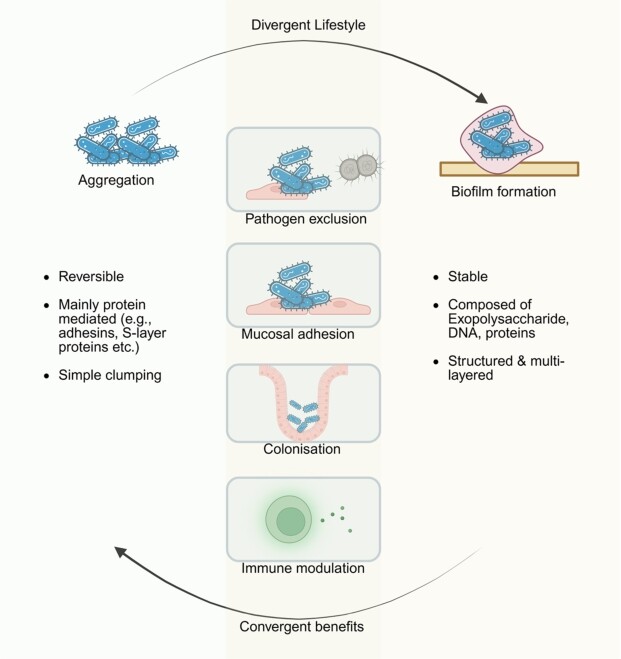
Aggregation in lactobacilli: an unexplored dimension
In: Beneficial MicrobesSearch for other papers by M. Kaur in
Current site
Google Scholar
PubMed
Search for other papers by C. Forestier in
Current site
Google Scholar
PubMed
Search for other papers by S. Miquel in
Current site
Google Scholar
PubMed
Abstract
Autoaggregation is an often-overlooked but critical phenotypic trait in Lactobacillus species that plays a pivotal role in host colonisation, pathogen exclusion, and probiotic functionality. This review explores the molecular mechanisms, surface factors, and environmental cues influencing aggregation, distinguishing it from but also linking it to biofilm formation. While traditionally associated with initial steps in biofilm development, autoaggregation in lactobacilli can occur independently of and sometimes conversely to biofilm production. We assess the contributions of surface proteins, such as S-layer proteins and aggregation-promoting factors, and those of exopolysaccharides, pili, and environmental modulators in shaping aggregation behaviour. In addition, we discuss how aggregation enhances mucosal adhesion, immune modulation, and competitive exclusion of pathogens, making it a promising selection marker for next-generation probiotics and live biotherapeutics. Finally, we stress the need for standardised methods and advanced tools to elucidate the complex interplay between bacterial surface architecture and lifestyle strategies like aggregation and biofilm formation.
| All Time | Past 365 days | Past 30 Days | |
|---|---|---|---|
| Abstract Views | 825 | 825 | 310 |
| Full Text Views | 39 | 39 | 2 |
| PDF Views & Downloads | 50 | 50 | 6 |