


Aspects of political security have been among the key topics addressed in the political programs and speeches of prime ministers and presidents since 1989. Among the most relevant themes to analyze in this area are:
allied security;
special relations with other countries, particularly EU countries, the US, and Russia;
terrorism as a global and local threat;
combating crime and corruption.
As in the case of military security, not all issues were securitized during the 30 years of the Third Republic; some were merely politicized, without necessitating special action or being presented as existential threats. An issue that received considerable attention and was viewed as fundamental to Poland’s security – that is, Poland’s entry into NATO – did not exhibit the hallmarks of securitization because, as with the development of the Polish Armed Forces, there was complete consensus on it not only among the political elite but also – society. Thus, there was no need for extraordinary measures. On the other hand, regarding integration with the European Union, one can point to attempts at securitization, carried out, for example, through messages sent to opponents of integration, which often referred to the statement that by being outside the Union, Poland risks: isolation, economic exclusion, being cut off from Europe, etc. In the last analyzed campaign from 2023, however, themes about the Union as a threat to Poland’s security, especially its sovereignty, emerged. There was a definite securitization of relations with Russia. Finally, there is also securitization concerning terrorism, which was effectively presented as an existential threat to Poland and its citizens. Periodically, certain groups securitize issues of fighting crime, especially organized crime and corruption.
1 Discourse on Allied Security (NATO and EU)
Kornel Morawiecki was the first Polish politician to speak openly about aspirations for NATO membership in 1991, when the country was still part of the Warsaw Pact and “hosted” Russian troops on its territory. He could afford to do so because he did not represent the ruling party. Politicians who had engaged in talks with Western partners understood that such appeals unnecessarily irritated both sides: Russia, which was reluctant to part with its former empire, and the West, which was in no hurry to accept underinvested, backward armies into its ranks. Even politicians who later took much firmer stances, in the late 1980s and early 1990s, spoke, for example, of Porozumienie Centrum (PC) (1990), “taking the current political situation into account.” The first step was to get out of the old alliances and for the Soviet troops to leave Poland. The process of transformation on the European continent should move toward the emergence of a pan-European collective security system. It should proceed with security guarantees for all its participants. Even before the circumstances allowing its dissolution arise, the Warsaw Pact should be adapted to the new political situation (PC, 1990).
When the RWPG and the Warsaw Pact were dissolved, and the agenda for the withdrawal of Russian troops from Poland began to take shape, demands for establishing a new order began to emerge. These ranged from general proposals to those calling for outright cooperation with NATO (and the EU) for future integration. “Poland should base its security on developing European structures for cooperation and integration” (SdRP, 1991). “We advocate for overcoming the continent’s division and for Poland’s active participation in shaping the European security system. Poland should withdraw from the remnants of the Eastern Bloc’s political, economic, and military structures” (UD, 1991).
The most broadly cautious approach to integration, when it was realistically not possible in the short term, was presented by the UD program. Its leaders acknowledged the limitations mentioned earlier. Therefore, the proposal was to first apply for accession to the CSCE rather than NATO and the EU.
In considering Poland’s security, we should go beyond traditional factors involving relations with two powerful neighbors. A clear answer to the question of the future system of international security, capable of permanently guaranteeing Poland’s independence, remains difficult to articulate today. The response to current threats, challenges, and opportunities must involve a dynamic national development policy and the active construction of a complex, multilateral system of international ties. This new system of linkages should enable us to achieve, in the future, a level of security comparable to that of the democratic states of Western Europe. (UD, 1991)
Some parties called for integration into NATO. However, these parties did not significantly influence the government’s structure or foreign policy, as previously mentioned. “The only real force standing guard over Europe is the North Atlantic Pact. In this situation, we must establish closer cooperation with NATO” (PSL Solidarność, 1991). “In the interim period, Poland’s security should be based on bilateral agreements with both NATO and the USSR, as well as multilateral agreements with the countries of Central and Eastern Europe” (Solidarność Pracy, 1991). “For Poland’s security, we must seek political ties and cooperation with Western countries more explicitly than before” (UD, 1991).
The positions of prime ministers and presidents at that time were similarly conservative. Tadeusz Mazowiecki (1989) noted clearly:
Poland wants to co-create a new Europe and overcome the post-war divisions of the world. (…) Our opening to Europe, however, does not mean rejecting our previous ties and commitments. If we reiterate today that the new government will respect Poland’s allied commitments, this is not a tactical appeasement ploy; it flows from our understanding of the Polish raison d’état and analysis of the international situation. If the day comes when European security does not require military blocs, we will bid them farewell without regret. (Mazowiecki, 1989)
Two years later, Jan Krzysztof Bielecki (1991) could already afford to begin his exposé by expressing joy at the collapse of the RWPG and the Warsaw Pact. In 1992, Jan Olszewski went a step further in expressing Poland’s integration aspirations: “We aspire to a Poland that will be a full member state of the European Communities. This connection will bind our democracy to others and ensure the country’s security” (Olszewski, 1992). “The most crucial matter today is Poland’s integration into the EEC,” said Waldemar Pawlak (1992). “My government will strive to make Poland’s security equal to that of other European countries, linking this to bringing the prospect of Poland’s membership in the North Atlantic Alliance closer,” declared Hanna Suchocka (1992).
In the 1993 elections, as the last train cars carrying Russian soldiers departed the country, declarations about new alliances became more resolute. Right-wing, post-Solidarity parties spoke somewhat openly about NATO and the Union, while left-wing parties discussed a new order that combined the needs and approaches of East and West. “We advocate an immediate and vigorous effort to admit Poland into the Atlantic Alliance. We need to feel secure and break the dependencies that fetter us” (PC, 1993). “Poland’s defense doctrine should be based on close cooperation leading to a bonded alliance with NATO member states constituting a guarantee of state security” (Partia Chrześcijańskich Demokratów, 1993). “The main direction of our search for development and security opportunities connects us to the European Community and NATO” (UD, 1993). “Poland’s security should be sought in the future collective security system in Europe” (SLD, 1993).
Standing at the head of the government again, W. Pawlak (1993) declared openly: “integration with the European Union, closer cooperation, and future membership in NATO and Western Europe Union.” Such declarations will be a regular feature of speeches from now on. “I understand Poland’s membership in the European Union, the Western European Union and NATO as part of expanding the zone of security and stability,” Józef Oleksy said in 1995. “Poland’s interests lie primarily in becoming part of the European Union and the North Atlantic Alliance as soon as possible (…) Our membership in NATO is not directed against any country or group of countries” (Cimoszewicz, 1996). Aleksander Kwaśniewski (1995) said in his speech to the National Assembly simply: “external security is first and foremost Polish participation, Polish presence, Polish membership in the North Atlantic Alliance.”
The excerpts from Prime Ministers’ speeches quoted above effectively illustrate the style of the debate on NATO membership in the 1990s. It fell under the security category, but the narrative lacked references to public acceptance or the need for extraordinary measures. This was due to the general consensus among the main political factions on the direction of integration. There was no necessity to seek public support or propose non-standard measures. Thus, the focus was on the technical aspects: the roadmap for integration, cooperation under currently feasible terms, or the modernization of the army. The issue of membership in Western organizations was presented as a significant, key, strategic element of Polish state policy, the best way to ensure regional and global security, but was placed in the realm of normal politics. Securitization occurred in the 21st century, first when the requirements for bringing Polish Armed Forces to NATO standards were analyzed, second during involvement in NATO operations abroad, and third when Poland sought the presence of Alliance troops on its territory.
The 1997 parliamentary campaign proceeded with a similar calm conviction about the inevitability and appropriateness of a NATO integration direction. “Poland’s external security requires first and foremost that Poland join NATO” (UP, 1997). “Poland’s full integration into the security structures of democratic countries” (UW 1997). “Ensuring the country’s security – initiating the process of integration with European and NATO structures” (SLD, 1997). Crucial for “ensuring Poland’s security is its integration into the collective security system in Europe. The PSL supports efforts to bring Poland into NATO” (PSL, 1997).
Standing at the head of the new AWS and UW government, Jerzy Buzek (1997) spoke in the same vein:
We want to become a full member of the Euro-Atlantic community as soon as possible, which in today’s world is the most important guarantee of civilizational development based on the free market and democracy, on the freedom of individuals and nations. Poland in the North Atlantic Treaty Organization is a permanently secure, permanently independent Poland. (Buzek, 1997)
“We joined NATO,” Aleksander Kwaśniewski said simply in 2000, taking office as president of Poland for the second time. Becoming a member of the North Atlantic Treaty Organization began a new period of thinking and talking about the Alliance. Since then, the debate has been dominated by themes of (1) Poland’s role and fulfillment of obligations, including modernization of the army and the organization of military command, (2) NATO’s strategy and its involvement in conflicts outside the area of the Alliance countries, and (3) calls for NATO reform, especially after 2014 and 2022. Hence, the programs of the SLD and PiS in the 2001 elections included extensive passages relating to the first of the themes mentioned above:
Fulfilling the external and internal commitments of the Polish Armed Forces will require significant expenditures, a major restructuring effort, and mitigation of the social consequences of the reduction in the size of the military and the military infrastructure. (SLD, 2001)
We have been admitted to the Alliance on credit, so to speak, and without a change in this state of affairs we will not be able to take advantage of the opportunities offered by our geographic location and population potential. (PiS, 2001)
The requirement to “repay the loan” didn’t create securitization circumstances – although it was necessary to meet the high standards and level of training, investing considerable money, and changing the mentality, habits, and mindset of the command staff in particular. These measures were accepted, as it were, by acclamation, with no significant dissenting voices. No “extraordinarity” was needed. When taking over the prime minister’s chair, Leszek Miller (2001) spoke in general terms: “security is not given once and for all. Of fundamental importance in this regard is our membership in the Atlantic Alliance.” His successor, Marek Belka (2004), standing before the Sejm at the time of the presentation of his government, said this about interaction with NATO: “We are fulfilling our commitments in Iraq, supporting efforts to engage NATO and for a speedy transfer of power to the Iraqi people” (Belka, 2004). Iraq was a significant test for the Alliance countries, whose ultimate involvement in the region was far less than that of the US and its coalition partners. It also showed that the Allies were not unanimous on many issues, and Poland had to find a place for itself in this network of relationships. Hence the proposals in the following years for closer relations either with the US or with European countries, or possibly calls to keep an “equal distance.” These topics, as well as the issue of modernizing armed forces, were raised extensively in the 2005 PiS election program. “We will consolidate our place in the North Atlantic Alliance as a contributor state to the global security architecture. Our goal is to ensure Poland’s proper role in NATO” (PiS, 2005). Not all parties shared this view. SLD staked its position in this regard on relations with the European part of NATO, through the EU: “We are for strengthening the European Union. In favor of a common foreign and security policy” (SLD, 2005).
In his exposé, Prime Minister Kazimierz Marcinkiewicz heralded symmetry in relations, with Poland in the role of peacemaker-connector of “both sides of the Atlantic”:
Integration within the structures of the European Union is a guarantor of development and prosperity, and the alliance with the United States within NATO is a guarantor of security. The two options, European and Atlantic, should not compete with each other. (Marcinkiewicz, 2005)
This symmetry was no longer evident in his successor. Jarosław Kaczyński (2006) put the alliance with the US on a par with NATO membership (J. Kaczyński, 2006).
The campaign prior to the 2007 elections emphasized the need to strengthen defense at the Union level, address changes in NATO, and refine the approach to foreign operations. Even PiS acknowledged the necessity of enhancing cooperation on the continent. “We aim to strengthen NATO while developing a unified European defense policy” (PiS, 2007). PO, while not belittling the role of NATO (it called the Alliance “the main guarantor of Poland’s security”), advocated strengthening EU security policy: “It is the EU and the North Atlantic Alliance that bear responsibility for global peace, security and stability of the international order” (PO, 2007). The PO’s symmetrism will be the party’s enduring approach to global and regional security policy. The PSL had a similar approach: “We will ensure Poland’s international security through participation in NATO, the UN, EU, OSCE structures” (PLS, 2007). The Left, on the other hand, saw European integration as the first pillar of the country’s security:
Increasing Poland’s security, strengthening its sovereignty and authority in Europe and the world through activity and initiative in the process of deepening European integration, strengthening alliances, and building good-neighborly relations and regional cooperation. (LiD, 2007)
Prime Minister Donald Tusk left no doubt about the North Atlantic Alliance’s leadership in providing regional security, but he also acknowledged the EU’s role. For the first time at such a high level, a candid statement was made that military involvement outside the country’s borders is not due to a threat posed by the intervening country or humanitarian motives, but rather to Allied commitments, which also reflects Poland’s future potential needs regarding the defense of its borders. “We view our contribution to NATO’s expeditionary missions as an investment that the Alliance will reciprocate with a greater commitment to security at NATO’s external borders” (Tusk, 2007). The already-quoted excerpt from Bronisław Komorowski’s 2010 speech carried the same content that the prime minister had previously conveyed. “As a member of NATO, Poland is aware of its allied obligations. We understand that for the sake of our own and collective security we should engage our forces in allied activities” (Komorowski, 2010).
The 2011 campaign was full of references to allied relations and was dominated by themes of (1) institutional reform, (2) strengthening Poland’s position, and (3) criticism and disillusionment with allied organizations. PiS dedicated the most attention to NATO in its program, beginning with the understanding that allied relations alone do not guarantee complete security. This new narrative, stemming from Russia’s attack on Georgia, elevated Poland-NATO relations to a new stage, which culminated, by the way, in the realization of the postulate. The party extensively addressed the future of the organizations in question and their potential to ensure security. For the first time since the Alliance’s involvement in foreign operations, the disparity between the interests of the countries for which they are a priority and those of Poland, which has legitimate security concerns about its territory, was clearly highlighted. There was a theme of “reciprocity.” “Poland should make its support for efforts to make the Alliance a vehicle for expeditionary operations contingent on recognition of our demands to maintain effective collective defense mechanisms” (PiS 2011).
The PO similarly supported the view that membership in security organizations does not solve all problems: “Being a full member of the strongest military alliance in history – NATO – Poland must take into account various threats in its defense policy” (PO, 2011). The Left put security provided in the European system first. In the case of NATO, SLD was betting on: tightening, deepening cooperation, including participation in more potential missions abroad. PSL called for a combination of installing NATO infrastructure and deploying troops on Polish territory, while maintaining good relations with Russia. The program offered no practical guidance on how to achieve this. Two other parties running in these elections – Ruch Palikota i Samoobrona – showed less support for NATO and its policies than the mainstream parties. “Samoobrona is not opposed to Poland’s presence in NATO. However, the alliance should serve mainly to develop the Polish army and ensure the defense of the Republic, not to participate in further senseless wars” (Samoobrona, 2011).
Donald Tusk’s second exposé was shorter than the first and mostly devoted to economic issues. There was not a word about NATO in it. Ewa Kopacz, who replaced him in 2014, referred to the Alliance in one sentence: “The Ukrainian crisis shows how important it is that we do not have to face this challenge alone, because the European Union and NATO are behind us.” But back in the 2015 parliamentary campaign, the PO spoke the language of the PiS:
We will increase the military presence of NATO and the United States on Polish territory. (…) Participation in the North Atlantic Alliance will remain a key element of Poland’s military security. Our goal is to convince the allies to establish permanent military bases in Poland, confirming Poland’s special position in the Alliance. (PO, 2015)
This special place of Poland in NATO, achieved through previous loyalty to key Alliance countries, has appeared multiple times in both the PO and PiS narratives. Gained through involvement in Iraq and Afghanistan, as well as the purchases of the F-16/F-35 or the Patriot system, it became a crucial measure to eliminate the threat emanating from Russia. After 2014 and 2022, the issue of protecting Polish territory from the threat from the East began to be securitized. To defeat this threat, it was postulated: increase defense spending, change the approach to the use of the Armed Forces, establish the Territorial Defense Forces, “pull” NATO to the territory of Poland.
Once again, the most comprehensive program on collective defense was presented by PiS. Party began with a diagnosis that included criticism of NATO’s insufficient guarantees of assistance in the event of an emergency. “We do not expect privileges. We want to equalize our security status with that of Western Europe. (…) Poland cannot be a second-class member in NATO” (PiS, 2015). “Second-class” membership, demanding equal treatment with “old” NATO countries, is a new element in the discourse on the role of the North Atlantic Treaty Organization. After 2014, as the conviction began to grow in some political circles in Poland that a conventional attack on the country’s territory by Russia was not only possible but highly probable, demands that NATO and the US pay their debts for Afghanistan and Iraq emerged not only from Pis. In addition to investing in its own army and limiting its use abroad, the demand for NATO military and infrastructure presence in the former Warsaw Pact countries served as a complementary element to extraordinary measures aimed at countering the Russian threat. All these elements were incorporated into the PiS program.
We naturally view NATO’s role through the prism of our national security interests. (…) Poland needs real – i.e., material – security guarantees and the strengthening of NATO’s presence not only in our country, but also on the territory of other members of the Alliance from Central and Eastern Europe. (PiS, 2015)
“The fundamental goal for the coming years remains unchanged – the North Atlantic Alliance must continue to be a politically and militarily credible guarantor of the security of NATO countries,” Beata Szydło said when taking over the Prime Minister’s portfolio (2015). The tone of Andrzej Duda’s statement was similar (2015, a month later): “The task for the near future is to strengthen allied guarantees in the North Atlantic Alliance. And here the matter must be put unequivocally. We need greater guarantees from NATO” (Duda 2015). Two years later, Prime Minister Mateusz Morawiecki (2017) argued that the ambitious plans of 2015 are already largely in place, and his main concern now is harmonizing EU and NATO cooperation, where Poland has a significant role to play. “NATO is and will remain the foundation of our security, while the United States is our main ally” (Morawiecki, 2017).
The 2019 parliamentary campaign maintained the trends outlined in 2015. PO, running as part of the KO, reiterated the need for balance in Europe’s involvement in the security of Poland and the region, while maintaining NATO’s leading role. “We will support any form of cooperation within the EU that develops the defense capabilities of member states in coherence with NATO” (KO, 2019). Koalicja Polska (KP), composed of PSL and Kukiz15, spoke in a similar tone. The direction of basing security on the EU and NATO was obvious, although the order of the mentioned institutions – significant. “The pillar of our security is firmly embedded in the structures of the European Union and NATO. Our foreign policy cannot be limited to courting one country” (KP, 2019).
PiS (in the Zjednoczona Prawica, ZP coalition) has upheld the line of basing Poland’s security on NATO/US, with the possibility of including the European Union.
Poland and the United States have become important partners in strengthening security, stability and development in Europe and the world. Poland has become the security keystone of our region and the entire continent. (…) We will strengthen NATO’s eastern flank by expanding the Alliance’s defense infrastructure of strategic importance on the territory of our country. (ZP, 2019)
Prime Minister-designate Mateusz Morawiecki (2019) reiterated the main tenets of his party’s election program: “We will defend the alliance of Europe and the United States. Just as the European Union is the guarantor of the continental order, NATO takes care of the global order” (Morawiecki, 2019). Andrzej Duda’s speech (2020) was also not surprising: “We must work to strengthen Euro-Atlantic ties and the North Atlantic Alliance” (Duda, 2020).
Allied security returned with redoubled force in the 2023 election campaign. The consensus of the main parties on the inevitability of relying on collective defense was almost total: “Embedding in NATO (…) Strong Poland in a Strong Europe” (Lewica, 2023); “Strong in Alliances: Poland will become the security foundation of NATO’s eastern flank. Thanks to this, Poland’s role as a strong partner will also be important for our allies” (PiS, 2023). Only Konfederacja (2023) pointed out: “successive governments have wrongly seen the only guarantee of Poland’s security – that is, participation in alliances and international organizations,” but NATO membership itself was not questioned. The importance of the Alliances was also discussed by the two prime ministers delivering the 2023 exposé: “We are responsible for the security of a key section of the eastern flank of NATO and the European Union” (Morawiecki, 2023); “Poland is and will be a key, strong, sovereign link of the North Atlantic Alliance (…) I ask everyone to stop pretending that the threat to Poland is our friends and allies of the North Atlantic Treaty Organization and the European Union” (Tusk, 2023).
…
The North Atlantic Treaty Organization is the primary alliance regarded as the guarantor of Poland’s security. This perception exists both during the period when its membership was not yet openly discussed (early 1990s) and at the time of association, culminating in full membership. Since February 2022, following the Russian invasion of Ukraine, it has been under special review. The views regarding the organization, Poland’s role within it, and the expectations from the Alliance have been evolving. The prevailing narrative at the beginning was that we joined NATO “on credit,” needed to increase military spending and modernize forces, and had to “earn full membership” through participation in overseas operations. This shifted by the end of the first decade of the new century, influenced by the events in Georgia (2008) and Ukraine (2014 and 2022). In the second decade of the 21st century, Poland, representing other Central and Eastern European countries, began demanding that NATO and its leaders withdraw from the 1997 agreements with Russia and deploy permanent military components and infrastructure on the territory of new alliance members. Finally, a strong response to Russian aggression in 2022 included providing military support to the struggling Ukraine.
NATO membership, Poland’s position in the Alliance, and the level of guaranteed support in the event of an external threat are issues that were not themselves subject to securitization but intersected with related areas. Being a member of this organization, based on terms formulated by Poland, is a guarantee of security. Therefore, it was necessary to first modernize the army and align it with NATO standards, then to engage in foreign operations whose connection to a direct threat to Poland is difficult to establish, and finally, to secure the permanent presence of allied troops on Polish territory, even at the cost of building infrastructure from our own budget or purchasing equipment from allies.
2 Discourse on Special Relations with Other Countries and Regions (Europe, USA, Russia)
2.1 Europe
In the initial years following the first partially free elections of June 1989, enthusiasm for integration into the Western world was moderate. Several factors influenced this perspective. Solidarity’s electoral victory marked a significant change in Poland, but not in its surrounding environment. The People’s Republic of Poland (a name that remained until December 1989) was still part of the Warsaw Pact, and the constitution, amended in 1976, contained a provision for friendship with the USSR. Soviet troops were stationed on Polish territory, and, apart from radicals, few advocated for accelerating relations with other countries. A key aspect of relations with nations west of Poland was the maintenance of the Oder-Neisse border following German reunification. Consequently, most discussions at that time centered on peace and finding a place within the European family, emphasizing an atmosphere of friendship and cooperation while respecting autonomy. Between 1989 and 1991, specific references to deeper integration were noticeably absent. Instead, the focus was on dissolving old divisions rather than establishing new blocs.
The first prime ministers spoke in a similar vein. Tadeusz Mazowiecki (1989) declared his desire to “co-create a new Europe and overcome the post-war divisions of the world, which are now completely anachronistic,” but in the next paragraph he made it clear that our “opening to Europe does not mean rejecting existing ties and commitments.” He was looking forward to “a time when European security would not require military blocs,” but it did not appear from the statement that this would happen soon. He talked a lot and in a decidedly non-confrontational way about the USSR, and devoted more space to it than to the West or Europe. Of the European countries, he mentioned Germany (West Germany and East Germany), emphasizing the need to develop good relations.
His successor, Jan Krzysztof Bielecki (1991), expected from the West above all a radical reduction of our debt. He spoke cautiously, though less conservatively than his predecessor, about international relations: “We will base our security on good relations with neighboring and other countries in the region, on the emerging pan-European security system” (Bielecki, 1991). Jan Olszewski (1991), who delivered his exposé in the same calendar year, but less than 12 months apart, was already more radical in his statements.
“We are today between two worlds: the Western world, which is peacefully forming and uniting, and the Eastern world, which is disintegrating. We do not yet belong to the former, already – to the latter. We have decided to join the structures of the West, but for the time being we are without alliances, anchoring, securing. We must make an effort to change this risky state. We are striving for a Poland that will be a full member state of the European Communities” (Olszewski, 1991). We are convinced that our country is capable of influencing its international environment in a way that corresponds to our interests and at the same time is conducive to the creation of a better, safe and prosperous Europe said Hanna Suchocka (1992).
Caution also characterized the first presidents’ speeches. In Wojciech Jaruzelski’s speech (1989) there was no reference to other countries. Lech Wałęsa spoke of Poland “wanting to be part of a peaceful order in Europe” and a good neighbor, including to Germany, “in which we want to know a friendly gateway to Europe” (Wałęsa, 1990).
In the 1993 campaign, Europe ceased to be seen as a collection of separate countries; it took on the organizational form of the EEC. This trend will continue until membership in the organization is achieved. Individual countries, apart from the US, including Ukraine and a group of Baltic States (possibly the Weimar Triangle or the Visegrad Group), will not be featured in programs as reference points in the security context. Additionally, prime ministers, who traditionally mention foreign partners in their exposés, will do so infrequently. It can be noted that since Poland was given the green light to declare its official integration intentions and was subsequently admitted to NATO and the EU, consciously or not, there has been a shift away from basing security on relations with specific states or smaller groups. The trend of “thinking organizationally” was already evident in Waldemar Pawlak’s second exposé: “integration with the European Union, closer cooperation and active expansion of bilateral relations and regional cooperation.” He mentioned Germany, the Visegrad Group and the Baltic States, but in the context of economic relations and “general friendliness.” Jozef Oleksy (1995) spoke in a similar vein: “Our intention is to continue the strategic line of foreign policy; the line of European and Atlantic orientation and the pursuit of friendly multilateral and bilateral relations.”
Włodzimierz Cimoszewicz said bluntly: “We will attach great importance to bilateral relations with other member states of the North Atlantic Treaty Organization and the European Union” (Cimoszewicz, 1996). A year later, Jerzy Buzek (1997) mentioned NATO and the EU, along with integration with these organizations in the context of security. A little over a month after the 9/11 attacks, Leszek Miller expressed the importance of bilateral relations, though without specifics. Marek Belka, who succeeded Miller, focused on economic issues and unemployment. In terms of relations with other countries, he did not extend beyond the “EU membership scheme.” The 2005 campaign, like the previous two, did not address the discussed themes. In Prime Minister Kazimierz Marcinkiewicz’s exposé, there were general references to the EU, NATO, and support for Ukraine. Jarosław Kaczyński, taking control a year later, similarly to his predecessors, referred to NATO and the Union, with the latter being expanded to include Ukraine.
A little more than six months before his brother’s exposé, during his swearing-in as president, Lech Kaczyński spoke of new energy in foreign policy, albeit based on transatlantic relations and the Union. In the case of the latter, however, he recognized the nuances of bilateral relations: the improvement in relations with Germany and France is a positive development, “which does not mean that there are not still, especially in relations with the former country, Germany, very significant problems.” He went on to mention Ukraine and the Baltic States, as well as Belarus. He mentioned the Czech Republic, Slovakia, Hungary and the Scandinavian countries, but without any specific context. The overall message was: relations should be good.
In the 2007 elections, the left returned to the policy of distinguishing between EU states as separate entities and not just partners in the organization:
Germany in a strong and successfully unifying Europe will not be a threat to Poland. On the other hand, Germany, operating in Europe’s increasingly weak and shaky international environment, caused by the erosion of EU and NATO structures and mechanisms, could be a serious challenge for Polish foreign policy. (LiD, 2007)
Other parties did not address this topic. The exposé of new Prime Minister Donald Tusk devoted a great deal of space to the cohesion and strength of the Union. The prime minister did not speak about its members except to refer to the Visegrad Group and the Baltic Sea countries in the economic and political context.
Bronisław Komorowski (2010) laconically referred to other than intra- organizational relations with other European countries. “In order to express Poland’s European rootedness, I will make my first foreign visit to Brussels, Paris and Berlin. (…) I will also, of course, work to deepen cooperation with other EU partners” (Komorowski, 2010). In the 2015 campaign, the PO was the only one to mention non-EU relations with European countries.
We recognize the fundamental importance that the Franco-German tandem has for European integration. We want to continue to implement the cooperation with Germany and France within the Weimar Triangle, which was resumed under the PO government, maintaining an open dialogue based on partnership and trust. (PO, 2015)
President Andrzej Duda (2015) emphasized without going into details that good neighborly relations are important “because they strengthen security” (Duda, 2015). In 2020, he referred to the idea of the Trilateral Initiative, which he promoted.
In 2019, the Koalicja Obywatelska, in a similar tone to the earlier PO, declared stronger cooperation with France and Germany. However, it stressed that it was taking place within the EU.
We will return to close collaboration between the EU’s largest countries, including especially Germany and France, and for the countries of the region we will become a worthy representative and valued ally. In this way, we will be a natural link between the largest and smaller countries, Western and Central Europe, the Baltic and the Danube. (KO, 2019)
Koalicja Polska (PSL and Kukiz15) spoke in a similar vein. Zjednoczona Lewica did not address this topic, nor did the Konfederacja (it emphasizes its anti- Unionism instead).
In describing its foreign policy, Prawo i Sprawiedliwość focused not so much on Poland’s relations with other countries as on the country’s position. The program was constructed in a trend familiar to voters since 2015: politics of dignity and getting up from the knees, resisting the decisions of both the EU as a whole and its individual states. The example of Germany well demonstrated this: “We want our relations with Germany – a very important neighbor of Poland – to be based on the principle of equal partnership, respect for our interests in the region and on the continent, and consistent dialogue.” This narrative was also maintained in 2023, where it declared further “rejection of clientelism – swimming in the mainstream and bidding Polish affairs higher” (PiS, 2023). The topic of relations with other European countries didn’t appear in the exposés of Prime Ministers Morawiecki and Tusk, other than declarations about supporting the embattled Ukraine in the context of Poland’s military security.
2.2 United States of America
Despite Poland being a member of the Alliance since 1999, the special relationship with the US has not only retained its importance but has strengthened. In 2020 and 2023, the issue of a strategic alliance with this superpower was even more prominent than ever before, particularly during the negotiation of terms for installing elements of the so-called missile shield in Poland and the permanent presence of NATO troops on Polish territory. Moreover, over this period, there were times when Polish-American relations were heavily securitized.
The first programs of political parties in 1989 and 1990 did not mention the US. Tadeusz Mazowiecki (1989) spoke only of “catching up with the EEC and the United States,” primarily in the economic context. His successor, Jan Krzysztof Bielecki, attached “great importance to the development of relations with the US and Canada,” but mentioned them in a string of other groups of countries from all continents, without giving special importance. The United States was not the first point of reference in the early 1990s – relations with its closest neighbors were key.
In the 1991 campaign, the US was mentioned sporadically, in several election programs, always in the same context – the importance of good relations, among other security aspects. The importance of US involvement in Europe was presented in general terms – the security of the entire continent. “For the processes of Europe and the Western world, the active participation of the United States is still important. The country still seriously determines the security and stability of our continent” (KLD 1991). “The contribution of the U.S. to the maintenance of European equilibrium – among other things, through its role in NATO – is and will continue to be very important” (Ruch Obywatelski – Akcja Demokratyczna, 1991). The new prime minister – Jan Olszewski (1991) – was the first to point out that “the US military presence in Europe is a factor of stability.” Like his predecessors, he also saw the United States as an economic partner. W. Pawlak saw the US as a stabilizer of Europe’s security: “we see their military presence in Europe and participation in European cooperation as an all-around stabilizing factor” (Pawlak 1993). Hanna Suchocka held the line of her predecessors: “Pan-European stability is also guaranteed by the political and military presence of the United States in Europe” (Suchocka, 1993).
In the 1993 elections, only one party referred directly to the North American superpower in security terms: “A continued U.S. presence in Europe remains important for Poland’s security” (Ruch dla Rzeczpospolitej, 1993). Others focused primarily on NATO and the possibility of Poland’s association with the North Atlantic Treaty Organization as a whole. New-old Prime Minister W. Pawlak (1993), in his second exposé, upheld integration declarations, not deeming it necessary to mention the US separately in the context of security. His successor, J. Oleksy (1995), neutrally indicated that “he would give special attention to the development of political, economic and cultural relations with the United States and Russia.” President Aleksander Kwaśniewski, elected in 1995, did not mention the US even once. But Prime Minister W. Cimoszewicz (1996) returned to involving the US in the security of the continent: “The future of Europe depends to a large extent on the involvement of the United States in the process of development and security of our continent. Our relations with the US have essentially taken on an alliance character” (Cimoszewicz, 1996).
The 1997 parliamentary campaign did not note the role of the US in building security. Only one party picked up this theme: “Recognizing the priority of Poland’s security, we will participate in building an effective system of collective security in Europe, respecting the special role of the US in shaping the global security system” (PSL, 1997). The new prime minister, representing AWS Jerzy Buzek, used the words strategic partnership in the US context for the first time. “We believe that the strategic interest of both Poland and the whole of Europe is to maintain the American military and political presence on our continent” (Buzek, 1997). However, this trend – common in the 21st century in the perception of the United States by Polish politicians – although started by leaders of the Left (A. Kwaśniewski and L. Miller) will be more strongly represented by parties and politicians of the right, with each year more and more focused on the US, and moving away from the European Union. The 2005 program of PiS is a good example: “We will work to strengthen the strategic partnership with the United States, which is our key ally and main guarantor of security. Cooperation with the US strengthens Poland’s position in the EU” (PiS, 2005).
As can be seen from the above quote, the relationship with the US was to be “strategic, special, privileged, formal, beneficial and deep,” but not to weaken joint defense within NATO. The beginnings of the party’s narrative, which highlighted the need for a strong bilateral relationship with the North American superpower amid a weakening NATO and a Union that is insufficiently focused on security and defense issues, appeared here. These special relations (extraordinary measures) were then justified by extraordinary threats (possible energy blackmail from Russia, or even an invasion, similar to those in Georgia and Ukraine, and finally – the 2022 invasion). They justified spending on the presence of American troops in Poland and the purchase of military equipment from the US. However, the basis for this undeniable securitization process should be sought as early as the 2005 announcements. Prime Minister Kazimierz Marcinkiewicz (2005) spoke in a similar vein, noting in particular that the EU and the US are not competitors, as they share common threats: “The current challenges of world politics, such as globalization and terrorism, impose a close alliance between the European Union and the US. It is an essential condition for global stability.” A strong alliance with a partner from across the Atlantic was also heralded by Lech Kaczyński (2005): “relations with the United States must, in the best national interest, be strengthened, and in difficult moments be maintained, while firmly placing our demands.” Six months later, taking over the Prime Minister’s portfolio, Jarosław Kaczyński, in other words, directed a very similar message to the MP s gathered in the Sejm: “Poland is in an alliance with the United States. This alliance is maintained and strengthened by joint ventures. These are controversial and not easy undertakings” (Kaczyński, 2006). In the statements of both leading PiS politicians, one can see the “conviction” of courting special relations, the need to take on challenges that are not always popular (this is, of course, about the presence in Iraq), but they are still subject to certain caveats.
Three parties addressed relations with the US in the 2007 elections campaign. PiS again devoted the most space to the issue, again advocating the strengthening of relations, but not without conditions. “Installing elements of a missile defense system in Poland has the dual significance of enhancing Poland’s security and strengthening the strategic partnership with the US” (PiS, 2007).
The US was mentioned laconically in their election manifestos by PO and LiD. According to PO, the relationship with the superpower should be: “Allied and partnership, that is, closely linked to NATO and EU security policy” (PO, 2007). “In matters of foreign and security policy, relations with the United States have traditionally been important for Poland,” Lewica asserted (LiD, 2007). The incoming Prime Minister, Donald Tusk, said in his exposé: “With the United States, as with the European Union, we are linked by a community of values. (…) We will try to convince our American partners that our alliance should find expression in a greater American presence in Poland” (Tusk, 2007).
In this statement one can see outlined only a trend emerging in the later policy of Platforma Obywatelska to strengthen relations with the US, not to gain distance from the EU and to support rather than criticize its security policy. In practice, this was reflected in the involvement in operations abroad under the EU flag and in the push for the withdrawal of Polish troops from Iraq. Bronislaw Komorowski (2010) did not give special importance to relations with the US – he saw them in the context of joint NATO membership.
Protracted negotiations over the deployment of elements of the missile shield in Poland and the withdrawal of troops from Iraq earlier than the ally wanted, weakened ties. Hence, in the 2011 campaign, PiS called for a return to the tracks of strategic cooperation: “It is important to take steps to renew our relations with the United States. This will likely require redefining our country’s engagement in various directions in such so it involves greater U.S. involvement in our part of Europe” (PiS, 2011). For its part, the PO, which is seeking re-election, did not plan for change. “In relations with the US, we try to present a reciprocity-based policy. Within its framework, we have negotiated good agreements on deploying elements of the missile defense system and on the status of US troops in Poland.” It also pointed to the need to seek other than defense benefits from cooperation (PO, 2011). Samoobrona, on the other hand, criticized the presence of foreign military installations on Polish territory and the purchase of American technology.
The moment that restored the pro-Americanism of Polish foreign and defense policy and lowered criticism of the terms of bilateral cooperation was the seizure of Crimea by the Russian Federation in 2014. The weakness of NATO and the EU in the face of this violation of international law showed that in order to realize the demand for a permanent presence of the Alliance’s troops in Poland, it is necessary to cooperate more closely with the Americans in this regard. Hence the exposé by Ewa Kopacz, representing the still skeptical PO recently, included an unequivocal statement: “In view of what is happening in Ukraine, it becomes all the more important to strengthen relations with the United States, so my government will make every effort to ensure that the United States increases its military presence in Poland” (Kopacz, 2014). It was a time when the two main parties of the Polish political scene – PO and PiS – spoke with one voice: “The political, economic and military alliance with the United States is a key element in the security of not only Poland, but all of Europe. We will strive to increase the US presence in our part of Europe, first and foremost in the security dimension” (PiS, 2015). Prime Minister Beata Szydło (2015) spoke in a similar tone: “We attach special importance in security matters to relations with the United States of America, which is today and will remain in the foreseeable future the main guarantor of world peace.”
The 2019 parliamentary campaign referred in the American context primarily to the presence of US troops in Poland. However, the thread was taken up by only two main groups. Koalicja Obywatelska declared the strengthening of this presence, but “on a partnership basis.” “KO is in favor of strengthening and expanding the presence of US and NATO troops on Polish territory. We will base relations with the US on partnership principles, because America does not expect servility, but professionalism” (KO, 2019). PiS, in turn, reproached PO for loosening relations with the US and naiveté in seeing the European Union (and especially Germany) as a guarantor of Poland’s security. “It was in the strategic interest of Poland and the entire region to revitalize Polish-American relations. (…) Poland and the United States have become mutually important partners for strengthening security, stability and development in Europe and the world” (PiS, 2019). President Andrzej Duda (2020) spoke in a similar vein. “We must continue to develop our cooperative capabilities with the allied forces present on our territory, in particular with the US military.”
The 2023 campaign had a strong focus on strengthening cooperation with the US in the face of the growing Russian threat and the war in Ukraine. There was virtually no rift here between the country’s main political forces, as with the speeches of Prime Ministers M. Morawiecki and D. Tusk.
Special Polish-US relations and their various aspects, including the presence of US troops on Polish territory, were subject to securitization processes at times. The need to strengthen these relations was emphasized, especially after 2014 and 2022, in conjunction with the demand for increased spending on the army. This funding was intended to finance not only the expansion of the Polish military but also the procurement of American equipment and the preparation of infrastructure for the presence of US troops. These high costs (extraordinary measures) had to be accepted because the enemy was at the borders and could threaten Polish territory. NATO and the EU had not proven effective as organizations in providing security. Therefore, it was necessary to rely on bilateral relations with the superpower, which, although costly, were certain – American soldiers came to NATO’s eastern flank and are still stationed here, even though they “had the farthest to go.” Western European countries did not shy away from sending their armed forces near the borders with Belarus and Russia. Many of them, especially Germany and France, had economic ties with Russia, sold it arms, and were not interested in stopping its expansion. We could only count on the US. This narrative, though constructed primarily by PiS, became dominant in the second decade of the 21st century. PiS opponents did not present an equally strong case for strengthening security and defense relations among European countries. Following the 2020 Russian aggression against Ukraine, all major political forces spoke with one voice about the importance of American support. Therefore, the securitized issue of special Polish-American relations was able to undergo a process of desecuritization and return to “normal” politics: the consensus on the inevitability of this path, along with the purchase commitments made and accepted in the US arms industry, meant that there was no longer any reason to call for extraordinary measures. Figure 12 illustrates the process of securitization of Poland-US relations.

Securitization of special relations with the USA
Source: own study
2.3 USSR/Russian Federation
A neighbour, ally, and partner of Poland, while serving as an overt enemy for at least some of the parties, appeared in political speeches and party programs from the very beginning. The period until 1993 was dominated by themes of loosening relations, leaving the Warsaw Pact, and the withdrawal of Soviet/Russian troops from Polish territory. Thereafter, until the end of the 20th century, the primary issue was NATO expansion and Russia’s agreement to this process. In the 21st century, relations were largely defined by energy and, more broadly, economic issues (considered within the security dimension) as well as Vladimir Putin’s expansionist policies (Abkhazia, South Ossetia, Donbas, Crimea, Transnistria, all of Ukraine).
In retrospect, there are various assessments of the process of changing alliances after 1989. Many opinions suggest that it could have occurred more swiftly (Strzelczyk, 2002). Years later, however, this contention appears to hold little significance, and the acceleration could be measured in months at most. The Soviet army’s combat troops departed Poland in 1992, with the last soldier leaving in 1993. The RP exited the Warsaw Pact with its dissolution in July 1991, while the RWPG did so a month earlier. Considering that until December 1990, the president of Poland was the architect of martial law, and the first fully free elections took place in the fall of 1991, there was significant fragmentation among the post-Solidarity forces, exacerbated by a president who could not unite them, this pace still merits appreciation. It is important to remember that the group (both politicians and their electorate) resisting rapid political change still maintained its strength. Back in November 1989, that is, when Tadeusz Mazowiecki was prime minister, the PZPR proclaimed: “We believe that Poland’s alliance with the Soviet Union, based on equal, mutually beneficial state and economic relations, is an important factor in the security and development of our country” (PZPR, 1989). Prime Minister Mazowiecki, in his exposé, asserted that “the government continues to attach great importance to economic relations with the Soviet Union and other RWPG countries.” Regarding Poland-Soviet bilateral relations, he spoke diplomatically:
Mutual relations between a superpower like the Soviet Union and a medium-sized country like Poland are inherently complex. A rational approach to this issue must seek solutions that consider the interests of the great superpower while also respecting our state’s sovereignty and its full freedom to shape its internal affairs. (Mazowiecki, 1989)
The caution of the first non-communist prime minister was fully justified. The bipolar world persisted, the PZPR still held power, and a security apparatus remained in place. This was not a time for radical declarations of independence. Fearing a bloody revolution, Mazowiecki advocated for evolutionary changes. Admittedly, Gen. Wojciech Jaruzelski, in his speech following his election as president, did not mention the USSR or bilateral relations, but the newly formed SdRP (1990) made it clear that it would not support a rapid reversal of alliances: “In a divided Europe, it is unacceptable both to extend the NATO zone to the Polish border and to abandon the security guarantees of Warsaw Pact membership” (SdRP, 1990).
There was a realistic attitude among the opposition regarding the possibility of a rapid loosening of the “brotherly alliance,” and while the trend toward sovereignty in relations with the USSR and closer ties with Europe was present, it was not radical. In 1990, PC wrote in its program:
It is in the interests of both Poland and the USSR that the changes taking place respect the right of nations to self-determination, and in a way that could bring the nations of the USSR closer to Europe. Such a transformation would facilitate the creation of a European collective security system to replace the existing blocs in the future. (PC, 1990)
Other parties spoke similarly. Those advocating for a rapid withdrawal from old alliances and a break from the USSR were in the minority. As time passed, with changing opportunities, peaceful democratic reforms in other countries, and the weakening of the Eastern superpower, calls for a change in alliances were proclaimed more forcefully. Taking over the portfolio from T. Mazowiecki in January 1991, Jan Krzysztof Bielecki said in the first sentence of his exposé: “The disintegration of the UW and the RWPG and the withdrawal of Soviet troops in quick succession should complete the work of nations taking their affairs into their own hands.” Less than a year later, Jan Olszewski (1991) began his exposé with external threats to Poland still coming from its eastern neighbor. Nevertheless, he declared cooperation with the new order emerging across the eastern border: “Our relations with the Russian Federation, Ukraine and the Republic of Belarus are becoming paramount. Both opportunities and threats are emerging for us in the East” (Olszewski, 1991).
Waldemar Pawlak (1992), in his first exposé, laconically mentioned Russia alongside several other eastern countries with which Poland was to have good neighborly and partnership relations, while noting: “We will see to the implementation of the package of agreements on the withdrawal of Russian troops from Poland.” Speaking a few days later, new Prime Minister Hanna Suchocka, like her predecessor, announced: “In relations with Russia, Ukraine, Belarus and Lithuania, we are particularly interested in the following issues: security and balance, economic exchange and the situation of Poles living across our eastern border” (Suchocka, 1993).
In the 1993 campaign, the Russian Federation was mentioned as a neighbor with which Poland maintained good neighborly relations. Russian troops left Polish territory, and the former superpower was temporarily uninterested in expansion. Of course, it still opposed NATO’s expansion, but the Alliance itself was not yet prepared for such a step either. After the SLD won the elections, successive prime ministers from the SLD-PSL coalition dedicated little attention to Russia in their speeches and did not present the issue of Polish-Russian relations in a significant way. Pawlak (1993) suggested that relations with all of Poland’s eastern neighbors were equally good and unproblematic, while Oleksy (1995) did say: “we are particularly concerned about the development of political, economic and cultural relations with Russia,” but mentioned it after the US. W. Cimoszewicz (1996) was the only one of the prime ministers of this term of the Sejm to view Russia in terms of security. When negotiating Polish accession to NATO, he had to face opposition from the Russian Federation.
Nor was Russia a special topic in Alexander Kwaśniewski’s speech (1995). He referred to it in common with other Eastern Bloc countries as “neighbors with whom we have shared the good and bad pages of history for centuries.” In the subsequent 1997 election campaign, Russia did not appear as a security topic. Politicians focused on NATO integration and no one intended to “tease the bear.” Taking over the Prime Minister’s portfolio, Jerzy Buzek (1997) declared attaching special importance to relations with Russia. “Unencumbered by the baggage of historical pasts burdening the previous coalition, we will make efforts to make Polish-Russian contacts a partnership and as good as the mutual knowledge of Poles and Russians is.” Pointing out areas where this cooperation has a chance to develop, he referred not to security, but to the economy and culture. This strategy would be typical of the second half of the 1990s–to talk about Russia where a neutral or even open position could be taken.
Some change came in 2001, when PiS’s program included a passage heralding the narrative that was advanced by the party in subsequent years: “The pursuit of good-neighborly relations with the Russian Federation must be conducted with an awareness of the dangers associated, in particular, with the fact that our partner has numerous assets inside our country” (PiS, 2001). It is no coincidence that this occurred during the period when Vladimir Putin took power in that country. The Russian Federation became a threat to Poland in the military, political and economic fields, with a particular focus on energy. In some cases, the threat has been securitized. Lech Kaczyński, taking the oath of office before the National Assembly, said:
An important issue is our relations with Russia, which has remained for centuries, despite the vicissitudes of fate, our great neighbour. We look at them taking into account, first of all, the historical perspective, maintaining patience and the conviction that there are no objective reasons why they could not be good. (Kaczyński, 2005)
“We would like to have the best possible relations with our neighbors in the East,” Jarosław Kaczyński declared a year and a half later when taking over the Prime Minister’s portfolio (2006). – “There we must be, first, patient, second, patient and third, patient. The processes that will lead to Poland’s acceptance as an important European actor and partner for Russia will probably be long” (Kaczyński, 2006). In doing so, he pointed out the boundary conditions for good relations between the countries – the superpower must recognize that Poland, as a member of the EU and NATO, holds a different status than when it left the Warsaw Pact and RWPG. These relations must be rebuilt from an equal position to Russia.
When winning the 2007 elections and taking over the Prime Minister’s portfolio, Donald Tusk said: “while we have our views on the situation in Russia, we want dialogue with Russia as it is. Lack of dialogue serves neither Poland nor Russia” (Tusk, 2007). This approach was also characteristic of Platforma Obywatelska in the following years of the 21st century. After 2010, when PiS accused the Russian Federation and V. Putin personally of causing the Smolensk catastrophe, the PO stayed with its line, at least until 2014. Hence Bronisław Komorowski (2010), standing before the National Assembly declared: “There will be no stable development of our region without cooperation with Russia.” A year later, in the parliamentary campaign, the PO wrote in the same vein in its program: “A constructive approach to Russia strengthens our position in Europe. (…) It is in our interest to dialogue with Russia primarily through the Union” (PO, 2011).
Meanwhile, the PiS program from that campaign was full of threads that not only described Russia as a threat but also pointed out the behavior of politicians in Poland who do not accept this stance as dangerous. It clearly indicated that failing to take a hard line against Russia amounts to treason. This narrative, developed across successive elections, bore the hallmarks of securitization: a new (or rather, old but with a renewed force of destruction) threat emerged, which had to be confronted by all means in various areas (political, military, economic, cultural). In the party’s 253-page program, almost 10 pages are devoted to this diagnosis of Russia as an existential threat: “Russia, regardless of who governs it, will have no interest in strengthening Poland’s position through the development of bilateral relations until it acknowledges that our country’s position is robust enough to make maintaining good relations with it beneficial” (PiS, 2011).
The excerpt quoted above from the PiS program was absolutely unique compared to the material presented so far. Even during periods of particular tension between Poland and Russia, even among small, radical groups, there has never been such an openly hostile tone towards another country. This breakneck narrative frame: the threat from Russia – the EU, especially Germany, pressuring Poland – Poland dependent on Russia in the hands of EU powers, persisted in the language of PiS for a long time. The act of securitization was based on this frame. There was a DANGER (ex-KGB-ruled Russia, which was at least complicit in the death of the president), for which the only SOLUTION was a change in the position of prime minister (traitor, promoter of foreign interests), to which the grouping appealed to the voters (appeal for ACCEPTANCE through voting). Throwing accusations of a large caliber, believing in the evil intentions not only of the neighboring state but also of political opponents, and openly proclaiming this in a serious document while pointing out the multidimensional consequences of maintaining the threat, were intended to make the threat existential.
J. Kaczyński was assisted in maintaining the narrative of a special Russian threat by external circumstances, particularly following the seizure of Crimea in 2014 and the aggression in 2022. However, prior to these events, PO won the elections again, and Prime Minister D. Tusk’s only remarks about Russia were that gas contracts with Russia, along with agreements with Qatar and the gas port, provided Poland with “gas security.” His successor, Ewa Kopacz (2014), mentioned the consequences of deteriorating relations with Russia, such as embargoes on Polish food products, but did not address the underlying reasons. It was not until a year later, in the PO election program, that it took a stance regarding the new international situation:
At present, Russia is damaging the chances for good relations with Poland by questioning the international order in Europe, undermining the principles of inviolability of borders, non-violence in international disputes and the sovereignty of states. We will consistently oppose Russia’s aggressive policies and continue to successfully seek unity in the Western world on this issue. We believe that in relations with Russia, Polish interests are best served through the European Union on economic issues and NATO on security issues. (PO, 2015)
PO’s position to talk to Russia through the EU or NATO has been a constant in the party’s narrative since then. The party called for solving this problem (threat) through the rules/principles of normal politics, not extraordinary measures.
PiS, on the other hand, began its presentation of the Russian issue with a description of the threat:
Russian imperialism is being reborn before our eyes. Russia is demanding a new balance of power in the world. It is breaking up the unity of our region and the Union and NATO. (…) The European Union is torn between wanting to cooperate with resource-rich Russia and wanting to maintain relations with post-Soviet countries that would like to be closer to Europe. NATO is also divided on this issue. (PiS, 2015)
The diagnosis led to the conundrum that Poland cannot be passive: “We cannot delude ourselves that Moscow will reward us for our passivity or tacit approval of Russian imperialism” (PiS, 2015). In this context, the diplomatic provisions of the PSL program looked as if they had been carried over from another era: “Strengthening good-neighborly relations on our eastern border, with Russia, Ukraine and Belarus, while supporting democratic processes in these countries” (PSL, 2015).
The situation was repeated after the next elections. In the campaign, PiS spoke of the clientelism of its political opponents toward Russia, a submissiveness that was supposed to ensure Poland’s praise in the “salons of the European Union.” The party then declared: “We want to improve relations with Russia. These are necessary not only for both countries and peoples, but also for the region and the continent. However, for changes to take place they require the will of both countries” (PiS, 2019).
PSL viewed Russia solely in economic terms – as a source for food exports, which are currently blocked, and coal imports, which should be halted. However, the program made no reference to the security issues at hand. The SLD and Konfederacja did not tackle the Russian problem. PO criticised the PiS government for its record coal imports from Russia, but did not elaborate on this point. Prime Minister Morawiecki, addressing parliament for the second time with a motion for a vote of confidence, emphasised the need for energy independence from the East, yet failed to address at least the allegations regarding coal imports. He did not portray Russia as a threat, nor did President Andrzej Duda in 2020. The situation changed dramatically during the 2023 campaign following the Russian aggression against Ukraine. However, an act of securitization did not occur, as there was no call for extraordinary measures. The national consensus on the necessity to invest in defense, build energy independence, and support Ukraine’s struggle against Russia meant that decisions in this area were made according to a “normal policy.”
The situation was different in 2023. “I think we all know what would happen if Russia triumphed in this conflict. I don’t think we can pretend in this situation that we don’t know the height of the stakes,” Donald Tusk (2023) said in his expose without elaborating on the thread in a particular way. “Russia’s neo-imperialist policy is only gaining momentum, we can see it in Ukraine,” Mateusz Morawiecki (2023) conceded.
The narrative surrounding Russia in Polish political discourse has been shaped by three factors: (1) the collapse of the bipolar world and the dissolution of old alliances, (2) the changing leadership in Russia (from B. Yeltsin’s “reeling” empire to V. Putin’s rebuilding power), and (3) the attitude of the Western world toward Russia. Until the end of the 20th century, while Poland awaited the withdrawal of occupying troops from its territory and the opening of the door to NATO, the strategy of “not irritating the bear” prevailed. The clear signal from Washington and European capitals that Yeltsin had to agree to NATO enlargement meant that the narrative was extremely diplomatic: they preferred to discuss trade and culture rather than tanks or guns. The situation changed in the 21st century. V. Putin’s rise to power coincided with a growing belief among the new countries of the North Atlantic Alliance that NATO membership guaranteed that Russia would not view Poland differently from Germany or France. However, Putin’s strategy of negotiating with states rather than with NATO or the EU, along with the low effectiveness of these organizations in presenting Poland’s perspective in relations with Russia, meant that at least from 2004/5 (Nord Stream I) through 2008 (Georgia) to the crucial year of 2014 (the seizure of Crimea) and finally 2022, Russia began to be openly portrayed by some political circles as an enemy (an existential threat) and by others at least as a problem that needed to be handled with care. Although the strategies for addressing this threat varied (bilateral, strong alliance with the US with military presence on Polish territory, or allied actions), due to the change in the attitudes of leaders from other EU and NATO countries after 2014, Russia began to be treated as a “security issue.” This became part of the securitization process – a justification for changing defense strategy and increasing military spending. The securitization of Polish-Russian relations and Russian imperial policy is presented in Figure 13.
Securitization of the relations with Russia
Source: own study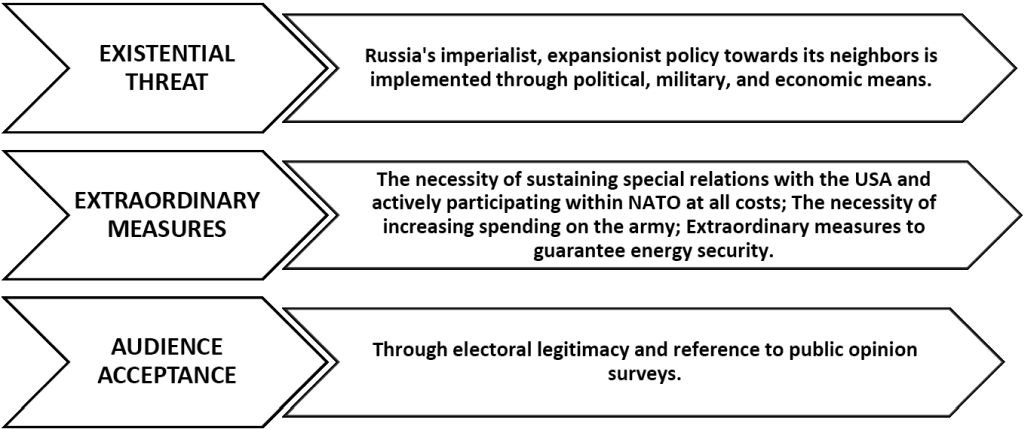
3 Discourse on Terrorism
Terrorism as a threat to both global and local security did not appear in electoral programs and political speeches until after the September 11, 2001 attacks, as Leszek Miller (2001) said in his exposé delivered just over a month after the attacks on New York and Washington: “The tragic events dramatically reminded everyone of the old truth that individual and overall security is not given once and for all” (Miller, 2001). Two years later, when Poland took part in the operation in Iraq, the terrorist threat was a side thread justifying the involvement. Announcing the decision, President Aleksander Kwaśniewski said that “we were intervening in the belief that together we should take action against terrorism” (Kwaśniewski 2003). “Poland must also look at terrorism and the threat of weapons of mass destruction as potential threats to our country as well,” Leszek Miller (2003) said a week later during a debate on involvement in Iraq.
Despite the above, terrorism did not take up much space on political agendas in subsequent years. In the 2005 campaign, only PiS and PO referred to it, in general way: “International terrorism remains an immediate threat” (PiS, 2005). “Terrorism, organized crime, uncontrolled migration are much more serious threats today” (PO, 2005). “The current challenges of world politics, such as globalization and terrorism, impose a close alliance between the European Union and the US,” Prime Minister Kazimierz Marcinkiewicz stated briefly in his exposé (2005). Slightly more space was devoted to this threat a year later by Jarosław Kaczyński (2006): “Today this external security revolves primarily around two problems, that is, economic security and security against terrorism” (Kaczyński, 2006). In the next election, the Law and Justice Party proposed stricter penalties for terrorist crimes.
“Global policy does not revolve in a vacuum. Still, it centers around specific problems and challenges: energy security, climate change, terrorism, migration, hunger and disease, debt, weak and failed states” (LiD, 2007), the Left’s program said, placing terrorism in line with other global threats. The PO spoke in a similar vein, noting that “only a strong and efficient EU can meet the challenges that no member country will be able to face alone: terrorist threats, migration pressures, climate change” (PO, 2007). Later in the program, PO noted that “Poland could become a transit state for terrorists at any time. It is also impossible to rule out terrorist acts and attacks in any of Poland’s cities” (PO, 2007).
Terrorism, on a global scale, has posed a threat that has been subject to strong, effective, and – as Rita Floyd advocates – in some cases, like the war on terror as a response to this threat, unjust – securitization. Spectacular attacks that can be executed at minimal cost anywhere in the world have led most societies to accept extraordinary measures for combating this threat: from banning water bottles on aeroplanes to the humiliating removal of shoes during personal inspections, alongside special laws permitting services to wiretap, arrest, and imprison suspected terrorists, both domestic and foreign. Poland, however, did not embrace the securitization shift of 2001. Although the attacks on the USA shocked Polish citizens and policymakers, there was a prevalent perception that these events were a geographically distant problem. This situation only changed at the beginning of 2015, when Europe started to experience attacks carried out on its territory by jihadists (Madrid, Nice, Manchester, London, Paris, Brussels, Berlin), in which Polish victims were also involved. The large mass events held in Poland at that time (NATO Summit, Youth Days with the personal participation of Pope Francis) and the associated threats necessitated new legal solutions, such as the Anti-Terrorism Act of 2016. However, beyond this, we cannot speak of an act of securitization here.
References to terrorism in the 2011 elections were more specific than in previous years and included fairly detailed arguments. The PSL called for the protection of infrastructure. PiS indicated that “the preparation and enactment of a special law on countering terrorist threats was becoming an increasingly urgent need” (PiS, 2011). The Left did not believe in the state’s readiness to fight terrorism. 10 years after the 9/11 attacks, terrorism was present in election programs, but the scale of this presence was not large. The topic only returned in the party’s 2015 PO election program, as a demand to strengthen the anti-terrorism system.
Despite the persistently low level of terrorist threat in our country, measures are needed to expand the scope of cooperation of institutions that care about anti-terrorist security, to make citizens aware of the possibility of events and the rules of conduct in the event of their occurrence. (PO, 2015)
The issue was presented somewhat differently by PiS, which in its program advocated changes in the law and new powers for individual services, announced as early as 2011. PiS was given the opportunity to implement its demands. Upon taking the prime minister’s seat, Beata Szydło (2015) began her exposé with the terrorist threat precisely, referring to the Paris attacks that took place a few days before her speech: “I take office as Prime Minister of the Republic at a time when our world – built on the values of freedom, democracy and tolerance – is increasingly aggressively attacked by those who do not respect the right to freedom of others. We do not agree with such a vision of the world” (Szydło, 2015). References to the terrorist threat in Prime Minister Szydło’s speech were not without pointing out that one of the causes of attacks in Europe is refugees and the flawed migration policies of Western member states.
In 2019, terrorism was no longer a significant problem. In its program, PiS stated: “We have no record of acts of terrorism in our country, and there are no radical Islamic violent organizations operating in Poland” (PiS, 2019). KO announced the repeal of some provisions of the anti-terrorism law that harm civil rights: “We will protect the privacy and secrecy of correspondence of citizens and citizens. Those provisions of the ‘surveillance’ and ‘anti-terrorism’ laws that may violate human rights and civil liberties will be repealed. They were adopted in defiance of a Constitutional Court ruling” (KO, 2019). Prime Minister Mateusz Morawiecki (who did not mention terrorism once in 2015) simply stated in his exposé that new threats, “such as global terrorism and waves of immigration, have emerged in the world in the 21st century” (Morawiecki, 2019). Nor was terrorism a topic of the 2023 campaign.
4 Discourse on Crime
An important part of political agendas and speeches by politicians is occupied by issues related to law and order within the traditional approach to security. Today, these issues are central to homeland (internal) security analysis, and their social significance ensures that the topic’s prominence in political discourse remains strong.
In Polish political discourse, one can distinguish three periods with varying distributions of accents and narratives in the area. The 1990s was a time for shaping the system to ensure internal security: the construction of both the judiciary and the law enforcement apparatus (the reform of the police and the establishment of specialized structures to combat crime) took place under the challenging conditions of rising organized crime. This period saw the creation of a new criminal code (1997) abolishing the death penalty while advocating for increased penalties for crimes, laying the groundwork for anti-corruption legislation, and highlighting the chronic underfunding of services. A significant symbol of this era is the assassination of Police Chief Gen. Marek Papała for motives and under circumstances that remain not fully explained. Symbolically, the establishment of a professional formation to combat organized crime – the Central Bureau of Investigation (CBŚ, today: Police Central Bureau of Investigation – CBŚP) – in April 2000 can be considered its conclusion.
The years 2000–2007 were a time when these issues became particularly politically important. Lech Kaczyński built a political career on his fierce opposition to the liberalization of punishments and the sluggishness of law enforcement agencies, earning him the nickname “Sheriff”: first as Minister of Justice in Jerzy Buzek’s government, then as Mayor of Warsaw, and finally as President of Poland. Symbolically, this period ends with the creation of the Central Anti-Corruption Bureau (CBA) – a new special service established to combat corruption and actions detrimental to the state treasury.
The second decade of the 21st century is a time when issues of law and order have given way to problems such as terrorism, migration, and external threats to the entire Republic. In the political discourse, there are themes of service oversight, financing formation, and judicial reform.
In the 1990s, a key issue was the organization of the law enforcement and justice apparatus, along with reforms of the criminal code and laws inherited from the PRL. Sovereignty, independence, rule of law, and efficiency/effectiveness emerged alongside the concepts of justice and security. Potential threats to the rights and lives of citizens were perceived not only from criminals but also from the state and its institutions, as well as from the remaining post-PRL legal regulations. Calls for ensuring a just verdict signified not only a demand for punishment for the offender, but also for the protection of the citizen from wrongful conviction, along with guaranteeing him a fair trial and respect for his rights. Judicial reform was one of the key issues raised in the exposé by Prime Minister Tadeusz Mazowiecki. “We will strive to accelerate our work on new codifications of criminal law, particularly criminal procedure, which must meet the requirements of the right to a defense and the right to a court,” said the former oppositionist and Solidarity activist, emphasizing not fighting crime, but ensuring human rights (Mazowiecki 1989) In a similar vein, he characterized the tasks of the transformed militia: it was to become a formation that supports rather than harasses citizens. Jan Krzysztof Bielecki spoke about the withdrawal of state supervision of citizens in every sphere of their lives, but also very clearly stated that: “criminal crime is becoming an increasingly dangerous scourge. The development of democratic freedoms cannot be compromised by the impunity of bandits and thieves” (Bielecki, 1991). He pointed to not only low salaries in the police, but also the lack of decisiveness caused by its transformation, personnel movements, and uncertainty about the expectations of superiors as reasons for this state of affairs. Waldemar Pawlak (1992), analyzing privatization processes, spoke of the threat of corruption: “Very dangerous to the reform process are the phenomena of corruption, fraud and getting rich by seizing public pennies. We will fight these phenomena decisively.”
The 1993 campaign already focused more on citizens who were afraid of crime.
“We must begin to feel safe in our homes and on the streets. Rising crime must be decisively opposed by the state bodies set up for this purpose. We consider it necessary to tighten penal policy,” PC declared. – “When it comes to punishing crimes, it is necessary to introduce the possibility for courts to impose prison sentences combined with hard labor. The rights and interests of crime victims must be respected in criminal proceedings.” (PC, 1993)
This would be a narrative characteristic of this party (later PiS) for the next 20 years. Other right-wing and conservative groups also spoke in a similar vein.
The left and the center parties generally did not deviate in their narrative from right-wing groups, but focused more on the justice system’s effectiveness. SLD called for creating “an Efficient System of Legal Protection Institutions to guarantee that criminals would receive just punishment” (SLD 1993), while UD wrote: “A growing problem is the low efficiency of the justice system. This gives rise to insecurity and loss of citizens’ sense of security” (UD, 1993).
Prime Minister Pawlak’s second exposé (1993) already presented crime as a serious problem.
“People should not live in fear of losing their lives, health, property. Efforts should be made to remove the causes and reduce organized and economic crime, to fight corruption, bank fraud, tax fraud, money laundering, car theft, drug production and trafficking. There will be a rapid strengthening of crime-fighting structures,” Pawlak declared. (1993)
His successor, Józef Oleksy, continued: “Inevitable and swift punishment must be one of the basic elements of prevention. After all, it is the criminal who is supposed to feel threatened, not the citizen” (Oleksy, 1995). W. Cimoszewicz did not break from the narrative of his predecessors. He portrayed crime as the biggest scourge facing the state.
The growing number of crimes committed and the dangerous tendencies involving a rapid increase in the number of crimes of the most serious types, the emergence of organized crime, and finally the criminal world’s building of a strong financial base for its activities – pose a challenge to the state. (Cimoszewicz, 1996)
The problem of crime also found a place in the president’s speech. In 1995, during his swearing-in, Aleksander Kwaśniewski said that “we cannot be the first generation to live with a sense of external stability, and at the same time the first to have a sense of instability and fear on the streets of cities.” The parliamentary election campaign of 1997 was marked by increasing efficiency, tightening up, improving functioning and order. Unia Pracy, in the very first words of its program, promised “a determined fight against crime and corruption.” The ROP declared: “We will curb banditry and crime. We will streamline the judiciary, reducing the length of court procedures to the maximum” (ROP, 1997). AWS promised changes in the law to make it easier to punish criminals. Other parties spoke in a similar vein. SLD declared an “effective fight against juvenile crime and demoralization” (SLD, 1997), PSL promised to “protect the life, health, property of citizens and ensure public order” (PSL, 1997). The UPR wrote in its program: “Citizen security means efficient police, prosecutors and courts. The inevitability and permanence of the punishments handed down” (UPR, 1997).
“First – free people in strong families. Second – repair of the state,” the new Prime Minister Jerzy Buzek (1997) presented his government’s action plan. – “Citizens must feel safer than they do today. This requires improving the work of the police, other services, law enforcement agencies and courts. The justice system is the foundation on which a strong state must be based. Meanwhile, it is in deep crisis.” (Buzek, 1997)
Three years later, Aleksander Kwaśniewski spoke in a similar vein as he began his second presidential term: “I also want another issue of importance to the world of politics is the duty to raise the level of citizens’ sense of justice and personal security. This is about the effectiveness of the courts, prosecutors, police. It’s about the general disapproval of corruption” (Kwaśniewski, 2000).
The 2001 parliamentary campaign was full of references to crime and internal security. The reason for this was the seriousness of the problem. As the SLD noted in its program, “although successive governments announce a fight against crime, the situation is not improving. People still feel threatened. Victims and victims of crime wait too long for the perpetrators to be detected and tried” (SLD, 2001). Samoobrona and PSL spoke briefly about the need to improve the fight against crime: “Eliminating the causes of the increase in crime, not just the effects, confiscating the property of affaires and fighting corruption” (Samoobrona, 2001); “Increasing the effectiveness of the state in maintaining order, order and security for citizens” (PSL, 2001). “In Poland, there is a growing sense of helplessness in the face of crime, leading to a widespread decline in security that citizens feel. The basic problem is the state’s lack of sufficient capacity in introducing a unified crime-fighting policy and in consistently implementing it.” – seconded by PO (2001).
PiS devoted the most space to this topic. The party’s 2001 campaign was based on a program to fight crime. It can even be assumed that in its first campaign, this party was a one-issue party, which allowed its leaders to build political capital in the following years. No other party in Poland after 1989 has presented such an approach. PiS appealed to the vision of criminalizing the economy, portraying it through the prism of corruption and fraud, questioning how the transition to a free market in the 1990s occurred and building the belief that certain socio-political elites profited from it. Hence, PiS called for a referendum with a question on introducing a law to tighten the fight against crime. The program went on to enumerate in detail: “It is necessary to carry out a fundamental revision of the Penal Code, so that its basic principles of punishment and the clear increases in the threat for individual crimes are changed” (PiS, 2001). The party’s proposals included much more far-reaching solutions than those of other parties. The new special laws, the extraordinary mode of punishing the most dangerous offenders, and the search for public support through a referendum demonstrate the securitization of the issue of fighting crime that has been undertaken – moving it from ordinary politics to the category of an emergency (existential threat), requiring exceptional and extraordinary measures.
PiS made heavy accusations by encasing them in a typically populist narrative: only the rich elite are doing well, and only they can feel safe. “An average citizen who makes a mistake in his tax return, a small businessman who fails to pay his tax on time are treated as criminals. Meanwhile, the real criminals, who have made fortunes, sleep soundly” (PiS, 2001). Hence, there is a demand for the services to be given greater powers to obtain information potentially usable in fighting crime. As mentioned, all parties pointed to the need for change, but none presented the entire sphere as pathologized to the marrow and in need of immediate, far-reaching “corrective” measures. PiS, however, needed it to carry out the securitization move smoothly (Figure 14).
Securitization of the crime in the political discourse of PiS in 2001
Source: own study
Despite a good result in the poll, PiS did not receive enough support for its proposals. The elections were won by the Left and it was SLD, together with the PSL, that formed the new government. On taking office as prime minister, Leszek Miller said Poland must become a safe country. Moreover, he declared: “We declare an unwavering fight against criminals, regardless of their identity. (…) Justice must proceed swiftly, as it is then more effective and economical” (Miller, 2001). This was a narrative held in the same vein as the campaign proposals, not as radical as that of PiS.
The three major corruption scandals uncovered under the SLD and PSL governments instilled in some of the public a belief that the claims of a corruption-ridden PiS elite might have been accurate. During the 2005 campaign, all parties proposed changes in this regard, but PO and PiS had the most to say, although the tone of these parties was quite different.
PiS’s program content can be divided into three aspects. The first focuses on holding predecessors accountable, the second addresses legal changes to combat crime, and the third deals with reforming institutions and services. The program began by announcing the establishment of “a parliamentary Truth and Justice Commission. Its primary task will be to investigate all types of scandals and abuses” (PiS, 2005). The proposal for extraordinary solutions was already evident in this first provision. The state of security was assessed in the context of the story of the bad wolf.
Murders of random passersby in housing estates, robberies and rapes of defenseless women, thefts of cell phones, car burglaries, and numerous economic scandals confront Poles daily. As a result of liberal penal policies and the poor functioning of the police, courts, and prosecutors’ offices, the number of crimes remains very high. Instead of sitting in jail, bandits roam the streets of cities, feeling a sense of impunity. (PiS, 2005)
The story pointed directly to the guilty and promised to hold them accountable. When the frightened reader began to check behind his or her back to see if a threat was lurking, a “deliverance” appeared – a program of recovery. It was detailed in over a dozen pages and addressed the smallest details of the issues raised. “The new Criminal Code will effectively combat crime and protect victims of crime. The high risk of severe punishment will effectively deter both petty thieves and dangerous bandits” (PiS, 2005).
The issue of punishment received considerable attention in the program. It was central to both combating and preventing crime. Other measures – beyond the deterrent effect of a high sentence – were not envisioned by Pis. The proposed range of punishments was extensive and varied, including longer prison sentences and the introduction of absolute life imprisonment, higher penalties for repeat offenders, confiscation of criminal property, and tougher penalties for violent crimes. In return, citizens who abide by the law were to be supported in protecting their rights. After announcing the aforementioned changes in the law, PiS turned to organizational issues and highlighted elements of reform for the judiciary and law enforcement apparatus. Just as it did not believe in the possibility of prevention beyond deterrent punishment, it also assumed that there was a pathology in the courts or the prosecutor’s office that needed to be eradicated. This pessimistic worldview fostered a sense of insecurity, thereby laying the groundwork for the securitization act. “Significant organizational changes are essential in the prosecutor’s office. We will establish an elite unit within the central prosecutor’s office to combat major mafia and scandal-related crimes” (PiS, 2005).
As in the 2001 campaign, the issue of fighting crime was securitized. We have a constructed threat and a proposal for extraordinary measures (new powers for the services, new obligations for businesses). Acceptance of the extraordinary measures was intended to be the vote cast in the elections (Figure 15).
Securitization of the crime in the political discourse of PiS in 2005
Source: own study
The PO in its program also criticized the state of security and the functioning of the institutions providing it, though not entirely. Although critical, the diagnosis of the state of security was conveyed in a language distinct from that of PiS. The PO addressed the same problems pointed out by PiS and made similar accusations. However, the program included objections regarding the limits of deliberation of codes and the empowerment of services. There was no call for extraordinary measures, and the issue of crime as a threat was not raised to an existential level. Thus, there was no securitizing procedure here; the problems remained within the framework of ordinary politics.
Voters, however, opted for harsher rhetoric and allowed the Law and Justice party to win the dual elections – parliamentary and presidential. Kazimierz Marcinkiewicz, who took over as prime minister, continued his party’s narrative:
This is not the kind of state we dreamed of when we regained sovereignty in 1989. Corruption, in addition to public outrage, spoils market mechanisms. The low efficiency of law enforcement and the judiciary reduces the security of economic transactions. It creates a sense of impunity in criminals and vulnerability and helplessness in citizens. (Marcinkiewicz, 2005)
Later in the exposé he declared: “we want to take back the state from the pathological arrangements and informal pressure groups parasitizing it. We want to give it back to citizens” (Marcinkiewicz, 2005). Replacing Marcinkiewicz as prime minister, Jarosław Kaczyński upheld the line outlined by the party: “We need to go further here. We have to make the Pole know that the right to peace in the apartment, on the street, at work is his right guarded by the state” (Kaczyński, 2006). In the 2007 campaign, PiS reiterated most of its earlier demands. It slightly reframed the narrative due to its two years in power: there was no longer a sharp criticism of the status quo, though it was made clear that the reforms had been interrupted by early elections. Given previous assessments of how much remains to be addressed, one might question the program’s final conclusion. Nonetheless, the fight against crime played an important role, as it had in 2001 and 2005, although it no longer exhibited the hallmarks of a securitization act: the anti-crime plan was incorporated into the political agenda and began to be governed by the rules of standard politics.
PiS’s biggest rival, PO, also referred to the issue of fighting crime and organizational changes in this area. Still, the perspective adopted in the narrative focused on correcting the mistakes of predecessors: “Our goal is to reduce threats to state security and public order while increasing the citizens’ sense of security, without unduly restricting their freedoms and liberties” (PO, 2007). As in earlier programs, PO proposed tightening regulations or granting new powers to the services, but clearly stipulated that the process must not violate civil liberties. Partia Pracy spoke similarly: “Restoring confidence in the justice system. Addressing real crime, including violence against women and children and trafficking in women and children” (PP, 2007). Donald Tusk’s (PO) addressed the issue of fighting crime at the very end: “The fight against crime will be carried out with full determination. But it is not enough to introduce only toughening punishments and dazzle the public with spectacular arrests” (Tusk, 2007). In an attempt to regain power in 2011, the Law and Justice party returned to “zero tolerance” rhetoric and criticized opponents for being too liberal in their approach to fighting crime. It recalled its successes in this field, interrupted by the loss of early elections, and promised to continue the program announced previously. The diagnosis made by the SLD was similar to that made by PiS. The party accused its predecessors of not doing enough and of manipulating statistics.
The sense of security in our country is still far from expectations. Most of us fear traffic pirates and drunk drivers, theft and burglary, hooligan attacks and assaults. We are not sure that our children are effectively protected from drug traffickers, as well as from various forms of violence and harassment. (SLD, 2011)
The parties in power for the previous four years did not question the reality but only planned further actions. Donald Tusk indirectly referred to the internal security issue, talking about reform the pension system for law enforcement. Three years later, Ewa Kopacz asked rhetorically: “How do we find the line between what is necessary for people to feel safe and their natural need for freedom?” (Kopacz, 2014).
“The competency chaos in homeland security and crisis management will be eliminated first” (PiS, 2015) – declared PiS in victorious 2015 campaign. The Left hinted at the need to control the work of the secret services. PO presented the set of slogans without details (PO, 2015). Prime Minister Beata Szydło, speaking on behalf of the victorious PiS, said in her exposé: “We will accelerate the modernization of the uniformed services, restore proper operation and supervision of the special services” (Szydło, 2015). However, no details were given. It was the last time, when law and order issues were raised in the campaigns and prime ministers’ speeches. The time when political capital could be built on these topics has passed.
5 Discourse on Corruption
As with crime in general, certain phases can be distinguished in the narrative and political discourse on corruption and organized crime. The first is (1) the 1989–2000 period, when corruption was stigmatized, but solutions to combat and prevent it were lacking, as in the case of economic crime. The second – (2) the period 2001–2006, namely the time of building laws and institutions, including the creation of the Central Anti-Corruption Bureau (CBA). The third period – (3) from 2007 to the present features a variety of proposals for reforming the system and improving the effectiveness of prosecution.
In the 1990s, politicians spoke about corruption with one voice, as to the need to combat it. Prime Ministers T. Mazowiecki, J. K. Bielecki and J. Olszewski did not yet consider it a topic worthy of an exposé, but Waldemar Pawlak was already declaring firmly: “The phenomena of corruption, fraud and getting rich by seizing public pennies are hazardous to the reform process” (Pawlak, 1992). His successor, Hanna Suchocka, was even more resolute: “I will immediately demand that ministers review the criteria and procedure for granting concessions and quotas. The government will introduce transparent criteria and an open procedure in such matters” (Suchocka, 1992). “Efforts should be made to remove the causes and reduce organized and economic crime, to fight corruption, bank fraud, tax evasion, money laundering,” W. Pawlak declared in his next exposé (1993), when he headed the SLD-PSL government. Józef Oleksy and Włodzimierz Cimoszewicz did not raise the topic, as did most party programs from the 1997 elections. The issue of corruption or economic crime appeared rarely.
During his swearing-in for a second term, President Aleksander Kwaśniewski said, listing Poland’s successes: “Many problems have not been solved. I’m thinking of the scale of (…) corruption” (Kwaśniewski 2000). The turn of the century was the beginning of treating the phenomena of corruption and economic crime as serious challenges that needed to be solved, if only in the context of Poland’s efforts to join the European Union. In the 2001 campaign, more space was already devoted to these issues. There appeared for the first time a demand – put forward by PiS – for the establishment of a central anti-corruption office: “new formation with strong powers, made up of new people, not entangled in the arrangements, which could take action to identify and expose links between politicians and the criminal world” (PiS, 2001). The Left pointed out that “a more effective fight against corruption was an extremely urgent need” (SLD, 2001), and Samoobrona proposed: “Confiscation of property for scandals and the fight against corruption, accounting for privatization: who privatized what, for how much and where the money is” (Samoobrona, 2001).
Corruption was included in the exposés of both prime ministers of the SLD-PSL government.
“Mess, waste of public good, conflicts, incompetence and ineptitude were features of the past term. It was challenging to find a month without scandal, suspicions of corruption, examples of privatization and power quarrels,” Leszek Miller began his speech. – “Criminal repression of corruption crimes should be tightened, including confiscation of illegally acquired property.” (Miller 2001)
Marek Belka also spoke similarly: “It is worth talking less about corruption and acting more against corruption” (Belka, 2004).
In the 2005 campaign, the subject was raised even more frequently, and the proposal to establish a special office to combat corruption was raised not only by PiS. The issue was also one of the main topics of a speech by Kazimierz Marcinkiewicz, who represented PiS as prime minister: “Corruption, in addition to public outrage, spoils market mechanisms. The low efficiency of law enforcement and the judiciary reduces the security of economic turnover” (Marcinkiewicz, 2005). The narrative was continued a year later by Jarosław Kaczyński when he took over as prime minister: “This is a pathology, at the center of which is corruption as this phenomenon that is destroying our social life. This is a pathology related to the use of public funds for private purposes. This is the building of mafia arrangements around the state apparatus” (Kaczyński, 2006).
PiS’s proposal to establish an anti-corruption office and start a “new” IV Republic can be seen as an extraordinary solution to combating a significant threat. Never before – or since – has there been a proposal to establish a new, separate special service. To date, the service has only been reformed. State anti-corruption security is another securitized area in the political discourse of the Third Republic. Fig. 16 illustrates the process vividly.
Securitization of the corruption in the political discourse of PiS
Source: own study
Corruption and fight against it remained one of the main elements of PiS’s anti-crime narrative. In the campaign before the 2007 elections, the party’s program meticulously enumerated the successes achieved in this field: “As promised, we established the Central Anti-Corruption Bureau. The CBA fights corruption regardless of political options, views, wealth of wallet” (PiS, 2007). PO also addressed the issue of fighting corruption, but was not so radical: “To fight corruption, it is essential to adopt a cross-party anti-corruption pact, defining methods to fight this phenomenon. It must include not only organizational, detection and procedural measures, but also preventive ones” (PO, 2007). PiS was not able to continue reforms in this area. The incoming Prime Minister Donald Tusk (PO) understood that fighting corruption was still a hot topic and devoted a lot of space to it in his exposé. To show that he also has initiatives in this area, he announced the appointment of an anti-corruption attorney (Tusk, 2007). The subject was also revisited in the 2011 campaign, where PiS recalled its successes before the PO-PSL coalition government. SLD was as critical as PiS, although it looked elsewhere for the culprits and defined the causes of the phenomenon differently. It pointed out that “one of the reasons for the occurrence of corruption in individual cases is the still existing deficit of services in certain public sectors” (SLD, 2011). However, in the case of crime, the era for gaining political capital in the fight against corruption was to be over. Donald Tusk’s second exposé (2011) did not devote even one sentence to corruption. Three years later, Ewa Kopacz (2014) also did not consider the problem important enough to talk about it on the day of her speech to the Sejm. In the 2015 campaign, even PiS did not devote a separate space to the topic, and the PO stated laconically: “We will introduce further solutions to improve the effectiveness of preventing and combating economic crime” (PO, 2015).
In 2019, the PO did not address the topic at all, while PiS devoted a single paragraph to it, focusing not so much on corruption itself but on its new key term: “the VAT gap.” The concept, however, did not become an important enough theme to build a broader narrative around it. The topics of corruption and the fight against corruption in conjunction with economic crime have been desecuritized – they have returned to the bosom of ordinary politics. In 2023, the campaign talked about corruption only in the context of the scandal with the sale of visas to Poland by Foreign Ministry officials: this corruption led to an uncontrolled flow of migrants to Poland (PO, 2023). However, the issue has disappeared from the main positions of Polish political discourse on security.
6 Conclusions
The discourse on political security in Poland after 1989 is characterized by various topics and attitudes, including the securitization of certain issues. Relations with international organizations crucial to Poland’s security, such as the European Union and NATO, were not securitized, despite the many efforts and sacrifices that the country made during the accession process. This was the result of a cross-party consensus that integration with Western institutions was both inevitable and strategic in terms of ensuring national security. Therefore, securitization does not appear in the debate on integration matters, and the aforementioned efforts are undertaken as part of “normal politics.”
Periodic securitization pertains to relations with two key state actors for Poland’s security: the US and the Russian Federation. In the first case, securitization involves the establishment and maintenance of special relations, particularly ensuring the presence of US troops on Polish territory. Extraordinary measures include, among others, the purchase of US weapons, funding for Americans, and the participation of Polish troops in foreign operations initiated by the US (Iraq, Afghanistan). In the second case – Russia – the imperial, aggressive policy of this country towards others, particularly those in the former Eastern Bloc, is portrayed as an existential threat to Poland, necessitating a response not only through increased spending on its own army but also by strengthening alliances, especially with the US, regardless of the costs.
The issue of fighting crime and corruption is also securitized, but only by PiS, which was founded as a “single-issue party” dedicated to fighting crime and corruption. Hence, the narrative of an existential threat, a cancer eating away at the Polish state, must be addressed differently than before – in a non-standard way – with new laws, manual control of the courts and the prosecution, deep systemic reform, verification of judges and prosecutors, and even media pressure. However, this is merely the demand of one party, which finds selective acceptance in society, as reflected in the results of parliamentary and presidential elections.